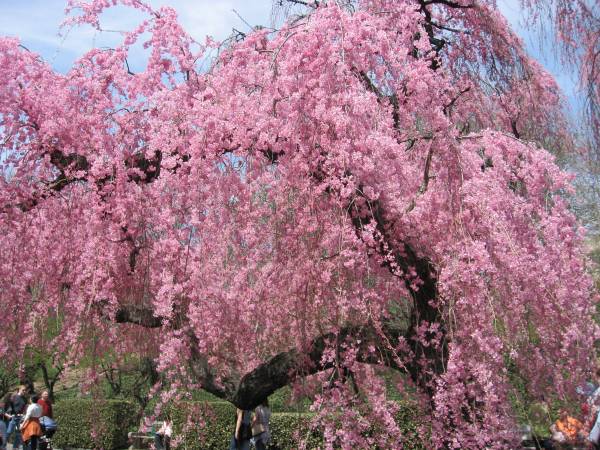
The annual two-day Sakura Matsuri will beautify Brooklyn this weekend (photo by twi-ny/mdr)
Brooklyn Botanic Garden
900 Washington Ave. at Eastern Parkway
Saturday, April 30, and Sunday, May 1, $10-$15
718-623-7200
www.bbg.org
For many New Yorkers, it isn’t really spring until the cherry blossoms are in bloom at the Brooklyn Botanic Garden. The spectacular trees should be gushing this weekend for the annual Sakura Matsuri, two days of Japanese art, food, and culture that usually is jam-packed with families, photographers, and other celebrants. The weather is currently forecast as partly cloudy with a high of sixty-seven, perhaps not ideal but a whole lot better than rain. There will be special events held throughout the beautiful botanic garden, including a children’s Suzuki recital, anime stand-up comedy, Butoh dance, cosplay cabaret, origami workshops, an ikebana flower exhibit, an interactive tea installation, a vintage kimono display, fish-printing demos, enka poetry, manga and anime artist and book signings, logic puzzles and other games, numerous bonsai events, garden tours, Japanese karate demonstrations, and much more, with such special guests as April Vollmer, Godfather of Sudoku Maki Kaji, Jack Schwartz, Fumiko Allinder, Michele Brody, Grandmaster Kaicho T. Nakamura, and Pokémon voice artist Veronica Taylor; below are some of the recommended highlights.
Saturday
Hanagasa Odori: Flower Hat Dance Procession, Japanese Folk Dance Institute of NY, Osborne Garden North, 1:00
Nihon Buyo Classical & Ryukyu Buyo Okinawan Dance, Dancejapan with Sachiyo Ito, Cherry Esplanade Stage, 1:15
BBG Parasol Society Promenade, with live music by happyfunsmile, registration 11 a.m.–1 p.m. behind Cherry Esplanade Stage, parade from Cherry Esplanade Stage to Osborne Garden, 3:00
Traditional Tea Ceremony, Urasenke Chanoyu Center, A.T. White Amphitheater, 3:30
Split Spirits/Spirit Splits: A Samurai Drama, Samurai Sword Soul, Cherry Esplanade Stage, 4:15
Sunday
Taiko Drumming, Soh Daiko, Cherry Esplanade Stage, 12 noon
Origami Paper Folding with Jeremy Aaron Horland, Lily Pool Terrace, 1:00
Butoh Dance, Dean Street FOO Dance, Osborne Garden North, 2:00
Cooking Demonstration: Authentic Dashi Making, with Momo Sushi Shack’s Chef Makoto Suzuki and Phillip Gilmour, A.T. White Amphitheater, 3:00
Cosplay Fashion Show, hosted by Uncle Yo, with live music by Morning Musuko, Cherry Esplanade Stage, 6:15


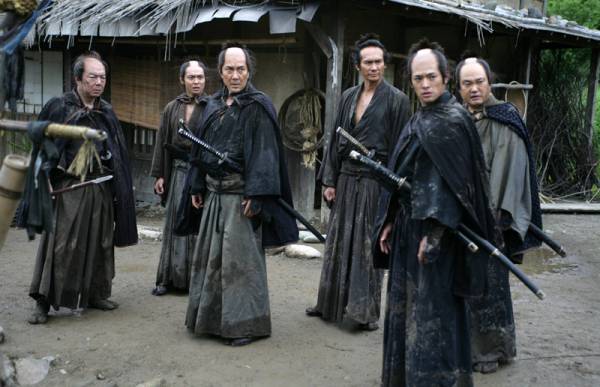
 Japanese director Takashi Miike’s first foray into the samurai epic is a nearly flawless film, perhaps his most accomplished work. Evoking such classics as Kurosawa’s Seven Samurai, Mizoguchi’s 47 Ronin, Aldrich’s The Dirty Dozen, and Eastwood’s High Plains Drifter, 13 Assassins is a thrilling tale of honor and revenge, inspired by a true story. In mid-nineteenth-century feudal Japan, during a time of peace just prior to the Meiji Restoration, Lord Naritsugu (Gorô Inagaki), the son of the former shogun and half-brother to the current one, is abusing his power, raping and killing at will, even using his servants and their families as target practice with a bow and arrow. Because of his connections, he is officially untouchable, but Sir Doi (Mikijiro Hira) secretly hires Shinzaemon Shimada (Kôji Yakusho) to gather a small team and put an end to Naritsugu’s brutal tyranny. But the lord’s protector, Hanbei (Masachika Ichimura), a former nemesis of Shinzaemon’s, has vowed to defend his master to the death, even though he despises Naritsugu’s actions. As the thirteen samurai make a plan to get to Naritsugu, they are eager to finally break out their long-unused swords and do what they were born to do. “He who values his life dies a dog’s death,” Shinzaemon proclaims, knowing that the task is virtually impossible but willing to die for a just cause. Although there are occasional flashes of extreme gore in the first part of the film, Miike keeps the audience waiting until he unleashes the gripping battle, an extended scene of blood and violence that highlights death before dishonor. Selected for the 2009 Cannes Film Festival and nominated for the Silver Lion at the 2010 Venice Film Festival, 13 Assassins is one of Miike’s best-crafted tales; nominated for ten Japanese Academy Prizes, including Best Picture, Best Director, Best Screenplay (Daisuke Tengan), Best Editing (Kenji Yamashita), Best Original Score (Koji Endo), and Best Actor (Yakusho), it won awards for cinematography (Nobuyasu Kita), lighting direction (Yoshiya Watanabe), art direction (Yuji Hayashida), and sound recording (Jun Nakamura).