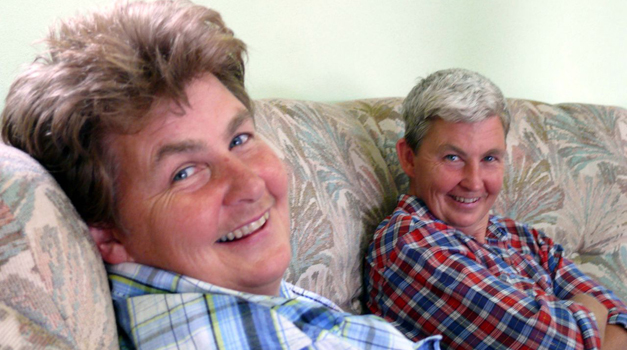
Dean Haspiel will participate in twi-ny’s tenth anniversary celebration on May 18 at Fontana’s (photo by Seth Kushner)
Fontana’s
105 Eldridge St. between Grand & Broome Sts.
Wednesday, May 18, free, 7:00 – 9:30
212-334-6740
www.fontanasnyc.com
www.deanhaspiel.com
For more than two decades, Dean Haspiel has been a comic book force all his own. A wildly talented and gregarious writer, illustrator, promoter, creator, and organizer, Dino works nonstop to build up his own expansive resume as well as the industry itself. In February 2006, he started ACT-I-VATE, a web-based comics collective that features such series as Josh Neufeld’s “Lionel,” Kevin Colden’s “Fishtown,” Nick Bertozzi’s “Iraq War Stories,” and his own “Billy Dogma” and “Street Code,” the latter a terrific semiautobiographical tale set in New York City, where Dino was born and raised. Along the way, he has collaborated on prestigious projects with Harvey Pekar (American Splendor, The Quitter), Jonathan Lethem (Back on Nervous St.), Michael Chabon (The Escapist), and Jonathan Ames (The Alcoholic), and he contributes drawings and illustrations to Ames’s HBO cable series Bored to Death, which features Zach Galifianakis playing a character inspired by Haspiel’s real life.
On May 14, Ames and Haspiel will be honored at the “100 Works on Paper” benefit at Kentler International Drawing Space in Red Hook, where attendees donate $200 and go home with an original work of art. On May 18, the Emmy-winning Haspiel will be presenting a new Street Code comic as part of twi-ny’s tenth anniversary celebration at Fontana’s, which will also feature readings from Nova Ren Suma, Andrew Giangola, and Kyle Thomas Smith and live performances from James Mastro and Megan Reilly, Paula Carino and the Sliding Scale, and Evan Shinners.
twi-ny: You’ve collaborated with such talented writers as Harvey Pekar, Jonathan Lethem, Michael Chabon, and Jonathan Ames; who is your next dream collaborator?
Dean Haspiel: I’ve been itching to collaborate with author Tim Hall on an original graphic novel and we have something planned. I’d also like to collaborate with mystery writer Joe R. Lansdale on adapting his brilliant Hap and Leonard characters into comics form. Plus, I don’t think my career would feel satisfactory if I hadn’t collaborated with some of my favorite comic book writers, the likes of Mark Waid, J. M. DeMatteis, and a handful of others.
twi-ny: Who is your favorite character to draw, whether created by you or another artist?
DH: My favorite characters to draw are my creator-owned Billy Dogma & Jane Legit. But I love drawing Stan Lee and Jack Kirby’s the Thing from the Fantastic Four, and I was recently afforded the opportunity to write and draw a short Thing story in an upcoming issue of Marvel Comics’ Strange Tales sequel.
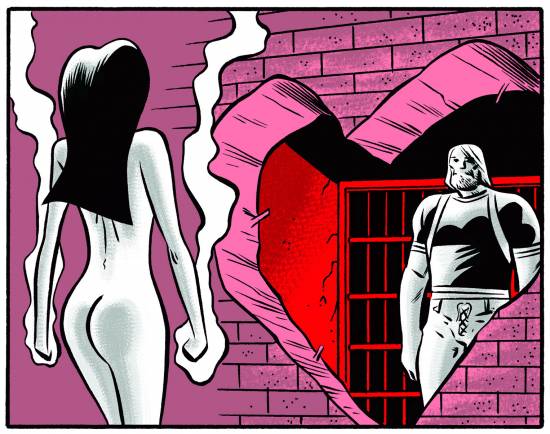
Jane Legit shows her love for Billy Dogma in Dean Haspiel’s “Bring Me the Heart of Billy Dogma,” from THE ACT-I-VATE PRIMER
twi-ny: On Bored to Death, Zach Galifianakis’s Ray Hueston character is based on you. Is it easy to watch him, or does it hit a little too close to home?
DH: The Ray Hueston character on Bored to Death is loosely based on some events that happened to me, but I don’t think Zach Galifianakis was subjected to a parallax view of my life and my behavioral traits by any stretch of the imagination. So, I can safely declare that Zach and Jonathan Ames have wholly created Ray from spirited, albeit inspired, cloth. However, I was recently privy to the filmmaking of a certain scene in the upcoming season and I remarked how bizarre it was to watch my proposed doppelganger play out an important event, something I never got the opportunity to do in my own life, and how frustrating yet weirdly cathartic that was for me.
twi-ny How do you find the time to do all the things you do, including serving as a relentless promoter of the comics industry?
DH: Don’t even get me started. If everyone on their chosen social networking sites would just share what they liked with the simple click of a button rather than whine about this and that and publish what they had for lunch, I might be able to shrug off my self-imposed burden to cheer what is good and, instead, produce more stories and eat dinner before ten pm with the people I love to spend time with. Alas, the internet accesses a dark gene in humanity that encourages some folks to constantly complain and act like jerks and do things they wouldn’t dare do in front of real people. I don’t do anything that we all couldn’t do together if we just took a minute to think straight and understand our information and entertainment values.

 First and foremost, don’t link Bridesmaids in with all those lousy Saturday Night Live one-note movies and the string of overrated and overhyped lowbrow trash streaming out of the Judd Apatow factory. And don’t assume it’s a silly chick flick either. As it turns out, Bridesmaids is one of the most consistently funny laugh-out-loud romps of this young century. Directed by Freaks and Geeks creator Paul Feig, Bridesmaids is an endlessly clever and insightful examination of love, loneliness, and friendship starring SNL’s Kristen Wiig, who cowrote the smart script with Groundlings member Annie Mumolo (who makes a cameo as a nervous flyer). Wiig shows surprising depth and range as Annie, a perennial screw-up whose closest childhood friend, Lillian (Maya Rudolph), is marrying into a very snooty upper-crust family. After agreeing to be Lillian’s maid of honor, Annie gets involved in a battle of wits with Lillian’s future sister-in-law, the elegant Helen (a radiant Rose Byrne), who is determined to outshine Annie in every way possible and steal Lillian away from her. Already a mess — she had to close her bakery, she shares an apartment with a bizarre pair of British siblings, she works in a jewelry store where she drives away potential customers with her sorry tales of woe, and she allows herself to be treated miserably as a late-night booty call for a self-centered businessman (Jon Lamm) — Annie experiences a series of hysterical, pathetic setbacks as she attempts to organize the bridal shower and bachelorette party, including a riotous potty-humor scene in a high-end boutique that is likely to go down in comedy history for its sheer relentlessness. The rest of the bridesmaids are quite a hoot — Becca (Ellie Kemper), the Disney-loving kewpie doll; Rita (Wendi McLendon-Covey), a foul-mouthed married mother who can’t wait to go crazy away from her family; and the groom’s burly sister, Megan (the hugely entertaining Melissa McCarthy), who lives life without a filter. Annie is so caught up in her own failures that she doesn’t recognize when something potentially good enters her life, in the form of state trooper Nathan Rhodes (Chris O’Dowd). Wiig gives the finest performance of her career as Annie, clearly a role that is very close to her heart. Despite the slapstick nature of many of the jokes, Bridesmaids is filled with heart and soul, making it one of the best comedies in years.

 Previously profiled in such documentaries as 2002’s Yves Saint Laurent: His Life and Times and Yves Saint Laurent 5 Avenue Marceau 751116 Paris, Algerian-born French fashion designer Yves Saint Laurent is seen from a very different perspective in L’Amour Fou (not to be confused with Jacques Rivette’s 1969 four-hour-plus tale of a marriage falling apart). On June 1, 2008, the iconic figure died of brain cancer at the age of seventy-one; the following February, the vast art collection Saint Laurent amassed with his longtime life and business partner, Pierre Bergé, was sold at a Christie’s auction. Director Pierre Thoretton tells Saint Laurent’s story chronologically as Bergé shares intimate details of their relationship while showing off the impressive soon-to-be-sold objets d’art displayed in their homes in Paris, Normandy, and Marrakech. A strong, direct man, Bergé admits to not being nostalgic as he relates his life with Saint Laurent, from Yves’s days as the successor to the House of Dior to the development of his own fashion empire, which made a name for itself with, among other things, his famed prêt-à-porter line and colorful Piet Mondrian dresses. Thoretton mixes in news footage, archival and family photographs, runway clips, and brief interviews with two of Saint Laurent’s muses, models Betty Catroux and Loulou de la Falaise, in addition to former French Minister of Culture Jack Lang, to draw an intimate portrait of the designer, but it’s most fascinating to watch Bergé as he talks about his friend and lover. “I know that tomorrow all of this will be gone,” he says about the art collection, but he could just as easily have been referring to Saint Laurent himself. “Which means what? A part of my soul, a part of my life.”