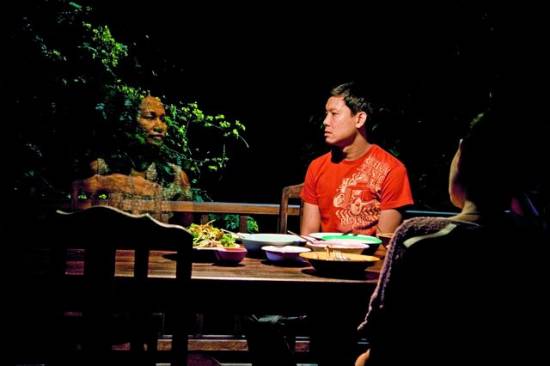
Apichatpong Weerasethakul’s Palme d’Or winner is a subtly beautiful meditation on death and rebirth, memory and transformation
UNCLE BOONMEE WHO CAN RECALL HIS PAST LIVES (LUNG BOONMEE RALUEK CHAT) (Apichatpong Weerasethakul, 2010)
Asia Society
725 Park Ave. at 70th St.
Sunday, May 22, $7, 5:00
Series runs May 13 – June 17
212-288-6400
www.asiasociety.org
 Winner of last year’s Palme d’Or at Cannes, Thai writer-director Apichatpong Weerasethakul’s Uncle Boonmee Who Can Recall His Past Lives is an elegiac meditation on memory, transformation, death, and rebirth, a fascinating integration of the human, animal, and spirit worlds. Uncle Boonmee (Thanapat Saisaymar) is dying of kidney failure, being tended to by his Laotian helper, Jaai (Samud Kugasang). Boonmee is joined by his dead wife’s sister, Jen (Jenjira Pongpas), in his house in the middle of the jungle. Boonmee and Jen have nearly impossibly slow conversations that seem to go nowhere, just a couple of very simple people not expecting much excitement out of what’s left of their lives. Even when Boonmee’s long-dead wife, Huay (Natthakarn Aphaiwonk), and his long-missing son, Boonsong (Geerasak Kulhong), now a hairy ghost monkey covered in black fur and with two laserlike red eyes, suddenly show up, Boonmee and Jen pretty much just go with the flow. Weerasethakul maintains the beautifully evocative pace whether Jaai is draining Boonmee’s kidney, the characters discuss Communism, Tong (Sakda Kaewbuadee) questions his monkhood, a princess (Wallapa Mongkolprasert) has sex with a catfish, or they all journey to a cave in search of another of Boonmee’s past lives. The film, which was shot in 16mm and was inspired by a 1983 book called A Man Who Can Recall His Past Lives, is part of the Primitive Project, Weerasethakul’s multimedia installation that also includes the short films A Letter to Uncle Boonmee and Phantoms of Nabua. Weerasethakul, who gained a growing international reputation with such previous works as Blissfully Yours (2002), Tropical Malady (2004), and Syndrome and a Century (2006) and has a bachelor’s degree in architecture from Khon Kaen University and an MFA in filmmaking from the Art Institute of Chicago, is a master storyteller who continues to challenge viewers with his unique visual language and subtly effective narrative techniques.
Uncle Boonmee is being shown May 22 as part of Asia Society’s “Blissfully Thai” film series, with Weerasethakul participating in a Q&A following the screening. The series begins May 13 with Pen-ek Ratanaruang’s Ploy (followed by a Q&A with the director) and continues with Mingmongkol Sonakul’s I-San Special on May 20, Yongyoot Thongkongtoon’s The Iron Ladies on May 26, Ratanaruang’s Mon-Rak Transistor on June 3, Wisit Sasanatieng’s Tears of the Black Tiger on June 10, Aditya Assarat’s Hi-So on June 11 (followed by a Q&A with actress Cerise Leang), and Weerasethakul’s Blissfully Yours on June 17. Weerasethakul and Ratanaruang will also take part in a special discussion about the past, present, and future of Thai filmmaking on May 14 at 2:00, followed by a reception with the artists.
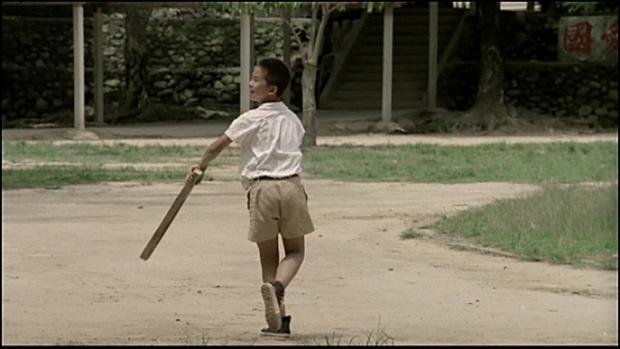
 Hou Hsiao-hsien’s Taiwanese New Wave masterpiece, A Time to Live, a Time to Die, is a bittersweet, nostalgic look back at his childhood, after his father’s government job moves the family from Mainland China just as the Cultural Revolution is taking effect. The semiautobiographical film is seen through the eyes of young Ah-ha (You Anshun) as his father (Tien Feng) suffers ill health, his older brother gets harassed by a local gang, his mother (Mei Fang) tries to maintain the household, and his grandmother (Tang Ju-yun) keeps getting lost, being brought back by rickshaw drivers who demand ever-larger payments. The family lives in a Japanese-style home that is beautifully photographed by cinematographer Mark Lee Ping-bing, with Hou favoring long shots with limited camera movement, calmly shifting from scene to scene as Ah-ha grows up into a teenager (Hsiao Ai) and discovers a whole new set of problems and reality. The middle film in Hou’s coming-of-age trilogy (in between 1984’s A Summer at Grandpa’s and 1986’s Dust in the Wind), A Time to Live is a deeply personal, intimate, unforgettable story of life, death, and the bonds of family. The film is screening May 15 as part of the Film Society of Lincoln Center’s “Taiwan Stories: Classic and Contemporary Film from Taiwan” series, which continues through May 19 and also includes such classic works as Pai Ching-jui’s Home Sweet Home (1970), Li Xing and Li Jia’s Oyster Girl (1964), and King Hu’s A Touch of Zen (1969) as well as such modern films as Doze Niu’s Monga (2008), Chen Wen-tang’s Tears (2009), and Chen Yu-Hsun, Hou Chi-jan, and Shen Ko-Shang’s Juliets (2010).

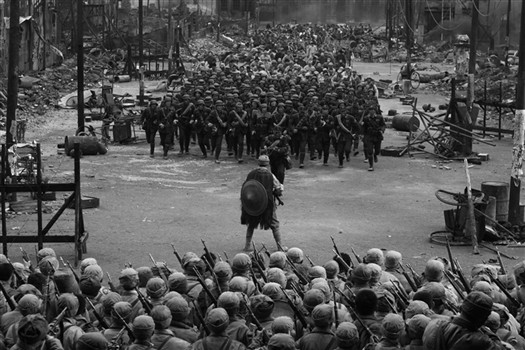
 In December 1937, Japanese military forces invaded Nanking (now called Nanjing), occupying the Chinese capital for six weeks of unspeakable atrocities, resulting in hundreds of thousands of murders and tens of thousands of rapes. Based on survivor accounts on both sides of what became known as the Rape of Nanking (and the Nanking Massacre) in addition to postcards and journals from a group of international workers who furiously attempted to maintain a refugee Safety Zone, Lu Chuan’s City of Life and Death is a brutal, harrowing depiction of this controversial period, the exact details of which are still debated in Japan and China. Writer-director Lu (The Missing Gun, Kekexili: Mountain Patrol) holds nothing back as he tells the story through the eyes of several main characters: Miss Jiang (Gao Yuanyuan), the leader of the refugees who is desperately trying to protect the women and children; Mr. Tang (Fan Wei), a Chinese collaborator who believes he can negotiate with the Japanese army, headed by commander Ida (Ryu Kohata); Xiaodouzi (Bin Liu), a young child who silently watches the horror surrounding him; and Kadokawa (Hideo Nakaizumi), seemingly the only Japanese soldier with a conscience. Evoking such war films as Steven Spielberg’s Saving Private Ryan and Schindler’s List and Stanley Kubrick’s Full Metal Jacket, City of Life and Death is an unsparing look at holocaust and genocide that walks the fine line between propaganda and cinema verité docudrama; Lu and cinematographer Cao Yu increase the feeling of reality by using handheld cameras and shooting the film in a stark black and white. Filmed over the course of 253 days and featuring some thirty thousand extras, City of Life and Death is a massive undertaking that unfolds on-screen in a series of unforgettable images and vignettes that will stay with viewers a long time, capturing a truly horrifying wartime tragedy that is not nearly as well known in the West as it should be.