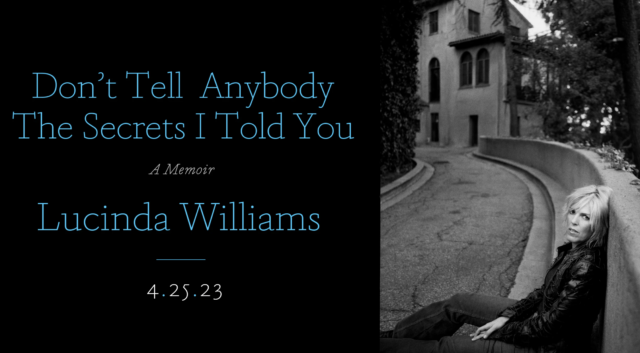
Who:Lucinda Williams,Steve Earle What: Book launch Where:Congregation Beth Elohim, 271 Garfield Pl., Brooklyn When: Monday, April 24, $36.84, 7:00 Why: “Yes, my family was dysfunctional, fucked up. But that’s not what really matters to me. What matters is that I inherited my musical talent from my mother and my writing ability from my father,” Louisiana-born singer-songwriter Lucinda Williams writes in her new memoir, Don’t Tell Anybody the Secrets I Told You (Crown, April 25, $28.99). She also admits about choosing not to attend the 1994 Grammy Awards, where her tune “Passionate Kisses” won for Best Country Song, “The truth is that I was not just self-conscious but also scared. I feared that I didn’t belong. It’s a feeling I’ve been trying to shake my entire life.” She has proved she belongs over the last twenty-nine years, being nominated for a total of seventeen Grammys and winning twice more, for Best Contemporary Folk Album for the amazing Car Wheels on a Gravel Road and Best Female Rock Vocal Performance for “Get Right with God.” Her next album, Stories from a Rock n Roll Heart, featuring such songs as “Stolen Moments” and “New York Comeback,” the latter with background vocals by Bruce Springsteen, is due out June 30.
On April 24, Williams, who finishes up a four-show run at City Winery on Tuesday night, will be at Congregation Beth Elohim with another Bruce collaborator, Steve Earle, to discuss her life and career. Williams and Earle have been longtime friends who joined forces on Earle’s “You’re Still Standin’ There” in 1996, on Williams’s “Joy” in 2004, and for a New Yorker interview with performances during the pandemic, so it promises to be an intimate evening, which is organized by Brooklyn’s Community Bookstore. Tickets are $36.84 and come with a copy of Don’t Tell Anybody the Secrets I Told You.
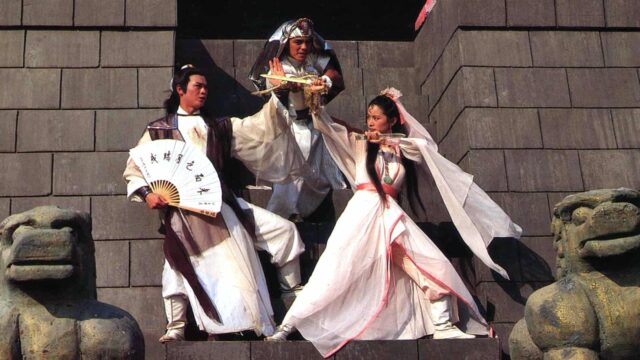
US premiere of 2K remaster of Chang Peng-yi’s The Night Orchid is part of Metrograph series
OLD SCHOOL KUNG FU FEST: SWORD FIGHTING HEROES EDITION
Metrograph
7 Ludlow St. between Canal & Hester Sts.
April 21-30 metrograph.com
When I was a kid, I spent many a rainy Saturday afternoon watching Kung Fu Theater, a weekly serving of wuxia films, poorly dubbed martial arts films from Hong Kong that were among the coolest movies I’d ever seen, filled with indecipherable plots and fantabulous weapons. It didn’t get much better than The Story of Drunken Master,Five Fingers of Death, and Bruce Lee squaring off against Chuck Norris and Kareem Abdul-Jabbar.
Last year the RZA and DJ Scratch joined forces for the tribute song “Saturday Afternoon Kung Fu Theatre,” in which the RZA declares, “Can we watch another movie next Saturday? / Be sure to tune in next week / for The Masked Avengers and Heroes of the East.”
You don’t have to wait for next week, as Metrograph is currently showing the tenth “Old School Kung Fu Fest: Sword Fighting Heroes Edition” through April 30. The tenth festival consists of fifteen flicks, little known and classic, including the US premiere of Lin Jing-jie’s three-and-a-half-hour documentary The King of Wuxia, about King Hu; Hu’s 1969-71 A Touch of Zen, 1973 The Fate of Lee Khan, and 1975 The Valiant Ones; Yang Shih-ching’s 1970 The Grand Passion, made by A Touch of Zen’s production manager during downtime of that film; a 2K remaster of Chang Peng-I’s 1983 The Night Orchid; Sung Tsun-shou’s 1969 Iron Mistress; and Chris Huang’s 2000 The Legend of the Sacred Stone.
Below are some of the other highlights of the series, which is presented by Metrograph and Subway Cinema in association with Taipei Cultural Center in New York.
THE GHOST HILL (Ting Shan-hsi, 1971)
Sunday, April 23, 3:00 metrograph.com
The Swordsman of All Swordsmen trilogy concludes with Ting Shan-hsi’s fantastically mad The Ghost Hill. You don’t need to have seen Joseph Kuo’s The Swordsman of All Swordsmen or Lung Chien’s The Bravest Revenge — although the former is screening at Metrograph April 22-23 and the latter is available virtually on Metrograph at Home — to get instantly sucked into the grand finale, in which Tsai Ing-chieh (Tien Peng) might at last avenge the murder of his father by Yun Chung-chun (Chen Bao-liang). The wuxia epic begins with a high-flying battle between Tsai and Feng Chun-ching (David Tang Wei), aka Black Dragon Hero, on a rocky beachfront, overseen by the Grand Master (Kao Ming), who will present to the winner the coveted Purple Light Sword, bestowing upon him the title of Master Swordsman.
Tsai takes home the trophy, but it is immediately stolen from him by thieves who also slay his master. Tsai and his goofy but loyal brother head out to regain the sword and kill Yun, but it turns out that someone has already beaten them to it, although Yun’s daughter, Fei Yen-tzu (Polly Shang-kuan), an accomplished assassin known as Flying Swallow, blames Tsai for the evil deed. But soon Tsai, his brother, Fei, and Feng are teaming up to defeat the evil King Chin (Hsieh Han) and the girl he raised, Chin Man-chiao (Han Hsiang-chin), aka Princess of the Underworld, who he is grooming to be his bride.
As the men fight over the women and the women fight over the men, the action moves into Chin’s fortress, where Tsai and his merry band of homeless beggars must make it through ten boobytrapped hells in order to face Chin and his dangerous left arm.
Writer-director Ting, cinematographer Lin Tsan-ting, art director Tsao Nien-lung, and set decorator Chen Shang-lin add fab touches to every scene, from character names — Green Demon Judge, Misty Light Master, Iron Bull, and the Murdering Wonder Child to the Black and White Wuchang, the Ox Head Demon, the Yanluo Wang, and the Soul-Hunting Yaksha — to colorful costumes, lavishly cheesy sets, a boiling oil bath, epic sound effects and music (with Theremin!), ultracool weapons, and plenty of fire and blood, along with watermelons and a special beheading.
There are also a number of awesome quotes. “We can never understand the grievances of the previous generation,” Yen-tzu posits. “The gates of heaven are open but you choose to knock on hell’s door,” King Chin warns Tsai.
The Ghost Hill evokes such later films as Steven Spielberg’s Raiders of the Lost Ark, Chang Cheh’s Five Venoms, Quentin Tarantino’s Kill Bill, and Ang Lee’s Crouching Tiger, Hidden Dragon, but it’s in a class all by itself. And it should be special watching it not alone on a rainy day but in a theater packed with wuxia fans likely to be hooting and hollering all the way.
Shu Qi is an expertly trained killer with a conscience in Hou Hsiao-hsien’s gorgeous period drama
THE ASSASSIN (刺客聶隱娘) (NIE YINNIANG) (Hou Hsiao-hsien, 2015)
Saturday, April 29, 7:00, and Sunday, April 30, 9:15 metrograph.com
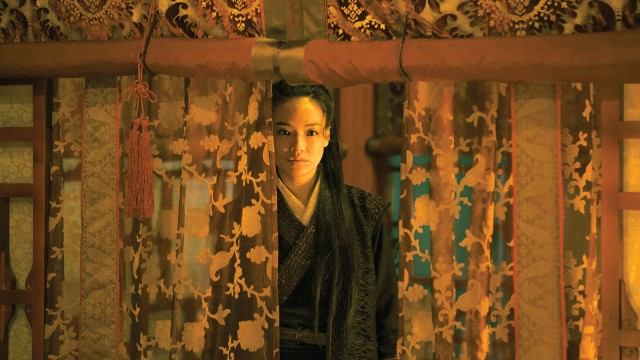
Taiwanese master Hou Hsiao-hsien’s first film in eight years is a visually sumptuous feast, perhaps the most beautifully poetic wuxia film ever made. Inspired by a chuanqi story by Pei Xing, The Assassin is set during the ninth-century Tang dynasty, on the brink of war between Weibo and the Royal Court. Exiled from her home since she was ten, Nie Yinniang (Hou muse Shu Qi) has returned thirteen years later, now an expert assassin, trained by the nun (Fang-Yi Sheu) who raised her to be a cold-blooded killer out for revenge. After being unable to execute a hit out of sympathy for her target’s child, Yinniang is ordered to kill Tian Ji’an (Chang Chen), her cousin and the man to whom she was betrothed as a young girl, as a lesson to teach her not to let personal passions rule her. But don’t worry about the plot, which is far from clear and at times impossible to follow. Instead, glory in Hou’s virtuosity as a filmmaker; he was named Best Director at Cannes for The Assassin, a meditative journey through a fantastical medieval world. Hou and cinematographer Mark Lee Ping-Bing craft each frame like it’s a classical Chinese painting, a work of art unto itself. The camera moves slowly, if at all, as the story plays out in long shots, in both time and space, with very few close-ups and no quick cuts, even during the martial arts fights in which Yinniang displays her awesome skills. Hou often lingers on her face, which shows no outward emotion, although her soul is in turmoil. Hou evokes Andrei Tarkovsky, Akira Kurosawa, Ang Lee, and Zhang Yimou as he takes the viewer from spectacular mountains and river valleys to lush interiors (the stunning sets and gorgeous costumes, bathed in red, black, and gold, are by Hwarng Wern-ying), with silk curtains, bamboo and birch trees, columns, and other elements often in the foreground, along with mist, fog, and smoke, occasionally obscuring the proceedings, lending a surreal quality to Hou’s innate realism.
There are long passages of silence or with only quiet, barely audible music by composer Lim Giong, with very little dialogue, as rituals are performed, baths are prepared, and a bit of black magic takes place. The opening scenes, set around a breathtaking mountain abbey in Inner Mongolia, are shot in black-and-white with no soundtrack, like a silent film, harkening to cinema’s past as well as Yinniang’s; when it switches over to color, fiery reds take over as the credits begin. Throughout the film, the nun wears white and the assassin wears black, in stark contrast to the others’ exquisitely colorful attire; however, the film is not about good and evil but something in between. Shu and Cheng, who played a trio of lovers in Hou’s Three Times, seem to be barely acting in The Assassin, immersing themselves in their characters; Hou (The Puppetmaster,Flowers of Shanghai) gives all of his cast, professional and nonprofessional alike, a tremendous amount of freedom, and it results here in scenes that feel real despite our knowing better. Sure, a touch more plot explication would have been nice, but that was not what Hou was after; he wanted to create a mood, an atmosphere, to transport the actors and the audience to another time and place, and he has done that marvelously. The Assassin is a treasure chest of memorable moments that rewards multiple viewings. I’ve seen it twice and can’t wait to see it again — but I’ve given up trying to figure out exactly what it’s about, instead reveling in its immense, contemplative beauty. Hou’s previous full-length film was 2007’s Flight of the Red Balloon; it’s now been eight years since The Assassin, so here’s hoping his next film is on its way.
King Hu’s A Touch of Zen is a trippy journey toward enlightenment
A TOUCH OF ZEN (King Hu, 1969/1971)
Sunday, April 30, 1:00 metrograph.com
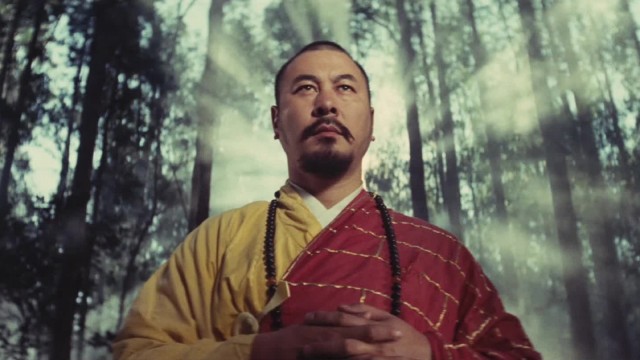
King Hu’s 1969 highly influential wuxia classic, A Touch of Zen, is a three-hour epic that features an impossible-to-figure-out plot, a goofy romance, wicked-cool weaponry, an awesome Buddhist monk, a bloody massacre, and action scenes that clearly involve the overuse of trampolines. Still, it’s great fun, even if it is way too long. (The film, which was initially shown in two parts, earned a special technical prize at the 1975 Cannes Film Festival.) Shih Jun stars as Ku Shen Chai, a local calligrapher and scholar who is extremely curious when the mysterious Ouyang Nin (Tin Peng) suddenly show up in town. It turns out that Ouyang is after Miss Yang (Hsu Feng) to exact “justice” for the corrupt Eunuch Wei, who is out to kill her entire family. Hu (Come Drink with Me, Dragon Gate Inn) fills the film with long, poetic establishing shots of fields and the fort, using herky-jerky camera movements (that might or might not have been done on purpose) and throwing in an ultra-trippy psychedelic mountain scene that is about as 1960s as it gets. Winner of the Technical Grand Prize at Cannes, A Touch of Zen is ostensibly about Ku’s journey toward enlightenment, but it’s also about so much more, although I’m not completely sure what that is.
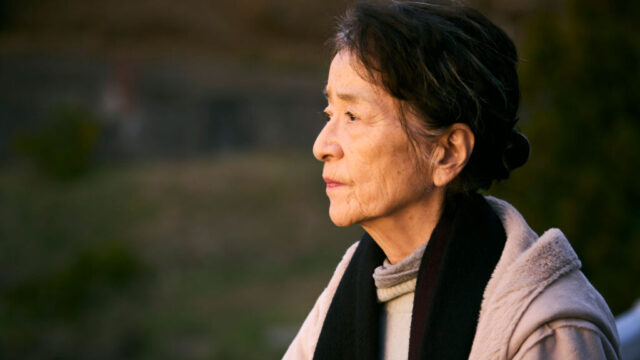
Michi Kakutani (Chieko Baisho) faces the end of her life sooner than she wants to in Plan 75
PLAN 75 (Chie Hayakawa, 2022)
IFC Center
323 Sixth Ave. at West Third St.
Opens Friday, April 21
212-924-7771 www.ifccenter.com www.kimstim.com
In March 2020, at the beginning of the Covid-19 pandemic, sixty-nine-year-old Texas lt. gov. Dan Patrick told Tucker Carlson on Fox News, “No one reached out to me and said, ‘As a senior citizen, are you willing to take a chance on your survival in exchange for keeping the America that all America loves for your children and grandchildren?’ And if that’s the exchange, I’m all in.” Many people agreed that in order to protect the US economy, it was acceptable to let senior citizens die from the coronavirus.
Japanese writer-director Chie Hayakawa takes that concept to the next level in her debut feature, the melancholic, gorgeously photographed Plan 75, opening April 21 at IFC Center.
Expanded from a short film she made for the 2018 omnibus Ten Years Japan, in which five directors made works set ten years in the future, Plan 75 unfolds in a near dystopia where the Japanese government, in order to combat the inconvenient truth that the population is aging at a potentially unsustainable rate, offers all citizens seventy-five and older the opportunity to be euthanized, no questions asked, in exchange for one thousand dollars and free cremation, among other lures.
“The surplus of seniors is draining Japan’s economy and taking a heavy toll on the young generation,” a young man with a rifle narrates at the beginning of the film. “Surely the elderly don’t wish to be a blight on our lives. The Japanese have a long, proud history of sacrificing themselves to benefit the country. I pray that my courageous act will trigger discussion and a future that’s brighter for this nation.”
Yôko Narimiya (Yumi Kawai) takes a job at a government euthanasia company in Plan 75
Plan 75 evokes elements of Richard Fleischer’s 1973 thriller Soylent Green, in which the government provides extravagantly organized assisted suicide, and Michael Anderson’s 1976 sci-fi flick Logan’s Run, in which citizens are not permitted to live past the age of thirty.
Legendary actress and singer Chieko Baisho is mesmerizing as Michi Kakutani, an elegant seventy-eight-year-old woman with no family. After losing her job as a hotel maid, she tries to find other employment, but it’s difficult at her age. Running out of money, she worries that she might soon be homeless.
She then finds out about the government program called Plan 75; cheerful banners and television commercials are pervasive. Several of her friends, including Ineko (Hisako Ôkata), are interested in the proposition, especially the part that comes with a free stay in a resort. But Michi is not ready to die.
Hiromu Okabe (Hayato Isomura) is a bright and enthusiastic young man who is one of Plan 75’s leading salesmen. He eagerly signs up senior citizens for Plan 75 with a smile on his face, believing it is a good thing for everyone. But when his uncle, Yukio Okabe (Taka Takao), shows up to enroll in the program, he starts having second thoughts.
Meanwhile, fellow employee Yôko Narimiya (Yumi Kawai) is assigned to Michi’s case, quickly growing close with the older woman, which is against the rules. And Maria (Stefanie Arianne) is a Filipino caregiver who has come to Japan to make enough money to pay for her ailing daughter’s heart operation; instead of helping sick and elderly people survive, she is now processing their belongings after they are killed by the state, reminiscent of how the Nazis collected the possessions of victims of the gas chambers.
“Humans have no choice about whether to be born, but it would be a good thing if we were able to choose when it’s time to die,” an elderly woman says happily in a commercial in a Plan 75 waiting room that reverses our usual expectations; instead of waiting to see doctors to keep them healthy, these seniors are waiting to die. “Being able to decide how my life will end provided me peace of mind,” the spokeswoman adds.
Plan 75 is a chilling look at where we might be headed; at times it feels like a documentary, its narrative all too believable. Cinematographer Hideho Urata’s camera ranges from close-ups of Baishô’s face, both celebrating and mourning every deep wrinkle, to dark interiors where the elderly slowly go through their meager daily existence and bright exteriors where children play and trains speed by as Michi can only watch.
At one point, after reading a section of the Plan 75 manual, which purports to give older people the chance to die with dignity, Yôko stares accusingly at the audience, implicating us in this frightening example of elder abuse. Hayakawa and Urata then cut to a sunset peeking through a tree next to a bland housing complex, followed by a shot of Michi’s hand, held up to a fading light through the window, examining each bent and crooked finger as she lies on a futon, wondering if she’s made the right choice — or even was given much of one in the first place.
Winner of a Caméra d’Or Special Distinction at Cannes, Plan 75 is a haunting cautionary tale that speaks volumes as to how senior citizens are treated, or mistreated, whether during a global pandemic or just every day, in Japan or elsewhere, including right here in America, where too many politicians consider them excess baggage. And the stunning finale emphasizes that we need to do something about it, and fast.
Hayakawa (Bird,Niagara) will be at IFC Center opening weekend, participating in Q&As on April 21 at 7:00 with Reiko Tahara, April 22 at 7:10 with Risa Morimoto, and April 23 at 4:25 with Kris Montello.
A team of public defenders forms a unique culinary group in Lunch Bunch (photo by Julieta Cervantes)
LUNCH BUNCH
122CC
150 1st Ave. at Ninth St.
Tuesday – Saturday through April 22, $10-$100 playco.org
In their 2006 study “The Cultural Structuring of Mealtime Socialization” published in Wiley InterScience, Elinor Ochs and Merav Shohet write, “Anthropologists have long considered ways in which food preparation, distribution, and consumption authenticate both social order and moral and aesthetic beliefs and values. Less frequently examined are the socialization processes that promote continuity and change across generations in the sociocultural life of food. . . . With this notion of cultural site in mind, mealtimes can be regarded as pregnant arenas for the production of sociality, morality, and local understandings of the world. Mealtimes are both vehicles for and end points of culture.”
Starting in childhood, all of us have experienced mealtime socialization, the good and the bad. At school, we might sit at the cool kids’ table or be left to sit alone, wondering why we’ve been ostracized. I remember when I started my first full-time job after college, I desperately wanted to be asked to join the group that went out for dollar grilled cheeses and shot pool once a week at lunch. Writer Sarah Einspanier and director Tara Ahmadinejad take the concept of the office lunch to a new level in Lunch Bunch, a delectable new collaboration between PlayCo and Clubbed Thumb extended through April 22 at 122CC.
The fifty-five-minute show — the running time just about matches the standard one-hour lunch break — was inspired by a real lunch group at the Bronx Defenders’ office, “a nonprofit that is radically transforming how low-income people in the Bronx are represented in the justice system and, in doing so, is transforming the system itself.” Lunch Bunch follows eight public defenders, five of whom use their daily shared lunch hour as a much-needed break from their heavy caseloads, trying to help their clients survive an unnecessarily complex system that too often separates children from parents.
Jacob (Ugo Chukwu) is the ersatz leader of the bunch, a serious gourmet who treats lunch as a way to approach culinary perfection. Only five employees at a time can participate in lunch bunch; each one is assigned a day to prepare lunch for the entire group. Initially, Tuttle (Louisa Jacobson) is Monday, Jacob is Tuesday, Hannah (Jo Mei) is Wednesday, Greg (Francis Mateo) is Thursday, and Tal (Janice Amaya) is Friday.
They prepare such superb fare as lemon tahini goddess noodles with tempeh “bacon” and garlic broccolini; spicy peanut soba noodles topped with shaved carrot and cucumber salad; lentil loaf with sweet potatoes and Brussels sprouts; and BBQ jackfruit sandwich with side arugula pear salad. This is no casserole club.
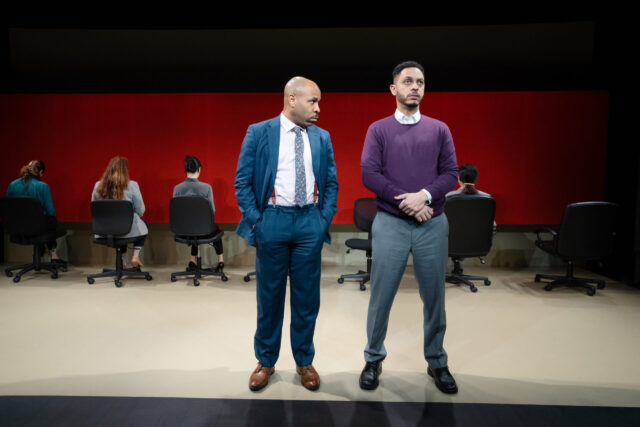
Jacob (Ugo Chukwu) and Greg (Francis Mateo) talk about more than just lunch in PlayCo / Clubbed Thumb collaboration (photo by Julieta Cervantes)
However, Tal’s vacation to Paris and Tuttle’s conversion to the restrictive Whole30 diet means Jacob has two days to fill. He turns to a pair of new lawyers, Nicole (Julia Sirna-Frest) for Monday and Mitra (Tala Ashe) for Friday, bookending the week. While Mitra looks like she’ll fit in fine, it is clear that Nicole is going to be a problem for Jacob, who is aghast when he learns that Nicole does not know what a cast-iron is.
Over the course of several weeks, the lunch bunch enjoys four mouthwatering meals a week while agonizing over specific cases, complaining about certain judges, going for cries in the coat closet, and sharing tidbits about their personal lives. When Jacob says, “I’m not asking for a Michelin star. I’m asking for a four and a half star Yelp review,” he is essentially talking about more than just what’s for lunch, whether he realizes it or not.
“How do I say this?” the perennially uptight Jacob begins. “I have low ‘expectations,’ little ‘faith,’ when it comes to the law, government, organized religion, things that fall under the umbrella of ‘humanity’ and its ‘systems.’ And soooo, I seek my jollies, my ‘joy,’ my ‘bliss,’ what have you — some semblance of control — in this one area, this one ‘arena,’ of my existence.”
The more Zen-like Greg explains, “It’s about happiness, anxiety, boredom, chronic dissatisfaction, escalating expectations, fixation on achievement, our ultimate aloneness — basically, existential dread — really it’s about the fact that there’s no way our ‘affluent,’ ‘scientific,’ supposedly ‘sophisticated’ world is going to provide us with happiness, and that no matter how much energy we devote to its care the body will give out — eventually.”
At one point, a former lunch buncher named David (David Greenspan) walks past; he now works on the fourth floor but was thrown out of the group for considering pretzels a side dish. He delivers a wickedly delicious monologue that hearkens back to the Stone Age, well before there was anything like Top Chef.
Pain and pleasure intersect as things threaten to reach the boiling point, with Hannah’s eyelid growth getting bigger and Jacob ready to explode at any second.
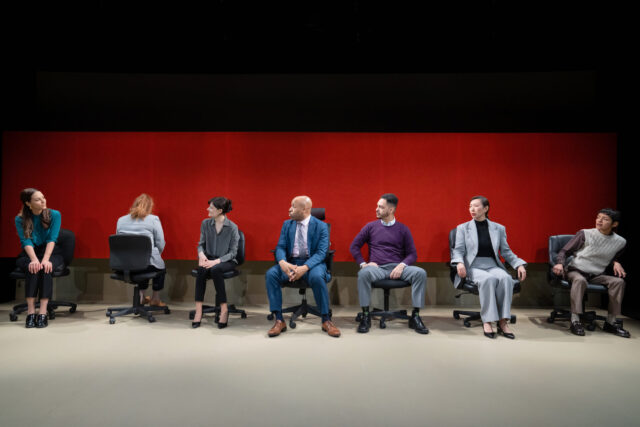
Jean Kim’s shallow set features seven rolling desk chairs up against a long red wall; the characters sit facing it when they’re working and turn around when they talk to one another and eat. Alice Tavener’s costumes are workplace efficient and pitch-perfect, ranging from Jacob’s blue suit to Greg’s sweater and slacks, the women in well-tailored pants and sharp shoes. The lighting is by Oona Curley, with sound by Ben Vigus.
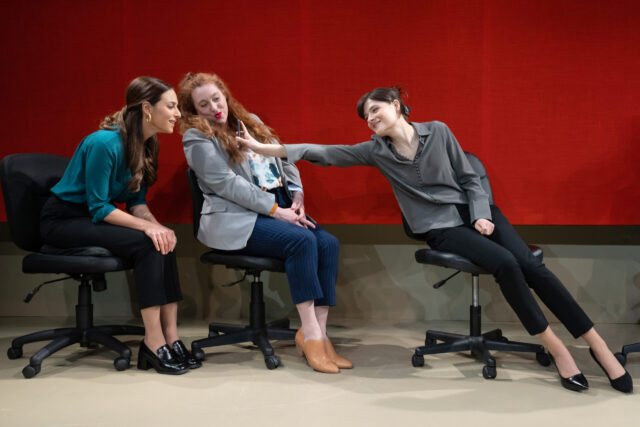
Mitra (Tala Ashe), Nicole (Julia Sirna-Frest), and Tuttle (Louisa Jacobson) take a break in Lunch Bunch (photo by Julieta Cervantes)
The cast forms a tight-knit unit, with sweet and savory performances by Chukwu as the insensitive Jacob, Ashe as the smart, sassy Mitra, Mateo as the keenly perceptive Greg, Jacobson as the goofy Tuttle, Amaya as the wacky Tal, Mei as the serious Hannah, Greenspan as the mysterious David, and Sirna-Frest as Nicole, who so wants to fit in at her new job, a feeling nearly all of us have had. Einspanier’s funny, barbed dialogue captures the drudgery of what it’s like to work in an office environment, while Ahmadinejad calmly stirs the pot as the tension mounts.
Lunch Bunch is reminiscent of Lynn Nottage’s 2021–22 Broadway play, Clyde’s, about a small group of ex-cons working at a roadside diner who each attempt to create the perfect sandwich, as if doing so would make their life meaningful and solve all their problems.
In the case of Lunch Bunch, it’s public defenders coming up with gourmet meals that could go a long way toward helping them believe they’re more than just cogs in a machine, caught up in an unwinnable game where people’s lives are at stake. Lunch success could also prevent these public servants from experiencing what happened to David, who remembers being “completely alone and . . . utterly defenseless.” The monologues are funny and often poignant, the dialogue deadpan hilarious, instantly relatable to anyone who’s ever worked in an office. Despite the generic, soul-deadening cubicle situation, the actors make the characters sparkle with uniqueness and verve — and somehow, humanity triumphs.
In the 1987 film Wall Street, Gordon Gekko (Michael Douglas) declares, “Lunch is for wimps.” Studies have shown that more than sixty percent of office workers have their lunch alone at their desk, eating what the Atlantic calls “sadwiches.” The famous tumblr Sad Desk Lunch was an instant hit and is still going strong. Some claim that partaking of lunch with fellow employees can boost productivity, while others argue that eating with colleagues can lead to additional stress.
Lunch Bunch is not concerned about any of that data. Instead, it offers up a tasty mélange of lawyers seeking some solace from the everyday grind, using food as a way to lighten their heavy load as well as assert their individuality, rephrasing “You are what you eat” as “You are what you make.” But it turns out it’s not quite as simple as all that.
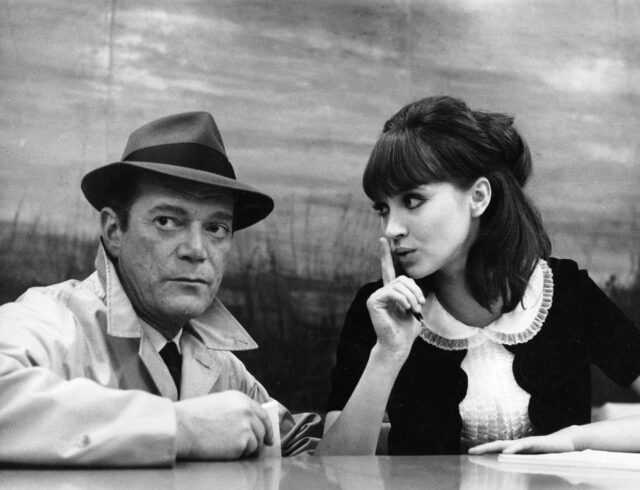
World premiere of 4K restoration of Jean-Luc Godard’s Alphaville kicks off “Rialto at 25” at MoMA (photo courtesy the Kobal Collection)
RIALTO AT 25
MoMA Film, Museum of Modern Art
11 West 53rd St. between Fifth & Sixth Aves.
April 19 – May 22, $8-$12
212-708-9400 www.moma.org www.rialtopictures.com
In 1997, Bruce Goldstein started Rialto Pictures, joined the following year by Adrienne Halpern. For more than a quarter-century, Rialto has been dedicated to reissuing and restoring classic foreign and independent films, both famous and forgotten, often debuting them at Film Forum, where Goldstein has long served as master programmer. MoMA pays tribute to copresidents Goldstein and Halpern with “Rialto at 25,” a five-week series consisting of thirty-one films released by the beloved distribution company, beginning with Henri-Georges Clouzot’s 1947 murder mystery, Quai Des Orfèvres, and the world premiere of a brand-new 4K restoration of Jean-Luc Godard’s 1965 futuristic thriller, Alphaville.
Organized by MoMA Film curator Dave Kehr, the festival also includes Jean-Pierre Melville’s Army of Shadows, Francis Ford Coppola’s The Conversation, John Carpenter’s Escape from New York, Robert Hamer’s Kind Hearts and Coronets, Marcel Carné’s Le Jour Se Lève, Akira Kurosawa’s Ran, Carol Reed’s The Third Man, Joe Dante’s The Howling, and Alberto Cavalcanti’s Went the Day Well?
“I began Rialto Pictures out of sheer frustration. Many classic movies, particularly European films, had no distribution in the United States, with prints either impossible to get or unavailable to repertory cinemas,” Goldstein said in a statement. “And, just as bad, a lot of important classics — like Renoir’s Grand Illusion and Godard’s Breathless — were seen for decades only in miserable 16mm copies, with bad image and sound. By getting the rights to movies like these myself, I could make brand new 35mm prints and show them — not just in New York — but in movie theaters across the country.”
Rialto has amassed a profoundly remarkable collection that is well represented in the MoMA series; among the other highlights and surprises are Federico Fellini’s Nights of Cabiria (with a seven-minute restored scene), Jules Dassin’s Rififi, Orson Welles’s The Trial, Joseph Losey’s Mr. Klein, John Boulting’s Brighton Rock, and Luis Buñuel’s The Discreet Charm of the Bourgeoisie and That Obscure Object of Desire. In addition, MoMA has created a special forty-five-minute compilation of Rialto trailers.
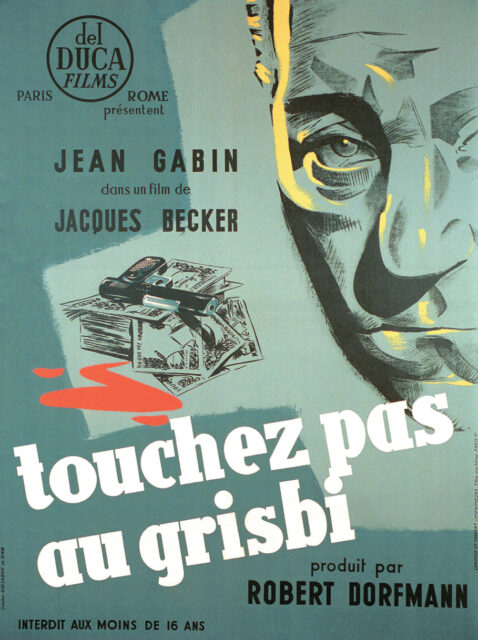
On April 29, Goldstein will present the illustrated talk “The Art of Subtitles”; several screenings will feature introductions or discussions; and originally commissioned Rialto posters will be on view. Goldstein will introduce Jacques Deray’s La Piscine on April 26 and Dino Risi’s Una Vita Difficile on May 14, translator and subtitler Michael F. Moore will introduce Francesco Rosi’s Christ Stopped at Eboli on April 22, Whit Stillman and actors Dylan Hundley and Carolyn Farina will participate in a discussion following a screening of Metropolitan on April 27, actor Madjid Niroumand will talk about Amir Naderi’s Davandeh with Goldstein after a screening on April 28, and Julien Duvivier’s Panique will be introduced on April 26 by Pierre Simon, the son of Georges Simenon, on whose novel the film is based. You might as well just move in to MoMA from April 19 to May 22, but keep looking over your shoulder.
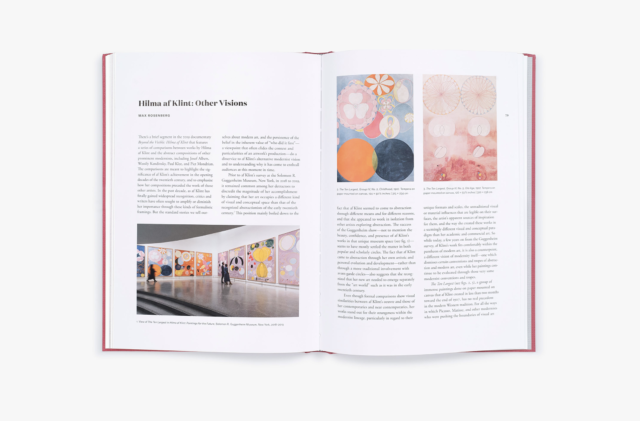
Hilma af Klint: Tree of Knowledge is one of two books about the Swedish abstractionist launching at New Museum on April 20 (courtesy David Zwirner)
Who: Massimiliano Gioni, Julia Voss, Tracey Bashkoff What: Book launches and panel discussion Where:New Museum Theater, 235 Bowery at Prince St. When: Thursday, April 20, $10, 6:30 Why: From October 2018 to April 2019, the Guggenheim hosted the smash exhibition “Hilma af Klint: Paintings for the Future,” the first major US solo show dedicated to the Stockholm-born abstract artist. That was followed by Halina Dyrschka’s documentary Beyond the Visible, which delved further into af Klint’s life and career. On April 20, the New Museum is hosting “Two New Texts on Hilma af Klint,” serving as a book launch for Hilma af Klint: Tree of Knowledge (David Zwirner, 2023, $55), featuring contributions from Julia Voss, Susan Aberth, Suzan Frecon, Max Rosenberg, Helen Molesworth, Joy Harjo, and William Glassley, and Voss’s Hilma af Klint: A Biography (University of Chicago, 2022, $35). New Museum artistic director Massimiliano Gioni will be joined by Voss and Guggenheim curator Tracey Bashkoff celebrating both books and the art of af Klint (1862–1944), who is finally having her long-deserved moment.
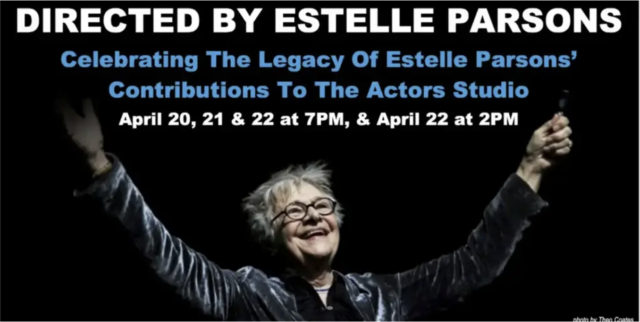
Who: Estelle Parsons, Actors Studio members What: Seventy-fifth anniversary celebration Where:The Actors Studio, 432 West Forty-Fourth St. between Ninth & Tenth Aves. When: April 20-22, free with RSVP Why: In March 2017, legendary Oscar and Obie winner and five-time Tony nominee Estelle Parsons directed Stephen Adly Guirgis’s The Last Days of Judas Iscariot at LaMama, featuring members of the Actors Studio. As part of its ongoing seventy-fifth anniversary celebration, the influential studio is now presenting “Directed by Estelle Parsons,” in which the ninety-five-year-old Parsons will direct productions of Maria Irene Fornés’s The Danube on April 20 and 21 at 7:00, the first two acts of Anton Chekhov’s Uncle Vanya on April 22 at 2:00, and the new Re-Entry on April 22 at 7:00. Co-associate artistic director of the Actors Studio and the mastermind behind the Theater and Climate Change Series, Parsons won her Oscar for Bonnie and Clyde, made her Broadway debut in 1955 in Happy Hunting, has appeared in such other shows as The Seven Descents of Myrtle,And Miss Reardon Drinks a Little,Miss Margarida’s Way, and Morning’s at Seven, and has directed such other plays as Guirgis’s Our Lady of 121st St.,Oedipus,Romeo and Juliet,Macbeth,As You Like It,Salome, and Orgasmo Adulto Escapes from the Zoo. Seating is free and extremely limited, so reserve your spot now.