twi-ny recommended events

BROADWAY REVIVALS: THE PIANO LESSON / DEATH OF A SALESMAN / 1776

John David Washington plays the role Samuel L. Jackson originated in Broadway revival of August Wilson’s The Piano Lesson (photo by Julieta Cervantes)

THE PIANO LESSON
Ethel Barrymore Theatre
243 West 47th St. between Broadway & Eighth Ave.
Tuesday – Sunday through January 29, $74–$318
pianolessonplay.com

“We live in a recycled culture,” Stephen Sondheim told Frank Rich of the New York Times in March 2000. Sondheim explained that there are “two kinds of shows on Broadway — revivals and the same kind of musicals over and over again, all spectacles.”

Broadway revivals are a curious thing. They are often vehicles with built-in star power — Hugh Jackman in The Music Man, Bette Midler in Hello, Dolly! — offering new takes on beloved, household-name shows, for better or worse, something that is unique to theater. In pop music, artists cover hit songs but also do deep dives into another musician’s catalog, resurrecting little-known gems. In cinema, directors remake successful movies — there’s not a whole lotta interest in redoing bad films — but how many remakes were at least equal to or better than the original? (I’ll wait.) And in literature, well, you can’t rewrite a book that has already been written. “It has to do with seeing what is familiar,” Sondheim said to Rich. That’s why so many movies are made into Broadway musicals, generally packing in the crowds despite less-than-enthusiastic reviews.

Right now on Broadway you can see seven revivals on the Great White Way, with several more coming. There are currently four revivals in the fall season, only two of which are exemplary, honoring the spirit of the original. I’ve already raved about Kenny Leon’s adaptation of Suzan-Lori Parks’s superb Topdog/Underdog at the Golden.

At the Ethel Barrymore, Tony nominee LaTanya Richardson Jackson’s version of August Wilson’s The Piano Lesson is exquisite, a stirring adaptation of the fourth play in Wilson’s ten-part Pittsburgh Cycle, this one set in in 1936. (Each play takes place in a different decade of the twentieth century.) It’s a truly American story of race, colonialism, slavery, family, and the ghosts of a shameful history; the play premiered at Yale in 1987 and on Broadway three years later, earning five Tony nominations including Best Play.

At Yale, Samuel L. Jackson starred as Boy Willie, a dreamer with a plan to sell a truckload of watermelons and the family heirloom piano in order to buy a hundred acres of land where his forebears had toiled for the Sutters first as slaves, then as sharecroppers. Thirty-five years later, Jackson, who is married to LaTanya Richardson Jackson, is Doaker Charles, Boy Willie’s (John David Washington) sensible uncle, who lives with Boy Willie’s widowed sister, Berniece (Danielle Brooks), and her young daughter, Maretha (Nadia Daniel or Jurnee Swan). Berniece, whose husband, Crawley, died several years before, is not about to sell the piano, into which her great-grandfather, Willie Boy, carved powerful images of their ancestors and stories from their lives.

Boy Willie has unexpectedly arrived with his friend Lymon (Ray Fisher), a shy ladies’ man who takes a liking to Berniece, who is being courted by the local preacher, the boring Avery Brown (Trai Byers). It’s Avery who delivers one of the most important points of the play when he tells Berniece, who refuses to play the piano anymore, “You got to put all of that behind you, Berniece. That’s the same thing like Crawley. Everybody got stones in their passway. You got to step over them or walk around them. You picking them up and carrying them with you. All you got to do is set them down by the side of the road. You ain’t got to carry them with you. You can walk over there right now and play that piano. You can walk over there right now and God will walk over there with you. Right now you can set that stack of stones down by the side of the road and walk away from it. You don’t have to carry it with you. You can do it right now. . . . You can walk over here right now and make it into a celebration.”

Another surprise arrival is Doaker’s older brother, Wining Boy (Michael Potts), who serves as the comic relief. Wining Boy is a gambler and former piano player who shows up only when he needs money. “That piano got so big and I’m carrying it around on my back. I don’t wish that on nobody,” he tells Boy Willie. “Now, there ain’t but so many places you can go. Only so many road wide enough for you and that piano. And that piano get heavier and heavier. . . . But that’s all you got. You can’t do nothing else. All you know how to do is play that piano. Now, who am I? Am I me? Or am I the piano player? Sometime it seem like the only thing to do is shoot the piano player cause he the cause of all the trouble I’m having.”

In the second act, a partying Boy Willie brings home Grace (April Matthis), who might be the most perceptive of the group. “Something ain’t right here,” she tells Boy Willie and Lymon.

Beowulf Boritt’s set features the kitchen and living room, with the upstairs open, without doors or walls, hinting that secrets are going to be exposed. The cast is outstanding, led by the confident and self-assured Jackson. I’ve seen several other productions, with Brandon J. Dirden as Boy Willie at the Signature in 2012, directed by Wilson mainstay Ruben Santiago-Hudson, and with a Tony-nominated Charles S. Dutton as Boy Willie at the Walter Kerr in 1990, directed by Wilson’s longtime cohort Lloyd Richards; it’s a testament to the writing that all three productions were excellent, staying true to Wilson’s words and story, which were inspired by onetime Pittsburgh resident Romare Bearden’s 1983 painting, which itself was inspired by Henri Matisse’s 1916 The Piano Lesson and 1917 The Music Lesson. The play might take place in 1936, but it has a timeless quality that still hits hard in 2022.

Wendell Pierce and Sharon D Clarke star in reimagined Death of a Salesman (photo by Joan Marcus

DEATH OF A SALESMAN
Hudson Theatre
141 West Forty-Fourth St. between Sixth & Seventh Aves.
Tuesday – Sunday through January 15, $58-$297
salesmanonbroadway.com

Unfortunately, the same cannot be said for Miranda Cromwell’s reimagining of Arthur Miller’s 1949 classic, Death of a Salesman, running at the Hudson Theatre through January 15. What seemed like a slam dunk turns out to be a forced, disjointed narrative despite the timelessness of the original.

The play still is set in Brooklyn in 1949, but the Loman family is Black: patriarch Willy (Wendell Pierce), his devoted wife, Linda (Sharon D Clarke), and their ne’er-do-well sons, former high school football star Biff (Khris Davis) and Happy (McKinley Belcher III), a womanizing dreamer not unlike Boy Willie in The Piano Lesson. The sixty-three-year-old Willy has been having difficulty on the road, losing customers and experiencing driving issues. We never learn exactly what it is he’s selling, but it’s not important; he represents hardworking Americans who toil down to the bone, rarely able to catch a break or get ahead in life.

As Willie slowly starts to realize that he’s not vital anywhere, his neighbor, Charley (Delaney Williams), keeps offering him a job closer to home, but Willy turns him down, instead relying on his boss, Howard (Blake DeLong), to honor his loyalty, but Howard has his eyes set to the future, one that does not include men like Willy.

Willy tries to find hope and solace in the words and wisdom of his late brother, Ben (the fabulously attired André De Shields), now only a ghost, and his despairing family starts to suspect something is seriously wrong.

One of the great characters in the American canon, Willy has been played onstage and -screen by Lee J. Cobb, Fredric March, George C. Scott, Dustin Hoffman, Brian Dennehy, and Philip Seymour Hoffman. Pierce is far too loud as Willy, nearly always shouting, bringing no nuance to the role. Clarke is terrific as his long-suffering wife, but Davis and Belcher III never firmly take control of their parts.

Crowell adds a strolling bluesman (Femi Temowo) who occasionally shows up to serenade the audience, but it feels too random. The dinner scene between Willy, Biff, and Happy is moved to a jazz club that seems out of place. Anna Fleischle’s set, primarily the interior of the Loman household, gets confusing with all its imaginary barriers. To me it was like everyone was trying too hard to put their own stamp on the tale, not trusting that the switch to making the family African American gave the play a new depth all by itself.

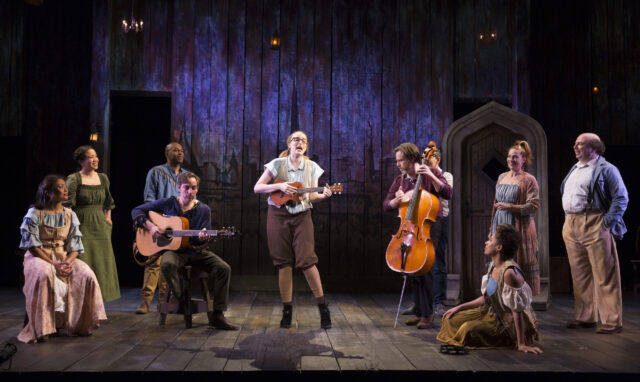
A casting gimmick tries to put 1776 into a different perspective (photo by Evan Zimmerman)

1776
American Airlines Theatre
227 West 42nd St. between Broadway & Eighth Ave.
Tuesday – Sunday through January 8, $56-$250
www.roundabouttheatre.org

When it comes to reinterpreting a hit, 1776 takes the cake — and hits the nadir. The 1969 Tony-winning Best Musical focuses on the debates leading up to the signing of the Declaration of Independence at the second Continental Congress, in Philadelphia. For this Roundabout revival at the American Airlines Theatre, directors Jeffrey L. Page and Diane Paulus have chosen a cast of women, transgender, and nonbinary actors portraying the Founding Fathers (and two of their wives). However, this is no Hamilton.

The show features music and lyrics by Sherman Edwards and a book by Peter Stone. It begins cleverly enough with a row of men’s shoes at the front of the stage, which the characters step into with a kind of feminist glee; it’s a lovely moment, but it’s all downhill from there as the casting becomes the point of the revival. Oh, look, Thomas Jefferson is played by a pregnant woman (Elizabeth A. Davis). Ben Franklin is portrayed by an actor who looks nothing like him (Patrena Murray). The casting feels like a gimmick that dominates everything else when it could have been so much more. It’s not that I’m averse to change; I loved Daniel Fish’s reinvention of Oklahoma! a few years ago. But the changes have to be pertinent, not just made for the sake of change.

At first, it’s engaging and relevant to what’s happening in the sociopolitical spectrum in 2022, as evidenced by John Adams’s (Crystal Lucas-Perry, later replaced by Kristolyn Lloyd) all-too-believable speech: “If you don’t want to see us hanging / On some far off British hill; / If you don’t want the voice of independency / Forever still, / Then, god, sir, get thee to it! / For Congress never will! / You see, we Congress / Piddle, twiddle, and resolve. Eh . . . / Not one damned thing do we solve. . . . Piddle, twiddle, and resolve, . . . / Nothing’s ever solved in Congress.”

Leading the fight against independence are the conservative John Dickinson of Pennsylvania (Carolee Carmello), George Read of Delaware (Nancy Anderson), and Edward Rutledge of South Carolina (Sara Porkalob). They argue about the rules of the vote, a clause involving slavery, and other elements, some of which are based on fact, others unverifiable, and others just plain inaccurate. The only two female characters, Abigail Adams (Allyson Kaye Daniel) and Martha Jefferson (Eryn LeCroy), were most likely not in Philadelphia at the time, although Adams’s “Compliments” is a standout, having more power than the more well known showstopper “Molasses to Rum,” performed by Rutledge.

There are also unnecessary projections that compare 1776 to today, particularly with regard to women in politics, something that did not need to be said but was clear from the rest of the show, which mostly falls flat. The televised January 6 Committee hearings were more interesting than this revival, which highlights the original’s many faults. The 1969 edition was nominated for five Tonys, winning three, while the 1997 revival earned three nominations, taking home none. I can’t imagine this one could top either of those come 2023 awards time.

There’s a reason why Sondheim won eight Tonys (as well as an Oscar, eight Grammys, a Pulitzer, and the Presidential Medal of Freedom) and so many of his shows are revived, on and off Broadway. As he told Rich in 2000, “‘Less is more’ is a lesson learned with difficulty. . . . Reduction releases power.” Just look at the current smash Broadway revival of Sondheim’s Into the Woods at the St. James.

PARDO È PAPEL: THE GLORIOUS VICTORY AND NEW POWER

Maxwell Alexandre’s “Pardo é Papel: The Glorious Victory and New Power” reimagines the museum/gallery experience (photo by twi-ny/mdr)

PARDO È PAPEL: THE GLORIOUS VICTORY AND NEW POWER
The Shed, the Bloomberg Building at Hudson Yards
545 West 30th St. at Eleventh Ave.
Wednesday – Sunday through January 8, $10
theshed.org
online slideshow

As you enter Brazilian artist Maxwell Alexandre’s debut North American solo exhibition at the Shed, “Pardo é Papel: The Glorious Victory and New Power,” the key work is to your immediate right, a large, vertical empty gold frame on wrinkled brown kraft paper hanging from the ceiling on plastic wires, its borders populated by cartoonish characters. What’s critical is what’s not in the frame: a person, particularly a Black one. It is also infused with an engaging yet disturbing fragility, as if it could fall apart at any minute.

The Shed’s level four gallery is divided into two sections, “The Glorious Victory” and “New Power,” two series that make up Alexandre’s “Pardo é Papel,” which translates as “brown is paper”; the term refers not only to the pardo paper Alexandre uses but the Brazilian census category that forces citizens to choose between Black, brown (mixed race), or white, identifying themselves by skin color and not culture and ancestry and contributing to the whitening of the country since fewer people will call themselves Black. The exhibition, organized by curator at large Alessandra Gómez, is arranged as mazes filled with images that celebrate Black empowerment and foster the idea of community amid rampant consumerism and discrimination.

“When I started painting on brown paper, it was not only a conceptual issue but a political and social issue as well,” Alexandre explains in a promotional video. “And some years later, I had an idea of painting a self-portrait, much for the sake of wanting to represent a character that was Black and blond, with dyed hair. . . . ‘Pardo é Papel’ is a series that talks specifically about empowerment, self-esteem, and the speculation of the future of glory and prosperity for Black people. So it starts pointing to these various directions, and these paintings for me are very representative because they speak of this moment of ascension, of my ascension as an artist. That I have my integrity as a Black Brazilian favelado, and as an individual, as an artist.”

The works feature pop-culture references scattered throughout, from such recording artists as Baco Exu do Blues, Djonga, BK, and Nina Simone to such consumer goods as the chocolate drink Toddynho (with its smiling mascot), Danone yogurt, and Capri pools; the latter is the focus of one of the most powerful pieces in the show, Até Deus inveja o homem preto (Even God envies the Black man), which depicts a Black swimmer with blond hair at the upper left, sucking on a long red-and-white straw that goes into the butt of Toddynho at the lower right, an actual small pool of water on the floor at the corner of the painting.

Alexandre, who was born in Rio de Janeiro in 1990 and was a professional street inline skater for twelve years, also incorporates shoe polish on many canvases, the same polish he used while serving in the army. The majority of the people in his works do not have full faces, adding to the confusion surrounding their identity. In the back room, a painting of velvet ropes is next to a long, vertical work in which four couples — and Brazilian soccer star Neymar — are looking around, as if at an art gallery, but above them is a gold landscape with no figures; at the far end, an older, perhaps wiser gentleman is walking away, ready for a different future. Meanwhile, access is blocked to a second door from the hallway, but we can see the back of a painting, in which a small, solitary Black person is floating in the upper right rectangle, facing the hall, not the gallery, as if being kept out, not allowed inside.

“Pardo é Papel” calls into question how we experience galleries and museums, from the figures depicted in the works to the creators, bringing to the forefront the history of the exclusion of artists of color; even the wall text is written on pardo paper. Discussing “New Power” in the accompanying pamphlet, Alexandre notes, “From a biographical perspective, the series talks about how I, upon arriving at a position of success, looked around and found myself in a world dominated almost exclusively by white people. The series is a study and mapping of the contradictions, pitfalls, and opportunities in this field so that more Black people can infiltrate it not only as spectators or subjects but also as agents in positions of power: curators, artists, collectors, directors, funders, gallerists, and so on.”

“Pardo é Papel” goes a long way to that necessary goal.

UNDER THE RADAR 2023

A Thousand Ways (Part Three): Assembly brings strangers together at the New York Public Library (photo courtesy 600 Highwaymen)

UNDER THE RADAR FESTIVAL
Public Theater and other venues
January 4-22, free – $60
publictheater.org

The Public Theater’s Under the Radar Festival is back and in person for its eighteenth iteration, running January 4-22 at the Public as well as Chelsea Factory, NYU Skirball, La MaMa, BAM, and the New York Public Library’s Stavros Niarchos Foundation branch. As always, the works come from around the world, a mélange of disciplines that offers unique theatrical experiences. Among this year’s selections are Jasmine Lee-Jones’s seven methods of killing kylie jenner, Annie Saunders and Becca Wolff’s Our Country, Roger Guenveur Smith’s Otto Frank, Rachel Mars’s Your Sexts Are Shit: Older Better Letters, Kaneza Schaal’s KLII, and Timothy White Eagle and the Violet Triangle’s The Indigo Room.

In addition, “Incoming! — Works-in-Process” features early looks at pieces by Mia Rovegno, Miranda Haymon, Nile Harris, Mariana Valencia, Eric Lockley, Savon Bartley, Raelle Myrick-Hodges, and Justin Elizabeth Sayre, while Joe’s Pub will host performances by Eszter Balint, Negin Farsad, Julian Fleisher and his Rather Big Band, Salty Brine, and Migguel Anggelo.

Below is a look at four of the highlights.

600 HIGHWAYMEN: A THOUSAND WAYS (PART THREE): AN ASSEMBLY
The New York Public Library, Stavros Niarchos Foundation Library
455 Fifth Ave. at Fortieth St., seventh floor
January 4-22, free with advance RSVP
publictheater.org

At the January 2021 Under the Radar Festival, the Obie-winning 600 Highwaymen presented A Thousand Ways (Part One): A Phone Call, a free hourlong telephone conversation between you and another person, randomly put together and facilitated by an electronic voice that asks both general and intimate questions, from where you are sitting to what smells you are missing, structured around a dangerous and lonely fictional situation that is a metaphor for sheltering in place. The company followed that up with the second part, An Encounter, in which you and a stranger — not the same one — meet in person, sitting across a table, separated from one another by a clear glass panel, with no touching and no sharing of objects. In both sections, I bonded quickly with the other person, making for intimate and poignant moments when we were all keeping our distance from each other.

Now comes the grand finale, Assembly, where sixteen strangers at a time will come together to finish the story at the New York Public Library’s Stavros Niarchos Foundation branch in Midtown. Written and created by Abigail Browde and Michael Silverstone, A Thousand Ways innovatively tracks how the pandemic lockdown influenced the ways we interact with others as well as how critical connection and entertainment are.

Palindromic show makes US premiere at Under the Radar Festival (photo courtesy Ontroerend Goed)

ONTROEREND GOED: Are we not drawn onward to new erA
BAM Fishman Space
321 Ashland Pl.
January 4-8, $45
publictheater.org
www.bam.org

What do the following three statements have in common? “Dammit, I’m mad.” “Madam in Eden, I’m Adam.” “A man, a plan, a canal – Panama.” They are all palindromes, reading the same way backward and forward. They also, in their own way, relate to Ontroerend Goed’s Are we not drawn onward to new erA, running January 4-8 at BAM’s Fishman Space. Directed by Alexander Devriendt, the Belgian theater collective’s seventy-minute show features a title and a narrative that work both backward and forward as they explore climate change and the destruction wrought by humanity, which has set the Garden of Eden on the path toward armageddon. But maybe, just maybe, there is still time to save the planet if we come up with just the right plan.

PLEXUS POLAIRE: MOBY DICK
NYU Skirball
566 LaGuardia Pl.
January 12-14, $40
publictheater.org
nyuskirball.org

The world is obsessed with Moby-Dick much the way Captain Ahab is obsessed with the great white itself. Now it’s Norwegian theater company Plexus Polaire and artistic director Yngvild Aspeli’s turn to harpoon the story of one of the most grand quests in all of literature. Aspeli (Signaux, Opéra Opaque, Dracula) incorporates seven actors, fifty puppets, video projections, a drowned orchestra, and a giant whale to transform Herman Melville’s 1851 novel into a haunting ninety-minute multimedia production at NYU Skirball for four performances only, so get on board as soon as you can.

Brian Mendes and Jim Fletcher get ready for NYCP’s Field of Mars (photo courtesy New York City Players)

NEW YORK CITY PLAYERS: FIELD OF MARS
NYU Skirball
566 LaGuardia Pl.
January 19-22, 24-29, $60
publictheater.org
nyuskirball.org

I’ll follow Richard Maxwell and New York City Players anywhere, whether it’s on a boat past the Statue of Liberty (The Vessel), an existential journey inside relationships and theater itself (The Evening, Isolde) and outside time and space (Paradiso, Good Samaritans), or even to the Red Planet and beyond. Actually, his newest piece, Field of Mars, playing at NYU Skirball January 19-29, refers not to the fourth planet from the sun but to the ancient term for a large public space and military parade ground. Maxwell doesn’t like to share too much about upcoming shows, but we do know that this one features Lakpa Bhutia, Nicholas Elliott, Jim Fletcher, Eleanor Hutchins, Paige Martin, Brian Mendes, James Moore, Phil Moore, Steven Thompson, Tory Vazquez, and Gillian Walsh and that the limited audience will be seated on the stage.

Oh, and Maxwell noted in an email blast: “Field of Mars: A chain restaurant in Chapel Hill is used as a way to measure the progress of primates, from hunter/gatherer to fast casual dining experience. Topics covered: Music, Food, Nature, and Spirituality. . . . I also wanted to take this opportunity to tell parents regarding the content of Field of Mars: my kids (aged 11 and 15) will not be seeing this show.”

EDDIE IZZARD: CHARLES DICKENS’ GREAT EXPECTATIONS

Eddie Izzard works some magic in one-woman adaptation of Charles Dickens’s Great Expectations, (photo by Bruce Glikas)

GREAT EXPECTATIONS
The Greenwich House Theater
27 Barrow St. at Seventh Ave. South
Tuesday – Sunday through January 22, $60-$99
www.eddieizzardgreatexpectations.com

Eddie Izzard is absolutely delightful portraying approximately twenty characters in her one-woman retelling of Charles Dickens’s Great Expectations, continuing at the Greenwich House Theater through January 22. Adapted by Izzard’s brother, Mark, into a taut two hours (with intermission) from the five-hundred-plus-page 1861 novel, it’s a classic British coming-of-age story divided into three stages of the life of one Philip Pirrip. The Aden-born, two-time Emmy-winning, Tony-nominated actor, comedian, and activist — who is exactly 150 years younger than Dickens to the day — looks fabulous in spiky blond hair and a steampunk goth costume (by Tom Piper and Libby da Costa) consisting of a ruffled V-neck white blouse, form-fitting black coat, black skirt, black stockings, and knee-high lace-up black boots. Piper’s set features lush red drapery in the front and the dilapidated facade of a white house with graying, torn curtains in the back, emblematic of the faded royalty of Miss Havisham, one of the most memorable figures in all of literature.

Izzard is Pip, the book’s narrator, who sets the tone and scene in the opening monologue:

My father’s family name being Pirrip, and my Christian name Philip, my infant tongue could make of both names nothing longer or more explicit than Pip. So I called myself Pip. I never saw my father or my mother, never saw any likeness of either of them, for their days were long before the days of photographs, that wondrous new invention. Ours was the marsh country, south and east of London by the Thames river, within twenty miles of the sea. On a raw afternoon towards evening I found out that this bleak place overgrown with nettles was the churchyard; that Philip Pirrip, late of this parish, and also Georgiana, wife of the above, were dead and buried; and that five little stone lozenges, arranged in a neat row beside, were sacred to the memory of five little brothers of mine. I also discovered that the dark flat wilderness beyond the churchyard was the marshes, and that the distant savage lair from which the wind was rushing was the sea, and that Pip was the small bundle of shivers growing afraid of it all.

Pip is seven when the tale begins, living with his sole remaining sibling, his mean sister, who is married to the kind blacksmith Joe Gargery. Wallking through the marshes, Pip is accosted by a dangerous-looking man, Abel Magwitch, who declares, “Hold your noise, you little devil, or I’ll cut your throat!” He demands that Pip bring him food and an iron file, and Pip obliges, seeing no other choice, stealing the items, including a Christmas pork pie, that was meant for such family and friends as Mr. Wopsle, Uncle Pumblechook, and the Hubbles. “I was too cowardly to do what I knew to be right, just as I had been too cowardly to avoid doing what I knew to be wrong,” he admits, a theme that runs through his life, which takes its next turn when he is summoned by the mysterious spinster Miss Havisham, who wants the poor Pip to play with her adopted daughter, Estella.

Eddie Izzard is superb as Pip and everyone else in Great Expectations (photo by Bruce Glikas)

Pip, who learned how to read from the orphan Biddy, is desperate to become a gentleman, and the surprise opportunity arises when a London lawyer named Jaggers arrives, explaining to Joe that a benefactor wishing to remain anonymous is offering Pip the chance to study in the city and, indeed, become a gentleman. “I have come to relieve you of your apprentice,” Jaggers says to Joe. “The communication I have to make is that this young fellow has great expectations.”

Those “great expectations” lead Pip to meet London tutor Matthew Pocket, son of Herbert Pocket, Miss Havisham’s cousin; Jaggers’s clerk, Mr. Wemmick; rival scholar Bentley Drummle; Magwitch’s fellow convict, Compeyson; the merchant Clarriker; and Clara Barley, who takes a liking to Herbert. The adaptation has cut a few figures from the story, including Miss Havisham’s younger half-brother, Arthur; blacksmith Dolge Orlick; Wemmick’s friend Miss Skiffins; and another of Pip’s fellow students, Startop.

Izzard, who has appeared in such films as Ocean’s Twelve and Ocean’s Thirteen, The Lego Batman Movie, and Whiskey Galore!, such television series as The Riches, Hannibal, and Powers, and such plays as The Cryptogram, A Day in the Death of Joe Egg, and Race, is dyslexic; as a challenge, she recorded Great Expectations as an audiobook, the first major literary work she had ever read, and in doing so decided to make it into a solo show. She has a graceful, commanding stage presence onstage, smoothly transitioning between roles with just a twist of her body and a slight change of voice; the subtle movement direction is by Didi Hopkins. Izzard’s clear familiarity with the text and understanding of the material help her develop a quick rapport with the audience, who cannot help but root for Pip, a character previously played by such actors as John Mills, Roddy McDowall, Michael York, and Ethan Hawke.

The Izzards and director Selina Cadell (Love for Love, The Life I Lead) create a menacing Victorian atmosphere, especially when it comes to Miss Havisham; when she is in a scene, Tyler Elich/Lightswitch turns down the lights onstage and up on either side of the audience, an eerie glow building slowly to correspond with the ghostliness of Miss Havisham’s existence. You can practically see and smell the (nonexistent) decaying, rat-eaten bride-cake in the corner, the remnants of her being left at the altar many years before.

“As I had grown accustomed to my expectations, I had begun to notice their effect upon me and those around me and I knew very well that it was not all good,” Izzard says as Pip about halfway through the play. Izzard lives up to expectations, and it is all good.

MIKE BIRBIGLIA: THE OLD MAN & THE POOL

Mike Birbiglia discusses mortality with a smile in The Old Man & the Pool (photo by Emilio Madrid)

MIKE BIRBIGLIA: THE OLD MAN AND THE POOL
Vivian Beaumont Theater at Lincoln Center Theater
150 West 65th St. between Broadway & Amsterdam Ave.
Tuesday – Saturday through January 15, $104-$268
212-362-7600
www.lct.org

I remember being home sick one day in fourth grade, when I was ten, grabbing a relatively short book from my parents’ library, and reading it straight through in bed. It was the first real novel I ever picked up, called The Old Man and the Sea, by a man named Ernest Hemingway, about a fisherman facing his own mortality as he desperately tries to reel in a marlin in a life-or-death struggle, for both him and his catch. I can still feel myself turning the pages, the excitement building moment to moment.

The title, and the theme of mortality, is the jumping-off point of Mike Birbiglia’s latest one-man show, the deeply personal and extremely funny The Old Man & the Pool, continuing at Lincoln Center’s Vivian Beaumont Theater through January 15. In such past solo works as The New One, Thank God for Jokes, and Sleepwalk with Me, the Massachusetts-born, Brooklyn-based comedian and This American Life contributor has documented his REM sleep behavior disorder, his sex life, trying to conceive, and the power of jokes themselves. “There are details in my life that are both setups and punchlines,” he explained in his Broadway debut, The New One, and the same is true once again in The Old Man & the Pool, in which mortality is front and center for seventy-five hysterical, moving minutes.

The show begins with Birbiglia describing his 2017 annual physical, “which I always dread because I have a lot of preexisting conditions, which I call ‘conditions’ because everything is existing if it does and everything is ‘pre’ unless it happened on the way to the appointment. When I see that checklist I circle the whole thing and cross out ‘pregnant.’” When he has trouble blowing into a tube for a pulmonary test, his doctor tells him that based on those results, he might be having a heart attack right then and there. “I call it ‘the birthday cake test,’” Birbiglia tells the audience, “because it sort of tells you how many birthday cakes . . . you have left.” Shortly after that, the doctor tells Birbiglia that he has type two diabetes.

At the time, Birbiglia was forty-four, married to Jenny (who he calls Chlo for no apparent reason), and raising their three-year-old daughter, Oona. Both his father and his paternal grandfather had heart attacks at fifty-six. “I’ve always thought I should just set aside that whole year when I turn fifty-six and get an airbnb by the hospital and keep a flexible schedule,” he says. I understand exactly where he’s coming from; my father died of a heart attack at forty-seven, his father at fifty-seven. Those kinds of facts tend to weigh heavily on your mind.

Mike Birbiglia surfs through a serious diagnosis in latest Broadway solo show (photo by Emilio Madrid)

It’s one of the many reasons why Birbiglia’s shows work so well. He’s a kind of everyman, sharing his foibles with a genuine self-deprecation and easygoing relatability. It pains him that he was raised in a family that would say “Take care” instead of “I love you.” He also tends to come down with extreme medical conditions that are fascinating to hear about. He has to sleep in a special sleeping bag and wear mittens so his sleepwalking doesn’t result in accidentally causing harm to himself, his wife, or his daughter. In The New One, he details undergoing a varicocele repair that makes every male in the audience wince and cringe. He survived bladder cancer. And now, he’s fighting off diabetes and a potential heart attack.

He’s told that he has to start doing cardio five days a week. “I don’t think anybody does cardio five days a week,” he tells his doctor, who replies, “A lot of people do cardio five days a week.” The doctor suggests he swims at the YMCA, which brings up a poignant and profound memory for Birbiglia in which, at the age of seven, he decided he would never again go to a YMCA pool. But the thought of leaving Oona fatherless overwhelms him, and the exercise regime begins as he strives to improve his health, even if it involves changing his diet and swimming laps five days a week. It evokes Santiago, the old man in Hemingway’s story, thinking to himself, “Now is no time to think of what you do not have. Think of what you can do with what there is.” Similarly, Birbiglia asks, “Why do we not do the thing we know we should be doing?”

Mike Birbiglia takes it easy while considering death in The Old Man & the Pool (photo by Emilio Madrid)

Birbiglia, who also wrote, directed, and starred in the films Don’t Think Twice and Sleepwalk with Me, is immensely personable and self-effacing, telling his tale in a laid-back, even-tempered manner. He picks up the sole prop, a stool, and walks around the stage with it, occasionally sitting on it. He relaxes on the floor, lays down, and works off the energy of the audience. The night I went, a handful of people came in late, including a woman in the front row. Birbiglia, who was laying on his side at the time, welcomed them and decided to get them up to speed by giving them a quick, unscripted summary of what they missed. It was a brilliant moment, and one that quickly sealed the bond between us and him.

Beowulf Boritt’s set is sparse but effective: a concave board that mimics both a giant wave in its shape and a swimming pool in its gridlike design of blue squares. At times Birbiglia appears to surf under it, while at other times it looks like it is going to envelop him, drowning him. He wears jeans, comfy shoes, and an untucked blue-and-white button-down shirt that echoes the backdrop; the costume is by Toni-Leslie James, with lighting by Aaron Copp, projections by Hana S. Kim, and sound by Kai Harada, all helping develop a warm intimacy. Birbiglia’s longtime director, Seth Barrish, knows just how to keep it all moving forward as Birbiglia heads off on hilarious digressions about wrestling, mold, sugar fries, and signs such as “Slippery When Wet” and “No Breath Holding.”

The show begins and ends with the propulsive song “Red Hearse” by the LA band Red Hearse, in which Jack Antonoff, Sam Dew, and Sounwave promise, “I’ll be better than I was before / A natural, all of the past out the door / I never let you go, was all at our knees before / It’s gettin’ deeper, we’re caught up in the undertow / So come on / And if you can’t hold me / I’ll dive in it headfirst / I’ll die ridin’ in a red hearse.” In The Old Man & the Pool, master storyteller Birbiglia guides the audience through the undertow, emerging safely, and happily, from the abyss.

BARBARA KRUGER: THINKING OF YOU. I MEAN ME. I MEAN YOU.

Barbara Kruger’s immersive atrium installation continues at MoMA through January 2 (photo by twi-ny/mdr)

BARBARA KRUGER: THINKING OF YOU. I MEAN ME. I MEAN YOU.
The Museum of Modern Art
Donald and Catherine Marron Family Atrium
11 West 53rd St. between Fifth & Sixth Aves.
Through January 2, $14-$25
www.moma.org
online slideshow

There’s one word that sticks out in Barbara Kruger’s text-based architectural installation Thinking of You. I Mean Me. I Mean You. in MoMA’s atrium, and it’s in the title twice: No, not Mean but You. Standing in the middle of the imposing space, you are surrounded by words, phrases, and sentences in black-and-white, arranged in horizontal grids and ovals on the floor, walls, and stanchions, that deal with personal and group identity, racial and class injustice, greed, war, consumer culture, and capitalism. These are themes the seventy-seven-year-old Newark native has been exploring throughout her five-decade career, in such pervious works as I Shop Therefore I Am, You Are Not Yourself, The Globe Shrinks, Untitled (Questions), and Whose Hopes? Whose Fears?

A block on the floor pronounces: “IF YOU WANT A / PICTURE OF THE / FUTURE, IMAGINE / A BOOT STAMPING / ON A HUMAN FACE, / FOREVER. / GEORGE ORWELL.”

On the upper south wall, Kruger explains: “THIS IS ABOUT THE YOU NOT I. / THIS IS ABOUT A WORLD OF HURT. / THIS IS ABOUT LOOKING FOR / THE MOMENT WHEN PRIDE / BECOMES CONTEMPT. ABOUT / WANTING ONE ANOTHER. / ABOUT FEARING ONE ANOTHER. / ABOUT TOUCHING ONE ANOTHER. / ABOUT THE WAR FOR ME TO BECOME YOU. I MEAN ME. I MEAN YOU.”

Among the other statements that emerge in this dizzying display are “MONEY TALKS,” “THIS IS ABOUT LOVING AND LONGING. ABOUT SHAMING AND HATING. . . . ABOUT WHO GETS WHAT AND WHO OWNS WHAT,” “YOU ARE HERE, LOOKING THROUGH THE LOOKING GLASS, DARKLY. / SEEING THE UNSEEN, THE INVISIBLE, THE BARELY THERE,” and “IN THE END, YOU DISAPPEAR / IN THE END, LIES PREVAIL / IN THE END, ANGER FADES / IN THE END, HOPE IS LOST.” In addition, a few playful emojis contribute their thoughts on it all.

“Barbara Kruger said architecture is one of the predominant orderings of social space,” curatorial assistant Margarita Lizcano Hernandez says in a MoMA ArtSpeaks video, continuing, “There’s this level of activation of the space that, just by entering it, you’ve become part of it.”

But even as the words, in Kruger’s trademark bold, sans serif font, predict loneliness and doom, hope is not lost; there is an innate joy in just seeing these words, in sharing them with the strangers around you undergoing the same experience. There’s a reason why “YOU” and “ME” are crossed out in the title, followed by a “YOU” that is not crossed out: It’s really about us; Kruger is pointing a finger at everyone.

EUPHORIA

Giancarlo Esposito plays a philosophical cabbie in Julian Rosefeldt’s Euphoria (photo by Nicholas Knight / courtesy of Park Avenue Armory)

EUPHORIA
Park Ave. Armory, Wade Thompson Drill Hall
643 Park Ave. at Sixty-Seventh St.
Daily through January 8, $18
www.armoryonpark.org

“The point is, ladies and gentleman, that greed — for lack of a better word — is good,” Gordon Gekko (Michael Douglas) famously pronounced in Oliver Stone’s Oscar-nominated 1987 film, Wall Street. “Greed is right. Greed works. Greed clarifies, cuts through, and captures the essence of the evolutionary spirit. Greed, in all of its forms — greed for life, for money, for love, knowledge — has marked the upward surge of mankind. And greed — you mark my words — will not only save Teldar Paper but that other malfunctioning corporation called the USA.”

Well, as it turns out, greed has not exactly saved America or the world, but is there still hope? German filmmaker Julian Rosefeldt explores that possibility in his beautifully rendered twenty-four-channel immersive installation, Euphoria, continuing at Park Avenue Armory through January 8. It arrives at an opportune moment, not only in the midst of a post-global-pandemic economic crisis but during the holiday season, when rampant consumerism dominates our everyday life.

In 2016, Rosefeldt presented Manifesto at the armory, a thirteen-channel film projected on screens placed throughout Wade Thompson Drill Hall, featuring Cate Blanchett as twelve different characters spouting cultural missives by artists and philosophers going back more than 150 years. One of the themes came from Jim Jarmusch: “Nothing is original.” While nearly all the dialogue in Euphoria is taken from another source, how it is incorporated into a 115-minute visual and aural feast is anything but derivative or uninventive. And it’s about a lot more than just the Benjamins.

Euphoria comprises six distinct scenes, each of which exists on its own in a loop; you can enter at any time, as the order doesn’t matter. The linking factor is the discussion of socioeconomics in the modern world. There are black fold floor chairs scattered around the space, but you can also walk around the installation. The main screen hangs at the center, where the six stories are told. Five smaller screens are at the same level in a circle, where drummers Terri Lyne Carrington, Peter Erskine, Yissy García, Eric Harland, and Antonio Sanchez occasionally pick up their sticks and play. Eighteen more screens surround the space, except for the entrance, on which 140 members of the Brooklyn Youth Chorus are projected, life-size; in the dark hall, it often looks like they are actually there, in person, singing or, when silent, standing more or less still, their slight swaying adding a dash of reality to the primary narrative, which delves into the fantastical. (The score is by Samy Moussa, with an additional composition by Cassie Kinoshi.)

Julian Rosefeldt’s twenty-four-channel installation surrounds viewers (photo by Nicholas Knight / courtesy of Park Avenue Armory)

On a cold winter night in New York City, a taxi driver played by Giancarlo Esposito, partially channeling his character from Jarmusch’s Night on Earth, including his “fresh” winter hat with earflaps, picks up a well-dressed man with shopping bags who is going to the Brooklyn Navy Yard; it’s not long before we realize Esposito is playing both roles. The cabbie does most of the talking, his dialogue made up of quotes from John Steinbeck, Noam Chomsky, Fareed Zakaria, G. K. Chesterton, JR, Milton Friedman, Ayn Rand, and others, seamlessly woven together. “My momma always said: Too many people buy things they don’t need with money they don’t have to impress people who don’t care,” the cabbie says (Will Rogers). Passing by strange things happening on the street, the cabbie delivers lines that essentially sum up much of what Euphoria is about: “And then they see their idealism turn into realism, their realism into cynicism, their cynicism turn into apathy, their apathy into selfishness, their selfishness into greed and then they have babies, and they have hopes but they also have fears, so they create nests that become bunkers, they make their houses baby-safe and they buy baby car seats and organic apple juice and hire multilingual nannies and pay tuition to private schools out of love but also out of fear. What happened? You start by trying to create a new world and then you find yourself just wanting to add a bottle to your cellar, you see yourself aging and wonder if you’ve put enough away for that and suddenly you realize that you’re frightened of the years ahead of you. You never think you’ll become corrupt but time corrupts you, wears you down, wears you out. You get tired, you get old, you give up on your dreams. . . . You mind who you think you wanted to be” (Don Winslow).

The action moves next to a postapocalyptic ship graveyard where five white homeless men, Poet, Smartass, Randy, Keynes, and Sidekick, gather around a trash fire, discussing the “three great forces [that] rule the world: stupidity, fear, and greed” (Albert Einstein). Randy declares, “It seems to me that not doing what we love in the name of greed is just very poor management of our lives. I will tell you the secret to getting rich: Be fearful when others are greedy and greedy when others are fearful!” (Warren Buffett). Quotes from Machiavelli, Snoop Dog, Erich Fromm, Socrates, Adam Smith, Stephen King, Elizabeth Warren, and more are interwoven as the men pass around a bottle of rum, eat marshmallows, and burn a smartphone and, unbeknownst to them, a parade of animals in the background boards a large wooden ship, as if a new world is starting that the men will not be part of.

In a parcel delivery factory, three women (Virginia Newcomb, Ayesha Jordan, Kate Strong) work an assembly line, scanning and organizing packages while discussing how “things can only get worse” (Invisible Committee). They detail their struggles with overwhelming debt, long hours and low pay, racial injustice, motherhood, and misogyny and sexualization, sharing the words of Audre Lorde, Sojourner Truth, Ursula K. Le Guin, Angela Davis, bell hooks, Cardi B, and Frantz Fanon. “You sound like an archaeologist!” one of the women says to her conveyor-belt mate, who responds, “That’s right! I am an archaeologist. You wanna know why? ’Cause my life lies in fucking ruins.”

One of the scenes in Euphoria takes place in a surreal bank (photo by Nicholas Knight © Julian Rosefeldt / courtesy of Park Avenue Armory)

An elegant Kyiv bank turns into a surreal carnival in a scene that kicks off with a doorman (Yuriy Shepak) looking into the camera and saying, “It is a kind of spiritual snobbery that makes people think they can be happy without money” (Albert Camus). A moment later he adds, “Money is like blood. It gives life if it flows. Money enlightens those who use it to open the flower of the world” (Alejandro Jodorowsky). Excerpts from Yuval Noah Harari, Michael Lewis, Matt Taibbi, Bertolt Brecht, George Carlin, Don DeLillo, and Karl Marx merge as a security guard (Nina Songa), a mother (Evgenia Muts), a homeless woman (Elena Aleksandrovich), and a cleaner (Corey Scott-Gilbert) go about their business, the bankers transforming into magicians, acrobats, and dancers. It’s a Busby Berkeley celebration in which money isn’t real, just another trick or performance. As the cleaner notes, “Money isn’t a material reality — it is a psychological construct. It works by converting matter into mind. So why does it succeed? Because people trust the figments of their collective imagination. Trust is the raw material from which all types of money are minted. Religion asks us to believe in something. Money only asks us to believe that other people believe in something” (Yuval Noah Harari).

In another vignette, six skate teens (Rocio Rodriguez-Inniss, Esther Odumade, Tia Murrell, Dora Zygouri, Asa Ali, and Luis Rosefeldt) come together in an abandoned bus terminal talk to about the future, debating quantitative vs. qualitative value, spouting lines from Arthur C. Clarke, Victor Hugo, William Shakespeare, Aldous Huxley, and John Maynard Keynes. “It’s considered sexy to accumulate property, money, stocks, cars. What a waste of dopamine and adrenaline if it’s all just about quantity, right?” (JR) one of the girls asks. “Right,” replies a second girl. “I mean, if a monkey hoarded more bananas than it could eat, while most of the other monkeys starved, scientists would study that monkey to figure out what the heck was wrong with it. When humans do it, we put them on the cover of Forbes” (Nathalie Robin Justice). One of the boys points out, “A brutal state of affairs, profoundly inegalitarian, is presented to us as ideal” (Alain Badiou), adding, “We humans want to compete with each other, to grow, to invent, to expand. Fair enough. But why not within an ethically defined framework, based on common shared values” (JR). As almost always, the younger generation believes they can change the world for the better, through education and the reestablishment of goals based on equality and what’s best for all, not competition that serves the few. “We need to think big. Our natural habitat has always been the future, and this terrain must be reclaimed” (Nick Srnicek/Alex Williams) a third girl says. But as a fourth girl points out, “No wonder the galaxies recede from us in every direction, at the speed of light. They are frightened. We humans are the terror of the universe” (Edward Abbey). Perhaps unsurprisingly, this section contains the most original dialogue, as the teenagers seek to discover what comes next for themselves and not just relying on existing theories.

My cycle concluded in a large supermarket, where a bold, beautiful, ever-threatening tiger (voiced by Blanchett) makes its way up and down the aisles of canned, boxed, and bottled food and drink. It warns us, “Of the world as it exists, it is not possible to be enough afraid (Theodor W. Adorno). History repeats itself, first as tragedy, second as farce (Karl Marx). Those who do not know history are condemned to repeat it. But even knowing can’t save them. ’Cause what is constant in history is greed and foolishness and a love of blood (Cormac McCarthy).” With quotes from Thomas Hobbes, Terry Pratchett, A. S. Byatt, Marquis de Sade, and Theodor W. Adorno, the hungry, swaggering animal accuses humans of being short-sighted power-mongers, filled with hatred and violence, whose extinction would bring no harm to the planet; in fact it would be welcomed. But the tiger adds, “And the best at war, finally, are those who preach peace. Beware the preachers. Beware the knowers. Beware their love” (Charles Bukowski).

In his 2000 breakthrough hit, “Ride wit Me,” Nelly proclaimed, “Hey, must be the money!” In Euphoria, Rosefeldt zeroes in specifically on greed and its devastating cost on humanity. At the beginning of the bank scene, the doorman says, “For thousands of years, philosophers, thinkers, and prophets have besmirched money and called it the root of all evil,” quoting Hurari. But the full biblical quote from the apostle Paul in Timothy 6:10 actually puts it in a different perspective: “For the love of money is the root of all evil: which while some coveted after, they have erred from the faith, and pierced themselves through with many sorrows.” Today, more than ever, with more of the planet’s wealth in very few hands, financial institutions are like houses of worship, evoked further by the celestial sounds of the Brooklyn Youth Chorus in the armory. Perhaps the security guard says it best when, quoting one of the wisest sages of the last fifty years, George Carlin, he says, “Give a man a gun and he can rob a bank. Give a man a bank and he can rob the world.”