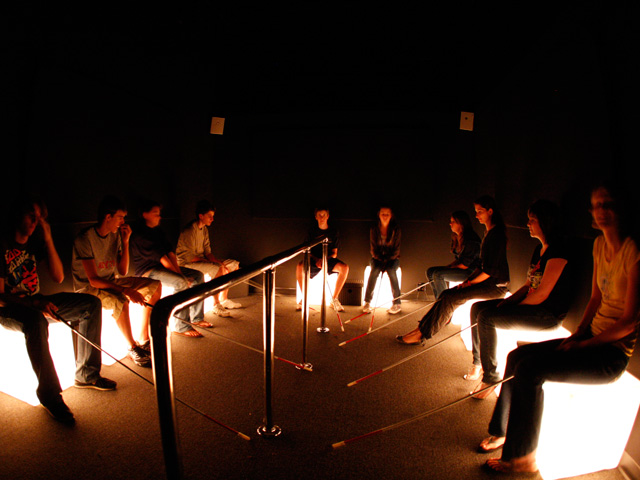
A group gets ready to experience Dialog in the Dark, which opened at the South Street Seaport on August 20
11 Fulton St., South Street Seaport
Daily 10:00 am – 7:00 or 9:00 pm
Timed tickets: $18-$22.50
1-888-926-3437
www.dialognyc.com
During the last few days, New York and New Jersey residents stocked up on candles, batteries, and flashlights just in case their power went out. But what if you lived every day in near or total darkness? Dialog in the Dark, a new immersive exhibition at the South Street Seaport, simulates what it might be like for sighted people to suddenly live in complete darkness. Premier Exhibitions, the company behind “Bodies . . . The Exhibition” (which is held in the same building), in partnership with Dialogue Social Enterprise, Lighthouse International, and Fairway, has brought to the city the long-running Dialog in the Dark, a sixty-minute excursion in which a group of eight to ten people are given authentic walking canes and then led by a visually impaired or blind guide through totally dark rooms that re-create indoor and outdoor places in New York. Inside each space, visitors are asked to figure out where they are and what is in the room by using only their senses of touch, hearing, and smell. Be prepared to go up and down small ramps and steps, reach out for doorways and walls, bump into seats, and grasp for handrails as you make your way through each installation. And don’t be shy, because you will regularly, if accidentally, be touching other people, and at times some of you may get caught up in a corner together. The designers of DITD have used unique textures to mimic the feel of these familiar environments, but we’re not going to tell you quite what to expect, as it’s more fun to figure that out on your own. And in order to do that, don’t hold back and wait for the others to do the work for you; forge ahead and be adventurous (while following the explicit instructions of your guide). At the end of your journey, you’ll all sit down and discuss your experience, and you’ll be able to ask your guide just about anything you want, about the project and themselves.
Dialog in the Dark began more than twenty years ago in Germany and has since expanded to more than one hundred cities in more than thirty countries, where more than seventy million people have gone through the site-specific installations, led by more than 7,700 guides. DITD’s mission “is to facilitate social inclusion of marginalized people across the world,” with its primary goals to “raise awareness and create tolerance for Otherness in the general public and thereby overcome barriers between ‘us’ and ‘them’ [and to] create jobs for disadvantaged people by turning deficits into potentials and thereby strengthening their self-esteem.” They stress that some eighty percent of vision loss is correctable or preventable and encourage everyone to get regular eye exams. After the tour is over, a gallery provides biographical information on all the guides, who have come together to form their own little community and are all happy to talk about what our guide, Stephanie, called a “transforming experience” for them too, as well as details about such diseases as retinitis pigmentosa, glaucoma, hermianopia, diabetic retinopathy, and macular degeneration. Thus, DITD is meant to be educational as well as a whole lot of fun as it challenges you to face one of most people’s greatest fears. Upcoming special events include Dining in the Dark, a four-course meal served in total darkness, and the singles party Dating in the Dark.

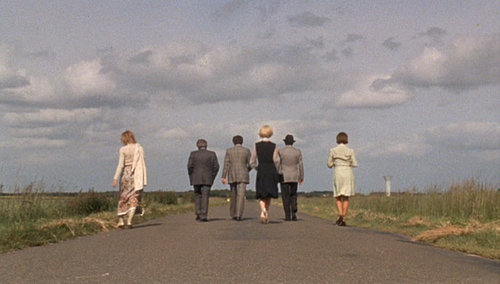
 Winner of the 1972 Oscar for Best Foreign Language Film, Luis Buñuel’s The Discreet Charm of the Bourgeoisie is a sharp, cynical skewering of the European power structure, taking on the high-falutin’ hypocrisy of the government, the military, religion, and, primarily, the wealthy class in hysterical vignettes that center around a group of rich friends trying to sit down and enjoy a meal. But every time they get close, they are ultimately thwarted by miscommunication, a corpse, army maneuvers, terrorists, and, perhaps most bizarrely, fake stage chicken. Buñuel regular Fernando Rey is a hoot as Rafael Acosta, the cocaine-dealing ambassador of Miranda who doesn’t take insults well. Stéphane Audran and Jean-Pierre Cassel play the Sénéchals, a lustful couple desperate to finish a romantic rendezvous even as their guests wait, Julien Bertheau is the local bishop who moonlights as a gardener, Claude Piéplu is an erudite colonel not afraid to share his opinion at a haughty cocktail party, and Maria Gabriella Maione is a sexy stranger who might or might not be a revolutionary after Acosta. Meanwhile, Acosta doesn’t mind making a play for Simone Thévenot (Delphine Seyrig) right under her husband’s (Paul Frankeur) nose. And Ines (Milena Vukotic), one of the Sénéchals’ maids, watches it all with a wonderfully subtle disdain. As if the first half of the film were not surreal enough, the second half includes a series of riotous dream sequences involving ghostly apparitions and a bit of the old ultra-violence, either outwardly related by characters or as cinematic surprises dished out by the masterful Buñuel.
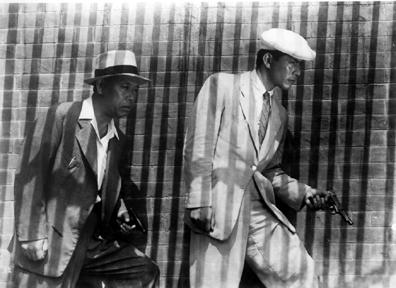
 Akira Kurosawa’s thrilling police procedural, Stray Dog, is one of the all-time-great film noirs. When newbie detective Murakami (Toshirō Mifune) gets his Colt lifted on a bus, he thinks he will be fired if he does not get it back. But as he searches for it, he discovers that it is being used in a series of robberies and murders that he feels responsible for. Teamed with seasoned veteran Sato (Takashi Shimura), Murakami risks his career — and his life — as he tries desperately to track down his gun before it is used again. Kurosawa makes audiences sweat as postwar Japan is in the midst of a heat wave, with Murakami, Sato, prostitute Harumi Namiki (Keiko Awaji), and others constantly mopping their brows, dripping wet. Inspired by the novels of Georges Simenon, Stray Dog is a dark, intense drama shot in creepy black and white by Asakazu Nakai and featuring a jazzy soundtrack by Fumio Hayasaka that unfortunately grows melodramatic in a few key moments — and oh, if only that final scene had been left on the cutting-room floor. Stray Dog will be screening on August 27 at Symphony Space as part of the “Kurosawa” series, consisting of special presentations of the master’s films shown on the big screen in HD for the first time ever; the series concludes August 28 with Rashomon.