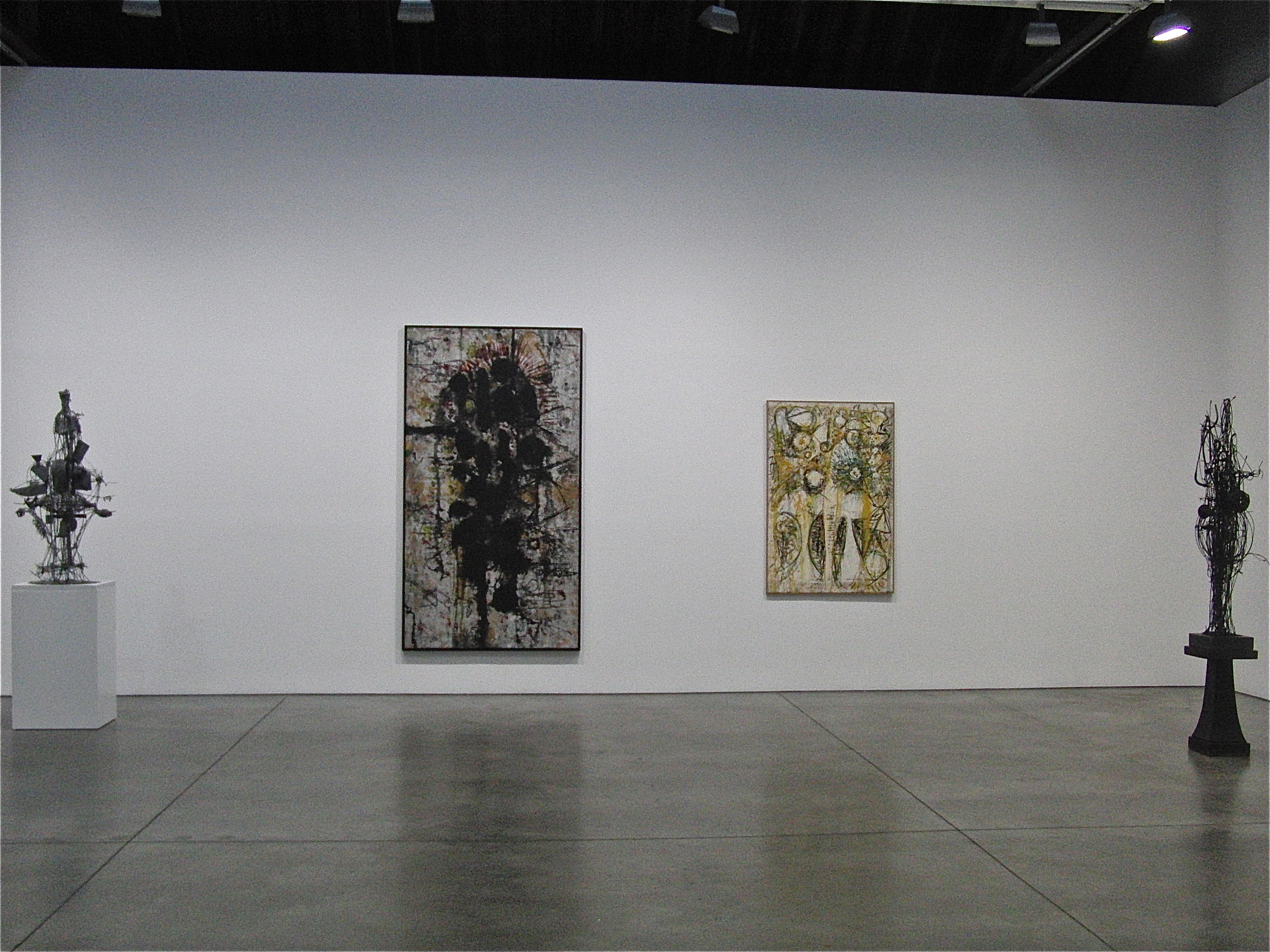
Beautiful Pousette-Dart show at Luhring Augustine includes paintings and wire sculpture (photo by twi-ny/mdr)
Luhring Augustine
531 West 24th St. between Tenth & Eleventh Aves.
Tuesday – Saturday through December 21, free, 10:00 am – 6:00 pm
212-206-9100
www.luhringaugustine.com
Organized by Christopher Wool and Joanna Pousette-Dart, “Richard Pousette-Dart: East River Studio” comprises painting and wire sculpture produced by the Minnesota-born Abstract Expressionist while living and working in a former brewery on East 56th St., including works that has not been seen by the public since they were originally displayed at the Betty Parsons Gallery more than five decades ago. Wool and the artist’s daughter have hung the show beautifully, giving each piece plenty of room to breathe in the spacious Luhring Augustine gallery, allowing visitors to take their time appreciating the enticing black, white, gray, and yellow palette employed by Pousette-Dart, especially on such exemplary works as “Bridge Horizon,” “Dragon Head,” and the nearly blinding “East River Sun.” Vertical wire sculptures such as “The Woman with a Horn” and “Arc of the Bird” are mounted on pedestals, while “Untitled (The Web)” resembles a framed painting from afar but is actually composed of twisting brown wires and found objects. “I strive to express the spiritual nature of the Universe,” Pousette-Dart explained in 1947. “Painting for me is a dynamic balance and wholeness of life; it is mysterious and transcending, yet solid and real.” All of those elements are on view through December 21 at this delightful show at Luhring Augustine.

 Livia Bloom’s “Documentary in Bloom” series at the Maysles Cinema usually introduces new nonfiction films, but it has something a little different in store for December: the U.S. theatrical release of a thirty-six-year-old French work. It’s hard to believe that Daguerreotypes, Agnès Varda’s absolutely charming look at her longtime Parisian community, has never had a theatrical run in America, so it is exciting that her wonderful little tale is finally being shown on the big screen. In Daguerreotypes, Varda, who has made such New Wave classics as Cléo de 5 à 7 and Le Bonheur as well as such seminal personal documentaries as The Gleaners and I and The Beaches of Agnès, turns her camera on the people she and husband Jacques Demy lived with along the Rue Daguerre in Paris’s 14th arrondissement. Varda, who also narrates the seventy-five-minute film, primarily stands in the background while capturing local shopkeepers talking about their businesses and how they met their spouses as customers stop by, picking up bread, meat, perfume, and other items. Varda uses a goofy, low-rent magic show as a centerpiece, with many of the characters attending this major cultural event; the magician references the magic of both life and cinema itself, with Varda titling the film not only after the street where she lives but also directly evoking the revolutionary photographic process developed by Louis Daguerre in the 1820s and ’30s. Daguerreotypes will surely have a different impact now than it did back in the mid-1970s, depicting a time that already felt like the past but now feels like a long-forgotten era, when neighbors knew one another and lived as a tight-knit community. The film will be proceeded by the 1965 short Elsa la Rose, a twenty-minute documentary directed by Varda and Raymond Zanchi and narrated by Michel Piccoli that explores the loving relationship between French writers and communists Louis Aragon and Elsa Triolet.
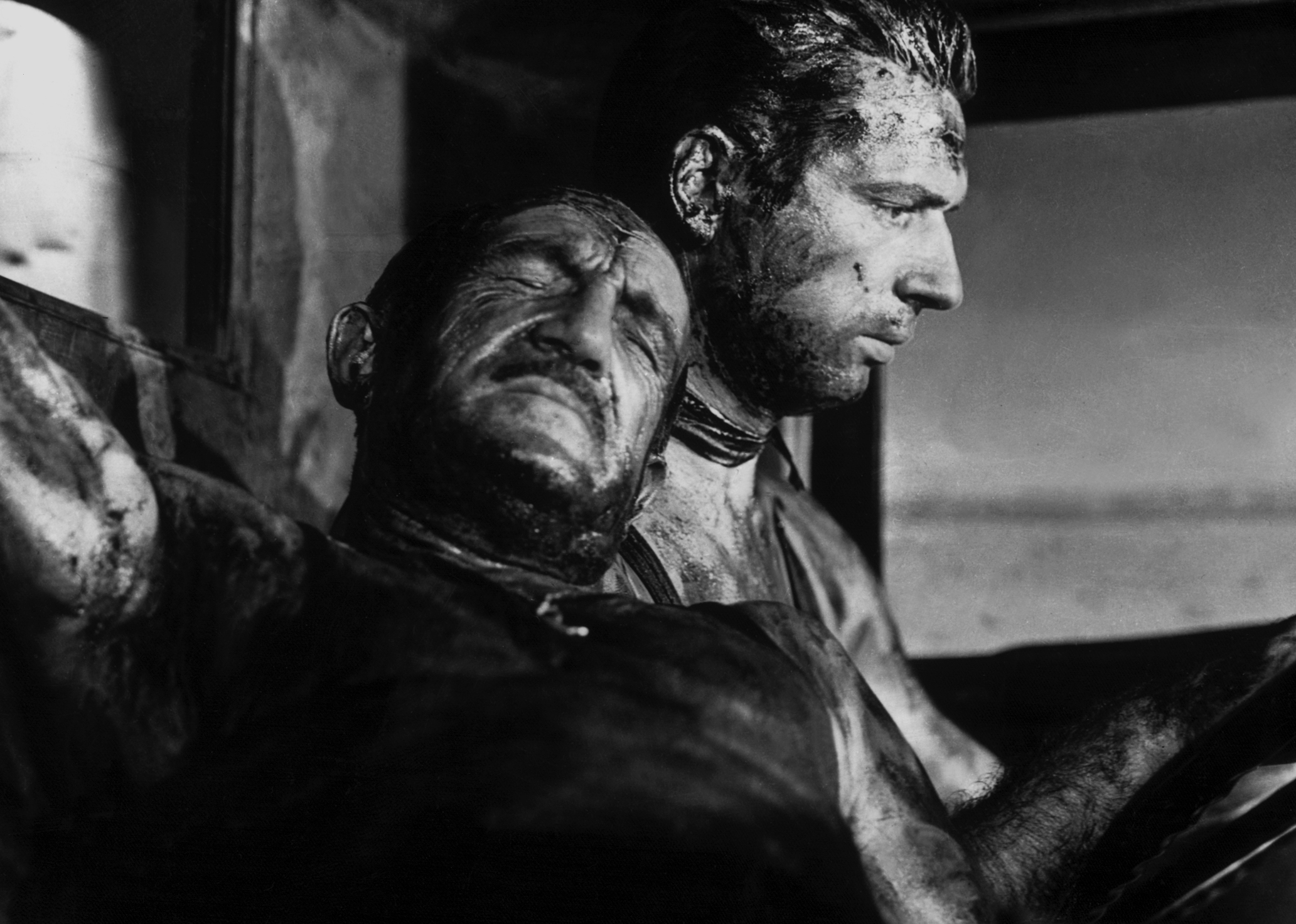
 In a very poor South American village, four men are needed to transport two truckloads of nitroglycerin to the scene of an industrial accident. The men jump at the chance to risk their lives for a small amount of cash because they have nothing else in their pitiful lives. Yves Montand stars in this endlessly tense, harrowing film that won the Golden Bear in Berlin, the BAFTA in England, and the Grand Prize at Cannes. The cast also includes Charles Vanet, Peter van Eyck, Folco Lulli, and Véra Clouzot, the wife of director Henri-Georges Clouzot (Les Diaboliques, Les Espions). Based on the novel by Georges Arnaud, The Wages of Fear was remade as Sorcerer by William Friedkin in 1977, starring Roy Scheider — a good film, but not nearly the cinematic experience the original still is. Clouzot’s back-and-white classic, a masterpiece of suspense that will literally have you on the edge of your seat, ready to explode at any moment, is being shown December 9-22 at Film Forum in a new 35mm that should make it even more terrifying. For more Clouzot, see