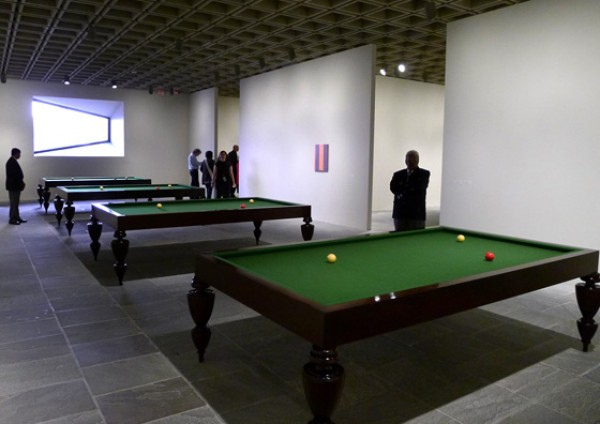
Sherrie Levine, “La Fortune” (After Man Ray: 4), felt and mahogany, 1990 (Whitney Museum of American Art, © 1990 Sherrie Levine)
Whitney Museum of American Art
945 Madison Ave. at 75th St.
Wednesday – Sunday through January 29, $18 (pay-what-you-wish Fridays 6:00 – 9:00)
212-570-3600
www.whitney.org
Walking through Sherrie Levine’s expansive “Mayhem” at the Whitney, one is overcome by a warm feeling of familiarity that is enhanced upon further examination of the unique conceptual world the American artist has created. For more than thirty years, the Pennsylvania-born Levine has been exploring ideas of ownership, gender, class, authenticity, and the creative process itself through painting, sculpture, photography, and installation. By reappropriating, repurposing, and recontextualizing existing imagery, often through dramatic acts of repetition, Levine brings up questions of artistic reproduction, art history, and how time and place influence perception. Taking works by Edgar Degas, Alfred Stieglitz, Piet Mondrian, Walker Evans, Marcel Duchamp, Gustave Courbet, Constantin Brancusi, and many others, Levine breathes new life into them, bringing them into the modern age and offering new ways to see them while wholly making them her own. For “After Walker Evans 1-22,” Levine photographed seminal WPA pictures taken by Evans and arranged them in a grid on the wall. For “Fountain (Madonna),” she cast a bronze urinal, combining Duchamp with Brancusi, and placed it in a vitrine to emphasize its artistic value. For the “Melt Down” series, Levine used a computer program to reproduce works by Mondrian, Monet, and Ernst Ludwig Kirchner, turned each into a monochromatic color field, and then filled canvases with that new color. In “La Fortune (After Man Ray),” she took a billiard table out of Man Ray’s “La Fortune” surrealist painting, creating four life-size replicas and placing them in a room, turning the Whitney into a pool hall. And in “Newborns,” Levine re-created a pair of Brancusi’s “Newborn” sculptures, one in black, one in white, and placed each on a grand piano, based on how she saw a Brancusi sculpture displayed in a photograph of a British collector’s home, bringing the private sphere into the public. “Mayhem” is not arranged as a chronological retrospective; instead, it forms a fascinating journey through the mind of an artist who lays bare the process behind her conceptual work, creating a very different kind of “group show” by a single artist.
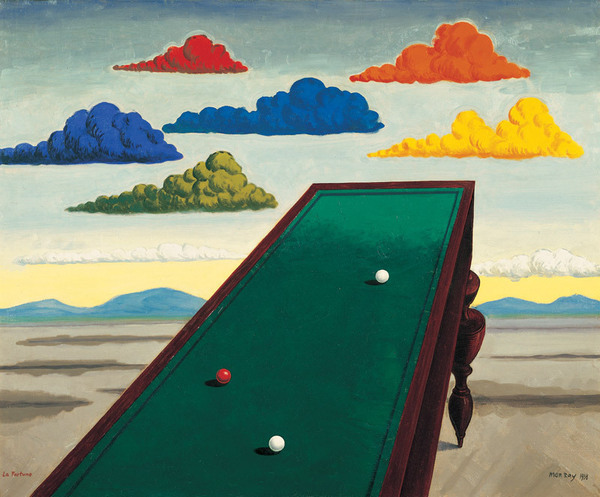
Man Ray, “La Fortune,” oil on canvas, 1938 (© 2009 Man Ray Trust / Artists Rights Society (ARS), NY / ADAGP, Paris)
As a bonus, you can find Man Ray’s original 1938 “La Fortune” painting in the current “Real/Surreal” exhibit (through February 12), the second in the Whitney’s ongoing reexamination of its permanent collection as it prepares for its eventual move downtown. The exhibition also features works by Edward Hopper, Marsden Hartley, George Tooker, George C. Ault, Louis Guglielmi, Rockwell Kent, Charles Sheeler, Yves Tanguy, and others depicting scenes that are not quite as realistic as they might initially appear. Also at the Whitney right now are “Three Landscapes: A Film Installation by Roy Lichtenstein” (through February 12) and “Aleksandr Mir: The Seduction of Galileo Galilei” (February 19), in which the Polish-born Swedish and American artist attempts to reconstruct Galileo’s gravity experiments by building a tower with tires.
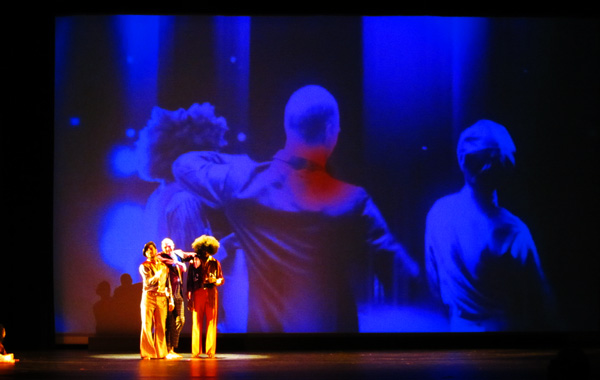


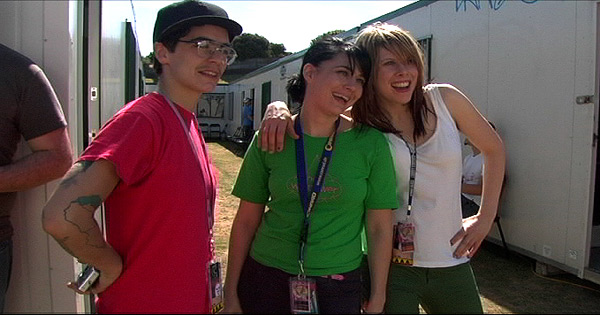
 In 1961, Barry Mann and Gerry Goffin wrote, “I’d like to thank the guy / who wrote the song / that made my baby / fall in love with me.” The title of that be-bop song, “Who Put the Bomp,” inspired one of music’s first fanzines and later the punk record label Bomp! Records. In their 1999 song “Deceptacon,” the riot grrrl group Le Tigre flipped that question around, asking, “Who took the bomp from the bompalompalomp? / Who took the ram from the ramalamadingdong?” In the song they also dare, “Let me hear you depoliticise my rhyme.” Formed in 1998 by former Bikini Kill leader Kathleen Hanna, zine writer Johanna Fateman, and visual artist Sadie Benning, who was replaced in 2000 by DJ and projectionist JD Samson, Le Tigre challenged the male-dominated world of rock and punk, championing individuality and sexual freedom while redefining gender roles. In 2004, Hanna, Fateman, and Samson set out on a world tour in support of their third and final album, This Island, and asked their lighting designer, Carmine Covelli, to capture it all on film. The result is the engaging Who Took the Bomp? Le Tigre on Tour, in which Covelli and director Kerthy Fix go onstage, backstage, and behind the scenes as the influential trio heads across four continents and ten countries, playing exciting live shows, meeting the media, taking pictures with Slipknot, revealing what they pack in their luggage, exercising in the gym, and talking about facial hair. They also discuss more serious issues such as gender identity, lesbianism, and their DIY mentality, which flew in the face of the music industry. The seventy-two-minute film, which features live multimedia performances of such songs as “Hot Topic,” “Keep on Livin’,” “Viz,” and “Deceptacon,” is screening on January 25 at 9:00 at the Nitehawk Cinema in Brooklyn and will be followed by a Q&A with members of the band.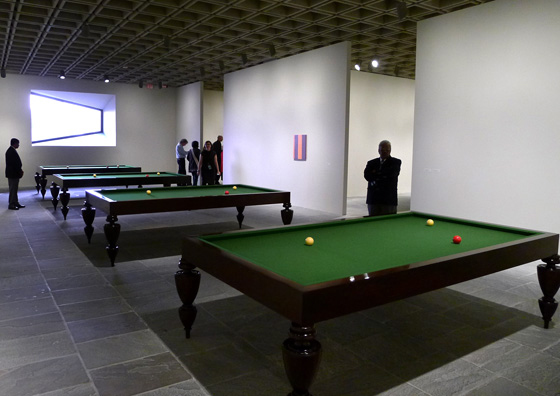

 “Kino-eye has managed to find its way in the struggle with bourgeois cinema,” Russian filmmaker Dziga Vertov wrote in 1925, “and we seriously doubt that the latter (despite its present international dominance) can long withstand our revolutionary onslaught. There is another, greater danger — the distortion of our ideas.” One of the early masters of the new art form, Vertov, along with such contemporaries as Sergei Eisenstein, Lev Kuleshov, and Vsevolod Pudovkin, explored the potential power of the cinema in both fiction and nonfiction storytelling and as a propaganda tool. Vertov, whose most famous film is 1929’s Man with a Movie Camera, a revolutionary work about cinema itself, searched for truth in his films, what he referred to as “kino-pravda,” employing a unique cinema-verité style to capture real life. Not that he also didn’t have a very specific agenda. In the seminal Kino-Eye, what Vertov called a “tapestry of life,” Vertov and one of his brothers, cameraman Mikhail Kaufman, depict Soviet life of the 1920s, exploiting the technology of the medium while following a group of Young Pioneers marching through towns putting up political banners and waving flags. Along the way they stop by a village party filled with drunken revelers, wander through a street market, camp out in the fields, watch a Chinese magician perform, and come upon such health issues as tuberculosis and mental illness. Several scenes are projected in reverse, including the butchering of meat, the baking of bread, and even the sport of diving, as Vertov and Kaufman play with the story while also revealing the methods of production. By focusing on the children, Vertov is forming a blueprint for the future of the nation, just as in the film itself he is laying the groundwork for the future of cinema. Kino-Eye is screening on January 21 at 5:15 as part of Anthology Film Archives’ continuing “Essential Cinema” series, which followed by Vertov’s Forward, Soviet! at 7:00 and A Sixth of the World at 8:45.