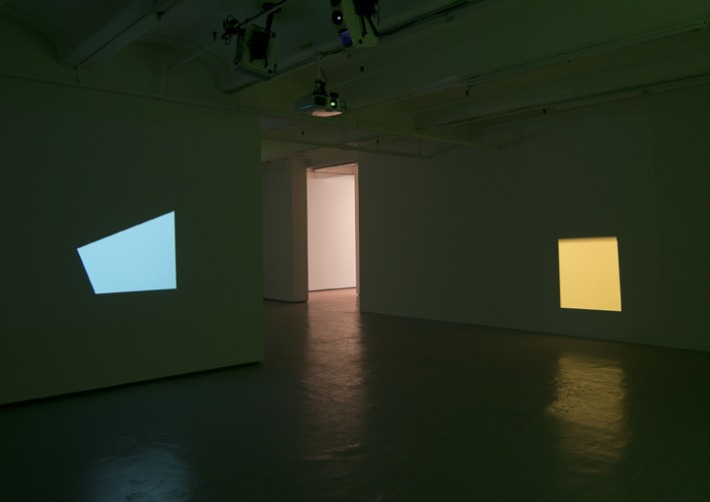
Michael Snow, “The Viewing of Six New Works,” installation view, seven looped video projections, silent, touch design recording technology by Greg Hermanovic, 2012
Jack Shainman Gallery
513 West 20th St. between Tenth & Eleventh Aves.
Tuesday – Saturday through February 11, free, 10:00 am – 6:00 pm
212-645-1701
www.jackshainman.com
Canadian conceptual artist Michael Snow has been creating cutting-edge multimedia works for more than fifty years, including such seminal experimental films as Wavelength and Corpus Collosum and such site-specific projects as “Flightstop” and “The Audience.” In his latest gallery show, the eighty-two-year-old Guggenheim Fellow and chevalier de l’ordre des arts et des lettres explores the creation and perception of visual art itself in the four-part installation “In the Way.” Visitors first encounter “La Ferme,” in which Snow takes 16mm footage of grazing cows, then arranges eleven successive frames horizontally, the way it was actually seen as the film was made, instead of vertically, the way the frames would appear in the developed film itself; the 1998 work announces that you are in for a unique experience that is going to examine ways of seeing while laying bare the process behind it all. In a room off to the left, “In the Way” (2011) features a twenty-three-minute video loop projected onto the floor; you have to stand right on it in order to get the full impact of the panning shots taken from a truck, making you feel like you’re moving over green fields, dirt, asphalt, and rocks, each surface giving you a different visceral experience. Experience is at the heart of “The Viewing of Six New Works” (2012), as Snow projects seven changing geometric shapes, in varying bright colors, onto the walls of a large room, each image shifting based on how the eye reads a rectangular work of art on the wall, following ocular patterns of perception and forcing viewers to see these images in the same way. “When attention is not being paid to it,” Snow explains in the press release, “the object/rectangle is not there.” The fourth piece, 1985’s “Exchange,” involves a holographic set-up in a daring red that falls short of expectations, with little happening as you move around it. Continuing at Jack Shainman in Chelsea through February 11, “In the Way” is another engaging example of how we look at art, from one of the masters of the genre.
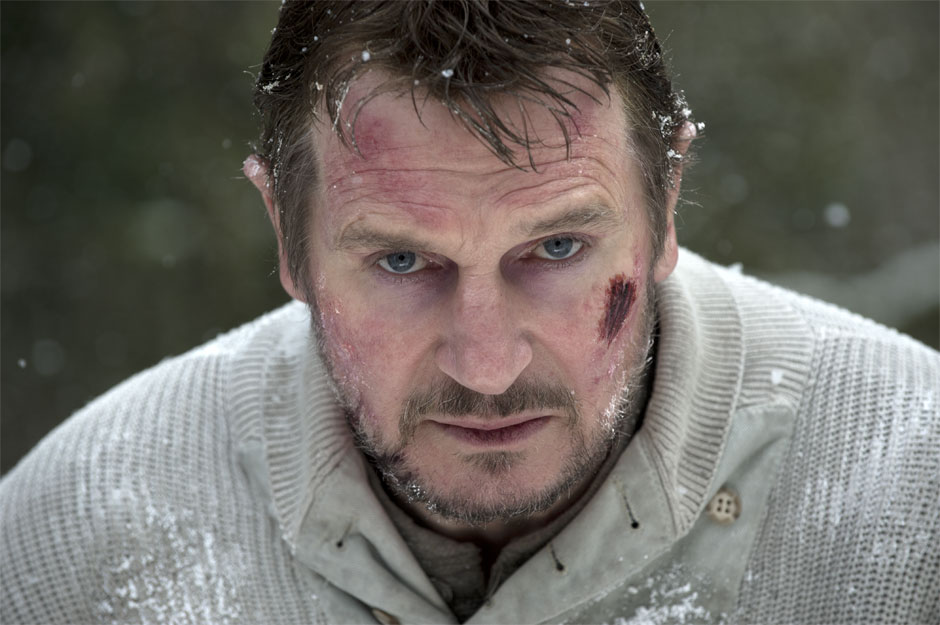
 Shortly after suicidal sharpshooter John Ottway (Liam Neeson) decides to kill a big grey instead of himself, the desperate man is fighting for his life, leading a small group of men who have survived a horrific plane crash only to find themselves right smack in wolf territory — and the wolves are none too happy that their territory has been intruded upon. Based on the short story “Ghost Walker” by Ian Mackenzie Jeffers, who wrote the taut screenplay with director Joe Carnahan (Narc,) The Grey is an intense, gripping thriller set in the vast Alaskan wilderness. In the middle of nowhere, a gang of societal outcasts — Ottway, Diaz (Frank Grillo), Talget (Dermot Mulroney), Henrick (Dallas Roberts), Flannery (Joe Anderson), Burke (Nonso Anozie), Hernandez (Ben Bray), and Lewenden (James Badge Dale), who all work at an oil refinery at the end of the earth, since no one else will have them — must band together if they want to survive, something that is a whole lot easier said than done with this collection of miscreants. As the men battle the increasingly dangerous elements, the wolves hover just on the periphery, seemingly always at the ready to attack, especially at night. Meanwhile, Ottway has tender memories of being in bed with his wife (Anne Openshaw), who has left him, the flashbacks helping him focus on his natural survival instincts. But even the skilled hunter might have finally met his match with these fierce, vengeful wolves. Beautifully photographed by Masanobu Takayanagi, The Grey expertly mixes action-adventure with horror, filled with thrills and chills galore. Evoking Sigourney Weaver in the Alien series, Neeson lends class to the film with his sensitive portrayal of the severely damaged Ottway, a good man who is more than a little down on his luck. Carnahan rarely settles for the lowest common denominator, instead telling the primal story of Ottway’s inner and outer journeys with wit and intelligence — and plenty of scares. The new year is less than a month old, but The Grey is destined to be one of the best films of 2012. (And be sure to stick around for the end of the credits for a brief bonus.)