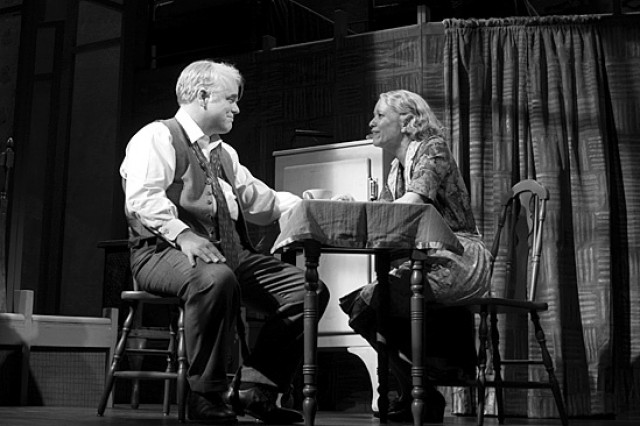
Philip Seymour Hoffman and Linda Emond hope for better days in DEATH OF A SALESMAN (photo by Brigitte Lacombe)
Ethel Barrymore Theatre
243 West 47th St.
February 13 – June 2
deathofasalesmanbroadway.com
Arthur Miller’s Death of a Salesman stakes its claim once again as the Great American Play in Mike Nichols’s poignant new version, running at the Ethel Barrymore Theatre through June 2. Winner of the 1949 Pulitzer Prize, Death of a Salesman is about nothing less than the death of the American dream. Willy Loman (Philip Seymour Hoffman) is a traveling salesman who has just returned to his New York City home after an aborted attempt at a sales trip to New England. A sixty-three-year-old man who has worked for the same company for thirty-six years, Loman has been beaten down, left out of the booming post-WWII economy and lagging behind changing times. He is consoled by his gentle, stalwart wife, Linda (Linda Emond), who reminds him that both of his grown sons are back in their room upstairs, sleeping soundly. The older Biff (Andrew Garfield) has yet to find himself, having recently spent time on a farm in Texas despite grand hopes, while the younger Hap (Finn Wittrock) is a ladies’ man with big dreams of going into business with his brother. Over the course of a single day, the Lomans are forced to face some hard, cold truths about themselves and their uncertain future. Hoffman is magnificent as Loman, his barren eyes haunted by his lack of success, his body hunched over, dragging around a briefcase filled with meaningless items he has been hawking for decades — items that are never specified, because it doesn’t matter; they could be anything. All he wants is to be able to complete the payments on an appliance before it breaks, to have at least one of his sons make something of his life, to own something of value. Willy is overwhelmed by flashbacks and memories that remind him of what could have been, drifting in and out of conversations with his brother Ben (John Glover), an adventurer who struck it rich in Alaska, and with a younger Biff as he prepares for the football game that will likely earn him a college scholarship.
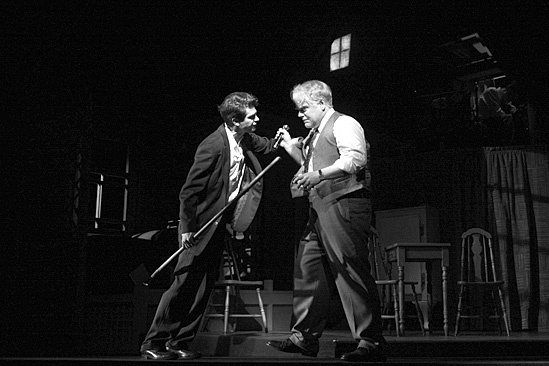
Father and son search for common ground in Miller masterpiece (photo by Brigitte Lacombe)
Hoffman — who played a theater director staging a unique version of Death of a Salesman in Charlie Kaufman’s Synecdoche, New York — is not made up to look much older than he actually is, yet he embodies the wear and tear that has ravaged Loman’s body, mind, and spirit. At forty-four, Hoffman is not the youngest actor to take on the iconic role; Loman originator Lee J. Cobb was a mere thirty-seven, while Dustin Hoffman was forty-six, George C. Scott forty-seven, Brian Dennehy sixty, and Fredric March fifty-three in the 1951 film. But Hoffman plays old marvelously, his Loman an everyman for whom age is not the central problem. Nichols has brought back Death of a Salesman at a critical juncture in American history, when the separation between the haves and the have-nots keeps widening amid mortgage failures and bank bailouts, ripping an ever-widening hole in the fabric of the nation. But Hoffman’s Loman (low man) is no mere victim seeking sympathy; he has been complicit in his family’s downfall, making bad choices that has thwarted them every step of the way. Filled with complexity, depth, and sparkling dialogue, Miller’s masterpiece feels as fresh and relevant as ever.

 In works such as

 No way around it; this is one funny movie. Written and directed by Mel Brooks (who won an Oscar for Best Original Screenplay), The Producers stars Zero Mostel as Max Bialystock, a once great Broadway producer now relegated to wooing old ladies for their checkbooks. Gene Wilder earned an Oscar nomination for Best Supporting Actor as Leo Bloom, a by-the-book accountant who figures out that it could be possible to make more money from a bomb than a hit. And the bomb they turn to is the extraordinary Springtime for Hitler, featuring a great turn by Kenneth Mars as a neo-Nazi. Brooks, Mostel, Wilder, Mars, and the rest of the crazy cast — which also includes Dick Shawn, Lee Meredith, Estelle Winwood, Christopher Hewett, Renee Taylor, Barney Martin, Bill Macy, and William Hickey — don’t just play it for laughs but for giant guffaws and jaw-dropping disbelief in this riotous romp that was turned into a very good but overrated Broadway musical and a terrible film version of the show, both starring Nathan Lane and Matthew Broderick, neither of whom can fill Mostel and Wilder’s shoes. The Producers is screening March 23 as part of the Film Society of Lincoln Center’s “15 for 15: Celebrating Rialto Pictures” series honoring the fifteenth anniversary of the art-house distributor founded by Film Forum programmer extraordinaire Bruce Goldstein; upcoming films include Jules Dassin’s Riffifi, Claude Berri’s The Two of Us, Federico Fellini’s Nights of Cabiria, and Jacques Becker’s Touchez pas au grisbi.


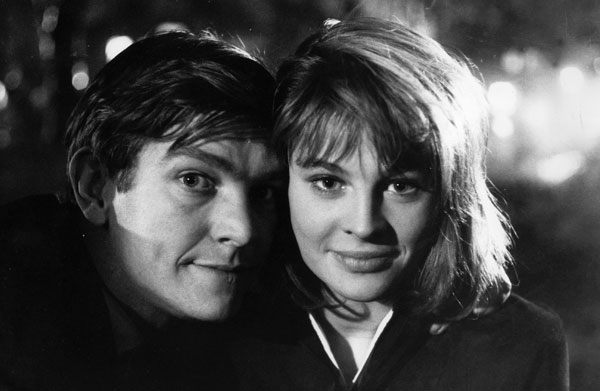
 Based on the novel by Keith Waterhouse (which he also adapted into a play with Willis Hall and which later became a musical), John Schlesinger’s Billy Liar is a prime example of the British New Wave of the 1950s and 1960s, which features work by such directors as Lindsay Anderson, Joseph Losey, Ken Russell, Nicolas Roeg, and Karel Reisz. Tom Courtenay stars as William Fisher, a ne’er-do-well ladies’ man who drudges away in a funeral home and dates (and lies to) multiple women, all the while daydreaming of being the president of the fictional country of Ambrosia. Billy lives in his own fantasy world where he can suddenly fire machine guns at people who bother him and be cheered by adoring crowds as he leads a marching band. Reminiscent of the 1947 American comedy The Secret Life of Walter Mitty, in which Danny Kaye dreams of other lives to lift him out of the doldrums, Billy Liar is also rooted in the reality of post-WWII England, represented by Billy’s father (Wilfred Pickles), who thinks his son is a no-good lazy bum. Shot in black-and-white, the film glows every time Julie Christie appears playing Liz, a modern woman who takes a rather fond liking to Billy. The film made Christie a star; Schlesinger next cast her in Darling, for which she won the Oscar for Best Actress. Billy Liar is screening March 23 as part of the Film Society of Lincoln Center’s “15 for 15: Celebrating Rialto Pictures” series honoring the fifteenth anniversary of the art-house distributor founded by Film Forum programmer extraordinaire Bruce Goldstein. “When I first encountered Billy Liar in the early 1970s, I’d never heard of it,” Goldstein wrote in a 2011 Criterion essay. “I’d somehow acquired a 16mm panned-and-scanned print, and was intrigued by both the title and cast. I certainly knew who Julie Christie was, and I vaguely remembered Tom Courtenay in The Loneliness of the Long Distance Runner, so I ran it. I then ran it a second time. And then again and again, until I fell in love with it.”
