twi-ny recommended events

15 FOR 15 — CELEBRATING RIALTO PICTURES: BREATHLESS (À BOUT DE SOUFFLE)

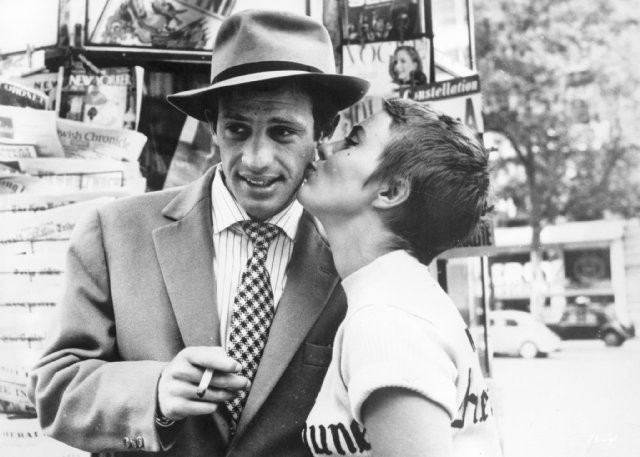
They don’t come much cooler than Jean-Paul Belmondo and Jean Seberg in Jean-Luc Godard’s Nouvelle Vague classic

BREATHLESS (À BOUT DE SOUFFLE) (Jean-Luc Godard, 1960)
Film Society of Lincoln Center
Walter Reade Theater
165 West 65th St. at Amsterdam Ave.
Thursday, March 22, 1:15
Series runs March 19-29
212-875-5601
www.filmlinc.com

The fiftieth-anniversary restoration of Jean-Luc Godard’s Nouvelle Vague classic, Breathless, which came out in 2010, will leave audiences, well, breathless. Godard’s first feature-length film, buoyed by an original treatment by François Truffaut and with Claude Chabrol serving as technical adviser, is as much about the cinema itself as it is about would-be small-time gangster Michel Poiccard (an iconic Jean-Paul Belmondo), an ultra-cool dude wandering from girl to girl in Paris, looking for extra helpings of sex and money and having trouble getting either. Along the way he steals a car and shoots a cop as if shooing away a fly before teaming up with Patricia Franchini (Jean Seberg) and heading out on the run. Godard references William Faulkner and Dashiell Hammett, Humphrey Bogart and Sam Fuller as Michel and Patricia make faces at each other, discuss death, and are chased by the police. Anarchy prevails, both in Belmondo’s character and the film as a whole, which can go off in any direction at any time. Godard himself shows up as the man who identifies Michel, and there are also cameos by New Wave directors Jean-Pierre Melville and Jacques Rivette. The beautiful restoration, supervised by the film’s director of photography, Raoul Coutard, also includes a new translation and subtitles that breathe new life into one of cinema’s greatest treasures. Breathless is screening March 22 at 1:15 as part of the Film Society of Lincoln Center’s “15 for 15: Celebrating Rialto Pictures” series, consisting of fifteen films reissued and restored over the last fifteen years by the art-house distributor founded by Film Forum programmer extraordinaire Bruce Goldstein. The series includes such other seminal works as Melville’s Army of Shadows and Léon Morin, Priest, Robert Hamer’s It Always Rains on Sunday, Federico Fellini’s Nights of Cabiria, Claude Berri’s The Two of Us, and Mel Brooks’s The Producers.

WILL RYMAN: ANYONE AND NO ONE

Will Ryman’s “Everyman” wraps around gallery space and lets visitors walk inside his head (photo by twi-ny/mdr)

Paul Kasmin Gallery
293 Tenth Ave. at 27th St. and 515 West 27th St.
Tuesday – Saturday through March 24, free, 10:00 am – 6:00 pm
212-563-4474
www.paulkasmingallery.com
anyone and no one slideshow

Will Ryman keeps growing as an artist, both literally and figuratively. Since 2003, the former playwright and student of Absurdist philosophy has been creating such fantastical characters and installations as “The Dog Walker,” “The Bed,” and, perhaps most famously, “The Pit,” containing figures made of papier-mâché, PVC tubing, wire mesh, and acrylic paint, amassing a rogues’ gallery of engaging creatures with oddly shaped heads. He’s also constructed giant roses out of fiberglass and stainless steel that first filled the Marlborough Gallery for “A New Beginning” in 2009, then reached new heights for “The Roses” along Park Ave. last year. For his first exhibition at Paul Kasmin, the New York-based Ryman has gone mammoth with “Anyone and No One,” a two-gallery show centered by “Everyman,” a ninety-foot-long sculpture of a man lying on his side, wrapped around three walls of the Tenth Ave. space. His huge papier-mâché white head leads to an upper body of 250 pairs of shoes painted blue and extremities made out of 30,000 silver bottle caps and dressed in enormous denim jeans. A welcoming hand reaches out at the viewer, the fingers raised in a beckoning manner. In “The Pit,” Ryman placed dozens of small characters in a white box that visitors would look down into; here he has one figure — perhaps representing the artist himself — squeezed into the gallery space, the artist as installation encircling his audience. Ryman then invites visitors inside his mind, as the huge head has an opening that allows people to walk into another room — the artist’s brain? — where 200,000 paintbrushes are stacked in rows forming a kind of forest one can wander through. Employing unused paintbrushes for these neural pathways is an interesting choice, given that Ryman’s father, Robert, is one of the leading minimalist artists of his time, most well known for his white-on-white canvases.

Will Ryman’s “Bird” is caged in at Paul Kasmin Gallery (photo by twi-ny/mdr)

While “Everyman” is squeezed into his white box, Ryman’s “Bird” has a bit more room in its cage, Kasmin’s West 27th St. space right around the corner. Loosely inspired by Edgar Allan Poe’s “The Raven,” Ryman constructed the twelve-foot-high, two-ton avian out of 1,500 real and fabricated straight and curved nails, as if the bird is its own cage. As with the paintbrushes, Ryman again uses objects more associated with the making and hanging of art as the very raw materials in his art. From its beak dangles a rose, referencing Ryman’s previous work as well as adding color to the piece. “Bird” eyes the ceiling-length windows from the side of its head, gazing upon a freedom that will never come, the artist trapped in his own cage.

’TIS PITY SHE’S A WHORE

Cheek by Jowl returns to BAM with its first non-Shakespeare Brooklyn production (photo by Manuel Harlan)

Brooklyn Academy of Music
BAM Harvey Theater
651 Fulton St. between Ashland & Rockwell Pl.
March 20-31, $25-$80
718-636-4100
www.bam.org

Founded in 1981 by Declan Donnellan and Nick Ormerod, British theater company Cheek by Jowl specializes in presenting unique takes on the classics, with a primary focus on the actors. The London-based troupe, which has previously been at BAM with As You Like It in 1994, Much Ado About Nothing in 1998,Othello in 2004, Cymbeline in 2007, and Macbeth in 2011, is back at the Harvey with John Ford’s controversial seventeenth-century tragedy, ’Tis Pity She’s a Whore. Directed by Donnellan and designed by Ormerod, the production stars Jack Gordon as Giovanni and Lydia Wilson as Annabella, wealthy siblings who are more than just a little bit too close. Romy Schneider and Alain Delon played the incestuous couple in a 1961 stage version at the Théâtre de Paris directed by Luchino Visconti, while Charlotte Rampling and Oliver Tobias inhabited the roles for Giuseppe Patroni Griffi’s 1971 film, Addio, fratello crudele. The play was even a major inspiration for Peter Greenaway’s 1989 cult classic, The Cook, the Thief, His Wife & Her Lover. So it should be fascinating to see what Cheek by Jowl, which was named after a line in Shakespeare’s A Midsummer Night’s Dream, does in its first non-Bard play in Brooklyn.

Update: As the audience enters the Harvey Theater — which, on the night we went, included namesake and former BAM president Harvey Lichtenstein himself — a young woman in a red hoodie is sitting on a red bed in the middle of the stage, playing with her laptop. On the back wall of her bedroom are movie posters for The Vampire Diaries, A Clockwork Orange, Breakfast at Tiffany’s, and Sweet Bird of Youth, hinting toward such things to come as innocence betrayed, dangerous sex, and a bit of the old ultraviolence, and come they do. The woman on the bed is Annabella (a delightful Lydia Wilson), a cheery sort whose father, Florio (David Collings), is preparing to marry her off to one of a string of well-dressed suitors who parade in front of her, but it turns out that she is most attracted to Giovanni (Jack Gordon), who just happens to be her older brother. After doing the dirty deed — depicted by director Declan Donnellan in a hot and heavy manner — all kinds of nastiness ensues, including scandal, treachery, lies, unwanted pregnancy, deception, more sex, and bloody murder. Cheek by Jowl’s streamlined version of John Ford’s controversial 1633 Jacobean drama is a lively, energetic production thumping with loud dance music and displaying a wry, ribald sense of humor. Although a few couples got up and left following the incest scene, everyone else stayed for the two-hour show — performed without intermission, which makes sense for this fast-paced production — only rising to their feet at the end, expressing their admiration by way of standing ovation.

TWI-NY TALK: DAVID GEDGE OF THE WEDDING PRESENT

David Gedge cuts loose at the Seaport in August 2010 (photo by twi-ny/mdr)

More than a quarter-century ago, the Wedding Present anchored NME’s C86 cassette, which helped introduce the world to such British indie bands as Primal Scream and the Mighty Lemon Drops. The Wedding Present’s lineup has changed often over the years, but there has been one constant throughout: lead vocalist, guitarist, and songwriter David Gedge. In August 2010, the Wedding Present played a blistering free concert at the South Street Seaport, including a full performance of their 1989 record, Bizarro. The foursome is back in New York this week for two shows that will feature their 1991 Steve Albini–produced disc, Seamonsters, as well as tunes from their eighth studio album, the exceptional Valentina (Scopitones, March 20, 2012). The brand-new record consists of exquisite, mature, bittersweet songs of love and heartbreak, of relationships gone seriously wrong. Powered by Pepe le Moko’s loping bass, Charles Layton’s furious drumming, and Gedge and Graeme Ramsay’s guitars, the quartet pounds out the group’s trademark sound of continually changing styles and tempos, moving from punk to pop to lounge to electronic noise, sometimes within the same song.

“So now you want to apologize / Well, that comes as no surprise / ’cause I can read you / and I don’t need you,” Gedge sings with brutal honesty on “You’re Dead,” which opens the new album. “This time you went too far / I know exactly what you are / I understand you / and I can’t stand you / But how come during times like this / I still want your touch and I want your kiss / It’s insane and I can’t explain why / You’re not the one for me although / I just can’t seem to let you go,” he continues. But on the next song, “You Jane,” he spits out, “I hope you find what you’re looking for / Do you even know what that is anymore? / I hope he’s really the one who / will make all your dreams come true / But if by some unexpected chance / this doesn’t turn out to be your fairy-tale romance / Just don’t come crying to me.” We corresponded with Gedge just as the Wedding Present, who come to the Bell House on March 21 and (le) poisson rouge on March 22, was preparing for a series of shows at Austin’s SXSW festival.

twi-ny: In 2010 you played Bizarro in New York City, and now you’ll be tackling Seamonsters. What do you think of this relatively recent trend of playing older, complete albums?

David Gedge: I must admit that I wasn’t particularly fond of the idea when it was first suggested to me, but now I’m a complete convert. I think I felt that, as an artist, I should be looking forward, not back, but it really is such an interesting experience to revisit something you’ve done a while ago. It’s a brilliant opportunity for reevaluation and reinterpretation. So I think I’ve now come to the conclusion that what we’ve done in the past is just as valid as what we’re doing today. Seamonsters, especially, works very well live. It’s such an intense experience.

twi-ny: Do you envision revisiting any other earlier records in the future?

David Gedge: Whether we’ll do more, I don’t know . . . I’m not a big planner. Planning’s for architects, not rock musicians!

twi-ny: How has the Wedding Present managed to be among the only two post-Smiths, C86 bands (besides Primal Scream) that’s still around and successful?

David Gedge: Hopefully it’s because we’re good at what we do! We have attained a certain standard and try not to let people, or ourselves, down; I’m very conscious of not releasing weak material. But also I’ve tried to establish a relationship with our fans. I’m not here just to sell them products. I want people to have a lasting relationship with us . . . and I hope that doesn’t sound like marketing-speak!

twi-ny: You’re currently in the midst of playing a series of shows at SXSW. What is that experience like?
 
David Gedge: We’re not there yet . . . courtesy of United Airlines! Our early-morning flight to Austin is now a late-night flight to San Antonio! We have a pretty hectic schedule ahead of us because a lot of people wanted us to play at their showcases or parties. We are doing so many we had to turn some down. So it’s going to be pretty crazy.

twi-ny: Valentina is a phenomenal-sounding album. With the digital revolution, have you changed your approach to songwriting and recording?

David Gedge: Well, recording’s definitely a bit easier now with portable recording devices in the rehearsal room and sending files from studio to studio and stuff, but most of our music is still recorded on old-fashioned analogue tape, anyway. And it definitely hasn’t changed the songwriting process. That’s still just me with a pen, paper, guitar, and solitude. Oh, and a rhyming dictionary.

CINDY SHERMAN / SANJA IVEKOVIĆ

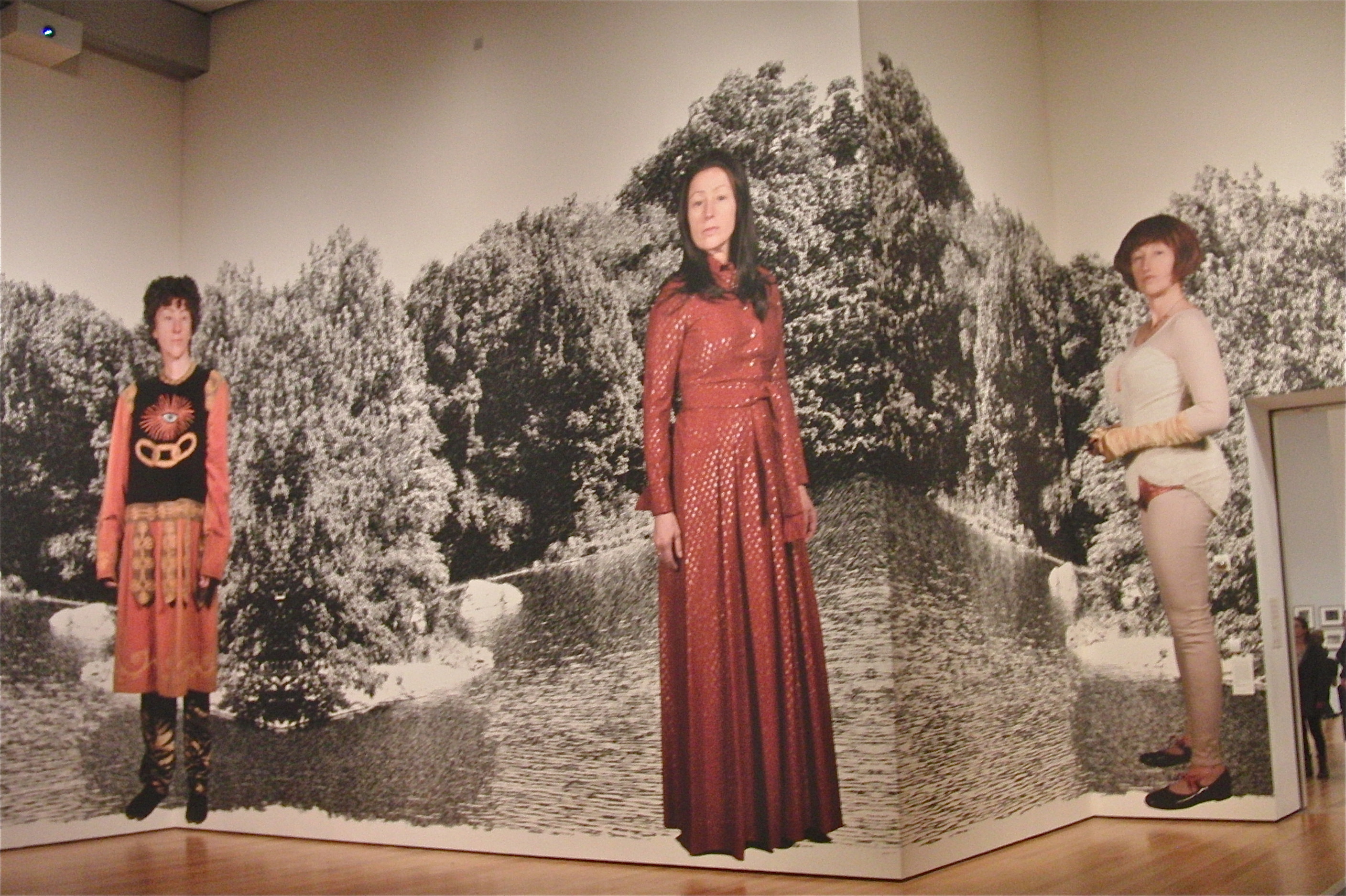
Giant Cindy Shermans watch over entrance to stunning MoMA retrospective (photo by twi-ny/mdr)

Museum of Modern Art
11 West 53rd St. between Fifth & Sixth Aves.
“Cindy Sherman” through June 11, Joan and Preston Robert Tisch Exhibition Gallery, sixth floor
“Sanja Iveković: Sweet Violence” through March 26, Donald B. and Catherine C. Marron Atrium and Special Exhibition Galleries, third floor
Wednesday – Monday, $25 (includes same-day film screenings)
212-708-9400
www.moma.org

MoMA is currently home to two solo shows by women who take very different approaches to explorations of gender, identity, sexual freedom, empowerment, and representation. “Cindy Sherman” is an appropriate title for the revelatory career survey of American artist Cindy Sherman, who has been photographing herself in ever-evolving series for thirty-five years. Sherman’s oeuvre is not a celebration of herself but an examination of how women are depicted and treated in society. Working alone, Sherman, who is most often associated with the Pictures Generation, dresses up in an endless array of costumes and makeup, becoming a sexy chanteuse, an elderly aristocrat, a centerfold model, a fashion icon, a clown, a Renaissance virgin, a tattooed punk rebel, and a murder victim. Each photograph, most of which were taken in her studio, is untitled, allowing viewers to experience it for themselves, bringing their own biases to it without being prodded. Her “Untitled Film Stills” are not based on actual movies, allowing the viewer to create their own story around the carefully choreographed pictures. In such series as “Centerfolds,” “Fashion,” “Fairy Tales and Disasters,” and “History Portraits,” she re-creates herself in ways that make the story about who she portrays, not who she is. “Time and time again, writers have asked, Who is the real Cindy Sherman?” exhibition organizer Eva Respini writes in the show’s catalog. “It is Sherman’s very anonymity that distinguishes her work. Rather than explorations of inner psychology, her pictures are about the projection of personas and stereotypes that are deep­seated in our shared cultural imagination.” In representing the fascinating work of one of contemporary art’s most important figures, “Cindy Sherman” is a spectacular success. (On March 26, such artists as George Condo, Kalup Linzy, Elizabeth Peyton, and Collier Schorr will participate in the panel discussion “Cindy Sherman: Circle of Influence,” moderated by Respini. In addition, Sherman has curated the film series “Carte Blanche,” which runs April 2-10 and includes such films as Barbara Kopple’s Harlan County USA, Tobe Hooper’s The Texas Chain Saw Massacre, Bong Joon-ho’s The Host, David Lynch’s Inland Empire, John Cassavetes’s Shadows, John Waters’s Desperate Living, and Sherman’s own Doll Clothes and Office Killer.)

Sanja Iveković’s “Lady Rosa of Luxembourg” rises high in MoMA’s Marron Atrium (photo by twi-ny/mdr)

As “Cindy Sherman” settles in to MoMA, continuing through June 11, “Sanja Iveković: Sweet Violence” prepares to move out, ending March 26. The first museum retrospective of the Croatian multimedia artist and activist born five years before Sherman, the show consists of photography, sculpture, drawing, video, and collage that tackle such issues as politics, female identity, and gender roles in war-torn East Central Europe. Like Sherman, Iveković, who is part of the Nova Umjetnička Praksa (New Art Practice) generation, often puts herself in her work, but she is much more direct and far less subtle. In “Tragedy of a Venus,” Iveković pairs older, existing pictures of herself with shots of Marilyn Monroe, while in “Double Life” she is seen alongside magazine advertisements for beauty products. In the short video “Personal Cuts,” Iveković films herself using scissors to slice off parts of a dark stocking that covers her face, intercut with historical footage of the post-Tito history of the former Yugoslavia. And in “Practice Makes a Master,” Iveković wears a white sheet over her head as the continually falls to the ground as if having been executed, while Monroe sings a song from Bus Stop. Other series include “Paper Women,” in which Iveković rips, scratches, and tears actual magazine ads with female models; “Sweet Violence,” in which she places bars on a television monitor showing a Zagreb economic propaganda program; and “Women’s House (Sunglasses),” large-scale prints of fashion models on which details of beaten and abused women are superimposed. The show’s centerpiece is “Lady Rosa of Luxembourg,” Iveković’s public art project that involved the re-creation of a war monument in which she made the statue of Nike into a pregnant woman and replaced the names of the fallen soldiers with such words as “Kitsch,” “Madonna,” “Virgin,” “Resistance,” “Justice,” and “Whore.” Seen together, “Cindy Sherman” and “Sanja Iveković: Sweet Violence” offer two very different perspectives on very similar themes, from two women artists from two very different cultures.

15 FOR 15 — CELEBRATING RIALTO PICTURES: THE THIRD MAN

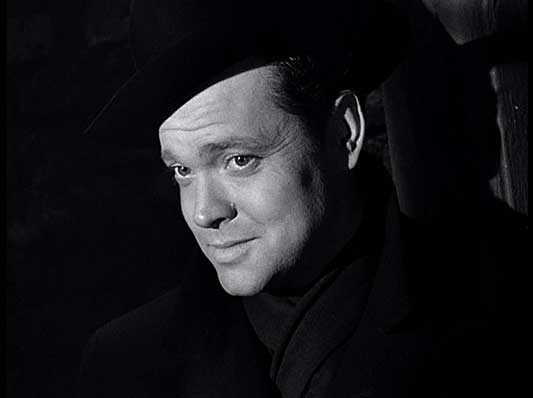
Orson Welles makes one of the greatest entrances in film history in THE THIRD MAN

THE THIRD MAN (Carol Reed, 1949)
Film Society of Lincoln Center
Walter Reade Theater
165 West 65th St. at Amsterdam Ave.
Wednesday, March 21, 1:45
Series runs March 19-29
212-875-5601
www.filmlinc.com

The Film Society of Lincoln Center is celebrating the fifteenth anniversary of Rialto Pictures, the art-house film distributor founded by Film Forum programmer extraordinaire Bruce Goldstein, by screening fifteen works reissued over the last fifteen years, including 1949 Cannes winner The Third Man. Carol Reed’s thriller is quite simply the most entertaining film you’re ever likely to see. Set in a divided post-WWII Vienna amid a thriving black market, The Third Man is heavy in atmosphere, untrustworthy characters, and sly humor, with a marvelous zither score by Anton Karas. Joseph Cotten stars as Holly Martins, an American writer of Western paperbacks who has come to Vienna to see his old friend Harry Lime (Orson Welles), but he seems to have shown up a little late. While trying to find out what happened to Harry, Martins falls for Harry’s lover, Anna (Alida Valli); is told to get out of town by Major Calloway (Trevor Howard) and Sergeant Paine (Bernard “M” Lee); meets a stream of Harry’s more interesting, mysterious friends, including Baron Kurtz (Ernst Deutsch) and Popescu (Siegfried Breuer); and is talked into giving a lecture to a literary club by old Mr. Crabbin (Wilfrid Hyde-White). Every scene is a finely honed work of art, filled with long shadows, echoing footsteps, dripping water, and unforgettable dialogue about cuckoo clocks and other strangeness. SPOILER: The shot in which Lime is first revealed, standing in a doorway, a cat brushing by his feet, his tongue firmly in cheek as he lets go a miraculous, knowing smile, is one of the greatest single moments in the history of cinema. The Third Man is screening March 20 at 1:45; the Rialto series kicks off March 19 with Alberto Lattuada’s Mafioso and includes such other seminal works as Jules Dassin’s Riffifi, Jean-Luc Godard’s Breathless, John Schlesinger’s Billy Liar, Luis Buñuel’s Diary of a Chambermaid, and Jean-Jacques Beineix’s Diva, forming a kind of Film Forum’s Greatest Hits taking place on the Upper West Side.

FILM COMMENT SELECTS: KEYHOLE

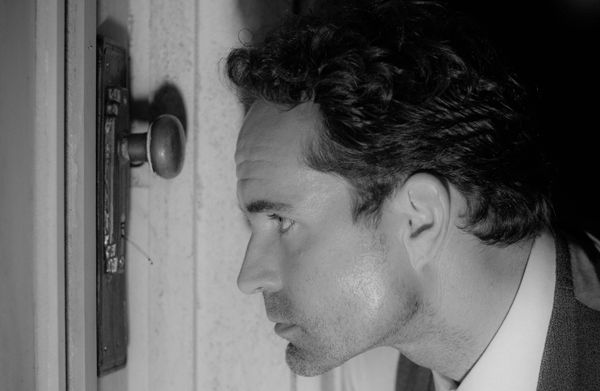
Ulysses Pick (Jason Patric) searches for his wife in Guy Maddin’s haunting noir, KEYHOLE (photo © 2011 Cinema Atelier Tovar Ltd.)

KEYHOLE (Guy Maddin, 2011)
Film Society of Lincoln Center
Walter Reade Theater
165 West 65th St. at Amsterdam Ave.
Tuesday, March 20, $20, 8:30
212-875-5601
www.filmlinc.com
keyhole-movie.tumblr.com

Inspired by Homer’s Odyssey, Gaston Bachelard’s The Poetics of Space, and the Bowery Boys’ Spooks Run Wild, Canadian experimental filmmaker Guy Maddin has made Keyhole, a 1930s-style psychological gangster/ghost story set in a haunted house in which each room offers different thrills and chills and it’s nearly impossible to tell who is alive and who is dead. Shot in his trademark black-and-white (except for one quick image in color) but digitally for the first time, Maddin relates the barely decipherable tale of Ulysses Pick (Jason Patric), who has returned home after being away for many years. As he makes his odyssey through the house on a mission to find his ill wife, Hyacinth (Isabella Rossellini), who has shackled her naked father, Calypso (Louis Negin), to her bed, Ulysses carries a drowned girl, Denny (Brooke Palsson), and drags a bound-and-gagged teenager, Manners (David Wontner), the son he does not recognize. A confident, determined man, Ulysses battles Big Ed (Daniel Enright) over control of the gang, including a tense scene with an electric chair at the center. Going door-to-door, Ulysses peers through keyholes as screams pierce through the night and clocks endlessly tick and tick and tick. “The happiness the house has known is free to vanish the moment its inhabitants leave,” Calypso intones in a voice-over, “but sorrow, sorrow must linger.” Maddin, who has previously made such gems as Tales from the Gimli Hospital, Careful, and My Winnipeg, has a unique cinematic style that veers away from linear, dialogue-laden narrative and instead concentrates on mood, offbeat characters, mysterious music, and captivating visuals that harken back to the silent-film era. In Keyhole, he has created an old-fashioned yet modern noir that, despite a meandering plot, is a captivating look at life, death, family, memory, and the human psyche. Keyhole is having a special screening March 20 at 8:30 as part of the Film Society of Lincoln Center’s “Film Comment Selects” series, with the engaging, self-deprecating Maddin in attendance to discuss the work, before opening theatrically April 6 at the IFC Center.