DECASIA (Bill Morrison, 2002)
Maysles Institute
343 Malcolm X Blvd. between 127th & 128th Sts.
Tuesday, April 10, $10, 7:30
212-582-6050
www.mayslesinstitute.org
www.billmorrisonfilm.com
 Experimental filmmaker Bill Morrison’s production company is called Hypnotic Pictures, and for good reason; the Chicago-born, New York-based auteur makes mesmerizing, visually arresting works using archival found footage and eclectic soundtracks that are a treat for the eyes and ears. Several of his films were recently shown at a retrospective at the World Financial Center (including The Miners’ Hymns, Spark of Being, The Great Flood, and his masterpiece, Decasia), but if you missed that last one, you now have another chance to catch it at the Maysles Institute on April 10, where it is screening as part of the “Street Views” series curated by Paul Dallas and Anthony Titus. Made in 2002, Decasia is about nothing less than the beginning and end of cinema. The sixty-seven-minute work features clips from early silent movies that are often barely visible in the background as the film nitrate disintegrates in the foreground, black-and-white psychedelic blips, blotches, and burns dominating the screen. The eyes at first do a dance between the two distinct parts, trying to follow the action of the original works as well as the abstract shapes caused by the filmstrip’s impending death, but eventually the two meld into a single unique narrative, enhanced by a haunting, compelling score by Bang on a Can’s Michael Gordon, which begins as a minimalist soundtrack and builds slowly until it reaches a frantic conclusion. The on-screen destruction might seem random, but it is actually carefully choreographed by Morrison, who wrote, directed, produced, and edited the film. Following the screening, Morrison will participate in a Q&A with architect David Gersten of the Cooper Union, moderated by Titus. “Street Views,” which “explores our connection to the built environment through documentaries, narratives, and experimental works,” continues April 24 with Peter Bo Rappmund’s Psychohydragraphy and concludes April 25 with Nikolaus Geyrhalter’s Abendland.
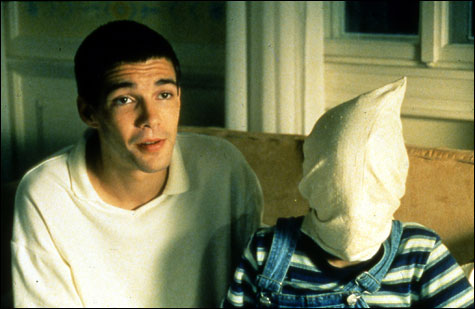
 Michael Haneke’s Funny Games is a harrowing home invasion movie that is as brutal as it is ultimately frustrating. Haneke (The Piano Teacher, Cache) manipulates the audience nearly as much as he does the characters on-screen, even breaking the fourth wall by having one of the villains address the viewer several times. When Anna (Susanne Lothar), Georg (Ulrich Mühe from The Lives of Others), and their son, Schorschi (Stefan Clapczynski), head to their summer vacation home on a lake, they have no idea what lies in store for them. A man (Arno Frisch) claiming to be a friend of their neighbors’ shows up asking for some eggs, but there is a subtle malevolence behind his odd demeanor. He is soon joined by a companion (Frank Giering) who insists on trying out one of Georg’s golf clubs. It’s not long before the two men, who alternately call each other Peter and Paul, Tom and Jerry, and Beavis and Butt-Head, have severely broken Georg’s leg, sexually harass Anna, and put a bag over Schorschi’s head, all for no apparent reason except that they are bored and want to play some games, the more dangerous the better. It’s a tense, frightening film that never lets up, even when it appears to be over. The soundtrack juices up the horror, with classical music by Mozart and Handel offset by screeching punk by John Zorn and Naked City. Mühe and Lothar later reunited for Nicole Mosleh’s Nemesis, which was completed shortly before Mühe’s sudden death from stomach cancer in 2007. Haneke made an American remake of Funny Games in 2008, with Tim Roth as George, Naomi Watts as Anna, Brady Corbet as Peter, and Michael Pitt as Paul, with an appearance by Frisch as well. The original Funny Games is screening April 7 as part of MoMA’s “Carte Blanche: Cindy Sherman” series, a collection of films curated by photographer Cindy Sherman in conjunction with her glorious
 Inspired by Homer’s Odyssey, Gaston Bachelard’s The Poetics of Space, and the Bowery Boys’ Spooks Run Wild, Canadian experimental filmmaker