On its new album, True (Slumberland, May 15, 2012), Brooklyn-based trio Violens takes a major leap forward from its 2010 full-length debut, Amoral. Featuring multi-instrumentalist Jorge Elbrecht, Iddo Arad on synths and guitar, and Myles Matheny on bass, with Will Berman adding drums, Violens creates soaring, harmonic ’80s-style pop that recalls Depeche Mode, Spandau Ballet, and New Order on such songs as “Totally True,” “Der Microarc,” and “Melting,” then turning more aggressive on the propulsive “Lavender” and “All Night Low.” Violens will be holding an album release party on May 16 at (le) poisson rouge with Kuroma and the New Lines.
twi-ny recommended events
KOREAN MOVIE NIGHT: KING AND THE CLOWN
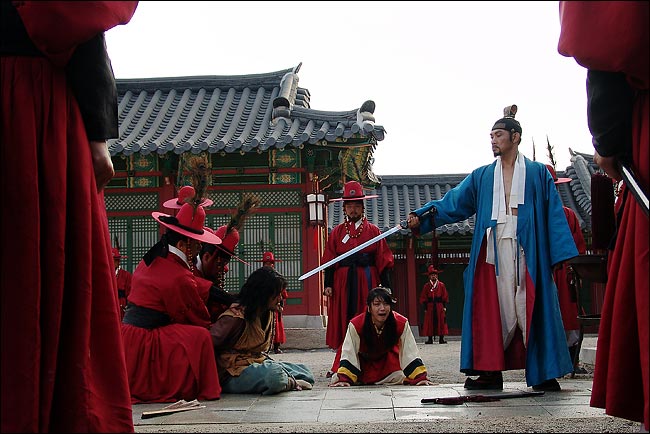
Korean smash KING AND THE CLOWN is based on the Royal Records of the Chosun Dynasty
EPIC ROMANCE: KING AND THE CLOWN (WANG-UI NAMJA) (Lee Jun-ik, 2009)
Tribeca Cinemas
54 Varick St. at Laight St.
Tuesday, May 15, free, 7:00
Series runs every other Tuesday through June 19
212-759-9550
www.koreanculture.org
www.tribecacinemas.com
 Adapted from Kim Tae-woong’s award-winning play Yi (You) and inspired by the Royal Records of the Chosun Dynasty, Lee Jun-ik’s historical epic, King and the Clown, was a critical and popular smash in Korea despite its homosexual subtext. In the early sixteenth century, a troupe of traveling minstrels is making its way across the country when Jang-saeng (Kam Wu-seong) decides that he no longer wants Gong-gil (Lee Jun-ki), an androgynous member of the group who plays all the sexy female characters, to be pimped out to towns’ local leaders. After a deadly fight, the two clowns are on the run, soon taking up with another small troupe and getting arrested for mocking King Yeonsan (Jeong Jin-yeong) and his mistress, Jang Noksu (Kang Seong-yeon). Facing execution, they are saved when the king takes a liking to them, and especially to Gong-gil. But as they continue to stage routines criticizing important ministers and other VIPs, they make high-ranking enemies and once again find their lives in danger. While the first half of King and the Clown tends to be a bit goofy, it sets up the masterfully told second half, an intense, compelling combination of love, fear, politics, and power. Jeong is excellent as Yeonsan, capturing the yin-yang of a leader trying to break free of his late father’s far-reaching grasp, laughing at the clowns one moment, brutally killing someone the next. Lee is alluring as Gong-gil, a beautiful boy uncomfortable with his role but willing to do whatever is asked of him. But the film’s centerpiece is Kam as Jang-saeng, a confident, forward-thinking, risk-taking performer who believes in justice, honor, and creative and personal freedom. King and the Clown is screening for free May 15 at Tribeca Cinemas as part of the Korean Cultural Service film series “Epic Romance,” which continues June 5 with Kim Dae-woo’s Forbidden Quest and June 19 with Kim Yong-gyun’s The Sword with No Name.
BELLA GAIA
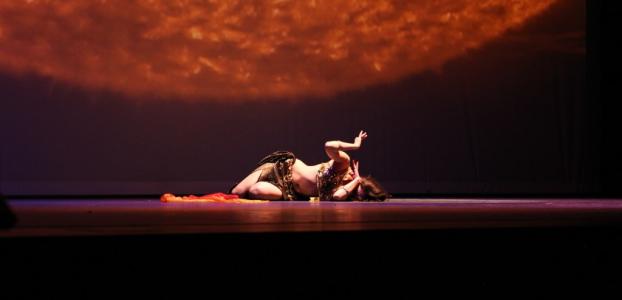
Art and science converge in multimedia BELLA GAIA
BEAUTIFUL EARTH: A POETIC VISION OF EARTH FROM SPACE
Eyebeam Art & Technology Center
540 West 21st St. between 10th & 11th Aves.
May 15-16, $25-$30, 8:00
www.bellagaia.com
eyebeam.org
Composer, director, and violinist Kenji Williams has been touring the world with Bella Gaia: A Poetic Vision of Earth from Space an immersive multimedia exploration of the planet as seen by astronauts. Produced in association with NASA, Bella Gaia, which translates as “Beautiful Earth,” features an eight-piece ensemble performing live in front of a large-screen backdrop showing views of Earth, with Deep Singh on tabla, vocals, and percussion, Yumi Kurosawa on koto, Lety Ellaggar on nay and sax, Kristin Hoffmann on vocals and keyboards, and Williams on violin and laptop, with dance by Irina Akulenko, Lale Sayoko, and Kaeshi Chai. Bella Gaia comes to Eyebeam Art & Technology Center for two shows on May 15 and 16 at 8:00, taking viewers on a fantastical and environmental journey across land, sea, and sky, a “living atlas” that travels from the Amazon to the Arctic, revealing natural beauty and man-made wonders as the Anthropocene continues. “Bella Gaia shows you how humans and nature are connected, and how art and science are connected,” Williams explains. “Itʼs an exploration of the relationship between human civilization and our ecosystem.”
VIDEO OF THE DAY ― MAN FOREVER: “SURFACE PATTERNS”
Brooklyn-based experimental drummer and composer John Colpitts, also known as Kid Millions, has played percussion with such groups as Oneida and the Boredoms. Next week he is set to release his second album as Man Forever, Pansophical Cataract (Thrill Jockey, May 15, 2012). Inspired by Lou Reed’s Metal Machine Music, the album consists of two long tracks built around propulsive drum rolls that sound as if they are about to introduce something that never quite arrives. But both the thirty-minute “Surface Patterns” and the forty-minute “UR Eternity” are filled with little surprises as they unfold, electric instruments or bass adding bits of drone, mystery, and nuance here and there. It’s like an audio version of Michael Snow’s avant-garde classic Wavelength, in which a camera makes its way slowly across an apartment, oblivious to anything that happens in the room as it approaches the wall ― and then beyond. For the “Surface Patterns” video, Colpitts recruited a group of musicians who have played with Man Forever, including Sarah Richardson, Richard Hoffman, Brad Truax, Shahin Motia, Leah McManigle, and Brian Chase; on May 15, Richardson, Hoffman, Motia, and Chase, along with James McNew, Bryan Devendorf, Ryan Sawyer, Greg Fox, and Oran Canfield, will join Kid Millions for an album release party at (le) poisson rouge, with the Colin Langenus Orchestra and Nymph opening the show. Man Forever then heads out across the country before returning for performances June 29 at Issue Project Room and July 11 at the Stone.
SUNDAY SESSIONS: TARYN SIMON
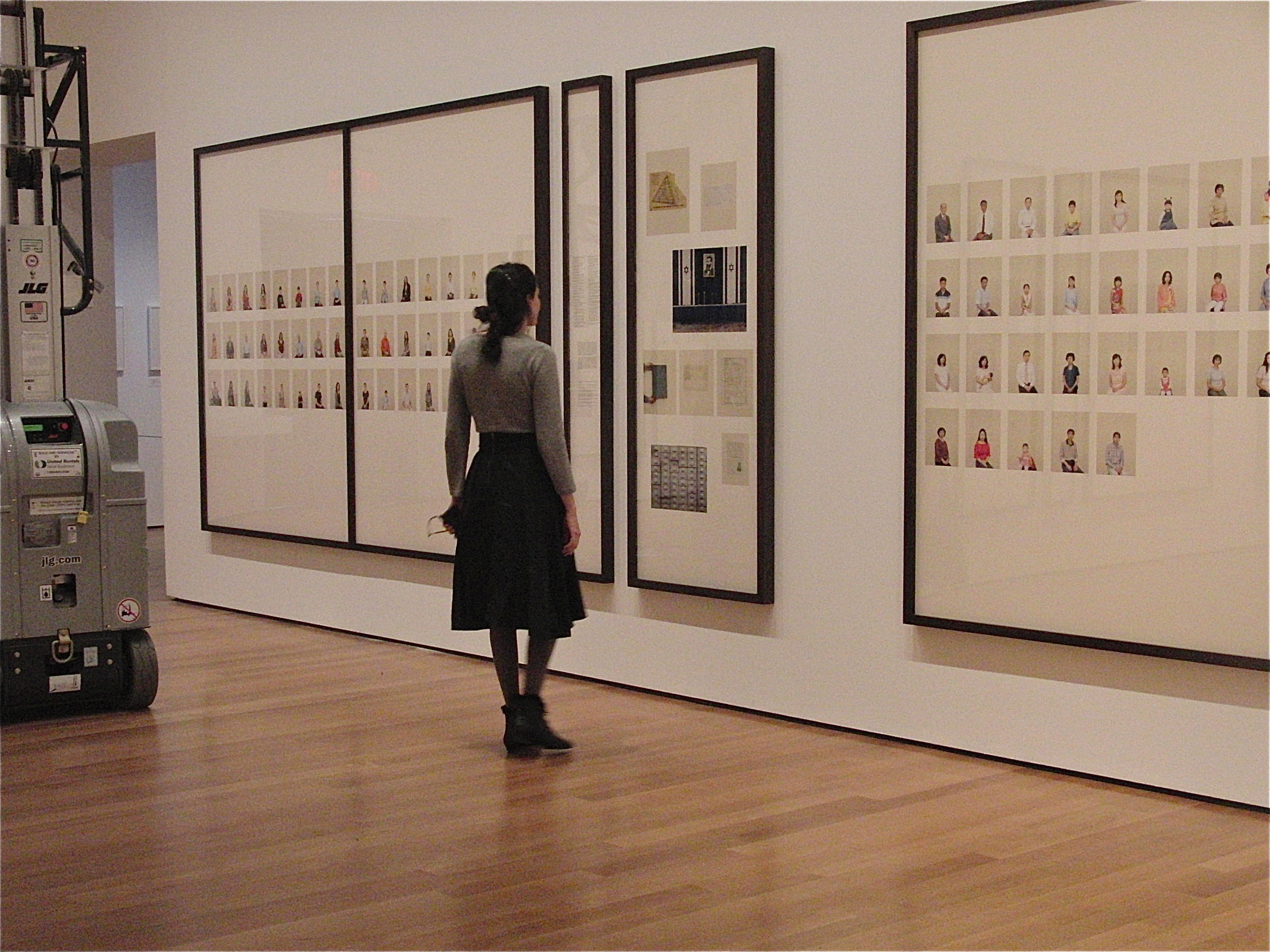
Taryn Simon examines her new photography installation at MoMA and will discuss it on May 13 at MoMA PS1 (photo by twi-ny/mdr)
A LIVING MAN DEAD AND OTHER CHAPTERS I-XVIII
MoMA PS1
22-25 Jackson Ave. at 46th Ave.
Sunday, May 14, $10, 12 noon – 6:00
718-784-2084
www.ps1.org
As it prepares for its summer Warm Up series, MoMA PS1’s final Sunday Sessions program will be held on May 13. In addition to your last chance to see the exhibitions “Darren Bader: Images” and “Kraftwerk ― Retrospective 1 2 3 4 5 6 7 8,” both of which close on Monday, legendary DJ Afrika Bambaataa will pay tribute to the German electronic music pioneers from 3:00 to 6:00 in the Performance Dome. Also at 3:00, artbook @ moma ps1 will host the book discussion group “A Short Course on Resistance.” Food will be available from Long Island City favorites M. Wells, and the exhibitions “Lara Favaretto: Just Knocked Out,” “Max Brand: no solid footing ― (trained) duck fighting a crow,” “Rania Stephan,” and “Frances Stark: My Best Thing” will also be open. We’re most looking forward to the 2:00 conversation between native New York artist Taryn Simon and MoMA PS1 associate curator Jenny Schlenzka on the occasion of the publication of Simon’s A Living Man Declared Dead and Other Chapters, I-XVIII, the catalog to the exhibition currently on view in MoMA’s photography wing. Native New Yorker Simon, whose “Contraband” filled the Lever House lobby in late 2010 with thousands of photos of items that were confiscated at JFK International Airport, has now turned her attention on bloodlines, cataloging families from around the world, organizing them in very specific order, accompanied by photos of documents and other paraphernalia relating to their story. Nine of the chapters can be seen at MoMA, including the Indian Yadav clan, which is fighting to regain land they lost when Shivdutt Yadav was wrongly listed as being deceased; the Ondijos of Kenya, where HIV/AIDS doctor Joseph Nyamwanda Jura Ondijo has nine wives, thirty-two children, and sixty-three grandchildren; the sadly small Mehićs and Nukićs of Bosnia and Herzegovina, victims of genocide; the Chinese family of Su Qijian, declared by China’s State Council Information Office as the best representative of multigenerational Chinese bloodlines; and a large group of children living in a Ukrainian orphanage. Simon also spends one chapter depicting dozens of Australian rabbits used for experimentation that ultimately died during the tests or were later euthanized. A Living Man Declared Dead and Other Chapters, which continues at MoMA through September 3, is a fascinating, involving collection of photographs of life and death, of science and politics, of the known and the unknown, intricately organized and arranged to create a complex, compelling visual narrative.
FORT BLOSSOM REVISITED (2000/2012)
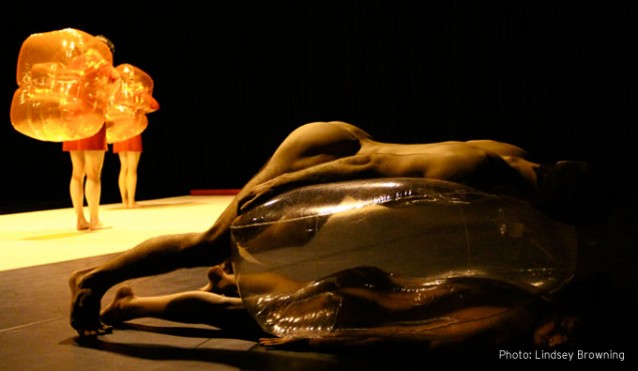
John Jasperse revisits FORT BLOSSOM at New York Live Arts this week
FORT BLOSSOM REVISITED (2000/2012)
New York Live Arts
219 West 19th St. between Seventh & Eighth Aves.
May 9-12, $15-$30, 7:30
May 11, 10:00 pm show added by popular demand
212-691-6500
www.newyorklivearts.org
www.johnjasperse.org
John Jasperse once again turns expectations inside out and upside down with Fort Blossom revisited. An updated, expanded version of a 2000 work he appeared in, the piece features two clothed women, Lindsay Clark and Erika Hand, and two nude men, Ben Asriel and Burr Johnson. (The 2000 piece was performed by Jasperse, Miguel Gutierrez, Parker Lutz, and Juliette Mapp.) The quartet interacts with one another and a group of plastic inflatables, using them as furniture, toys, costumes, and sexual barriers. Moving on and off a rolled vertical canvas while experimental noise by Ryoji Ikeda rumbles in the background or goes silent for extended moments, the dancers, paired off by gender for most of the show, bring their bodies together in mesmerizing, breathtaking, awe-inspiring, and taboo-busting ways, particularly Asriel and Johnson, who examine every nook and cranny of their bodies, every crevice, rubbing, pumping, and melding into architectural and sculptural forms rarely seen onstage in such bare glory. Fort Blossom revisited is a spectacular achievement, a brutally honest and challenging work from one of the dance world’s most innovative choreographers. (For more on Jasperse and Fort Blossom revisited, read our twi-ny talk with him here.)
I WISH (KISEKI)

Real-life brothers Ohshirô Maeda and Koki Maeda star as close siblings in Hirokazu Kore-eda’s masterful I WISH
I WISH (KISEKI) (Hirokazu Kore-eda, 2011)
Lincoln Plaza Cinema, 1886 Broadway at 63rd St., 212-757-2280
Angelika Film Center, 18 West Houston St. at Mercer St., 212-995-2570
Opens Friday, May 11
www.magpictures.com/iwish
Japanese auteur Hirokazu Kore-eda’s I Wish is an utterly delightful, absolutely charming tale of family and all of the hopes and dreams associated with it. Real-life brothers Koki Maeda and Ohshirô Maeda of the popular MaedaMaeda comedy duo star as siblings Koichi and Ryu, who have been separated as a result of their parents’ divorce. Twelve-year-old Koichi (Koki) lives with his mother (Nene Ohtsuka) and maternal grandparents (Kirin Kiki and Isao Hashizume) in Kagoshima in the shadow of an active volcano that continues to spit ash out all over the town, while the younger Ryu lives with his father (Joe Odagiri), a wannabe rock star, in Fukuoka. When Koichi hears that if a person makes a wish just as the two new high-speed bullet trains pass by each other for the first time the wish will come true, he decides he must do everything in his power to be there, along with Ryu, so they can wish for their family to get back together. Kore-eda, who has previously explored the nature of family in such powerful films as Maborosi, Nobody Knows, and Still Walking, once again displays his deft touch at handling complex relationships in I Wish, the Japanese title of which is Kiseki, or Miracle. Originally intended to be a film about the new Kyushu Shinkansen bullet train, the narrative shifted once Kore-eda auditioned the Maeda brothers, deciding to make them the center of the story, and they shine as two very different siblings, one young and impulsive, the other older and far more serious. Everyone in the film, child and adult, wishes for something more out of life, whether realistic or not. Ryu’s friend Megumi (Kyara Uchida) wants to be an actress; Koichi’s friend Makoto (Seinosuke Nagayoshi) wants to be just like his hero, baseball star Ichiro Suzuki; and the brothers’ grandfather wants to make a subtly sweet, old-fashioned karukan cake that people will appreciate. Much of the dialogue is improvised, including by the children, lending a more realistic feel to the film, although it does get a bit too goofy in some of its later scenes. Written, directed, and edited by Kore-eda, I Wish is a loving, bittersweet celebration of the child in us all.