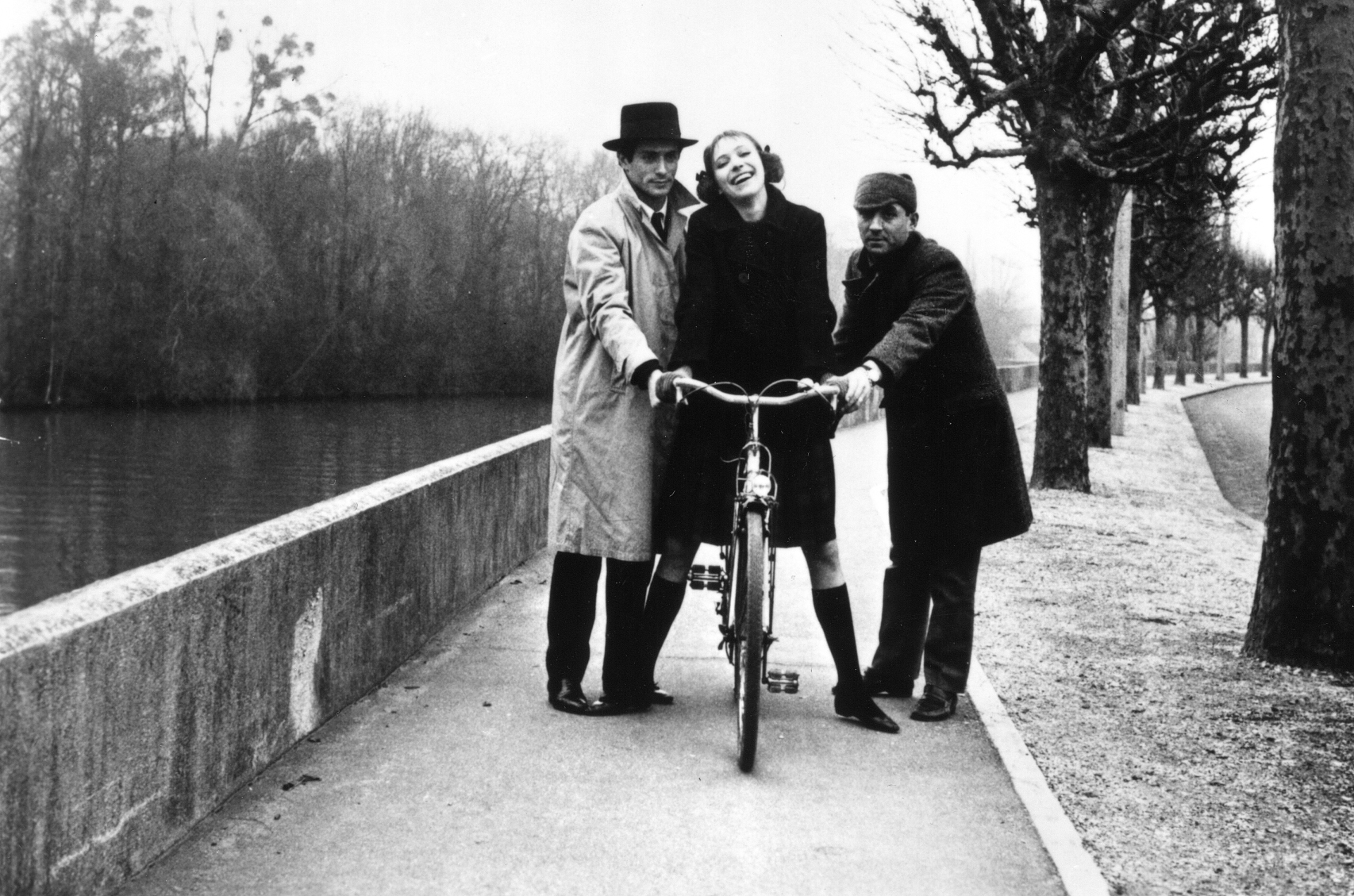
Jean-Luc Godard’s BAND OF OUTSIDERS is a different kind of heist movie
FROM FANTÔMAS TO A GANG STORY: BANDE À PART (BAND OF OUTSIDERS) (Jean-Luc Godard, 1964)
MoMA Film, Museum of Modern Art
11 West 53rd St. between Fifth & Sixth Aves.
Saturday, August 18, 7:00, and Wednesday, August 22, 4:30
Series runs through September 4
Tickets: $12, in person only, may be applied to museum admission within thirty days, same-day screenings free with museum admission, available at Film and Media Desk
212-708-9400
www.moma.org
 When a pair of disaffected Parisians, Arthur (Claude Brasseur) and Franz (Sami Frey), meet an adorable young woman, Odile (Anna Karina), in English class, they decide to team up and steal a ton of money from a man living in Odile’s aunt’s house. As they meander through the streets of cinematographer Raoul Coutard’s black-and-white Paris, they talk about English and wealth, dance in a cafe while director Jean-Luc Godard breaks in with voice-over narration about their character, run through the Louvre in record time, and pause for a near-moment of pure silence. Godard throws in plenty of commentary on politics, the cinema, and the bourgeoisie in the midst of some genuinely funny scenes. Band of Outsiders is no ordinary heist movie; based on Dolores Hitchens’s novel Fool’s Gold, it is the story of three offbeat individuals who just happen to decide to attempt a robbery while living their strange existence, as if they were outside from the rest of the world. The trio of ne’er-do-wells might remind Jim Jarmusch fans of the main threesome from Stranger Than Paradise (1984), except Godard’s characters are more aggressively persistent. One of Godard’s most accessible films, Band of Outsiders is screening August 18 and 22 as part of the MoMA series “Gaumont Thrillers: From Fantômas to A Gang Story,” which continues with such Gaumont-produced films as Henri-Georges Clouzot’s The Murderer Lives at 21, Jules Dassin’s Riffifi, and Luc Besson’s La Femme Nikita and The Professional.

 All work and no play makes Jack a not-so-quite dull boy in Stanley Kubrick’s classic horror story, based on the Stephen King novel. One of the all-time-great frightfests, The Shining is a truly scary movie about a writer named Jack Torrance (Jack Nicholson at his overacting best) who has agreed to become the caretaker of the old Overlook Hotel in Colorado during the snowy winter when the enormous mountain resort closes down for the season. He is joined by his perpetually nervous wife, Wendy (Shelley Duvall), and their young son, Danny (Danny Lloyd), who seems to have brought along his invisible friend, Tony, who speaks through Danny’s finger. Between taking care of the Overlook and working on his novel, Jack finds a whole bunch of other folks to hang out with, people who have populated the place during the ritzy establishment’s golden age, including a strange woman in room 237. Kubrick plays with horror conventions as he seeks to scare the crap out of the audience, something he accomplishes time and time again as Jack grows more disturbed, Wendy’s shrieks become more and more ear piercing and annoying, and Danny’s visions get more and more bloody. No matter how many times you’ve seen it, it still gets you, even when you know exactly what’s lurking around that corner. Only those who went to the film during its opening weekend, as we did, got to see the two-minute finale that Kubrick cut out immediately thereafter, which involved the iconoclastic director riding his bicycle to various theaters, armed with a pair of scissors. The Shining is screening in digital high-definition on Friday and Saturday at midnight as part of the IFC Center’s Waverly Midnights: Late-Night Favorites series, which continues next with such other greats as Alejandro Jodorowsky’s El Topo and The Holy Mountain, the Coen brothers’ Fargo, and John Carpenter’s remake of The Thing.
 In 1991, Bruce Weide and Pat Tucker were asked to help raise a gray wolf named Koani for a documentary about what they consider to be a largely misunderstood species. Weide and Tucker, who had started the organization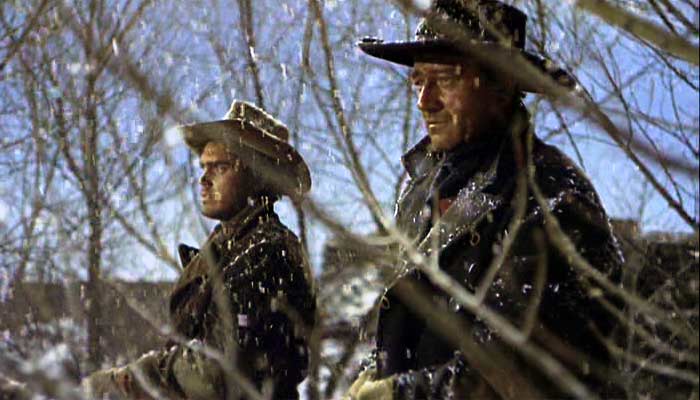
 That’ll be the day when someone tries to claim there’s a better Western than John Ford’s ethnocentric look at the dying of the Old West and the birth of the modern era. Essentially about a gunfighter’s attempt to find and kill his young niece, who has been kidnapped and, ostensibly, ruined by Indians, The Searchers is laden with iconic imagery, inside messages, and not-so-subtle metaphors. Hence, it is no accident that John Wayne’s son, Patrick, plays an ambitious yet inept officer named Greenhill. The elder Wayne stars as Ethan Edwards, a tough-as-nails Confederate veteran seeking revenge for the murder of his brother’s family; he’s also out to save Debbie (Natalie Wood) from the Comanches, led by a chief known as Scar (Henry Brandon), by ending her life, because in his world view, it’s better to be dead than red. Joining him on his trek is Debbie’s adopted brother, Martin Pawley (Jeffrey Hunter), who wants to save her from Edwards. The magnificent film balances its serious center with a large dose of humor, particularly in the relationships between Ethan and Martin and Ethan with his Indian companion, Look (Beulah Archuletta). And keep your eye on that blanket in front of the house. The Searchers is screening August 18 & 19 as part of the Museum of the Moving Image See It Big! series, which continues this month with such other splendid films as Martin Scorsese’s Taxi Driver, Terry Gilliam’s Brazil, David Lynch’s Blue Velvet, and David Lean’s Doctor Zhivago.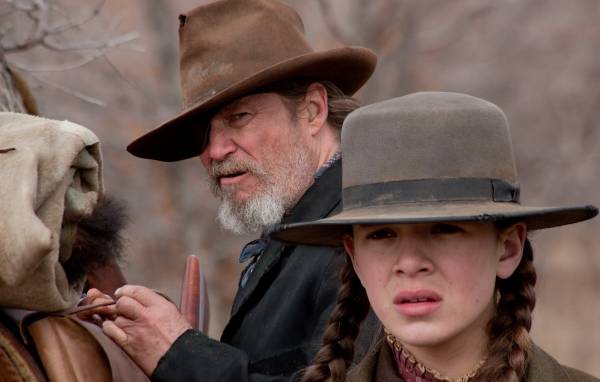
 Since their 1984 debut feature, Blood Simple, Coen brothers Joel and Ethan have tackled numerous genres with dazzling originality, resulting in such fresh, unusual, and intelligent fare as Barton Fink (1991), Fargo (1996), The Big Lebowski (1998), No Country for Old Men (2007), and A Serious Man (2009). They’ve had some hiccups along the way, but their only true dud was also their only remake, 2004’s The Ladykillers, an unwatchable version of the 1955 Alec Guinness original. Now they’re revisiting the 1969 classic Western True Grit, which earned Johny Wayne his only Oscar and has held up poorly over the years. For the 2010 reboot, the Coens turned to Jeff Bridges to step into the Duke’s shoes as U.S. marshal Reuben J. “Rooster” Cogburn, an aging lawman with a thing for the bottle, as well as for killing. He’s hired by determined fourteen-year-old Mattie Ross (Hailee Steinfeld) to hunt down her father’s murderer, a man named Tom Chaney (Josh Brolin), who’s also being tracked by ever-faithful Texas Ranger La Boeuf (Matt Damon) for other crimes against humanity. Instead of merely remaking the previous film, which was directed by Henry Hathaway (Kiss of Death, Airport) and also starred musician Glen Campbell as La Boeuf and Kim Darby as Mattie, the Coens went back to Charles Portis’s 1968 novel, with the most important difference being the change in point of view; the new True Grit is told from Mattie’s perspective, including voice-over narration from the adult Mattie (Elizabeth Marvel), which breathes new life into the tired old horse. While Wayne played Cogburn with his tongue firmly in cheek, adding bits of silly comic relief, Bridges imbues the marshal with more seriousness and less hulking bravado as he continually — and more and more drunkenly — tells stories from his past. By going back to the book, the Coens also get to add more violence, especially near the end, as well as a coda about Mattie’s future. While the original featured a bombastic, overreaching score by Don Black, longtime Coen brothers composer Carter Burwell ratchets things down significantly, using the old hymn “Leaning on the Everlasting Arms” as his central musical theme. As much as the Coens want the new film to be viewed in its own right, there are still too many similarities to avoid comparisons with the original, but their True Grit does turn out to be a better executed, less predictable, and more entertaining genre piece. True Grit is screening August 17 and 19 at MoMA as part of the series “A View from the Vaults, 2012: Recent Acquisitions,” which continues through August 19 with such new films in MoMA’s collection as Christopher Guest’s Best in Show, Gregg Araki’s Mysterious Skin, and William A. Wellman’s Frisco Jenny.