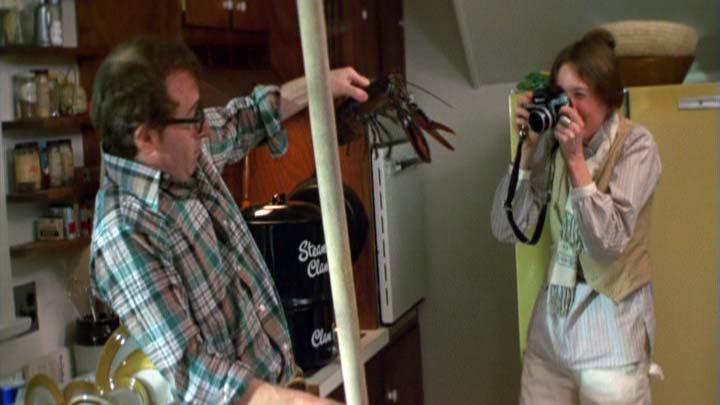
Woody Allen and Diane Keaton struggle with domestic bliss in ANNIE HALL
BAMcinématek, BAM Rose Cinemas
30 Lafayette Ave. between Ashland Pl. & St. Felix St.
September 8-9
Series runs through September 17
212-415-5500
www.bam.org
“We enjoy your films, particularly the early, funny ones,” an alien tells Sandy Bates in Woody Allen’s vastly underrated 1980 Fellini homage, Stardust Memories. Allen stars as Bates, a very serious director being honored at a film festival where everyone raves about his early stuff, much as fans and critics did after the Woodman shocked his public with the Bergmanesque Interiors in 1978. But what early stuff it was, with Allen and real-life partner Diane Keaton teaming up to become one of the greatest comedy duos of them all, right up there with Tracy and Hepburn, Powell and Loy, Martin and Lewis, and Cary Grant and any number of leading ladies. BAMcinématek is honoring Allen and Keaton (as well as all those others) as part of the fabulous series “American Gagsters: Great Comedy Teams,” screening four of their best films this weekend. In 1977’s Annie Hall (Saturday at 2:00 & 6:50), Allen plays Alvy Singer, a Jewish television writer who has fallen in love with the ultimate goy, Annie (a never-better Keaton, whose real name is Diane Hall). As their relationship ebbs and flows, they discuss major spiders, lobsters, sharks, and other creatures while driving through Plutonium and meeting Marshall McLuhan. (Alvy: “What’s the difference? It’s all mental masturbation.” Annie: “Oh, well, now we’re finally getting to a subject you know something about.” Alvy: “Hey, don’t knock masturbation. It’s sex with someone I love.”) In 1973’s Sleeper (Saturday at 4:30 & 9:15), Allen is Miles Monroe, a cryogenically preserved liberal who has woken up two hundred years later to find a very different world as poses as a robot butler for the snooty Luna Schlosser (Keaton), tests out an orgasmotron, and becomes a revolutionary. (Luna: “Oh, I see. You don’t believe in science, and you also don’t believe that political systems work, and you don’t believe in God, huh?” Miles: “Right.” Luna: “So then, what do you believe in?” Miles: “Sex and death — two things that come once in a lifetime . . . but at least after death, you’re not nauseous.”)
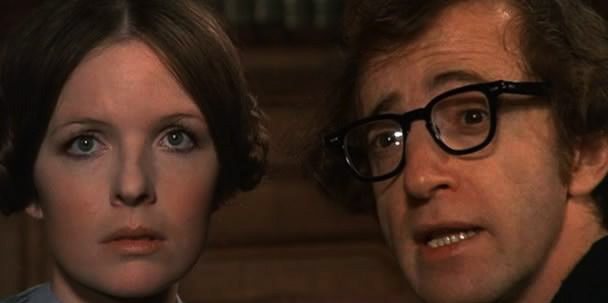
Diane Keaton and Woody Allen fight for Mother Russia in intellectual slapstick comedy
In 1979’s Manhattan (Sunday at 2:00 & 6:50), a celebration of Gershwin and New York City, Allen plays Isaac Davis, a forty-two-year-old television writer who starts dating seventeen-year-old Tracy (Mariel Hemingway), much to the consternation of the snobby Mary Wilkie (Keaton), who is having an affair with Isaac’s best friend (Michael Murphy). (Mary: “What are you thinking?” Isaac: “I dunno, I was just thinking. There must be something wrong with me, because I’ve never had a relationship with a woman that’s lasted longer than the one between Hitler and Eva Braun.”) And in 1975’s absolutely riotous Love and Death (Sunday at 4:30 & 9:15), a hysterical parody of classic Russian literature, Allen takes on the role of the less-than-heroic Boris Grushenko, who finds himself dueling with a gentleman and going after Napoleon with Sonja (Keaton), the cousin he is madly in love with. (Sonja: “And I want three children.” Boris: “Yes. Yes. One of each.”) Allen went on to make some terrific films with his future partner, Mia Farrow, but it his work with Keaton that cemented his reputation and is likely to be best remembered now, in 2173, and beyond.
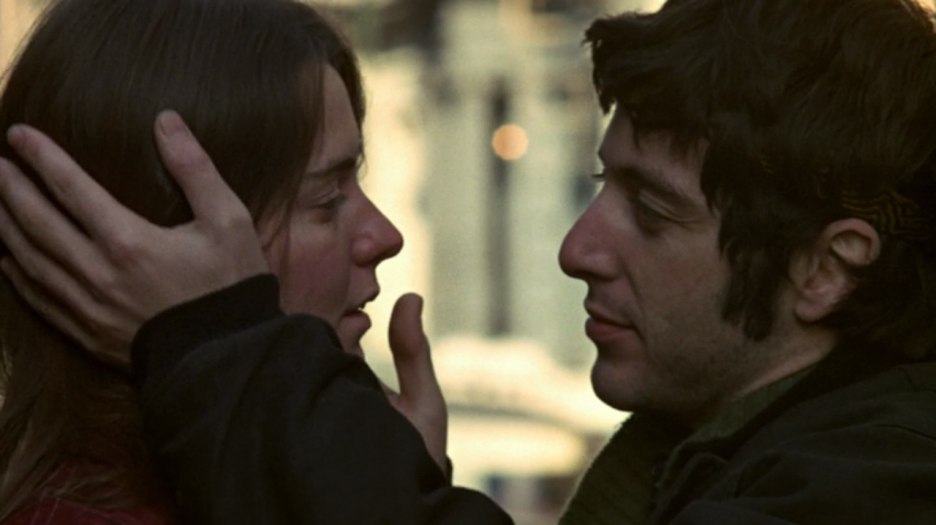
 Al Pacino burst onto the cinematic landscape in The Panic in Needle Park, his first starring role. Pacino is fabulously unsettling as Bobby, a junkie always looking to score around Sherman Square at 72nd St. and Broadway, known then as Needle Park. Bobby hooks up with Helen (Kitty Winn, who was named Best Actress at the 1971 Cannes Film Festival for her performance), and the two of them do whatever is necessary to stay high as they wander the streets of the city. Director Jerry Schatzberg (Scarecrow, The Seduction of Joe Tynan, Street Smart) uses natural sound and light to give the film a more realistic feel, as if you are walking through the streets with Bobby and Helen. Several scenes will break your heart, including the one on the Staten Island Ferry; the powerful screenplay was the first written by novelist Joan Didion. The film launched Pacino’s stellar film career; his next five movies were The Godfather, Scarecrow, Serpico, The Godfather Part II, and Dog Day Afternoon, arguably the best start to an acting career ever. Gritty, realistic, and surprisingly tender, The Panic in Needle Park will be screening September 9, 13, and 17 as part of Anthology Film Archives’ ongoing series From the Pen of . . ., paying tribute to the often underrecognized writers behind some great films, this time around focusing on screenplays written by novelists, including Donald Westlake (Cops and Robbers, The Stepfather), Elmore Leonard (Joe Kidd, Mr. Majestyk), James Salter (Downhill Racer), Richard Matheson (House of Usher), Truman Capote (The Innocents), and others.
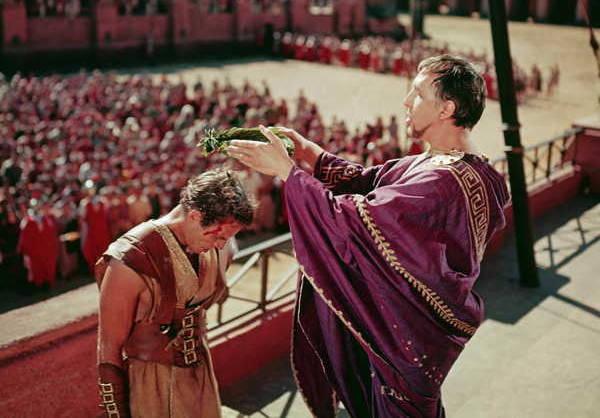
 One of the grandest epics ever made, William Wyler’s Ben-Hur was shown in a new digital restoration last fall as part of the New York Film Festival’s Masterworks sidebar, and now it’s coming to the Museum of the Moving Image, where it will screen September 8-9 in the “See It Big!” series. The DCP restoration of Wyler’s remake of Fred Niblo’s 1925 silent version, which starred Ramón Novarro and Francis X. Bushman (there was also a fifteen-minute Ben Hur made in 1907, all adapted from Lew Wallace’s 1880 novel), celebrates the fiftieth anniversary of the eleven-time Oscar winner, which garnered Academy Awards for Best Picture, Best Director, Best Actor (Charlton Heston as Judah Ben-Hur), Best Supporting Actor (Hugh Griffith as Sheik Ilderim), Best Score (Miklós Rózsa), Best Cinematography, Best Set Decoration, Best Costume Design, and Best Special Effects, among other trophies. The $15 million blockbuster tells the story of two childhood friends, Judah Ben-Hur and Messala (Stephen Boyd), who get caught up in religion, politics, and slavery in first-century Rome and eventually have a magnificent showdown on the chariot course. As cinema spectacles go, they don’t get much bigger or better than this.