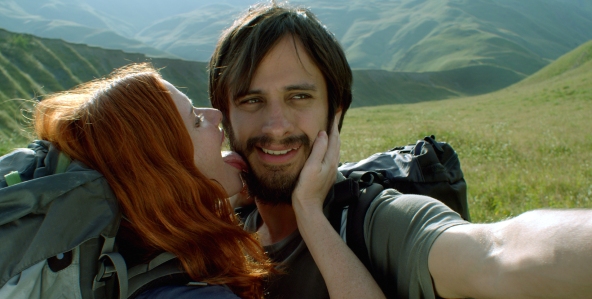
Nica (Hani Furstenberg) and Alex (Gael García Bernal) experience a moment that changes everything in THE LONELIEST PLANET
THE LONELIEST PLANET (Julia Loktev, 2011)
IFC Center
323 Sixth Ave. at West Third St.
Opens Friday, October 26
212-924-7771
www.ifcfilms.com
www.ifccenter.com
 The first half of Julia Loktev’s second feature film, The Loneliest Planet, is a dazzling tour de force, as young lovers Alex (Gael García Bernal) and Nica (Hani Furstenberg) revel in all that life has to offer. Shortly before getting married, they have decided to go on a hiking trip through the Caucasus Mountains in Georgia, led by a guide named Dato (real-life mountaineer Bidzina Gudjabidze, in his first acting role). Alex and Nica are fresh and alive, their eyes filled with wonder, their faces in perpetual, infectious smiles as they make their way through spectacular landscapes gorgeously photographed by cinematographer Inti Briones. In several shots, the three hikers are barely visible walking in the distance as Briones focuses on breathtaking views of the lush green mountainside and vast Central Asian landscape (as well as, in close-up, Furstenburg’s dazzling red hair). What little dialogue there is doesn’t really matter; in fact, much of it is hard to hear, more like background noise, and what is spoken in foreign languages isn’t even translated. But when the travelers run into three locals, something happens that upends the dynamic and severely changes the relationship among Alex, Nica, and Dato, something that requires the kind of split-second decision that one can never take back, resulting in a return journey that is much darker, the smiles, laughter, and romance disappearing in a stark moment. Based on Tom Bissell’s short story “Expensive Trips Nowhere,” The Loneliest Planet recalls such seminal works as Mikhail Kalatozov’s The Letter Never Sent, Andrei Tarkovsky’s Stalker, John Boorman’s Deliverance, Akira Kurosawa’s Dersu Uzala, and Roberto Rosselini’s Voyage in Italy, in which location serves as a character of mystery and potential danger. Loktev, a visual artist who previously made the 1998 documentary Moment of Impact, which details her family’s very personal experiences after her father was hit by a car, and her 2006 narrative debut, Day Night Day Night, about a female Palestinian suicide bomber, has crafted a mesmerizing tale built around small subtleties and the tender, fragile nature of human relationships, in which one misstep can have shattering consequences. Mexican actor García Bernal and New York-born Israeli star Furstenberg make a terrifically believable couple, so vibrant in the first half, so tentative and subdued in the latter sections.
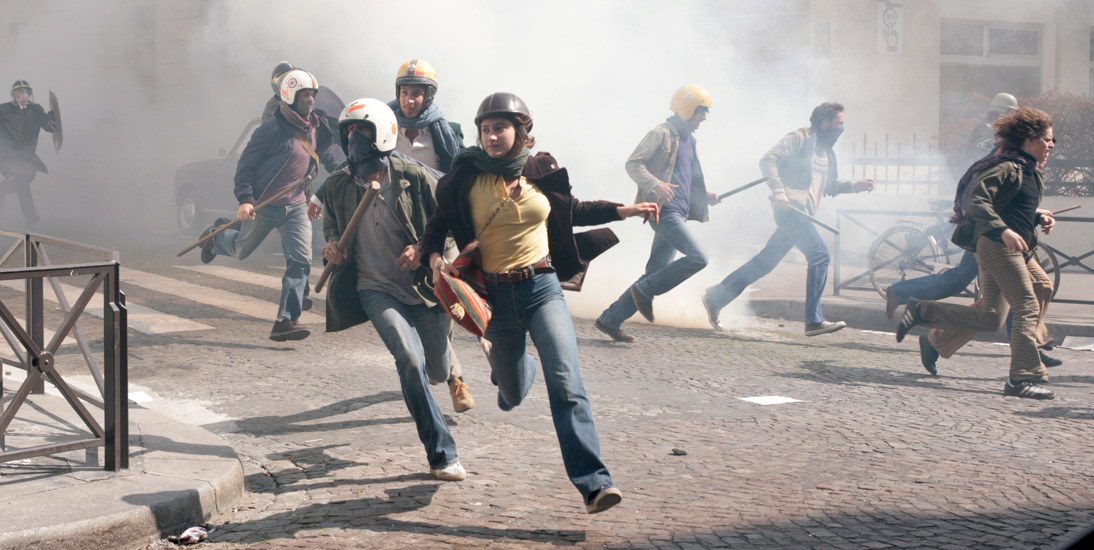
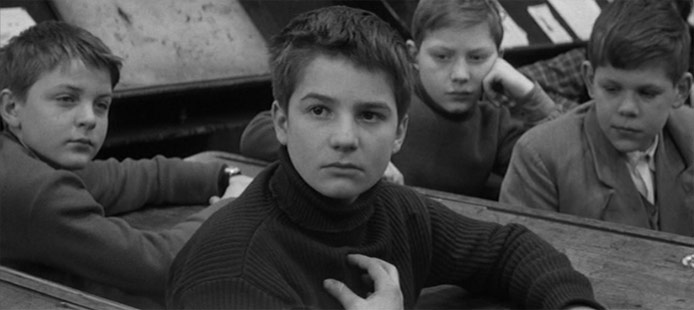
 “They won’t be happy you’re missing school like this,” a man tells fourteen-year-old Jean-Pierre Léaud as he’s auditioning for the part of Antoine Doinel in François Truffaut’s The 400 Blows. “It doesn’t matter, as long as I’m happy,” Léaud responds. Screening on October 26 as part of the Rubin Museum Cabaret Cinema series “Happiness Is . . . ,” where it will be introduced by Columbia professor and Truffaut expert Annette Insdorf, The 400 Blows marked the first of five films, including one short, in which Léaud played the iconic character, as audiences around the world followed his search for happiness. In The 400 Blows, Doinel is a twelve-year-old kid who loves Balzac, has never seen the ocean, and is always getting into trouble with his parents, who treat him more like a problem than a son. He is clearly very smart, but he does poorly in school, where he is harassed by his teacher (Guy Decomble). One day when he decides to play hooky, he catches his mother (Claire Maurier) kissing another man, and instead of telling his father (Albert Rémy), he runs away from home, moving in with his friend René (Patrick Auffay), setting off a series of events that lead to a whole lot more trouble and an unforgettable final shot. The 400 Blows is one of the most intelligent films ever made about adolescence, a tender, honest portrayal of a mischievous kid who just wants to be understood. Léaud gives a wonderfully nuanced performance that makes Antoine a uniquely believable and sympathetic character even when he is making some very bad choices. The film is also about escape of all kinds, beginning and ending with the camera racing away alongside Jean Constantin’s glorious score. The Adventures of Antoine Doinel series continues with 1962’s Antoine and Colette, 1968’s Stolen Kisses, 1970’s Bed and Board, and 1979’s Love on the Run, while “Happiness is . . .” continues through December 28 with such films as Ingmar Bergman’s Cries and Whispers, Michael Curtiz’s Casablanca, and George Cukor’s Camille, held in conjunction with the larger Rubin Museum program “
 Following the Tuscany-set