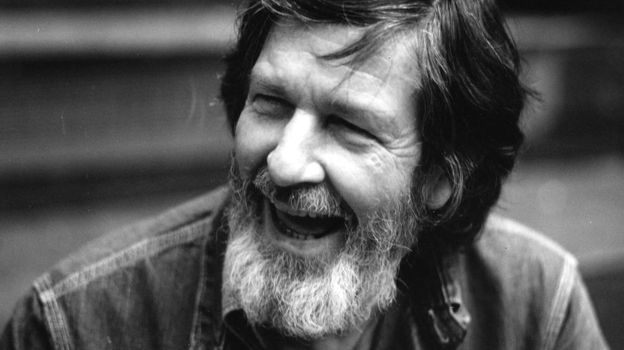
A four-day program at White Box celebrates the centenary of the birth of revolutionary sound artist John Cage
White Box
329 Broome St. between Grand & Delancey Sts.
December 20-23, suggested donation $10
www.eartotheearth.org
www.whiteboxnyc.org
New York City’s celebration of the centennial of John Cage’s birth continues with an impressive collection of audiovisual programs December 20-23 at White Box. Held in conjunction with Ear to the Earth and MA.P.S (Media Arts, Performance, and Sound), “100 x John: A Global Salute to John Cage” consists of one hundred compositions and sound projects, beginning Thursday at 5:00 with “Phill Niblock: Four Videos from Working Title, in which Niblock will present a multimedia examination of his life and art. At 7:00, “Cagean Mix #1: Sounds from Around the World” is highlighted by a sound collage organized by Joel Chadabe and video improvisation by Luke DuBois, followed at 8:00 by solo soundscapes by Rodolphe Alexis, Adam Gooderham, Walter Bianchi, Warren Burt, Thomas Gerwin, and Arsenije Jovanovic. Friday night’s program includes “Cagean Mix #2: Sounds of Water and the Natural World” at 7:00 and performances by Joseph Kubera, Susan Kaprov and Don Bosley, and David Rothenberg. On Saturday at 12 noon, “Sounds and Images” comprises solo pieces by David de Gandarias, Jovanovic, Alexis, Leah Barclay, and Annea Lockwood, followed by a book talk at 3:00 with Kay Larson, author of Where the Heart Beats: John Cage, Zen Buddhism, and the Inner Life of Artists; at 8:00, there will be performances by Garth Paine, Guy Barash, and Richard Lainhart. The festival concludes on Sunday with a Christmas party and “Cagean Mix #3: Sounds of New York City” at 5:00 and “Shelley Hirsh, Katherine Liberovskaya, Gil Arno: New York Stories” at 8:00. To get a sneak peek at some of the “100 x John” soundscapes, go here.
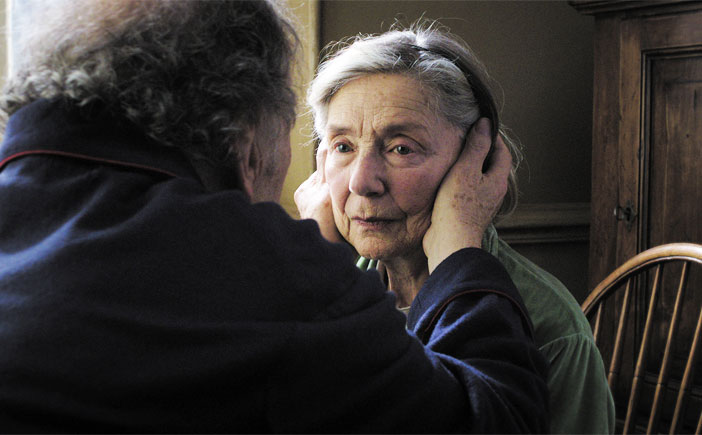
 Legendary French actor Jean-Louis Trintignant puts an exclamation point on his long, distinguished career with Amour, one of the most beautiful love stories ever told. In his first film in nearly a decade, Trintignant, the star of such classics as Z, My Night at Maud’s, A Man and a Woman, and The Conformist, plays Georges, an octogenarian who is immediately concerned when his wife, Anne (Emmanuelle Riva), suddenly freezes for a few moments, unable to speak, hear, move, or recognize anything. So begins a downward spiral in which Georges takes care of his ailing wife by himself, refusing help from his daughter, Eva (Isabelle Huppert), as he faces the grim situation with grace and dignity. A genuine romance for the ages, Amour is brilliantly written and directed by Michael Haneke, earning the German filmmaker his second Palme d’Or, following 2009’s The White Ribbon. Haneke (Cache, The Piano Teacher) and cinematographer Darius Khondji allow the heartbreaking tale to unfold in long interior shots with very little camera movement, spread across more than two hours. Despite its length, the film is far from torturous; instead, it is filled with quietly beautiful moments. Trintignant, who just turned eighty-two, is magnificent as Georges, his every physical movement and eye glance rendered with powerful yet gentle emotions, whether he’s preparing food for Anne or trying to catch a bird that has flown into the apartment. It’s an unforgettable performance in an unforgettable film.
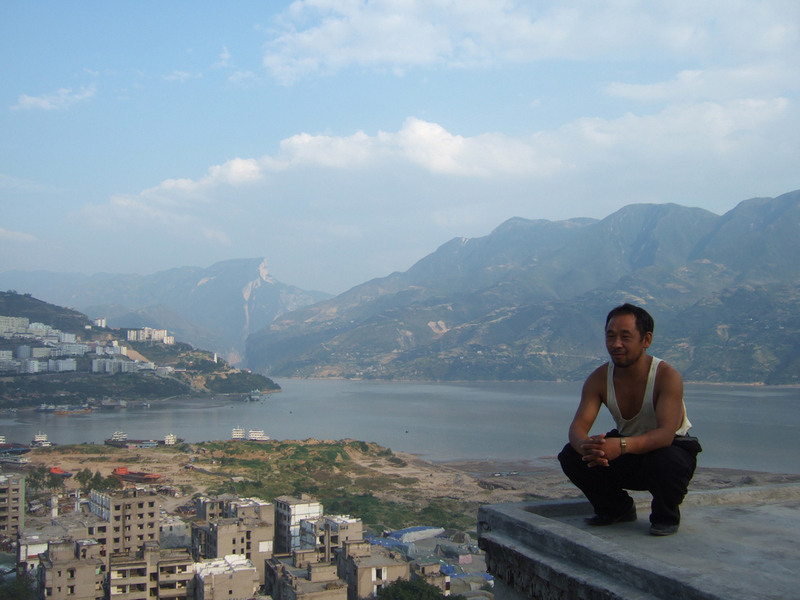
 Sixth Generation Chinese film director Jia Zhangke won the Golden Lion for Best Film at the Venice Film Festival for Still Life, his beautiful, elegiac, documentary-like examination of displaced family. Jia sets his film around the ongoing, controversial Three Gorges Dam project, which has forced millions of residents from their homes. Han Sanming, a miner from Shanxi, arrives in the former town of Fengjie, looking for the daughter he hasn’t seen in sixteen years, since she was a baby. Meanwhile, a young nurse, Shen Hong, is seeking out her husband, a construction executive whom she hasn’t heard from in two years. Using nonprofessional actors, Jia (Platform, The World) tells their heartbreaking stories virtually in slow motion, with many scenes driven by Han’s tired eyes, featuring little or no dialogue. He gets a job helping tear down buildings, in direct contrast to his desire to rebuild his relationship with his long-lost family. Jia’s gentle camera reveals how China, in its quest for modernization and financial power, has left behind so many of its people, the heart and soul of the land that has literally been torn out from under them. A small gem, Still Life is screening December 20 at 9:00 in a new 35mm print as part of the IFC Center series “Road Movies: Directed and Selected by Walter Salles,” in conjunction with the December 21 theatrical release of Salles’s adaptation of Jack Kerouac’s On the Road.