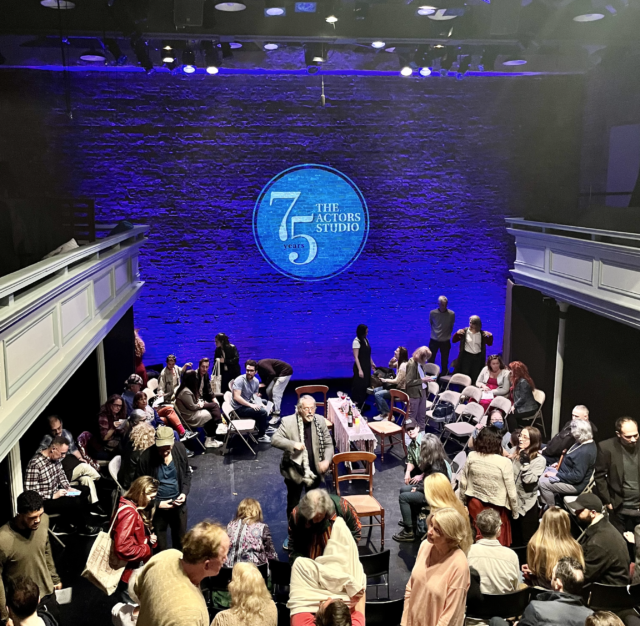
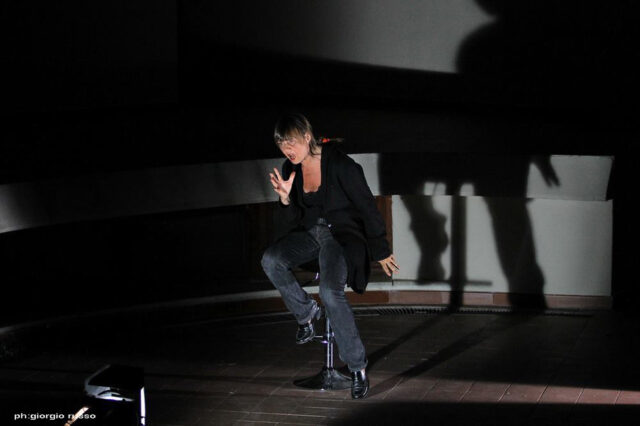
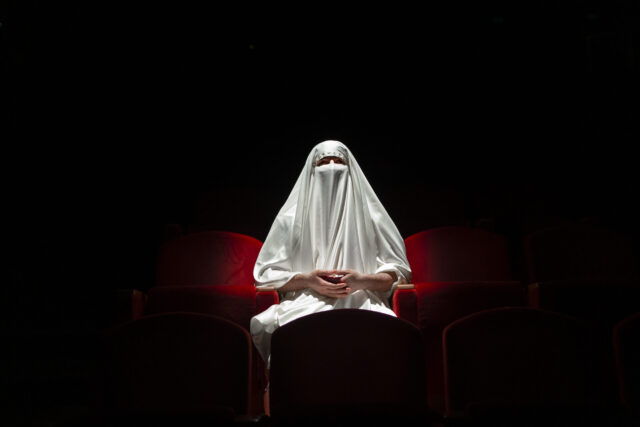
The Actors Studio continues its seventy-fifth anniversary celebration with several special free events this month (photo courtesy the Actors Studio)
THE ACTORS STUDIO IN PROCESS
The Actors Studio
432 West Forty-Fourth St. between Ninth & Tenth Aves.
May 12-13, free with RSVP, 7:00
Additional events May 14, 19-20, 25-26 theactorsstudio.org
If you haven’t been paying attention, the Actors Studio has been celebrating its seventy-fifth anniversary with some outstanding public events. Last month, “Directed by Estelle Parsons” featured the Oscar- and Obie-winning actress helming three works; in December, Carroll Baker was on hand for a talk following a screening of Elia Kazan’s Baby Doll; and in October, Al Pacino hosted a screening of Sidney Lumet’s Dog Day Afternoon at United Palace.
The party continues this weekend with Tony and Obie winner Lois Smith and others taking audiences behind the scenes in “The Actors Studio in Process.” On May 12 and 13 at 7:00, there will be open rehearsals of scenes from three plays: Elizabeth Stearns’s Hillbilly Women, directed by Marilyn Fried and starring Smith, Jacqueline Knapp, and Taylor Plas; writer-director Dennis Russo’s Midnight and Sky, with Russo and Marc Solomon; and Chris Stack and Scott McCord’s We Might Fall Apart, with McCord, Stack, and Plas. Admission is free with RSVP.
On May 14 at 3:00, an encore of “The Playwright: Tales from the Color Line” consists of scenes from plays exploring race, followed by Q&As, with Phillip Hayes Dean’s This Bird of Dawning Singeth All Night Long, directed by Paul Calderon and starring Martha Gehman and Richarda Abrams; James Baldwin’s Blues for Mister Charley, directed by Patricia Floyd and featuring McCord, Robert Mobley, Samuel Pygatt, Delissa Reynolds, and Lawrence Stallings; Lorraine Hansberry’s The Sign in Sidney Brustein’s Window, with Michael Billingsley, Aprella Godfrey-Barule, and Omar Ezat and directed by JoAnna Rhinehart; and Charles Gordone’s No Place to Be Somebody, with Mobley, Brittaney Chatman, Rony Clanton, Marcus Naylor and Steven Vause, directed by Naylor.
The festivities carry on later in the month with “On the Fly 2023: Then and Now” on May 19 and 20, a two-part presentation of short plays by BIPOC writers and directors, the first night a screening of Zoom plays streamed during the pandemic, the second live works, and May 25 and 26 with “Areyto: Latine Celebration,” an immersive theatrical ceremony rooted in equatorial tribal origins, followed by a reception.
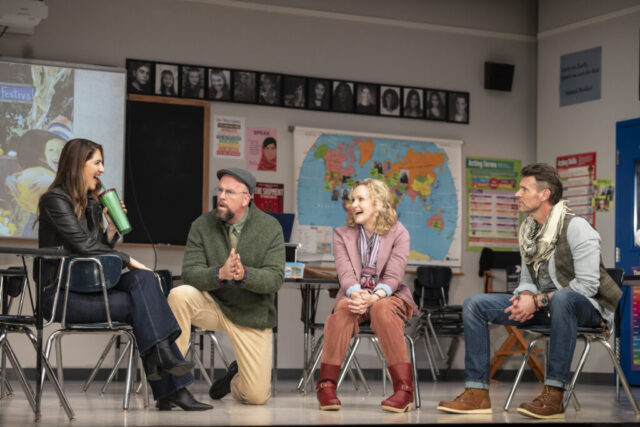
D’Arcy Carden, Chris Sullivan, Katie Finneran, and Scott Foley star in The Thanksgiving Play on Broadway (photo by Joan Marcus)
THE THANKSGIVING PLAY
Hayes Theater
240 West 44th St. between Broadway & Eighth Ave.
Tuesday – Sunday through June 11, $109-$169 2st.com/shows www.playwrightshorizons.org
Call it The Thanksgiving Play That Goes Wrong.
In November 2018, I wrote that the world premiere of Larissa FastHorse’s The Thanksgiving Play at Playwrights Horizons was “a wild and woolly farce that takes on important indigenous issues — in real life and on the stage. [FastHorse] is attempting to level the playing field by increasing diversity and pushing an own-voices sensibility.”
Nearly five years later, the play is debuting on Broadway from Second Stage, with a different director, different cast, different set, and significantly tweaked script that make it all feel like so many dried-out leftovers.
The plot is the same. Logan (Katie Finneran) is a high school drama teacher directing a forty-five-minute Thanksgiving play for elementary school students. She has hired her overly politically correct boyfriend, local street performer Jaxton (Scott Foley), to star in the show, along with professional actress Alicia (D’Arcy Carden), whose experience has been primarily in Disney theme parks; elementary school history teacher and amateur writer and actor Caden (Chris Sullivan) is the research consultant. Logan has decided it will be a devised production, with everyone contributing in an improvised fashion, which delights Caden, who has come with plans for a major epic, but bores Alicia, who says, “I’m an actress. Could I come back when there’s a script? I just got to town and have a hundred things to do.”
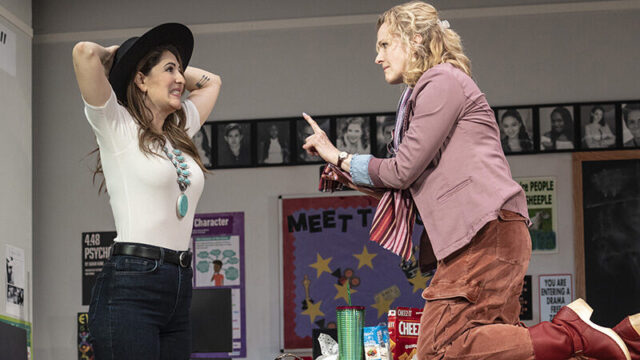
Logan, who is proudly vegan and refers to Thanksgiving as “the holiday of death,” has received the Race and Gender Equity in History Grant, the Excellence in Educational Theater Fellowship, a municipal arts grant, the Go! Girls! Scholastic Leadership Mentorship, and the Native American Heritage Month Awareness Through Art Grant and is determined to please all her funders. She is distressed when she discovers that Alicia, who she believed was Native American because of one of her head shots, is not. “So we’re four white people making a culturally sensitive First Thanksgiving play for Native American Heritage Month? Oh my Goddess,” Logan proclaims as if it’s the end of the world.
Alicia (D’Arcy Carden) and Logan (Katie Finneran) face some PC issues in The Thanksgiving Play (photo by Joan Marcus)
Each scene that they discuss unravels either because of length, cost, or political sensitivity. When Caden suggests starting the play four thousand years ago with the agricultural revolution and using lots of fire, Logan says, “I am conscious of not allowing my personal issues to take up more space in the room than the justified anger of the Native people around this idea of Thanksgiving in our postcolonial society. I want to make that crystal clear.” Alicia asks, “Was America even invented yet?” To which Jaxton replies, “It was not. Better times. That makes me wonder if using the word of the conqueror, ‘American,’ could be a trigger for people? What word do you prefer for naming this physical space? I’ve heard ‘Turtle Island’ used a lot. Do you prefer that?” Alicia chimes in, “I like turtles.”
They argue about casting, food, historical accuracy, prayer, Columbus Day, the depiction of violence, and “white people speaking for white people” as they try to figure out what actions they can take in good conscience in today’s equality-conscious culture.
The word “woke” began to take on its current meaning in 2014 following the police killing of Michael Brown in Ferguson, Missouri. In the October 2020 Vox article “A History of ‘Wokeness,’” Aja Romano writes, “In the six years since Brown’s death, ‘woke’ has evolved into a single-word summation of leftist political ideology, centered on social justice politics and critical race theory. This framing of ‘woke’ is bipartisan: It’s used as a shorthand for political progressiveness by the left, and as a denigration of leftist culture by the right.” This evolution of wokeness lies at the heart of the problems with this new iteration of The Thanksgiving Play; in the five years since it debuted off Broadway, the play has become a victim of its own wokeness.
In 2018, MacArthur Genius FastHorse (Cherokee Family Reunion, Urban Rez,What Would Crazy Horse Do?) was right on target, skewering how difficult it was to use the proper language to describe people and events. The battle between Logan and Jaxton’s progressiveness and Caden’s insistence on historical accuracy was hilariously spoofed by Alicia’s utter disinterest in what either side had to say, representing Americans who were fed up with partisan fighting over everything and instead just wanted to get on with it all. At one point, Jaxton says about Alicia’s lack of Native American heritage, “I think we could get away with using her before 2020, but now we’re post the postracial society. We can’t be blind to differences.”
At Playwrights Horizons, Jaxton said “a few years ago” instead of “before 2020,” and therein lies the conundrum. What was a clever, prescient satire in 2018 now feels stale and mean, revealing that the show is already dated. The cast is fine, led by Carden as a sexier Alicia, but Riccardo Hernández’s classroom set is confining, although it’s telling that posters on the wall promote such previous school productions as Sarah Kane’s 4.48 Psychosis, Euripides’s Medea, Sophocles’s Oedipus, and Aleshea Harris’s Is God Is, works that many school districts today would consider too controversial to put on.
The supremely talented Rachel Chavkin (Hadestown,Natasha, Pierre & the Great Comet of 1812) is unable to get a firm grasp on the proceedings, teetering between farce and a cautionary tale. I wrote about the PH show, “One of the main reasons why The Thanksgiving Play works so well, despite the occasional bumpiness, is because we recognize parts of ourselves in the four characters; of course, off-Broadway audiences tend to be significantly liberal — and often privileged — terrified of uttering or doing the wrong thing when it comes to people of color yet rather clueless about their own giant blind spots. Thus, there are moments in the show when you are likely to hesitate before laughing, wondering whether you are being insensitive by enjoying yourself too much.” That dichotomy is missing here.
The original production began with Logan (Jennifer Bareilles), Alicia (Margo Seibert), and Jaxton (Greg Keller) coming out dressed as pilgrims and Caden (Jeffrey Bean) as a giant turkey, singing, “The Twelve Days of Thanksgiving,” announcing that this was going to be a good-natured social comedy. The Broadway edition opens with a video of children, dressed in homemade costumes, singing the same song, but it is announcing that the debates over the validity of how and why we celebrate Thanksgiving and the entire DEI movement are poisoning the next generations. Each version concludes with the statement: “Teacher’s note: This song can do more than teach counting. I divide my students into Indians and pilgrims so the Indians can practice sharing.” At Playwrights Horizons, the audience laughed at that line; at the Hayes, they gasped. The Thanksgiving Play’s time has come and gone.
“This is a challenge, but we are the future of theater and education. Are we all in agreement?” Logan asks.
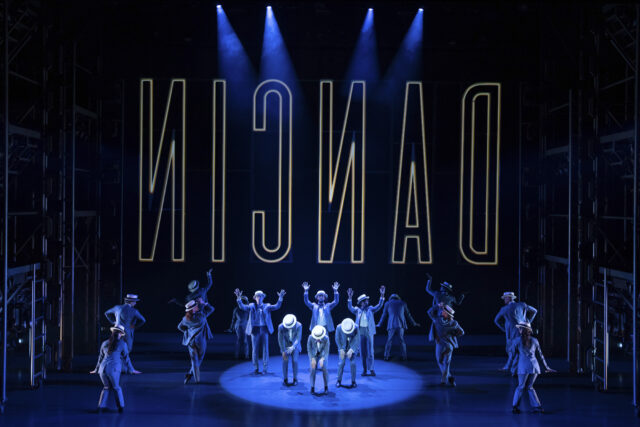
Dancin’ “revival” gets too much backward in looking forward (photo by Julieta Cervantes)
BOB FOSSE’S DANCIN’
Music Box Theatre
239 West 45th St. between Broadway & Eighth Aves.
Tuesday – Sunday through May 14, $114 – $318 dancinbway.com
The original Broadway production of Dancin’ was a thrilling celebration of music and movement as only Bob Fosse could do it. The superb cast included Sandahl Bergman, René Ceballos, Christopher Chadman, Wayne Cilento, Vicki Frederick, and Ann Reinking, shaking things up to a wide range of genres, from pop and jazz to classical and patriotic, with little or no plot. It was nominated for seven Tonys, with Fosse winning for Best Choreography and Jules Fisher for Best Lighting.
For the current reimagining of the show at the Music Box — there are too many changes to properly call it a revival — they have added Fosse’s name to the title, but that ends up being a disservice to the late, magnificent choreographer (and sometimes director) of Sweet Charity,Damn Yankees,The Pajama Game,Pippin,Chicago, and the film version of Cabaret, who is unlikely to have been thrilled with this 2023 iteration, which opened March 19 and has just posted an early closing notice of May 14 after receiving no love from the Tonys, coming up empty-handed.
Cilento is back, this time as director and musical stager, with Christine Colby Jacques credited with “reproduction of Mr. Fosse’s choreography” and David Dabbon with “new music and dance arrangements.” Cilento had his work cut out for him, as there was no script and no recordings of the original presentation, so he and Jacques, who understudied for the 1978 Broadway show, used muscle memory and YouTube videos of other productions. The result is a hot mess from start to finish, but it won’t tarnish Fosse’s legacy, as he can’t take any of the blame for this one. (Notably, however, Nicole Fosse, his daughter with Gwen Verdon, is one of the producers.)
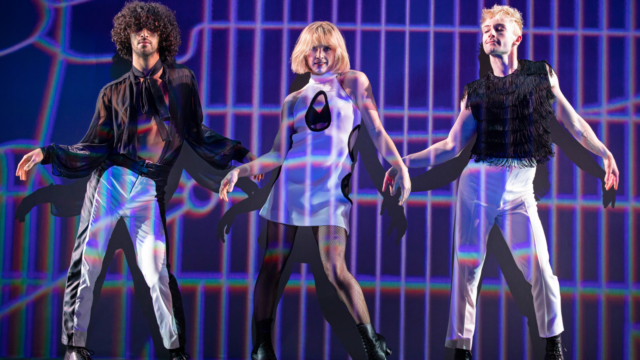
Dancin’ will be closing early after coming up with no Tony noms (photo by Julieta Cervantes)
The so-called Bob Fosse’s Dancin’ features a whole lotta hats, cigarette smoking, shoulder shimmying, sequins, and jazz hands as the cast prances and twirls in, on, and around tall metal scaffolding towers and in front of occasionally dizzying projections on a back screen. The imposing industrial set is by Robert Brill, with projections by Finn Ross, over-the-top sound by Peter Hylenski, excessive lighting by David Grill, and inconsistent costumes by Harriet Jung and Reid Bartelme.
“Recollections of an Old Dancer” kicks off with tone-deaf archival footage of Bill “Mr. Bojangles” Robinson. “Big City Mime,” which was understandably cut in 1978, returns, a sleazy depiction of New York as a town of hookers and pimps. “Big Deal” is a failed attempt at noir. “The Female Star Spot” goes woke on Dolly Parton’s “Here You Come Again.” The “America” segment, with such red, white, and blue tunes as “Yankee Doodle Dandy,” “When Johnny Comes Marching Home,” and “Gary Owen,” feels today like parody. (At least they cut “Dixie”; other numbers were left out because of rights issues.) “The Dream Barre” has been banished.
The second act opens with the still-stellar “Benny’s Number,” a rousing performance of the Benny Goodman Orchestra’s “Sing, Sing, Sing,” with drummer Gary Seligson soloing up high on a platform, although it goes on too long; uncoincidentally, the original company performed the first part of the piece at the Tonys, so it is in this piece that Fosse’s choreography is most closely replicated in 2023.
And speaking of singing, we are told at the beginning that there will be some singing, but it turns out that there is a significant amount, and most of the vocals are undistinguished, delivered more like the performers are on The Voice or American Idol than on a Broadway stage. The individual scenes are like flashy MTV videos that have little to do with one another; Dancin’ 1978 worked as individual set pieces, but Dancin’ 2023 doesn’t trust the dancing enough and instead bombards the audience with posturing glitz and glamour to grab our attention. That continues during the curtain call, in which each dancer takes a bow with their name projected hugely on the screen, as if we need to remember who is who when we vote.
The only name we’d prefer not to see is Bob Fosse’s on the marquee.
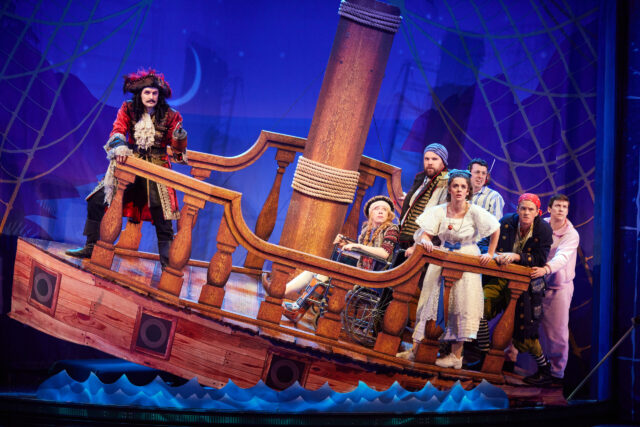
The Jolly Roger poses problems for the cast in Peter Pan Goes Wrong (photo by Jeremy Daniel)
PETER PAN GOES WRONG
Ethel Barrymore Theatre
243 West Forty-Seventh St. between Broadway & Eighth Ave.
Tuesday – Sunday through July 23, $74 – $165.50 pangoeswrongbway.com www.mischiefcomedy.com
In 2017 at the Lyceum on Broadway, Mischief Theatre Company’s The Play That Goes Wrong documented the Cornley Polytechnic Drama Society’s floundering presentation of the fictional Susan H. K. Bridewell’s British mystery The Murder at Haversham Manor, in which just about everything that could misfire did — except its ability to please audiences so much that the show is currently on an extended run at New World Stages. Cornley is now back on Broadway with its uniquely pathetic and hilarious production of J. M. Barrie’s children’s classic about (not) growing up, Peter and Wendy, in Mischief’s Peter Pan Goes Wrong at the Ethel Barrymore Theatre.
Penned by the same trio who wrote The Play That Goes Wrong — Henry Lewis, Jonathan Sayer, and Henry Shields — and directed by Adam Meggido, this follow-up, which debuted in London in December 2013, is another laugh-out-loud comic romp filled with pratfalls, electronic failures, missed cues, dangerous props, and questionable costumes. Back for more disastrous fun are Henry Shields as society president Chris Bean, Lewis as the bearlike Robert Grove (hapless head of the Cornley Youth Theatre), Sayer as Dennis Tyde, Charlie Russell as Sandra Wilkinson, Greg Tannahill as Jonathan Harris, Nancy Zamit as Annie Twilloil, and Chris Leask as Trevor Watson, the ever-busy stage manager. New to the cast are Matthew Cavendish as Max Bennett, Bianca Horn as Gill Jones, Harry Kershaw as Francis Beaumont, and Ellie Morris as Lucy Grove, Robert’s niece.
It’s opening night for Bridewell’s adaptation of Peter and Wendy, and the merriment is already underway as the audience enters the theater. Various characters greet guests, taking selfies and completing technical work. Chris, who channels John Cleese as Basil Fawlty, took pictures with a couple, then looked over at me and snidely said, “Oh, what do you want?! A photo? A cuddle?” I answered, “A cuddle would be nice,” but he gave me an imperious “No!” as he looked down his aquiline nose and squeezed past me first to help Gill fix the “death chair” in the row in front of me, then to playfully frighten the young girl a few seats to my right, who knew it was all a joke.
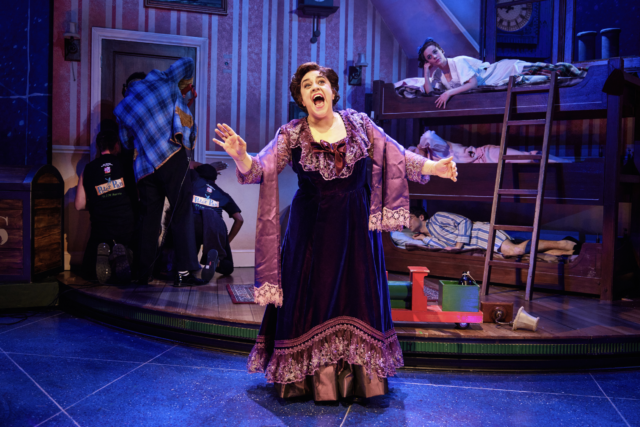
Annie Twilloil (Nancy Zamit) plays four roles in Cornley production of J. M. Barrie classic (photo by Jeremy Daniel)
The show within the show begins in London, in the home of the Darlings: father George (Chris), mother Mary (Annie), daughter Wendy (Sandra), and her younger brothers, John (Dennis) and Michael (Max). Also present are Lisa (Annie) the housekeeper and Nana (Robert) the shaggy nursemaid dog. The story is narrated by Francis (Harry Kershaw), who slides on- and offstage in a regal chair, often tossing glitter over himself upon exiting.
After the kids go to bed one night, Peter Pan (Jonathan) and Tinker Bell (Annie) arrive and fly them off to Neverland, where they meet a Lost Boy known as Tootles (Lucy) and attempt to rescue another Lost Boy, Curly (Annie), from a gang of pirates led by Captain Hook (Chris), who rules with a plastic fist over Smee (Dennis), Cecco (Francis), and Starkey (Robert). Hook is also on the prowl to find and kill the ticking crocodile (Max) that maimed him.
Peter Pan Goes Wrong is a rousing good time, almost to a fault. Some jokes are repetitive, within the show itself (Francis’s battle with the chair, Robert’s troubles with a doggie door, Dennis needing his lines fed to him through headphones) and for people who have seen The Play That Goes Wrong, while others go too far over the top (Annie being plugged in via an extension cord as Tink, the sound board operator accidentally broadcasting snippets from actors’ auditions and backstage chatter instead of sound effects).
Meggido, who has previously directed the Olivier-winning Showstopper! The Improvised Musical and Magic Goes Wrong (Mischief has also done A Christmas Carol Goes Wrong), keeps up a relentless pace that could use more than a few breathers (for the audience) and would benefit from being a 90-minute one-act instead of a 125-minute two-act with an intermission during which, alas, there is no tomfoolery. However, as with The Play That Goes Wrong, the split-second timing is masterful, particularly evident in numerous precarious stunts, from a wired Jonathan to a collapsing bunk bed, and at times you can hurt yourself from laughing so hard.
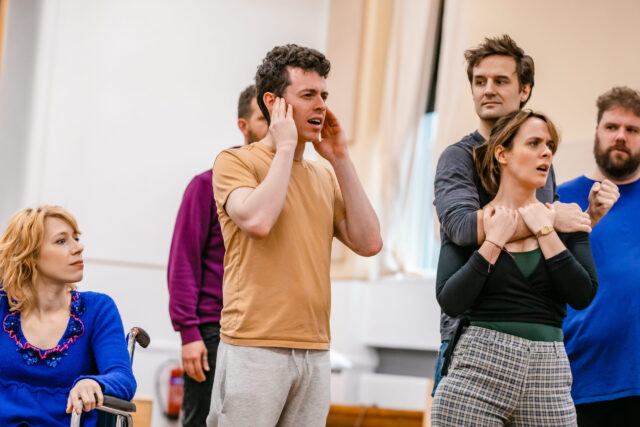
The cast of Peter Pan Goes Wrong rehearses in the studio (photo by Danny Kaan)
Simon Scullion’s revolving set is a marvel, especially when it starts spinning out of control like a runaway zoetrope. Roberto Surace’s costumes are amusingly silly, as is Richard Baker and Rob Falconer’s original music, while Matt Haskins’s lighting and Ella Wahlström’s sound expertly balance the incompetence of Cornley with the excellence of Mischief.
The courageous cast is a blast, with memorable turns by Zamit doing impossible quick changes between Mary and Lisa, Leask coming to the rescue time and time again as the beleaguered Trevor, and Cavendish smiling impishly as Max, who can’t hold back his excitement at being in the show. Russell’s calmness as Sandra nicely offsets the unpredictability of Shields’s Bean, who, as Hook, gets into booing fights with the audience.
Be sure to check out Cornley’s four pages in the Playbill, in which Annie seeks a date, the company touts its upcoming production of Wind in the Pillows, and Robert apologizes for leaving two students behind in a forest.
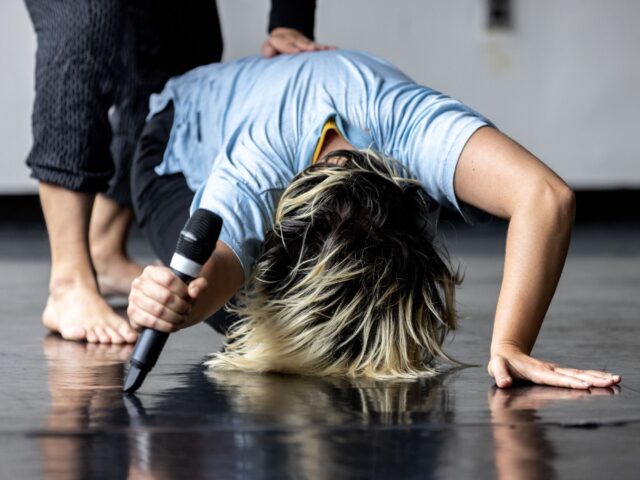
“This work examines Jewish violence, victimhood, and intergenerational trauma,” New York–based choreographer Juliana F. May says about her latest piece, Family Happiness, making its world premiere May 3–13 at the Playhouse at Abrons Arts Center. A co-commission with the Chocolate Factory, Family Happiness is part of the twentieth anniversary celebration of May’s company, MAYDANCE, and follows such powerful works as Folk Incest,Commentary=not thing, and Gutter Gate.
The new piece is written, directed, and choreographed by May and features a familiar roster of MAYDANCE favorites: Leslie Cuyjet, Tess Dworman, Lucy Kaminsky, Molly Poerstel, and Kayvon Pourazar, who all collaborated with May on the original songs. The music is by Tatyana Tenenbaum, with lighting by Chloe Z. Brown and costumes by Mariana Valencia. The narrative explores Zionism, the Israel-Palestine conflict, the Holocaust, individual and group communication, grief, and trauma through text, dance, and music.
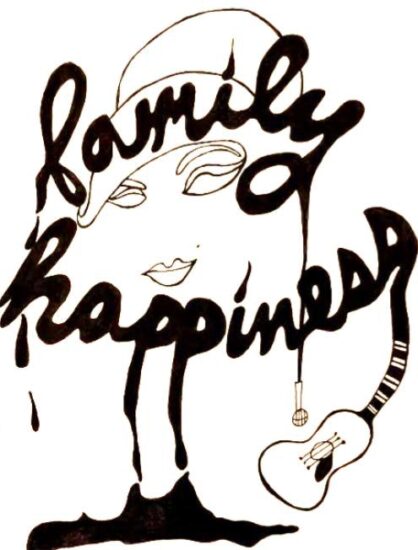
Performer Tess Dworman created a pecial poster for new work by Juliana F. May
“I worked on the beginning ideas of the piece during the pandemic in Tel Aviv, where my partner has family,” Guggenheim Fellow May explained in a statement. “I am a choreographer, but there is a lot of text in my work. I wrote this project ‘treatment’ on the tails of a dream I had about my father committing suicide and Trump losing the election. There’s a figure of a boy who looks like a scarecrow next to a pitchfork, a bird, and a half moon. He passes by the dog beach, the separate beach, the smoking beach, and eventually arrives at the sex beach. There are hundreds of naked people sitting on top of each other with legs intertwined in a series of eights. The dogs migrate over to the sex beach. Peripheral backward strokes follow a lunging and spreading and in an instant, the animals start to bite and peel skin away from bone, prying the upper extremities down towards the sand while the genitals remain connected like a roundabout on a playground. There is a rising smoke from the skinning like Christ being prepped with a soldering iron. The bodies smell like cocaine, synthetic cotton, or some kind of polyblend as they thrash around in the sand trying to free themselves from each locked jaw. They get close to the water and almost break free but realize they don’t know how to surf.”
May promises that Family Happiness “will be a big dance performance.” With that kind of description, how could it be anything else?
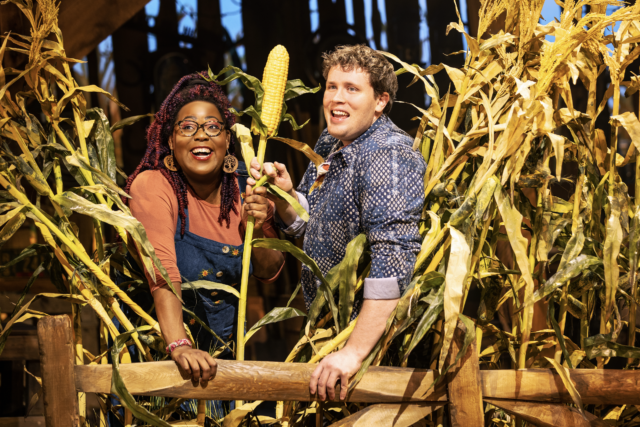
Ashley D. Kelley and Grey Henson serve as our narrators and guides in Shucked (photo by Mathew Murphy & Evan Zimmerman)
SHUCKED
Nederlander Theatre
208 West Forty-First St. between Broadway & Eighth Ave.
Tuesday – Sunday through January 14, $69-$247 shuckedmusical.com
When I was a kid, I watched a syndicated television show called Hee Haw, which originally ran on CBS from 1969 to 1971 and was hosted by celebrated American musicians Roy Clark and Buck Owens, both of whom are in the Country Music Hall of Fame. The variety series took place in the fictional community of Kornfield Kounty, combining great music with satirical sketches and purposely silly jokes poking fun at themselves and rural living. In the opening credits, a cartoon donkey emerged from a row of corn and barked out the title several times.
The new musical Shucked honors its forebear in the second act when, during the song “The Best Man Wins,” a group of guys repeatedly declares, “Yee haw hee haw.” Like Hee Haw,Shucked never passes up a chance at a corny joke; it seems to be why it exists in the first place. And there’s definitely still an appetite for corn: Shucked has quickly become a cult favorite at the Nederlander Theatre, where some attendees have taken to showing up in costume, attending performance after performance.
Featuring a book by Tony winner Robert Horn (Tootsie,13) and music and lyrics by eight-time Grammy nominee Brandy Clark (no relation to Roy) and three-time Grammy winner Shane McAnally, Shucked takes place in Cob County, an insulated hamlet surrounded by a wall of corn, where puns grow nearly as fast as the international dietary staple that the USDA says is both a vegetable and a grain.
The self-described “farm to fable” is narrated by two nameless storytellers, played by Ashley D. Kelley and Grey Henson, who watch (or participate in) the proceedings with a wink and a nod.
“Now, I know when some of you think ‘small town,’ you think gun totin’, rusted truck hayseeds who think ‘liberal’ is how you pour your whiskey and ‘fluid’ belongs in your gas tank. But I want you to open your minds and think — even smaller,” Kelley says near the beginning.
Cob County is preparing for the wedding of Maizy (Caroline Innerbichler), a play on “maize,” what Native Americans call corn, and prominent farmer Beau (Andrew Durand). It’s not just a celebration of true love but of corn, which brought the two of them together.
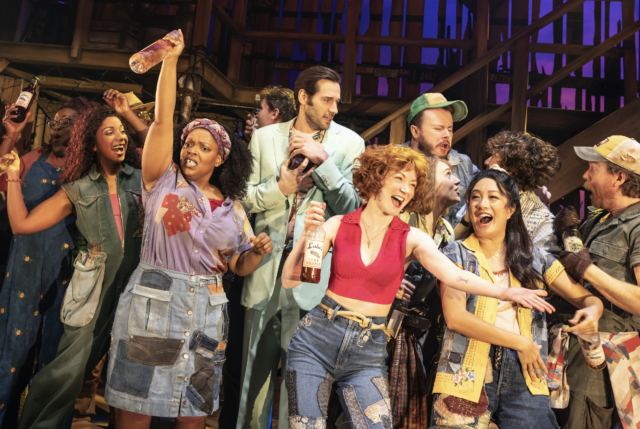
The cast of Shucked has never a met a pun it would turn its back on (photo by Mathew Murphy & Evan Zimmerman)
As the storytellers proclaim, “Sweet corn, street corn / It’s really hard to beat corn / Hands or feet no wrong way to eat corn / It’s a resource that’s always renewable / Bring it to a briss / Or a wedding / Or a funeral / Cook it on the cob / Or in a tortilla / You can even make it an onomatopoeia / Candy corn, kettle corn, put it in your mouth / It’s the same goin’ in comin’ out.” Yes, when it comes to corn pone, they leave no quip or double entendre to dry out in a drought.
The wedding is stopped when rows of corn suddenly start dying on the spot. The town’s future is now in jeopardy, from Beau’s farm to Maizy’s cousin Lulu’s (Alex Newell) whiskey.
Despite knowing that no one has ever left Cob County — and returned — Maizy asks Peanut (Kevin Cahoon), Beau’s not-too-bright brother, “Don’t you think someone should leave to get help?” Peanut, who has never been asked a question he couldn’t answer with ridiculous non-sequiturs (or, later, suggestive references involving sexual organs and bodily functions), responds, “I think . . . if your lawyer has a ponytail on his chin, you’re probably goin’ to prison. I think if you can pick up your dog with one hand, you own a cat. I think people in China must wonder what to call their good plates. And I think we need answers. I just don’t think leaving is one of them.”
Even worse than leaving the county is allowing a stranger in, but Maizy heads to the big, scary city — Tampa, Florida — seeking help, which she finds in Gordy (John Behlmann), a desperate con artist in debt to gangsters and who’s been posing as a strip mall podiatrist who treats such foot ailments as bunions and . . . corns. Maizy doesn’t quite get it so convinces Gordy to come back with her to save the town crop.
Sniffing an opportunity to make a fortune by stealing Cob County’s heretofore undiscovered mineral wealth, Gordy goes with Maizy, even pretending to fall in love with her to gain better access to the rocks and abscond, leaving the hapless hamlet to its fate.
Shucked is like a scrumptious piece of salty, hot buttered corn at a summer barbecue, but there’s only so much you can eat at one sitting: Bits get stuck in your teeth, and the rest can be tough to digest. The show is a nonstop barrage of puns that can be hysterical but also overwhelming. And as playfully absurd as the plot is, it sometimes goes haywire, pushing the bounds of credulity, but always with a smile.
Scott Pask’s multilevel wooden set is a ramshackle barn, with raggedy furniture and scene-setting props like small cornrows and neon signs that wheel on and off. Japhy Weideman’s lighting glows magnificently through the gaps in the wood, offering blue and purplish skies and red and yellow sunlight. Tilly Grimes’s costumes would make Roy Clark and Buck Owens proud, with plenty of overalls, baseball caps, boots, dungarees, and patches.
Three-time Tony winner Jack O’Brien’s (The Invention of Love,The Full Monty) direction goes from a sweet simmer to a full-tilt boil, allowing just the right amount of space for Sarah O’Gleby’s merry choreography. Jason Howland’s music supervision, music direction, orchestrations, and arrangements won’t frighten off audience members who think they won’t appreciate country music.
In her Broadway debut, Innerbichler (Frozen,Little House on the Prairie) is charming as the naive and innocent Maizy, while Durand (Ink,Head Over Heels) goes through a tumultuous series of emotions as the determined but heartbroken Beau. Kelley (Eve’s Song,Bella: An American Tall Tale) and Tony nominee Henson (Mean Girls,The Book of Mormon) are a hoot leading us through this hilarious hootenanny, particularly the latter, who offers such prime kernels of truth as “Like the guy with the lifejacket said: ‘It’s foreboding’” and “Like the personal trainer said to the lazy client: ‘This is not working out.’”
Behlmann (The 39 Steps,Significant Other) is deliciously evil as the mustache-twirling villain, but Newell (Glee,Once on This Island) steals the show as the philosophical Lulu, who shakes the rickety rafters belting out the feminist anthem “Independently Owned,” in which she declares, “I’m independently owned and liberated / And I think sleeping alone is underrated / Don’t need a man for flatteries / I got a corn cob and some batteries.”
She also shares this gem: “Men lie all the time. Hell, one tried to convince me you could suck out a kidney stone.”
Bruna Braidotti’s Luisa is part of Italian Theater Festival across five boroughs, May 1-16
IN SCENA!
Casa Italiana Zerilli-Marimo at NYU (and other locations)
24 West Twelfth St. between Fifth & Sixth Aves.
May 1-16, free – $23.41 www.inscenany.com
The tenth edition of the “In Scena!” Italian Theater Festival takes place May 1-16, at NYU’s Casa Italiana Zerilli-Marimò and other locations in all five boroughs. This year’s iteration features eight timely plays; admission is free with advance RSVP, but donations of $23.41 will be accepted. The opening-night celebration on May 1 at 7:00 includes an awards ceremony with artists present, along with a special video and more.
The works include four solo shows: Italian star Paola Minaccioni’s I am so much better live, with music by DJ Coco; Valentina Diana’s Mubarak’s Niece, performed by Marco Vergani, about a friendship that develops amid the Tahrir Square Revolution; Bruna Braidotti’s Luisa, which follows a woman haunted by the men in her past; Antonio Grosso’s Only Mozart Is Missing, performed by Marco Simeoli and based on the true story of Simeoli’s grandfather; and Marco De Simone’s We Puppets: Story of a life shattered by racism, set during the racial laws of 1938.
Marco Vergani stars in Valentina Diana’s Mubarak’s Niece at “In Scena!” festival
Also on the bill are The Gummy Bears’ Great War, about a fictional battle that echoes current events, written and directed by Angelo Trofa and performed by Valentina Fadda and Leonardo Tomasi; Maurizio Rippa’s Little Funerals, in which vocalist Rippa and guitarist Amedeo Monda play songs about a series of funerals; and Tiziana Troja’s DDD! Donne, Donnette, Donnacce, about a female comic duo, performed by Troja, Fadda, Trofa, Michela Sale Musio, and Michele Sarti, with original music and arrangements by Davide Sardo.
Presented by Kairos Italy Theater in association with KIT Italia and Casa Italiana Zerilli-Marimò, the festival, which moves to BAAD! Bronx Academy of Arts and Dance, Snug Harbor Cultural Center on Staten Island, the Vino Theater in Brooklyn, and Theaterlab in Queens (as well as Los Angeles, Detroit, and San Diego), concludes May 16 at the Italian Cultural Institute on Park Ave. with Andrea Scramali’s L’Attesa, about an estranged father and son who meet in an emergency room, and the presentation of the 2023 Mario Fratti Award to Scramali.