live performance

THE TREES

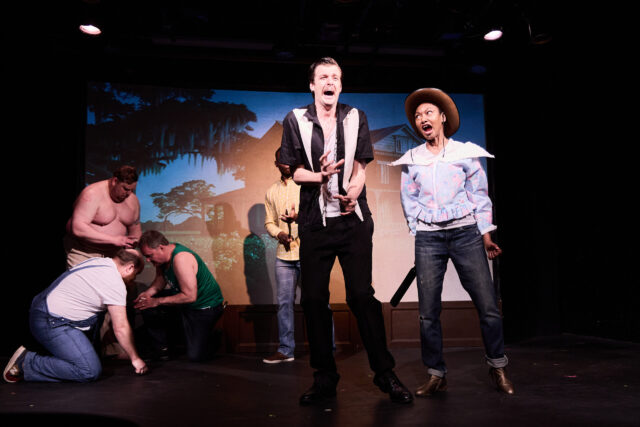
Sheila (Crystal Dickinson) and David (Jess Barbagallo) are stuck in a rut in The Trees (photo by Chelcie Parry)

THE TREES
Playwrights Horizons, Mainstage Theater
416 West 42nd St. between Ninth & Tenth Aves.
Tuesday – Sunday through March 19, $46-$76
www.playwrightshorizons.org

In L. Frank Baum’s 1919 book The Magic of Oz, the thirteenth and next-to-last of the illustrated Oz novels, a little girl named Trot and grizzled former sailor Cap’n Bill suddenly get stuck in the ground, and their feet start growing roots. As Baum writes: “This is hard luck,” [Cap’n Bill] declared, in a voice that showed he was uneasy at the discovery. “We’re pris’ners, Trot, on this funny island, an’ I’d like to know how we’re ever goin’ to get loose, so’s we can get home again.”

That’s precisely what happens to Sheila (Crystal Dickinson) and her older brother, David (Jess Barbagallo), near the beginning of Agnes Borinsky’s The Trees, making its world premiere at Playwrights Horizons (coproduced by Page 73) through March 19. It’s also what happens to the play itself, which is stuck in the mud from the get-go.

Sheila and David are both drunk, returning from a party. Instead of going into their house, they gleefully run around the forest until their feet get trapped in large circles and their toes start growing roots. “There’s still so much to do,” David says. “Will anyone notice?” Sheila asks.

People will notice, but there appears to be nothing much they can do about it as life goes on around the siblings, including visits from their Polish grandmother (Danusia Trevino); their longtime friend Charlotte (Becky Yamamoto); David’s boyfriend, Jared (Sean Donovan); Norman (Ray Anthony Thomas), who is caught in some nearby bushes; Saul (Max Gordon Moore), a rabbi from Cleveland; Sheryl (Marcia DeBonis), from the Cleveland congregation Sisterhood; twinks Julian (Nile Harris) and Tavish (Pauli Pontrelli); street vendor Terry (Sam Breslin Wright), who immediately senses opportunity; and, later, a child named Ezra (Xander Fenyes).

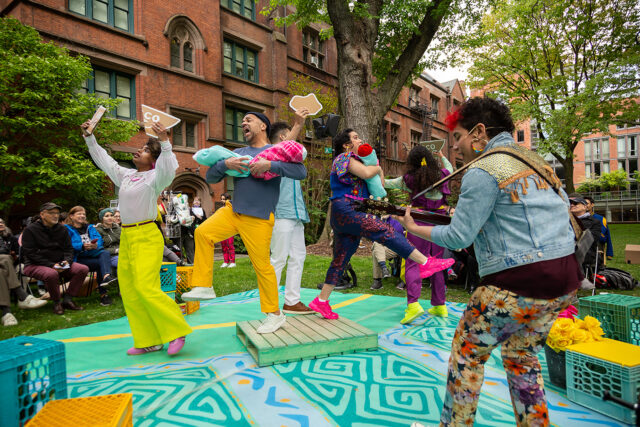
Agnes Borinsky’s The Trees takes place in a candy-colored forest (photo by Chelcie Parry)

Among the topics of conversation are capitalism, religion, romance, and loneliness, with hints at environmentalism.

“I think there’s a certain threshold of love one needs to feel in one’s life,” Norman says. “And if you never meet that threshold you continue to be filled with longing. You can keep on — but you’re hungry. And that is me. Slightly hungry. To the bitter end.”

The rabbi admits, “I’ve felt a great sliding in the world. Like we’re all sliding off this planet into somewhere . . . dark and ugly and dead. It seems a little bit like it’s all on autopilot. Like God is off . . . somewhere . . . else. And the plane of the world is off, somehow, and we’re just sliding. . . . And so when I read about you two, it seemed to me like God might have returned. And that this was the hand of God, that rooted you here. That life isn’t the miracle, but staying put. Because if the world were to tilt and the rest of us were to slide, you’d still be right here.”

David and Sheila remain right there as life plods forward, evoking Didi and Gogo in Beckett’s Waiting for Godot and Franz Kafka’s The Metamorphosis, but Borinsky (A Song of Songs, Ding Dong It’s the Ocean) is never able to establish much of a story aside from the central idea of two characters in search of an exit. In a “Playwright’s Perspective” program note, she admits, “I’m not great at writing plot. I end up writing logistics. . . . Plots are a bit ridiculous.” Unfortunately, a plot is precisely what The Trees needs, something to be nurtured, that can grow over the course of, in this case, a striking-looking but ultimately aimless 105 minutes. (The fun lighting is by Thomas Dunn, with sound by Tei Blow and puppets by Amanda Villalobos.)

Parker Lutz’s pristine white set is a glistening fairy-tale world with Greek columns, but the narrative is choppy and random. Enver Chakartash’s costumes can get wildly colorful, at times conjuring the rainbow Pride flag, but it’s primarily all for show, with not enough substance. Too often characters come and go without adding much, anecdotes that might be cute but are not critical. Director Tina Satter (Is This a Room, Ghost Rings) can only do so much with her two stars essentially cemented in place, and I’m still trying to figure out why David and Sheila occasionally go down into the ground and then come back up again; it’s a cool effect that does not have any apparent reason, fitting in with the rest of the play.

In Baum’s The Magic of Oz, the Kalidah reflects, “Our own Kalidah King has certain magical powers of his own. Perhaps he knows how to fill up these two holes in my body.” Perhaps he also knows how to fill up the two bodies in holes in The Trees.

twi-ny talk: JODY OBERFELDER / RUBE G. — THE CONSEQUENCE OF ACTION

Jody Oberfelder, Grace Yi-Li Tong, Paulina Meneses, and Ashley Merker will perform Rube G. — The Consequence of Action at Gibney this month (costumes by Claire Fleury / photo courtesy Jody Oberfelder Projects)

RUBE G. — THE CONSEQUENCE OF ACTION
Gibney Dance Agnes Varis Performing Arts Center, White Box Studio C
280 Broadway between Chambers & Reade Sts.
Saturday and Sunday, March 4-5, 11-12, 18-19, $15-$25
jodyoberfelder.com
gibneydance.org

New York–based director, dancer, choreographer, and filmmaker Jody Oberfelder is the September 2023 entry in the Modern Women: 21st Century Dance Coloring Book calendar. On that page she says, “Standing on my head I see the world upside down. When I’m right side up, I look again with a different perspective.”

The quote is apropos of her latest piece, Rube G. — The Consequence of Action, making its world premiere March 4-19 at Gibney.

“Many of the younger generation know my name in a vague way and connect it with grotesque inventions but don’t believe that I ever existed as a person,” Rube Goldberg once explained. “They think I am a nonperson, just a name that signifies a tangled web of pipes or wires or strings that suggest machinery. My name to them is like a spiral staircase, veal cutlets, barber’s itch — terms that give you an immediate picture of what they mean.”

Reuben L. Goldberg (1883–1970) was an engineer, sculptor, inventor, author, and cartoonist who won the Pulitzer Prize in 1948 for his political cartoon “Peace Today,” a depiction of an American family and their house perched atop a giant atomic bomb that is tilting precariously at the edge of a cliff. But Goldberg is best known for his drawings of crazy contraptions in which a series of odd items must connect in a chain reaction in order to make something happen, like dominoes but with objects and animals.

In Adam Felber’s 2006 novel Schrödinger’s Ball, a character explains, “You know: a lever is pulled, causing a boot to kick a dog, whose bark motivates a hamster to run on a wheel which winds a pulley that raises a gate that releases a bowling ball and so on? Until, at the end, finally, the machine does something incredibly mundane, like making a piece of toast. Yes? Well, as it turns out, that’s the world.”

A fun, immersive, interactive view of the world and our place in it, Rube G. — The Consequence of Action features Grace Yi-Li Tong, Paulina Meneses, and Ashley Merker, joined by Detroit native Oberfelder, weaving in and around an audience of forty people sitting on stools spaced two feet apart, with music by klezmer trumpeter Frank London. There is light touching as the performers ask audience members to give them small pushes, as if we’re all objects in a Rube Goldberg machine, which the Rube Goldberg Institution for Innovation & Creativity says “solves a simple problem in the most ridiculously inefficient way possible.”

In May 2019, London put together “In Dreams Begin Responsibilities” at the New York Public Library, in which he selected a wide range of artists to pay tribute to such Jewish cultural figures as Hannah Arendt, Benjamin Cardozo, Morton Feldman, Susan Sontag, and Kurt Weill; Oberfelder was assigned Goldberg. She spent the next four years researching him, leading to the short film Rube G., the performance Rube G at Roulette, and Amphitheater in East River Park.

On a recent Monday afternoon, I was a “test guest” at a rehearsal for the new work, experiencing the piece and then talking about it afterward with Oberfelder, Yi-Li Tong, Meneses, Merker, and fellow test guest EmmaGrace Skove as Oberfelder took notes; she was particularly interested in a comment I made about one section reminding me of a pinball machine. Following the discussion, I spoke with Oberfelder — whose oeuvre also includes Madame Ovary, 4Chambers, Throb, The Soldier’s Tale, and The Title Comes Last — about Goldberg, working with new dancers, making connections, and her affinity for site-specific immersive presentations.

Jody Oberfelder watches team rehearse at Open Jar Studios in Midtown (photo by twi-ny/mdr)

twi-ny: In creating this work, did you have a specific fascination with Rube Goldberg himself or the Rube Goldberg machine?

jody oberfelder: I’m thinking of it in a larger context, like how one thing affects another. Frank London actually gave me the assignment in 2019. He had a thing about Jewish thinkers, philosophers, poets, writers. He had like twenty people on a program at the New York Public Library. And he assigned who got what. So I got Rube Goldberg. I knew about Rube Goldberg because when I was working on The Brain Piece, the neuroscientist who was teaching a class in illusion showed us the the Okay Go video [“This Too Shall Pass”], which is quite amazing. I think everybody knows about Rube Goldberg without knowing they know about Rube Goldberg. But now I’ve been researching who he was as a person and how he was of his time. The humor is very much Jewish humor too, like his comic strip “Foolish Questions.” He asks about how things affect each other and that’s a question that’s been in my choreographic toolbox. What interests me is intersections of people and ideas. And my medium is bodies. So this is really nice for me, instead of doing a purely conceptual piece to just work physically with awesome dancers.

twi-ny: You said Frank approached you in 2019, but I would’ve thought that it came out of the pandemic lockdown, when people couldn’t connect. But it was already in process.

j.o.: But that was different; it was more celebratory.

twi-ny: It has the same name, but it’s not the same?

j.o.: That one I called Amphitheater, because I knew I would do Rube G., and then we did the show at Roulette. It totally was about Rube Goldberg.

twi-ny: And you did the film also.

j.o.: The film was a total pandemic film. People said, Look, can’t we wear masks? I’m like, no. Because one day nobody’s going to want to see masks. I look at that film and it was everybody in their little boxes, they would go outside to dance. And I just strung them together with the same words that catalyzed this piece. Like “bounce lever carousel” is one, “slide slice.” So I just came up with the action words from studying Rube Goldberg machines that were posted online, the ones that people work on for a really long time and they jump up and down at the end. In fact, some of the sound score was ripped from YouTube. You can hear the dominoes falling.

twi-ny: So these are new dancers for you?

j.o.: Yes. And that’s what changed the piece.

twi-ny: In what way? Was it an open call?

j.o.: Yes, they’re from the audition that I had. I just thought start fresh, look around, see who’s out there. Ashley is my Gyrotonics teacher; she’s so beautiful when she teaches. I just said, Look, I’m thinking about adding in some new dancers. Do you want to come to the studio? And in a two-hour span of time, I made up a whole bunch of material with her; that was a no-brainer. And then I picked the other two from the audition I had.

twi-ny: Ashley just seems like a natural human connector.

j.o.: She danced with Doug Varone and she still dances with Jacqulyn Buglisi, but I had no idea. You don’t know until you get in the studio how someone will be with you. Each of them has their own quality. They’re not carbon copies of each other. They’re unique dancers. And they just went with the material. I had to stop inventing. Even Frank said, Jody, you’ve got too much material. Just stop inventing.

Grace Yi-Li Tong, Paulina Meneses, and Ashley Merker go horizontal mountain climbing in Rube G. — The Consequence of Action (photo by twi-ny/mdr)

twi-ny: You just want to keep watching them do something.

j.o.: Well, yeah. Now I want to do a pinball machine. I think we’ll have to do something as a transition where someone’s trying to get through and they get bounced back. That’s great.

I don’t like to get an idea from seeing someone in someone else’s piece, because they’ll be different. In fact, I did go see Ashley perform with somebody and I just said, She’ll be different with me.

twi-ny: Since the very beginning of your career, you’ve been into immersive, interactive, site-specific pieces, before it was a thing, a genre. What was the impetus?

j.o.: I’m pretty visual. And I like environments. If I look at the music stands in this room, there’s definite space around each one. [Gets up and walks around room] You get an idea from looking at the place that you’re in. [Returns to seat] The immersive stuff that I’ve been doing the last three years is very much like leading the audience on an experience so that they know what this space is, so that they’re going on a journey.

twi-ny: So that’s how you explore the spaces you’re in? Your mind automatically sees that.

j.o.: I applied for an NEA grant and hopefully we’re going to be partnering with Green-Wood Cemetery. That would be the next thing. I came up with a title before, and I have the location. It’s going to be called And then, no.

twi-ny: It’s a great place to see a performance.

j.o.: I’m also doing a piece called Walking to Present, which we’re doing in Munich, right on the site of a Trümmerberg, which is a trauma mountain. It’s at Olympiaberg in Olympic Park. What they did after World War II is they made these huge piles of rubble and just covered it with turf. And then they got the great idea to turn it into a park. And when, when the Olympics came in 1972, they made a beautifully scaled park. And that’s where the performance will take place.

So working on all this primed me to get back to Rube G. in a different way, so that it wouldn’t just be on the stage, there wouldn’t be a separation. It’s an experiment to see if I can be immersive inside, if I can make the room come alive as if it were an installation of people.

twi-ny: Right. As a test guest, that’s exactly what I felt.

j.o.: We’re all in this period where we need to lighten up and not be so hard on ourselves. And we’re in this period where a little goodwill, a little lightheartedness is important. There’s all this heavy stuff we have to think about daily. Walking to Present is a little more deep. But I hope I can find after this piece more lightness, even though the subject matter of walking through history and walking over history is heavy. Cemeteries are heavy, but, on the flip side, you can’t experience heaviness unless you have lightness.

twi-ny: You’re Jewish. Does that have anything to do with your choice of doing it in Munich [where eleven Israeli coaches and athletes were killed in a terrorist attack in the Olympic Village in 1972]?

Jody Oberfelder Projects will become a dancing Rube Goldberg machine in world premiere at Gibney (photo courtesy Jody Oberfelder Projects)

j.o.: Definitely. I’m married to a German guy, so I’ve been going to Germany a lot, and I performed there in 1983, a solo concert in a club, three pieces. And this curator saw me and we’ve been in touch all these years. I was doing my piece Life Traveler with the suitcases, where it’s a one-on-one piece. And she got the gist of that and just said, We’d love you to be part of the [2023 Dance München] festival. So I feel really lucky to have that be in such good company. But Rube G. is its own piece. And it’s not an identity piece. It’s just what it is. It’s not a political statement, but it is kind of, because what would be political about it is what happens when people gather together. Either you resist and you’re destructive or you’re constructive.

twi-ny: Do you see Rube G. as a natural progression of your career or more of an outlier?

j.o.: Oh, well, I see this piece as both. It’s a return to the really athletic physical stuff I did for most of the first twenty years. I mean, I was very athletic. I didn’t dance until I was nineteen and I did gymnastics and water ballet. I was a cheerleader. You couldn’t get me to sit in a chair for over forty minutes.

So it’s a continuation of my exploration of physical possibilities. And it’s fed by the idea that the fourth wall has to come down. It’s just not interesting to me to dance on a stage unless it’s something with bells and whistles, visual opera. I heard a piano concert, Yuja Wang, and that was on a stage and I was riveted, I was part of it. There’s a way to put things on a stage and have the audience be part of it. But I like intimacy.

twi-ny: As an audience member at so many of your shows, I can say that’s one of the draws; you’re not going to just be sitting in the audience as an observer. You’re going to be involved. You might be physically touched, but you’ll certainly be emotionally and psychologically touched.

j.o.: Well, with these pieces that only forty people can attend, it’s hard to make a living. I have to do a benefit and hope people will come to that [on March 19]. Apply for grants . . . but I’m not complaining. I don’t stop working. I feel like dancers and artists, we work so hard, and our brilliance is something the world needs. The climate is making the world smaller. We’re all going to be suffering the same things. I hope I’m putting something really great in the world for people to experience.

PICTURES FROM HOME

Danny Burstein plays real-life photographer Larry Sultan in Pictures from Home on Broadway (photo by Julieta Cervantes)

PICTURES FROM HOME
Studio 54
254 West 54th St. between Seventh & Eighth Aves.
Tuesday – Sunday through April 30, $65-$312
212-719-1300
picturesfromhomebroadway.com

Even an all-star cast and an award-winning director can’t prevent Sharr White’s Pictures from Home from feeling like you’re watching people you don’t know show you their home movies and vacation photos; you can only care so much. The play, continuing at Studio 54 through April 30, has its share of touching and funny moments, but it’s primarily a bumpy, inconsistent trip through strangers’ family albums.

The show is adapted from photographer Larry Sultan’s 1992 book of the same name, the result of an eight-year project in which Larry (Danny Burstein) took pictures of his parents, Jean (Zoё Wanamaker) and Irving (Nathan Lane), primarily at their home in the San Fernando Valley. Larry lives in the Bay Area with his pregnant wife and child but spends many weekends visiting his mother and father to take photos, most of which are posed.

The three characters are aware of the audience’s existence, occasionally addressing them directly. The play begins with Larry explaining that he is a distinguished professor of photography at California College of the Arts in San Francisco and that “this project will become one of my hallmark achievements — I know that’s not a modest thing to say. Regardless, this isn’t about me, it’s about them.” Irv interjects, “Larry may say it’s about us, but trust me. It’s about him.”

Larry admits, “My wife, Kelly, and I joke that no matter how much respect I get in the outside world, stepping inside these walls is my Kryptonite. I turn to mush when I try to get the shots I’m looking for.”

After finding a dusty box in his parents’ garage filled with hundreds of reels of Super-8 film, “thirty years of folktales,” Larry decides to start photographing Irv, who is not in favor of the project and hates nearly all the pictures his son takes of him, and Jean, who is not so upset but doesn’t quite understand why Larry is making such a fuss.

Larry (Danny Burstein) documents his parents’ (Zoё Wanamaker and Nathan Lane) life in Pictures from Home (photo by Julieta Cervantes)

Asking the unseen projectionist to play a clip from one of the reels, Larry tells us, “You can’t watch this movie without getting the impression of, of . . . a family living in a small apartment in Brooklyn projecting its dreams onto film emulsion.” He adds, “Knowing the disparity between the actual circumstances of the movie versus the hopes you nurtured when you made the movie . . . can’t you then imagine the possibility that a home movie could be more than, as you call it . . . ‘a record of actual events?’” (The projections are by Ben Pearcy at 59 Productions.)

Irv doesn’t want the memories to be treated like some kind of psych evaluation, so he answers, “What I’m saying is, why am I not allowed to just have my home movies?” Larry responds, “I’m not saying you’re not! But did you ever think that my examining them is perhaps my way of getting to know . . . a different version of you?” Irv declares, “Larry, I think you know me perfectly well. And if you’d like, I’ll introduce you to a version of your mother.”

It’s a very funny exchange, but it’s an argument that runs throughout the play repeatedly, offering little that is new. Irv is a realist who did whatever he had to in order to support his family, from working in clothing stores to becoming an executive for Schick razors. Jean raised the kids and, later in life, began a successful career as a Realtor, which the retired Irv considers a hobby.

We don’t learn much about Larry’s siblings, or his wife and kids; it’s like they are an afterthought, not that important as Larry instead digs into his parents’ lives, whether they want him to or not. He tells his bewildered father, “What I’m doing, Dad? Is looking for the, the . . . life beyond the frame.” He wants to preserve them, particularly as they get older, but he appears to be sacrificing his own present to accomplish that.

Michael Yeargan’s set is a comfy, relatively spare California living room, with a flowery couch, a desk, and glass doors leading to a backyard where Irv gardens and barbecues. The space is cantilevered, with the back wall painted an ugly green. I initially thought that it was done that way for effect, a metaphor for their off-tilt, colorless life. (I can already hear Irv saying, “I don’t think that’s a metaphor,” which he barks at Larry early on.)

Irving (Nathan Lane) gives his son (Danny Burstein) another talking-to as his wife (Zoё Wanamaker) watches (photo by Julieta Cervantes)

But it turns out that it very much matches Irv and Jean’s actual home, which is not a candidate for House Beautiful; it’s more like my great-aunt Sylvia’s old Florida place from that same era. All the photos and videos are taken from Larry’s collection; they are of the real Irv and Jean, not Lane and Wanamaker, which is both good and bad. While it’s exciting to see the actual pictures, several of which are warmly Rockwellian, it also forces us to compare how much the actors do or don’t look like the people they are portraying, Lane in his white wig, Wanamaker in a poufy hairdo. Burstein, in an obviously fake ill-fitting wig, looks more like Jerry O’Connell than Larry.

Thus, it is hard to lose yourself in the production, as the artifice stands out. Complaining about one of the photos of him, Irv tells his son, “The picture shows how strained and artificial the situation was that you set up.” The play cannot escape that same feeling.

Three-time Tony winner Lane (It’s Only a Play, Angels in America) plays, well, Nathan Lane, using his trademark boisterous bravado. When he shouts at Jean, “I can’t interject? I’m just doing a little interjecting!,” we see Lane, not Irv. Four-time Tony nominee and two-time Olivier winner Wanamaker (Loot, Awake and Sing!) is underused, usually kept in the background except when they are discussing a photo of Jean in the garage. And Tony winner Burstein (Talley’s Folly, Fiddler on the Roof) is ever likable, but his character is severely underdeveloped, leaving too many holes about his life away from his parents. It’s also hard to believe he’s playing their son, as Lane and Wanamaker are only eight and fifteen years older than Burstein, respectively.

White (The Other Place, The True, The Affair) and Sher (My Fair Lady, Oslo) can’t get past the general stagnation of an audience watching actors look at photos on a wall. You keep wanting the show to go somewhere, to offer more than one man’s attempt to ensure his parents live forever, at least on film. Instead, it’s too slight, 105 minutes of studying a family album I had only mild interest in.

WOLF PLAY

Mitchell Winter is the wolf operating a young boy in Wolf Play (photo by Julieta Cervantes)

WOLF PLAY
Susan & Ronald Frankel Theater, the Robert W. Wilson MCC Theater Space
511 West 52nd St. between Tenth & Eleventh Aves.
Tuesday – Sunday through April 2, $68-$88
mcctheater.org

Hansol Jung’s Wolf Play is the most exhilarating hundred minutes you will spend in a theater right now, or at least through April 2, when its extended run at MCC’s Susan & Ronald Frankel Theater concludes.

Originally presented a year ago at Soho Rep in conjunction with Ma-Yi Theater Company, the production has transferred uptown to Hell’s Kitchen with all its joys, and all its horrors, fully intact, with the same cast and crew. Be sure to arrive early to check out You-Shin Chen’s set, which features a prop wall with hundreds of items, from baseballs, dolls, lights, and cabinets to an old stove, luggage, hat boxes, and a cast iron tub. Numerous items are used in the play, while others tantalizingly remain in place; they were carefully selected by director Dustin Wills and propmaster Patricia Marjorie from Wills’s personal collection or from previous shows of his, including a teddy bear, a pirate flag, two cacti, a wooden table with googly eyes, and an image of dancing Russian ladies, as detailed in a lobby display. It gives the show a homey feel; these things could be in anyone’s garage or attic, family mementos as well as junk.

While the house lights are still on, Mitchell Winter emerges from a surprise entrance and offers a prologue, speaking directly to the audience, which is seated on two opposite sides of the space, partially separated by a curtain. “What if I said I am not what you think you see,” he announces. He invites us to imagine that we are in a forest near a river, then tells specific audience members that they are a spider, or an eagle, or a drop of dew, riding on a giant turtle, before pulling the proverbial rug out from under us.

“The truth is a wobbly thing,” he says. “We shall wobble through our own set of truths like jello on a freight train, and tonight I add a bump to that journey and put to you my truth: I am not what you think you see. I am the wolf.” He then lets out a pair of howls and points out, “Wolves get a bad rep for being evil. . . . But you gotta understand these evil wolves are abandoned wolves. Solo wolves, not necessarily out on the prowl to steal your red riding hoods.” Just prior to becoming involved in the narrative, he tells us, “See, wolves suck at being alone. Wolves need family.” And it’s family the wolf will have, but not of its choosing.

The story begins as Peter (Christopher Bannow) arrives at the home of Robin (Nicole Villamil) and Ash (Esco Jouléy) to sell his adopted child. Ash isn’t there, but Robin’s brother, Ryan (Brian Quijada), is. Ash is Robin’s wife, a nonbinary person of color who is not in favor of the whole arrangement. Robin found out about Peter’s son, and how to acquire him, through a Yahoo! online group devoted to the exchange of adopted children; for a relatively small cash payment, Peter will sign over power of attorney to Robin and the deal will be done.

Ash (Esco Jouléy) sits down to breakfast with Jeenu and the wolf (Michael Winter) in Hansol Jung’s Wolf Play (photo by Julieta Cervantes)

Peter is giving up Peter Jr., a Korean orphan whom he and his wife adopted several years earlier, because they have just had a baby of their own and believe they can no longer properly take care of both of them. Peter makes clear to Robin that the child is nonreturnable; she must sign an “affidavit of waiver of interest in child.” Peter insists, “We’re really not terrible people. We really want what’s best for him. We love him. So much. We do.”

The powerful scene also introduces us to the show’s unique conceit: The child, who is six, is a three-foot-tall wooden puppet operated by Winter, who interjects asides to the audience, as if in a PBS nature special. When Peter says, “Katie and I, we had such a great time together, as a family,” the wolf tells us, “Sometimes wolves will ally with another species for coexistence. Wolves are not above making friends if it means survival.” When Peter Jr. won’t let go of Peter’s leg, the wolf explains, “Wolves are an extremely adaptable species / wolf is one of the few that survived the last ice age.”

When the child announces that his name is actually Jeenu and becomes more attached to Ash than to Robin, things get even more complicated. Ash is a boxer preparing for their first professional bout, being trained by Ryan at the gym he runs. They want to concentrate on the match, not raising a kid. As the fight approaches, Peter starts contacting Ryan to find out how things are going with Jeenu, perhaps reconsidering what he has done.

There is nothing conventional about Wolf Play. Jung (Wild Goose Dreams, Cardboard Piano, Human Resources) and Wills (Montag, Plano) inject every action with something unusual and special, and not just for effect, as each detail enhances the development of the story and the characters. The movement, accompanied by Barbara Samuels’s lighting and Kate Marvin’s sound, is spectacularly choreographed with split-second precision and more than a bit of stage magic, as Winter reveals. On several occasions, Ryan is engaged in a phone conversation but his words also seem to be responses to another character doing something else; for example, when Peter, at the sink in his kitchen, asks his unseen wife, “Honey, do you have the email, of those people that you found?,” Ryan, on the phone with his mother, says, “There was no time to ask, the kid was crying like a siren,” as if answering Peter.

One constant on the set is a ramshackle door that is moved around depending on whether it is for Robin and Ash’s home, Ryan’s gym, or another location, but it also represents the different types of entry and exit that are elusive to children such as Jeenu. He’s not a puppet just because it’s cool to watch; he’s treated like an object, similar to the items in the prop wall except more foreign. Early on, after being chastised by Peter for cursing, Ash argues, “We can import him from Asia, we can put him up for auction the minute something doesn’t feel right, but hey now be careful of the f word coz that will really fuck him up.” Shockingly, Wolf Play is not complete fiction; Jung began writing it after reading Megan Twohey’s 2013 Reuters investigative report “The Child Exchange: Inside America’s Underground Market for Adopted Children,” parts of which the audience can read on boards on their way out.

Peter (Christopher Bannow) tries to explain himself in Wolf Play (photo by Julieta Cervantes)

Winter (Frontières Sans Frontieres, Jung’s Romeo and Juliet) is remarkable as the wolf, bringing to life a wooden, thin-limbed puppet, imbuing it with emotion even though it has two black dots for eyes and no mouth, a performance reminiscent of how beautifully Kennedy Kanagawa operated Milky White in the recent Broadway revival of Into the Woods. Especially touching are breakfast scenes in which Ash and Jeenu bond at a long table.

Jouléy (The Demise, Interstate) and Villamil (How to Load a Musket, Network, Lessons in Survival) capture the fears and worries of a young couple suddenly faced with parenthood, while Quijada (Jung’s No More Sad Things, Oedipus El Rey) is the concerned uncle trying to find his place in this new situation. Bannow (Alamat, Oklahoma!) brings humanity to Peter, who could have been a straightforward villain, his name evoking Sergei Prokofiev’s 1936 symphonic fairy tale Peter and the Wolf.

Hovering over all the laughs and all the sighs is the very real issue of child trafficking, particularly of foreign-born children, recalling slavery as well as the current immigration crisis. Wolf Play is an endlessly imaginative and entertaining show, but it is also a cleverly layered examination of systemic problems that continue to haunt America.

UNBREAKABLE SPIRIT: COMMEMORATING ONE YEAR OF UKRAINE’S RESILIENCE AND RESISTANCE

Ukrainian Institute commemoration event on February 24 features art, film, dance, lectures, panel discussions, and more

Who: Sofika Zielyk, Olia Rondiak, Kathy Nalywajko, Ivanna Klympush-Tsintsadze, Evelyn Farkas, Marcy Kaptur, Adrian Karatnycky, Urmas Reinsalu, Taisa Markus, Denys Drozdyuk, Antonina Skobina, more
What: Ukrainian Institute commemoration event
Where: The Ukrainian Institute, 2 East Seventy-Ninth St. at Fifth Ave.
When: Friday, February 24, free, 12:00 – 6:00 pm
Why: On February 24, 2022, Russia invaded Ukraine, starting a war that has resulted in the deaths of more than forty thousand people in addition to more than fifty-five thousand wounded, at least fifteen thousand missing, and some fourteen million displaced. Russian president Vladimir Putin’s plan was to “demilitarize and denazify” Ukraine, but he never expected to be in a real battle twelve months later. The Ukrainian Institute will commemorate a year that has proved the strength, valor, and courage of Ukraine, under the leadership of President Volodymyr Zelenskyy, with “Unbreakable Spirit: Commemorating One Year of Ukraine’s Resilience & Resistance,” an afternoon of free programming on February 24 that includes art exhibitions, film screenings, panel discussions, dance, and special remarks. On the first floor will be “Window on Ukraine,” “The Pysanka: A Symbol of Hope” with curator and ethnographer Sofika Zielyk and more than five hundred eggs, and a Ukrainian bookstore.

The second floor features a concert hall and Chandelier Room where contemporary Ukrainian paintings will be on display as part of the Kozytskiy Charity Foundation’s “We and the World” initiative, short films and documentaries will be shown from noon to 4:00, and conversations with experts will be held. On the third floor will be a healing space with handmade motanky sculptures with artist Olia Rondiak and a “Lives Cut Short” print and video tribute to fallen artists, curated by Ukrainian dancers Denys Drozdyuk and Antonina Skobina, with live presentations from 4:00 to 6:00. There will also be remarks and conversations with Ukrainian Institute president Kathy Nalywajko, Ukrainian MP Ivanna Klympush-Tsintsadze, American national security advisor Evelyn Farkas, Congresswoman Marcy Kaptur, Eurasia Center senior fellow Adrian Karatnycky, Estonian minster of foreign affairs Urmas Reinsalu, White & Case partner Taisa Markus, Ukrainian female former POWs, and others. Slava Ukraini!

A BRIGHT NEW BOISE

Will (Peter Mark Kendall) tries to make a connection with Alex (Ignacio Diaz-Silverio) in Signature revival of Samuel D. Hunter’s A Bright New Boise (photo by Joan Marcus)

A BRIGHT NEW BOISE
The Pershing Square Signature Center
The Irene Diamond Stage
480 West 42nd St. between Tenth & Eleventh Aves.
Tuesday-Sunday through March 19, $49-$139
212-244-7529
www.signaturetheatre.org

Samuel D. Hunter’s most recent play, one of the best of 2022, is called A Case for the Existence of God. The Signature revival of one of his first works, 2010’s A Bright New Boise, could be retitled A Case for the Nonexistence of God.

The Obie-winning show was originally presented at the Wild Project in September 2010, two years before Hobby Lobby sued the government to allow the privately owned arts and crafts chain to prevent its employee health care plan from covering contraception, on religious grounds. “The Green family’s religious beliefs forbid them from participating in, providing access to, paying for, training others to engage in, or otherwise supporting abortion-causing drugs and devices,” the company said in a statement at the time.

A Bright New Boise takes place in a clean, windowless, nondescript Hobby Lobby break room in Boise, Idaho. Wilson Chin’s coolly efficient set features several tables and chairs, a refrigerator, vending machines, a microwave, a sink, a bulletin board with rules and regulations, and lockers. A television is mounted on the wall next to the door, playing either invasive, up-close medical procedures (a result of a problem with a satellite dish) or a never-ending Hobby Lobby TV program in which two men in white lab coats mutter on unintelligibly about corporate policy, their constant low drone suggesting a form of brainwashing.

Will (Peter Mark Kendall) is interviewing with store manager Pauline (Eva Kaminsky) for an open position, but she’s concerned about a specific period that’s missing from his resume; he tells her that he had an inconsequential second job as a bookkeeper for a church but is clearly uneasy talking about it. It won’t be long before she finds out why.

The main reason Will wants to work at Hobby Lobby, which he does not tell Pauline, is to reconnect with his seventeen-year-old son, Alex (Ignacio Diaz-Silverio), who works summers there; Alex was given up for adoption shortly after birth, and he is not excited when Will blurts out that he’s his father. The next morning, Alex grills Will to make sure he’s not just some creepy stalker. Mentioning his adoptive parents, Alex says, “Yeah, well, they’re assholes. If you are my father, then fuck you, because you gave me to assholes.” Whenever Alex doesn’t like what Will says, he chimes in, “I’m gonna kill myself” but assures Will that it’s “nothing, it’s just something I say.”

A Bright New Boise takes place in the break room of a Hobby Lobby store in Idaho (photo by Joan Marcus)

Will tries to begin a relationship with Alex, but Alex’s older brother, Leroy (Angus O’Brien), is suspicious of Will. Leroy is a tough-talking artist who wears homemade T-shirts with threatening slogans intended to upset the soccer moms, grade school kids, and little old ladies who shop at Hobby Lobby. Because he is the only employee who actually knows anything about art supplies, he gets away with it.

Will soon develops a friendship with fellow employee Anna (Anna Baryshnikov); they surprise each other in the break room after hours on his first day, both having hid in the store after closing time. Will does it for the wi-fi so he can continue writing his blog about the rapture; Anna does it so she can read books at night, which she’s not allowed to do at home, where she lives with her parents.

Pauline, an F-bomb dropper who runs a tight ship, is proud of how she “brought order to chaos,” turning a failing store into a profit center, so she’s not about to let any kind of family dysfunction affect her success. But when the truth emerges about that gap in Will’s resume, Pauline battens down the hatches.

“So you still believe in God?” Pauline asks Will. “Yes,” he answers. “After all that?” she says. “Yes,” he repeats. “Why?” she prods. “You’ll see,” he promises.

Hunter (Greater Clements, The Whale) was inspired in part to write A Bright New Boise from his personal experience attending a nondenominational Christian school that taught fundamental evangelical dogma and working as a cashier at Walmart as well as a documentary he saw about Westboro Baptist Church leader Fred Phelps. The play takes on such issues as adoption (Hunter and his husband adopted a girl six years ago), unionization, rampant consumerism, and the separation between church and state without getting overtly political, but there’s an underlying theme of religion’s ever-growing role in modern society, from the government to the church to the individual as extremism seeks to become the norm. In 2010, when the show debuted, words such as Hobby Lobby and Westboro Baptist Church weren’t so immediately fraught with meaning, dividing people into opposing camps, so Hunter doesn’t need to add anything to the inherent controversies. Nor does he focus on the dichotomies of capitalism itself, which is its own religion, although lacking a supreme being.

Pauline (Eva Kaminsky) has a chat with her new employee, Will (Peter Mark Kendall), in A Bright New Boise (photo by Joan Marcus)

But no matter their religious affiliation or lack thereof, all the characters are suffering from a kind of isolation, seeking connection to release them from their stagnation and boredom. The break room can be seen as a sort of purgatory where everyone is trying to figure out what comes next, whether they realize it or not.

Adroitly directed by Oliver Butler (What the Constitution Means to Me, GNIT), who effectively builds the expanding tension in the break room, the hundred-minute play features a strong cast led by Kendall (Blue Ridge, Mercury Fur), who splendidly portrays how awkward and squeamish Will is in his own skin; Kendall, who starred in Hunter’s solo microplay Brick in Theatre for One’s “Déjà Vu” at the Signature last year, makes it hard to like Will even as we root for him to find his place in life.

Kaminsky (Harry Potter & the Cursed Child, Hunter’s The Few) provides much-needed comic relief as the dedicated foul-mouthed manager, Baryshnikov (Time and the Conways, chekhovOS /an experimental game/) brings a warm innocence to Anna, and Diaz-Silverio (John Proctor Is the Villain) and O’Brien make superb off-Broadway debuts as two very different brothers. Jen Schriever’s lighting and Christopher Darbassie’s sound design spark each new scene with a jolt.

However, A Bright New Boise doesn’t know how to finish. I anticipated the lights going out for the last time twice before they actually did. Hunter raises important questions throughout this deeply compelling drama, but like the existence of God himself, he could have left a few more answers open-ended.

ANTHONY RAPP’S WITHOUT YOU

Anthony Rapp’s one-man show details the development of Rent (photo by Russ Rowland)

ANTHONY RAPP’S WITHOUT YOU
New World Stages
340 West Fiftieth St. between Ninth & Tenth Aves.
Wednesday – Monday through June 11, $110-$399
withoutyoumusical.com
newworldstages.com

Anthony Rapp’s Without You is a sweet-natured, heartfelt true story about life’s ups and downs, about love, exhilaration, and loss, told by an engaging entertainer, even if it doesn’t go quite as deep as we might want it to.

Actor and singer Rapp was born in October 1971 in Chicago and raised with his older brother and sister in Joliet, Illinois, by their mother; his parents divorced when he was two. He knew from an early age that he wanted to be a performer; his big break came when, in September 1994, he got an audition for a show described as “a new rock opera based on La Bohème about a group of friends in the East Village,” to be workshopped for four weeks at New York Theatre Workshop. The semiautobiographical musical was called Rent, by little-known composer and lyricist Jonathan Larson (Superbia, Tick, Tick . . . Boom!). Adapted from Rapp’s 2006 memoir, Without You: A Memoir of Love, Loss, and the Musical “Rent,” and first presented in 2012, the ninety-minute Without You follows the development of Rent — which turned out to be one of the most popular musicals of all time — alongside the concurrent illness of Rapp’s beloved mother.

In 1994, Rapp was working at Starbucks and sharing an apartment in the East Village with his brother, Adam, who would go on to become a successful playwright, director, screenwriter, and novelist (The Sound Inside, Blackbird). Anthony checked in regularly with his mother, who had always been supportive of “Tonio” and his career. In Without You, Rapp discusses meeting Larson, “a young curly-haired guy, with ears that stuck out a bit” who believed he was “the future of musical theater.” He talks about hanging out and working with his Rent colleagues, which included actors Adam Pascal and Daphne Rubin-Vega and director Michael Grief, and sings tunes from the show in addition to his audition song and several originals he wrote with David Matos and Joe Pisapia.

As the buzz around Rent and Larson’s tragic fate grows to deafening heights, Rapp, who plays Mark Cohen in the show, has to balance the success with his mother’s failing health. “I’ve known / All of my life / If I ever lost my way / She’d carry me home / She loved to / Carry me home,” he sings wistfully.

Anthony Rapp sings and shares personal stories in Without You at New World Stages (photo by Russ Rowland)

Set and lighting designer Eric Southern has transformed the stage into a cramped downtown New York apartment, complete with exposed brick walls and a fire escape. The five-piece band — cellist Clérida Eltime, bassist Paul Gil, drummer Jerry Marotta, guitarist Lee Moretti, and music director, orchestrator, and keyboardist Daniel A. Weiss — are situated in three separate places, including a few that seem to be under ever-present New York City scaffolding. David Bengali’s projections include photographs Rapp took during the Rent rehearsal process. The costumes are by Angela Vesco, with sound by Brian Ronan and additional arrangements by Tom Kitt.

Director Steven Maler (Suburbia, Starfuckers!) doesn’t add too much razzle-dazzle as Rapp walks across the stage sharing his story; he jumps on a table belting out one song and often talks to empty chairs that represent those people he has lost. He affects different accents for the various people in his life, from his mother to Jonathan to Jonathan’s parents. Understandably, he makes no mention of his sexual abuse allegations against Kevin Spacey, nor does he delve into other parts of his life (he is now engaged and has a child) and career, which comprises more than seventy-five appearances on film, television, and stage; most notably, he has been on Broadway in If/Then and You’re a Good Man, Charlie Brown and, since 2017, has portrayed Lt. Paul Stamets on Star Trek: Discovery.

As likable and kindhearted as Rapp is, Without You lacks the necessary dramatic tension to lift it to the next level. While some of the tidbits he offers about Larson are appealing, most of them are not new, regardless of whether you’ve read Rapp’s book. The majority of the songs are well executed, but Rapp’s own “Wild Bill,” in which he dons a cowboy hat and stands in front of projections of the West, is too silly. And as touching as his relationship with his mother is, it’s not heavy enough to carry half the show.

As he sings in the title song from Rent, “How can you generate heat / When you can’t feel your feet? . . . / How do you leave the past behind / When it keep finding ways to get to your heart / It reaches way down deep and tears you inside out / ’Til you’re torn apart.” Without You is plenty heartfelt, but it won’t tear your insides out or generate heat the way Rent itself did.