live performance

A DOLL’S HOUSE

Jessica Chastain remains seated for most of A Doll’s House revival on Broadway (photo by Emilio Madrid)

A DOLL’S HOUSE
Hudson Theatre
141 West Forty-Fourth St. between Sixth & Seventh Aves.
Tuesday – Sunday through June 10, $70-$357
adollshousebroadway.com
www.thehudsonbroadway.com

The beginning and ending of Jamie Lloyd and Amy Herzog’s Broadway revival of Henrik Ibsen’s A Doll’s House at the Hudson Theatre are unforgettable, for significantly different reasons. What happens in between is fairly memorable as well.

About fifteen minutes prior to showtime, the curtain rises, revealing Oscar-winning actress Jessica Chastain, alone on a barren stage, the lower part of the back brick wall behind her painted white, the wings visible. Arms folded, legs crossed, wearing a long black dress and black heels, Chastain is elegantly seated in a chair on a set that slowly revolves, staring out directly at the audience, making as much eye contact as possible as people file into the theater, chatter away, and check their phones. Most of the crowd pays little attention to what’s happening onstage, except for those eagerly snapping photos and taking video, then turning away to do other things.

I have to admit that I took a few photos and a video, but then I put my smartphone in my pocket and couldn’t look away from Chastain, playing Nora Helmer in Henrik Ibsen’s A Doll’s House, as she continued her seemingly endless circling. She occasionally crosses and uncrosses her legs, but otherwise she resembles a life-size doll, the rotation out of her control, being manipulated by unseen forces.

It’s an intense performance, every slight body move and eye shift a work of art while preparing the audience for what they are about to experience. One by one, the rest of the cast takes a chair and begins rotating on one of several other circles. They’re all dressed in Soutra Gilmour and Enver Chakartash’s mournful black costumes; Gilmour also designed the empty set, which, as Chastain rotates, includes the year “1879” projected on the back wall, the only signifier of when the play takes place, although it soon becomes clear that it could be any time in the past, present, or future.

Nora, a wife and mother of three unseen but heard children, is slowly joined onstage, one at a time, by her husband, Torvald (Arian Moayed), a lawyer who has just been named manager at his bank; Dr. Otto Rank (Michael Patrick Thornton), a close family friend; Kristine Linde (Jesmille Darbouze), a schoolmate of Nora’s; Nils Krogstad (Okieriete Onaodowan), a lawyer with secretive ties to several other characters; and Anne-Marie (Tasha Lawrence), the Helmers’ devoted nanny.

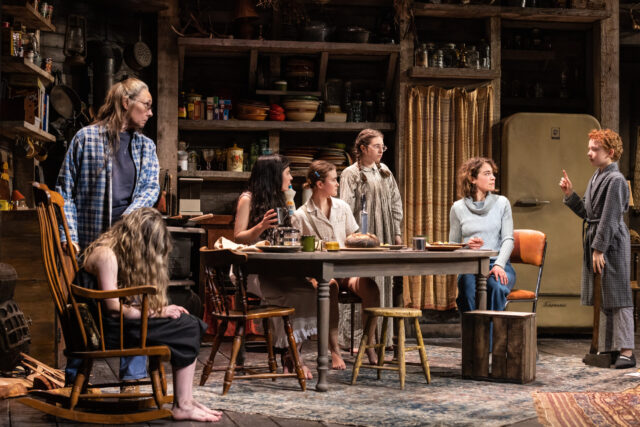
A Doll’s House cast is dressed in black and cast in shadows and silhouettes throughout (photo by Emilio Madrid)

About seven years prior, when Nora was pregnant with her first child, Torvald became seriously ill, and Nora financed a trip to Italy that doctors said would cure him. Everyone assumed she got the money from her dying father, but she’s been hiding an ugly truth while scrambling to pay back her debt. She’s been treated like a kid her entire life, so no one believes she can fend for herself or is responsible for any of her family’s success.

“Nora, you’re basically still a child,” Kristine tells her. Torvald calls Nora his “baby” and his “headstrong little bird,” but it’s not spoken like a loving, amorous husband. Dr. Rank suggests she dress for next year’s Halloween as Fortune’s Child. And Nora recalls how her father referred to her as “his little doll and he played with me just like I played with my dolls,” comparing that to how Torvald treats her, particularly when he makes her put on a fisher girl costume and dance like a young fairy at a party. But she wants more, even if she doesn’t know how to express her adult desires.

“You can see how being with Torvald is a lot like being with Papa,” she tells Dr. Rank.

Explaining to Kristine how she has been paying off her debt, she says, “I’ve had some jobs here and there, like I said. Last Christmas I got a big copying job; I stayed up late writing every night for weeks. It was exhausting, but it was also fun, to work hard and make money! I felt kind of like a man.”

As Kristine and Nils jockey for a position at the bank and Torvald worries about how his wife’s actions could jeopardize his reputation, Nora comes to an understanding about who she is and what she wants out of life in a dramatic turnabout that is a statement for women and marginalized people everywhere.

Pulitzer finalist Herzog’s (Mary Jane, 4000 Miles) adaptation focuses directly on Nora, who sits front and center nearly the entire play. Tony nominee Lloyd knows what to do with movie stars on spare sets; his recent productions of Edmond Rostand’s Cyrano de Bergerac at BAM, starring James McAvoy, and Harold Pinter’s Betrayal at the Jacobs on Broadway, with Tom Hiddleston, were both compelling, unique character-driven interpretations that mostly eschewed bombast. In A Doll’s House, all of the actors speak in an even-keeled manner free from sentimentality, save for one outburst by Moayed that feels out of place.

Jon Clark’s superb lighting casts long shadows across the stage and against the back wall, where he illuminates only part of it in a long white horizontal bar, keeping the rest in darkness. Ben and Max Ringham’s sound is highlighted by the offstage voices of Nora’s three children, Ivar, Bob, and Emmy, which emphasizes the kind of pretend world Nora has been thrust into and might not be able to escape from. When Dr. Rank asks Torvald for one of his good cigars and Nora offers to light it for him, there is no cigar and no lighter; a later exchange of objects is also made without actual props. It’s like Nora is play-acting in a doll house. The eerie score, by Alva Noto and the late Ryuichi Sakamoto, keeps an intriguing mystery hanging over everything.

Oscar winner Chastain (The Eyes of Tammy Faye, Zero Dark Thirty), whose only previous appearance on Broadway was in 2012’s The Heiress, is mesmerizing as Nora, commanding the stage with her bold presence for each of the 105 minutes; her character’s ultimate transformation is a bit sudden but powerful nonetheless. The rest of the cast is strong, but this is Chastain’s show, from its unusual start to its radical climax, which will leave some audience members cheering, some laughing, and others gasping.

“After all these years I still haven’t been able to teach Nora how to make a dramatic exit,” Torvald says to Kristine.

Well, she knows now.

DOUGLAS DUNN + DANCERS: GARDEN PARTY

Alexandra Berger, Janet Charleston, and Christopher Williams rehearse Douglas Dunn’s Garden Party (photo by Mimi Gross)

GARDEN PARTY
Douglas Dunn Studio
541 Broadway between Spring & Prince Sts., third floor
April 24-30, $15-$20
www.douglasdunndance.com
www.mimigross.com

All dancer and choreographer Douglas Dunn needed to do was give Mimi Gross the title of his new production and the painter, set and costume designer, installation artist, and teacher was off to the races.

Born in California in 1942, Dunn has been collaborating with Gross, a native New Yorker born in 1940, since Dunn presented Foot Rules in 1979; they’ve worked together some two dozen times since, including on 1980’s Echo, 1981’s Skid, 1988’s Matches, 1995’s Caracole, 2007’s Zorn’s Lemma, and 2017’s Antipodes. They met quite serendipitously.

“I’d been working with Charles Atlas on film, video, and costumes for several years. Being then in a moment unavailable, he suggested Mimi,” Dunn explained via email. “She made wonderful apparel for an hour-long duet for Deborah Riley and me called Foot Rules. What I noticed right away was her love of color.”

“Charlie Atlas was presenting live performances which he made up and directed. That is how I first met Charlie, and then I met Douglas,” Gross added. “They had been making dances and videos together. When Douglas asked Charlie if he could make some costumes for a new dance he was choreographing with Deborah Riley, Charlie was super busy — he was working with Merce Cunningham full-time — and recommended me to do it. I had made many costumes for movies with cardboard and hot glue . . . nothing to be washed! Or worn many times! Quite a challenge. Of course, I said sure. And then through the decades on and off we have shared many projects, sets and costumes, sometimes sets, sometimes costumes, sometimes both — very open, warm, clear mutual caring to work within our shared possibilities, never knowing how it will come out.”

Douglas Dunn emerges from his pulpit in Mimi Gross’s fantastical Garden Party installation (photo by twi-ny/mdr)

Dunn and Gross are currently at work on their latest project, Garden Party, which runs April 24-30 at Douglas Dunn + Dancers’ SoHo loft studio. Last week I attended a rehearsal of the sixty-minute piece, which features Dunn, Grazia Della-Terza, Alexandra Berger, Janet Charleston, Vanessa Knouse, Emily Pope, Paul Singh, Jin Ju Song-Begin, Timothy Ward, and Christopher Williams moving through the spectacular space created by Gross, consisting of lushly painted trompe l’oeil walls and ceiling and a long horizontal mirror, covered with pink, yellow, and green flowers, plants and trees, clouds, raindrops, and more. While the plants at the right are fake — Dunn told me at the rehearsal that he had “planted” some of them himself — the greenery at the left is real, repurposing the plants that were already in the studio.

There’s also a colorful pulpit where Dunn spends much of the show; he had specifically requested it, asking for it to be based on the design at Grace Church on Broadway. The dancers glide across the floor like blossoming flowers, in solos, pas de deux, and trios, celebrating birth, life, and growth; however, the soundtrack of pop and classical songs (Robert de Visée, John Lennon & Yoko Ono, Bach, Mark Knopfler & Emmylou Harris, more), birdsong, and poetry (by John Keats, Anne Waldman, Molière, Rainer Maria Rilke, John Milton, Stephanie Jacco, and others, read by Dunn, Waldman, Jacco, and Della-Terza) touch on loss and loneliness. A few of the dancers occasionally sit on an inviting white park bench, and Dunn clutches a plush bird named April.

“Mimi always helps me see color; I always see line first,” Dunn explained. “We got along just fine and knew right away how much to interact and how much to let the other alone. She often saw historical references in the dancing and she’d take off from there. We’re both dead serious but also insistent on having a good warm time relating when preparing for a new dance show. The feel of this evening was clear to me the day the title hit me (about three years ago, the pandemic postponing the project). The lavish beauty of Mimi’s set completely fulfills my initial intuition . . . as if she’d read my dancing mind.”

Douglas Dunn’s Garden Party runs April 24-30 in SoHo loft studio (photo by Jacob Burckhardt, 2023)

“The new dance had been talked about a long while ago,” Gross noted. “All of 2021-22, I made many landscape drawings, and then, when the pandemic seemed to subside, I painted these flowers last summer and called them ‘Feel Good Flowers.’ When Douglas asked me if I would make a garden and sets about ‘Early Spring,’ he said, ‘Fill up the studio.’ That was just what I was doing anyway. I asked him if I could paint it with this stylization, and that I didn’t know exactly how I would do it. He was fine with that. I made a big drawing of a bird and discussed the texture and color with Sue Julien, who fabricated it. Both Sue and David Quinn made an amazing contribution fabricating the costumes from my drawings. Douglas wanted each dancer to be different, with different leg lengths. That is all he had said. I pored over my Ballet Russe books, and Charles James and I made drawings. The only common link is the fluorescent yellow in each costume.”

The collaboration extends to Lauren Parrish, who designed the lighting and projections, and sound designer Jacob Burckhardt. The show will be preceded by live music from guitarist and composer Tosh Sheridan, who has released such albums as Tosh, Tosh Sheridan Trio, and solo/duo.

“All of these plain facts are fine and good and relate our collaborating history, but it is the depth of poetic reality where we really collaborate,” Gross concluded, “by dance and by making an atmosphere for the dance.”

And what an atmosphere Dunn and Gross have created for Garden Party.

PENNY ARCADE: LONGING LASTS LONGER

Who: Penny Arcade
What: One-night only engagement
Where: The Players NYC, 16 Gramercy Park South
When: Thursday, April 27, $35, 8:00
Why: “There is a gentrification that happens to neighborhoods and cities, but there is also a gentrification that happens to ideas,” Penny Arcade says in her solo show Longing Lasts Longer. On April 27, the legendary performance artist and activist will deliver what she calls a “refutation of nostalgia” at the Players NYC for one night only, mixing stand-up comedy, rock and roll, and memoir as she tackles zombie tourists, bookstores, advertising, cupcakes, hipsters, and how the world has changed during her lifetime, and not necessarily for the better.

Born in Connecticut in 1950, she has performed the show more than two hundred times in more than forty cities, including at Joe’s Pub and St. Ann’s Warehouse here in New York. At the Players, where it is being presented by the White Horse Theater Company, she will be joined as always by her longtime collaborator, director, designer, and filmmaker Steve Zehentner, who will create a live soundscape. “Look, people, thinking is hard work,” she says in the eighty-minute piece. “That’s why so few people do it.” Priority table seating is already sold out, but general admission tickets are still available to see this force of nature take on our contemporary society like no one else can.

BROOKLYN BY THE BOOK: LUCINDA WILLIAMS IN CONVERSATION WITH STEVE EARLE

Who: Lucinda Williams, Steve Earle
What: Book launch
Where: Congregation Beth Elohim, 271 Garfield Pl., Brooklyn
When: Monday, April 24, $36.84, 7:00
Why: “Yes, my family was dysfunctional, fucked up. But that’s not what really matters to me. What matters is that I inherited my musical talent from my mother and my writing ability from my father,” Louisiana-born singer-songwriter Lucinda Williams writes in her new memoir, Don’t Tell Anybody the Secrets I Told You (Crown, April 25, $28.99). She also admits about choosing not to attend the 1994 Grammy Awards, where her tune “Passionate Kisses” won for Best Country Song, “The truth is that I was not just self-conscious but also scared. I feared that I didn’t belong. It’s a feeling I’ve been trying to shake my entire life.” She has proved she belongs over the last twenty-nine years, being nominated for a total of seventeen Grammys and winning twice more, for Best Contemporary Folk Album for the amazing Car Wheels on a Gravel Road and Best Female Rock Vocal Performance for “Get Right with God.” Her next album, Stories from a Rock n Roll Heart, featuring such songs as “Stolen Moments” and “New York Comeback,” the latter with background vocals by Bruce Springsteen, is due out June 30.

On April 24, Williams, who finishes up a four-show run at City Winery on Tuesday night, will be at Congregation Beth Elohim with another Bruce collaborator, Steve Earle, to discuss her life and career. Williams and Earle have been longtime friends who joined forces on Earle’s “You’re Still Standin’ There” in 1996, on Williams’s “Joy” in 2004, and for a New Yorker interview with performances during the pandemic, so it promises to be an intimate evening, which is organized by Brooklyn’s Community Bookstore. Tickets are $36.84 and come with a copy of Don’t Tell Anybody the Secrets I Told You.

LUNCH BUNCH

A team of public defenders forms a unique culinary group in Lunch Bunch (photo by Julieta Cervantes)

LUNCH BUNCH
122CC
150 1st Ave. at Ninth St.
Tuesday – Saturday through April 22, $10-$100
playco.org

In their 2006 study “The Cultural Structuring of Mealtime Socialization” published in Wiley InterScience, Elinor Ochs and Merav Shohet write, “Anthropologists have long considered ways in which food preparation, distribution, and consumption authenticate both social order and moral and aesthetic beliefs and values. Less frequently examined are the socialization processes that promote continuity and change across generations in the sociocultural life of food. . . . With this notion of cultural site in mind, mealtimes can be regarded as pregnant arenas for the production of sociality, morality, and local understandings of the world. Mealtimes are both vehicles for and end points of culture.”

Starting in childhood, all of us have experienced mealtime socialization, the good and the bad. At school, we might sit at the cool kids’ table or be left to sit alone, wondering why we’ve been ostracized. I remember when I started my first full-time job after college, I desperately wanted to be asked to join the group that went out for dollar grilled cheeses and shot pool once a week at lunch. Writer Sarah Einspanier and director Tara Ahmadinejad take the concept of the office lunch to a new level in Lunch Bunch, a delectable new collaboration between PlayCo and Clubbed Thumb extended through April 22 at 122CC.

The fifty-five-minute show — the running time just about matches the standard one-hour lunch break — was inspired by a real lunch group at the Bronx Defenders’ office, “a nonprofit that is radically transforming how low-income people in the Bronx are represented in the justice system and, in doing so, is transforming the system itself.” Lunch Bunch follows eight public defenders, five of whom use their daily shared lunch hour as a much-needed break from their heavy caseloads, trying to help their clients survive an unnecessarily complex system that too often separates children from parents.

Jacob (Ugo Chukwu) is the ersatz leader of the bunch, a serious gourmet who treats lunch as a way to approach culinary perfection. Only five employees at a time can participate in lunch bunch; each one is assigned a day to prepare lunch for the entire group. Initially, Tuttle (Louisa Jacobson) is Monday, Jacob is Tuesday, Hannah (Jo Mei) is Wednesday, Greg (Francis Mateo) is Thursday, and Tal (Janice Amaya) is Friday.

They prepare such superb fare as lemon tahini goddess noodles with tempeh “bacon” and garlic broccolini; spicy peanut soba noodles topped with shaved carrot and cucumber salad; lentil loaf with sweet potatoes and Brussels sprouts; and BBQ jackfruit sandwich with side arugula pear salad. This is no casserole club.

Jacob (Ugo Chukwu) and Greg (Francis Mateo) talk about more than just lunch in PlayCo / Clubbed Thumb collaboration (photo by Julieta Cervantes)

However, Tal’s vacation to Paris and Tuttle’s conversion to the restrictive Whole30 diet means Jacob has two days to fill. He turns to a pair of new lawyers, Nicole (Julia Sirna-Frest) for Monday and Mitra (Tala Ashe) for Friday, bookending the week. While Mitra looks like she’ll fit in fine, it is clear that Nicole is going to be a problem for Jacob, who is aghast when he learns that Nicole does not know what a cast-iron is.

Over the course of several weeks, the lunch bunch enjoys four mouthwatering meals a week while agonizing over specific cases, complaining about certain judges, going for cries in the coat closet, and sharing tidbits about their personal lives. When Jacob says, “I’m not asking for a Michelin star. I’m asking for a four and a half star Yelp review,” he is essentially talking about more than just what’s for lunch, whether he realizes it or not.

“How do I say this?” the perennially uptight Jacob begins. “I have low ‘expectations,’ little ‘faith,’ when it comes to the law, government, organized religion, things that fall under the umbrella of ‘humanity’ and its ‘systems.’ And soooo, I seek my jollies, my ‘joy,’ my ‘bliss,’ what have you — some semblance of control — in this one area, this one ‘arena,’ of my existence.”

The more Zen-like Greg explains, “It’s about happiness, anxiety, boredom, chronic dissatisfaction, escalating expectations, fixation on achievement, our ultimate aloneness — basically, existential dread — really it’s about the fact that there’s no way our ‘affluent,’ ‘scientific,’ supposedly ‘sophisticated’ world is going to provide us with happiness, and that no matter how much energy we devote to its care the body will give out — eventually.”

At one point, a former lunch buncher named David (David Greenspan) walks past; he now works on the fourth floor but was thrown out of the group for considering pretzels a side dish. He delivers a wickedly delicious monologue that hearkens back to the Stone Age, well before there was anything like Top Chef.

Pain and pleasure intersect as things threaten to reach the boiling point, with Hannah’s eyelid growth getting bigger and Jacob ready to explode at any second.

Jean Kim’s shallow set features seven rolling desk chairs up against a long red wall; the characters sit facing it when they’re working and turn around when they talk to one another and eat. Alice Tavener’s costumes are workplace efficient and pitch-perfect, ranging from Jacob’s blue suit to Greg’s sweater and slacks, the women in well-tailored pants and sharp shoes. The lighting is by Oona Curley, with sound by Ben Vigus.

Mitra (Tala Ashe), Nicole (Julia Sirna-Frest), and Tuttle (Louisa Jacobson) take a break in Lunch Bunch (photo by Julieta Cervantes)

The cast forms a tight-knit unit, with sweet and savory performances by Chukwu as the insensitive Jacob, Ashe as the smart, sassy Mitra, Mateo as the keenly perceptive Greg, Jacobson as the goofy Tuttle, Amaya as the wacky Tal, Mei as the serious Hannah, Greenspan as the mysterious David, and Sirna-Frest as Nicole, who so wants to fit in at her new job, a feeling nearly all of us have had. Einspanier’s funny, barbed dialogue captures the drudgery of what it’s like to work in an office environment, while Ahmadinejad calmly stirs the pot as the tension mounts.

Lunch Bunch is reminiscent of Lynn Nottage’s 2021–22 Broadway play, Clyde’s, about a small group of ex-cons working at a roadside diner who each attempt to create the perfect sandwich, as if doing so would make their life meaningful and solve all their problems.

In the case of Lunch Bunch, it’s public defenders coming up with gourmet meals that could go a long way toward helping them believe they’re more than just cogs in a machine, caught up in an unwinnable game where people’s lives are at stake. Lunch success could also prevent these public servants from experiencing what happened to David, who remembers being “completely alone and . . . utterly defenseless.” The monologues are funny and often poignant, the dialogue deadpan hilarious, instantly relatable to anyone who’s ever worked in an office. Despite the generic, soul-deadening cubicle situation, the actors make the characters sparkle with uniqueness and verve — and somehow, humanity triumphs.

In the 1987 film Wall Street, Gordon Gekko (Michael Douglas) declares, “Lunch is for wimps.” Studies have shown that more than sixty percent of office workers have their lunch alone at their desk, eating what the Atlantic calls “sadwiches.” The famous tumblr Sad Desk Lunch was an instant hit and is still going strong. Some claim that partaking of lunch with fellow employees can boost productivity, while others argue that eating with colleagues can lead to additional stress.

Lunch Bunch is not concerned about any of that data. Instead, it offers up a tasty mélange of lawyers seeking some solace from the everyday grind, using food as a way to lighten their heavy load as well as assert their individuality, rephrasing “You are what you eat” as “You are what you make.” But it turns out it’s not quite as simple as all that.

DIRECTED BY ESTELLE PARSONS

Who: Estelle Parsons, Actors Studio members
What: Seventy-fifth anniversary celebration
Where: The Actors Studio, 432 West Forty-Fourth St. between Ninth & Tenth Aves.
When: April 20-22, free with RSVP
Why: In March 2017, legendary Oscar and Obie winner and five-time Tony nominee Estelle Parsons directed Stephen Adly Guirgis’s The Last Days of Judas Iscariot at LaMama, featuring members of the Actors Studio. As part of its ongoing seventy-fifth anniversary celebration, the influential studio is now presenting “Directed by Estelle Parsons,” in which the ninety-five-year-old Parsons will direct productions of Maria Irene Fornés’s The Danube on April 20 and 21 at 7:00, the first two acts of Anton Chekhov’s Uncle Vanya on April 22 at 2:00, and the new Re-Entry on April 22 at 7:00. Co-associate artistic director of the Actors Studio and the mastermind behind the Theater and Climate Change Series, Parsons won her Oscar for Bonnie and Clyde, made her Broadway debut in 1955 in Happy Hunting, has appeared in such other shows as The Seven Descents of Myrtle, And Miss Reardon Drinks a Little, Miss Margarida’s Way, and Morning’s at Seven, and has directed such other plays as Guirgis’s Our Lady of 121st St., Oedipus, Romeo and Juliet, Macbeth, As You Like It, Salome, and Orgasmo Adulto Escapes from the Zoo. Seating is free and extremely limited, so reserve your spot now.

THE COAST STARLIGHT

TJ (Will Harrison) and Jane (Camila Canó-Flaviá) consider what might be in The Coast Starlight (photo by T. Charles Erickson)

THE COAST STARLIGHT
Lincoln Center Theater at the Mitzi E. Newhouse
150 West 65th St. between Broadway & Amsterdam Ave.
Through April 16, $103
212-362-7600
www.lct.org

Sliding Doors meets Pirandello’s Six Characters in Search of an Author and the Twilight Zone episode “Five Characters in Search of an Exit” in Keith Bunin’s The Coast Starlight, making its New York City debut through April 16 at Lincoln Center’s Mitzi E. Newhouse Theater.

The ninety-five-minute play takes place on board the Coast Starlight, a real Amtrak train that travels from Los Angeles to Seattle in thirty-six hours. The premise is wholly relatable: Various individuals get on the train and sit in the same car, where they wonder about the identity of their fellow travelers and consider what might happen if they engaged one another in conversation. Who hasn’t been on a train, bus, or plane and thought about who was sitting nearby, thinking about who they might be and maybe even saying hello.

“One day, back in 1896, I was crossing over to Jersey on the ferry, and as we pulled out, there was another ferry pulling in, and on it there was a girl waiting to get off,” Mr. Bernstein (Everett Sloane) says in Citizen Kane. “A white dress she had on. She was carrying a white parasol. I only saw her for one second. She didn’t see me at all, but I’ll bet a month hasn’t gone by since that I haven’t thought of that girl.” There’s an inherent sadness in every fleeting glimpse we humans have of each other, that maybe life would have turned out differently if we had made a different choice in that instant.

For years, Missed Connections listings have appeared, first in newspapers and magazines, now online, from people who saw a stranger somewhere, regret not having introduced themselves, and are now trying to find that person. It was captured beautifully in Adrian Tomine’s November 8, 2004, New Yorker cover depicting a young man and a young woman in aligning subway trains, both reading the same book, looking at each other as if they understand they were meant to be together but might never get the chance.

Characters engage in imaginary conversations in moving play at Lincoln Center (photo by T. Charles Erickson)

In The Coast Starlight, the half dozen characters are all heading somewhere, but it’s not necessarily where they want to be going, and their inner and outer journeys could potentially be changed if only they had said something. “It’s an awful thing to feel like you don’t have a home,” Jane (Camila Canó-Flaviá) says about halfway through.

TJ (Will Harrison) is a navy medic about to go AWOL to avoid being sent back to Afghanistan. Jane is an aspiring animator visiting her boyfriend who she may not love anymore. Noah (Rhys Coiro) is a veteran and a drifter caring for his ailing mother. Liz (Mia Barron) is a loud, lively woman who has just ditched her lover at an Extraordinary Couples Workshop. Ed (Jon Norman Schneider) is a harried, drunk traveling salesman working for a questionable invention company. And Anna (Michelle Wilson) is a married mother who has just had to identify the body of her dead brother.

The play is primarily a series of imaginary conversations, as if the characters decided to speak to one another, sharing intimate details of who they are and what they want out of their daily existence.

“I wanted to lean across the aisle and say to her: I have no idea where I’m headed today — I just decided I’d get on a train and head north,” TJ says about Jane, who responds to the audience, “If he’d told me that, I’m not sure what I would’ve said. TJ: “Then I wanted to tell her: I’ve lived in California for a year and till this morning I’ve never been north of San Diego.” Jane: “And then I probably would’ve said: Well, I’ve never been to San Diego.” TJ: “You should definitely go sometime. It’s totally weird.”

“I wanted to tell all of you: Obviously I’m nowhere near the person I intended to be,” Ed says. “But I’m the only person I can be under the circumstances. I know how shitty today was and I hold no illusions about tomorrow.”

These six diverse people are not having their best day, and they have no idea what the future has in store for them. They are lost souls contemplating what happens next, not necessarily looking forward to it. Worried that he’s going to be caught and brought back to face justice for military desertion, TJ says, “Then I remembered nobody could be looking for me because I wasn’t missing yet.”

A whirlwind conclusion brings it all into perspective, focusing on the concept of “What if?”

Arnulfo Maldonado’s set is a rotating platform with six movable train seats. Daniel Kluger’s sound, Lap Chi Chu’s lighting, and Ben Pearcy’s projections (for 59 Productions) makes the audience feel that they’re also on the train, motoring north through gorgeous scenery, although only flashes of light and color stream by. Ásta Bennie Hostetter’s everyday-dress costumes help give identity to the characters.

Directed by Tyne Rafaeli (Epiphany, I Was Most Alive with You), the play occasionally gets lost itself, the dialogue running off the rails; it’s not clear why the stage spins or why the actors continually rearrange their seats, and Kluger’s interstitial music is too standard.

Harrison (Daisy Jones and the Six) is affecting in his off Broadway debut, speaking in a manner that emphasizes how unanchored TJ is. Canó-Flaviá (Dance Nation, Mac Beth) is warm and gentle as Jane, Coiro (Dinner at Eight, Boy’s Life) is compelling as the unpredictable Noah, and Barron (Dying for It, Domesticated) nearly rips the roof off the Newhouse in her entrance scene, screaming into her cellphone as if no one else is around. Wilson (Confederates, Sweat) is touching as Anna, while Schneider (Once Upon a [korean] Time, Awake and Sing!) does his best with a character who is more tangential, not as deeply nuanced.

At one point Jane imagines telling TJ about James Turrell’s Dividing the Light Skyspace at Pomona College. She explains, “The artist who made it, he believes that the sky is way too enormous for us to really comprehend it. So he builds these little rooms all over the world with holes cut in their ceilings so you can look up at the sky like it’s a picture in a frame. It’s so much cooler than I’m making it sound. I promise you’ll never look at the sky the same way again.”

It’s an apt metaphor for the Coast Starlight, both the train and the play. (Notably, Pearcy was an assistant to Turrell for ten years.) I’ve been on long train rides, and I’ve sat several times in Turrell’s first US Skyspace, Meeting, which is on permanent view at MoMA PS1. I’m not sure that, having seen Bunin’s show, I will be more amenable to engage strangers in conversation, but I’m likely to wonder a whole lot more about who they might be.