live performance

LUNCH BUNCH

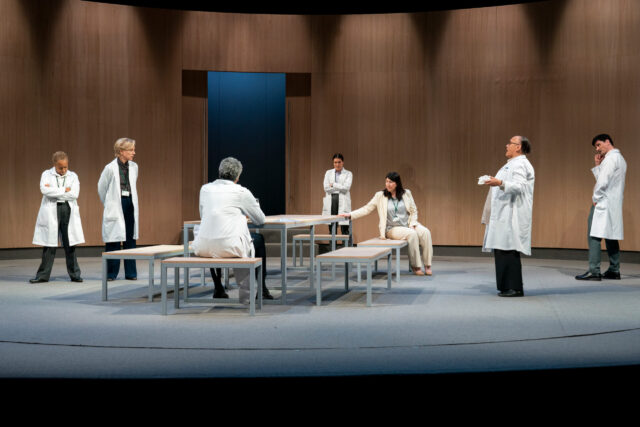
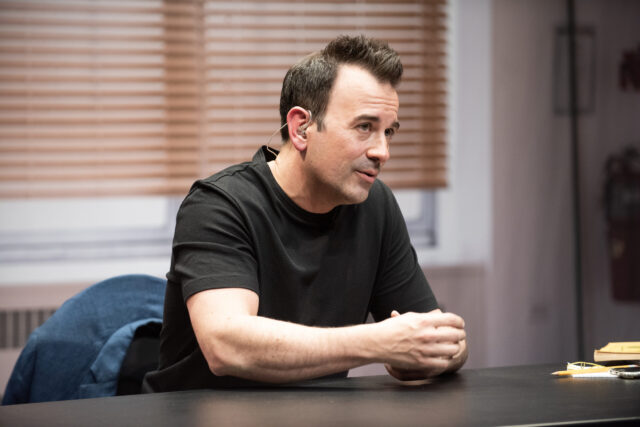
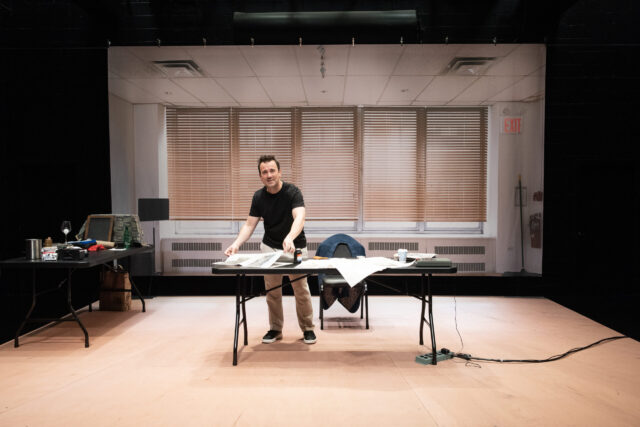
A team of public defenders forms a unique culinary group in Lunch Bunch (photo by Julieta Cervantes)

LUNCH BUNCH
122CC
150 1st Ave. at Ninth St.
Tuesday – Saturday through April 22, $10-$100
playco.org

In their 2006 study “The Cultural Structuring of Mealtime Socialization” published in Wiley InterScience, Elinor Ochs and Merav Shohet write, “Anthropologists have long considered ways in which food preparation, distribution, and consumption authenticate both social order and moral and aesthetic beliefs and values. Less frequently examined are the socialization processes that promote continuity and change across generations in the sociocultural life of food. . . . With this notion of cultural site in mind, mealtimes can be regarded as pregnant arenas for the production of sociality, morality, and local understandings of the world. Mealtimes are both vehicles for and end points of culture.”

Starting in childhood, all of us have experienced mealtime socialization, the good and the bad. At school, we might sit at the cool kids’ table or be left to sit alone, wondering why we’ve been ostracized. I remember when I started my first full-time job after college, I desperately wanted to be asked to join the group that went out for dollar grilled cheeses and shot pool once a week at lunch. Writer Sarah Einspanier and director Tara Ahmadinejad take the concept of the office lunch to a new level in Lunch Bunch, a delectable new collaboration between PlayCo and Clubbed Thumb extended through April 22 at 122CC.

The fifty-five-minute show — the running time just about matches the standard one-hour lunch break — was inspired by a real lunch group at the Bronx Defenders’ office, “a nonprofit that is radically transforming how low-income people in the Bronx are represented in the justice system and, in doing so, is transforming the system itself.” Lunch Bunch follows eight public defenders, five of whom use their daily shared lunch hour as a much-needed break from their heavy caseloads, trying to help their clients survive an unnecessarily complex system that too often separates children from parents.

Jacob (Ugo Chukwu) is the ersatz leader of the bunch, a serious gourmet who treats lunch as a way to approach culinary perfection. Only five employees at a time can participate in lunch bunch; each one is assigned a day to prepare lunch for the entire group. Initially, Tuttle (Louisa Jacobson) is Monday, Jacob is Tuesday, Hannah (Jo Mei) is Wednesday, Greg (Francis Mateo) is Thursday, and Tal (Janice Amaya) is Friday.

They prepare such superb fare as lemon tahini goddess noodles with tempeh “bacon” and garlic broccolini; spicy peanut soba noodles topped with shaved carrot and cucumber salad; lentil loaf with sweet potatoes and Brussels sprouts; and BBQ jackfruit sandwich with side arugula pear salad. This is no casserole club.

Jacob (Ugo Chukwu) and Greg (Francis Mateo) talk about more than just lunch in PlayCo / Clubbed Thumb collaboration (photo by Julieta Cervantes)

However, Tal’s vacation to Paris and Tuttle’s conversion to the restrictive Whole30 diet means Jacob has two days to fill. He turns to a pair of new lawyers, Nicole (Julia Sirna-Frest) for Monday and Mitra (Tala Ashe) for Friday, bookending the week. While Mitra looks like she’ll fit in fine, it is clear that Nicole is going to be a problem for Jacob, who is aghast when he learns that Nicole does not know what a cast-iron is.

Over the course of several weeks, the lunch bunch enjoys four mouthwatering meals a week while agonizing over specific cases, complaining about certain judges, going for cries in the coat closet, and sharing tidbits about their personal lives. When Jacob says, “I’m not asking for a Michelin star. I’m asking for a four and a half star Yelp review,” he is essentially talking about more than just what’s for lunch, whether he realizes it or not.

“How do I say this?” the perennially uptight Jacob begins. “I have low ‘expectations,’ little ‘faith,’ when it comes to the law, government, organized religion, things that fall under the umbrella of ‘humanity’ and its ‘systems.’ And soooo, I seek my jollies, my ‘joy,’ my ‘bliss,’ what have you — some semblance of control — in this one area, this one ‘arena,’ of my existence.”

The more Zen-like Greg explains, “It’s about happiness, anxiety, boredom, chronic dissatisfaction, escalating expectations, fixation on achievement, our ultimate aloneness — basically, existential dread — really it’s about the fact that there’s no way our ‘affluent,’ ‘scientific,’ supposedly ‘sophisticated’ world is going to provide us with happiness, and that no matter how much energy we devote to its care the body will give out — eventually.”

At one point, a former lunch buncher named David (David Greenspan) walks past; he now works on the fourth floor but was thrown out of the group for considering pretzels a side dish. He delivers a wickedly delicious monologue that hearkens back to the Stone Age, well before there was anything like Top Chef.

Pain and pleasure intersect as things threaten to reach the boiling point, with Hannah’s eyelid growth getting bigger and Jacob ready to explode at any second.

Jean Kim’s shallow set features seven rolling desk chairs up against a long red wall; the characters sit facing it when they’re working and turn around when they talk to one another and eat. Alice Tavener’s costumes are workplace efficient and pitch-perfect, ranging from Jacob’s blue suit to Greg’s sweater and slacks, the women in well-tailored pants and sharp shoes. The lighting is by Oona Curley, with sound by Ben Vigus.

Mitra (Tala Ashe), Nicole (Julia Sirna-Frest), and Tuttle (Louisa Jacobson) take a break in Lunch Bunch (photo by Julieta Cervantes)

The cast forms a tight-knit unit, with sweet and savory performances by Chukwu as the insensitive Jacob, Ashe as the smart, sassy Mitra, Mateo as the keenly perceptive Greg, Jacobson as the goofy Tuttle, Amaya as the wacky Tal, Mei as the serious Hannah, Greenspan as the mysterious David, and Sirna-Frest as Nicole, who so wants to fit in at her new job, a feeling nearly all of us have had. Einspanier’s funny, barbed dialogue captures the drudgery of what it’s like to work in an office environment, while Ahmadinejad calmly stirs the pot as the tension mounts.

Lunch Bunch is reminiscent of Lynn Nottage’s 2021–22 Broadway play, Clyde’s, about a small group of ex-cons working at a roadside diner who each attempt to create the perfect sandwich, as if doing so would make their life meaningful and solve all their problems.

In the case of Lunch Bunch, it’s public defenders coming up with gourmet meals that could go a long way toward helping them believe they’re more than just cogs in a machine, caught up in an unwinnable game where people’s lives are at stake. Lunch success could also prevent these public servants from experiencing what happened to David, who remembers being “completely alone and . . . utterly defenseless.” The monologues are funny and often poignant, the dialogue deadpan hilarious, instantly relatable to anyone who’s ever worked in an office. Despite the generic, soul-deadening cubicle situation, the actors make the characters sparkle with uniqueness and verve — and somehow, humanity triumphs.

In the 1987 film Wall Street, Gordon Gekko (Michael Douglas) declares, “Lunch is for wimps.” Studies have shown that more than sixty percent of office workers have their lunch alone at their desk, eating what the Atlantic calls “sadwiches.” The famous tumblr Sad Desk Lunch was an instant hit and is still going strong. Some claim that partaking of lunch with fellow employees can boost productivity, while others argue that eating with colleagues can lead to additional stress.

Lunch Bunch is not concerned about any of that data. Instead, it offers up a tasty mélange of lawyers seeking some solace from the everyday grind, using food as a way to lighten their heavy load as well as assert their individuality, rephrasing “You are what you eat” as “You are what you make.” But it turns out it’s not quite as simple as all that.

DIRECTED BY ESTELLE PARSONS

Who: Estelle Parsons, Actors Studio members
What: Seventy-fifth anniversary celebration
Where: The Actors Studio, 432 West Forty-Fourth St. between Ninth & Tenth Aves.
When: April 20-22, free with RSVP
Why: In March 2017, legendary Oscar and Obie winner and five-time Tony nominee Estelle Parsons directed Stephen Adly Guirgis’s The Last Days of Judas Iscariot at LaMama, featuring members of the Actors Studio. As part of its ongoing seventy-fifth anniversary celebration, the influential studio is now presenting “Directed by Estelle Parsons,” in which the ninety-five-year-old Parsons will direct productions of Maria Irene Fornés’s The Danube on April 20 and 21 at 7:00, the first two acts of Anton Chekhov’s Uncle Vanya on April 22 at 2:00, and the new Re-Entry on April 22 at 7:00. Co-associate artistic director of the Actors Studio and the mastermind behind the Theater and Climate Change Series, Parsons won her Oscar for Bonnie and Clyde, made her Broadway debut in 1955 in Happy Hunting, has appeared in such other shows as The Seven Descents of Myrtle, And Miss Reardon Drinks a Little, Miss Margarida’s Way, and Morning’s at Seven, and has directed such other plays as Guirgis’s Our Lady of 121st St., Oedipus, Romeo and Juliet, Macbeth, As You Like It, Salome, and Orgasmo Adulto Escapes from the Zoo. Seating is free and extremely limited, so reserve your spot now.

THE COAST STARLIGHT

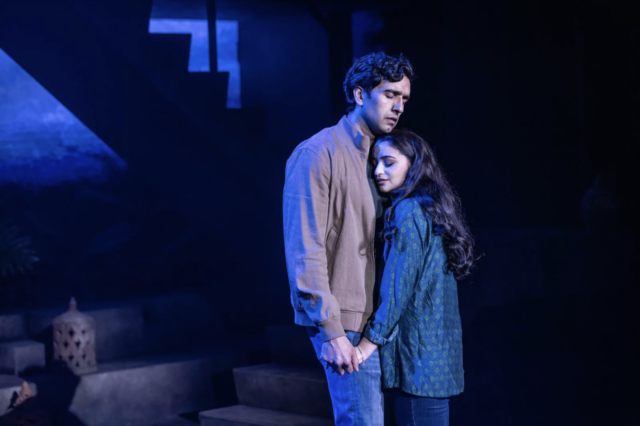
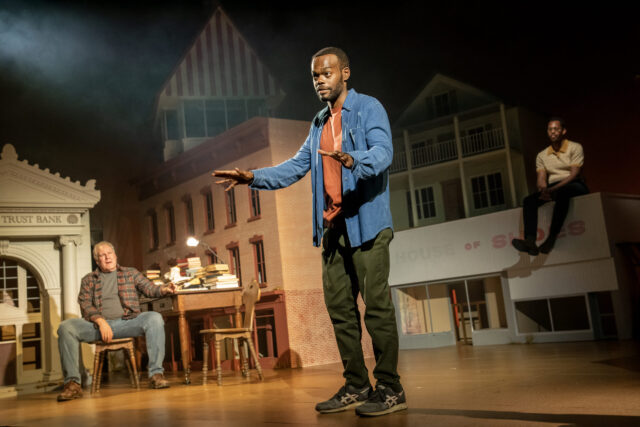
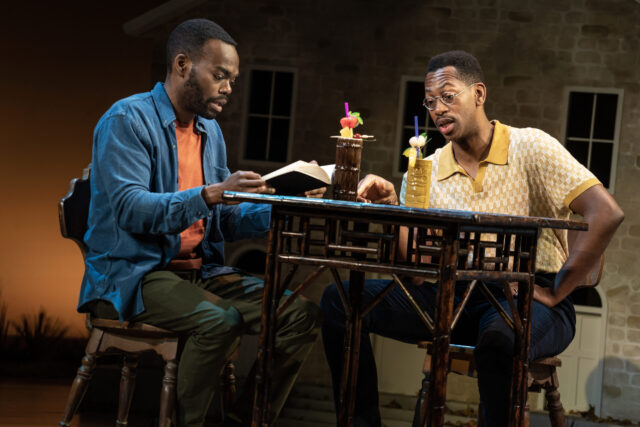
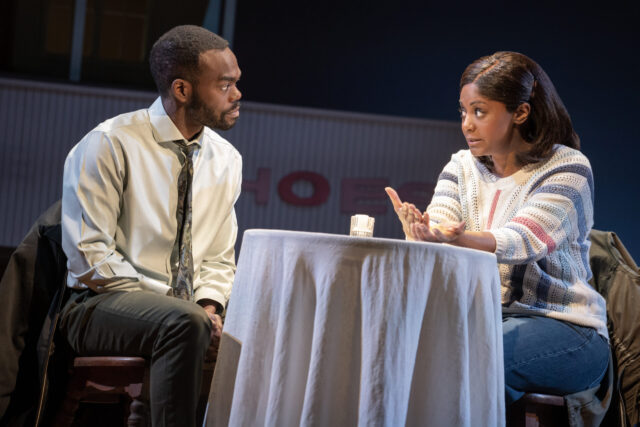
TJ (Will Harrison) and Jane (Camila Canó-Flaviá) consider what might be in The Coast Starlight (photo by T. Charles Erickson)

THE COAST STARLIGHT
Lincoln Center Theater at the Mitzi E. Newhouse
150 West 65th St. between Broadway & Amsterdam Ave.
Through April 16, $103
212-362-7600
www.lct.org

Sliding Doors meets Pirandello’s Six Characters in Search of an Author and the Twilight Zone episode “Five Characters in Search of an Exit” in Keith Bunin’s The Coast Starlight, making its New York City debut through April 16 at Lincoln Center’s Mitzi E. Newhouse Theater.

The ninety-five-minute play takes place on board the Coast Starlight, a real Amtrak train that travels from Los Angeles to Seattle in thirty-six hours. The premise is wholly relatable: Various individuals get on the train and sit in the same car, where they wonder about the identity of their fellow travelers and consider what might happen if they engaged one another in conversation. Who hasn’t been on a train, bus, or plane and thought about who was sitting nearby, thinking about who they might be and maybe even saying hello.

“One day, back in 1896, I was crossing over to Jersey on the ferry, and as we pulled out, there was another ferry pulling in, and on it there was a girl waiting to get off,” Mr. Bernstein (Everett Sloane) says in Citizen Kane. “A white dress she had on. She was carrying a white parasol. I only saw her for one second. She didn’t see me at all, but I’ll bet a month hasn’t gone by since that I haven’t thought of that girl.” There’s an inherent sadness in every fleeting glimpse we humans have of each other, that maybe life would have turned out differently if we had made a different choice in that instant.

For years, Missed Connections listings have appeared, first in newspapers and magazines, now online, from people who saw a stranger somewhere, regret not having introduced themselves, and are now trying to find that person. It was captured beautifully in Adrian Tomine’s November 8, 2004, New Yorker cover depicting a young man and a young woman in aligning subway trains, both reading the same book, looking at each other as if they understand they were meant to be together but might never get the chance.

Characters engage in imaginary conversations in moving play at Lincoln Center (photo by T. Charles Erickson)

In The Coast Starlight, the half dozen characters are all heading somewhere, but it’s not necessarily where they want to be going, and their inner and outer journeys could potentially be changed if only they had said something. “It’s an awful thing to feel like you don’t have a home,” Jane (Camila Canó-Flaviá) says about halfway through.

TJ (Will Harrison) is a navy medic about to go AWOL to avoid being sent back to Afghanistan. Jane is an aspiring animator visiting her boyfriend who she may not love anymore. Noah (Rhys Coiro) is a veteran and a drifter caring for his ailing mother. Liz (Mia Barron) is a loud, lively woman who has just ditched her lover at an Extraordinary Couples Workshop. Ed (Jon Norman Schneider) is a harried, drunk traveling salesman working for a questionable invention company. And Anna (Michelle Wilson) is a married mother who has just had to identify the body of her dead brother.

The play is primarily a series of imaginary conversations, as if the characters decided to speak to one another, sharing intimate details of who they are and what they want out of their daily existence.

“I wanted to lean across the aisle and say to her: I have no idea where I’m headed today — I just decided I’d get on a train and head north,” TJ says about Jane, who responds to the audience, “If he’d told me that, I’m not sure what I would’ve said. TJ: “Then I wanted to tell her: I’ve lived in California for a year and till this morning I’ve never been north of San Diego.” Jane: “And then I probably would’ve said: Well, I’ve never been to San Diego.” TJ: “You should definitely go sometime. It’s totally weird.”

“I wanted to tell all of you: Obviously I’m nowhere near the person I intended to be,” Ed says. “But I’m the only person I can be under the circumstances. I know how shitty today was and I hold no illusions about tomorrow.”

These six diverse people are not having their best day, and they have no idea what the future has in store for them. They are lost souls contemplating what happens next, not necessarily looking forward to it. Worried that he’s going to be caught and brought back to face justice for military desertion, TJ says, “Then I remembered nobody could be looking for me because I wasn’t missing yet.”

A whirlwind conclusion brings it all into perspective, focusing on the concept of “What if?”

Arnulfo Maldonado’s set is a rotating platform with six movable train seats. Daniel Kluger’s sound, Lap Chi Chu’s lighting, and Ben Pearcy’s projections (for 59 Productions) makes the audience feel that they’re also on the train, motoring north through gorgeous scenery, although only flashes of light and color stream by. Ásta Bennie Hostetter’s everyday-dress costumes help give identity to the characters.

Directed by Tyne Rafaeli (Epiphany, I Was Most Alive with You), the play occasionally gets lost itself, the dialogue running off the rails; it’s not clear why the stage spins or why the actors continually rearrange their seats, and Kluger’s interstitial music is too standard.

Harrison (Daisy Jones and the Six) is affecting in his off Broadway debut, speaking in a manner that emphasizes how unanchored TJ is. Canó-Flaviá (Dance Nation, Mac Beth) is warm and gentle as Jane, Coiro (Dinner at Eight, Boy’s Life) is compelling as the unpredictable Noah, and Barron (Dying for It, Domesticated) nearly rips the roof off the Newhouse in her entrance scene, screaming into her cellphone as if no one else is around. Wilson (Confederates, Sweat) is touching as Anna, while Schneider (Once Upon a [korean] Time, Awake and Sing!) does his best with a character who is more tangential, not as deeply nuanced.

At one point Jane imagines telling TJ about James Turrell’s Dividing the Light Skyspace at Pomona College. She explains, “The artist who made it, he believes that the sky is way too enormous for us to really comprehend it. So he builds these little rooms all over the world with holes cut in their ceilings so you can look up at the sky like it’s a picture in a frame. It’s so much cooler than I’m making it sound. I promise you’ll never look at the sky the same way again.”

It’s an apt metaphor for the Coast Starlight, both the train and the play. (Notably, Pearcy was an assistant to Turrell for ten years.) I’ve been on long train rides, and I’ve sat several times in Turrell’s first US Skyspace, Meeting, which is on permanent view at MoMA PS1. I’m not sure that, having seen Bunin’s show, I will be more amenable to engage strangers in conversation, but I’m likely to wonder a whole lot more about who they might be.

WEATHERING

Humanity gets caught up in the maelstrom in Faye Driscoll’s Weathering (photo by Maria Baranova / courtesy New York Live Arts)

WEATHERING
New York Live Arts
219 West Nineteenth St. between Seventh & Eighth Aves.
April 5-8, 12-15, $32-$50, 7:30
212-924-0077
newyorklivearts.org
www.fayedriscoll.com

Faye Driscoll’s latest work, Weathering, is, well, everything.

The seventy-minute piece, continuing at New York Live Arts through April 15, takes place on a squishy white movable platform raft designed by Jake Margolin and Nick Vaughan. The audience sits on all four sides of the object. One by one, ten performers — James Barrett, Kara Brody, Miguel Alejandro Castillo, Amy Gernux, Shayla-Vie Jenkins, Jennifer Nugent, Cory Seals, Eliza Tappan, Carlo Antonio Villanueva, and Jo Warren, in Karen Boyer’s costumes of everyday dress, some with backpacks, bags, and other accoutrements — step on and off the platform, eventually all standing in place and freezing, becoming what Driscoll calls a flesh sculpture.

Stage managers Emily Vizina and Ryan Gamblin, in all black, go to opposite corners and gently push the platform so it spins around, extremely slowly at first. The dancers barely move a muscle, but as the platform rotates, you can start to tell that the performers have shifted ever so slightly, lowering a knee, reaching out a hand, turning a foot, almost imperceptibly; the effect is like you are watching a living, creeping flipbook. Soon they begin touching, the connections electrifying, as if the contact is life affirming, which is especially potent as we emerge from Covid restrictions that kept us physically apart from one another. As the bodies interweave, they close gaps, filling spaces of loss and absence.

Performers encounter all five senses while spinning around the New York Live Arts stage (photo by Maria Baranova / courtesy New York Live Arts)

Driscoll incorporates all five senses as she and the stage managers occasionally spray the performers (and the audience) with citrus-smelling water and some of the dancers let out small groans and grunts as they put their mouths on an arm, leg, or neck that approaches them, somewhere in between the hunger for sex and the hunger of zombies seeking sustenance.

As the score builds — the sound and music direction is by Sophia Brous, with live sound and sound design by Ryan Gamblin and composition, field recordings, and sound design by Guillaume Malaret — the raft is spun around faster and faster. Personal items fall haphazardly to the ground: keys, a wallet, cellphones. Clothes start coming off, revealing more of who these people are and challenging what we might have previously thought about them while harkening back to our primeval existence, equating the beginning and the end. Chaos ensues, as the audience tries to capture as much of the action as it possibly can, not wanting to miss a single thing, as if every little movement, every sound, every change could upset the balance of this mini-universe.

Driscoll is telling us to pay attention, letting us know that humanity is failing and we are destroying the planet. The raft, evoking Earth and its orbit, sometimes slides slightly out of control, nearly hitting the people in the first row.

Faye Driscoll’s Weathering continues at NYLA through April 15 (photo by Maria Baranova / courtesy New York Live Arts)

The faster the raft goes, the more the audience is overcome by an intoxicating joy mixed with impending doom; it is absolutely exhilarating to follow each of the performers’ journeys, ten individuals striving to survive on their own and as a group, just as we in the audience are.

The show is accompanied by the companion reader Durations of Short Detail, with short pieces by dramaturg Dages Juvelier Keates (“We Are So Close”), dancer and choreographer Jesse Zaritt (“To Hold and Be Held”), and Driscoll, whose poem “Chariots of Flesh” relates, “We’ve been trembling in the trench for / Days? / Weeks? / Years? / Lifetimes? / Despite thick fog / I am overcome / By the smell of your clean shaven skin / Face, eyes, gaze, nose, mouth, fear / I try to pound you out but you latch onto my arm, / wrap your leg around me and reverse position / You try to pound me out but I latch onto your arm, / wrap my leg around you and reverse position / We are desperate to know the outcome / Desperate to know the outcome / Desperate to know the outcome. . . .”

As she has in such previous pieces as the Thank You for Coming trilogy, You’re Me, and There is so much mad in me, Driscoll investigates the intrinsic relationship between performer and audience, the imperative bond, but there is a lot more at stake in Weathering, nothing less than the future of the human race.

I don’t know that we can save the world through art, but with creators such as Driscoll, we can have a hell of a lot of terrifying fun trying.

MOVEMENT AT THE STILL POINT: AN EVENING OF DANCE

Who: Mark Mann, Sara Mearns, Megan LeCrone, Georgina Pazcoguin, Lloyd Knight, Xin Ying, Terese Capucilli, Skye Mattox, Karla Garcia, David Guzman, Ricardo Zayas, Morgan Marcell, Ryan Vandenboom, Curtis Holland, Rena Butler, Amadeo “Remy” Mangano, Ousmane “Omari” Wiles, Dardo Galletto, Alonso Guzman, Evan Ruggiero, Jie-Hung Connie Shiau, Maleek Washington, Francesca Harper, Carmen de Lavallade, Gus Solomons Jr., more
What: Book launch with live performances
Where: The Joyce Theater, 175 Eighth Ave. at Nineteenth St.
When: Monday, April 10, $81-$131, 7:30
Why: Photographer Mark Mann has assembled quite a group of all-stars to launch his coffee-table book, Still Point: An Ode to Dance (Rizzoli, March 2023, $60), at the Joyce on April 10. The book features photographs of more than 140 people in the dance world, several dozen of whom will be at the Joyce to celebrate with Mann, including New York City Ballet’s Sara Mearns, Martha Graham principals Lloyd Knight and Xin Ying, Broadway’s Skye Mattox and Ryan Vandenboom, voguers Amadeo “Remy” Mangano and Ousmane “Omari” Wiles, tango dancers Dardo Galletto and Alonso Guzman, tap dancer Evan Ruggiero, Ailey II artistic director Francesca Harper, and legends Carmen de Lavallade and Gus Solomons Jr. “Mark is one of a rare breed of photographers who understands dancers: how we move, the way we say things with our bodies that other people say in words, how much we love to perform for an audience — even an audience of one,” Chita Rivera writes in the foreword. “So I put on my top hat, white tie and tails, and we did our own little dance, and it shows in the images he made of me, and of all the dancers in this beautiful collection.”

Misty Copeland is among more than 140 dancers who posed for Mark Mann’s new book (photo courtesy Mark Mann / Rizzoli USA)

The Glasgow-born Mann, who had not photographed the dance community before, was inspired to do the project when commiserating with his sister-in-law, choreographer Loni Landon, about the pandemic lockdown, during which there were no live, in-person performances and Mann’s professional portraiture business had dried up. He accidentally discovered an empty warehouse space on the West Side, where he invited subjects to pose for him, with his beloved medium format Leica S that he calls Gretta. “When our first dancer, Rena Butler, came into the studio in February of 2021, I was speechless,” Mann explained in a statement. “I realized I was watching a performance tailored exclusively for my camera, and for the first few minutes I was so captivated that I actually forgot I was supposed to be taking photos. In that moment, as I began to photograph, my whole life as a photographer was turned upside down.”

In the book, many of the subjects contribute personal thoughts about their chosen discipline. “During the shoots, we spoke to the dancers about identity. The pandemic challenged a lot of us in terms of facing our true selves in a moment when we lost what had defined us,” Landon writes in the afterword. “Everyone figured out how to survive in their own way. It was astonishing to see perseverance paired with vulnerability — the resilience of these artists.” They now take the next step together on April 10 at the Joyce.

PARADE

Lucille (Micaela Diamond) and Leo Frank (Ben Platt) fight for justice in Parade (photo by Joan Marcus)

PARADE
Bernard B. Jacobs Theatre
242 West 45th St. between Broadway & Eighth Ave.
Tuesday – Sunday through August 6, $84-$288
paradebroadway.com

At intermission of the first Broadway revival of Parade, based on a true story of anti-Semitism, racism, and a terrible miscarriage of justice, several colleagues and I asked the same question: “Why is this a musical?” We found out in the far superior second act.

The show, directed by Harold Prince, with music and lyrics by Jason Robert Brown and a book by Oscar and Pulitzer Prize winner Alfred Uhry (Driving Miss Daisy), debuted at the Vivian Beaumont in 1998, running for thirty-nine previews and eighty-four regular performances, earning nine Tony nominations and winning for Best Book and Best Original Score. It is now playing at the Bernard B. Jacobs Theatre, in a version directed by Tony winner Michael Arden that transferred from Encores! at City Center and uses the 2007 Donmar Warehouse production, which included a few different songs from the original.

Parade begins with a prologue set in Marietta, Georgia, in 1862, as a young Confederate soldier (Charlie Webb) sings goodbye to his love and prepares to fight “for these old hills behind me / these old red hills of home. . . . in the land where honor lives and breathes.” The action then shifts to Atlanta in 1913, where the soldier (Howard McGillin), who lost a leg in the Civil War, is determined to help the South rise again, “honor” be damned.

It’s Confederate Memorial Day, and Lucille Frank (Micaela Diamond) wants to go on a picnic with her husband, Leo (Ben Platt), but he instead decides to go to work at the National Pencil Company, her father’s factory where Leo is superintendent. Thirteen-year-old Mary Phagan (Erin Rose Doyle) arrives to collect her pay and is later found murdered in the basement. The police arrest Leo for the crime, but he doesn’t take them very seriously, since he is innocent — but when power-hungry district attorney Hugh Dorsey (Paul Alexander Nolan) starts building a strong case against him, constructed on a series of lies, Leo suddenly faces reality as Lucille seeks to uncover the truth and reveal the conspiracy to railroad her husband.

Mary Phagan (Erin Rose Doyle) enjoys one final moment of life with Frankie Epps (Jake Pedersen) in based-on-fact musical (photo by Joan Marcus)

Among those participating in the frame-up led by Dorsey are National Pencil night watchman Newt Lee (Eddie Cooper), janitor Jim Conley (Alex Joseph Grayson), and Frank family maid Minnie McKnight (Danielle Lee Greaves), all of whom are Black and manipulated because of the color of their skin; Governor Jack Slaton (Sean Allan Krill), who is more concerned with his upcoming reelection campaign than the fate of one perhaps innocent man; Mary’s friend Frankie Epps (Jake Pedersen), who wants to see the murderer “burn in the ragin’ fires of hell forevermore”; right-wing newspaper editor and publisher Tom Watson (Manoel Felciano), who calls out, “Who’s gonna stop the Jew from killin’? Who’s gonna swing that hammer?”; Judge Roan (McGillin), who’d rather be fishing than in court; and Britt Craig (Jay Armstrong Johnson), an ambitious reporter who declares, “Take this superstitious city / Add one little Jew from Brooklyn / Plus a college education and a mousy little wife / And big news! Real big news! / That poor sucker saved my life!” Mary’s distraught mother (Kelli Barrett) is the only one considering forgiveness.

The focus of the show shifts dramatically after intermission, during which Leo remains onstage, in his jail cell, contemplating his fate; while the first act was all over the place, squeezing in too much information alongside oversized production numbers, the second act zeroes in on the touching relationship between Lucille and Leo as they desperately try to prove his innocence. It’s a beautiful, romantic love story, highlighted by a prison picnic Lucille brings to Leo in which she first chastises him for not accepting her assistance. “Do it alone, Leo — do it all by yourself. / You’re the only one who matters after all. / Do it alone, Leo — why should it bother me? / I’m just good for standing in the shadows / And staring at the walls, Leo,” she sings. Later they duet on “This Is Not Over Yet,” as Leo proclaims, “Hail the resurrection of / the south’s least fav’rite son! / It means I made a vow for better! / Two is better than one! / It means the journey ahead might get shorter. / I might reach the end of my rope! / But suddenly, loud as a mortar, there is hope!”

Parade features archival projections throughout (photo by Joan Marcus)

Dane Laffrey’s set is centered by a large wooden platform on which most of the action takes place, evoking a gallows as well as a coffin. There are scattered chairs and pews on either side, where many of the characters sit when they’re not in the scene, which can get confusing, especially for actors who play multiple roles. Susan Hilferty’s period costumes put us right in the 1910s, while Sven Ortel’s projections feature archival photographs of the real people and locations involved in the story, along with newspaper articles and a memorial plaque, a constant, and effective, reminder that this really happened — along with a final shot providing one last shock. Lauren Yalango-Grant and Christopher Cree Grant’s choreography thankfully calms down in the second half. Heather Gilbert’s lighting and Jon Weston’s sound maintains the dark mood surrounding the events. Music director and conductor Tom Murray handles three-time Tony winner Brown’s (The Last Five Years, Mr. Saturday Night) compelling score with a rousing touch, while director Michael Arden (Spring Awakening, Once on This Island) ably navigates through Uhry’s (Driving Miss Daisy, The Last Night of Ballyhoo) busy book. (Notably, Atlanta native Uhry’s great-uncle owned the National Pencil Company at the time of the killing.)

Tony winner Platt (Dear Evan Hansen, The Book of Mormon) and Diamond (The Cher Show, A Play Is a Poem) are wonderful together, portraying a Jewish couple in the Deep South facing bigotry; Platt captures Leo’s unrealistic belief that justice will triumph in the end, while Diamond embodies Lucille’s growth as she confronts what is happening in her beloved hometown. Grayson (Into the Woods, Girl from the North Country) brings down the house with “Feel the Rain Fall,” although, in 2023, it teeters on the edge of appropriation. Courtnee Carter (Once on This Island, Sing Street) as Angela and Douglas Lyons (Chicken & Biscuits, Beautiful) as Riley provide necessary perspective in their duet, “A Rumblin’ and a Rollin’,” in which they assert, “I can tell you this, as a matter of fact, / that the local hotels wouldn’t be so packed / if a little black girl had gotten attacked.” Also providing strong support are Cooper (Assassins, The Cradle Will Rock), Tony nominee Krill (Jagged Little Pill, Honeymoon in Vegas), and Greaves (Hairspray, Rent).

The final projection as the musical ends is a potent reminder that this country still has a long way to go when it comes to entrenched racism, misogyny, and anti-Semitism, in states such as Georgia and too many others that appear determined to continue a legacy of bigotry and hatred, although there is hope with such political stalwarts as Georgia senator Raphael Warnock, the reverend who tells us, before the show starts, to silence our cellphones but, implicitly, not our voices.

JAN TILLEY: EXCERPTS FROM JESUS CHRIST SUPERSTAR

EXCERPTS FROM JESUS CHRIST SUPERSTAR
The Cutting Room
44 East 32nd St. between Madison & Fifth Aves.
Friday, April 7, $40.35, $25 food & beverage minimum per person, 7:30
212-691-1900
thecuttingroomnyc.com
www.jantilley.com

Right after the two Passover seders and before Easter Sunday, rock & roll guitarist and singer Jan Tilley offers a holiday spectacular on Good Friday, an evening of songs from Andrew Lloyd Webber and Tim Rice’s 1971 Broadway smash, Jesus Christ Superstar. Tilley, the cofounder of the Rude Girls and an early portrayer of Krzysztof in Hedwig & the Angry Inch, has led several special concerts at the Cutting Room and will next revive her portrayal of Jesus from last year, with vocalist Lisa McQuade as Judas, singer, composer, and multi-instrumentalist Rachelle Garniez as Mary Magdalene, and singer and actor Joe Dettmore as Simon Zealotes, Pontius Pilate, and King Herod. The band consists of Tilley with Roger Lipson, Tim Brannigan, Paul Leschen, and Junior Pauls, ready to kick some ass on such songs as “What’s the Buzz/Strange Thing, Mystifying,” “Everything’s Alright,” “Heaven on Their Minds,” “I Don’t Know How to Love Him,” and “King Herod’s Song.”

Jan Tilley brings their rock-and-roll take on Jesus Christ Superstar back to the Cutting Room on Good Friday (photo by twi-ny/mdr)

If you haven’t seen Tilley rock out before at their Time Capsule 1970s/’80s shows and Heart tribute, you’re in for a treat. And with Lloyd Webber’s Phantom of the Opera closing on April 16 and his Bad Cinderella living up to its title, this is unquestionably the best Sir Andrew gig in town. (Even Ted Lasso is getting in on it all, making two Jesus Christ Superstar references in its first three episodes of season three.) Tickets are $40.35, with a $25 food and beverage minimum; the menu includes latkes in addition to burgers, salads, tacos, pizzas, and fish.