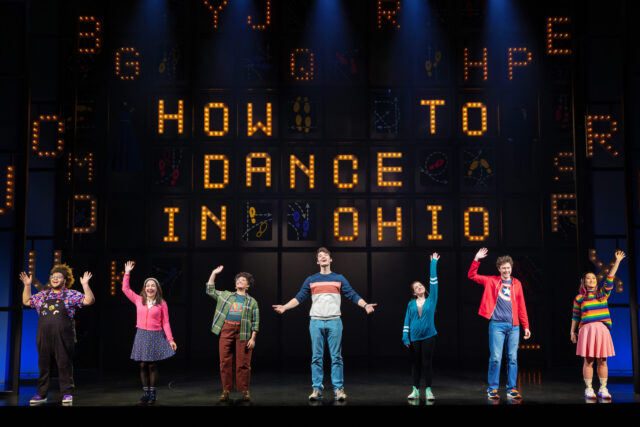
live performance

A CELEBRATION — THE ROOF GARDEN COMMISSION: LAUREN HALSEY

Lauren Halsey’s Met Roof Garden Commission will be activated by live performances and more this weekend (photo by twi-ny/mdr)

the eastside of south central los angeles hieroglyph prototype architecture (I)
Metropolitan Museum of Art, Met Fifth Avenue
The Iris and B. Gerald Cantor Roof Garden
1000 Fifth Ave. at 82nd St.
July 21-23, free with museum admission
Exhibit continues through October 22 (weather permitting)
Admission: $30 adults, children under twelve free (New York State residents pay-what-you-wish)
212-535-7710
www.metmuseum.org
the eastside of south central slideshow

“I get to build the worlds I wish I lived in,” artist Lauren Halsey says in a promotional video about her Met Roof Garden Commission, the eastside of south central los angeles hieroglyph prototype architecture (I). “I collapse all of these worlds: street, pyramid, gorgeous nature, domestic worlds, into one composition to create new opportunities that are about uplift, that are about togetherness.” Wanting to build an Egyptian-style modern-day temple, Halsey studied works at the Met, including the Temple of Dendur, listened to PFunk, and constructed the eastside, which will be part of her community center Summereverything in South Central after the roof show is over.

This weekend Metlivearts will activate the sculpture, which features likenesses of Halsey’s loved ones and influences and carvings of local images and text she’s collected over the last fifteen years, with a series of special events, all free with museum admission and first come, first served. On Friday at 6:30 and 7:30 on the roof, California-born disabled choreographer, dancer, and sound artist Jerron Herman will perform the solo piece LAX, with an ornate costume by unsighted textile artist Sugandha Gupta, as part of Disability Pride Month. On July 22 at 6:00 and 7:15 on the roof, Moten/López/Cleaver will present a new work inspired by the eastside, with Fred Moten on vocals, Brandon López on double bass, and Gerald Cleaver on drums. And on Sunday from 11:00 to 2:00, “A Celebration — The Roof Garden Commission: Lauren Halsey” consists of interactive drop-in stations, a creative writing workshop in the Charles Engelhard Court, a Scent Lab and Architectural Art Making at the Temple of Dendur, and gallery chats on the roof and at the famed temple.

Lauren Halsey Met roof installation features carved text and imagery (photo by twi-ny/mdr)

“This work is aspirational,” Halsey continues in the video. “They’re images around community, transcendence, self-determination, and autonomy. . . . I hope when folks come to the Met and experience my piece, they walk away with a more holistic view about South Central that aren’t about the violence, they aren’t about dread, they’re very much about survival, vibrancy, love. And they also are just into me reinvisioning the hieroglyph as a form to tell stories.”

ADAA CHELSEA GALLERY WALK: NXTHVN WALKTHROUGH AND LIVE PERFORMANCE

“NXTHVN: Reclamation” at Sean Kelly features curator tour, artist discussions, and live performance on July 19 (photo by Jason Wyche / courtesy Sean Kelly)

Who: Cornelia Stokes, Kiara Cristina Ventura, Athena Quispe, Ashanté Kindle, Donald Guevara, Edgar Serrano, Anindita Dutta
What: Curator-led walkthrough, artist discussions, live performance
Where: Sean Kelly Gallery, 475 Tenth Ave. at Thirty-Sixth St.
When: Wednesday, July 19, free, 6:00
Why: In 2016, arts incubator NXTHVN was founded by American artist Titus Kaphar, private equity entrepreneur Jason Price, and Canadian artist Jonathan Brand. Based in two former manufacturing plants in New Haven, Connecticut, the nonprofit’s mission is “to build an alternative model of art mentorship and career advising through a specially designed curriculum, and to simultaneously set into motion significant opportunities for emerging local entrepreneurs.” Sean Kelly Gallery is currently hosting the two-floor exhibition “NXTHVN: Reclamation,” continuing through August 11, featuring painting, drawing, collage, video, sculpture, installation, and performance by six artists from NXTHVN’s Cohort 04 Fellowship Program: Anindita Dutta, Donald Guevara, Ashanté Kindle, Athena Quispe, Edgar Serrano, and Capt. James Stovall V.

On July 19, as part of ADAA Chelsea Gallery Walk, the gallery will present a walkthrough of the show at 6:00, led by NXTHVN curatorial fellows Cornelia Stokes and Kiara Cristina Ventura, joined by Quispe, Kindle, Guevara, and Serrano, who will discuss their contributions. “It is in this dance that the display of contradictory bodies and settings superimposed and cut together become a new whole; the cyborg of cultural mixture in a new virtualized arena where the procession of time can be known but not yet felt,” Guevara says of his work.

At 6:30, there will a live performance by Dutta, who uses such found materials as clothing, shoes, fabric, rawhide, chairs, and horns to take on gender conflict, sexual violence, and impermanence. “When victims and perpetrators remain silent about heinous crimes, the truth remains obscured and inaccessible,” she notes in her artist statement. “I wonder who holds the truth? Who is the witness to the events that transpired? Who is the knower of all thoughts and feelings, pain and suffering, stigma, and depression?”

KOREAN ARTS WEEK AT LINCOLN CENTER: ONE DANCE BY SEOUL METROPOLITAN DANCE THEATRE

SUMMER FOR THE CITY AT LINCOLN CENTER: ONE DANCE
David H. Koch Theater at Lincoln Center for the Performing Arts
20 Lincoln Center Plaza
July 20-22, $24-$190 (use code KCCNYOD for 20% discount)
Korean Arts Week runs July 19-22, free
www.davidhkochtheater.com
www.lincolncenter.org

“All on the same line, in the same shape, with the same heart, it’s a heartfelt piece that brings us together,” Seoul Metropolitan Dance Theatre artistic director and choreographer Hyejin Jung says in a promotional video for One Dance (Il-mu), making its North American premiere at the David H. Koch Theater during Korean Arts Week, part of Lincoln Center’s Summer for the City program. The four-act, seventy-minute work, which melds traditional and contemporary Korean dance in stunning re-creations, debuted in May 2022 at the Sejong Grand Theater in Seoul.

One Dance is choreographed by Jung, Sung Hoon Kim, and Jae Duk Kim, with music by Jae Duk Kim and mise-en-scène by Ku-ho Jung, incorporating dazzling costumes and such props as bamboo sticks, swords, poles, and ritual objects. “I don’t think the beauty of Korea is an intricate technique but rather a symbolism of emptiness and abundance,” Ku-ho Jung explains in the video. “It’s really important to show the symbolism of the nuances. In fact, the process of staging One Dance was to show the Korean nuances by emptying out a lot of the material and focusing on the moves.”

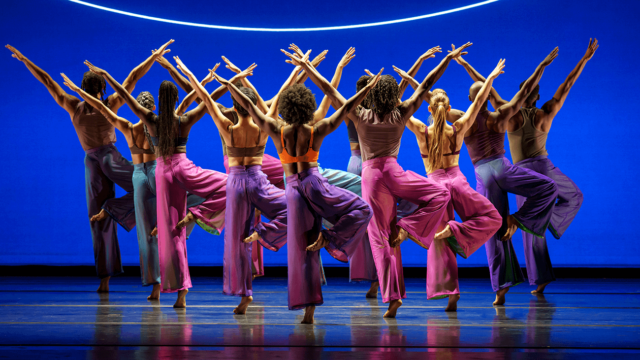
One Dance is divided into four sections — “Munmu”/“Mumu,” “Chunaengmu,” “Jungmu,” and “New Ilmu” — with fifty-four dancers paying homage to courtly processions, ancient martial arts traditions, and contemporary styles through movement, music, and song. Ticket prices begin at $24; you can use code KCCNYOD for a 20% discount.

Korean Arts Week runs July 19-22 and also includes a bevy of free events: the digital artwork WAVE by d’strict, a K-Lit symposium, a family-friendly showcase by KTMDC Dance Company, Musical Theatre Storytime with KPOP composer Helen Park, silent discos with BIAS NYC and DJ Peach, a guided meditation set to Korean traditional music, a screening of Bong Joon Ho’s horror favorite The Host, and concerts by Crying Nut, Say Sue Me, Yerin Baek, Dongyang Gozupa, and Gray by Silver.

BOB DYLAN’S PHILOSOPHY OF MODERN SONG

André De Shields, Odessa Young, and Meshell Ndegeocello will channel the thoughts of Bob Dylan at 92Y on July 17

Who: André De Shields, Odessa Young, Meshell Ndegeocello and Her Band
What: Dramatic reading and musical performance
Where: Kaufmann Concert Hall, 92nd St. Y, 1395 Lexington Ave. at Ninety-Second St.
When: Monday, July 17, $40, 7:30
Why: “The song of the lone wolf, the outsider, the alien, the foreigner, and night owl who’s wheeling and dealing, putting everything up for sale and surrendering his self-interest. On the move aimlessly through the dingy darkness — slicing up the pie of sentimental feelings, dividing it into pieces all the time, exchanging piercing penetrating looks with someone he hardly knows,” Bob Dylan writes about “Stranger in the Night” in his book The Philosophy of Modern Song (Simon & Schuster, $45, November 2022).

He continues, “Tramps and mavericks, the object of each other’s affection, enraptured with each other and creating an alliance — ignoring all the ages of man, the golden age, electronic age, age of anxiety, the jazz age. You’re here to tell a different story, a bird of another feather. You’ve got a tough persona, like a side of beef, and you’re aroused and stimulated, with an ear-to-ear grin, like a Cheshire cat, and you’re rethinking your entire formless life, your entire being is filled with a whiff of this heady ambrosia. Something in your vital spirit, your pulse, something that runs in the blood, tells you that you must have this tender feeling of love now and forever, this essence of devoted love held tightly in your grip — that it’s essential and necessary for staying alive and cheating death. Intruders, oddballs, kooks, and villains, in this gloomy lifeless dark, fight for space. Two rootless alienated people, withdrawn and isolated, opened the door to each other, said Aloha, Howdy, How you doing, and Good Evening. How could you have known that the smooching and petting, eros and adoration was just one break down mambo hustle away — one far sided google eyed look and a lusty leer — that ever since then, that moment of truth, you’ve been steamed up, head over heels, each other’s hearts’ desire. Sweethearts and honeys right from the beginning. Right from the inaugural sidelong sneak peek, the origin — the starting point. Now you’re yoked together, one flesh in perpetuity — into the vast eternity — immortalized.”

A living legend, Dylan himself has been immortalized as the ultimate iconoclastic, unpredictable singer-songwriter rock star over the course of his seven-decade career, during which there has also been an endless debate about the quality of his voice. Dylan himself reads the audiobook, joined by Jeff Bridges, Steve Buscemi, John Goodman, Oscar Isaac, Helen Mirren, Rita Moreno, Sissy Spacek, Alfre Woodard, Jeffrey Wright, and Renée Zellweger. Like him or hate him, Dylan is still a master of vocal phrasing, as a singer and a narrator, in this case delving into sixty-six wide-ranging tunes.

There’s no argument about the mellifluous tones of Emmy, Grammy, and Tony winner André De Shields (Hadestown, Ain’t Misbehavin’), who will be at the 92nd St. Y on July 17 to present dramatic readings from The Philosophy of Modern Song and live musical performances of some of the songs Dylan waxes poetic about in the book; the special Unterberg Poetry Center event, directed by Michael Almereyda (Another Girl Another Planet, Hamlet, Paradise), also features Australian actress Odessa Young (The Daughter, High Life) and German-born American artist Meshell Ndegeocello and Her Band (Plantation Lullabies, Cookie: The Anthropological Mixtape).

Writing about Tin Pan Alley themes, Dylan explains in the book, “It is important to remember that these words were written for the ear and not for the eye. And as in comedy, where a seemingly simple sentence can transform into a joke through the magic of performance, an inexplicable thing happens when words are set to music. The miracle is their union.” That union is what Almereyda, De Shields, Young, and Ndegeocello will be celebrating Monday night at the 92nd St. Y.

THE SAVIOUR

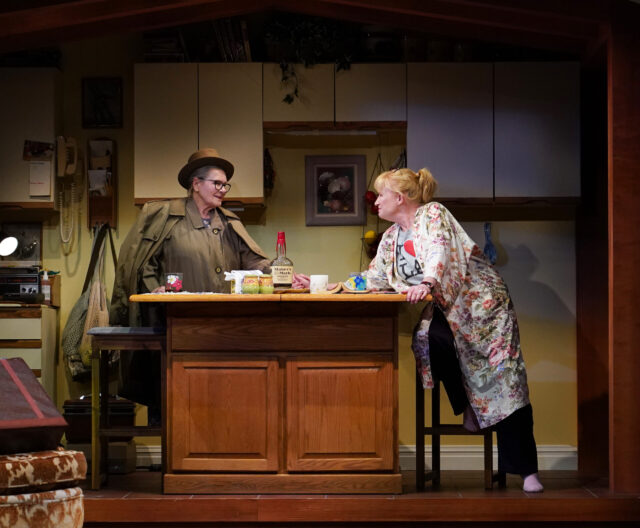
Máire Sullivan (Marie Mullen) glows in the bask of postcoital sex in The Saviour (photo by Carol Rosegg)

THE SAVIOUR
Irish Repertory Theatre, Francis J. Greenburger Mainstage
132 West 22nd St. between Sixth & Seventh Aves.
Tuesday – Sunday through August 13, $50-$90
212-727-2737
irishrep.org

The first half of the world stage premiere of Deirdre Kinahan’s The Saviour at the Irish Rep is gorgeous. On the morning of her sixty-seventh birthday, Máire (Marie Mullen) is basking in the glow of having had sex with a much younger man the night before. Lying in bed with a cigarette, the widowed mother and grandmother, during a long monologue to Jesus, says, “Get a grip on yourself, Máire Sullivan! I can hear you say that, Jesus. And you’re right. Do you know you’re right . . . I’m acting ridiculous. At my age! I hope you’re not getting all jealous now or anything? Are you, Jesus?”

But when a man (Jamie O’Neill) arrives, the play takes a decidedly different tack, one that raises several important issues but also turns its back on what had come before.

A devout Irish Catholic, Máire is in her glory after “heaving and shunting” with Martin. She is explaining herself to Jesus, hoping her lord and savior understands her new feelings. “Sex has always been a means to an end. Foisted on me when I didn’t want it or offered for a bit of peace,” she says. Barefoot and in a long white nightgown (the costumes are by Joan O’Clery), Máire gets up and walks over to her night table, putting on makeup and fixing her hair; there is actually no glass in the mirrors she is using, so we can see her in a frame as she gussies herself up. “I mean, I didn’t even know that sex was possible at my age,” she tells Jesus.

Waiting for Martin to come upstairs with breakfast and coffee, she shares scenes from her hardscrabble life. Her mother died when she was young, so her father, who found work in England, sent her off to the Magdalene Laundries, Irish sweatshops operated by nuns that were primarily a place to hide and punish pregnant teenagers.

“In the convent in Stanhope Street you gave your name away at the door,” she sadly recalls. “And I don’t think Daddy knew that when he put me in there. . . . Stanhope Street wasn’t really a school. A reformatory for whores and hussies! But I wasn’t one of them. Was I? No. I was good,” she says unsurely, as if having to convince herself.

She is haunted by the experience, remembering, “You didn’t ask any questions of the silence. Because we worked in silence. Lived in silence. Silence was our penance . . . for being orphaned girls. Forgotten girls. Bad girls. Or just . . . girls.”

But mostly, she is anticipating Martin coming upstairs and showering her with yet more attention — and sex. But that’s not quite what she has in store for her birthday.

Máire (Marie Mullen) and an unexpected figure (Jamie O’Neill) face some hard truths in The Saviour (photo by Carol Rosegg)

Ciarán Bagnall’s set is a slightly elevated turntable that revolves between the creaky bedroom, highlighted by a cross high on one wall, and the kitchen, with an open space stage right. Bagnall’s lighting and Aoife Kavanagh’s sound turn eerie whenever Máire drifts back into her memories of Stanhope Street, when the show briefly becomes a ghost story.

I cannot begin to tell you how uplifting it was to watch an actress of a certain age portray a woman who is euphoric about having had sex. Tony winner Mullen (The Beauty Queen of Leenane, The Gifts You Gave to the Dark) radiates as Máire details some of the events of the previous night, and the audience celebrates along with her as she carefully brushes her hair and shuffles around the bedroom, animated by this new lease on life, suddenly filled with hope and promise.

But Kinahan (Embargo, Halcyon Days) and director Louise Lowe (The Book of Names, The Party to End All Parties) then pull the rug out from under everyone’s feet when the visitor, ably played by O’Neill (Staging the Treaty, Luck Just Kissed You Hello), starts sharing some difficult truths about Máire, going all the way back to when she was raising her children. The Saviour abruptly becomes an issue play bringing up controversial topics instead of being about an older woman experiencing a positive life change. In addition, it grows repetitive, covering the same angles multiple times.

I felt like it was a kind of theatrical bait-and-switch; it might be my own fault for wanting the play to go in another direction, but, a week later, I still feel let down and betrayed. Perhaps I was so invested in Máire’s exhilaration that I didn’t want anything to get in the way of my enjoyment of that reaction. I can’t help but wonder whether it would have been so bad to have an older, decidedly unglamorous character simply enjoy sex in a show for a full seventy minutes.

But if anything, The Saviour, originally produced online during the pandemic in June 2021, is a distinctly Irish tale, one that delves into family, religion, and societal ills in which happy endings are far from guaranteed.

UNCLE VANYA

Jack Serio’s adaptation of Anton Chekhov’s Uncle Vanya is set in a private Flatiron loft (photo by Emilio Madrid)

UNCLE VANYA
Private Flatiron loft
Wednesday – Monday through July 16, $58.54-$247.54
Extension: August 8 – September 3, $58.37-$275.29 ($39 lottery)
vanyanyc.com

Jack Serio’s superb production of Anton Chekhov’s Uncle Vanya is the theatrical event of the summer, and the one likely to be seen by the fewest people. It’s billed as being “hyper-intimate,” and it lives up to that description in just about every way.

Tickets were released without much fanfare on May 17 and sold out almost immediately; a mere forty seats were available for each of sixteen performances at an undisclosed private loft in the Flatiron District. The day before my show, I got an email advising me of the exact address and letting me know that “seating is general admission on a mix of chairs and comfortable high-back stools.” Because there is only one bathroom inside, we were told, “Please plan accordingly and use the restroom prior to your arrival if possible.” We were also warned not to come earlier than the designated time. “Please do not arrive prior to this time, as we will not be able to admit you into the building. We also cannot allow guests to congregate outside the building prior to or after the performance. Remember, this is a residential building and we’d like to be respectful to our neighbors.”

It made it all seem wonderfully secretive, as if we were part of some kind of clandestine club. There is no signage at the building; I was fully expecting there to be a hush-hush knock before I was led to a tiny elevator that can fit only a few people at a time. We got off at the second floor — stairs are not an option, up or down — where we were met with a large sign with information about the cast and creative team, so I knew I was in the right place. (Note that although the run is sold out, rush lottery tickets are available for each performance.)

The main space is a narrow, rectangular room with two farm tables pushed together at the center. The audience sits on either side, in the first row of chairs or the second row of taller high-back stools. The night I went, more than half the seats already had names on them, so there was a bit of confusion for those whose names were not taped to a seat; several groups of two or three ended up sitting apart from one another because of the scarcity of available, unmarked chairs. (The pricing structure ranges from general admission to reserved, so if you purchased the former, be sure to get there early.) Meanwhile, songs by Bob Dylan and Neil Young played in the background.

Ványa (David Cromer) can’t hide his love for Yeléna (Julia Chan) in hyper-intimate Chekhov production (photo by Emilio Madrid)

Walt Spangler’s cozy set features a working kitchen at one end and a couch beneath a window looking out at the courtyard at the other, with double metal doors leading to the fire escape, which is used as an entrance and exit throughout the show. Stacey Derosier’s lighting consists of two rows of track lights and a handful of carefully placed small stage lights, with flashlights and candles that cast mysterious glows. Carrie Mossman’s props include mirrors and old family photos on exposed brick walls and on the piano in one corner. Christopher Darbassie opts for a naturalistic sound design, which, the night I went, was enhanced by real rain and thunder. Ricky Reynoso’s costumes are contemporary but not fancy, save for Yeléna’s chic dresses, and several characters walk around in socks, slippers, or bare feet.

Serio uses Paul Schmidt’s 1999 translation, which felt fresh and vibrant to me, perhaps because all the recent productions of the play I’ve seen have been radical reimaginings or mashups (Vanya and Sonia and Masha and Spike, New Saloon’s Minor Character: Six Translations of Uncle Vanya at the Same Time, Aaron Posner’s Life Sucks.) in addition to Richard Nelson’s 2018 adaptation for the Hunter Theater Project.

At an undefined time and location — although there are no cell phones — a group of friends and relatives have gathered at a country farm run by Ványa (David Cromer) and his niece, Sónya (Marin Ireland). Sónya’s father, the elderly, ailing professor Alexánder Serebriakóv (Bill Irwin), has arrived from the city with his second wife, the much younger and elegant Yeléna (Julia Chan), with plans on what to do with the estate they are tiring of. Both Ványa and Ástrov (Will Brill), a local doctor, are in love with Yeléna and not afraid to show it. Sónya, whose mother, Ványa’s sister, died many years before, is obsessed with Ástrov but too embarrassed to tell him, as she is afraid that she is too plain for him. Mrs. Voinítsky (Ann McDonough), Sónya’s grandmother, spends most of her time reading, drinking tea, and pontificating on such subjects as principles and change. Telégin (Will Dagger), known as Waffles, lives on the farm and helps out, still faithful to his wife, who left him for another man the day after they were married. And the longtime family nurse, Marína (Virginia Wing), knits and ruminates on the past.

Over the course of a few days, relationships entangle, secret loves are revealed, and one of the most famous gunshots in theater history echoes through the room.

Ástrov (Will Brill) can’t hide his love for Yeléna (Julia Chan) in Uncle Vanya (photo by Emilio Madrid)

Serio (This Beautiful Future, On Set with Theda Bara) maintains a fine line between intimate and immersive or interactive in the two-and-a-half-hour show (with intermission). Although the actors are almost always only a few feet away from the audience, they don’t make eye contact; it’s almost like a fly-on-the-wall documentary of a family falling apart, with no idea how to save itself. Cromer (The Waverly Gallery, A Raisin in the Sun) portrays Ványa as a broken man who seems to have already given up on life, essentially sleepwalking through the days, resigned to never be content. “Oh, God, my mind’s a mess,” he wails.

Brill (A Case for the Existence of God, Oklahoma!) imbues Ástrov with an innate selfishness that is the yin to Ványa’s yang. In this space, Ástrov’s environmentalism is even more prophetic than usual. “We were born with the ability to reason and the power to create and be fruitful, but until now all we’ve done is destroy whatever we see,” he says, talking about more than just trees, an ever-present pencil tucked behind one ear. “The forests are disappearing one by one, the rivers are polluted, wildlife is becoming extinct, the climate is changing for the worse, every day the planet gets poorer and uglier. It’s a disaster!”

You can feel the professor’s pain as Irwin (Old Hats, On Beckett) shuffles across the space, failing to recognize how his decisions impact everyone else, especially Ványa, who says of him, “A retired professor, a has-been, a moldy mackerel with a college degree. He has gout, rheumatism, migraines, his liver’s swollen with jealousy and envy.” Chan (2:22 A Ghost Story, The Great Canadian Baking Show) is alluring as Yeléna, who is well aware of her power over men. Dagger (The Antelope Party, Corsicana) offers welcome interludes as Telégin plays his acoustic guitar.

Sónya (Marin Ireland) can’t hide her love for Ástrov (Will Brill) in Jack Serio’s Uncle Vanya (photo by Emilio Madrid)

But Ireland (On the Exhale, Marie Antoinette), a New York City treasure, steals the show as Sónya, an ingénue who thinks she is ugly and undeserving of happiness. Telling Yeléna of her feelings for Ástrov, she opines, “It hurts so much! And it’s all so hopeless. It’s completely hopeless!” Ireland makes full use of the set; she sits on top of the couch and looks out the window longingly. She jumps on the kitchen island and speaks to Ástrov by tender candlelight. Wearing a baseball cap backward, she contorts her face and body in mesmerizing ways that capture the heartache in her soul. Sónya just wants to love, and be loved; she is the most human character in the play, the one most of us can identify with the closest.

The intimacy — or hyper-intimacy, if you will — allows us to understand the people who populate this farm in a deeply profound way. They exist in a world that is passing them by, stirring our compassion and inspiring us to wish to avoid the same fate.

[Ed. note: The play is being brought back August 8 – September 3 for an encore run, with a few cast changes: Thomas Jay Ryan (Dance Nation, Eureka Day) is taking over as Serebriakóv, with Dario Ladani Sanchez (Juliet & Romeo, a wake for david’s fucked-up face) as Yefim.]

[Mark Rifkin is a Brooklyn-born, Manhattan-based writer and editor; you can follow him on Substack here.]
JUKEBOX HEROES, TAKE TWO: ONCE UPON A ONE MORE TIME / ROCK AND ROLL MAN

Six fairy-tale characters reimagine their future in Once Upon a One More Time (photo by Matthew Murphy)

ONCE UPON A ONE MORE TIME
Marquis Theatre
210 West Forty-Sixth St. between Seventh & Eighth Aves.
Tuesday – Saturday through September 3, $59.75-$319.50
onemoretimemusical.com

In May, I wrote about a pair of jukebox musicals, the extremely disappointing A Beautiful Noise: The Neil Diamond Musical, which unsurprisingly received no Tony nominations, and the absolutely delightful & Juliet, which earned nine nods but unfortunately took home none. The former was a disjointed look at the life and career of the Brooklyn-born megastar, while the latter was a clever follow-up to Shakespeare’s Romeo and Juliet in which his wife, Anne Hathaway, decides to pen a sequel in which Juliet survives and, leaving behind the dead Romeo, heads to Paris to start a new life, set to existing tunes written or cowritten by Swedish producer Max Martin for the Backstreet Boys, Robyn, Demi Lovato, Bon Jovi, Katy Perry, *NSYNC, Justin Timberlake, Britney Spears, and others.

Last week I encountered a similar situation when I saw two new musicals, one an unsatisfying biographical chronicle, the other a surprisingly clever reimagining of a fairy-tale world using nothing but songs by Spears, the Princess of Pop, who has sold nearly 150 million records but has won more Golden Raspberries (3) than Grammys (1).

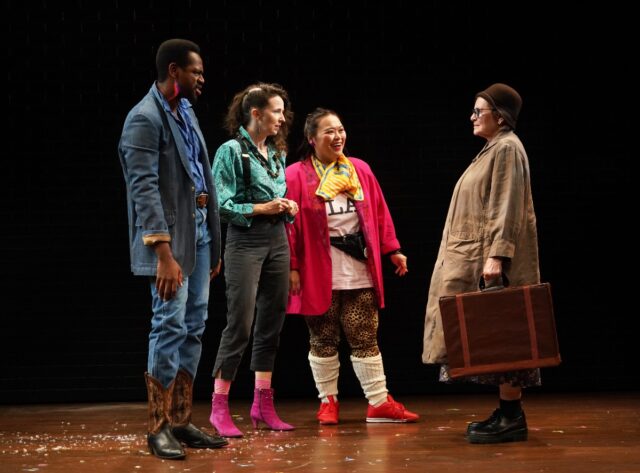
At the Marquis Theatre, Once Upon a One More Time is a load of fun despite a fairly ludicrous setup: After generations of following the rules enforced by the Narrator (Adam Godley), who makes sure to keep every female character in her place from story to story, Cinderella (Briga Heelan), Snow White (Aisha Jackson), Rapunzel (Gabrielle Beckford), Sleeping Beauty (Ashley Chiu), Princess Pea (Morgan Whitley), and Little Mermaid (Lauren Zakrin) start to realize there might be something else out there for them after the O.F.G. — the Original Fairy Godmother (Brooke Dillman) — gives Cin a copy of Betty Friedan’s 1963 game-changer, The Feminine Mystique, which helped usher in second-wave feminism. And they explore their situations through such Spears hits as “Lucky,” “Toxic,” “Womanizer,” “Oops! . . . I Did It Again,” and “. . . Baby One More Time.”

Prince Charming (Justin Guarini) turns out to be quite the dog in Britney Spears musical (photo by Matthew Murphy)

Cinderella is the first to consider that she might have a choice in her future, which upsets the Narrator. “Yes. Listen, I’ve been doing this a long time. And believe me, if I change so much as an intonation, the children go full Rumpelstiltskin,” he tells her. “They want things the same, every time. The narrative is very clear. We’re not here to make fairy tales, we’re here to follow them. Don’t overthink it. Oh, and don’t furrow your brow! We want you delivering lines, not wearing them. There. Better. Happy ever after.”

When Snow notices that Cin appears to be a bit off, she says, “Hey, you seem ‘stuck.’ Doc gives me pills for when I get like that.” Cinderella turns her down, then points out that Snow White’s latest needlepoint, “Happy ever after,” is filled with typos. Snow replies, “Huh. I guess neither of us knows what happy ever after’s supposed to look like. . . . All right, I gotta go get chased through the woods by a terrifying man in pitch blackness.”

When Cin discovers that her Prince Charming (Justin Guarini) is also Snow’s Faithful, the misogyny that is baked into traditional fairy tales rises to the surface and begins to turn things upside down and inside out. Not only do the young women — including Belle (Liv Battista), Goldilocks (Amy Hillner Larsen), and Red (Justice Moore) — start reevaluating the state of their being, but Prince Erudite (Ryan Steele) and Clumsy (Nathan Levy) wonder if they can explore their potential relationship as well. Meanwhile, Cinderella’s Stepmother (Jennifer Simard) and her two stepsisters, Belinda (Ryann Redmond) and Betany (Tess Soltau), lie in wait, willing to play by the rules in order to land Prince Charming or even Prince Brawny (Joshua Daniel Johnson), Mischievous (Kevin Trinio Perdido), Gregarious (Mikey Ruiz), Suave (Josh Tolle), or Affable (Stephen Scott Wormley).

Cinderella (Briga Heelan) discovers a whole new world in a book by Betty Friedan (photo by Matthew Murphy)

If you took Six, & Juliet, Into the Woods, Head Over Heels, Wicked, and Bad Cinderella and put them into a blender, you would come up with something like Once Upon a One More Time. Not all of it works; at two and a half hours with intermission, it is repetitive, and the last fifteen minutes or so should be chopped off, as it basically explains to us what we’ve already seen. The whole Betty Friedan element is still puzzling to me — I understand why they chose that book, but the whole idea of making it a key part of the plot and (sort of) getting away with it is mind-boggling to me — as are the Narrator’s threats to send rule breakers to a place called Story’s End.

Jon Hartmere’s (bare, The Upside) book is otherwise witty and clever, no doubt helped by five-time Tony nominee David Leveaux serving as creative consultant. The crack ten-piece band keeps Spears’s songs down to earth, avoiding haughty orchestrations, although several ballads threaten to go over the top. In their first Broadway show, directors and choreographers Keone and Mari Madrid (Beyond Babel,The Karate Kid) cut loose with ecstatic Spears-inspired dance numbers performed by an exuberant cast.

Anna Fleischle’s appealing set features trees and the facades of houses raised and lowered, an elegant staircase, a multilevel platform laden with stage lighting, a balcony, windowlike screens in the back, and a giant quill in a bubble hanging from the ceiling, daring anyone to grab it and rewrite the fairy tales. Sven Ortel’s projections range from the night sky to scary woods to magic castles, with fanciful lighting and plenty of glowing spots by Kenneth Posner and raucous sound by Andrew Keister.

Many of Loren Elstein’s costumes are based on outfits Spears wore in videos and concerts, with wigs by Nikiya Mathis that further our immersion into all things Britney, as if each fairy-tale character represents a separate part of her history. In her Broadway debut, Heelan is absolutely delightful as Cinderella, a stand-in for anyone ready to burst out with their own story. Jackson (Paradise Square, Waitress) is lovely as Cin’s best friend, Guarini (American Idiot, Wicked) has a field day as the self-absorbed, selfish prince who gets to belt out “Oops! . . . I Did It Again,” and two-time Tony nominee Godley (The Lehman Trilogy, Anything Goes) is just right as the Narrator, who is terrified of change. But two-time Tony nominee Simard (Company, Mean Girls), as she so often does, steals the show as the evil stepmother who always has a plan up her corset.

Once Upon a One More Time bites off more than it can chew, but it’s no poison apple it’s nibbling on but is instead shiny, fresh, and crisp, even if it’s occasionally sour.

While the show is not about Spears’s controversial life — it arrives on Broadway less than two years after Spears was freed from her father’s conservatorship — there are fairy-tale aspects to her early career, followed by bittersweet personal and professional entanglements that titillated the public and impacted her reputation. Once Upon a One More Time helps reestablish that original image.

Leo Mintz (Joe Pantoliano) and Alan Freed (Constantine Maroulis) come up with a plan to spread the gospel of rock and roll in musical (photo © Joan Marcus 2023)

ROCK & ROLL MAN
New World Stages
340 West 50th St. between Eighth & Ninth Aves.
Wednesday – Monday through September 1, $90-$164
rockandrollmanthemusical.com
www.newworldstages.com

When my mother was a teenager in the mid-1950s, she would sneak out of her apartment and catch rock and roll shows at the Brooklyn Paramount, seeing all the greats, the originators of the art form. I grew up with that music, treasuring two small boxes of 45s that contained many of the best singles ever recorded, by Little Richard, Chuck Berry, Jerry Lee Lewis, the Moonglows, the Coasters, the Platters, the Drifters, and others.

All of those artists and more are featured in Rock & Roll Man, a new musical about legendary DJ Alan Freed (Constantine Maroulis) that is making its New York premiere at New World Stages. It opens at the Paramount with Freed’s 1958 Holiday Rock and Roll Extravaganza, kicking off with my favorite song from that era, “Sh-Boom” by the Bronx-based Chords: “Life could be a dream / If I could take you up in paradise up above / If you would tell me I’m the only one that you love / Life could be a dream, sweetheart.” Unfortunately, after a promising beginning, the rest of the show proves not to be a dream of paradise.

The goofy premise is that on the last night of his life, January 20, 1965, amid Beatlemania and the Vietnam War, the Pennsylvania-born Freed is dreaming that he is being tried in an imaginary Court of Public Opinion by Judge Mental (Eric B. Turner) in the trial of The World versus Alan Freed; with the help of his lawyer, Little Richard (Rodrick Covington), Freed must defend his legacy against relentless prosecutor J. Edgar Hoover (Bob Ari), who has charged him with “the destruction of the American way of life by inventing the genre of music which you named rock and roll,” claiming that Freed is a “fraud . . . a modern day snake oil salesman who concocted this foul form of music solely for the purpose of self-promotion and illicit profit . . . then foisted it on our unsuspecting youth, manipulating them into a world of juvenile delinquency, alcohol, narcotics, and . . . SEX!!!!!”

Through flashbacks, Freed returns to Cleveland, where he got his start in radio, teaming up with Record Rendezvous owner and station advertiser Leo Mintz (Joe Pantoliano) to bring rock and roll to the younger generation. Freed immediately draws an integrated audience, with Black and white teenagers listening to his Moondog Show, hanging out at the record store, and going to concerts hosted by Freed and featuring such acts as LaVern Baker (Valisia LeKae).

Constantine Maroulis stars as controversial deejay Alan Freed in Rock & Roll Man (photo © Joan Marcus 2023)

Freed hits the big time when he moves to New York City and WINS, teaming up with Roulette Records owner and Birdland cofounder Morris Levy (Pantoliano), who allegedly associated with the Mafia. When a district attorney asks him, “Is it true you associate with known mobsters like Vinnie the Chin Gigante and other members of the Gambino crime family?,” he replies, “Look, I grew up in New York City. I know a lot of different people, including a few of the gentlemen you just mentioned. I also know Cardinal Spellman. That don’t make me a Catholic. And by the way, the cardinal loves me. He’s a real mensch.”

Freed and Levy present Little Richard, Frankie Lymon (Jamonté) and the Teenagers, Buddy Holly (Andy Christopher), Chuck Berry (Matthew S. Morgan), Jerry Lee Lewis (Dominique Scott), Bo Diddley (Eric B. Turner), and other breakthrough favorites, fighting off the trend of Caucasian crooners like Pat Boone (Christopher) “sucking the soul [right out of Little Richard’s] songs . . . bleaching ’em lily white,” with the original artists not seeing a penny in royalties when they’re played on the radio or on TV. Introducing Boone’s hot new song “Ain’t That a Shame” — first recorded by Fats Domino, who wrote it with Dave Bartholomew — on American Bandstand, host Dick Clark (Scott) calls himself “one of the good guys playing good clean American rock and roll for all you good clean American teenagers.”

But white performers and producers weren’t the only ones on the take; as Freed keeps growing more successful, FBI chief Hoover comes after him, accusing him of not only corrupting children but of accepting payola, setting up a final showdown.

By including new songs alongside classic oldies, Rock & Roll Man sets itself up with a major problem: Gary Kupper’s (Freckleface Strawberry, Consumer Behavior) original music and lyrics are vastly overshadowed by “Sixty Minute Man,” “Rocket 88,” “Lucille,” “See See Rider,” and “Smoke Gets in Your Eyes.” Covington and LeKae rip it up as Little Richard and LaVern Baker, respectively, with strong support from Turner as a singer in multiple groups, far outshining Morgan as Berry and Scott as Jerry Lee. The show might have benefited from a more wide-ranging book from Kupper, Larry Marshak, and Rose Caiola, adding much-needed attention to Freed’s family life; there are perfunctory appearances by his daughter Alana (Anna Hertel) and his wife Jackie (Autumn Guzzardi) — which was not the name of any of his three wives. Notably, one of the producers is Colleen Freed, who is married to Alan’s son Lance from his first marriage.

Rodrick Covington rips it up as Little Richard in Alan Freed biomusical (photo © Joan Marcus 2023)

Director Randal Myler (It Ain’t Nothin’ But the Blues, Hank Williams: Lost Highway), music supervisor and arranger Dave Keyes (with Kupper), and choreographer Stephanie Klemons only lift the show out of first gear when the classic songs are performed, with Keyes on synth, George Naha on guitar, Lee Nadel on bass, Mark Ivan Gross Sr. on reeds, and Rocky Bryant on drums and percussion.

Tim Mackabee’s two-level set morphs from record store to nightclub to radio station to concert stage. Leon Dobkowski’s costumes capture the feel of the era, enhanced by Kelley Jordan’s fab wigs. The projections are by Christopher Ash, with lighting by Matthew Richards and Aja M. Jackson and sound by Ed Chapman.

Tony nominee Maroulis (Rock of Ages, Jekyll & Hyde) has a charm to him but is not given enough character depth, falling short of Tim McIntire’s more energetic portrayal of Freed in Floyd Mutrux’s 1978 film, American Hot Wax. Emmy winner Pantoliano (Great Kills, Frankie and Johnny in the Claire de Lune) seems more at home as Levy than Mintz, and he sings, too. Ari (Bells Are Ringing, Picasso at the Lapin Agile) is like a grizzly bear onstage as several villainous figures.

There’s no need to sneak out of your apartment to see Rock & Roll Man. If you need to hear “Tutti Frutti,” “Maybellene,” “Great Balls of Fire,” “Yakety Yak,” and “Why Do Fools Fall in Love” — and you do — you can always come over to my place and listen to the original pressings on my Victrola.