live performance

LIVE FROM THE GREENE SPACE: THE REVOLVING DOOR

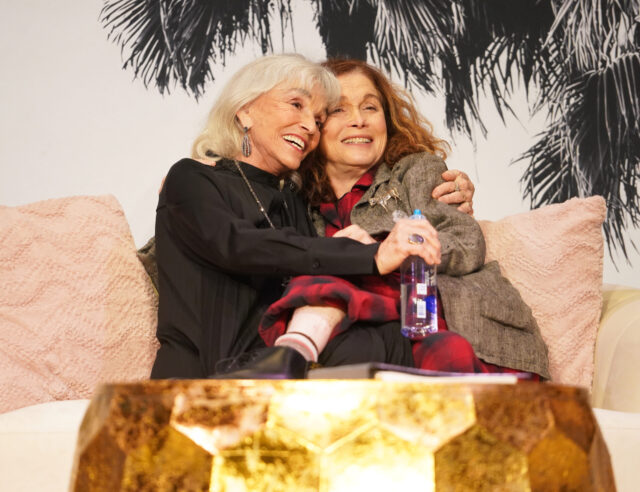
Who: Jessie Eisenberg, Daphne Rubin-Vega, Chad Coleman, David Strathairn
What: Live dramatic reading and discussion from Theater of War Productions
Where: The Greene Space, 44 Charlton St.
When: Monday, July 31, free with RSVP, 7:00
Why: In his May 22 New Yorker article “The Revolving Door,” titled “The System That Failed Jordan Neely” online, Adam Iscoe uses the incident between Jordan Neely and Daniel Penny to examine mental health issues, homelessness, and law enforcement in New York City. On May 1, the thirty-year-old Black Neely died after being put into a chokehold for several minutes by twenty-four-year-old White former marine Daniel Penny on a northbound F train. Iscoe writes, “The N.Y.P.D. questioned Penny, then released him. (His lawyers say that he was acting in self-defense.) ‘We don’t know exactly what happened here,’ Mayor Eric Adams said, afterward. ‘We cannot just blanketly say what a passenger should or should not do in a situation like that.’ Kathy Hochul, the governor of New York, said, ‘There’s consequences for behavior.’ Was she talking about Neely, or the man who killed him?”

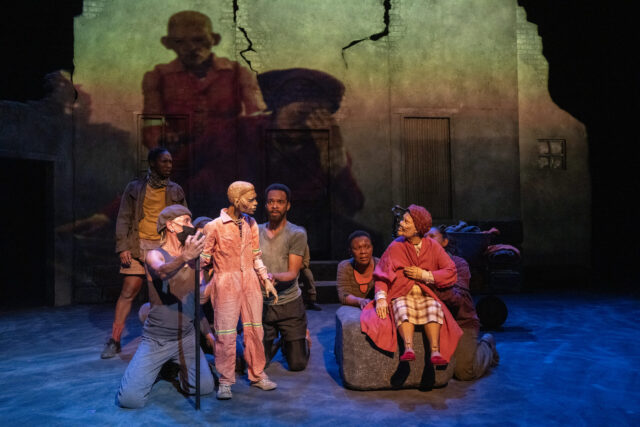
On July 31, the Greene Space will kick off its new series, “Theater of War Productions: Live from the Greene Space,” with a dramatic reading of Iscoe’s article, featuring the all-star cast of Jessie Eisenberg, Daphne Rubin-Vega, Chad Coleman, and David Strathairn. That will be followed by an in-depth guided community discussion with paramedics, psychiatric nurses, case workers, law enforcement, transit workers, the unhoused, those who serve them, and concerned citizens. There is limited in-person seating for the free event at the Greene Space, but everyone is invited to watch the program over Zoom.

Since 2009, Theater of War has been presenting dramatic readings and discussions, pairing classical and modern works with hot-button topics, including Sophocles’s Oedipus, the King with the pandemic and the climate crisis, William Shakespeare’s King Lear with caregiving and death, Aeschylus’s Prometheus Bound with incarceration, Eugene O’Neill’s Long Day’s Journey into Night with addiction and substance abuse, and Sophocles’s Antigone with racialized police violence. The organization, founded by Bryan Doerries, was active during the pandemic, hosting dozens of programs with such participants as Bill Murray, Oscar Isaac, Taylor Schilling, John Turturro, Samira Wiley, Ato Blankson-Wood, Frances McDormand, Keith David, Jeffrey Wright, Kathryn Erbe, and Frankie Faison.

“In and out. Around and around. One institution to the next: 7-Eleven, Kirby Forensic, Atlantic Armory, Manhattan Psychiatric, Maimonides, Lincoln, Kings County, Bellevue,” Iscoe writes. “Tonight, there are more than seventy thousand people without beds of their own sleeping in homeless shelters and temporary-housing programs and other places, too. Some shelters have kitchens that serve freshly stewed chicken thighs and homemade strawberry pie; others serve chicken that is undercooked and mealy apples for dessert. Many shelter beds are seven inches off the ground and bolted to the floor. For the mentally ill, there are forty-nine hundred beds in mental-health shelters, but more than forty-nine hundred people want to sleep in them. And so tonight mentally ill men and women are sleeping in large intake shelters, on the street, in the trains. Tomorrow, they will wake up and go about their day.”

NORTH CIRCULAR

North Circular tells the story of a Dublin road through music and its wide-ranging residents

NORTH CIRCULAR (Luke McManus, 2022)
DCTV Firehouse Cinema
87 Lafayette St.
Opens Friday, July 28
212-966-4510
firehouse.dctvny.org

“All the time I said I’d move away / I’m thinkin’, ‘Gemma, were you going insane?’” Gemma Dunleavy sings to a packed club audience over the closing credits of Luke McManus’s gorgeous, elegiac documentary musical, North Circular, opening July 28 at DCTV Firehouse Cinema.

Shot in stark, emotionally resonant black-and-white that forges a timeless atmosphere, the film takes viewers across all of Dublin’s North Circular Road, from Phoenix Park to Dublin Port, as locals talk about their lives, play music, and rail against gentrification while defending their communities.

“I think the North Circular bears the marks of its history: the marks of power and of privilege . . . Pain and poverty . . . unravelling of lives,” one man says. “The pageantry of empire, but also the reality of its military violence.”

Kids hang out on a stoop on North Circular Road in documentary musical

A slow-moving, often still camera focuses on animals, monuments, cricketers, birds, kids on stoops, construction, a pet shop, a waterfall, a cemetery. It follows a group trying to save the Cobblestone pub. It shows fans of the Bohemian Football Club, known as Bohs, preparing for a match against their archrivals, the Shamrock Rovers, at Dalymount Park. The camera lingers on images — dark passages, fireworks, unique architecture, a helicopter flying over a stadium, a man walking his ferret, the sun, the moon and clouds — making everything and everybody equal. Not a single person in the film is identified, by name, occupation, or otherwise.

A former inmate stands outside Mountjoy Prison and admits, “Not knowing what was going to happen when you went in, and actually not knowing what was going to happen when you came out, because you walked that road, whatever direction you went in. . . . The road took me in a different direction, so to speak. Because the last time I got out I walked out onto the North Circular Road and I took a different route. I took the route of looking for help.”

Along the way, people sing traditional ballads and new dirges in pubs and on the street, including Annie Hughes (“The Blackbird of Avondale”), John Francis Flynn (“The Lag’s Song”), Julie Kavanagh (“Siúil a Rún”), Séan Ó Túama (“An Cualann”), Jerry O’Reilly (“Van Diemen’s Land”), Eoghan O Ceannabháin (“Dark Horse on the Wind”), Ian Lynch (“Banks of the Nile”), and Dunleavy (“Up de Flats”), using guitar, banjo, drums, pennywhistle, and bagpipes.

“I think the hardest thing about the pipes sometimes is listening to them, you know?” a military bagpiper says, worrying that the younger generation is not turning to the instrument. (You can find out more about the music in the film here.)

In his directorial debut, McManus, who has lived just off North Circular Road for twenty years, beautifully weaves together music, dialogue, and imagery; the emotive score features incidental music by Kevin Murphy and Thomas Haugh of Seti the First, in addition to the vocal quartet Landless, that maintains the even-keeled pace.

The documentary was edited by John Murphy with a heart-wrenching, mesmerizing attention to detail; nothing is random. McManus, who cites
Gianfranco Rosi’s Sacro GRA and Zed Nelson’s The Street as inspiration, refers to the film as a “documentary musical,” explaining in a director’s note, “The use of music as a specific technique of storytelling is both an aesthetic and an editorial decision — to make a documentary that combines the musical and the factual film in a way that isn’t simply a documentary about music but is more a documentary
musical.”

North Circular is a paean to what was, what is, and what might be, in Dublin and, essentially, in tight-knit neighborhoods everywhere, particularly when it comes to class, colonialism, and gentrification. “There are people who have lived their whole lives on the road, and it is their world,” one man says. “But there are also people for whom it’s a place of transience. The flow of people is fundamental to the area.” Because in the end, it’s the people who make a place a home.

(There will be five performance Q&As with McManus, Hughes, Maeve O’Boyle, John Riordan, Donal Foreman, John Lee, and the Cobblestone’s Meabh Mulligan opening weekend at DCTV Firehouse Cinema, featuring discussion and music.)

NEW YORK CITY POETRY FESTIVAL 2023

(photo by twi-ny/mdr)

You can relax with a wide range of poetry at annual festival on Governors Island (photo by twi-ny/mdr)

NEW YORK CITY POETRY FESTIVAL 2023
Governors Island
Colonels Row
July 29-30, free with RSVP (donation suggested), 11:00 am – 6:00 pm
newyorkcitypoetryfestival.com
new york city poetry festival slideshow

Hosted by the Poetry Society of New York, the twelfth annual New York City Poetry Festival returns to Governors Island this weekend, honoring Gotham’s literary heritage with stages named after such iconic landmarks as the Algonquin, the White Horse, and Chumley’s. Poets from dozens of publishing houses, university presses, and nonprofit organizations read their works, in addition to the Ring of Daisies open mic and other places where poetry just pops up. There should be lots of booths, with food and drink.

Walking across the big Colonels Row field, you can listen as one poem from one location morphs into one from another and then one from another in a kind of audio rainbow of words and expression. The 2023 headliners are Danez Smith, Franny Choi, Saeed Jones, and torrin a. greathouse. The festival also comes with a content warning, which reads in part: “We at the Poetry Society of New York want to acknowledge that the content of this festival may potentially cover triggering and graphic topics ranging from mental illness to imagery of painful human experiences. We have asked our readers to give content warnings before their readings. . . . We aim to create a safe space for both our readers and our attendees, so please be mindful that you may encounter themes that are uncomfortable to engage with.” The lineup should be posted here any time now.

NUGGETS FIFTIETH ANNIVERSARY CONCERTS

GOLDEN JUBILEE ANNIVERSARY
City Winery New York
25 Eleventh Ave. at Fifteenth St.
Friday, July 28, and Saturday, July 29, $35-$125, 8:00
646-751-6033
citywinery.com

The greatest rock compilation in the history of pop music, Nuggets: Original Artyfacts from the First Psychedelic Era, 1964-1968 was released in October 1972 and led to the creation of generations of rock fans and garage bands. Assembled by Elektra Records founder Jac Holzman and record store employee and music critic Lenny Kaye, the double album consisted of seventy-eight minutes of twenty-seven gems, most under three minutes.

The collection was impeccable, beginning with the Electric Prunes’ “I Had Too Much to Dream (Last Night)” and the Standells’ “Dirty Water” and continuing with the Seeds’ “Pushin’ Too Hard,” the 13th Floor Elevators’ “You’re Gonna Miss Me,” Count Five’s “Psychotic Reaction,” the Leaves’ “Hey Joe,” the Amboy Dukes’ “Baby Please Don’t Go,” Blues Magoos’ “Tobacco Road,” and the Chocolate Watchband’s “Let’s Talk About Girls” before concluding with the Nazz’s “Open My Eyes,” the Premiers’ “Farmer John,” and the Magic Mushrooms’ “It’s-a-Happening.” I have never heard anything like it before or since.

On July 28 and 29, an all-star roster will be at City Winery performing songs from the original double album, the follow-up that was initially shelved, and “Also Dug-Its,” which have been released in a five-LP anniversary edition from Rhino. The additional tunes are from such groups as Love, the Swingin’ Medallions, the Beau Brummels, Syndicate of Sound, and ? & the Mysterians.

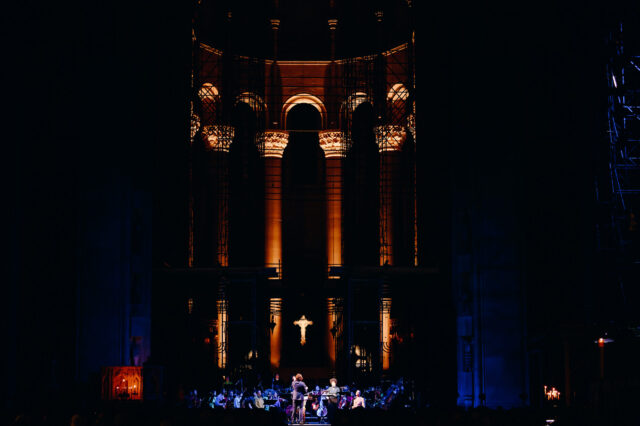
The outrageously cool lineup of musicians includes Patti Smith, Ivan Julian, Peter Buck, James Mastro, Marshall Crenshaw, Joan as Police Woman, Juliana Hatfield, Bob Mould, Steve Wynn, Ed Rogers, Eric Ambel, Mary Lee Kortes, Tom Clark, Vicki Peterson, Richard Lloyd, Link Cromwell, and Tammy Faye playing with the Jubilee house band: Tony Shanahan, Jack Petruzzelli, Glen Burtnik, Dennis Dike, and Kaye himself. A different set of songs will be performed each night.

“Oh Yeah” (the Shadows of Knight), there’s “No Time Like the Right Time” (the Blues Project) to “Run, Run, Run” (the Third Rail) to City Winery and show your “Respect” (the Vagrants), ’cause this ain’t just a bunch of “Talk Talk” (Music Machine); “It’s-a-Happening.”

INAUGURAL HARLEM FESTIVAL OF CULTURE

Who: Adam Blackstone, Bell Biv DeVoe, Cam’ron, Coco Jones, Doug E. Fresh, Eric Bellinger, Fat Joe, Ferg, Jozzy, MAJOR., MA$E, Muni Long, Remy Ma, Ro James, Teyana Taylor, Tink, Wyclef Jean, Patra, Lumidee, Max Glazer, Mr. Killa, Nadine Sutherland, Nina Sky, Rupee, Serani, Wayne Wonder, more
What: First annual Harlem Festival of Culture (HFC)
Where: Randall’s Island
When: July 28-30, $82-$108 per day, VIP $187-$266 per day, weekend bundle $240-$635, 3:00 – 11:00
Why: Questlove’s Oscar- and Grammy-winning 2021 Summer of Soul (. . . Or, When the Revolution Could Not Be Televised) reintroduced the world to the mostly forgotten 1969 Harlem Cultural Festival, when an extraordinary group of performers — including Stevie Wonder, Mahalia Jackson, Nina Simone, the 5th Dimension, the Staple Singers, Gladys Knight & the Pips, Mavis Staples, Blinky Williams, Sly and the Family Stone, and the Chambers Brothers — gathered at what is now Marcus Garvey Park over the course of six Sundays and played their hearts and souls out.

The inaugural Harlem Festival of Culture (HFC), taking place July 28-30 on Randall’s Island, seeks to recapture that feeling with live music, art, food, and more, hosted by MC Lyte. Friday’s lineup features Bell Biv DeVoe, Cam’ron, Doug E. Fresh, Ferg, MA$E, and Estelle Presents “The LinkUp” with Patra, Lumidee, Max Glazer, Mr. Killa, Nadine Sutherland, Nina Sky, Rupee, Serani, and Wayne Wonder. On Saturday’s roster are Jozzy, Major, Muni Long, Teyana Taylor, and Tink. Sunday’s headliner is Wyclef Jean, preceded by Adam Blackstone, Coco Jones, Eric Bellinger, Fat Joe, Remy Ma, and Ro James.

“From the Harlem Renaissance to the Harlem Cultural Festival of 1969 to the Harlem Shake, this community is known worldwide for its immeasurable contributions in fashion, sports, dance, art and music — and has always played an integral role in moving culture forward,” HFC cofounder Yvonne McNair said in a statement. “For this inaugural year, we were very thoughtful and intentional in building what is an amazing lineup that aptly reflects the incredibly unique legacy that is intrinsic to the village of Harlem as well as the breadth and brilliance of Black music and culture.”

LINCOLN CENTER SUMMER FOR THE CITY: THIRD ANNUAL BAAND TOGETHER DANCE FESTIVAL

Who: Ballet Hispánico (BH), Alvin Ailey American Dance Theater (AAADT), American Ballet Theatre (ABT), New York City Ballet (NYCB), Dance Theatre of Harlem (DTH)
What: Free dance festival
Where: Damrosch Park, Lincoln Center for the Performing Arts
When: July 25-29, free, workshops 5:00, performances 7:30 [ed note: The July 28 workshop and performance have been canceled due to extreme heat]
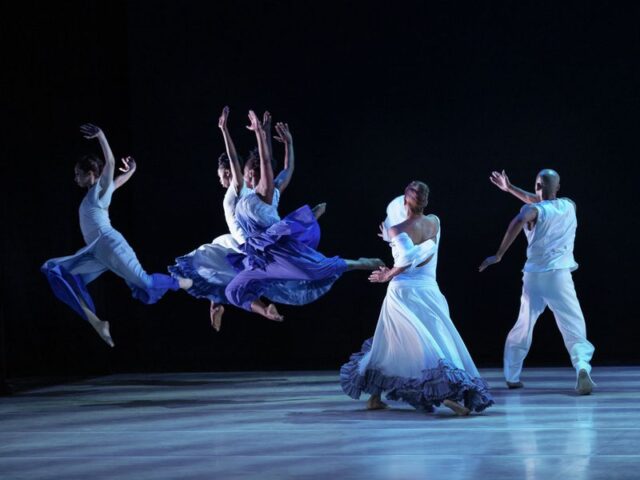
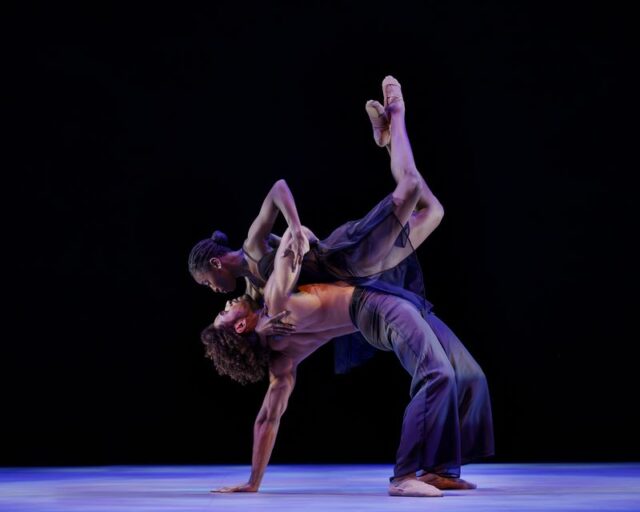
Why: The third annual BAAND Together Dance Festival once again brings together Ballet Hispánico, Alvin Ailey American Dance Theater, American Ballet Theatre, New York City Ballet, and Dance Theatre of Harlem for five nights of free contemporary dance performances on the Damrosch Park stage as part of Lincoln Center’s Summer for the City programming.

Dancers rehearse Pas de O’Farill for BAAND Festival at Lincoln Center this week (photo by Lawrence Sumulong)

From July 25 to 29 at 7:30, the troupes will present one work apiece: BH’s Línea Recta by Annabelle Lopez Ochoa (a unique take on flamenco, set to music by guitarist Eric Vaarzon Morel), ABT’s Other Dances by Jerome Robbins (choreographed for Natalia Makarova and Mikhail Baryshnikov, set to works by Frédéric Chopin), DTH’s Nyman String Quartet No. 2 by Robert Garland (a mix of styles and cultures), the world premiere of the BH/NYCB collaborative duet Pas de O’Farill by Pedro Ruiz (a tribute to Arturo O’Farill), an excerpt from AAADT’s Dancing Spirit by Ronald K. Brown (a tribute to Judith Jamison, with music by Duke Ellington, Wynton Marsalis, and War), and NYCB’s The Times Are Racing by Justin Peck (a sneaker ballet set to songs from Dan Deacon’s 2012 album, America). In addition, each show will be preceded by a workshop at 5:00 led by members of one of the five companies.

“The BAAND Together Dance Festival is a testament to the vibrancy and diversity of the New York City dance community,” the five artistic directors said in a group statement. “We are thrilled to be returning with a spectacular program that features the city’s most internationally revered repertory companies. This year’s program highlights the innovative visions that have made New York City our nation’s dance capital.”

ORPHEUS DESCENDING

Valentine Xavier (Pico Alexander) and Lady Torrance (Maggie Siff) are lost in the dark in Orpheus Descending (photo by Gerry Goodstein)

ORPHEUS DESCENDING
Theatre for a New Audience, Polonsky Shakespeare Center
262 Ashland Pl. between Lafayette Ave. & Fulton St.
Tuesday – Sunday through August 6, $97
866-811-4111
www.tfana.org

Imagine an entire season of a nighttime soap opera, set in the south in the 1950s, mercilessly squeezed into two and a half uncomfortable hours and you have Theatre for a New Audience’s adaptation of Tennessee Williams’s Orpheus Descending, which opened Tuesday night at the Polonsky Shakespeare Center.

A rewrite of 1940’s Battle of Angels and loosely based on the Greek legend of Orpheus and Eurydice, Orpheus Descending debuted on Broadway in 1957, arriving during Williams’s most fertile period, the seventeen years that brought the world The Glass Menagerie, A Streetcar Named Desire, The Rose Tattoo, Cat on a Hot Tin Roof, Suddenly Last Summer, Sweet Bird of Youth, and The Night of the Iguana. It ran for only sixty-eight performances and was revived on Broadway by Peter Hall in 1989; otherwise, it has been unseen onstage in New York City, with good reason: It’s a hot mess, particularly in a second act that deteriorates by the minute, and there’s nothing that talented director Erica Schmidt can do to save it.

The play takes place in the Torrance Mercantile Store in a small southern town in the 1950s. The dry goods shop is run by Lady Torrance (Maggie Siff), daughter of an Italian immigrant, a woman thoroughly disappointed with life, married to Jabe Torrance (Michael Cullen), an obstinate, much older racist who seems to be at death’s door. The show opens as Jake is returning from a Memphis hospital with his unpleasant caretaker, Nurse Porter (Fiana Tóibín). Lady’s tragic back story unspools immediately: Her Italian immigrant father died when his wine garden was burned to the ground by the Klan for serving Black customers. In his memory, Lady is building a confectionery adjoined to the store, trying to bring at least some sweetness into her sour existence.

The town is all abuzz when a handsome stranger, Valentine Xavier (Pico Alexander), mysteriously arrives, wearing a snakeskin jacket and carrying an acoustic guitar. The local gossips, Eva Temple (Kate Skinner), Sister Temple (Prudence Wright Holmes), Dolly Hamma (Molly Kate Babos), and Beulah Binnings (Laura Heisler), are all atwitter about Val, serving as a kind of judgmental Greek chorus. Carol Cutrere (Julia McDermott), a sad, oversexed twenty-seven-year-old hellraiser with too much mascara who walks around barefoot in a trench coat and has been banned from town, takes an immediate interest in Val, who asks Carol why she makes such a spectacle of herself. “I’m an exhibitionist!” she declares. “I want to be noticed, seen, heard, felt! I want them to know I’m alive! Don’t you want them to know you’re alive?” Her version of being alive mainly consists of driving up and down the local highway drinking and dancing in every juke joint along the way.

David Cutrere (James Waterston) and Lady Torrance (Maggie Siff) rehash the past in rare Tennessee Williams revival (photo by Gerry Goodstein)

Lady, who once upon a time was in love with Carol’s brother, David (James Waterston), is desperate to be free, in some ways jealous of Carol. When Val tells her about a type of bird that has no legs and so instead must remain perpetually in the air, never touching the ground, Lady is intrigued, as if there is a heaven out there where she can escape her hell on earth. “I don’t think nothing living has ever been that free, not even nearly,” she says.

Vee Talbott (Ana Reeder), the wife of the sheriff (Brian Keane), knows Val is alive, cuddling up to him and showing him her paintings, abstract religious works based on her visions. “I paint a thing how I feel it instead of always the way it actually is. Appearances are misleading, nothing is what it looks like to the eyes. You got to have — vision — to see!” she explains. But nobody in this community can see beyond what they already know.

The more Jabe abuses Lady — upstairs in his room, he often pounds the floor with his cane three times, the sound echoing like a missive from the devil — the more she falls for Val, setting up a space in the store where he can secretly sleep over. Meanwhile, Jabe’s henchmen, Dog Hamma (Matt DeAngelis) and Pee Wee Binnings (Gene Gillette), are ready to do his bidding, eagerly anticipating being able to use their fists and guns. They get their chance in a wildly uneven and incredulous finale that is reimagined by Schmidt, straying from the original with reckless abandon. Oh, and before I forget, and I wish I could forget, there is also a clown (DeAngelis), who is clearly the work of a demon, and a conjurer known as Uncle Pleasant (Dathan B. Williams), who appears from, well, I have no idea.

“Curiosity is a human instinct,” Beulah says at one point, and that’s essentially what this production of Orpheus Descending is, a curiosity. Schmidt has previously directed the unique and unforgettable Shakespeare adaptation Mac Beth for Red Bull, an uneven musical version of Cyrano and the powerful coming-of-age drama All the Fine Boys for the New Group, and the underappreciated and underseen Lucy for Audible. In each of those shows, she displayed a daring feel for narrative, willing to challenge herself and the audience, but her efforts go astray with Orpheus Descending, which is not among Williams’s finest.

Julia McDermott steals the show as Carol Cutrerein TFANA (photo by Gerry Goodstein)

As opposed to the legless bird flying free, the play never gets off the ground. Amy Rubin’s claustrophobic two-floor set features a ceiling and walls that can barely contain the cast; the large, empty spaces to the right and left apparently alternate between the confectionery and Val’s sleeping quarters and places for some actors to sit while waiting to reenter the scene. In addition, the entrances to these areas are inconsistent, with characters sometimes walking through a door and other times around it in what seems like an impossible geography.

The play might not have a great history, but it has attracted marvelous casts. Cliff Robertson was Val, Maureen Stapleton was Lady, and Lois Smith was Carol in its 1957 Broadway bow; Marlon Brando was Val, Anna Magnani Lady, and Joanne Woodward Carol in Sidney Lumet’s 1960 film version, The Fugitive Kind; and Kevin Anderson was Val, Vanessa Redgrave Lady, and Anne Twomey Carol in the 1989 Broadway revival.

At TFANA, only McDermott (Heroes of the Fourth Turning, Epiphany) and Reeder (In the Blood, Sight Unseen) distinguish themselves, the former portraying Carol with a dark sadness, the latter adding an innate, innocent charm to Vee. Alexander (The Portuguese Kid, Punk Rock) is too understated as Val, who barely plays his guitar, while Siff (Billions, Curse of the Starving Class) ably runs the gamut of emotions Lady goes through, but even as the text repeatedly makes her Italian heritage clear, the actress produces an Eastern European accent that befuddles the audience with its incongruity.

Throughout the play, Williams refers to one of his favorite topics, corruption. “I lived in corruption but I’m not corrupted,” Val says. Everyone in Orpheus Descending lives in corruption but most of them are not corrupted as they try to survive in a bardo between heaven and hell. Unfortunately, this version of the story is stuck in the bardo as well; for an irresistible show about Orpheus and Eurydice, you’re much better off heading over to Hadestown at the Walter Kerr on Broadway.