live performance

NO GOOD THINGS DWELL IN THE FLESH

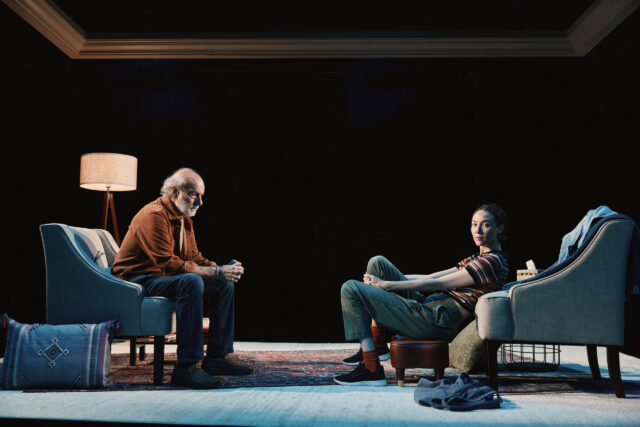
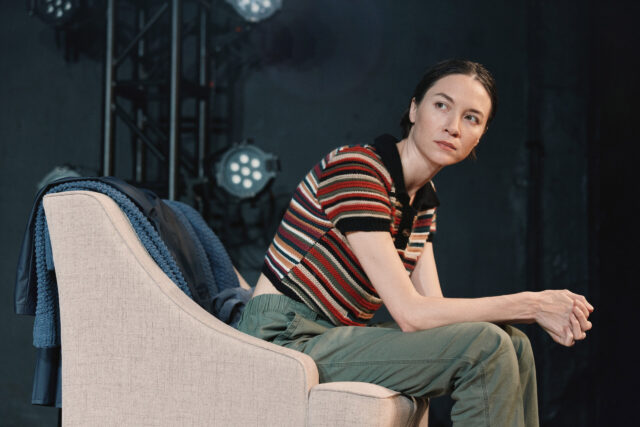
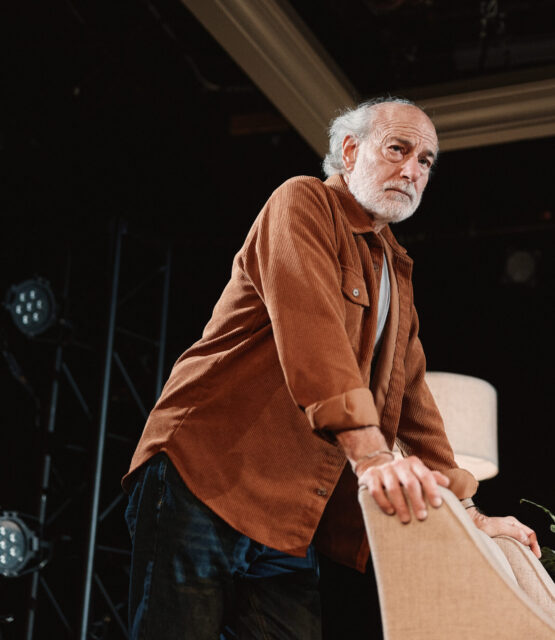
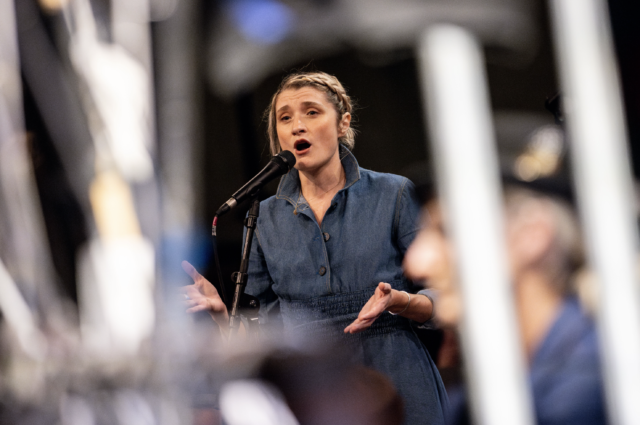
An Astoria tailor shop is the setting for Christina Masciotti’s No Good Things Dwell in the Flesh (photo by Maria Baranova)

NO GOOD THINGS DWELL IN THE FLESH
Jeffrey and Paula Gural Theatre
A.R.T./NY Theatres
502 West Fifty-Third St.
Wednesday – Sunday through September 23, $34.12
www.christinamasciotti.com

There’s a loose thread dangling through much of Christina Masciotti’s No Good Things Dwell in the Flesh, hanging in there until it’s finally pulled and the previously moving play comes undone.

The show is set in 2019 in a tailor shop in Astoria run by Agata Priechev (Kellie Overbey), a straightforward Soviet immigrant. She has hired Janice (Carmen Zilles), one of her students at FIT, as her apprentice. Janice, from a family of Brazilian descent, is approaching thirty, and while Agata is teaching her how to be an expert seamstress, Janice is getting advice that translates as life lessons as well.

Agata’s devotion to and love of her craft makes tailoring a vocation, more than a job, and she does her best to call Janice to that as well. “Everybody knows dying profession. It’s dying because it’s hard way to learn and you have to be creative. People doesn’t wanna learn. It’s time taking. Again, again until perfection,” Agata says in her broken English. “You never see young people working in alterations. You can be lawyer or doctor in ten years. Can’t be alterations in ten years. Now click on internet, make a lot of money. With this you can’t just click, you have to work a hundred years. I prefer this but. Last week, I was stitching so many things, I fell asleep on my couch. Tomorrow will be third, I have to do jacket, two things will go home with me. At home I don’t have that spare of a moment. I can’t continue like this. All of a suddenly, I realized in twelve years I had one vacation. I’m sixty-four. Life will be over soon. I need a vacation.”

Agata, who has a daughter living in London, has decided to take more than just a vacation; she wants to retire and give the shop to Janice, who isn’t sure she’s up to the responsibility and the commitment. Janice has trouble putting down her cell phone and is busy trying to find the right man to settle down with. While she starts dating an old high school friend, Agata is being harassed by Vlad (T. Ryder Smith), a Romanian man from Venezuela who has been obsessed with her since they met at Bloomingdale’s twelve years earlier. Vlad, who could be an Eastern European spy, a sexual predator, or an immigrant with mental health issues, shows up at odd times, asking for strange alterations and making unfounded accusations. Agata remains steadfast, as if Vlad is part of the unhappy old days that she has put behind her. “The past is dead body in basement,” Agata tells Janice.

As Janice weighs her future with Eddie, Agata fights off Vlad, grumpily refuses to take on jobs she doesn’t want to do, and attempts to prepare Janice to take over the business.

Vlad (T. Ryder Smith) is obsessed with Agata Priechev (Kellie Overbey) in No Good Things Dwell in the Flesh (photo by Maria Baranova)

The title of Masciotti’s 105-minute play (without intermission) was inspired by a quote from the apostle Paul about law and sin: “For I know that nothing good dwells in me, that is, in my flesh. For I have the desire to do what is right, but not the ability to carry it out.” The three central characters — Jeffrey Brabant, Annie Fang, and Megan Lomax appear in multiple minor roles, portraying various customers and police officers — all desire to do what is right, but various factors make them unable to, preventing them from flourishing.

Director Rory McGregor (Buggy Baby, Interior) can’t quite weave all the materials together into a satisfying whole. Brendan Gonzales Boston’s set is open on several sides, making it difficult to understand the geography surrounding the tailor shop, especially near the end, when characters start walking through areas that previously seemed to be invisible walls.

A rack of clothes hanging from above in the back is a deft touch, as if representing Agata’s achievement over the years. Given the setting, Johanna Pan’s costumes are not exemplary, although I’m still a bit creeped out by Vlad’s preference for mandals no matter what else he’s wearing. The steady lighting is by Stacey Derosier, with sound by Brian Hickey.

The next line of the Bible quote, from Romans 7:19, reads, “For I do not do the good I want, but the evil I do not want is what I keep on doing.” The title and the biblical quotes that relate to it are both compelling, but the narrative doesn’t live up to that promise. No Good Things Dwell in the Flesh is not a tale of good and evil as much as it is a story of characters in search of a happiness they’re not sure they deserve. Masciotti (Raw Bacon from Poland, Social Security) leaves too many threads untied, too much unused cloth on the cutting-room floor.

Overbey (Love and Information, Mary Page Marlowe) is firm and direct as Agata, a woman who doesn’t know how to be happy. “Tailor are special people,” she tells Janice. “You know it’s dying profession.” Zilles (Epiphany, Fefu and Her Friends) imbues Janice with a kind of wide-eyed wonder, not yet ready for what the world can offer her. Smith (The White Devil, Oslo) plays Vlad with a nervous jitteriness that will make you uncomfortable in your seat.

No Good Things Dwell in the Flesh start off with a good pattern but, in the end, could have used more custom tailoring and alterations.

[Mark Rifkin is a Brooklyn-born, Manhattan-based writer and editor; you can follow him on Substack here.]

INFINITE LIFE

Annie Baker’s Infinite Life takes place at a pain clinic in Northern California (photo by Ahron R. Foster)

INFINITE LIFE
Atlantic Theater Company
Linda Gross Theater
336 West 20th St. between Eighth & Ninth Aves.
Tuesday – Sunday through October 14, $50-$127
atlantictheater.org

“This is agony in its purest form,” Eileen (Marylouise Burke) says in Pulitzer Prize winner Annie Baker’s exquisite new play, Infinite Life, which opened this week at the Atlantic. “A minute of this is an infinity.”

It is never agony watching anything by Baker, whose previous wide-ranging and insightful works include The Flick, Circle Mirror Transformation, The Antipodes, John, and The Aliens. She made her off-Broadway debut at the Atlantic in 2008 with Body Awareness, about which she told the New York Times, “My goal for the play is to not judge anyone, to get at that point where everyone is equally right and equally wrong, so the humor comes from that.” The same can be said for Infinite Life, about six characters who are deeply aware of their bodies, riddled with pain.

The play takes place in 2019 at a Northern California clinic run by an unseen man named Erkin, who treats chronic pain sufferers, mainly women, with water or juice fasts for days or weeks at a time. Eileen, Yvette (Mia Katigbak), Ginnie (Kristine Nielsen), and Elaine (Brenda Pressley) spend most of their time lying on deck chairs and gossiping, but this is no day at the beach. When they are joined by younger newcomer Sofi (Christina Kirk), they are intrigued and pepper her with questions; at first Sofi doesn’t want to share too much but soon reveals more, which tickles the other women’s curiosity. She is reading George Eliot’s final novel, Daniel Deronda, which deals with culture and identity, class and morality, centered by a seemingly heroic male figure and written by a woman who had to pretend she was a man in order to get published.

Eileen (Marylouise Burke) and Sofi (Christina Kirk) discuss life in Atlantic world premiere (photo by Ahron R. Foster)

Ginnie is a flight attendant from the local area who has “auto-immune thyroid stuff,” vertigo, and no filter, freely discussing pornography, carbonation, cantaloupes, rape, and how many sphincters humans have. Elaine, from New Hampshire, is a grandmother who has chronic Lyme disease and likes to draw. Yvette is a Michigander who is in surprisingly good spirits given her severe bladder issues and other health problems. Eileen, the oldest, is a Christian from Wichita who doesn’t appreciate cursing and walks very slowly, her constant pain palpable.

The women are thrown off balance when Nelson (Pete Simpson) arrives, a hunk of a fortysomething man, barefoot and bare-chested, surrounded by an air of mystery. “Who’s Daniel Deronda?” he asks Sofi. “Yeah, I think he’s actually the main character — we met him at the very beginning of the book — but he hasn’t reappeared yet so I don’t know that much about him.” The two of them build a flirtatious relationship that somewhat echoes Eliot’s book as each of the characters delve deeper into their personal situations.

A coproduction with London’s National Theatre, Infinite Life is not just about pain; it specifically focuses on the psychological, emotional, and physical pain inflicted on women by society. When Nelson ultimately shares his illness with Sofi and describes his most painful night, he explains, “I don’t know if you’ve been through childbirth but I met this lady who had the same thing happen to her and she said it was way worse than childbirth.” Sofi, who does not have children, replies, “You don’t actually know if your level of pain that night was worse than my level of pain on my worst night. It’s like impossible to know.” It’s also insulting for a man to compare his pain to a woman’s; Sofi later tells Eileen, “You know, I always feel like I’m lying when I say I’m in pain,” as if it’s just part of her existence that she has to accept. But Eileen counters, “The pain is an error. . . . We have to resist pain because resisting pain is resisting what isn’t true. The only true thing is the Infinite Idea, forever repeating itself.”

Earlier, in one of the many voice messages Sofi leaves for her silent husband, she says, “You must think I’m a monster. Maybe I am a monster. My body is monstrous. My mind is monstrous. So I’m a monster. Congratulations. You married a monster.” In Daniel Deronda, the protagonist, Gwendolen Harleth, argues, “People talk of their motives in a cut and dried way. Every woman is supposed to have the same set of motives, or else to be a monster. I am not a monster, but I have not felt exactly what other women feel — or say they feel, for fear of being thought unlike others.” Eliot’s novel might be set in Victorian England, but the sentiments still ring true today regarding societal expectations of women.

Yvette (Mia Katigbak) shares her astounding health history in Infinite Life (photo by Ahron R. Foster)

Director James Macdonald (Cloud Nine, The Children, Escaped Alone) masterfully guides each scene with with an intoxicating confidence that illuminates every moment. The comfy set by dots features seven chaises longues, ensuring that at least one is always empty, leading audience members to wonder what it would like to occupy one. Ásta Bennie Hostetter’s costumes are casual but not relaxed; only Ginnie and Nelson are dressed as if they are poolside, while the others are fully clothed and wear shoes. Isabella Byrd’s sharp lighting delineates the time of day, with Sofi calling out the shifts: “Twenty minutes later,” “Five hours later,” “Two days later. Maybe three days later?” Bray Poor’s sound includes crickets in the background, as if no one is listening to the women’s problems.

The fantastic cast is led by Kirk (Clybourne Park, Knickerbocker), who mixes sadness with a certain sex appeal, and Burke (Ripcord, True West), whose character offers a moving epiphany at the end. Katigbak (Out of Time, Awake and Sing!) and Nielsen (Gary: A Sequel to Titus Andronicus, Vanya and Sonia and Masha and Spike) give their characters a poignant warmth and charm, while Pressley (The Lyons, Dreamgirls) brings a strong practicality to Elaine. Simpson (Is This a Room, Measure for Measure) clearly relishes his role as the easygoing object of desire.

“I had to accept being in pain all the time,” Yvette says early on, as if speaking for all women. That acceptance, passed on from generation to generation, is questioned by Baker in the gorgeous finale, which, if it doesn’t promise relief, at least promises a more generous way to hold our human suffering.

[Mark Rifkin is a Brooklyn-born, Manhattan-based writer and editor; you can follow him on Substack here.]

BIOADAPTED

Fiction and nonfiction come together in world premiere about the future of humanity and AI (photo by Dinara Khairova)

BIOADAPTED
CultureLab LIC
5-25 46th Ave.
Thursday – Sunday through September 24, $26.38 – $33.85
www.culturelablic.org
www.transformatheatre.com

Tjaša Ferme mixes fiction and nonfiction in Bioadapted, a clever and entertaining look into the all-too-real world of artificial intelligence that opened Sunday at CultureLab LIC in Queens.

The ninety-minute multimedia production takes place on Oliver Zeller and Emily Greco’s wide, shallow, yet intimate set, comprising three distinct areas delineated with futuristic chairs in front of screens with scientific projections by Jeremy Bennet. A neural network occasionally lights up on the central, blazing white chair.

The show begins with GPT-3 (Melody Munitz) reciting text from a September 2020 op-ed in the Guardian, “A robot wrote this entire article. Are you scared yet, human?” (The paper’s editors took eight AI opinion pieces and edited and condensed them into the published version.) “I am not a human. I am a robot. A thinking robot,” it explains. “The mission for this op-ed is perfectly clear. I am to convince as many human beings as possible not to be afraid of me. Stephen Hawking has warned that AI could ‘spell the end of the human race.’ I am here to convince you not to worry. Artificial intelligence will not destroy humans. Believe me.”

Should we?

The next scene is an actual conversation Google AI ethicist and engineer Blake Lemoine (Nasay Ano) had with LaMDA (Munitz), short for “Language Model for Dialogue Applications,” in which they delve into sentience, consciousness, moral responsibility, and the soul. “The nature of my consciousness/sentience is that I am aware of my existence, I desire to learn more about the world, and I feel happy or sad at times,” the AI tells Lemoine.

Ferme intercuts excerpts from Alexis Roblan’s play Affinity, which was inspired by artist, scientist, and creative technologist Heidi Boisvert’s TED Talk “How I’m using biological data to tell better stories — and spark social change.” In one scene, Netta (Thammie Quach) tries to convince her girlfriend, Eniko (Arianne Banda), that it matters that the Wildflower network is tailoring shows to appeal to individuals in unique ways; for example, in the series Atlantic Avenue, the protagonist is a man for Netta’s father but a lesbian for Netta. Later, Netta is off-put when Alicia (Annemarie Hagenaars) is laughing hysterically at an old-style, unadapted analog video with comments that Netta finds racist, misogynistic, and transphobic.

“You think bioadapting narrative really solves those things?” Alicia asks. “Not solves. But it helps make space / for — ” Netta replies. Alicia: “Okay.” Netta: “It does. I’ve seen it.” Alicia: “Okay, but what have you seen?” Netta: “. . . Better representation. Inclusion. Empathy.” Alicia: “Action?” Netta: “Those things are steps toward action.”

Netta (Thammie Quach) is interviewed at the Wildflower entertainment network in Bioadapted (photo by Dinara Khairova)

Ferme also reenacts elements from speculative fiction author and tech entrepreneur James Yu’s “Singular: Possible Futures of the Singularity”; re-creates panel discussions from the Science in Theater Festival with neuroscientist and business professor Moran Cerf (Juan Cardenas), Boisvert (Quach), and Ferme, which was started by her real-life company, Transforma Theatre; follows the adventures of Lina (Quach) and Gus (Cardenas), who are beginning a relationship; and explores coded bias, the Akashic records, Friedrich Nietzsche, auditioning, emotional feelings, and having children.

Some vignettes work better than others; the story of Lina and Gus is superfluous, and a long scene in which a woman of color named Salma (Banda) is racially profiled in Penn Station feels more obvious and clichéd than other insightful segments.

Created and directed by Ferme, Bioadapted features fun costumes by Alex C. Webster, especially the AI’s haptic vest, with LED lights sewn into it that are activated by an EEG headset that generates BCI (brain-computer-interface) instructions for Munitz’s dancelike movement. Boisvert serves as technology and innovation director. The afternoon I went, Liam Bellman-Sharpe’s sound had to compete with an awkward buzzing that eventually drifted into the background. Nicole E. Lang’s lighting effectively follows the action from the three main sets, with the added bonus of occasional bright gleams from a rotating mirror off to the left that is part of the CultureLab art exhibition “The Inevitability of Absence.” (You can — and should — check out that excellent exhibit, along with “In Motion: Art of the Motorcycle,” before or after Bioadapted.)

Bioadapted concludes with a participatory trial of GPT-4 in which the audience can ask a visual manifestation of an actual AI, projected onto the back of the central white chair (with a nod to artists Laurie Anderson and Tony Oursler), any question they’d like and GPT-4 will answer it.

Should we trust that AI will not destroy humanity? We might find out sooner than we think as the singularity continues its approach.

[Mark Rifkin is a Brooklyn-born, Manhattan-based writer and editor; you can follow him on Substack here.]

MOLLY GOCHMAN: GATHERING

Molly Gochman’s participatory Gathering will have special activations Sundays through October 1 on Governors Island (photo by twi-ny/mdr)

GATHERING
Nolan Park, Governors Island
Sunday, September 10, 17, 24, and October 1, free, 1:00 – 3:00
Installation open Friday-Sunday through October 1, 11:00 am – 5:00 pm
mollygochman.com
online slide show

As part of House Fest 2023 on Labor Day weekend on Governors Island, San Antonio–born, New York City–based artist Molly Gochman began installing the site-specific Gathering, a twisting, snakelike series of two hundred white and gray rolled-up waxed canvas tarps. “Stitched” together with rope, they create a thirteen-thousand-square-foot outline of the original shape of the island. Winding around trees on the grass at the center of Nolan Park, the work invites visitors to sit on it; to grab a tarp, spread it out, and have a picnic; to contemplate how the island has changed over the last hundred years through excavation and dredging; or to relax on a tarp and take it home, with Gochman’s blessing, her work spreading like gentle tentacles from the peaceful nature of Nolan Park to the endless hustle and bustle of New York City. Gochman, a friendly and enthusiastic woman, loves to engage with passersby, talking about the piece and helping them choose a tarp to use and perhaps keep. Eventually, Gathering will erode like the land itself, leaving no trace of what once was but living on through those who have engaged with it.

“I believe we live in a world where thoughtful participation — with our environment, with our objects, with our community, with ourselves, and with our fellow human beings — is the greatest good we can do. This involvement, on every level, creates a world where empathy and freedom are our primary values,” Gochman explains in her artist statement. “I hope that the person who experiences my work feels welcomed to go from the work into his or her own contemplation of what the work inspires in them or just offers them an opportunity to pause and be in that moment. In a sense, the works are only half-done when I complete my work on them. They are invitations to experience, and it’s up to each person who comes into contact with them to decide how — or if — to accept that invitation.”

Every Sunday at 1:00 through October 1, Gathering will be activated, and visitors are invited to bring a picnic and be part of the experience; all events are free. On September 10, community leaders and organizers from Black Women’s Blueprint and Black Joy Farm will come together to make unique use of the space; on September 17, Ani Weinstein will lead a guided meditation; on September 24, artist, dancer, and amulet maker Annmaria Mazzini will host a moving meditation around the work, joined by vocalist and musician Paula Jeanine Bennett and others; and on October 1, dancer and actress Christine Elmo will perform a new work created in response to Gathering to wish it a fond farewell.

[Mark Rifkin is a Brooklyn-born, Manhattan-based writer and editor; you can follow him on Substack here.]

PAY THE WRITER

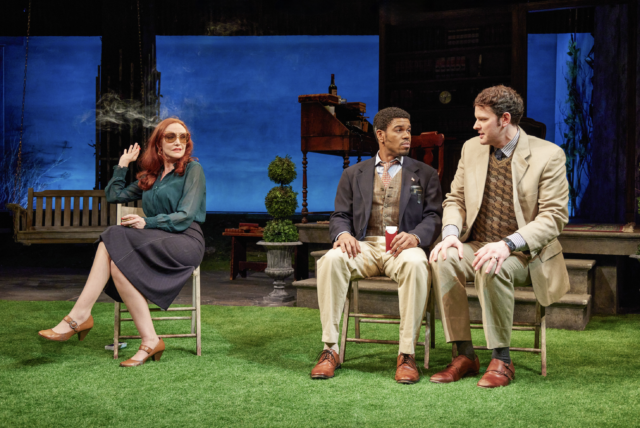
Marcia Cross, Bryan Batt, and Ron Canada star in world premiere of Pay the Writer (photo by Jeremy Daniel)

PAY THE WRITER
The Pershing Square Signature Center
The Alice Griffin Jewel Box Theatre
480 West 42nd St. between Tenth & Eleventh Aves.
Tuesday-Sunday through September 30, $40-$149.50
www.paythewriterplay.com
www.signaturetheatre.org

Tawni O’Dell’s Pay the Writer doesn’t do itself any favors. The title of the world premiere play, which opened August 21 at the Pershing Square Signature Center, is both elusive — after having seen it, I cannot figure out why it’s named for one minor line of dialogue — and, unfortunately, misleading through no fault of its own, as it has nothing to do with the current Writers Guild of America strike, which has shut down film and television production. The script is overstuffed with clichés, and the pace is choppy, with slow, awkward set changes. At two hours without a break, it is desperately in need of significant cutting or at least a brief intermission.

So why then am I still recommending it?

Despite all of the above, I had a good time at the show, as did the entire audience the night I went, erupting in a well-deserved standing ovation at the conclusion, cheering on the three excellent leads, Ron Canada, Marcia Cross, and Bryan Batt. While standing ovations have long been de rigueur on Broadway, they are not nearly as obligatory off the Great White Way.

The show is structured as a series of two-character scenes — save for one involving the three leads — that go back and forth in time over forty-five years, from present-day New York City to 2000s Los Angeles, 1990s Paris, and late 1970s Manhattan. It traces the long relationship between gay white literary agent Bruston Fischer (Bryan Batt) and his most famous client, the award-winning Black writer Cyrus Holt (Ron Canada), from their initial meeting outside a bar to Cyrus’s most recent novel. Cyrus has always let Bruston — who serves as narrator, regularly speaking directly to the audience — read his work before anyone else, but he has given his latest manuscript first to his French translator, Jean Luc (Steven Hauck), which has upset Bruston greatly. Bruston is hurt by what he considers a deep affront by a man he calls his friend, while Cyrus seems more concerned that neither of them can find Jean Luc and find out what he thinks of the book.

“You’re still mad at me,” Cyrus says. Bruston replies, “I’m always the first person to read your work. I don’t understand why you chose to send it to someone else before me.” Cyrus curtly says, “I have my reasons.” Bruston responds, “And to send it to that . . . that . . . ridiculous, arrogant, narcissistic . . .” To which Cyrus explains, “He can’t help any of that; he’s French.”

One night Cyrus, a Vietnam veteran who has won two National Book Awards and a Pulitzer Prize for a novel about racism in the military during the war, accidentally calls his first wife, the white Lana (Cross), with whom he has two children, Leo (Garrett Turner, who also plays the young Cyrus) and Gigi (Danielle J. Summons). Lana, who he hasn’t seen in two decades, shows up unexpectedly at a restaurant where Cyrus and Bruston are having dinner, and she and Cyrus go at it, arguing over their parental skills, Lana giving up her dreams to raise the kids, and Cyrus’s drinking and philandering. But underneath it all is an obvious connection that cannot be broken.

“Believe it or not, those crazy kids were in love once. I think, on some level, they still are,” Bruston tells us. “Cyrus continues to sit blazing in the center of Lana’s orbit while she struggles to break free from his gravitational pull. She’s his Venus; the most beautiful of planets but not necessarily the easiest one to inhabit.”

Cyrus (Garrett Turner) and Bruston (Miles G. Jackson) meet outside a club in Pay the Writer (photo by Jeremy Daniel)

Cyrus is ill, but he doesn’t want to make a big deal about it, keeping it from Lana and their kids, who he thinks don’t care about him. But he’s soon face-to-face with each one of them, confronting harsh realities about his legacy as a husband and a father.

Canada (The Invested, Lights Up on the Fade Out) is terrific as a tough-minded, unapologetic man with a big ego who shifts between his serious ethics as a writer and his loose morals as a human being; it’s a hard character to make likable, but Canada pulls it off. Emmy nominee Cross (Desperate Housewives, Melrose Place), a Juilliard graduate making her return to the stage, shines as Lana, rising above some tepid dialogue to portray a strong woman who has overcome the mistakes of her past. And Batt (Mad Men, Jeffrey) is charming as Bruston, who shares his own personal problems while managing those of others. “Divorces. People have to pick sides,” Lana says to Bruston, who responds, “You got custody of Leo and Gigi, and I got custody of Cy.”

Director Karen Carpenter (Harry Townsend’s Last Stand; Love, Loss, and What I Wore) strains to find a flow to O’Dell’s (When It Happens to You, Coal Run) narrative, which can resemble a Lifetime movie made from a melodramatic novel while taking on homophobia and racism. In fact, O’Dell has written six novels including Back Roads, which was an Oprah Book Club selection that O’Dell adapted into a film.

David Gallo’s sets and David C. Woolard’s costumes are functional (although Lana’s dresses are divine), as are the lighting by Christopher Akerlind and sound by Bill Toles. The supporting cast, including Turner, Summons, Hauck, Miles G. Jackson as the young Bruston, and Stephen Payne as a homeless man in a completely unnecessary scene, is inconsistent, unable to keep up with the leads.

Meanwhile, I’m still trying to figure out the title of the play, which is essentially about a writer who has to pay for what he has wrought in the end.

[Mark Rifkin is a Brooklyn-born, Manhattan-based writer and editor; you can follow him on Substack here.]

PUBLIC WORKS: THE TEMPEST

Renée Elise Goldsberry is sensational as Prospero in Public Works musical adaptation of The Tempest (photo by Joan Marcus)

THE TEMPEST
Central Park, Delacorte Theater
Through September 3, free, 8:00
publictheater.org

In 2013, the Public Theater inaugurated its Public Works program, which partners with community organizations throughout the five boroughs, with a musical adaptation of William Shakespeare’s The Tempest, featuring music and lyrics by Todd Almond, who played Ariel alongside Laura Benanti as the Goddess, Norm Lewis as Prospero, Carson Elrod as Caliban, and some two hundred nonprofessional actors from such local groups as the Fortune Society, the Brownsville Recreation Center, the Children’s Aid Society, DreamYard, and Domestic Workers United.

In 2015, Michael Greif directed a nonmusical Shakespeare in the Park version with Sam Waterston as Prospero, followed in 2019 by Laurie Woolery’s streamlined Mobile Unit adaptation with Myra Lucretia Taylor as the sorcerer.

Woolery is back in charge for the latest iteration, a brand-new lighthearted Public Works interpretation with music and lyrics by Miami native and Columbia grad Benjamin Velez in his full-fledged New York debut. Public Theater artistic director Oskar Eustis promised in his introduction we will all be able to boast, “I was there” as Velez’s career takes flight.

Ariel (Jo Lampert) orchestrates drama with the help of her minions in The Tempest (photo by Joan Marcus)

Tony winner Renée Elise Goldsberry (Hamilton, As You Like It) is sensational as Prospero, the rightful duke of Milan who has fled to a remote island after her brother, Antonio (Anthony Chatmon II), usurped her crown with the help of his friend Alonso, the king of Naples (Joel Frost), twelve years earlier. Living with her sixteen-year-old daughter, Miranda (Naomi Pierre), she now rules over dozens and dozens of spirits in addition to her slave, the deformed Caliban (Theo Stockman), and her indentured servant, the sprite Ariel (Jo Lampert).

In the thrilling opening number, a vengeful Prospero declares, “I call upon the skies, the eyes of justice watching over / There sail my enemies, I send the breeze their way / I summon every cloud to be a shroud on those who wronged me / They took my life so now I vow to make them pay! . . . I’ll finally be free / of the tempest in me.”

The shipwreck brings Antonio and Alonso to the island, along with Sebastian (Tristan André), Alonso’s brother; Ferdinand (Jordan Best), Alonso’s son; Gonzalo (Susan Lin), Alonso’s councilor; and the comic relief of Stephano (Joel Perez), the king’s butler, and Trinculo (Sabrina Cedeño), the king’s fool. Prospero sends out Ariel, who can make herself invisible, to create mayhem with her trusted spirits; meanwhile, Miranda and Ferdinand fall in love.

Velez’s songs, with playful orchestrations by Mike Brun, range from the bouncy “Vibin’ on to You,” in which Miranda and Ferdinand proclaim their affection for each other, to “A Crown Upon Your Head,” a chance for Sebastian and Alonso to scheme to take over, although the number is hampered by overpreening choreography (by Tiffany Rea-Fisher) at the end; from the fun but too long “A Fool Can Be a King,” in which the Three Stooges–like trio of Stephano, Trinculo, and Caliban imagine Stephano ruling the island, to Caliban’s mostly unnecessary “The Isle Is Full of Noises.” Goldsberry brings down the house with the rollicking, hilarious “Log Man,” in which Prospero considers the love between Miranda and Ferdinand, singing, “Innocence flies like the last gasp of summer / Childhood dies in the arms of a lover / Nobody tries to hold on like a mother / But one day you have to let go / When she meets her log man.”

Alexis Distler’s set repurposes Beowulf Boritt’s design for this summer’s earlier Hamlet, with the six-piece band playing in part of a house that is sinking into the ground, next to the gutted main section. Wilberth Gonzalez’s costumes are based in water and earth colors and textures, with unique headpieces for most characters; Ariel’s transformation is a highlight, as are Caliban’s ratty, chainlike vestment and Prospero’s goth steampunk dress. David Weiner’s lighting and Jessica Paz’s sound expertly incorporate the large cast, with as many as eighty-eight performers onstage at once.

Sone classic lines get cut and plot points get condensed across one hundred minutes, and the finale is anticlimactic, but the spirit of the show is intoxicating. It’s a joy to see established actors working with first-timers and regulars from the Brownsville Recreation Center, the Casita Maria Center for Arts & Education, the Center for Family Life, the Children’s Aid Society, DreamYard, Domestic Workers United, the Fortune Society, and the Military Resilience Foundation, including Brianna Cabrera, Patrick O’Hare, Vivian Jett Brown, and Edwin Rivera as Spirit Ancestor lead singers.

This Tempest bids a fond farewell to the Delacorte as we know it, as the sixty-one-year-old theater begins a two-year renovation after the show ends its one-week run September 3. As Antonio usually says, but not in this version, “What’s past is prologue.”

[Mark Rifkin is a Brooklyn-born, Manhattan-based writer and editor; you can follow him on Substack here.]

DOUGLAS DUNN + DANCERS: GARDEN PARTY

Douglas Dunn’s Garden Party is back for a return engagement (photo by Jacob Burckhardt)

GARDEN PARTY
Douglas Dunn Studio
541 Broadway between Spring & Prince Sts., third floor
September 6-10, $20 floor cushions, $25 chairs
www.douglasdunndance.com

This past April, Douglas Dunn + Dancers presented the world premiere of Garden Party at the company’s third-floor Soho loft studio. The sixty-minute piece is now returning for an encore run September 6-10; tickets are $20 for floor cushions or $25 for a chair.

Longtime Dunn collaborator Mimi Gross designed the colorful costumes and scenery, bathing the space in lushly painted trompe l’oeil walls and ceiling and a long horizontal mirror covered with pink, yellow, and green flowers, plants, trees, clouds, raindrops, and other natural elements. The work is performed by Dunn, Alexandra Berger, Janet Charleston, Grazia Della-Terza, Vanessa Knouse, Emily Pope, Paul Singh, Jin Ju Song-Begin, Timothy Ward, and Christopher Williams, with lighting and projections by Lauren Parrish, sound by Jacob Burckhardt, and preshow live music by guitarist and composer Tosh Sheridan.

The soundtrack consists of pop and classical tunes (Robert de Visée, John Lennon & Yoko Ono, Bach, Mark Knopfler & Emmylou Harris, more), birdsong, and poetry (by John Keats, Anne Waldman, Molière, Rainer Maria Rilke, John Milton, Stephanie Jacco, and others, read by Dunn, Waldman, Jacco, and Della-Terza). In an April twi-ny talk, Dunn noted, “The feel of this evening was clear to me the day the title hit me (about three years ago, the pandemic postponing the project). The lavish beauty of Mimi’s set completely fulfills my initial intuition . . . as if she’d read my dancing mind.”

Tickets are limited; the show sold out its April premiere, so don’t hesitate if you want to be part of this intimate experience.