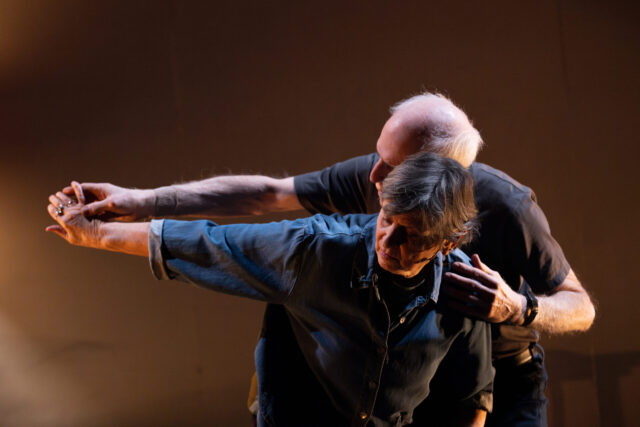
live performance

MOLLY GOCHMAN: GATHERING

Molly Gochman’s participatory Gathering will have special activations Sundays through October 1 on Governors Island (photo by twi-ny/mdr)

GATHERING
Nolan Park, Governors Island
Sunday, September 10, 17, 24, and October 1, free, 1:00 – 3:00
Installation open Friday-Sunday through October 1, 11:00 am – 5:00 pm
mollygochman.com
online slide show

As part of House Fest 2023 on Labor Day weekend on Governors Island, San Antonio–born, New York City–based artist Molly Gochman began installing the site-specific Gathering, a twisting, snakelike series of two hundred white and gray rolled-up waxed canvas tarps. “Stitched” together with rope, they create a thirteen-thousand-square-foot outline of the original shape of the island. Winding around trees on the grass at the center of Nolan Park, the work invites visitors to sit on it; to grab a tarp, spread it out, and have a picnic; to contemplate how the island has changed over the last hundred years through excavation and dredging; or to relax on a tarp and take it home, with Gochman’s blessing, her work spreading like gentle tentacles from the peaceful nature of Nolan Park to the endless hustle and bustle of New York City. Gochman, a friendly and enthusiastic woman, loves to engage with passersby, talking about the piece and helping them choose a tarp to use and perhaps keep. Eventually, Gathering will erode like the land itself, leaving no trace of what once was but living on through those who have engaged with it.

“I believe we live in a world where thoughtful participation — with our environment, with our objects, with our community, with ourselves, and with our fellow human beings — is the greatest good we can do. This involvement, on every level, creates a world where empathy and freedom are our primary values,” Gochman explains in her artist statement. “I hope that the person who experiences my work feels welcomed to go from the work into his or her own contemplation of what the work inspires in them or just offers them an opportunity to pause and be in that moment. In a sense, the works are only half-done when I complete my work on them. They are invitations to experience, and it’s up to each person who comes into contact with them to decide how — or if — to accept that invitation.”

Every Sunday at 1:00 through October 1, Gathering will be activated, and visitors are invited to bring a picnic and be part of the experience; all events are free. On September 10, community leaders and organizers from Black Women’s Blueprint and Black Joy Farm will come together to make unique use of the space; on September 17, Ani Weinstein will lead a guided meditation; on September 24, artist, dancer, and amulet maker Annmaria Mazzini will host a moving meditation around the work, joined by vocalist and musician Paula Jeanine Bennett and others; and on October 1, dancer and actress Christine Elmo will perform a new work created in response to Gathering to wish it a fond farewell.

[Mark Rifkin is a Brooklyn-born, Manhattan-based writer and editor; you can follow him on Substack here.]

PAY THE WRITER

Marcia Cross, Bryan Batt, and Ron Canada star in world premiere of Pay the Writer (photo by Jeremy Daniel)

PAY THE WRITER
The Pershing Square Signature Center
The Alice Griffin Jewel Box Theatre
480 West 42nd St. between Tenth & Eleventh Aves.
Tuesday-Sunday through September 30, $40-$149.50
www.paythewriterplay.com
www.signaturetheatre.org

Tawni O’Dell’s Pay the Writer doesn’t do itself any favors. The title of the world premiere play, which opened August 21 at the Pershing Square Signature Center, is both elusive — after having seen it, I cannot figure out why it’s named for one minor line of dialogue — and, unfortunately, misleading through no fault of its own, as it has nothing to do with the current Writers Guild of America strike, which has shut down film and television production. The script is overstuffed with clichés, and the pace is choppy, with slow, awkward set changes. At two hours without a break, it is desperately in need of significant cutting or at least a brief intermission.

So why then am I still recommending it?

Despite all of the above, I had a good time at the show, as did the entire audience the night I went, erupting in a well-deserved standing ovation at the conclusion, cheering on the three excellent leads, Ron Canada, Marcia Cross, and Bryan Batt. While standing ovations have long been de rigueur on Broadway, they are not nearly as obligatory off the Great White Way.

The show is structured as a series of two-character scenes — save for one involving the three leads — that go back and forth in time over forty-five years, from present-day New York City to 2000s Los Angeles, 1990s Paris, and late 1970s Manhattan. It traces the long relationship between gay white literary agent Bruston Fischer (Bryan Batt) and his most famous client, the award-winning Black writer Cyrus Holt (Ron Canada), from their initial meeting outside a bar to Cyrus’s most recent novel. Cyrus has always let Bruston — who serves as narrator, regularly speaking directly to the audience — read his work before anyone else, but he has given his latest manuscript first to his French translator, Jean Luc (Steven Hauck), which has upset Bruston greatly. Bruston is hurt by what he considers a deep affront by a man he calls his friend, while Cyrus seems more concerned that neither of them can find Jean Luc and find out what he thinks of the book.

“You’re still mad at me,” Cyrus says. Bruston replies, “I’m always the first person to read your work. I don’t understand why you chose to send it to someone else before me.” Cyrus curtly says, “I have my reasons.” Bruston responds, “And to send it to that . . . that . . . ridiculous, arrogant, narcissistic . . .” To which Cyrus explains, “He can’t help any of that; he’s French.”

One night Cyrus, a Vietnam veteran who has won two National Book Awards and a Pulitzer Prize for a novel about racism in the military during the war, accidentally calls his first wife, the white Lana (Cross), with whom he has two children, Leo (Garrett Turner, who also plays the young Cyrus) and Gigi (Danielle J. Summons). Lana, who he hasn’t seen in two decades, shows up unexpectedly at a restaurant where Cyrus and Bruston are having dinner, and she and Cyrus go at it, arguing over their parental skills, Lana giving up her dreams to raise the kids, and Cyrus’s drinking and philandering. But underneath it all is an obvious connection that cannot be broken.

“Believe it or not, those crazy kids were in love once. I think, on some level, they still are,” Bruston tells us. “Cyrus continues to sit blazing in the center of Lana’s orbit while she struggles to break free from his gravitational pull. She’s his Venus; the most beautiful of planets but not necessarily the easiest one to inhabit.”

Cyrus (Garrett Turner) and Bruston (Miles G. Jackson) meet outside a club in Pay the Writer (photo by Jeremy Daniel)

Cyrus is ill, but he doesn’t want to make a big deal about it, keeping it from Lana and their kids, who he thinks don’t care about him. But he’s soon face-to-face with each one of them, confronting harsh realities about his legacy as a husband and a father.

Canada (The Invested, Lights Up on the Fade Out) is terrific as a tough-minded, unapologetic man with a big ego who shifts between his serious ethics as a writer and his loose morals as a human being; it’s a hard character to make likable, but Canada pulls it off. Emmy nominee Cross (Desperate Housewives, Melrose Place), a Juilliard graduate making her return to the stage, shines as Lana, rising above some tepid dialogue to portray a strong woman who has overcome the mistakes of her past. And Batt (Mad Men, Jeffrey) is charming as Bruston, who shares his own personal problems while managing those of others. “Divorces. People have to pick sides,” Lana says to Bruston, who responds, “You got custody of Leo and Gigi, and I got custody of Cy.”

Director Karen Carpenter (Harry Townsend’s Last Stand; Love, Loss, and What I Wore) strains to find a flow to O’Dell’s (When It Happens to You, Coal Run) narrative, which can resemble a Lifetime movie made from a melodramatic novel while taking on homophobia and racism. In fact, O’Dell has written six novels including Back Roads, which was an Oprah Book Club selection that O’Dell adapted into a film.

David Gallo’s sets and David C. Woolard’s costumes are functional (although Lana’s dresses are divine), as are the lighting by Christopher Akerlind and sound by Bill Toles. The supporting cast, including Turner, Summons, Hauck, Miles G. Jackson as the young Bruston, and Stephen Payne as a homeless man in a completely unnecessary scene, is inconsistent, unable to keep up with the leads.

Meanwhile, I’m still trying to figure out the title of the play, which is essentially about a writer who has to pay for what he has wrought in the end.

[Mark Rifkin is a Brooklyn-born, Manhattan-based writer and editor; you can follow him on Substack here.]

PUBLIC WORKS: THE TEMPEST

Renée Elise Goldsberry is sensational as Prospero in Public Works musical adaptation of The Tempest (photo by Joan Marcus)

THE TEMPEST
Central Park, Delacorte Theater
Through September 3, free, 8:00
publictheater.org

In 2013, the Public Theater inaugurated its Public Works program, which partners with community organizations throughout the five boroughs, with a musical adaptation of William Shakespeare’s The Tempest, featuring music and lyrics by Todd Almond, who played Ariel alongside Laura Benanti as the Goddess, Norm Lewis as Prospero, Carson Elrod as Caliban, and some two hundred nonprofessional actors from such local groups as the Fortune Society, the Brownsville Recreation Center, the Children’s Aid Society, DreamYard, and Domestic Workers United.

In 2015, Michael Greif directed a nonmusical Shakespeare in the Park version with Sam Waterston as Prospero, followed in 2019 by Laurie Woolery’s streamlined Mobile Unit adaptation with Myra Lucretia Taylor as the sorcerer.

Woolery is back in charge for the latest iteration, a brand-new lighthearted Public Works interpretation with music and lyrics by Miami native and Columbia grad Benjamin Velez in his full-fledged New York debut. Public Theater artistic director Oskar Eustis promised in his introduction we will all be able to boast, “I was there” as Velez’s career takes flight.

Ariel (Jo Lampert) orchestrates drama with the help of her minions in The Tempest (photo by Joan Marcus)

Tony winner Renée Elise Goldsberry (Hamilton, As You Like It) is sensational as Prospero, the rightful duke of Milan who has fled to a remote island after her brother, Antonio (Anthony Chatmon II), usurped her crown with the help of his friend Alonso, the king of Naples (Joel Frost), twelve years earlier. Living with her sixteen-year-old daughter, Miranda (Naomi Pierre), she now rules over dozens and dozens of spirits in addition to her slave, the deformed Caliban (Theo Stockman), and her indentured servant, the sprite Ariel (Jo Lampert).

In the thrilling opening number, a vengeful Prospero declares, “I call upon the skies, the eyes of justice watching over / There sail my enemies, I send the breeze their way / I summon every cloud to be a shroud on those who wronged me / They took my life so now I vow to make them pay! . . . I’ll finally be free / of the tempest in me.”

The shipwreck brings Antonio and Alonso to the island, along with Sebastian (Tristan André), Alonso’s brother; Ferdinand (Jordan Best), Alonso’s son; Gonzalo (Susan Lin), Alonso’s councilor; and the comic relief of Stephano (Joel Perez), the king’s butler, and Trinculo (Sabrina Cedeño), the king’s fool. Prospero sends out Ariel, who can make herself invisible, to create mayhem with her trusted spirits; meanwhile, Miranda and Ferdinand fall in love.

Velez’s songs, with playful orchestrations by Mike Brun, range from the bouncy “Vibin’ on to You,” in which Miranda and Ferdinand proclaim their affection for each other, to “A Crown Upon Your Head,” a chance for Sebastian and Alonso to scheme to take over, although the number is hampered by overpreening choreography (by Tiffany Rea-Fisher) at the end; from the fun but too long “A Fool Can Be a King,” in which the Three Stooges–like trio of Stephano, Trinculo, and Caliban imagine Stephano ruling the island, to Caliban’s mostly unnecessary “The Isle Is Full of Noises.” Goldsberry brings down the house with the rollicking, hilarious “Log Man,” in which Prospero considers the love between Miranda and Ferdinand, singing, “Innocence flies like the last gasp of summer / Childhood dies in the arms of a lover / Nobody tries to hold on like a mother / But one day you have to let go / When she meets her log man.”

Alexis Distler’s set repurposes Beowulf Boritt’s design for this summer’s earlier Hamlet, with the six-piece band playing in part of a house that is sinking into the ground, next to the gutted main section. Wilberth Gonzalez’s costumes are based in water and earth colors and textures, with unique headpieces for most characters; Ariel’s transformation is a highlight, as are Caliban’s ratty, chainlike vestment and Prospero’s goth steampunk dress. David Weiner’s lighting and Jessica Paz’s sound expertly incorporate the large cast, with as many as eighty-eight performers onstage at once.

Sone classic lines get cut and plot points get condensed across one hundred minutes, and the finale is anticlimactic, but the spirit of the show is intoxicating. It’s a joy to see established actors working with first-timers and regulars from the Brownsville Recreation Center, the Casita Maria Center for Arts & Education, the Center for Family Life, the Children’s Aid Society, DreamYard, Domestic Workers United, the Fortune Society, and the Military Resilience Foundation, including Brianna Cabrera, Patrick O’Hare, Vivian Jett Brown, and Edwin Rivera as Spirit Ancestor lead singers.

This Tempest bids a fond farewell to the Delacorte as we know it, as the sixty-one-year-old theater begins a two-year renovation after the show ends its one-week run September 3. As Antonio usually says, but not in this version, “What’s past is prologue.”

[Mark Rifkin is a Brooklyn-born, Manhattan-based writer and editor; you can follow him on Substack here.]
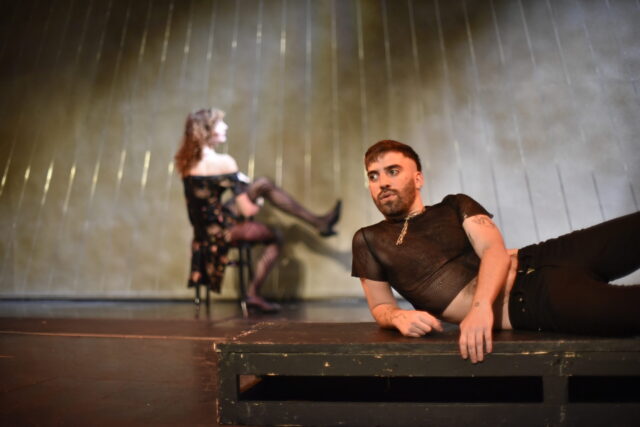
DOUGLAS DUNN + DANCERS: GARDEN PARTY

Douglas Dunn’s Garden Party is back for a return engagement (photo by Jacob Burckhardt)

GARDEN PARTY
Douglas Dunn Studio
541 Broadway between Spring & Prince Sts., third floor
September 6-10, $20 floor cushions, $25 chairs
www.douglasdunndance.com

This past April, Douglas Dunn + Dancers presented the world premiere of Garden Party at the company’s third-floor Soho loft studio. The sixty-minute piece is now returning for an encore run September 6-10; tickets are $20 for floor cushions or $25 for a chair.

Longtime Dunn collaborator Mimi Gross designed the colorful costumes and scenery, bathing the space in lushly painted trompe l’oeil walls and ceiling and a long horizontal mirror covered with pink, yellow, and green flowers, plants, trees, clouds, raindrops, and other natural elements. The work is performed by Dunn, Alexandra Berger, Janet Charleston, Grazia Della-Terza, Vanessa Knouse, Emily Pope, Paul Singh, Jin Ju Song-Begin, Timothy Ward, and Christopher Williams, with lighting and projections by Lauren Parrish, sound by Jacob Burckhardt, and preshow live music by guitarist and composer Tosh Sheridan.

The soundtrack consists of pop and classical tunes (Robert de Visée, John Lennon & Yoko Ono, Bach, Mark Knopfler & Emmylou Harris, more), birdsong, and poetry (by John Keats, Anne Waldman, Molière, Rainer Maria Rilke, John Milton, Stephanie Jacco, and others, read by Dunn, Waldman, Jacco, and Della-Terza). In an April twi-ny talk, Dunn noted, “The feel of this evening was clear to me the day the title hit me (about three years ago, the pandemic postponing the project). The lavish beauty of Mimi’s set completely fulfills my initial intuition . . . as if she’d read my dancing mind.”

Tickets are limited; the show sold out its April premiere, so don’t hesitate if you want to be part of this intimate experience.

THE SHARK IS BROKEN

Richard Dreyfuss (Alex Brightman), Robert Shaw (Ian Shaw), and Roy Scheider (Colin Donnell) find plenty of downtime in The Shark Is Broken (photo by Matthew Murphy)

THE SHARK IS BROKEN
Golden Theatre
252 West Forty-Fifth St. between Broadway & Eighth Aves.
Tuesday – Sunday through November 19, $58-$215.50
thesharkisbroken.com

The first two adult books I read were Ernest Hemingway’s The Old Man and the Sea and Herman Melville’s Moby-Dick, when I was in fourth grade. (I discovered only when I was in college that the latter was actually the Reader’s Digest Condensed version; I should have realized that by the opening sentence, which was “Call me Ish.”) A few years later, I devoured Peter Benchley’s Jaws, at least in part because the novel took place on Long Island, where I had spent most of my childhood. Not yet a teenager, I then saw the movie, which was actually filmed on Martha’s Vineyard, when it was released in the summer of 1975. It scared the hell out of me, and I loved every second of it.

I might not have loved every second of The Shark Is Broken, the Broadway play that goes behind the scenes of the making of the film, but I enjoyed enough of it to make it more than seaworthy.

English actor Ian Shaw was four years old when his father, Oscar-nominated actor, novelist, and playwright Robert Shaw (From Russia with Love, A Man for All Seasons) was on set alongside eventual two-time Oscar nominee Roy Scheider (The French Connection, All That Jazz) and soon-to-be Oscar winner Richard Dreyfuss (American Graffiti, The Goodbye Girl). Robert died in 1978 at the age of fifty-one, when Ian was only eight. In 2017, Ian read his father’s drinking diary, which, he explains in an online letter, he found “painful and very brave.” That was the impetus for The Shark Is Broken, which he cowrote with Joseph Nixon and premiered at the 2019 Edinburgh Fringe.

There is no curtain at the Golden Theatre, where the play opened August 21. Onstage is a cross-section of the Orca, the ramshackle lobster boat owned by salty shark hunter and WWII veteran Quint, Shaw’s character. Scheider (Colin Donnell) is playing new police chief Martin Brody, a former New York City cop who has moved to the supposedly much quieter beach community with his family. And Dreyfuss (Alex Brightman) is portraying oceanographer Matt Hooper, who has been brought in for his expert advice.

The three men sling testosterone around for ninety-five minutes as they wait for Bruce, the mechanical shark, to be repaired yet again; it keeps breaking down, giving the actors time to talk about their careers and for Shaw and Dreyfuss to lace into each other, with the cool and calm Scheider as referee.

The Shark Is Broken goes behind the scenes of the making of Jaws, storms and all (photo by Matthew Murphy)

The neurotic, Jewish Dreyfuss, who is from Queens, declares, “What a god-almighty fucking waste of time! This whole thing is a disaster.” New Jersey native Scheider, who spends most of the downtime reading the newspaper and catching rays, closely following the Nixon-Watergate story, says, “Well . . . it’s not the time it takes to take the take that takes the time. . . . It’s the time it takes between the takes that takes the time to take the take.” Dreyfuss responds, “How much time did that take you?”

Complaining about the way Steven Spielberg is directing the film, shooting on the ocean and constantly making changes to the script, Dreyfuss argues, “Jews should stay away from water. Nothing good ever happened to any Jew on the water.” Scheider asks, “Didn’t Jesus walk on water?” Dreyfuss concludes, “Yeah! Look what happened to him!”

Meanwhile, Shaw preys on Dreyfuss’s lack of worldly knowledge. “You’re a philistine, boy!” he declares. When Dreyfuss admits he has never heard of Damon Runyon, saying “You can’t expect me to know everything,” Shaw barks back, “I think our mistake is expecting you to know anything.” A few minutes later, Dreyfuss asks, “What, you think I’m an idiot?” to which Shaw replies, “I presume that’s a rhetorical question.”

The interplay among the three is like the scar scene in the film, when the three men show off their scars and share other intimacies, including discussing their relationships with their fathers, ultimately bonding if not exactly becoming best buds. Shaw has hidden bottles all over the boat, Scheider can’t get enough of the blazing sun, and Dreyfuss is a young, highly ambitious nervous wreck. Certain that he was a failure in American Graffiti and that his lead role in The Apprenticeship of Duddy Kravitz will not get him the respect he craves, Dreyfuss yearns to do Shakespeare and Pinter, just like the grizzled Shaw has done, all the while both seeking Shaw’s approval and desperately wanting to best him.

The structure of the play, directed with a loose hand by Guy Masterson (Morecambe, One Flew Over the Cuckoo’s Nest), is as rickety as the Orca; the narrative centers around the most poignant moment in the film, Quint’s speech about having survived the July 1945 sinking of the USS Indianapolis, the ship that delivered components for Little Boy, the atomic bomb dropped on Hiroshima. But the scene doesn’t involve Bruce at all, so it is never quite clear why they are waiting around for the mechanical shark to be fixed before proceeding with the shooting. Jaws is essentially a character study constructed around greed, from the Amity mayor’s refusal to close the beaches as the great white attacks continue during the profitable July 4 weekend to humans’ belief that they have any power at all over the natural world. The Shark Is Broken is a vastly entertaining character study as well, but there’s not a whole lot more meat on its bones. In the play, Dreyfuss asks, “What do you think it’s about?”; he’s referring to the movie, but the same can be said of the show.

Ian Shaw cowrote and stars as his father, Robert Shaw, in The Shark Is Broken (photo by Matthew Murphy)

In addition, the dialogue is filled with bons mots that wink at what happened after the film; some of them are funny, but others are too obvious. “One thing’s for certain — if there is a sequel, I will not be in it,” Scheider says; he was back for Jaws 2. Reading the paper, Scheider remarks, “Christ! There will never be a more immoral president than Tricky Dicky,” a cheap laugh no matter what you think of 45. And when the three men talk about their families, Scheider asks Shaw about his children (the English actor had ten with three wives), “Do any of yours want to be actors?” Shaw replies, “Christ, I hope not! It’s a shrivelling profession, isn’t it?,” a sly reference to Ian.

Duncan Henderson’s set and costumes put the audience right on board the cutaway Orca, surrounded by Nina Dunn’s effective projections of the sea and storms, enhanced by Jon Clark’s lighting and Adam Cork’s sound and interstitial music.

Donnell (Anything Goes, Love’s Labour’s Lost) is steadfast and hunky as Scheider, who is a calming influence among the three actors. Brightman (Beetlejuice, School of Rock) is uncanny as Dreyfuss, looking and sounding so much like him that you will sometimes forget it isn’t Dreyfuss himself. And in his Broadway debut, Ian Shaw (War Horse, Common) pays wonderful tribute to his father, capturing his essence in every word and move while depicting his virtues and his flaws.

“There is no folly of the beast of the earth which is not infinitely outdone by the madness of men,” Ishmael says in Moby-Dick. It’s a line that also relates to a trio of actors portraying three very different men, each with his own unique form of madness, hunting a mechanical shark in a make-believe Hollywood movie.

[Mark Rifkin is a Brooklyn-born, Manhattan-based writer and editor; you can follow him on Substack here.]
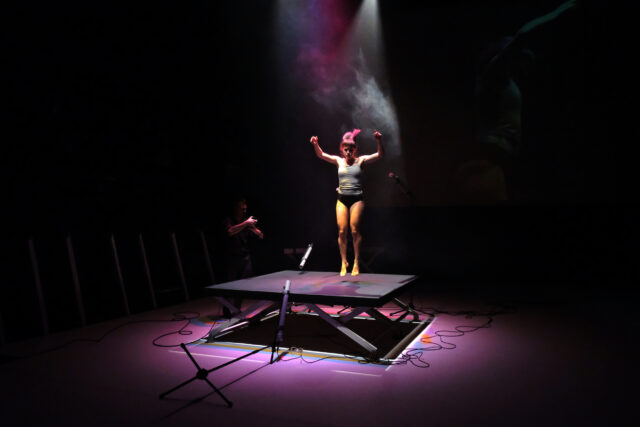
twi-ny talk: ROBIN WILSON OF THE GIN BLOSSOMS

Robin Wilson is being inducted into the Long Island Music and Entertainment Hall of Fame on August 25 (Zoom screenshot by twi-ny/mdr)

ROBIN WILSON
The Long Island Music and Entertainment Hall of Fame
97 Main St., Stony Brook
Friday, August 25, $40, 7:00
www.limusichalloffame.org/museum
www.ginblossoms.net

Lou Reed, Run-D.M.C., Salt-N-Pepa, the Ramones, Count Basie, Beverly Sills, Pat Benatar, Louis Armstrong, Kurtis Blow, Blue Oyster Cult, Joan Jett, John Coltrane, Aaron Copland, Neil Diamond, George Gershwin, Stray Cats, Barbara Streisand, Billy Joel, Taylor Dane, Simon & Garfunkel.

Those are only some of the artists who have been inducted into the Long Island Music and Entertainment Hall of Fame (LIMEHOF). The next to join that prestigious roster is Robin Wilson, lead singer of the Gin Blossoms, who will be inducted on August 25. Wilson was born in Detroit and raised in Arizona, but he moved to Valley Stream on Long Island more than twenty years ago to spend more time with his son, Grey Wilson, and his ex-wife, Gena Rositano, a longtime stage manager at Saturday Night Live. On Valentine’s Day, 2021, Wilson had a serious fire in his home, forcing him to temporarily relocate to Hicksville, but he returned to Valley Stream, where he played a series of free house shows during the pandemic.

Robin Wilson and Gena Rositano with their son Grey at SNL (photo courtesy Gena Rositano)

I grew up in Malverne but went to high school in Valley Stream with Rositano and have closely followed Grey’s development as a musician in his own right; he is now part of several bands, including the Mercurys, the Afternoon Grifters, and Theo & the London Outfit.

Wilson, fifty-eight, became a Gin Blossom in 1988, one year after the group formed. The band’s major label debut, 1992’s New Miserable Experience, was packed with hits, including “Hey Jealousy,” “Until I Fall Away,” “Found Out About You,” and “Allison Road,” and has sold over five million copies. The follow-up, 1996’s Congratulations I’m Sorry, featured “Follow You Down” and “Til I Hear It from You,” the latter recorded for the 1995 film Empire Records. In addition to performing with the Gin Blossoms, Wilson joined the Smithereens after the 2017 death of Pat DiNizio; he writes songs with the band and alternates on lead vocals with Marshall Crenshaw.

Heavily tattooed and wearing black horn-rimmed glasses, a black T-shirt, and black shorts, Wilson zoomed in from a hotel gym in Indianapolis, where the Gin Blossoms were scheduled to play the penultimate show of their summer tour at the Indiana State Fair that night. After a short break, they’re going back out on the road, stopping at the Paramount in Huntington on September 12.

At the LIMEHOF induction ceremony on August 25 in Stony Brook, Wilson will play a set with a pair of fellow Smithereens, guitarist Jim Babjak and drummer Dennis Diken, along with Joe Jackson bassist Graham Maby and special guest Grey Wilson.

During our talk, Wilson was generous with his answers, giving them careful consideration while being open and direct. Below he discusses fathers and sons, the modern concert experience, cover songs, living in Valley Stream, and more.

twi-ny: We met briefly when your son Grey’s band the Mercurys played the Klub 45 Room in Times Square and you joined them onstage. You played the Gas Giants’ “Quitter,” which was a blast.

robin wilson: It was such a blast.

twi-ny: Grey has also played with the Gin Blossoms. What are those experiences like to have either you jump onstage with him or him jump onstage with you?

rw: Well, it’s a thrill for me because music is the predominant force in my life. And for it to become equally so in my son’s means a lot. It fills me with pride to see him take my lead and to try to follow in my footsteps.

My father was a stuffy Republican accounting professor who wanted nothing to do with me, and we had nothing in common. I never had a moment like that with my dad. There’s no parallel experience that I’ve had with my father. So it means a great deal to me to be able to perform with Grey from time to time.

twi-ny: You went to school where your father taught.

rw: We lived in Tempe. He was a professor at Mesa Community College. Which was nearby. He started teaching there in 1971 when we moved from Detroit to Arizona. And so I grew up on that campus and that was one of my first jobs, working in the cafeteria there. When I got out of high school, I was a student at Mesa. For a long time.

Since my dad was a professor, tuition was free. I went to school there for five years. I never quite got an associate’s degree. For the first few years, I changed my major a bunch of times and kind of floundered around. But by the time I finally found direction, I was studying physics and other of the physical sciences, like chemistry and calculus and geology. And then the band took off, and so I never got to finish my degree. I was very proud to walk into my physics professor’s office one day and say, I can’t finish this semester. Our band is going on tour.

twi-ny: That’s a great excuse.

rw: You know it; it was great. And I remember when I dropped out of college for that first tour, my dad told me, “Robin, you’re a fucking idiot.” [ed. note: After New Miserable Experience went gold, Wilson’s father conceded, admitting, “Robin, I feel like a fucking idiot.”] So I know what it means to my son to pursue music and what it means to dream of a life creating and performing music. I want him to succeed, and I want to give him the tools that he’ll need to accomplish his goal.

twi-ny: I’ve seen Grey play live and on YouTube and Instagram. He’s quite accomplished. He’s got a great stage presence, and he can play that guitar.

rw: Yeah, he can really play. And so I’m always really proud to have him join us onstage with the band. It’s gonna be great to have him performing at the Hall of Fame induction, too.

Bill Leen, Scott Hessel, Robin Wilson, Jesse Valenzuela, and Scott Johnson of the Gin Blossoms (photo courtesy the Gin Blossoms)

twi-ny: The Gin Blossoms have been together for about thirty-five years now, including four core members who have been together since 1992. What is the secret to the longevity of the group?

rw: Well, it’s a combination of factors, the most important of which is compromise. Knowing when to keep your mouth shut and just do your job. That goes a long, long way in the rock band environment. That combined with the fact that we have really good songs and we can go to any city in America and sell a thousand tickets and people can sing along with our music. It’s just such a gift to have been able to accomplish that sort of commercial success that it would be stupid just to turn your back on it. You’d have to be really, really unhappy and miserable to want to just blow the whole thing up just because you don’t want to go do rock shows.

It’s not easy. Most of what we do is the traveling. There’s at least ten or twelve hours of travel for every hour we spend onstage. But that ninety minutes a day onstage makes up for all the other bullshit. And my bandmates and I have been able to put our grievances behind us for the most part and accept that everyone in the band is allowed to have their own experience. So we just try to do our jobs and stay out of each other’s way, not create trouble. And we’re grateful that we could still do it at this level,

twi-ny: Touring has obviously changed since the band started. What are one or two things that stick out to you that are either better or worse than they were in the late eighties, early nineties? Fans are throwing objects at lead singers for TikTok. Have you encountered anything or like that?

rw: Well, that kind of thing has happened randomly throughout our career, but it’s just a random occurrence. It’s not a part of any sort of trend. The main force that makes it different now than what it used to be is this device that I’m talking to you on, the smartphone. When we first started touring, we didn’t have GPS. We had a road atlas that was about this thick.

twi-ny: I remember those.

rw: And that would go underneath the driver’s seat. When we would pull into a new town, we would have to pull that out and look through a map. You had to be able to read a map and find your way through a new city to get to the gig. There wasn’t a way to just pull up Yelp and find someplace to eat. You had to ask if there was a restaurant nearby or physically drive around looking for somewhere you could eat.

And then, of course, the worst thing about the phone, this new media, is social media. It’s just a fucking cancer. It makes everyone think that they’re the star of their own reality show and that everything is about them. I don’t mind people taking pictures of the band while we’re performing. I don’t mind video of the band while we’re performing. But what I cannot stand is when someone will stand right in front of me and take a selfie of themselves. That’s just so incredibly rude and so self-absorbed, and it takes you out of the moment, you know? Here’s a picture of me not listening to my favorite Gin Blossoms song.

I just don’t get it. And again, it’s just so rude. The way I think about it is, imagine if your child was onstage in the school play and someone stood up in front of your child while they were delivering their lines and started taking selfies of themselves and started distracting your child. How outraged would you be? Because this person is doing that. It would make you sick to see someone do that.

We didn’t enjoy concerts any less in the eighties and nineties before everybody had a camera with them. We enjoyed concerts just as much when we were forced to use our brains to remember them. And these people who say, Well, I’m entitled to capture the moment. Well, capture it with your brain, you lazy asshole. It’s so stupid. So that’s maybe the main thing. Like I said, I have no problem with people taking pictures or video of the band, but it absolutely disgusts me to see people taking pictures of themselves while standing in front of the band.

The Gin Blossoms’ most recent album is 2018’s Mixed Reality

twi-ny: As someone who goes to a lot of shows and often is up front, I can tell you it’s also distracting for the audience. If I’m standing behind someone and they suddenly turn around and their face is in my face so they can take a picture of you behind them onstage, it takes me out of the concert for that split second. And so it’s also annoying on that end.

rw: Yeah. But virtually everything else about the concertgoing experience is the same. I mean, how people react to the music and the performers, what the music means to them, the way it inspires genuine emotion. All of that is the same. The thrill of the light show and the sense of community and all of those things. None of that has changed. The only difference is that everybody’s got the phone, and the phone is a way to take you out of the moment.

twi-ny: Over the years, the Gin Blossoms have developed that real sense of community you just mentioned. Your songs really touch people. And I think that reaching them on an emotional level is really part of what’s kept you guys going so strong. I’ve also noticed on the current tour, you’re playing some great covers: Johnny Cash’s “Folsom Prison Blues,” Sam Cooke’s “Twistin’ the Night Away,” and then one of my favorite old songs, the Plimsouls’ “A Million Miles Away”; I saw them play that at the Whiskey a Go Go back in the early eighties.

rw: It’s just great music. I’m glad you’ve enjoyed those songs. And those are all certainly songs that I love to play. I like to play cover songs; I wish that we actually played more covers. I don’t necessarily want to do more covers per show, but I wish we had a larger repertoire of covers we could dip into. But not everybody in the band really loves playing cover songs. They prefer to play original music. And I can appreciate that.

And so, again, what I was saying earlier, the most important thing is to compromise and not make it so any one person in the band is absolutely miserable about the way the shows are done. Everybody’s entitled to have some fun during the show. So if one guy doesn’t want to play a lot of cover songs, well, his feelings are very important to me. So we try to keep it to a minimum. We find the place where we can compromise on these types of issues.

twi-ny: Which doesn’t always happen in a band.

rw: Yeah, it’s very, very difficult to find that. And it’s especially hard when you’re a young band and you’re just coming up and you’re on the charts for the first time. But part of keeping a band together for thirty-five years is learning how to communicate with each other and learning how to find those compromises and the middle ground.

twi-ny: Speaking of original songs, your last album came out in 2018. Anything you guys are working on?

rw: Yeah, at some point. We haven’t got a firm date set to record a new record. But I would suspect that we are going to be in the studio sometime in 2024, have something done by the end of the year. You know, we’re not super anxious, but some of us already have songs that we want to record, and we know we can’t really go much longer before we start to feel bad about it. We don’t owe anybody anything.

It’s not like we sell a lot of records anymore. But as musicians of a part of a certain generation, we feel like we owe it to ourselves to create new music from time to time to challenge ourselves, to create something that we feel holds up with the rest of our catalog. So we know we’ll do it for our own reasons on our own schedule. There’s no record company hounding us to get it done or anything. We’ll just do it when we feel like it. I suspect that it won’t be too long from now before we get another record done. [ed. note: The Gin Blossoms sold a majority stake in their music publishing rights and artist master royalties in 2021 to Primary Wave.]

Robin Wilson and Willie Nile join Theo & the London Outfit for a Valley Stream house concert under the Arizona state flag (photo courtesy Theo & the London Outfit)

twi-ny: So getting back to August 25, you’re being inducted into the Long Island Music and Entertainment Hall of Fame. What was it like getting that notification?

rw: Well, it was really amusing. I mean, of course I’m filled with pride and it’s very gratifying. But I’ve had such a contentious relationship with Long Island; my being there, my living there is just such a strange, unlikely circumstance. And it took me so long to get used to it. If you knew what my bandmates have heard me say about Long Island over the years, we’d be laughing as hard as we were when we found out about this, because it was just very difficult for me to get used to being and living on Long Island.

But eventually, it did take, and I’m proud of my home there in Valley Stream, and I’m proud to be the only guy on Long Island who flies an Arizona flag on the front porch. I think it’s really funny when my neighbors come by while they’re walking their dogs and they say, “What is that flag?”

twi-ny: What country is that?

rw: What’s funny to me is, that’s Arizona, that’s the forty-eighth state, you know? So I’m there on Long Island representing my home state of Arizona, which I miss terribly. And now I’ve become a big part of this community.

The company that I’m in with this honor is incredible. It’s humbling and very gratifying. And I’m especially proud for my New York family, the Rositanos, all of my nieces and nephews, my ex-wife and my son, my sister-in-law, my brothers-in-law, and their families. I’m really proud for them, of all the Christmases and holidays we’ve spent together, and now they get to take pride in this, and their pride in this means more to me than anything else about this honor. So I’m very excited for my family, the Rositanos, and I hope they can all be there for for the ceremony.

twi-ny: Is that what brought you to Valley Stream in the first place, family?

rw: Yeah. My ex-wife, Gena, is from Valley Stream. She and I met at MTV. She used to work at MTV.

twi-ny: Yes, I remember.

rw: That’s right. You know Gena. And so she and I met doing The Jon Stewart Show on MTV. [ed. note: You can watch that full episode, also featuring Long Islander Howard Stern, here; Gena was one of the stage managers on the program.]

twi-ny: They just had a reunion, with Jon and everyone.

rw: Yes, that’s right, for the cast and crew. In 1996, Jenna and I had Jon Stewart ordained as a minister, and he performed our wedding ceremony in Valley Stream. It was my connection to Gena and specifically my son, Grey, that kept me there in in Long Island. I could have moved home to Arizona. I always thought I would, but when it came time to actually pull the trigger, I couldn’t leave and I wanted to be there for my son.

And so I’m a Long Island guy now, go figure. And my son, he is in a couple of bands that play around Long Island, Brooklyn, Queens, and whatnot. And then he’s also a DJ on the radio station at Nassau Community College, WHPC 90.3; his show is called “Alternative to What?” It’s Tuesday nights at 7:00, so everybody tune in and hear my son on the radio spinning the alternative hits. That’s 7:00 on Tuesdays, WHPC 90.3.

twi-ny: Excellent. I do want to ask you one other thing, and it has to do with Valley Stream. I was born in Brooklyn and went to school in Valley Stream. And so my wife has listened for decades to all the things I’ve said about Long Island, probably some of the same things that you would tell your bandmates about Valley Stream before you moved there. As a teenager, I couldn’t wait to get out of there to come to New York City. But a lot of my friends still live in Valley Stream and the surrounding area and love it. You’ve really settled in, huh?

rw: Yeah, I really have. You know, It’s a great little town. It’s got tons of great pizza; Ancona’s would be my favorite. There’s really great Pakistani food everywhere. It seems like we have a really large community of really good immigrant cooks everywhere. It’s a very diverse community.

twi-ny: That was not the case when I went to school there.

rw: On my block alone in Valley Stream, there are three families from Guam. You know, I went my entire life in Arizona without ever meeting anyone from Guam. And there on my street in Valley Stream, there are three families from Guam. So there’s something about it. My theory is that these families are moving to America, and they land at JFK with all their bags, and they get out to the curb and they look around and they go, Well, let’s buy a house. And they end up there in Valley Stream.

And I think that’s part of the strength of our community, the diversity and the variety of food and of viewpoints and such. I know that it wasn’t always like that; when I first moved to Valley Stream it was a very different place, in terms of the racial makeup. I very much enjoy how diverse and cool it is now, and how many different cultures are represented just on my block alone.

It’s great to be part of the community. I love my neighborhood. I love all my neighbors. I got to know everybody during the pandemic. I was doing shows for my neighbors during the pandemic; I would be out in my front yard and I would put on concerts. I am really happy. I’m really proud to live there. And so I hope that they can take pride in this honor too.

twi-ny: You recently played a show with Willie Nile and Grey at your house.

rw: Yes, indeed. That was the first one I had done in a while. And so if anyone’s interested in seeing the livestream performances that I’ve done from my home studio or in my front yard, you can go to the Gin Blossoms official YouTube page and see the shows I was doing for my neighbors during the pandemic.

It was the best part of the pandemic for me, performing for my neighbors; it really meant a lot to me that I was able to bring the neighborhood together in a time of isolation. I really enjoyed the pandemic. I mean, obviously it’s not something you would choose to happen, but I managed to make the most of it.

I enjoyed being home for the first time in my adult life. I enjoyed being home for more than a few weeks at a time. I really enjoyed getting to know my neighbors and performing for them, and spending time with my son. I made a lot of carnitas and I played a lot of video games, and I created a lot of content for the Gin Blossoms YouTube page. That’s really kind of when I truly became a citizen of Long Island, during the pandemic.

So, hi to Gena and Grey and all the Rositanos. I’m looking forward to seeing you guys soon. I’m gonna be home for a couple of weeks, for the first time since last winter. I actually have more than five days off starting next week. So I’m looking forward to spending some time in the studio with my son and riding my bike in Valley Stream State Park, just relaxing and enjoying my home.

twi-ny: Well deserved. And congratulations again on the Hall of Fame. I don’t know who’s going to have more fun, you or Grey, but it’s great for both of you.

rw: Definitely Grey; everything’s more fun for Grey than it is for me.

twi-ny: Thanks, man. This was great.

rw: No, thank you. Peace and love for everybody on Long Island. Rock away!

[Mark Rifkin is a Brooklyn-born, Manhattan-based writer and editor; you can follow him on Substack here.]

HOOP DREAMS: FLEX / THE HALF-GOD OF RAINFALL

Starra Jones (Erica Matthews) and Sidney Brown (Tamera Tomakili) face off against each other in Candrice Jones’s Flex (photo by Marc J. Franklin)

FLEX
Lincoln Center Theater at the Mitzi E. Newhouse
150 West 65th St. between Broadway & Amsterdam Ave.
Through August 20
www.lct.org/shows/flex

“Being a fan is like having a religion,” Matt says in Rajiv Joseph’s King James, a play that ran this spring at MTC at New York City Center about two Cleveland men who bond over their mutual love of hoops star LeBron James, perhaps the greatest player of all time.

Here in New York, basketball itself is a religion. Fans continue to worship the Knicks and pack Madison Square Garden even though the team has won only one playoff series in ten years and has not taken home a championship in half a century; the city went into mourning when former All-Star MVP center Willis Reed died this past March at the age of eighty. Across the East River, the Nets have been in turmoil since they moved to Brooklyn in 2012, going through superstars at the Barclays Center like Halloween candy, with nothing to show for it.

Meanwhile, for those paying attention, the other team at Barclays, the New York Liberty, is having its best season since the Women’s National Basketball Association started in 1997, in serious contention for its first league title.

Basketball lies at the heart of two current dramas in Manhattan, one worthy of a championship, the other, well, in need of significant rebuilding; both conclude their seasons on August 20.

At Lincoln Center’s Mitzi E. Newhouse, Candrice Jones’s Flex is a fast-paced and exciting play set in rural Arkansas in 1998, where five seventeen-year-old Black women on the team known as the Lady Train are preparing for their next big game. Shooting guard Sidney Brown (Tamera Tomakili) is being scouted by major colleges. Point guard Starra Jones (Erica Matthews) is a ball hog jealous of the attention Sidney is getting. Power forward Cherise Howard (Ciara Monique) believes they all need to be cleansed and offers to baptize everyone. Center Donna Cunningham (Renita Lewis) is the most grounded and caring of the tight-knit group. And shooting guard April Jenkins (Brittany Bellizeare) is pregnant but wants to keep playing, despite the strong objections of coach Francine Pace (Christiana Clark).

Matt Saunders’s primary set consists of half a court, with the rim affixed on the top of a barn garage. The floor is actually parquet but we’re told it’s dirt. At the beginning, all five players appear to be with child, but following practice, four of them take out fake pregnant belly prosthetics. It’s a funny moment that instantly shows their camaraderie and support for one another.

The narrative is divided into four quarters, just like a basketball game. The cast displays its skills right from the opening tip-off, getting into a rhythm. “My first buzzer beater ever! / I finally know I’m just as good as you! / No more Plainnole, Arkansas, dirt courts for me, Mama! / No more dust in my eyes, my ankles, my fingernails. / I’m gonna win regionals, then state,” Starra says to her late mother, who gave up bball for the army. “Ain’t no way you gonna believe this. / But, scouts are coming here, to Plainnole. / You said by the time I got older. / There’d be a girls’ NBA. / You were right. / I’m going to the WNBA.”

Starra’s selfishness leads to major problems when the teammates hang out one night at Sidney’s house, discussing Michael Jordan, sexual abuse, abortion, condoms, and boxers vs. briefs. Soon they’re in an ingeniously designed car, singing Aaliyah’s “Are You That Somebody,” each of them highlighting individual lines that are particularly meaningful, which include “I’ve been holdin’ back this secret from you / I probably shouldn’t tell it, but / But if I, if I let you know / You can’t tell nobody, I’m talkin’ ’bout nobody.” Secrets keep coming out — or teeter around the rim — as the state tournament approaches and the game plan might involve benching several starting players.

Tony-nominated director Lileana Blain-Cruz (Fefu and Her Friends, Anatomy of a Suicide) guides the action like a masterful basketball coach, smoothly transitioning between offense and defense, knowing exactly who should have the ball at any given moment. The play is in constant motion, leaving no time for slacking. In a brilliant move, the stage crew dress like referees, adding humor and referencing how the players are too often being judged.

While it’s about a lot more than just basketball, Jones doesn’t overplay the metaphors, keeping her eyes on the rock as the action heats up. Mika Eubanks’s costumes range from sweats, shorts, and T-shirts to snazzy uniforms, with Adam Honoré’s lighting and Palmer Hefferan’s sound contributing to the overall tension.

The title refers specifically to a play run by the five players on the court, but it also evokes the Brooklyn street dance known as flexing, a word used for boasting or expressing oneself, and the standard dictionary meaning, to bend, intimating that the teammates have to be flexible if they want to succeed.

The cast, which also features Eboni Edwards as the sixth member of the Lady Train, comes together like a successful team with a legitimate shot at the crown. They face serious issues at school and at home, with boyfriends, girlfriends, and relatives, and with race and religion, but the more they work together, the more their goals are within reach, but it’s going to take more than a buzzer-beating three-pointer for them to win in the game of life.

Demi (Mister Fitzgerald) leads his team on the Battle Field in Inua Ellams’s The Half-God of Rainfall (photo by Joan Marcus)

THE HALF-GOD OF RAINFALL
New York Theatre Workshop
79 East Fourth St. between Second & Third Aves.
Through August 20
www.nytw.org

Over at New York Theatre Workshop, Inua Ellams’s The Half-God of Rainfall features seven characters on a floor of dirt and mulch, constructed around the game of basketball while being about much more, although precisely what gets garbled like a stalled offense and a defense with too many holes.

The ninety-minute play, a melding of Greek and Yoruba mythology told as an epic poem in chapters, opens with the fine cast introducing themselves, a dose of reality that immediately blurs the fantasy that follows. At the center is Demi (Mister Fitzgerald), a demigod born to Zeus (Michael Laurence) and the mortal Modúpé (Jennifer Mogbock). Observing the proceedings are the River Goddess Osún (Patrice Johnson Chevannes), Sàngó, an Orisha God of Thunder (Jason Bowen), Hera, the Goddess of Marriage, Women, and Family (Kelley Curran), the Orisha Gods Òrúnmilà and Elégba (Lizan Mitchell), and other mythical figures. Because his father is Zeus, the young Demi, called the Town Crier because of his propensity to rain down tears, is banned from playing basketball, which in this world represents war.

Mortals play on a makeshift court known as the Battle Field — “where generals were honored and mere soldiers crushed” — built with telephone poles, tires, fishing nets, and charcoal. “Basketball was more than sport; the boys were obsessed,” Elégba says. “They played with a righteous thirst,” Hera adds. Sàngó: “There were parries, thrusts . . .” Elégba: “shields and shots . . .” Zeus: “strategies and tactics . . .” Osún: “land won and lost . . .” Modúpé: “duels fought . . .” Hera: “ball like a missile . . .” Zeus: “targets locked.”

When Demi surprisingly reveals a remarkable shooting acumen, everyone begins to view him differently. But Demi’s prowess leads to both an NBA contract as well as disagreements among the Gods and a war that takes place with weapons, not a round ball.

Similarly to the young women in Flex, the young men in Rainfall engage in trash-talking and worship Michael Jordan; among the same issues that are brought up are sexual assault, prayer, and competition that extends beyond the court. Whereas the women see basketball as a way to improve their lot in life and form a close group, in Rainfall “Hera rolled her eyes at how mortal Gods could be, how like men to reduce disputes down to sporting feats, but it was done: the stakes, awful, the route to run.”

Characters in Rainfall shift between dialogue and narration, often in the same speech, so it can become confusing whether they’re talking to the audience or the other Gods and mortals. Too much of the action is described instead of playing out on the court, turning the show into a kind of staged reading. Riccardo Hernández’s set contains scrims on three sides where Tal Yarden projects abstract and concrete images that only add to the perplexity. Linda Cho’s costumes and the props at times feel more like cosplay than serious theater.

The thirty-eight-year-old Ellams, who was born in Nigeria and raised there and in England and Ireland, has been playing basketball since he was twelve; he is also a Marvel Comics enthusiast and has written books and performed solo shows. He stuffs too much into The Half-God of Rainfall, which also has problems with its timeline as it ventures between the ancient and the present, particularly when Sàngó mentions which other real-life all-stars are demigods. (How many people in the audience are likely to know who Clyde Drexler is?)

From start to finish, Flex shows that it’s got game, effectively executing its strategy with an expert balance of humor and sincerity as it sets its sights on its championship goals. The Half-God of Rainfall is all over the place, in desperate need of a tactical blueprint if it wants to have a shot at possibly making the playoffs.

[Mark Rifkin is a Brooklyn-born, Manhattan-based writer and editor; you can follow him on Substack here.]