live performance

R.O.S.E.

Park Ave. Armory has been transformed into a rave club for R.O.S.E. (photo by Stephanie Berger)

R.O.S.E.
Park Ave. Armory, Wade Thompson Drill Hall
643 Park Ave. at Sixty-Seventh St.
September 5-12, $65
www.armoryonpark.org

Sharon Eyal’s exhilarating R.O.S.E., which opened September 5 for a too-brief seven-show run in Wade Thompson Drill Hall in Park Ave. Armory, ebbs and flows as a participatory dance experience that pulses with a series of slow fuses that explode about half a dozen times over the course of three hot hours.

An armory commission that debuted last year at New Century Hall in Manchester, R.O.S.E. starts off calmer than one might expect. The hall is divided into front and back sections by a floor-to-ceiling side-to-side black fabric wall. As the audience arrived in the first section of the hall, about a half hour before showtime, a DJ spun droning tunes in the space, mostly empty save for a few couches and benches; a projection of a large white rose glowed on the wall behind the DJ.

On opening night, one man moved slowly back and forth to the music as a handful of others relaxed, talked, and checked their phones. Little was going on; excitement was nonexistent. At 7:30, the crowd began entering the main space; staff wearing glow sticks placed a sticker over each person’s phone camera lens, as absolutely no photo or video is allowed inside.

The truncated area lacks the breathtaking awe of the hall’s usual vastness, with walls and curtains on all sides and lights and speakers hanging down, blocking the view of the impressive ceiling. There are four step-platforms, with bars in two corners, the tech crew in a third, and DJ Ben UFO in the fourth. (The set design is by Daphnée Lanternier, who is also credited with creative direction.)

Dancers weave in, through, and around the crowd in Sharon Eyal’s immersive R.O.S.E. (photo by Stephanie Berger)

It was not clear what to do at first as attendees considered where to stand. (I recommend hanging around wherever you see white tape on the floor.) The crowd consisted of people from all age groups (except children), in all types of dress and hairstyles, including small groups that appeared to come straight out of SNL’s old “Sprockets” skits; some swayed to the music, others chattered away, and a few scanned their phones. After about fifteen curious minutes, one gentleman stepped into a spotlight in the middle of the room and clapped his hands over his head several times; that was all it took to get more people to start dancing.

Shortly after eight o’clock, as the packed dance floor was heating up, nine performers (Darren Devaney, Guido Dutilh, Juan Gil, Alice Godfrey, Héloïse Jocqueviel, Johnny McMillan, Keren Lurie Pardes, and Nitzan Ressler) entered the space, making their way through the audience, which parted to let them pass. Wearing postapocalyptic beige costumes by Maria Grazia Chiuri of Christian Dior Couture (that occasionally included cowls and cinch sacks), metal jewelry and makeup by Noa Eyal Behar (that featured streaked black eyeliner, teardrops, and piercings), they moved through the crowd with insectlike precision, their arms and legs forming awkward angles.

Eyal cut her teeth as a member and choreographer of Batsheva Dance Company, and her exciting movement language contains elements of former Batsheva artistic director Ohad Naharin’s Gaga system. The work is codirected by Eyal’s longtime collaborator Gai Behar, whom Eyal met in a club in the late 1990s, and Caius Pawsom of the Young art collective.

While some audience members hung back on the platform risers, others followed the nine dancers around the room as the music thumped, haze wafted over everyone, and Alon Cohen’s propulsive lighting shifted between darkness and light. And then the dancers disappeared.

A team of twelve dancers in black join the fray at Park Ave. Armory (photo by Stephanie Berger)

This pattern happened five or six times during the evening. The dancers would sneak into the area, starting from different corners, and groove for between five and fifteen minutes, sometimes breaking off into stunning solos. If you decide to remain close to them, you have to stay vigilant, as they unpredictably turn, twist, and reach out; you might be touched — one woman stood her ground, so a dancer made contact with her, while another dancer gently put a hand on a man’s shoulder — and you might even be given a black rose.

For one exquisitely choreographed scene, the nine dancers faced off against twelve dancers in black lace (New York–based Julia Ciesielka, Blu Furutate, Antonia Gillette, Michaella Ho, Destinee Jimenez, Nick LaMaina, Natalie Wong, Nina Longid, Julian Sanchez, Luc Simpson, Kailei Sin, and Jeremy Villas) in an epic battle that evoked both West Side Story and The Warriors (as well as a smidgen of Beneath the Planet of the Apes).

It’s a long night, so if you need a break, you can wander back to the first section or even out into the armory’s various period rooms with chairs and couches, and you can get a breath of fresh air outside, but the time between dances gets shorter and shorter as the evening continues, and you don’t want to miss any of them. Part of the fun is anticipating where the dancers will next emerge from and when and where they will exit. Near the end, there are longer solos and, ultimately, a stirring finale where everyone comes together in a rousing celebration bursting with electricity.

The more you put into R.O.S.E., the more you will get out of it. Don’t take off the phone sticker and try to steal a picture or video, which I saw at least two people doing, and don’t obsessively scroll through your cell in between dances. Get into the groove. Bask in the freedom. Join the party and rave on!

[Mark Rifkin is a Brooklyn-born, Manhattan-based writer and editor; you can follow him on Substack here.]
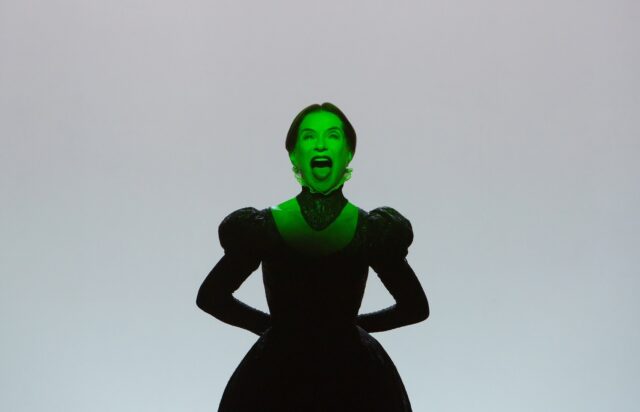
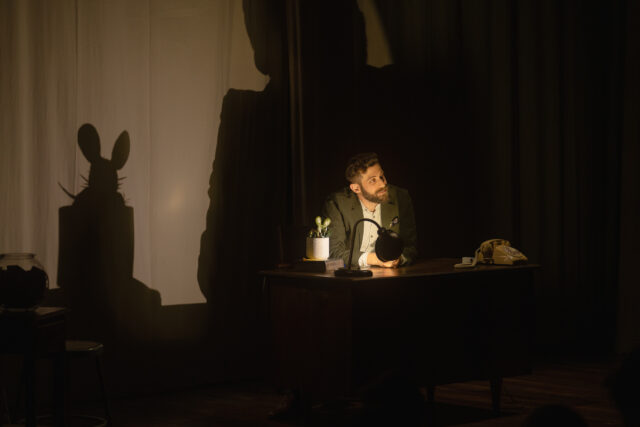
RICHARD TOPOL ON ABRAM, SHYLOCK, AND ANTISEMITISM: OUR CLASS / THE MERCHANT OF VENICE

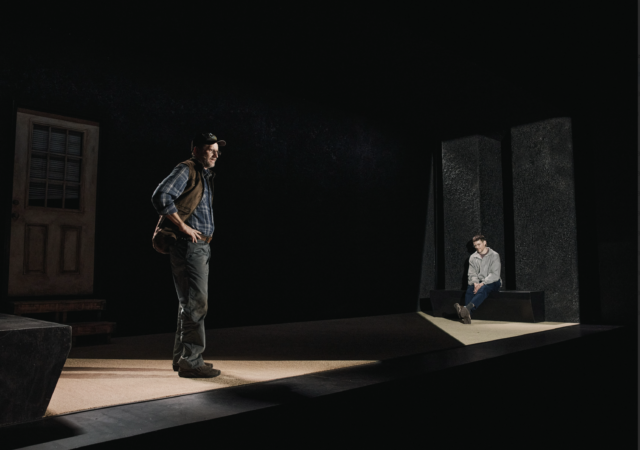
Rich Topol first played Abram Baker in Our Class at BAM this past January (photo by Pavel Antonov)

OUR CLASS / THE MERCHANT OF VENICE
Classic Stage Company, Lynn F. Angelson Theater
136 East Thirteenth St. between Third & Fourth Aves.
Our Class: Tuesday – Sunday, September 12 – November 3, $89-$139
The Merchant of Venice: Tuesday – Sunday, November 22 – December 22, $59-$129
www.classicstage.org
www.arlekinplayers.com

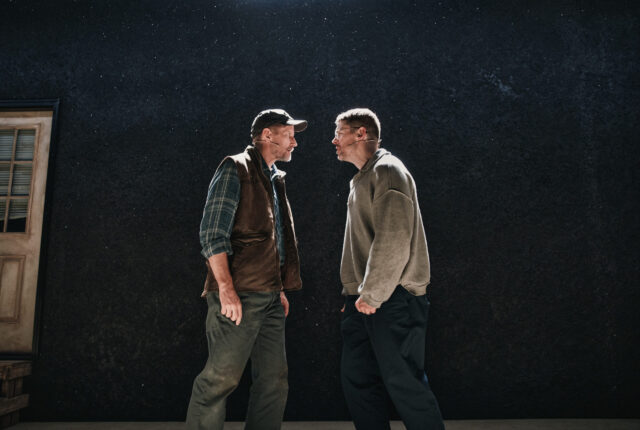
Earlier this year, Arlekin Players Theatre and MART Foundation’s timely new adaptation of Polish playwright Tadeusz Słobodzianek’s 2008 drama, Our Class, sold out a three-week run at the BAM Fisher as part of the Under the Radar festival. Inspired by actual events that occurred in the small village of Jedwabne, Poland, the three-hour play, directed by the endlessly inventive Igor Golyak, focuses on antisemitism among a group of ten Polish students, five Jewish, five Catholic, all born in 1919–20, from childhood to young adulthood to old age, although several don’t make it through a horrific 1941 pogrom.

In my January 30 review, I wrote, “The cast and crew, who hail from Russia, Ukraine, Poland, Israel, Germany, and the US, are superb. . . . Perhaps the best thing about Our Class is that it doesn’t preach at the audience; it has a message and a point of view but is not teaching us about good and evil.”

The show, which was nominated for Drama League, Outer Critics Circle, and Drama Desk Awards, is back for a return engagement September 12 – November 3 at Classic Stage, with the same cast and crew. One thing that will be at least somewhat different is the staging, as Classic Stage is smaller and more intimate than the Fisher (199 seats vs. 250), and the audience sits on three sides of the action. Arlekin’s residency continues there November 22 – December 22 with the New York debut of its unique and unusual production of Shakespeare’s The most excellent historie of the Merchant of Venice with the exxtreame cruelitie of Shylocke the Jewe, featuring much of the same team as Our Class, including director Golyak and actors Richard Topol, Gus Birney, José Espinosa, Tess Goldwyn, Stephen Ochsner, and Alexandra Silber.

Topol, who has starred as Jewish characters on and off Broadway in such works as Indecent, The Chosen, Awake & Sing, Prayer for the French Republic, and King of the Jews, plays Abram Baker in Our Class, a student who leaves Poland and becomes a rabbi in America. In The Merchant of Venice, he will play Shylock, the Jewish moneylender previously portrayed by Edmund Kean, Edwin Booth, Jacob Adler, Orson Welles, Al Pacino, Laurence Olivier, John Douglas Thompson, Andrew Scott, and many others.

In my January 8 Substack post “‘class consciousness’: we are not safe. again.,” exploring Our Class and antisemitism in relation to Hamas’s brutal attack on Israel on October 7 and the aftermath, Topol explained, “Certainly the violence that is occurring in both Ukraine and Israel/Gaza is impacting my relationship and understanding of the play. And it’s making Our Class a story that feels even more important to tell. Because it’s based on true events that occurred not far from Ukraine. And because it’s about cycles of hate. And the violence that can come from that hate.”

As the company began rehearsals for the Classic Stage transfer, I asked Topol several questions about the two plays and his characters.

twi-ny: What similarities do you see between Abram and Shylock?

rt: Well, for starters, they are both Jews living through perilous times filled with antisemitism. They are both fathers who love their children deeply. They are both connected to their religion fully. And they both face moments where they struggle with how to respond to people who treat them with indignity.

twi-ny: What are their main differences?

rt: I think their main difference is how they respond to being treated with indignity. Shylock seeks revenge. He can’t see straight once he’s been broken. Abram is treated less harshly but he also is a kinder man who tries to come to terms with the world as it is in a way that allows for forgiveness or redemption or understanding. And I think that is because Abram is a rabbi who feels the blessings of his G-d around him, even as he suffers harm. Shylock is a businessman, a moneylender, and though he is connected to his Jewish faith, he isn’t as grounded in its teachings as Abram is. Abram creates this gigantic family, these generations of descendants whom he loves and cherishes. Shylock feels like he’s alone in the world, with only his one daughter as his ally. And once she’s gone he has nobody he can lean on, live for, or help him see straight.

Also, because of Abram’s inherent kindness, he sees the best in people, the hope for the world, the possibilities for the future. Maybe Shylock had some kindness in him somewhere but we certainly don’t see much if any of it during the course of the play. Maybe it was snuffed out when his wife died. But bottom line there is a hardness in Shylock’s soul as opposed to a kind of softness in Abram’s.

twi-ny: How might Abram have fared as the Venetian moneylender in Merchant, and how might Shylock have done as the rabbi in Our Class?

rt: That’s a great question and a fun thing to try to imagine. Abram seems like a pretty smart guy, so maybe he would have figured out how to make a successful go of it as a Venetian moneylender. He’s good with languages, he’s a hard worker, and he has a kind of can-do attitude that would have stood him in good stead. I like his chances.

Shylock as a rabbi . . . hmm . . . I’m thinking no way. At least not the kind of rabbi I’d like to hear at synagogue! He definitely feels strongly about his tribe, his people, his religion. But I don’t see him as having the right temperament to be a leader to his fellow Jews.

twi-ny: What would they think about the state of the world if they were alive today, with the same jobs?

rt: Shylock as a modern-day moneylender — a banker in this world of global capitalism — he might be just fine. I think most of the Jews of this time live with greater freedoms, respect, and opportunity than during Shylock’s time in Venice. He’d certainly recognize the antisemitism of our time, but if he were a banker in Venice now I think he might be thriving and might feel like a true equal to his Christian counterparts.

Abram, well, he was alive not that long ago. But I think he’d be heartbroken to see the rise of antisemitism in this country. My sense of him is of someone who loved and seized on the promise and opportunity of America, symbolized by the Statue of Liberty. An immigrant who was always thankful for the chance to make a new and full life here. And he would be as disturbed by the hate and divisiveness of our time right now as many of us are.

[Mark Rifkin is a Brooklyn-born, Manhattan-based writer and editor; you can follow him on Substack here.]
TICKET ALERT: THE VOICES IN YOUR HEAD ENCORE ENGAGEMENT

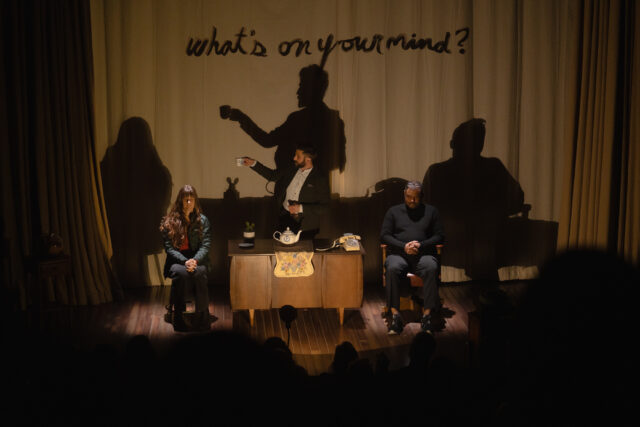
The Voices in Your Head is back for an encore run in a storefront Brooklyn church (photo by HanJie Chow)

THE VOICES IN YOUR HEAD
St. Lydia’s Dinner Church
304 Bond St., Brooklyn
September 9 – October 11, $39.72-$55.20
stlydias.org/events
www.eggandspoontheatre.org

In January, The Voices in Your Head offered a unique view of grief counseling, taking place at St. Lydia’s Dinner Church in Brooklyn. The sixty-minute play sold out quickly, extending its run and adding seats. It’s now back for a return engagement September 9 – October 11, and some nights are already fully booked. For other nights, there are either $39.72 or $55.20 Pay It Forward tickets available, but not both. Christian Caro, Marcia DeBonis, Tom Mezger, Daphne Overbeck, Erin Treadway, and Jehan O. Young reprise their roles in this Egg & Spoon remount, with Alex Gibson, Jamila Sabares–Klemm, and Molly Samson joining the cast.

Below is my original review of the January 2024 edition of this thoroughly involving and entertaining experience.

————————————

Lately I’ve been thinking more than ever about grief and death. I’m not a support group kinda guy, but when I heard about The Voices in Your Head, I knew I had to go.

I found solace — and nearly nonstop laughter — in Those Guilty Creatures’ immersive, site-specific group therapy black comedy, which continues at St. Lydia’s storefront dinner church in Brooklyn through January 29.

The space has been renamed St. Lidwina’s, after the Dutch patron saint of chronic pain and ice skating. The church has a large front window and door, looking more like a cozy shop than a place of worship. When you arrive, you are asked to check off your name on a sign-in sheet; to protect your anonymity, there are no last names, although people passing by outside can peek in and see you.

In the center of the room are more than two dozen unmatched chairs arranged in a large oval. In the back is a working kitchen where the facilitator, Gwen (Vanessa Kai), greets everyone while making tea and cookies. Several attendees engage in friendly conversation and chitchat. Shortly after Gwen calls the meeting to order, it becomes apparent that a handful of the participants are in the cast.

“It’s funny, when I was at my lowest, I was going to all these different meetings; it felt like dating, trying to find the right match, and they were all so . . . maudlin? I thought, there has to be another way. So, I started this group,” Gwen says. “Evidently, there was a need. So, we’re all here, we’ve met the criteria, but, broadly, I like to think of this as a place to share a sensibility. Laughter comes easier for me in here than out there. Everyone has their own relationship to grief; I’ve been considering mine, but what about anti-grief? We seek that through shared stories, activities, and discussions. . . . We aim to hear three stories each week, which, hopefully, helps us exchange some weird-ass joy.”

The audience becomes immersed in the grief of others in The Voices in Your Head (photo by HanJie Chow)

Sharing their sensibilities are the vivacious and outgoing Regina (Daphne Overbeck); Vivian (Marcia DeBonis), who believes in “Death, Embarrassment, Trauma”; Caleb (Christian Caro), who doesn’t want to be sad in college and can’t stop texting; the ultraserious Sandra (Erin Treadway); and the practical Hadiya (Jehan O. Young), who loves “the morbid stuff.”

They are eventually joined by first-timer Blake (Patrick Foley), who is determined to turn his story of loss into a Netflix special, and Ted (Tom Mezger), who actually attends the church and saw a flier.

Over the course of sixty fun, lively minutes, the group discusses Kelly Clarkson, hot cater waiters, self-care, vacuuming, exfoliating, sand, and other items and issues as they explore their personal misfortunes. A role-playing session that puts some of the group members in specific social situations doesn’t go quite as expected. During a break, the characters gossip, revealing more about who they are.

At the center of it all is the arbitrariness of death and Gwen’s assertion that we should “just approach the nature of the loss with a sense of humor. It helps us hold a certain space.”

The Voices in Your Head takes place in the storefront of a Brooklyn dinner church (photo by HanJie Chow)

The cast is uniformly excellent, led by Kai (The Pain of My Belligerence, KPOP) as the not-necessarily-so-stable Gwen, the always terrific DeBonis (Mary Page Marlowe, Small Mouth Sounds) as the chatty but caring Vivian, Treadway (Spaceman, War Dreamer) as the dour Sandra, Young (Speech, The Johnsons) as the purposeful Hadiya, Overbeck (Typed Out: A Princess Cabaret, Nightgowns) as the wonderfully over-the-top Regina, and Caro making his off-Broadway debut as the inattentive Caleb, but Foley (Circle Jerk, The Seagull/Woodstock, NY) nearly steals the show with his unforgettable Christmas story.

Created by Grier Mathiot and Billy McEntee and gleefully directed by Ryan Dobrin, The Voices in Your Head is as smart as it is hilarious. It’s not so much about how we deal with death than how we deal with life. Everyone reacts differently to tragedy and loss, but, as Gwen points out, “We need to hear each other’s laughter.”

The Voices in Your Head is not interactive — the audience should leave the talking to the actors — but feel free to mingle afterward and share your own thoughts about this engaging and involving experience.

[Mark Rifkin is a Brooklyn-born, Manhattan-based writer and editor; you can follow him on Substack here.]
YANIRA CASTRO: EXORCISM = LIBERATION

EXORCISM = LIBERATION
Multiple locations
September 6-28, free
www.acanarytorsi.org

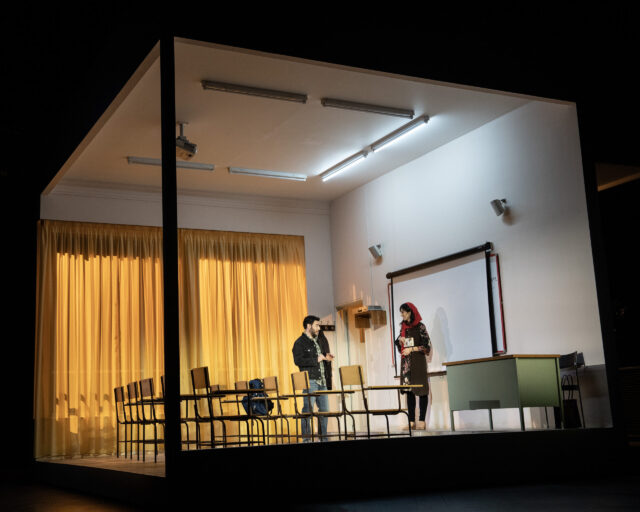
Yanira Castro is a fearless creator always ready to challenge herself and fully engage the audience. Born in Puerto Rico and based in Brooklyn, Castro and her company, a canary torsi (an anagram of her name), have presented such involving, complex, and entertaining multidisciplinary works as Dark Horse/Black Forest, a dance installation for public restrooms; the Jean-Luc Godard–inspired Paradis, a site-specific performance outdoors at twilight at the Brooklyn Botanic Garden; Performance | Portrait, an interactive video installation at the Invisible Dog Art Center; now.here.this, a meditative march of resistance in Prague; and Last Audience, a live communal laboratory at New York Live Arts, a performance manual, and a three-part space-opera podcast.

“Yanira Castro is a structural obsessive. She is an art scientist. She sees the rules and patterns lurking just beneath the surface of things,” Chocolate Factory Theater cofounding artistic director Brian Rogers has written. “The stuff that’s easier not to see . . . chaos staring at itself in the mirror, finding order.”

The Chocolate Factory is one of several venues hosting Castro’s latest project, Exorcism = Liberation, which explores climate change, immigration, land rights, colonialism, and self-determination in activations modeled around political campaigns. Kicking off September 6 and continuing each Saturday this month, the programs, seen through a Puerto Rican lens, include listening sessions, live music, food, and posters, stickers, banners, lawn signs, and pins. (There will also be activations in Chicago, and Western Massachusetts.)

Exorcism = Liberation asks participants to examine three slogans: “I came here to weep,” “Exorcism = Liberation,” and “What is your first memory of dirt?” Conceived, written, and directed by Castro, the project features audio design by Erica Ricketts, graphics by Alejandro Torres Viera and Luis Vázquez O’Neill, voice performances by Melissa DuPrey, josé alejandro rivera, and Steph Reyes, a bomba danced by Michael Rodríguez, and live musical performances by devynn emory and Martita Abril.

In a 2014 twi-ny talk about Court/Garden at Danspace Project, Castro explained, “It is not that I want to challenge the audience. I want to create a scenario for them and to be in conversation with them and I want them to form the picture, craft their experience. Their presence dynamically changes what is occurring. That is what ‘live’ means for me. It is dynamic because of the people in the room.”

In addition to the below events, installations at Abrons Arts Center, the Center for Performance Research (with a November activation date TBD), and the Chocolate Factory will continue into November.

Yanira Castro will present activations of Exorcism = Liberation in multiple locations this month

Friday, September 6, 6:00
I came here to weep: immersive group audio experience with movement score performed by Martita Abril, light refreshments prepared by Castro, stickers and pins available, Abrons Arts Center, 466 Grand St. at Pitt St., Manhattan

Saturday, September 7, 6:00
What is your first memory of dirt?: activation and collective listening session, followed by movement score “Clearing Practice” performed by devynn emory, light refreshments prepared by Castro, stickers and pins available, the Invisible Dog garden, 51 Bergen St., Brooklyn

Saturday, September 14, 7:00
CATCH 76: collective action, followed by a movement score performed by Martita Abril, with ice pops and limbers de coco y limon, the Chocolate Factory Theater (outside), 38-33 24th St., Long Island City

Saturday, September 21, 2:00
I came here to weep: activation and long table discussion with Jeremy Toussaint-Baptiste, Sami Hopkins, and Theodore (ted) Kerr, ISSUE Project Room, 22 Boerum Pl., Brooklyn

Saturday, September 28, 2:00-4:00
Exorcism = Liberation: activation with ice pops, limbers de coco y limon, the Clemente Soto Vélez Cultural & Educational Center, 107 Suffolk St., Manhattan

Friday, October 25, 1:00 – 9:00
OPEN LAB: What is your first memory of dirt? Aural Archiving with Yanira Castro / a canary torsi, advance RSVP required, the Center for Performance Research, 361 Manhattan Ave., Brooklyn

[Mark Rifkin is a Brooklyn-born, Manhattan-based writer and editor; you can follow him on Substack here.]

R.O.S.E.

R.O.S.E. premiered last year at the Manchester International Festival (photo by Johan Persson)

R.O.S.E.
Park Ave. Armory
643 Park Ave. at Sixty-Seventh St.
September 5-12, $65
www.armoryonpark.org

Park Ave. Armory’s massive Wade Thompson Drill Hall has been turned into a flashy nightclub for the North American premiere of the immersive R.O.S.E., running September 5-12.

There are no seats for the three-hour production, so the audience will be on their feet and on the move, shaking and grooving to the show, which features cutting-edge choreography by Sharon Eyal, direction by Gai Behar and Caius Pawson of the record label Young, musical curation by Mattis With of Young, stage and creative design by Daphnée Lanternier, lighting by Alon Cohen, costumes by Maria Grazia Chiuri, and music by DJ Ben UFO. (Audience members can take a break on lounge seating in adjoining reception rooms.)

An armory commission that previously played at New Century Hall in Manchester, R.O.S.E. explodes with freedom, energy, and intimacy as audience and performers meld together as one.

There are several special programs being held in conjunction with R.O.S.E. On September 7 at 7:00, there will be a SLINK rave ($35) with DJs Currency Audio, Laenz, Simisea, rrao, and Enayet, while on September 8 at 6:00 the STUNT QUEEN!!! rave will be led by DJs Kilopatrah Jones, MORENXXX, madison moore, and TYGAPAW, hosted by Xander C. Gaines Aviance and with a poetry reading by Abdu Mongo Ali. And on September 8 at 3:00, “Day for Night: A Salon on Art and Nightlife” ($35) features “Music and Deejaying” with madison moore, Kevin Aviance, and Xander C. Gaines Aviance; “Dance and Club Culture” with Ariel Osterweis and MX Oops; and “The Art of Queer Worldmaking” with Gage Spex, Raúl de Nieves, Dosha, and Jacolby Satterwhite.

Some shows are already sold out, so act fast if you want to catch what should be one of the hottest shows of the year.

[Mark Rifkin is a Brooklyn-born, Manhattan-based writer and editor; you can follow him on Substack here.]
DOWNTOWN ARTISTS: NEIGHBORHOOD TOUR

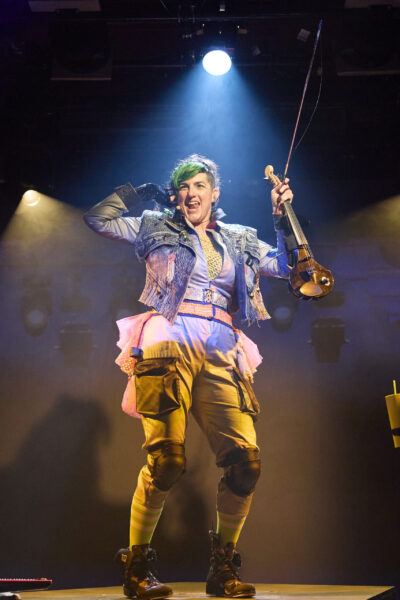
New Museum will host four neighborhood art tours this month (photo courtesy New Museum 2024)

DOWNTOWN ARTISTS: NEIGHBORHOOD TOUR
New Museum
235 Bowery at Prince St.
Thursday, September 5 & 19, $12-$15, 6:00
Saturday, September 14 & 28, $12-$15, 11:00
www.newmuseum.org

The New Museum might be closed until early 2025 while undergoing an expansion, but that doesn’t mean it’s taking time off from being part of its downtown community.

The institution will be hosting four guided walks in September, focusing on the artistic history of NoHo, NoLita, and SoHo from the 1960s to 1980s. On September 5, 14, 19, and 28, teaching artist and poet Rosed Serrano, who was born and raised in the Bronx, will lead groups to the homes, hangouts, and studios of such artists as John Giorno, Lynda Benglis, Adrian Piper, Lorraine O’Grady, Keith Haring, and Jean-Michel Basquiat. You will need your smartphone not just to take pictures but to access the voice amplification system. Tickets are $12 for members, $15 for the general public; you can find out more about some of the Bowery artists here.

[Mark Rifkin is a Brooklyn-born, Manhattan-based writer and editor; you can follow him on Substack here.]
CELLINO V. BARNES

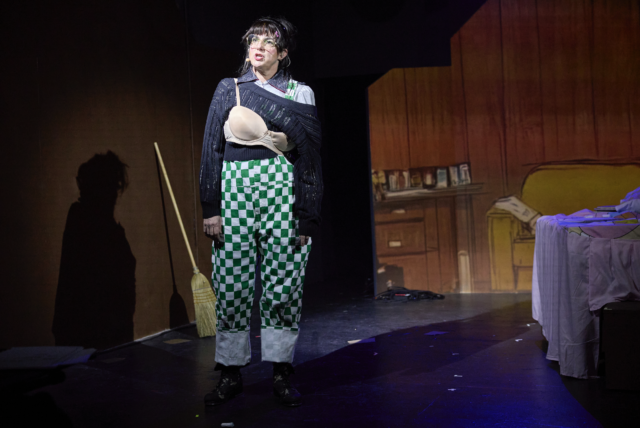
Steve Barnes (Noah Weisberg) and Ross Cellino (Eric William Morris) have quite a bromance in hilarious satire (photo by Marc J. Franklin)

CELLINO V. BARNES
Asylum NYC
123 East Twenty-Fourth St. between Lexington & Park Aves.
Tuesday – Sunday through March 30, $59 – $129
www.cellino-v-barnes.com
asylumnyc.com

“It’s funny, when I look back, it all feels like a dream. Hard to tell what was real and what wasn’t,” Steve Barnes (Noah Weisberg) says near the end of the hilarious farce Cellino V. Barnes.

Ross Cellino (Eric William Morris) adds, “But a lot of it was real. Like, if someone in the future looked us up on Wikipedia, they’d see a lot of this was pretty . . . dead on.”

Don’t bother checking Wikipedia, because I already have, and it turns out that only the barest of bones of Cellino V. Barnes corresponds with reality. But that actually makes it all even more ridiculous and entertaining.

In the late 1990s and early 2000s, Cellino and Barnes gained fame and fortune as a Buffalo law firm that advertised on television, the sides of buses, billboards, subways, and benches. They took unique, often highly questionable approaches to cases and became legal (or is that illegal?) loan sharks. Ross’s father had started Cellino and Likoudis in 1958; Barnes was a marine and military lawyer before hooking up with Cellino. Cellino had his healthy head of hair parted on the right side; Barnes was mostly bald except for hair behind and above his ears.

But most important, they had that jingle, which dramatically escalated their cultish popularity when they changed to a toll-free number:

“Cellino and Barnes / Injury attorneys / Call 800-888-8888.”

Running through January 26 at the Asylum NYC comedy club, the current iteration of the show — the play debuted at Union Hall in July 2018 and has undergone various changes over the years — is an intimate and fun experience. The walls leading to the theater are papered with advertisements for personal injury lawyers. Next to a urinal in the men’s room is an ad for Saul Goodman, the law-breaking lawyer character Bob Odenkirk played on Better Call Saul and Breaking Bad.

Riw Rakkulchon’s small set features a desk with a laptop, a small filing cabinet, a phone with a cord, and high stacks of storage boxes. There are several rows of chairs for audience members on three sides of the stage in addition to traditional seats in the back. Cellino and Barnes are practically on top of each other throughout the show’s eighty minutes as their bromance blossoms, then falls apart.

Writers Mike B. Breen and David Rafieledes, who originated the roles back in 2018, have made Cellino a ne’er-do-well son who is not very bright when it comes to the law or life in general — he has a particular problem with fax machines — while Barnes is a know-it-all attorney with at least some kind of a conscience, until the money starts pouring in.

They first meet when Barnes is interviewing for a position at Cellino and Likoudis and Cellino catches him riffling through paperwork.

“Did you arrive to the interview twenty minutes early to infiltrate my office, steal my interview questions, and prepare answers ahead of time?” Cellino asks.

A humbled Barnes answers, “Umm. Yes. I can head out. I’m really sorry. Nice almost meeting you.”

But Cellino stops him, saying, “No. I love it. Stay. You don’t want to play by the rules? Let’s shake things up.”

That’s precisely what they do for more than twenty years as they grow rich, Cellino finds himself behind bars, and they have a very public breakup that ends up in court.

Cellino (Eric William Morris) gets serious with Barnes (Noah Weisberg) in comic romp at Asylum NYC (photo by Marc J. Franklin)

Codirectors Wesley Taylor, who has starred in such Broadway musicals as Rock of Ages, The Addams Family, and SpongeBob SquarePants, and Alex Wyse, who has appeared in such Great White Way productions as Lysistrata Jones, Spring Awakening, and Good Night, Oscar, gleefully let the narrative go way over the top, occasionally too far, as the silliness reaches near-epic proportions. The show works best when the protagonists are in their suits and ties, scraping up the very bottom of the law for any money they can acquire. (The costumes are by Ricky Curie, with sound by UptownWorks, original music by Max Mueller, and lighting by Aiden Bezark.)

Morris (White Girl in Danger, The Perplexed) is terrific as Cellino, a buffoonish fraudster desperate to hear from his father, or Barnes, that he has done a “good legal job,” while Weisberg (Charlie and the Chocolate Factory, Elf) is quirky as Barnes, who you are sure must have more ethics and morals than he displays, but maybe not. They are like an absurdist Abbott and Costello or Holmes and Yoyo, getting laughs by letting their characters hold nothing back.

Regardless of how much of Cellino V. Barnes is true, it will leave you humming that jingle — and thinking twice the next time you or a loved one might need an injury attorney.

[Mark Rifkin is a Brooklyn-born, Manhattan-based writer and editor; you can follow him on Substack here.]