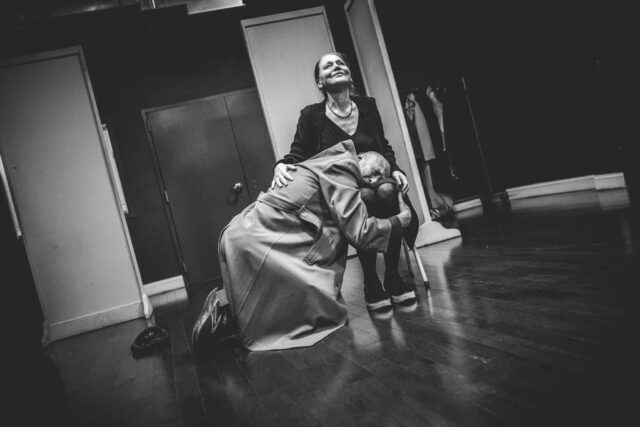
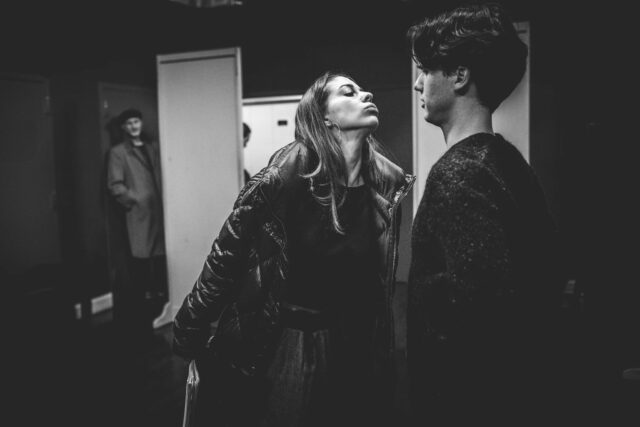
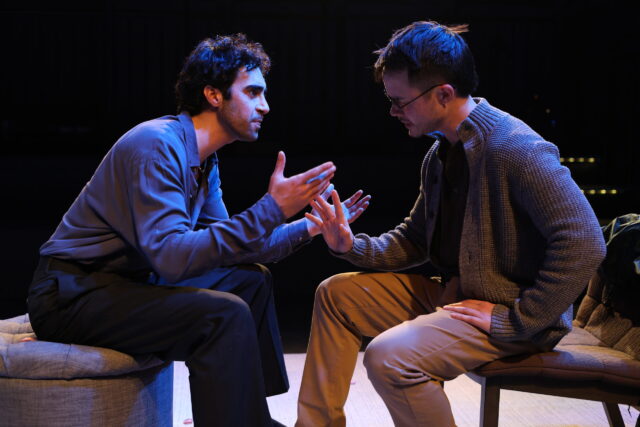
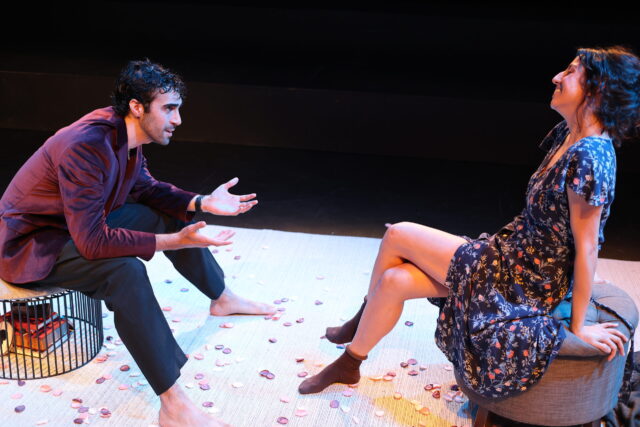
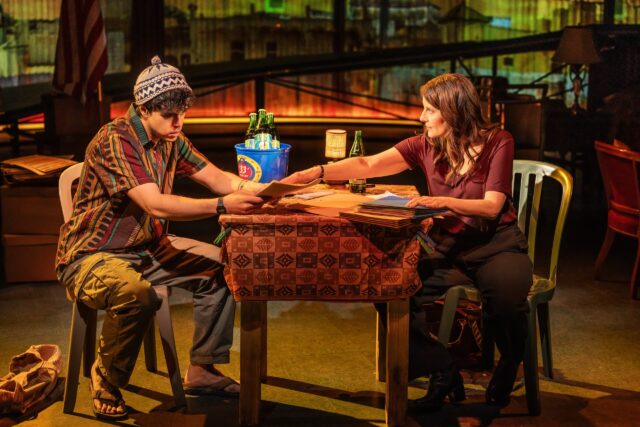
Tamara (Snezhana Chernova) and Ilyin (Roman Freud) reunite after being apart for seventeen years in Five Evenings (photo by Alexandra Vaynshtein)
FIVE EVENINGS
Chain Theatre
312 West Thirty-Sixth St. between Eighth & Ninth Aves.
March 20-30, $49.87 – $71.21 www.fiveevenings.com
“No, this is madness,” Zoya says to Ilyin at the start of Jewish-Soviet playwright Aleksandr Volodin’s Five Evenings, a five-act multigenerational melodrama that is as relevant today as it was when it was first presented in 1959 at the Leningrad State Academic Bolshoi Drama Theater and later adapted into an award-winning 1978 film by Nikita Mikhalkov.
The work is now being revived by director Eduard Tolokonnikov and producer Polina Belkina for a thirteen-show run at the Chain Theatre, with Lana Shypitsyna or Snezhana Chernova as Tamara, Roman Freud as Ilyin, Aleksei Furmanov as Slava, Inna Yesilevskaya as Zoya, and Dima Koan as Timofeev. The ninety-minute play (with intermission) will be performed in Russian with English surtitles; the set design is by Jenya Shekhter, with lighting by Ken Coughlin, sound by Denis Zabiyaka, and costumes by Natasha Danilova.
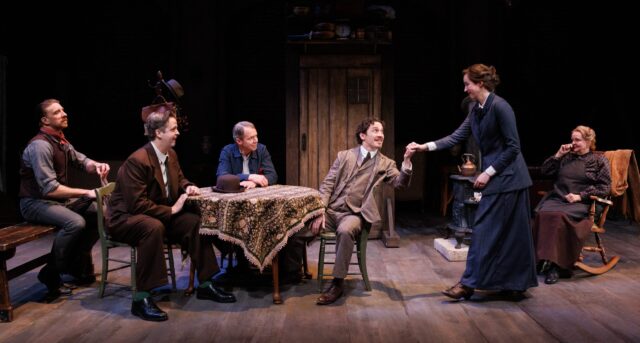
The story looks at two relationships, between the older Tamara and Ilyin and the younger Katya and Slava. In the second evening, they’re together at Tamara’s, and the two men have a chat while Slava sets the table, a scene that is representative of Volodin’s character development and dialogue:
Ilyin: See how nice it is? When there’s a white tablecloth and flowers on the table; it’s awkward to be petty, rude, or mean. The tablecloth should have creases from the iron — they bring back childhood memories. Slava: How poetic. Ilyin: One must live wisely, without haste. Remember, life’s book is full of unnecessary details. But here’s the trick: You can skip those pages. Slava: Well, this is one page I don’t feel like reading. Aunt Toma can clean up when she gets here. After all, isn’t there a division of labor? Ilyin: Don’t make me angry — get to work.
Katya walks in as Ilyin is teaching Slava how to box, declaring, “What are you doing, you slimy snake? What are you doing?!” A moment later, Ilyin says to Katya, “A demonic woman. Is that a manicure you’ve got there?”
Katya and Slava seek freedom and love in Five Evenings (photo by Alexandra Vaynshtein)
Born in Minsk and raised in Moscow after his mother’s death when he was five, Aleksandr Lifshitz — he changed his last name to Volodin because Lifshitz was too Jewish and was impacting his ability to get published — was drafted into the Red Army during WWII and was injured twice before earning a medal for courage. His first play, The Factory Girl, debuted in 1955 and traveled throughout the USSR. Five Evenings, which deals with time, suffering, resilience, and rebuilding, was followed by such plays as My Elder Sister and Do Not Part with Your Beloved in addition to several screenplays.
A champion of the individual who subtly rejected Stalinism in his works, Volodin died in 2001 in St. Petersburg at the age of eighty-two; his son Vladimir Lifschitz, professor emeritus of computer science at the University of Texas at Austin, revoked the copyright of his father’s plays in Russia after Putin invaded Ukraine. Lifschitz will be at the Chain Theatre to participate in a postshow discussion on March 20.
[Mark Rifkin is a Brooklyn-born, Manhattan-based writer and editor; you can follow him on Substack here.]
Who:John Madera,Kyle Thomas Smith, Josh Wexler What:Writers’ Voices — An Evening of Literary Readings Where:New York Insight Meditation Center, 115 West Twenty-Ninth St. between Sixth & Seventh Aves., twelfth floor, and online When: Sunday, March 16, free with advance RSVP (suggested donation $15), 2:00 Why: “There’s an album called Classical Music for Creativity that is perfect, or almost perfect, for blocking out noise so you can read, write, or study. I suppose you could paint or draw or sculpt or design clothes to it too. You can buy it on iTunes for $7.99. I could look up the track listings and rattle them off for you, but the truth is, I don’t know which track is which, or who composed what, when it’s sounding away in my earbuds. All I know is that when I hit shuffle, there are no lyrics and no singing to distract me, and the orchestras’ crescendos are often all that it takes to bring what I’m writing to a crescendo. Theories like the Mozart effect say that just listening to classical music will raise your IQ. That kind of thing used to be hugely important to me when I was younger, but what’s more important to me now is that the music drowns out other people’s chatter. I don’t want anyone or anything intruding on my flow. Still, there’s too much cabin fever when you write at home past a certain number of days and libraries are so stuffy. Plus, you can’t bring drinks in. So, I go to cafes. I’ve been going to them ever since I was a teenager. It’s good to be around people, and even to hear a dull roar of their voices, just to know you’re a part of something larger than yourself and your confines. It’s even better if you can tune everybody out when you’re around them and for me, Classical Music for Creativity does the trick.”
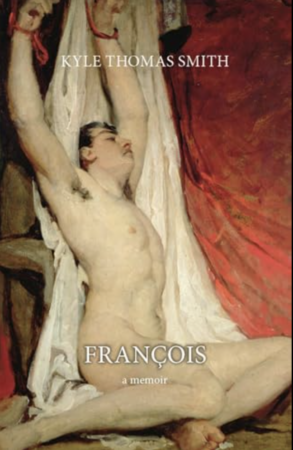
So begins award-winning author Kyle Thomas Smith’s latest memoir, François (StreetLegal Press, 2024), the Chicago-born, Brooklyn-based author’s follow-up to the hilarious 2018 Cockloft: Scenes from a Gay Marriage and the poignant 2010 novel 85A. Smith will be around people on Sunday, March 16, when he appears at New York Insight Meditation Center to read from François, which features William Etty’s dramatic 1828 oil painting Male Nude, with Arms Up-Stretched on the cover. Smith, a practice leader in New York Insight’s Brooklyn sangha, will be joined by New York City–based writer, editor, and publisher John Madera, who will read from Nervosities (Anti-Oedipus Press, 2024), his debut collection of short experimental fiction that includes such stories as “Some Varieties of Being and Other Non Sequiturs,” “Anatomy of a Ruined Wingspan,” and “Notes Toward the Recovery of Desiderata.” Following the readings, Smith and Madera will sit down for a conversation moderated by bookseller, activist, musician, piano teacher, and suicide hotline director Josh Wexler. The event, hosted by the NYI Artist Salon and being livestreamed as well, will begin with presentations by other members of New York Insight’s community.
And just in case Smith is interested, among the works on Classical Music for Creativity are Carl Philipp Emanuel Bach’s Symphony in G Major, Wq. 182 No. 1: I. Allegro di molto, conducted by Hartmut Haenchen; several Vivaldi concertos for violin, cello, mandolin, and/or strings; and Handel’s Music for the Royal Fireworks, HWV 351: IV. La réjouissance, in addition to compositions by Johann Sebastian Bach, Arcangelo Corelli, Mozart, Schubert, Beethoven, and Jean-Philipe Rameau.
[Mark Rifkin is a Brooklyn-born, Manhattan-based writer and editor; you can follow him on Substack here.]
Robert Hand (Rodd Cyrus) and Richard Rowan (Jeffrey Omura) are in love with the same woman in James Joyce’s only published play (photo by George Vail)
EXILES
Jeffrey and Paula Gural Theatre
A.R.T./NY Theatres
502 West Fifty-Third St. between Tenth & Eleventh Aves.
Wednesday – Sunday through March 15, $25-50 www.themaptheater.com/whats-on
Dublin-born writer James Joyce revolutionized literature with such novels as Ulysses,Finnegans Wake, and A Portrait of the Artist as a Young Man. It is little known that he published a single play, Exiles, an intriguing and frustrating work that is currently having its first New York City revival in nearly half a century, staged by the MAP Theater at the Jeffrey and Paula Gural Theatre through March 15. (He reportedly destroyed his only other play, the five-act A Brilliant Career.) While the semiautobiographical work does not revolutionize live drama, it proves to be more than just a side note in Joyce’s history.
Written in 1914–15, Exiles was inspired by the author’s seven-month sojourn to Rome and features characters loosely based on Joyce himself; his wife, Nora Barnacle; his friend Oliver St. John Gogarty; and Vincent Cosgrove, a suitor of Nora’s. It takes place in the summer of 1912, nine years after journalist Robert Hand (Rodd Cyrus) and writer Richard Rowan (Jeffrey Omura) both fell for Bertha (Layla Khoshnoudi), but Richard won her heart — and also impregnated her, causing a scandal. Richard has just finished a book about Robert’s former fiancée Beatrice Justice (Violeta Picayo), who Richard was in love with when he met Bertha. Beatrice teaches music to Richard and Bertha’s son, Archie (Mattie Tindall), a happy child who runs around with glee.
Richard, a dour, humorless man, and Robert, a flamboyant, Byronic figure, are best friends and rivals at the same time. One afternoon Robert stops by Richard and Bertha’s home and finds Beatrice there. “Oh, but I’m sorry I did not know you were coming. I would have met you at the train. Why did you do it? You have some queer ways about you, Beatty, haven’t you?” Robert, carrying flowers for Bertha, ask Beatrice, who coldly responds, “Thank you, Robert. I am quite used to getting about alone.”
Beatrice exits, leaving Bertha with Robert, who poetically proclaims his desire for Richard’s wife, who drinks it all in, returning the flirtation. Robert asks if she can kiss her hand, and she holds it out for him. He asks to kiss her eyes and she obliges. He inquires about kissing her mouth and she replies, “Take it.”
Richard arrives, pretending he does not know what is going on between them. Robert has helped get Richard invited to a dinner with the vicechancellor, where they can discuss the open chair of romance literature at the university. They speak of Robert’s cottage, where he and Richard had some wild times with a bevy of women when they were younger. “It was not only a house of revelry; it was to be the hearth of a new life. And in that name all our sins were committed,” Richard says. Robert answers, “I have no remorse of conscience. Maybe you have.”
Having arranged that Richard will be busy that night, Robert makes a secret rendezvous with Bertha, imploring her to come to the cottage so they can consummate their desire. After Robert leaves, Bertha tells Richard everything; he wants to know every detail, and he listens without jealousy but with a touch of excitement, or at least as excited as he ever gets.
Calling Robert “a liar, a thief, and a fool,” Richard encourages Bertha to go. “You forget that I have allowed you complete liberty — and allow you it still,” Richard says, the first of many times he does so. Bertha gives Richard the opportunity to tell him not to visit Robert, asking if he will blame her if she goes, but Richard proclaims with little emotion, “No, no! I will not blame you. You are free. I cannot blame you.”
It’s a key moment in the narrative, complicating the audience’s relationships with the main characters in a drawing room morality play without a moral. Bertha does indeed go to the cottage — but so does Richard.
Robert (Rodd Cyrus) declares his love for the married Bertha (Layla Khoshnoudi) in Exiles (photo by George Vail)
Adapted and gracefully directed by Zachary Elkind, Exiles is a post-Victorian intellectual soap opera that evokes the love triangle in François Truffaut’s 1962 Jules et Jim and the partner-swapping in Paul Mazursky’s 1969 Bob & Carol & Ted & Alice, tinged with the J. Geils Band’s 1980 hit “Love Stinks,” in which Peter Wolf sings, “You love her / But she loves him / And he loves somebody else / You just can’t win / And so it goes / ’Til the day you die / This thing they call love / It’s gonna make you cry.”
There may not be any tears in Exiles, but there aren’t a whole lot of laughs either. For all the freedom Richard keeps talking about, the adult characters are constrained by social mores, while the fun-loving Archie always has a smile on his face and a bounce in his step, too young to know of life’s many ills.
Cate McCrea’s set is a horizontal space with the audience sitting in three rows of rafters on either of the long sides. At each end is a white curtain and a chair, with two small, round ottomans in the middle, one oddly containing a pile of books and a few other objects. Amara McNeil’s lighting stays fairly bright throughout, so everyone in the audience is visible. Alyssa Korol’s contemporary costumes are highlighted by Bertha’s sexy flower-print dress.
Khoshnoudi is alluring as Bertha; it’s easy to see why everyone is in love with her. Omura, wearing wire-rim glasses that make him resemble Joyce, and Cyrus are each fine individually but don’t quite connect; it is difficult to imagine Richard and Robert were ever close friends. Picayo does what she can with the underwritten Beatrice, who is more of a plot device, while Tindall injects much-needed energy switching between Archie and Brigid, the Rowans’ servant.
Even at a trim ninety minutes, the show gets repetitive, but Exiles is no mere curiosity; it is an intelligent work written by a man at the peak of his abilities, exploring the idea of free love and open marriage in that brief window around the First World War, decades before they were to become hot topics in movies and on daytime television.
[Mark Rifkin is a Brooklyn-born, Manhattan-based writer and editor; you can follow him on Substack here.]
The Mint has resurrected Harold Brighouse’s 1914 political satire Garside’s Career (photo by Maria Baranova)
GARSIDE’S CAREER
The Mint Theater at Theatre Row
410 West 42nd St. between Ninth & Tenth Aves.
Tuesday – Sunday through March 15, $39-$79 minttheater.org www.theatrerow.org
I’ve written before about how one of the many joys of experiencing a work by the Mint Theater is not just the exquisite sets but the set changes; those in the know do not leave their seats during intermission but instead watch the transformation of the stage from one act to another, executed with expert precision, a choreographed dance that deservedly receives its own round of applause.
In the company’s latest show, a lovely revival of Harold Brighouse’s savvy 1914 political satire Garside’s Career, director Matt Dickson incorporates the set changes into the flow of the play; all the elements of Christoper Swader and Justin Swader’s scenic design are onstage through the entire 130 minutes (including intermission), piled in the back and the corners. As the story moves from Mrs. Garside’s working-class Midlanton cottage in Lancashire to Sir Jasper Mottram’s elegant house to Peter Garside’s extravagant Temple district home in London and back to the cottage, the furniture is switched out, mimicking Peter’s intense ambition, his past and future hovering around his present.
An engineer with a love of public speaking, Peter (Daniel Marconi) has been studying at night to earn a bachelor’s degree, with the support of his girlfriend, Margaret Shawcross (Madeline Seidman), a shy teacher who Mrs. Garside (Amelia White) believes is not good enough for her only child. Waiting for Peter to return home with his test results, Margaret tells Mrs. Garside, “I’m fearful of the odds against him — the chances the others have and he hasn’t. Peter’s to work for his living. They’re free to study all day long. Oh, if he does it, what a triumph for our class. Peter Garside, the Board School boy, the working engineer, keeping himself and you, and studying at night for his degree.”
Peter indeed has good news, explaining that he and Margaret can now marry, and he can be a journalist and go on lecture tours. “Peter, you didn’t do it for that!” Margaret declares, explaining that if they get married, she will have to give up her job as a teacher and that she is not in favor of his lecturing. Peter responds, “I did it for you. But I mean to enjoy the fruits of all this work. Public speaking’s always been a joy to me. You don’t know the glorious sensation of holding a crowd in the hollow of your hand, mastering it, doing what you like with it.”
Margaret makes herself clear, warning him of the intoxication of power, “I’ve seen men ruined by this itch to speak. You know them. Men we thought would be real leaders of the people. And they spoke, and spoke, and soon said all they had to say, became mere windbags trading on a reputation. Don’t be one of these, Peter. You’ve solider grit than they. The itch to speak is like the itch to drink, except that it’s cheaper to talk yourself tipsy.”
Peter’s boss, Ned Applegarth (Paul Niebanck), then arrives, with Peter’s colleagues Denis O’Callaghan (Erik Gratton) and Karl Marx Jones (Michael Schantz), not only to celebrate Peter’s success, but to convince him to run for a newly open Parliament seat, as a member of the Socialist Labour Party.
Denis spells it out: “We want you for another nail in the coffin of capitalism, another link in the golden chain that’s dragging us up from slavery the way we’ll be free men the day that chain’s complete.”
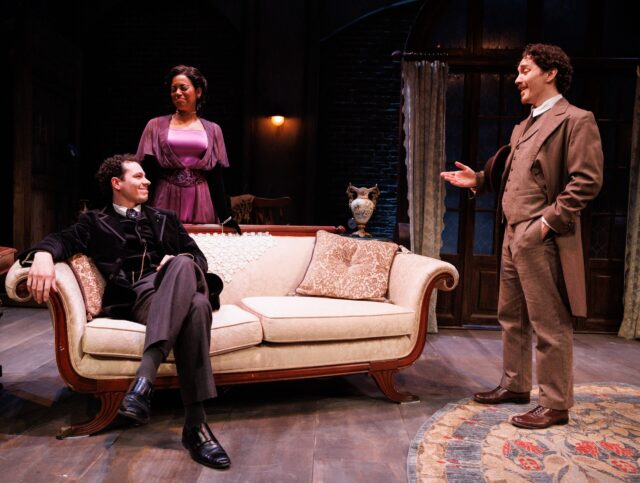
Effete siblings Freddie (Avery Whitted) and Gladys Mottram (Sara Haider) welcome Peter Garside (Daniel Marconi) into their elegant home in Mint production (photo by Maria Baranova)
Peter sees this as a great opportunity for fortune, fame, and more, but Margaret is hesitant, especially when Peter says that they can use their upcoming nuptials as an “advertisement” in the campaign. Ultimately, she decides that if Peter goes ahead with his candidacy, she will support the cause but will break their engagement, which delights Mrs. Garside.
Soon Peter is hobnobbing with the local wealthy Mottram clan: the haughty Lady Mottram (Melissa Maxwell), her flirtatious daughter, Gladys (Sara Haider), and her cheeky son, Freddie (Avery Whitted). They are initially enlisted by the opposition party to distract Peter from his campaign, but an attraction develops between him and Gladys, complicating matters, especially after he wins the election and heads off to London, his ambition growing by the minute, spiraling out of control.
The title character was inspired in part by Victor Grayson, a Liverpool carpenter’s son who became a fiery orator and controversial member of Parliament of whom Winston Churchill said in 1908, “The Socialism of the Christian era was based on the idea that, ‘All mine is yours,’ but the Socialism of Mr Grayson is based on the idea that ‘All yours is mine.’” Marconi (Sweeney Todd,The Mountains Look Different) portrays Peter with a gleam in his eye and a jaunt in his step; Haider (Partnership,Wait Until Dark) is enthralling as the sexy Gladys, while Seidman (Becomes a Woman,Partnership) excels as the steadfastly moral and independent Margaret, Gladys’s rival.
Garside’s Career is a solid, well-structured if somewhat slight comedy of manners with plot lines that relate to contemporary political situations, so it’s surprising that Dickson’s exemplary production is the New York premiere and, possibly, the first major US presentation since a Boston run in 1919. Brighouse also wrote the popular Hobson’s Choice, the oft-revived 1915 play that was adapted into an Oscar-winning 1954 film, the 1966 Broadway musical Walking Happy, and a 1989 ballet.
Thankfully, the Mint, as is its mission, has resurrected yet another long-forgotten gem with style and grace — and another memorable set.
[Mark Rifkin is a Brooklyn-born, Manhattan-based writer and editor; you can follow him on Substack here.]
“If we both describe the same thing at the same time, will one of our descriptions be more true than the other?” Isaac says to Nikolai in Rajiv Joseph’s 2017 time-leaping play Describe the Night. Later, Feliks tells Mariya, “You love to make up stories that are more interesting than what the truth is.”
The concept of “the truth” is also central to Joseph’s latest work, Dakar 2000, a gripping cat-and-mouse contemporary noir presented by Manhattan Theatre Club at New York City Center’s Stage 1 through March 23.
It’s December 31, 2024, and a fifty-year-old man (Abubakr Ali) walks onstage and delivers a monologue detailing a series of life-altering events that happened to him twenty-five years earlier, during the last few days leading up to Y2K, when some people thought the world might end.
Standing on a swirling ramp, he begins, “This is a story within a story, about a person within a person, in a time within another time. In a galaxy far, far away. All of it . . . is true. Or most of it, anyway. Names have been changed. Some of the places have been changed. Some of the boring parts snipped away. Some other stuff has been added to make it . . . theoretically more interesting. But otherwise all of it is almost entirely true.”
After telling us about a secret job he had that has taken him across the globe, he concludes, “The truth — the dumb, boring truth — is that this is mostly the story of a kid who just wanted to make a difference. And the truth is . . . he didn’t. I mean, I didn’t. Or I hadn’t . . . I hadn’t done much of any consequence, ever. Until I flipped my truck, just before the millennium . . . And met a woman who worked at the State Department.”
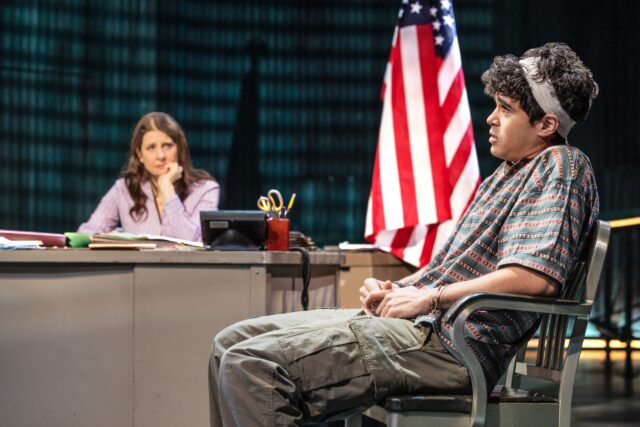
The narrative shifts to late December 1999, and Boubacar (Ali), known as Boubs (pronounced “boobs”), is a Peace Corps volunteer in Senegal, stationed in Kaolack and building a fenced-in community garden in the nearby village of Thiadiaye. Sporting a bandage around his injured head following the accident, he has been called in to meet with Dina Stevens (Mia Barron), who identifies herself as the Deputy Regional Supervisor of Safety & Security for Sub-Saharan Africa. Dina watches Boubs carefully as he shares the details of what led to the crash; she then starts asking pointed questions that tear holes in his story. He keeps up what turns out to be a ruse until she accuses him of lying about his situation, and he ultimately admits to repurposing materials that were meant for other projects.
Threatening to send him back home to America, Dina, who is hell bent on avenging the murder of several of her friends in the 1998 embassy bombing in Tanzania, offers Boubs the option of performing an odd task for her instead, which leads to another task, and another, each one more mysterious and perilous — and bringing Boubs and Dina closer and closer. As Y2K approaches, Boubs doesn’t know what to believe, and neither does the audience.
Boubs (Abubakr Ali) and Dina Stevens (Mia Barron) grow close working together in Rajiv Joseph’s Dakar 2000 (photo by Matthew Murphy)
Dakar 2000 is a riveting thriller reminiscent of Stanley Donen’s 1963 Hitchcockian favorite Charade, in which Audrey Hepburn stars as an American expat unexpectedly caught up in a dangerous spy drama in Paris after her husband is killed and she is pursued by multiple men, one of whom (Cary Grant) claims he is trying to help her even though she catches him in lie after lie. Which is not to say that Barron and Ali have the same kind of chemistry as Hepburn and Grant, but the quirky relationship between Dina and Boubs is appealing. At one point, when they’re on Boubs’s roof, face-to-face, you want them to kiss but also want them not to, as neither one is ultimately trustworthy.
Two-time Obie winner Rajiv Joseph (Bengal Tiger at the Baghdad Zoo,King James) and director May Adrales (Vietgone,Poor Yella Rednecks) keep us guessing all the way to the finale. Tim Mackabee’s turntable set moves from Dina’s office and a restaurant to the roof and a hotel bedroom, with small props occasionally surreptitiously added when it rotates from scene to scene. Shawn Duan’s projections range from a starry sky and outdoor African locations to text that establishes the precise time and location. A metaphor linking the 1997 Hale Bopp Comet to fate is confusing, but the choice of Culture Club’s 1983 hit “Karma Chameleon” as the song connecting Boubs with his ex-girlfriend is inspired, with Boy George singing, “There’s a loving in your eyes all the way / If I listen to your lies, would you say / I’m a man without conviction / I’m a man who doesn’t know / How to sell a contradiction / You come and go, you come and go.”
Ever-dependable Obie winner Barron (The Coast Starlight,Dying for It) effectively captures Dina’s enigmatic nature, representing an unethical government that holds all the cards. Ali (Toros) portrays Boubs’s younger self with a tender vulnerability that makes his actions understandable, although his overall characterization is ultimately a bit uneven, his voice too often switching pitches, his youth making him less than convincing as the modern-day Boubs.
Joseph has noted that Dina and Ali are based on actual people, but that doesn’t mean Dakar 2000 is a documentary play, particularly as words such as truth and lie show up over and over again. During the course of the work’s brisk eighty minutes, Dina tells Boubs, “You’re a good liar,” “Trust me, I wouldn’t lie to you about this,” and “Do you ever wonder if it’s all a big lie?” Meanwhile, Boubs wonders, “How could it be a lie?” when Dina questions humanity’s general consciousness.
Theater by its very definition presents a fictional version of reality, no matter how factual it might be. But in the case of Dakar 2000 and other plays by Joseph, we should be grateful that he “loves to make up stories that are more interesting than what the truth is.”
[Mark Rifkin is a Brooklyn-born, Manhattan-based writer and editor; you can follow him on Substack here.]
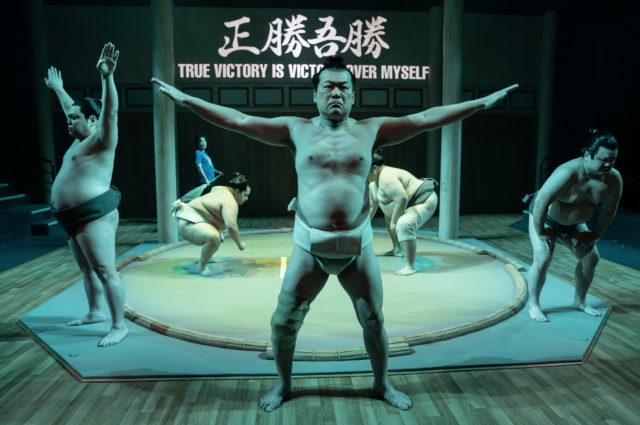
Wrestlers known as rikishi get ready to do battle in Lisa Sanaye Dring’s Sumo (photo by Joan Marcus)
SUMO
Anspacher Theater, the Public Theater
425 Lafayette St. at Astor Pl.
Tuesday through Sunday through March 30, $65-$93
212-539-8500 publictheater.org
Lisa Sanaye Dring’s Sumo takes audiences inside the ancient Japanese sport and sacred Shinto ritual of sumo, in which large-sized wrestlers known as rikishi do battle in a dohyo, or ring, attempting to push their opponent to the mat or out of the circle. Each competitor wears only a mawashi, or silk belt, around their waist, leaving little to the imagination, as they seek to climb the ladder of success through such san’yaku, or ranks, as the lower jonokuchi, jonidan, and sandanme to the higher sekiwake, ōzeki, and the ultimate yokozuna. Most matches are over in a few seconds, although some can last upwards of a minute.
The tense Ma-Yi Theater Company drama, which premiered in 2023 at La Jolla Playhouse and is now at the Public’s Anspacher Theater through March 30, is too long at two hours and twenty minutes (with intermission), and in its second act it gets caught up in treacly melodrama, but it is still a compelling exploration of dedication, honor, tradition, and respect in a sport Americans know little about, in a changing world that is redefining masculinity and conceptions about the human body.
Mitsuo (David Shih) is an ōzeki known as Kōryū, or Exalted Dragon, who runs a heya, or stable of wrestlers, that consists of the stalwart jūryō Ren (Ahmad Kamal), the makushita Shinta (Earl T. Kim), the sandanme Fumio (Red Concepción), the jonidan So (Michael Hisamoto), and the maezumo Akio (Scott Keiji Takeda), an overeager eighteen-year-old newcomer who is not ready to pay his dues, which includes sweeping up, remaining silent, and pouring tea before earning his way into the dohyo. A trio of kannushi, or Shinto priests (Kris Bona, Paco Tolson, Viet Vo), serve as a Greek chorus as well as the gyoji, or referees, and sponsors who scour the tournaments and practices deciding who they will bankroll.
Speaking directly to the audience early on, they explain, “Rikishi were once gods. Kami! Who fought for ownership of Japan. There were two deities: Takeminakata-no-Kami, god of wind and water, who fought on behalf of the humans. And Takemikazuchi-no-Kami, god of thunder, who fought on behalf of the divine. The imperial family supposedly descends from Takemikazuchi, and if Takeminakata had won instead of Takemikazuchi, Japan wouldn’t have been ruled for centuries by emperors and instead would have been governed by commoners — people like you. Ok, maybe not you.”
Mitsuo starts working Akio hard, seeing promise in him, which rankles the others, who nonetheless sneak in little lessons for Akio when no one else is around; they will be punished if Mitsuo catches them breaking the rules, which Akio doesn’t want to follow. “There is a saying: Before enlightenment, chop wood, carry water. After enlightenment, chop wood, carry water,” So tells Akio, who shoots back, “I’m not here to be enlightened.” A moment later, So, explaining how good they all have it, adds, “In here, we are free. But you have to learn to trust us.”
The rikishi compete in a series of matches, employing such kimarite, or techniques, as harite (a slap), henka (a sidestep), and tachiai (initial charge); train in their heya, where no one else, especially women, are permitted; and, in the case of two of the men, grow extremely close. At one point Akio shares his doubts with Shinta, asking, “Do you think I can do this?” Shinta responds, “I have no idea. Can your body? Probably. It depends.” Akio: “On what?” Shinta: “On if the gods want it.” Akio: “Who?” Shinta: “Whoever you pray to.” Akio: “I don’t pray.” Shinta: “Yes you do.” Shinta poetically discusses what’s at the heart of sumo: “Our bodies are so big, so alive, that we wake everyone who sees. . . . It’s a service. It’s all an offering to her.” Akio repeats, “Her,” to which Shinta says, “Yes. The spirit of sumo is a woman.”
As the heya participates in several tournaments, friendships and relationships get tested and Akio needs to look deep inside himself to figure out who he truly is.
David Shih leads a strong cast in Lisa Sanaye Dring’s Sumo at the Public (photo by Joan Marcus)
Although I’ve never been to a wrestling or sumo tournament, I have seen several boxing bouts, sitting ringside as well as in the upper decks; unsurprisingly, the closer you are to the action, the more exciting it is. The same is true for Sumo; from my second-row aisle seat, I seemed to have a different experience from some of my colleagues, who were in the last row. Every foot stomp, or shiko, gave me a tingle. Wilson Chin’s dramatic set turns two of the Anspacher’s pillars into a prop around the dohyo; when the actors are not in the ring, they are practically in the audience’s lap.
Paul Whitaker’s lighting features five rows of nine lights behind sliding doors that open and close to indicate time and space changes. Hana S. Kim’s lively projections announce details of the matches on the back wall and floor, occasionally fitting neatly within the dohyo. Mariko Ohigashi’s costumes go beyond the miwashi to include elegant kimono, traditional gyoji wear, and contemporary clothing. Fabian Obispo’s sound design and original compositions enhance the atmosphere, setting the pace with Japanese hip-hop before the show and at intermission, blasting out such tunes as Denzel Curry’s “Sumo | Zumo,” ¥ellow Bucks’s “My Resort,” and Yuki Chiba’s “Dareda?”
Be prepared to see a lot of flesh; these are big men who might not win any bodybuilding contests but have sacrificed conventional notions of physical attractiveness for the cause, to be the best at what they do, knowing that when they are done, they will have trouble reconnecting to society, as this exchange details:
Shinta: You can’t leave. So: I’ve given my whole body. Fumio: There’s this pus that comes from my feet. Shinta: Someone got my right ear — no more sound. So: I miss my brothers. Ren: We just do this. Fumio: I could have learned to sail. So: I have no skills. Fumio: It’s just this. Akio: How did you come here? Fumio: My father trained me from when I was a boy. Ren: Because my body needs it. So: My family had too many mouths to feed. Shinta: This was the path that opened before me, so I walked it. Mitsuo: Because I’ve always been the best. All: But only here. Ren: And when I leave here / Shinta: When I retire from here / So: I’ll never leave here. Fumio: When I get kicked out of here, I’ll be / All: Screwed. Akio: Then why do you do it? Ren: Hatakikomi. Because I can. Fumio: Tsuppari. Need. Shinta: Tsuri-otoshi. Beauty. So: Kote-nage. Devotion. Mitsuo: Uwate-nage: You do it to win.
The strong cast is a mix of established actors, such as Shih (Once Upon a (korean) Time,KPOP) and Tolson (The Knight of the Burning Pestle,The Wind and the Rain), and performers making their New York City debuts; all handle themselves well, with a bonus nod to Kamal as Ren, perhaps the most complex of the characters. Shih-Wei Wu provides thrilling live taiko drumming throughout.
As the story continues, it occasionally resembles a special episode of Cobra Kai, the entertaining streaming series that is an extension of the Karate Kid movies, but while that show, in which Ralph Macchio and William Zabka reprise their 1980s roles, has its tongue in its cheek while dealing with teen issues, Sumo takes itself too seriously. Ultimately, Dring (Hungry Ghost,Kairos) and Obie-winning director Ralph B. Peña (The Romance of Magno Rubio,The Chinese Lady) paint themselves into a corner, throwing too much information at the audience and getting bogged down in exposition.
But that doesn’t mean there isn’t much to admire in the play, especially if you are sitting ringside.
[Mark Rifkin is a Brooklyn-born, Manhattan-based writer and editor; you can follow him on Substack here.]
Anne Imhof reimagines Romeo and Juliet in Doom: House of Hope at the armory (photo by Nadine Fraczkowski / courtesy the artist, Galerie Buchholz, Sprüth Magers, and Park Ave. Armory)
DOOM: HOUSE OF HOPE
Park Avenue Armory, Wade Thompson Drill Hall
643 Park Ave. at 67th St.
March 3–12, $60
212-933-5812 www.armoryonpark.org
“What less than doomsday is the prince’s doom?” Friar Laurence asks Romeo in William Shakespeare’s tragic tale Romeo & Juliet.
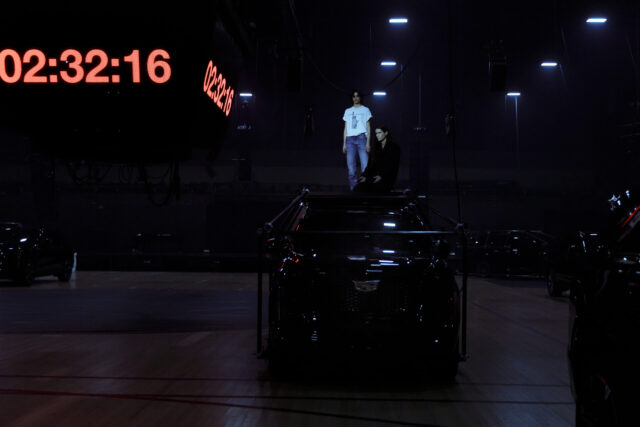
Because of its massive 55,000-square-foot Wade Thompson Drill Hall, Park Ave. Armory has been home to numerous unique theatrical productions and art installations, involving such unusual elements as thirty tons of clothing (Christian Boltanski’s No Man’s Land), wooden swings hanging seventy feet from the ceiling (Ann Hamilton’s The Event of a Thread), one hundred bleating sheep (Heiner Goebbels’s De Materie), and a dark, mysterious heath (Kenneth Branagh’s Macbeth).
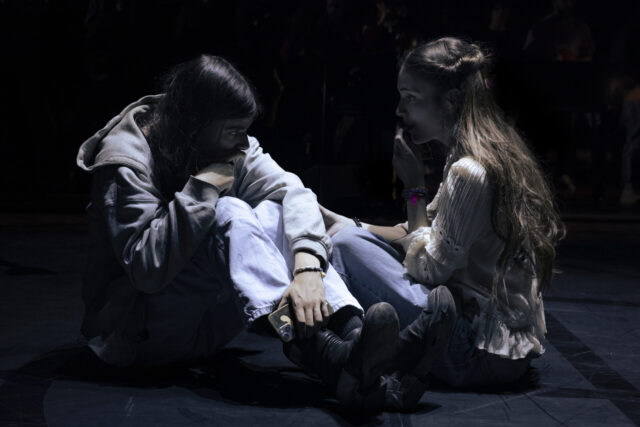
Now Berlin-based Golden Lion winner Anne Imhof has transformed the hall into an enormous prom gym, filling the space with more than fifty actors, dancers (ABT, modern, flexn, line), skateboarders, and musicians, twenty-six Cadillac Escalades, a Jumbotron, and other inspiring elements for Doom: House of Hope, a three-hour multidisciplinary reimagining of Romeo and Juliet, running March 3–12. Curated by Klaus Biesenbach, the durational performance features Sihana Shalaj, Levi Strasser, and Devon Teuscher as Romeo; Talia Ryder and Remy Young as Juliet; assistant director and costumer Eliza Douglas, choreographer Josh Johnson, Cranston Mills, and Connor Holloway as Mercutio; Jakob Eilinghoff, Arthur Tendeng, and Daniil Simkin as Benvolio; and Efron Danzg, vocalist Lia Wang, and Simkin as Tybalt. Among the other characters are Vinson Fraley and Toon Lobach as angels, Perla Haney-Jardine as the critic, Tess Petronio as the photographer, Casper von Bulow as the director and the revolutionary, Coco Gordon Moore as the poet, Tahlil Myth as the storyteller, and Henry Douglas as the gamer, offering yet more twists on the traditional tragedy.
The band, under the musical direction of Ville Haimala, consists of Sharleen Chidiac on guitar, Eilinghoff on bass, Eva Bella Kaufman on drums, and James Shaffer on guitar, with vocals by Lia Wang. The score ranges from Johann Sebastian Bach, Gustav Mahler, Franz Schubert, and Pyotr Ilyich Tchaikovsky to the Doors, Radiohead, and Frank Sinatra, along with original compositions by ATK44, Douglas, Haimala, Imhof, Lia Lia, Jacob Madden, and Strasser. In addition to Shakespeare, the text collects quotes from Jean Genet, Heinrich Heine, and Raymond Moody and writings about George Balanchine, John Cranko, Dieter Gackstetter, Bruce Nauman, Jerome Robbins, Tino Sehgal, and others.
The set is by sub, with sound by Mark Grey and lighting by the masterful Urs Schönebaum, who has dazzled audiences with his work on such previous armory productions as Inside Light and Doppelganger.
As its title states, the immersive show recognizes the doom so many feel now, the increasing anxiety over the state of the planet, while also seeing a potentially bright future.
Romeo (Levi Strasser) and Juliet (Talia Ryder) face doom and hope in Anne Imhof extravaganza at the armory (photo by Nadine Fraczkowski / courtesy the artist, Galerie Buchholz, Sprüth Magers, and Park Ave. Armory)
A few moments after Friar Laurence predicts the worst, Romeo tells him, “Hang up philosophy. / Unless philosophy can make a Juliet, / Displant a town, reverse a prince’s doom.” Perhaps there is a way out of this mess we’re in, although the Bard’s original play does not exactly end happily.
On March 11 at 5:30, Imhof, whose other works include Sex,Natures Mortes, and Angst I–III, will participate in an artist talk about Doom: House of Hope with writer and curator Ebony L. Haynes.
[Mark Rifkin is a Brooklyn-born, Manhattan-based writer and editor; you can follow him on Substack here.]