live performance

FROM NASHVILLE TO NEW ORLEANS: TWO JUKEBOX MUSICALS HEADING IN DIFFERENT DIRECTIONS

Louis Armstrong (James Monroe Iglehart) waves goodbye to Broadway in A Wonderful World (photo by Jeremy Daniel)

A WONDERFUL WORLD: THE LOUIS ARMSTRONG MUSICAL
Studio 54
254 West 54th St. between Seventh & Eighth Aves.
Tuesday – Sunday through February 23, $69-$278
louisarmstrongmusical.com

Jukebox musicals generally come in two basic kinds of flavors: somewhat-fact-based accounts of superstars (Tina Turner, Cher, the Temptations, Michael Jackson, Neil Diamond, Frankie Valli and the Four Seasons, Carole King) and original narratives based on the work of one composer, performer, or era (Alanis Morissette, Jagged Little Pill; Britney Spears, Once Upon a One More Time; Max Martin, & Juliet; the Go-Go’s, Head Over Heels; the 1970s, Rock of Ages).

A pair of current shows use contrasting approaches, but while one has been extended several times, the other has posted an early closing notice.

At Studio 54, A Wonderful World: The Louis Armstrong Musical tells the fact-based story of the American trumpeter and singer known as Satchmo (James Monroe Iglehart), concentrating on the songs he performed throughout his career, while at the West End Theatre, Music City relates a fictional contemporary tale of the search for fame and love, consisting of tunes by country songwriter J. T. Harding, who has penned hits for Uncle Kracker, Kenny Chesney, Keith Urban, Blake Shelton, Dierks Bentley, Darius Rucker, and others.

A Wonderful World features nearly thirty jazz and jazz-adjacent tunes as the narrative divides Armstrong’s story into four sections, each with a different woman by his side: tough-talking prostitute Daisy Parker (Dionne Figgins) in New Orleans, jazz pianist Lil Hardin (Jennie Harney-Fleming) in Chicago, dancer Alpha Smith (Kim Exum) in Hollywood, and Cotton Club performer Lucille Wilson (Darlesia Cearcy) in New York. Although the song list is impressive, with such numbers as “Basin Street Blues/Bourbon Street Parade,” “Up a Lazy River,” “Black and Blue,” “Heebie Jeebies,” “Do You Know What It Means to Miss New Orleans,” and “After You’re Gone,” many of them are given short shrift rather than full renditions, matching the lack of insight into what made Armstrong the larger-than-life figure he was.

Aside from finding out about his four wives, there is little new audiences will learn about Louis; even when it deals with racism, the focus gets lost, outshone by Armstrong’s huge showmanship and popular success and all his preening. Adam Koch and Steven Royal’s heavily blue sets are glitzy and Toni-Leslie James’s costumes are flashy, but the book, by Aurin Squire, conceived by Andrew Delaplaine and Christopher Renshaw, merely brushes the surface, and the direction, by Iglehart and Christina Sajous, is worshipful where it should be articulate.

Figgins (Memphis, Motown), Harney-Fleming (Hamilton, The Color Purple), Exum (The Book of Mormon), and Cearcy (The Color Purple, Ragtime) steal the show from Tony winner Iglehart (Aladdin, Hamilton), who seems to be playing a caricature of Armstrong, never reaching the necessary depth. Dewitt Fleming Jr. (The Tap Dance Kid, Pearl) gives nuance to Lincoln Perry, better known as Stepin Fetchit, while Gavin Gregory (The Gershwins’ Porgy & Bess, The Color Purple) plays hard-luck bandleader “King” Oliver.

A Wonderful World recently announced that it will be closing early, on February 23; overall, it was a missed opportunity.

Music City brings Nashville to the Upper West Side (photo by Ashley Garrett)

MUSIC CITY
West End Theatre
Church of St. Paul and St. Andrew
263 West Eighty-Sixth St. at West End Ave.
Tuesday – Sunday through March 2, $68 – $130.50
bedlam.org

Despite an exciting, promising first act, Bedlam’s Music City: A New Musical, which opened on November 17 and has been extended three times, the latest until March 2, also ends up being a missed opportunity.

Last year, I visited Nashville with friends and fell in love with the live music pouring out of every bar, club, and honky tonk and into the crowded streets, where people were partying well into the night. Director Eric Tucker and book writer Peter Zinn capture that energy on Clifton Chadick’s lifelike set, which transforms the theater at the Church of St. Paul and St. Andrew on the Upper West Side into the Wicked Tickle, a seedy watering hole in East Nashville. The audience sits at small tables as if they are guests at the club, where they can get drinks, check out the (fake) memorabilia on the walls, and whoop it up as the narrative unfolds around them.

About a half hour before curtain, an open mic begins, introducing some of the characters, so get there early and soak in the realistic atmosphere. The show proper begins with brothers TJ (Stephen Michael Spencer) and Drew (Jonathan Judge-Russo) performing their rousing “Y’allsome,” in which they declare, “Y’all ain’t scared to have a little fun. / Whiskey shots from a water gun. / Ain’t slowing down — / And here comes the sun! / Y‘allsome party people. / Y’allsome crazy mothers. / Y’allsome freakin’ good lookin’ country music lovers! / Hankin’ and drankin’ all wrecking ball shaking the walls.”

When they’re done, Drew, who comes up with the titles and ideas for the songs, and TJ, who writes the music and lyrics, are approached by Leeanne (Leenya Rideout), a slick record executive who wants to hear their demo, as she’s scouting tunes for country superstar Stucky Stiles’s (Andrew Rothenberg) next tour and album.

They don’t have a demo, so Drew decides to ask local drug dealer and open-mic regular Benjamin Bakerman (Rothenberg) to invest two grand in their band so they can afford studio time. Bakerman instead offers them the opportunity to earn the cash by delivering “cookies” for him. TJ is initially against the plan, but Drew talks him into it.

Soon TJ is handing off bags of meth to such junkies as Tammy (Rideout), a former wannabe country star. “Bet you think you’re gonna be a big ol’ star one day just like everyone else in this shithole town,” she says, lighting up her pipe. “I remember when I used to walk around Nashville with a guitar on my back. I wish somebody woulda told me back then how ridiculous I looked.”

At the next open mic, TJ instantly falls for a young woman named 23 (Casey Shuler) as she plays a deeply personal ballad, singing, “Like soldiers coming home from war / Who am I to want something more?”

With money in their pockets, TJ and Drew start working on their demo in drummer Newt’s (Drew Bastian) studio. Meanwhile, Stucky wants to be recording his own songs instead of party tunes written by others, but Leeanne tells him that ship has sailed.

TJ and 23 connect and start writing together, Stucky comes to the Wicked Tickle, and relationships get twisted and complicated as Bakerman keeps putting pressure on TJ to sell his product.

Drew (Jonathan Judge-Russo) and TJ (Stephen Michael Spencer) contemplate a shot at the big time in Music City (photo by Ashley Garrett)

Unfortunately, Tucker (Uncle Romeo Vanya Juliet, Sense and Sensibility) and Zinn (Rumspringa, Somewhere with You) throw in the kitchen sink in the second act, heaping on trauma after trauma, leading to a mind-boggling finale that comes out of nowhere and pulls everything that happened before down with it. In addition, John Heginbotham’s choreography, performed by Corry J Ethridge and Holly Wilder, seems to have come from a completely different show.

It’s a shame, because nearly all the other elements are in place: The backup band, featuring Ann Klein on guitars, Tony Tino on bass, Bastian on drums, and emcee and music director Julianne B. Merrill on keyboards, is excellent, keeping things hopping throughout, and the cast is charming and engaging, especially Spencer (Clyde’s, Julius Caesar) and Shuler (Titanic, Robin Hood), who make an adorable couple. The twenty songs, which include “Smile” (a hit for Uncle Kracker), “Somewhere with You” (Chesney), and “Alone with You” (Jake Owen), range across the country spectrum like a live jukebox, although “Sangria” (Shelton), which gets the spotlight, doesn’t carry enough weight here.

Then again, the PBRs are cheap, the staging is fun, and, hey, it’s Nashville in New York, which is some kind of wonderful.

[Mark Rifkin is a Brooklyn-born, Manhattan-based writer and editor; you can follow him on Substack here.]
ROMEO + JULIET ON BROADWAY CONQUERS KING LEAR AT THE SHED

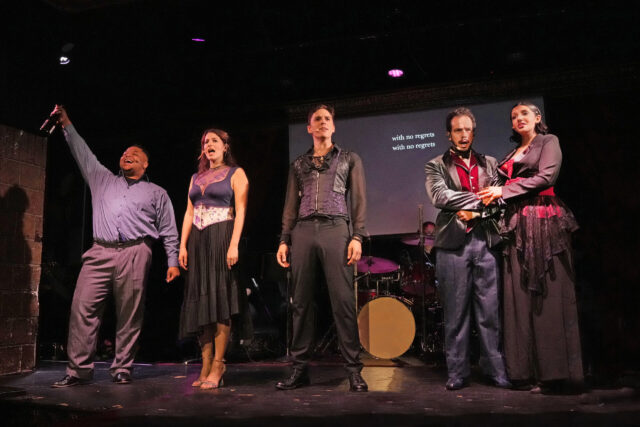
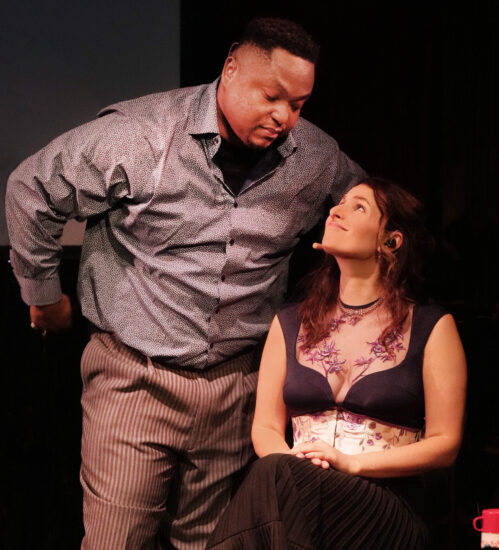
Sam Gold’s Romeo + Juliet is made for Gen Z but can be enjoyed by all (photo by Matthew Murphy and Evan Zimmerman)

ROMEO + JULIET
Circle in the Square Theatre
1633 Broadway at 50th St.
Tuesday – Sunday through February 16, $159-$1002
romeoandjulietnyc.com

Last fall, when I saw Sam Gold’s Romeo + Juliet at Circle in the Square and Kenneth Branagh’s King Lear at the Shed, I was not anticipating being charmed by the former and disappointed in the latter.

Tony and Obie winner Gold has had decidedly mixed results with controversial and often confusing star-driven adaptations of such Shakespeare plays as Macbeth and King Lear on Broadway, Othello at New York Theatre Workshop, and Hamlet at the Public.

Meanwhile, Branagh is widely considered the finest interpreter of the Bard since Laurence Olivier, both onstage, such as his immersive version of Macbeth at Park Ave. Armory and his 1987 and 2016 takes on Romeo and Juliet, and his well-received cinematic adaptations of Henry V and Much Ado About Nothing.

Lear is a personal favorite of mine; Branagh’s is the eighth major production I’ve seen in the last twenty years. I have not had as much luck with R&J, from David Leveaux’s flat 2013 Broadway revival to Hansol Jung’s profoundly perplexing 2023 effort at the Lynn Angelson, although I adored Michael Mayer’s & Juliet, a musical imagining of what might have happened if Juliet had survived.

Closing February 16, Gold’s Romeo + Juliet is a plush and lively, radical AMSR presentation tailored for Gen Z, complete with an Insta-friendly plethora of stuffed teddy bears onstage and in the lobby. When the audience enters the theater in the round, the actors are already hanging out, talking, dancing, and dissing with each other, pushing around a shopping cart of stuffed animals, skateboarding, and lounging on plastic furniture. They wear sneakers, hoodies, and a Hello Kitty backpack. On one side, a giant pink teddy bear watches in silence while across the space a DJ spins Jack Antonoff’s thumping music.

The youthful cast features the hot Rachel Zegler as Juliet and the even hotter Kit Connor as Romeo, with Tony nominee Gabby Beans as Mercutio and the friar, Sola Fadiran as both Capulet and Lady Capulet, Taheen Modak as Benvolio, Tommy Dorfman as the nurse and Tybalt, and Gían Pérez as Samson, Paris, and Peter. The doubling and tripling often makes it hard to know who is who, and some actors do better with the tweaked dialogue than others. Two songs are completely unnecessary, and the use of a handheld microphone is baffling, as is the handling of a poison jug.

But much of the staging is dazzling, from Juliet’s bed, which drops slowly from the rafters, to a colorful expanse of flowers that emerges from the floor. Yes, the F-bomb appears twice, but surprises await those who fully invest themselves in this contemporary tale made for this moment in time.

Kenneth Branagh’s ritualistic King Lear goes astray early (photo by Marc J. Franklin / courtesy the Shed)

Unfortunately, Branagh, codirecting with Rob Ashford and Lucy Skilbeck, struggles with his streamlined adaptation, which, at a rushed two hours without intermission, has cut several key scenes and famous lines, and without the proper character development it’s often hard to differentiate among the minor characters, who are played by recent graduates of the Royal Academy of Dramatic Arts and look like survivors from Game of Thrones. Branagh, who is sixty-four, does not portray Lear as an aged, failing man but as a younger warrior, which alters the plot’s narrative center.

Like Gold’s R+J, Branagh’s staging involves a large sphere, in this case an imposing UFO-like disc that hovers over the action, occasionally moving and tilting, onto which ominous weather patterns are projected. (The script identifies the setting as “outer space.”) It also leaves in one of the songs, which feels extraneous given the show’s shortened length.

Thus, my initial thoughts that Gold would pale in comparison to Branagh were misbegotten.

“O teach me how I should forget to think!” Romeo tells Benvolio.

Who woulda thunk it?

[Mark Rifkin is a Brooklyn-born, Manhattan-based writer and editor; you can follow him on Substack here.]
A WILD[E] SALOME FROM HEARTBEAT OPERA

Heartbeat Opera’s English-language Salome continues at the Space at Irondale through February 16 (photo by Russ Rowland)

SALOME
The Space at Irondale
85 South Oxford St., Brooklyn
February 4-16, $21.79-$114.25
www.heartbeatopera.org/salome

“When it premiered, it was extremely shocking to its audiences because it was dangerous and there were so many taboos that get broken in it,” co-adaptor and director Elizabeth Dinkova says about Richard Strauss’s Salome, which Heartbeat Opera is presenting this month in a rare English-language version at the Space at Irondale. In the promotional video, she continues, “There are a few core mysteries at the center of this piece around what it means to be in love, and the great terror and violence that erupts when you’re not.”

Oscar Wilde’s 1891 play about the first-century Jewish princess who was the daughter of Herodias and stepdaughter of Herod II was translated into German by Hedwig Lachmann and became the libretto for Strauss’s opera, which debuted in Dresden in 1905. Tom Hammond translated the work into English in the late 1980s for the English National Opera, and now Dinkova and co-adaptor, music director, and conductor Jacob Ashworth have collaborated on a new version for seven singers, eight clarinetists, and two percussionists. The cast features Summer Hassan as Salome, Patrick Cook as Herod, Nathaniel Sullivan as Jokanaan (John the Baptist), Manna K Jones as Herodias, David Morgans as Narraboth, Jaharis as Page Melina, and Jeremy Harr as a soldier; Francesca Federico will perform the title role on February 9.

Heartbeat has previously staged unique versions of such classics as Eugene Onegin, Tosca, and Fidelio as well as the original The Extinctionist. Up next is a one-hundred-minute retelling of Charles Gounod’s Faust at Baruch Performing Arts Center in May.

In the video, music arranger Dan Schlosberg explains, “This was a scandal, this piece; [Strauss] wrote it, and he knew that people were going to be scandalized.”

Heartbeat Opera attempts to bring back that sense of shock and scandal in its take on Salome, which promises, among other things, a “Dance of the Seven Veils” like you’ve never seen before.

[Mark Rifkin is a Brooklyn-born, Manhattan-based writer and editor; you can follow him on Substack here.]

WALLA WALLA BANG BANG: JOY BEHAR TAKES ON LOVE AND MARRIAGE

Joy Behar, Adrienne C. Moore, Tovah Feldshuh, and Susie Essman star in My First Ex-Husband (photo by Joan Marcus)

MY FIRST EX-HUSBAND
MMAC Theater
248 West Sixtieth St. between Tenth & Eleventh Aves.
Wednesday – Sunday through May 18, $69-$186
www.myfirstexhusband.com

Joy Behar looks at the lighter side of marital strife in the funny and affecting My First Ex-Husband, which opened last night at MMAC Theater. Based on interviews Behar conducted with numerous women, the eighty-five-minute play consists of eight poignant monologues delivered by four actors, taking turns at the front podium, where the script is there for them to refer to.

Behar, the longtime host of The View who has appeared in such shows as The Food Chain and The Vagina Monologues and written Crisis in Queens, Bonkers in the Boroughs, and Me, My Mouth and I, introduces the play by pointing out that nearly half of US marriages end in divorce. She asks the audience how many of them are divorced, then follows that up by saying, “How many of you wish you were?”

Through February 23, the the initial cast features the Brooklyn-born Behar, who is on her second marriage; two-time Emmy nominee and four-time Tony nominee Tovah Feldshuh (Funny Girl, Golda’s Balcony), a Manhattan native who has been married to the same man sine 1977; NAACP Image Award winner Adrienne C. Moore (The Taming of the Shrew, For Colored Girls . . . ,), who hails from Nashville; and Behar’s bestie of more than forty years, the Bronx-born Susie Essman (Curb Your Enthusiasm, Broad City), who has been married since 2008.

In the first monologue, “Clothes Make the Man?,” Serena (Essman) talks about dealing with her ex-husband’s fetish of wearing women’s clothes. In “The Widow,” June (Feldshuh) shares her abandonment issues and her ex’s obsession with her weight. In “Where Are You At,” Laila (Moore) is a successful actress on the brink of stardom whose husband is cheating on her. And in “The Touch,” Monica (Behar) discovers a new side of herself when her bookie husband is sent to the hoosegow.

Adrienne C. Moore nearly steals the show at MMAC Theater (photo by Joan Marcus)

Behar has a penchant for strong first lines, as demonstrated by the below examples.

“The Widow”: “Okay, my husband’s dead.”
“Walla Walla Bang Bang”: “My shrink says that it’s important to have some things in common with your spouse.”
“The Drummer’s Wife”: “I was on my way to the honeymoon, and I was thinking, ‘How am I gonna get out of this.’”
“Get Off of Me”: “I really don’t belong here tonight because I’m not divorced yet. But I’m on the cusp.”

It’s no surprise that the topic that comes up the most is not money or age or children but sex. “He was respectful and didn’t pressure me to have sex,” Serena says. Laila remembers when her husband asked her, “Can I please have sex on the side? I’ll be discreet.” In “Walla Walla Bang Bang,” Jessica (Essman) explains about her ex, “He also was a product of his strict Catholic upbringing, and he didn’t function very well sexually. In my opinion, religion can fuck up your libido.” In “Wigged Out,” an arranged Orthodox marriage between Rebecca (Feldshuh) and a teenage boy is complicated by her vaginismus. And in “Get Off of Me,” Gloria (Moore) thinks her husband might be a sex addict.

Under the unobtrusive direction of Randal Myler (Hank Williams: Lost Highway, Love, Janis), the ensemble, all dressed in black, is excellent, but Feldshuh and Moore deserve extra accolades for their performances, Feldshuh for injecting a sly sense of humor and Moore for bringing down the house several times with her energetic movement and overall enthusiasm, even when she’s sitting in the back watching the others, waiting for her turn.

From February 26 to March 23, Judy Gold, Susan Lucci, Cathy Moriarty, and Tonya Pinkins take over, followed March 26 to April 20 by Veanne Cox, Gina Gershon (April 2–20), Jackie Hoffman, and Andrea Navedo, and then Marilu Henner, Marsha Mason, Benja K Thomas, and Julia Sweeney from April 23 to May 18.

You should go no matter what state your own relationship is in, but don’t get any ideas.

[Mark Rifkin is a Brooklyn-born, Manhattan-based writer and editor; you can follow him on Substack here.]
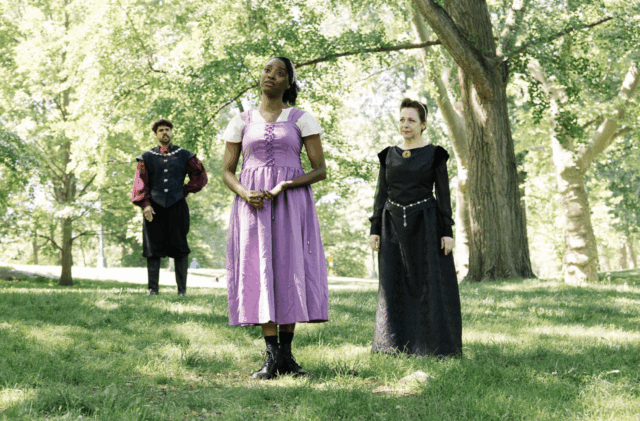
KINESTHETIC EMPATHY: DOWNTOWN RADIO AND THE AVANT-GARDE

Five actors re-create 1970s WNYC programs in documentary play (photo by Hunter Canning)

RADIO DOWNTOWN: RADICAL ’70s ARTISTS LIVE ON AIR
59E59 Theaters
59 East 59th St. between Park & Madison Aves.
Tuesday – Sunday through February 9, $44
212-279-4200
www.59e59.org

The Civilians’ Radio Downtown: Radical ’70s Artists Live on Air is an odd documentary play that is difficult to decipher. Conceived and directed by Steve Cosson and written by Cosson and Jocelyn Clarke, it consists of five actors re-creating segments from three 1970s programs on WNYC: Arts Forum, Artists in the City, and Poetry of the Avant-Garde.

The conceit is that, as the audience is told at the start, “The actors do not know their lines. This is made from archival recordings. The actual words, pauses, and sounds from back then will be fed into the actor’s ears.” I’m not quite sure why Cosson decided to present the dialogue that way; it makes for an uneasy experience, as I found myself on edge every time an actor paused, wondering whether the hesitation was in the original interview, there was a technical glitch, or the performer lost their place. In addition, these are professional actors, and one would think that, especially after several weeks of performance, they would know their lines, complete with pauses and hesitations.

Robert M. Johanson, Jennifer Morris, Joshua David Robinson, Maya Sharpe, and Colleen Werthmann portray a who’s who of the avant-garde scene: film theorist and historian P. Adams Sitney, experimental choreographer, dancer, and visual artist Yvonne Rainer, filmmakers George Kuchar and Kenneth Anger, poets Leroi Jones and Lorenzo Thomas, critic and academic Annette Michelson, polymath Harry Smith, and actress, dancer, and singer Kimako Baraka, among others. The seventy-minute production takes place in a room with numerous chairs, lamps on the floor (did they run out of tables, or was this how it was at WNYC?), and a back wall featuring a large image of part of a naked human body with a fly on its mouth.

The actors switch between characters by making small clothing adjustments, selecting jackets, vests, and other apparel hanging from hooks on each side of Andrew Boyce’s set. (The costumes are by Emily Rebholz.) Attilio Rigotti’s projections identify the speakers and include newspaper headlines, snippets from a Rainer dance rehearsal, and clips from Anger’s 1967 Lucifer Rising, which starred Bobby Beausoleil, who committed murder the next year as an associate of the Manson family and is still serving life in prison.

The highlight of the show is Anger discussing fellow filmmaker Maya Deren’s apparent disgust of his work. Deren had sent a letter to Anger explaining why she chose not to award a film of his a prize at a festival; in response, Anger describes, “I wrote her back and I said, ‘The whole thing was a joke.’ And she wrote me back and said, uh, she said, ‘You are guilty of confounding the public, and you are also guilty of pulling my leg, [laughter] and I will never forgive you.’ And I said, well, if she has — if she has such a lack of a sense of humor. . . .”

As far as a sense of humor goes, I was questioning mine throughout Radio Downtown, particularly when Werthmann, as Rainer, mimicked some of the choreographer’s slow, angular movement. While my theater companion found it hilarious in a good way, I was perplexed, uncertain whether it was a pretentious tribute or a playful parody of Rainer and the whole underground scene.

That was essentially my takeaway from the show, a constant level of confusion. Later, I checked out The NYPR Archive Collections, where you can listen to the original recordings and read the transcripts.

When I heard Rainer talk to Michelson about “kinesthetic empathy,” I knew just what she meant.

[Mark Rifkin is a Brooklyn-born, Manhattan-based writer and editor; you can follow him on Substack here.]

LOOK ALIVE: EXPLORING THE MUSEUM OF LATE HUMAN ANTIQUITIES

Two ancient women introduce the audience to Jordan Harrison’s The Antiquities at Playwrights Horizons (photo by Emilio Madrid)

A TOUR OF THE PERMANENT COLLECTION IN THE MUSEUM OF LATE HUMAN ANTIQUITIES or, just THE ANTIQUITIES
Playwrights Horizons, the Judy Theater
416 West 42nd St. between Ninth & Tenth Aves.
Tuesday – Sunday through March 2, $62.50 – $102.50
www.playwrightshorizons.org

“It’s alive, it’s alive!” a mad scientist cries out in the 1931 sci-fi classic Frankenstein, as he watches electricity breathe life into a creature made of stitched-together body parts from corpses. People have been searching for the fountain of youth essentially since the beginning of time, on an endless quest to defeat death and live forever.

Pulitzer Prize finalist Jordan Harrison traces that journey, focusing on our role in our own destruction, in A Tour of the Permanent Collection in the Museum of Late Human Antiquities or, just The Antiquities, an intensely clever and prescient warning shot that opened tonight at Playwrights Horizons, in a coproduction with the Vineyard and the Goodman.

Harrison (Marjorie Prime, The Amateurs) and codirectors David Cromer (A Case for the Existence of God, Tribes) and Caitlin Sullivan (Find Me Here, The Good John Proctor) lead the audience between 1816, when Mary Wollstonecraft Godwin shares a ghost story that would become her Gothic novel Frankenstein; or, The Modern Prometheus, and 2076, when AI has taken over in the postapocalyptic nightmare we all fear is coming.

The hundred-minute play begins with two women from the Museum of Late Human Antiquities surveying the audience, as if we are objects in a gallery.

A mother and son contemplate death in Jordan Harrison’s The Antiquities (photo by Emilio Madrid)

Woman 1: “Thank you for coming.” That’s what we’d say, if we were them. Thank you for coming. It’s good to see your faces. Fasten your seatbelts. Look alive.
Woman 2: “Look alive.”
W1: That’s one of my favorites. As if it were necessary to pretend.
W2: [To the audience, trying it out.] Look alive.
W1: [Regarding us.] They do, don’t they. You all look perfect. It’s like we’re really here. [A beat. She takes in the room.] Imagine we’re actually here in these seats in this room in the Late Human age. Imagine you have a body. Imagine that’s your body.

Cindy Cheung, Marchánt Davis, Layan Elwazani, Andrew Garman, Aria Shahghasemi, Kristen Sieh, Ryan Spahn, Julius Rinzel, and Amelia Workman portray multiple characters throughout the centuries, with quick costume and set changes; the effective period dress is by Brenda Abbandandolo, while Paul Steinberg’s cold, metallic set shifts for every scene as props are added and subtracted, from a bar and a kitchen refrigerator to an early home computer and a conference room. In 1816, Mary, Percy Bysshe Shelley, Claire Clairmont, Dr. Thomas Briggs, and Lord Byron gather around a campfire and try to scare one another. Early on, Mary offers, “What if I could bring back the dead.” Mary’s mother died ten days after her daughter was born, and Mary suffered several miscarriages and lost three children after birth, so her desire to bring back the dead was deeply personal.

In 1910, a father drops off his ten-year-old son to work in a factory where he might lose a finger or two if he’s not careful. In 1978, Stuart has built a robot that can learn, on its way to being sentient. “It’s life. I created life,” he boasts to a bartender. In 1994, a family of three bask in the glow of their new computer and prepare to connect to the internet for the very first time, via a loud dial-up modem. “Did you ever think you’d live in the future?” the mother asks. In 2008, a young woman teaches her grandfather how to use his iPhone to access the World Wide Web. In 2023, a woman is offered a big payout if she agrees to an NDA to silence her complaints about out-of-hand technology at her firm. She argues, “Doesn’t anybody get it? I’m telling you I made this thing, I helped make this thing, and now . . . We’re the dinosaurs. We’re the dinosaurs and this is the meteor.”

And then, in 2076 . . .

Humankind finds itself at a precipie in prescient new play (photo by Emilio Madrid)

Among the outdated items accumulated at the Museum of Late Human Antiquities are a pen, a rotary phone, a Betamax videocassette, a musical instrument, and a butter churn, pieces of a past that is now long gone. There’s also a ghostlight, a bulb that is placed on stages overnight to ward off troublesome spirits and/or provide light to the theater ghosts who inhabit the space, as if acknowledging that even if humans come to an end, their spirits might still remain. Woman 2 discloses, “So much has been lost, but we have recovered fragments. Scraps of language, abandoned devices. We have endeavored to fill in the gaps; to bring them to life again.”

Filling in some of the gaps, Harrison regularly reminds us that humanity’s time on earth has been squandered by our desperate fear of death, of what might be next, including nothing — and we only have ourselves to blame.

Stuart’s sister confesses to her son, “Everybody dies, baby,” referring to each person. But when Woman 1 promises, “One day you Began, and one day you will End,” she’s talking about the human species as a whole. Our addiction to technology in the pursuit of longevity might very well be our doom, as is already being predicted by many people involved in AI.

But perhaps there’s a glimmer of hope. In the future, a man named Len wonders, “All the while we’ll be getting stronger. We’ll remember the things people used to know, a thousand years ago. The plow. The candle. Probably people will become religious again. They’ll look up in the sky and want to explain a storm. Our kids will grow strong, out in the weather. And all the while, we’ll teach them to hate the inorganics. And eventually, though maybe not in our lifetimes, eventually human beings will rise again. We made the computers and we’ll destroy them.”

Famous last words?

[Mark Rifkin is a Brooklyn-born, Manhattan-based writer and editor; you can follow him on Substack here.]
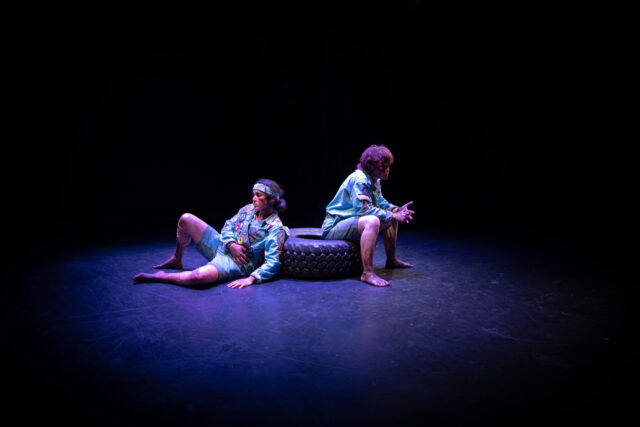
CHRISTMAS IN CONNECTICUT: A (DYS)FUNCTIONAL FAMILY SATIRE

The Dahls have a Christmas to remember — or forget — in Cult of Love (photo by Joan Marcus)

CULT OF LOVE
Hayes Theater
240 West 44th St. between Broadway & Eighth Ave.
Through February 2
2st.com

I started to call Leslye Headland’s hilarious, on-target Broadway debut, Cult of Love, the story of a dysfunctional family at Christmas, but I stopped myself because it sounded redundant; has there ever been a holiday-themed play about a functional family?

Directed with plenty of pizzazz and panache by Obie winner and two-time Tony nominee Trip Cullman, the hundred-minute satire introduces us to the musical Dahl family, who come together on Christmas Eve at their farmhouse in Connecticut to sing songs and do battle. Patriarch Bill (David Rasche) is a piano-playing Pollyanna and a hugger who prefers to avoid arguments; his children think he might be suffering from dementia, because how else can he be so positive? Matriarch Ginny (Mare Winningham) strums the guitar, sings songs about Jesus, and plays favorites with her children, even though she fails to see it.

The Dahls’ eldest progeny, Mark (Zachary Quinto), is a law clerk in DC, almost became a priest before abandoning Christianity, and is having marital problems with his wife, Rachel (Molly Bernard), who converted from Judaism and drinks too much at family events.

Older daughter Evie (Rebecca Henderson) recently got back from her Italian honeymoon with her new spouse, Pippa Ferguson (Roberta Colindrez); both have successful careers in brand management.

Third child Johnny (Christopher Sears) is the ever-late prodigal son who has been in and out of rehab for years; everyone is excited when they learn he is bringing a mystery guest, Loren Montgomery (Barbie Ferreira).

The baby of the group, twentysomething Diana Dahl Bennett (Shailene Woodley), is a Bible thumper with a six-month old son with her husband, Episcopal priest James Bennett (Christopher Lowell), and she is pregnant again.

Music is the only thing a Connecticut family can agree on in hilarious Broadway satire (photo by Joan Marcus)

Over the course of a fretful, highly volatile evening, the Dahls and their significant others discuss racism, homophobia, smoking, molestation, mental health, the Mexican wedding cookies known as polvorones, and tolerance in between picking up instruments (guitars, banjo, ukulele, melodica, washboard, sleigh bells, maracas) and breaking into traditional religious songs as well as tunes by Radiohead, the Fleet Foxes, and Sufjan Stevens, displaying gorgeous harmonies and pure joy that, momentarily, put aside their seemingly endless issues with one another.

“Evie! Are you picking a fight during Christmas carols?” Mark cries out. Evie responds, “I’m questioning the problematic lyrics, Mark!” Diana concludes, “You ruin it when you do that.”

When Evie wants to talk about Bill’s health, Mark argues, “Is Christmas really the best time for that?” Evie explains, “Christmas is exactly the time to talk about the things we never talk about.”

John Lee Beatty’s cluttered Christmas-themed set feels homey and lived in, with windows and glass doors that offer peaks at what is going on in the outside world, where perhaps sanity is possible. Jacinth Greywoode’s expert musical direction will make you wonder if there will be a cast album. The ensemble is terrific as Cullman guides them through an ever-more-claustrophobic situation.

“You must be having a wonderful time,” Bill says to Loren, who answers for her and the audience when she replies, “Oh, sure. I love the singing, the lesbian drama. It’s all great.”

[Mark Rifkin is a Brooklyn-born, Manhattan-based writer and editor; you can follow him on Substack here.]