live performance

MARGARET CHASE SMITH AND “A DECLARATION OF CONSCIENCE”: A SIMPLE HERSTORY AT THE TANK AND TORN PAGE

Who: Jocelyn Kuritsky, Kate MacCluggage, Jake Hart, Colleen Werthmann, Cecil Baldwin, Carl Raymond
What: Special live radio play presentation of A Simple Herstory
Where: The Tank, 312 West Thirty-Sixth St. between Eighth & Ninth Aves.; after-party at Torn Page, 435 West Twenty-Second St. between Ninth & Tenth Aves.
When: Sunday, June 7, radio play $28, 3:00, after-party free (suggested donation $13), 6:00
Why: In its award-winning inaugural season, actor, creator, producer, host/interviewer, and occasional designer Jocelyn Kuritsky’s audio fiction podcast, A Simple Herstory, explored the life and career of Victoria Woodhull, the suffragist who was the first woman to run for president, in 1872, representing the Equal Rights Party, battling incumbent commander in chief Ulysses S. Grant and newspaper editor and publisher Horace Greeley.

The upcoming second season turns its attention to Maine’s Margaret Chase Smith, who served in the House from 1940 to 1949 and in the Senate from 1949 to 1973. She ran for president in 1964 in the Republican primary, which was won by Barry Goldwater. Smith is most well remembered for her June 1, 1950, fifteen-minute speech delivered on the Senate floor that concluded with “A Declaration of Conscience,” a five-point message aimed at Wisconsin senator Joseph McCarthy’s communist witch hunt but still rings true today. “It is high time that we stopped thinking politically as Republicans and Democrats about elections and started thinking patriotically as Americans about national security based on individual freedom,” she said, supported by six other senators.

On June 7 at 3:00, a segment from season two of A Simple Herstory will be performed live at the Tank, featuring Kuritsky (Woodshed Collective), Kate MacCluggage (Left on Tenth), Jake Hart (Big George), Colleen Werthmann (Mr. Burns: A Post-Electric Play), and Cecil Baldwin (Welcome to Night Vale), directed by Meghan Finn (A Trojan Woman, Mahinerator) and written and developed by Jonathan A. Goldberg (Real Dead Ghosts, Deus Machina Ex or Eleanor Roosevelt vs. the God Machine). Don’t worry about the serious, and relevant, subject matter; Kuritsky promises “a fast, funny, inventive recounting of history that refracts the complexity and tension of politics through a live radio play experience.”

The show, being held in conjunction with the twenty-fifth anniversary of the Tribeca Festival, will be followed by an after-party at Torn Page, where the creative team will discuss the project with moderator Carl Raymond, creator and host of the podcast The Gilded Gentleman.

[Mark Rifkin is a Brooklyn-born, Manhattan-based writer; you can follow him on Substack here.]
THE BEST PLACE IN THE WORLD: XHLOE & NATASHA AT ARS NOVA

Natasha Roland and Xhloe Rice star in And Then the Rodeo Burned Down at Ars Nova (photo by Ben Arons)

AND THEN THE RODEO BURNED DOWN
Ars Nova
511 West 54th St. between Tenth & Eleventh Aves.
Monday – Friday through July 10, $43.67 – $80.12
arsnovanyc.com
www.xhloeandnatasha.com

“This is the best place in the world,” Dale says several times in Xhloe Rice and Natasha Roland’s enchanting, exhilarating And Then the Rodeo Burned Down. Dale is not just talking about the rodeo, where he is a clown who dreams of becoming a cowboy, but is referring to America itself — and how it may be necessary to burn it down and start all over again.

In 2022, the New York City–based duo known as Xhloe and Natasha won the Edinburgh Fringe First Award for Rodeo, then took home the prize in 2023 for What If They Ate the Baby?, a satire about being a conventional wife in 1950s America, and again in 2024 for A Letter to Lyndon B Johnson or God: Whoever Reads This First, which captures the America of the late 1960s as well as today, as politics, religion, and the military become intertwined and the everyday struggles of the common people are completely misunderstood or purposely ignored.

Last month they received a special Drama Desk Award for Baby?, which ran at SoHo Playhouse in the fall, and Letter to LBJ, which played there last June. They were cited for “their absurdist sensibilities [that] test the parameters of several genres and movement styles . . . and invite new appreciation for all of them.”

Rodeo, which opens today at Ars Nova for a run that has already been extended to July 2, continues their testing of parameters in yet another brilliant, endlessly inventive, and absolutely delightful work of theatrical wonder.

The fun begins with the program itself, which, on one page, identifies Natasha and Xhloe, in clown makeup and western garb, as “prime suspects” in an unnamed crime and offers a reward if they are found alive. “We will not be held liable for any hijinks, shenanigans, or mishaps you may or may not encounter in pursuit of these delinquents,” the poster proclaims.

Emmie Finckel has transformed the space into a welcoming one-ring circus centered by a platform with a star in the middle, a small animal gate, and banners and flags hanging everywhere, some depicting cartoonish wealthy businessmen and ridiculous royalty. The entrance music consists of such songs as Luke Bryan’s “Country Girl (Shake It for Me),” Carrie Underwood’s “Before He Cheats,” and, appropriately setting the stage, Shania Twain’s “Man! I Feel Like a Woman!,” in which the superstar sings, “Let’s go, girls! Come on! / I’m goin’ out tonight, I’m feelin’ alright / Gonna let it all hang out / Wanna make some noise, really raise my voice / Yeah, I wanna scream and shout / No inhibitions, make no conditions / Get a little outta line / I ain’t gonna act politically correct / I only wanna have a good time.”

And Then the Rodeo Burned Down is a hilarious excoriation of the American dream (photo by Ben Arons)

Over the course of the next seventy deliriously entertaining minutes, Xhloe and Natasha ostensibly tell the story of Dale (Rice) as he shares his hopes and dreams, often counteracted by his shadow (Roland). “Who are you?” Dale asks the figure that is suddenly sticking close to him. “I’m just like you!” the shadow answers in the first of many instances of mirroring.

Naming the shadow Dilly Dally, Dale explains, “The rodeo is the best place in the world. It’s where cowboys compete in roping calves and wrestling steer and riding bronco and everybody cheers and claps for ’em and everybody comes to see ’em and everybody wants to go to the rodeo and everybody wants to work at the rodeo and I get to live here and be here every day . . . so.” The metaphor of the rodeo — whose fan base leans heavily toward midwestern Republicans — as America is made clear by their relatively ratty costumes: Not only is their makeup red, white, and blue, but Xhloe is wearing pants with red and white stripes, while Natasha’s has a star on her butt. Together, they form their own version of Old Glory.

Soon Dale is being mentored by the rodeo’s macho main attraction, Barnaby (Roland), who Dale considers to be the perfect cowboy and role model. He makes it clear that this is his show and that Dale should be thankful just to be in his presence. “Ya know, you don’t want to confuse the audience on where to look,” he points out. “’Cause I know a thing or two about show business and lesson number one is to never make an audience confused; audiences are notoriously stupid.” (Warning: There is more than one ‘lesson number one.’”)

Barnaby’s tutoring is a subtly effective way of emphasizing classism, power, and misogyny that is enhanced as he teaches Dale how to smoke, endangering his health while hiding the addictive element of cigarettes, and when Arnold the Bull (Roland) escapes from his cage, calling to mind unjustly incarcerated minorities, undocumented immigrants, and American citizens held down by a corrupt, biased, bigoted system. “That thick head of yours not know the rules?” Dale, who is terrified of breaking the written and unwritten laws, says.

Various hilarious episodes deal with freedom, the silencing of women, gun violence, same-sex relationships, poverty, religion, the price of gas, and shoveling shit. But Xhloe and Natasha make sure Rodeo never gets preachy, never wears its heart on its sleeve. Incorporating magic, music (relevant songs by Johnny Cash and Elvis Presley), mime, Marx brothers slapstick, and marvelously simple props, Xhloe and Natasha, with codirector Tom Costello, keep the laughs coming; the two performers’ affection for each other, and, perhaps even more important, for the audience, shines through. That tenderness and warmth are also evident in Angelo Sagnelli’s lighting, which primarily remains bright so everyone can see one another until snapping into a stark darkness.

The show takes a critical shift shortly past the halfway point, turning into a fascinating, no-less-funny treatise on creativity and art in a country that no longer values those fundamental elements as it once did. Defending his profession, Dale says, “It is a really important job. I keep everybody safe.” But from what?

Putting all that aside, at its heart And Then the Rodeo Burned Down is about how we need to learn to love ourselves before we can love others, and even the country itself, the type of love that involves empathy, compassion, faith, trust, hope, and, most definitely, plenty of laughter.

Thus, right now, Ars Nova is one of the best places in the world, wherever Xhloe and Natasha are.

[Mark Rifkin is a Brooklyn-born, Manhattan-based writer; you can follow him on Substack here.]

BEING PRESENT: ALVIN AILEY BACK IN BROOKLYN AT BAM

Fourth consecutive AAADT BAM season features company premiere of Medhi Walerski’s Blink of an Eye (photo by Georgia Modi)

ALVIN AILEY AMERICAN DANCE THEATER
BAM Howard Gilman Opera House
30 Lafayette Ave. between Ashland Pl. & St. Felix St.
June 4–7, $46-$156
www.bam.org
ailey.org

New Alvin Ailey American Dance Theater artistic director Alicia Graf Mack leads the company into its fourth consecutive visit to BAM with an exciting program running June 4–7. A mix of the old and the new concludes Mack’s inaugural season, which included a terrific December/January season at City Center that featured the world premiere of Cuban American theater director and arts educator and activist Maija García’s dazzling, fabulously costumed Jazz Island, a fable celebrating the Afro-Caribbean diaspora, inspired by Geoffrey Holder’s book Black Gods, Green Islands, about Trinidad and Tobago, with original music by jazz trumpeter Etienne Charles; Matthew Neenan’s Ailey debut, Difference Between, set to emotive choral music by MacArthur fellow and two-time Obie winner Heather Christian; Jamar Roberts’s compelling narrative solo Song of the Anchorite, a reimagining of Alvin Ailey’s 1961 solo Hermit Songs, set to jazz trumpeter Avishai Cohen’s interpretation of a Ravel adagio; Fredrick Earl Mosley’s Embrace, which incorporates tunes by Stevie Wonder, Kate Bush, Etta James, Maxwell, Ed Sheeran, Des’ree, and P!nk in exploring the intimacy of human connection as a group of dancers in everyday dress make inventive use of tables; and the company premiere of Medhi Walerski’s Blink of an Eye, set to J. S. Bach’s violin sonatas and partita performed by Itzhak Perlman.

At BAM, AAADT will present a new production of Judith Jamison’s Emmy-winning Hymn, the 1993 thirty-seven-minute tribute to Ailey set to music by Robert Ruggieri and text by Anna Deavere Smith that uses the words of Ailey dancers and Ailey himself; the fifteen-minute Blink of an Eye; and the thirty-six-minute 1960 classic Revelations, a cultural touchstone inspired by Ailey’s childhood.

“I definitely can say to the audience to be present as much as our dancers because it will be over in the blink of an eye,” stager Valentina Scaglia says about Walerski’s piece in the above video. “I think it’s important to just be there and just breathe it in and see what it does. I think the music and the dancers together will bring it over in the most wonderful way.”

On June 4 at 6:00, there will be a free roundtable discussion with the original cast of Hymn in the Adam Space; you can RSVP here.

[Mark Rifkin is a Brooklyn-born, Manhattan-based writer; you can follow him on Substack here.]

CELEBRATING ISRAEL WITH TIGHTER SECURITY THAN EVER

The annual Israel Day parade will march up Fifth Ave. on May 31 (photo by twi-ny/mdr)

ISRAEL DAY ON 5th
62nd to 74th St. up Fifth Ave.
Sunday, May 31, free, 11:30 am – 4:00 pm
israeldayon5th.com

On May 14, 1948, “The Declaration of the Establishment of the State of Israel” proclaimed, “The State of Israel will be open for Jewish immigration and for the Ingathering of the Exiles; it will foster the development of the country for the benefit of all its inhabitants; it will be based on freedom, justice, and peace as envisaged by the prophets of Israel; it will ensure complete equality of social and political rights to all its inhabitants irrespective of religion, race, or sex; it will guarantee freedom of religion, conscience, language, education, and culture; it will safeguard the Holy Places of all religions; and it will be faithful to the principles of the Charter of the United Nations.” Israel’s existence has been fraught with controversy since the very beginning, but especially now since the October 7 attacks by Hamas and Benjamin Netanyahu’s military response in Gaza, but the nation perseveres, and on May 31 its seventy-eighth birthday will be honored with the annual Israel Day parade. This year’s theme does not back away from the growing vitriol, making a point: “Proud Americans, Proud Zionists.”

On Sunday, tens of thousands of marchers are expected to make their way from Sixty-Second to Seventy-Fourth Sts. up Fifth Ave., including members of synagogues and youth organizations, musicians, dancers, political figures (but not Mayor Zohran Mamdani), community and advocacy groups, civil servants, with lots of flag waving and singing, but the specific roster of entertainers is not being made public in advance of the event. There will be tighter security than ever, for participants as well as viewers; you can check out the details here. As a sign of the times, the grand marshal is police commissioner Jessica Tisch, who said in a press conference, “To be blunt, we are not messing around with security at this year’s parade.”

Onlookers. celebrants, and well-wishers can enter on Madison Ave. at Sixty-First, Sixty-Third, Sixty-Sixth, Seventieth, and Seventy-Third Sts.; the parade will also be broadcast on MY9 and livestreamed here.

BORN AGAIN: MONOLOGUES COME TOGETHER AT THE MINETTA LANE

Hugh Jackman, Marianna Gailus, and Sepideh Moafi star in Ella Hickson’s New Born (photo by Evan Zimmerman for MurphyMade)

NEW BORN
Audible’s Minetta Lane Theatre
18 Minetta Lane between Sixth Ave. and MacDougal St.
Through June 8, $25-$286.50
www.audible.com

There’s an important reason why the title of Ella Hickson’s new play, New Born, is two words; although children figure prominently in each of the three monologues that comprise the nearly two-hour show, it is not about pregnancy or infants. Instead, it deals with three people whose lives are changed forever by someone who unexpectedly enters their sphere of existence, as if they are born anew. Although their stories do not intersect, all three actors — Sepideh Moafi, Marianna Gailus, and Hugh Jackman — are onstage together at the beginning and end of each segment, as if part of an unrelated trio that intrinsically understands one another.

The play opens with “Light,” in which Moafi beautifully portrays a married mother of a young boy. She has a classics degree and an MFA from RISD, is obsessed with celebrity culture, has a job as an illustrator, and believes she is satisfied with her situation.

“I don’t complain, obviously. Never! Me? No. I’m very easy to live with,” she explains. “I can hear my husband cleaning the kitchen, while I’m on the floor, in the dark, holding our kid’s hand, trying to get him to sleep. . . . I can hear my breathing and our child’s breathing, and the soft clanking of my husband cleaning the sink . . . and I do know I’m lucky . . . the luckiest of all.”

But then one Saturday night she has to meet her brother-in-law at a club in order to give him the keys to their summer place and is swept off her feet by an international pop superstar. One dance could potentially lead to more as she takes stock of who she is and what she wants amid a flurry of text messages.

“Hearing from the singer feels like light. Like someone has opened up the top of my skull and poured a load of light inside,” she shares. She is so excited that she forgets to contemplate her own death, something that has plagued her since the day her son was born.

As the two women grow closer, the narrator is faced with yet more choices, none of them easy.

Wearing jeans and a white top, Moafi (The Pitt, Corruption) is warm and engaging as she wanders around Brett J. Banakis and Christine Jones’s spare, seemingly unfinished set, which features black-and-silver utility trunks, scattered chairs and tables, and a ladder in the center, as if it is still a work-in-progress at the Minetta Lane. She is so calmly appealing that I was disappointed when her monologue ended, with a shock.

“Light” is followed by “Rattle,” a blistering if uneven story told by Martha (Gailus), a bartender in her early twenties at an inn in the small town of Sheridan, Wyoming, about a hundred years ago. Raised by a single mother, Martha lives a simple life, one where, she says, “my feet ain’t never left this red sand ground.”

She works with her mama and Little Jimmy, a ten-year-old Black child. She appears to be unsocial yet content. “At nights, I hear the train horn sound right out across the plains, miles and miles of nothing in its way, and it gives me a feeling so lonely — like some kind of poverty,” she says. “I try to focus on something else — even mama’s snoring, or late summer, the sound of them poor cows when the ranchers take their calves away.”

But then one day three cowboys enter the bar: John, who she remembers from school, his friend Wyatt, and a third man. While serving them, the rag she is using for her menstrual flow falls onto the floor, and she notices at the same time the three men do. Seized with a sort of defiance, she doesn’t immediately pick it up, and Wyatt gives her a hard time and eventually punches her in the face.

Soon Martha is getting cozy with John, Wyatt might be hanging around with the Ku Klux Klan, and Little Jimmy goes missing.

Wearing a contemporary outfit, Gailus (Patriots, Sylvia, Sylvia, Sylvia) is deeply affecting as Martha, a jittery young woman who is surrounded by trouble but won’t let that bring her down. She appears to make questionable choices, even when aware of the possible consequences. She is a living dichotomy, just like Wyoming, the first state to grant women the right to vote, in 1890, while also becoming home to a wave of KKK activity in the 1920s.

“Rattle” is a bumpy tale with cinematic language, but it loses track of itself as it meanders to a surprising ending.

Hugh Jackman plays a hunky tree surgeon in “Deadwood” (photo by Evan Zimmerman for MurphyMade)

The show concludes with “Deadwood,” which lives up to its name. Jackman stars as a hunky tree surgeon who falls for one of his customers, a single woman named Katie. He is of course well aware that he is rather handsome and desirable, and he knows how to use that to his advantage.

“In my job, I meet a lot of women. I don’t know why, but it’s usually women who book the tree surgeon, or they’re the ones who are around when I show up — and, if they’re women of a certain age, like — you know, a decade either side of me — I do, just in a normal way — think . . . ‘Would I?’” he admits after she compliments him. “But on this occasion — and I know this sounds, I mean — but I think, I hadn’t considered sleeping with her because I was distracted by her — beauty. Not that I didn’t find her sexually attractive, because now she’s mentioned it, I really do — and I must have taken a while to respond, because she’s kind of laughing, in a nice way, waiting for me to say something.”

As their relationship evolves, he shares numerous metaphors involving trees, dead wood, wood chips, bark, and potentially dangerous boughs, but it all feels like a Hallmark romance movie for people of a certain age. It’s overgrown with genre clichés, standard plot twists, and somewhat boring explication, all delivered in the same straightforward manner by Emmy, Grammy, and Tony winner and Oscar nominee Jackman (The River, The Music Man). Even when tragedy strikes, he maintains his cool demeanor, which is admirable if not realistic. It fails to connect the way the first two monologues did, especially “Light.”

New Born is smoothly directed by Ian Rickson (Jerusalem, The Weir), who has helmed all four plays that have been presented at Audible’s Minetta Lane Theatre by Jackman and Sonia Friedman’s company, Together, which is “dedicated to live theater that is intimate and accessible . . . driven by a commitment to offering audiences a chance to experience theater in a fresh and engaging way.” Last year they staged Hannah Moscovitch’s Sexual Misconduct of the Middle Classes and August Strindberg’s Creditors in repertory with all-star casts, to well-deserved acclaim; this spring they brought back Sexual Misconduct for an encore, along with New Born and a wonderful revival of Tom Noonan’s What Happened Was . . .

A terrific idea that is off to a fine start, Together, still in its infancy, is an ambitious project that I hope continues long into the future.

[ Mark Rifkin is a Brooklyn-born, Manhattan-based writer; you can follow him on Substack here.]
BEWARE OF THE DISGUISE: HEARTBEAT OPERA’S VANESSA

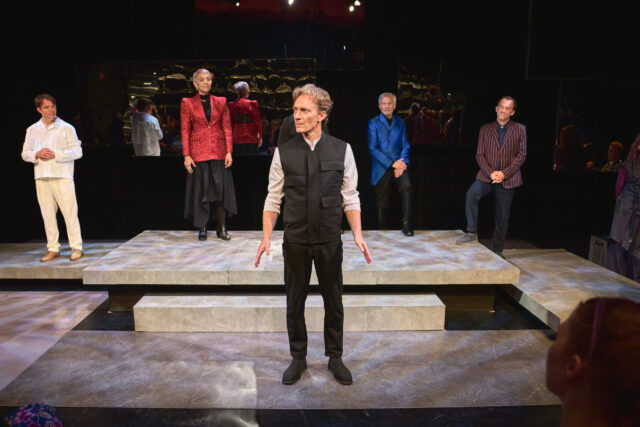
Heartbeat Opera’s Vanessa continues at Baruch Performing Arts Center through May 31 (photo by Russ Rowland)

VANESSA
Baruch Performing Arts Center
55 Lexington Ave. at 25th St.
Through May 31, $53 – $133
www.baruch.cuny.edu/bpac
www.heartbeatopera.org/vanessa

Heartbeat Opera’s Vanessa is a treat for opera lovers as well as opera newbies.

Adapted by company artistic director and conductor Jacob Ashworth with arrangements by music director Dan Schlosberg, the 1958 Pulitzer Prize winner by composer Samuel Barber and librettist Gian Carlo Menotti has been distilled down into its essence, a chilling one-hundred-minute Gothic romance with flashes of Douglas Sirk melodrama, film noir, and German expressionism. Sung in English, it is a taut tale of love both requited and unrequited, with a stark loneliness boiling at its center.

Vanessa (soprano Inna Dukach) has been pining away in her country mansion for twenty years, believing that her lost love will return to her. She lives with her niece, Erika (mezzo-soprano Kelsey Lauritano), who has sacrificed her youth to tend to her aunt, as well as her mother, the aging Baroness (mezzo-soprano Mary Phillips).

“Oh, I shall die if anything happens to him! / My heart, my heart, I can wait no longer,” Vanessa opines. Erika offers to calm her down by reading to her, choosing a rather relevant section from Sophocles’s Oedipus Rex, in which the protagonist declares, “Woe, woe is me, / Sorrowful, sorrowful that I am! / Where am I? Where am I going? / Where am I cast away?”

When someone approaches on a dark, stormy night, Vanessa is sure that it must be Anatol coming back to her, but it is actually his son, also named Anatol (tenor Freddie Ballentine), who shows affection for both Vanessa and Erika as the Baroness watches closely, suspicious of his intentions. Anatol explains, “All through my youth / I heard that name, ‘Vanessa.’ / Like a burning flame / it used to scorch my mother’s lips / and light my father’s eyes with longing. / Now that I am alone / I have been driven here / to meet at last the woman / who haunted so my house: Vanessa.”

When the Doctor (baritone Joshua Jeremiah) calls on Vanessa, he is at first overjoyed that she seems happy. “Ah, how good it is to see this house alive again!” the Doctor, who has loved Vanessa from afar, proclaims, but he is dumbfounded by the sudden appearance of Anatol and consumed by a jealousy that he does not know how to express. Meanwhile, both Vanessa and Erika have fallen for Anatol, but only the latter can face the reality of the situation. “It is a long winter here. Must the winter come so soon?” she wonders.

Vanessa (Inna Dukach) believes she has finally found love with Anatol (Freddie Ballentine) in Samuel Barber and Gian Carlo Menotti’s Pulitzer Prize winner (photo by Russ Rowland)

Vanessa unfolds on a spare, narrow, horizontal stage backed by a large white, angled screen onto which menacing shadows are cast by the performers, who are all dressed in black. Monochrome as the costumes are, the production’s one nod to excess, other than the emotional pitch, are the fabulous, diva-worthy retro ensembles. (The set is by Jiaying Zhang, with costumes by Terese Wadden and lighting by Yuki Nakase Link.) On one side is the seven-piece band, consisting of Sunny Sheu on violin, Thapelo Masita on cello, Louis Arques on clarinet and saxophone, Grace O’Connell on trumpet, Sam George on trombone, Deanna Cirielli on harp, and Eliot Goldmund on piano, playing the often ominous score.

Directed by R. B. Schlather (In the Penal Colony, The Mother of Us All), the opera drags a bit as it reaches its conclusion but is otherwise poignant and exciting, with superb performances by the ensemble amid striking visuals; the only props are chairs that are occasionally brought on and off, allowing the focus to be on the intense narrative.

It’s a heart-wrenching story that soars at the intimate Baruch Performing Arts Center, best encapsulated by the words of the Baroness, who says to Erika, “My poor child, love never bears / the image that we dream of; / when it seems to, / beware of the disguise!”

[Mark Rifkin is a Brooklyn-born, Manhattan-based writer; you can follow him on Substack here.]
FAKES, SHAMS, AND ARTIFICIALITY: KIP WILLIAMS REIMAGINES THE MAIDS FOR MODERN TIMES

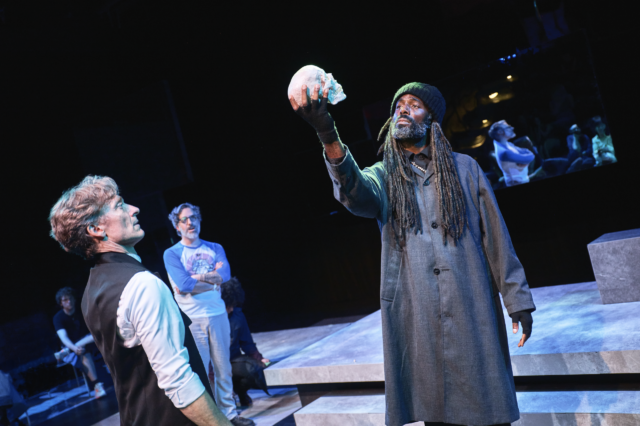
Kip Williams’s adaptation of Jean Genet’s The Maids skewers contemporary society (photo by Julieta Cervantes)

THE MAIDS
St. Ann’s Warehouse
45 Water St.
Tuesday – Sunday through June 14, $49-$149
stannswarehouse.org

“None of it is real,” two characters say in Kip Williams’s scathing adaptation of Jean Genet’s 1947 play The Maids, running through June 14 at St. Ann’s Warehouse.

In his lengthy introduction to the published edition of the play (paired with Deathwatch), Jean-Paul Sartre wrote, “It is the element of fake, of sham, of artificiality that attracts Genet in the theatre. He has turned dramatist because the falsehood of the stage is the most manifest and fascinating of all. Perhaps nowhere has he lied more brazenly than in The Maids.

Williams has reimagined the work for today’s social-media-obsessed culture, with potent results that, despite the “lies,” ring only too true.

Sisters Solange (Phia Saban) and Claire (Lydia Wilson) are live-in maids toiling for Madame (Yerin Ha), a wealthy, famous influencer whose father is a billionaire. The siblings both hate and love Madame, wanting to be her while also dreaming of killing her. They rummage through her closets of expensive couture and luxuriate in her bedroom, which is filled with colorful flowers and floor-to-ceiling mirrors.

For the first part of the play, Rosanna Vize’s plush, elegant set is surrounded by a thin translucent curtain, as if the characters are trapped inside, but when it opens it merges the “falsehood of the stage” with a kind of realism that only enhances the fantasy world Genet and Williams have created and the three characters bask in.

Solange and Claire have deviously plotted to frame Madame’s boyfriend, who has been arrested for embezzlement, another example of fakery. “I needed it to be real,” Claire says when detailing how they pulled it off.

When Madame finally shows up, she is aghast at everything and everyone, from the flowers Kim Kardashian has sent her to the selfie a fan had asked for. “You can tell her assistant directly from me that he should either consider a career change or do some fucking research cos even fucking ChatGPT could tell you that nobody is doing pink fucking hydrangeas anymore. Fuck. Why is it so hard to get good help these days?” she complains to Solange. “Ok!? I feel like I’m going to die, but there’s like a massive difference between my metaphoric death and sending me this fucking disgusting death parade of flowers. Like I am in mourning for my literal life, but like not for actual real, ok?”

As insults fly and the tension mounts, the proceedings are projected on the mirrored closets as if being broadcast live on Instagram or TikTok, complete with filters that make the characters look like garish versions of Brad Pitt and Angelina Jolie, name-dropping such brands as Gianvito Rossi, Balenciaga, and Gucci by Ancora while Madame worries that her boyfriend will be sent to Guantanamo and that she’ll have to move to her father’s villa in France to get away from all the tumult. “It’s going to be really hard,” Madame says. “I will make such a fuss over you both. You’ll be like my little country dolls.”

But through it all, the three women make sure to capture nearly every minute online, which is the only thing that truly matters.

“I’m over. I’m dead. I’ve been cancelled, babes!” Madame opines. “Solange, film this. Film this. This is perfect. This is how it ends. This is perfection!”

Madame (Yerin Ha) chooses just the right dress as sisters Solange (Phia Saban) and Claire (Lydia Wilson) stand back to back (photo by Julieta Cervantes)

Genet grew up in foster care and was arrested numerous times, including for vagrancy, theft, and using false identity papers. Identity is key to The Maids, as the characters occasionally take one another’s place and create fake identities online. Loosely inspired by the true story of sisters Christine and Léa Papin, two maids who killed their mistress and her daughter in France in 1933, Williams’s version is an unsparing satire about twenty-first-century Western culture mired in the desperate need of individuals to put their lives online, acquire likes, and expand their influence amid classism and capitalism run amok.

The Maids is tailor made for actors to hold nothing back and has boasted major trios in the past: Vivien Merchant, Glenda Jackson, and Susannah York in 1973, Cate Blanchett, Isabelle Huppert, and Elizabeth Debicki in 2013, and Uzo Aduba, Zawe Ashton, and Laura Carmichael in 2016. Saban (House of the Dragon, Oedipus) and Olivier nominee Wilson (King Charles III, Pains of Youth) appropriately devour the scenery as the virtually interchangeable sisters, while Ha (Bridgerton, Lord of the Flies) gets her fill as well, leading to a finale that reaches a devastating crescendo.

Williams, who also used live video in his Tony-nominated The Picture of Dorian Gray, Dracula, and Strange Case of Dr. Jekyll and Mr. Hyde, keeps the artifice front and center throughout. Zakk Hein’s projections are huge and grotesque, getting in the audience’s face, both enhancing and overwhelming the action unfolding onstage; should we be looking at the actors themselves or their giant images? Are we actually seeing ourselves and our desire for a fancy home, expensive clothing and accessories (the fanciful, and absurd, costumes are by Marg Horwell), and online fame assisted by botox and Ozempic? And how far are we willing to go to achieve any of that?

The stellar production also features sound by Dan Balfour, lighting by Jon Clark, and original music by DJ Walde that add to the “artificiality” of Genet’s vision. It’s often hard to watch, but you can’t turn away; as fantastical and outrageous as it all seems, it’s also all too real.

“Everything must be so false that it sets our teeth on edge,” Sartre adds in his introduction.

My teeth are still chattering.

[Mark Rifkin is a Brooklyn-born, Manhattan-based writer; you can follow him on Substack here.]