live performance

LUCKY STAR (0.3)

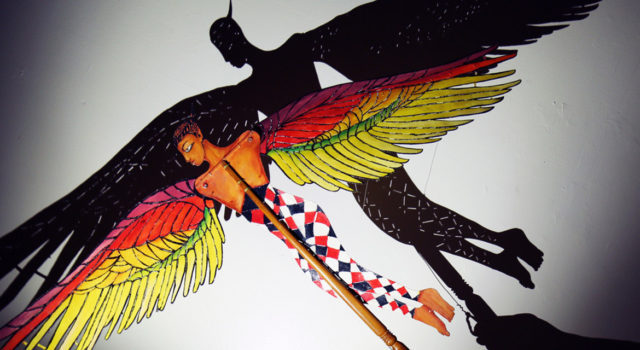
Pioneers Go East Collective’s Lucky Star (0.3) takes place at Judson Memorial Church July 13-30

LUCKY STAR (0.3)
Judson Memorial Church
55 Washington Square South between Thompson & Sullivan Sts.
Tuesdays, Thursdays, and Fridays, July 13-30, free with RSVP, 8:00
www.judson.org
pioneersgoeast.org

Pioneers Go East Collective honors the history of DIY queer artmaking at such famed New York City venues as La MaMa, Judson Memorial Church, and the Pyramid Club in Lucky Star (0.3), a free multidisciplinary performance installation taking place Tuesdays, Thursdays, and Fridays at 8:00 at Judson from July 13 to 30. Inspired by Club 57, which was recently highlighted in the documentary Kenny Scharf: When Worlds Collide, the in-person work consists of five episodes featuring dance/performance artists Shaina and Bryan Baira, Bree Breeden, Daniel Diaz, Beth Graczyk, and Joey Kipp and nightlife icon Agosto Machado. Lucky Star (0.3) was written by creative director Gian Marco Riccardo Lo Forte and production designer Philip Treviño, with choreography by Ori Flomin, film by Jon Burklund and video designer Kathleen Kelley, set design and fabrication by Mark Tambella, and sound by Marielle Iljazoski and Ryan William Downey.

Lucky Star was born by a desire to make art in a new time,” the collective said in a statement. “We pay homage to creators and legends whose trailblazing work has solidified ways for us to survive as artists reimagining our approach to sharing our work in the age of social media and instant gratification. We term the project a meta-creative journey inviting viewers to engage in an emergent process of collective liberation.” Inspired by Walt Whitman’s poem “Pioneers, O Pioneers!” (“O you youths, Western youths, / So impatient, full of action, full of manly pride and friendship, / Plain I see you Western youths, see you tramping with the foremost, / Pioneers! O pioneers!”), Pioneers Go East Collective was founded in 2010 to “empower a collective of thought-provoking, adventurous, and proud LGBTQ artists . . . dedicated to Latinx, BIPOC, and immigrant artists and teaching artists and their communities in all five boroughs, [exploring] stories of vulnerability and courage for social change.” Admission to Lucky Star (0.3) is free with advance RSVP.

SOCIAL DISTANCE HALL: ENEMY OF THE PEOPLE

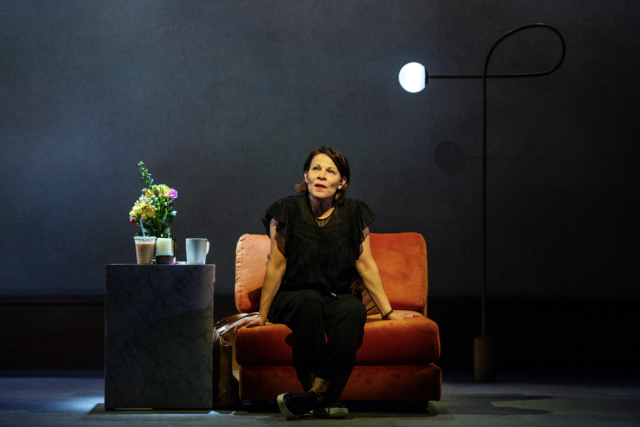
Ann Dowd is mesmerizing in one-woman Enemy of the People at Park Ave. Armory (photo by Stephanie Berger)

ENEMY OF THE PEOPLE
Park Ave. Armory
643 Park Ave. at Sixty-Seventh St.
June 22 – July 9 (canceled)
www.armoryonpark.org

Water, water everywhere: It was an odd coincidence that on City of Water Day, July 10, when the Waterfront Alliance hosts special events to raise awareness about water and the environment, Park Avenue Armory announced the cancellation of its widely praised extended run of Robert Icke’s superb reimagining of Henrik Ibsen’s Enemy of the People — which deals with poisoned water. The ninety-minute one-woman show, scheduled to continue through August 8, was forced to halt because star Ann Dowd had to “address a pressing family matter.” In another odd coincidence, on City of Water Day, I was watching NYClassical’s adaptation of King Lear with Nahum Tate’s 1681 “happy ending” when a sudden, unexpected storm hit the shores of Manhattan and forced us to scurry home, missing the positive conclusion. (Dark clouds became visible on the horizon just as the storm scene began.)

Ibsen’s play about the conflict between public good and private conscience famously centers on water. Icke’s adaptation updates it to the modern-day fictional community of Weston Springs, which advertises, “Come for Mother Nature’s therapy; stay afterwards for some retail therapy. Weston Springs, renowned the world over as a wonder in a mountain paradise. Quench your thirst.” The action opens as Dr. Joan Stockman has discovered that there’s a dangerous amount of lead in the water, which people both bathe in and drink. She wants her brother, Peter, the mayor, to close the spa immediately and authorize an expensive, multiyear reconstruction, which Peter argues would devastate the town’s economic stability. Dr. Stockman takes her case to the people and the local newspaper, resulting in tense discussions and arguments about the role of government, free speech, and the value of human life itself.

Enemy of the People is beautifully staged by Icke on Hildegard Bechtler’s awe-inspiring set, consisting of long wooden walkways that Dowd traverses, stopping at certain points and delivering her monologues; the audience listens through headphones, although when the actress was closer to me, I took them off to hear her natural timbre. (The sound design is by Mikaal Sulaiman.) Dowd serves as omniscient narrator and voices such characters as Joan and Peter; Joan’s husband, Jeffrey Cooper; immigrant housekeeper Vidya; Artie Goldman, editor of the Weston Eagle; his deputy editor, Robin; Dr. Mona at the Weston Medical Centre; Lily, the mayor’s press secretary; and various other members of the community. In the middle of the set is a circular spinning table on which Dowd places miniature white buildings, calling to mind both a globe and the Wheel of Fortune. Cameras also follow Dowd, who can be seen on two large screens at opposite ends of the space; when she is portraying a conversation between two characters, two shots of her are visible, the camera cutting back and forth between them. (The projections and video are by Tal Yarden, with lighting by Natasha Chivers.)

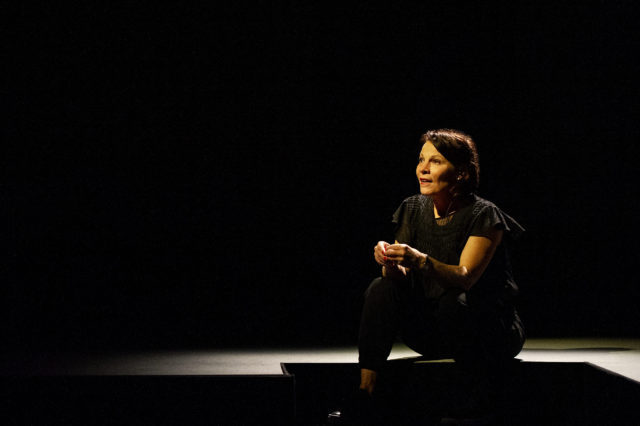
Ann Dowd plays multiple characters in interactive Enemy of the People at Park Ave. Armory (photo by Stephanie Berger)

Enemy of the People could only happen at the armory, in its massive Wade Thompson Drill Hall, which has recently been home to Steven Hoggett, Christine Jones, and David Byrne’s SOCIAL! the social distance dance club, Laurie Anderson and Jason Moran’s Party in the Bardo, and Bill T. Jones’s Afterwardsness as the pandemic lockdown lifts. The limited audience, all of whom must be vaccinated, is seated in pods of two to five at socially distanced rectangular tables that are equipped with a small desktop monitor that plays a commercial, mimics the internet, and presents questions for each group to answer by pressing one of two buttons; the results affect which direction the narrative follows, so each show is different. (It also accounts for why there are Teleprompters on the floor scrolling the dialogue for Dowd to scan, since there are several possible variations that would be nearly impossible to memorize.)

The tables are situated on a giant map of Weston Springs, as if each pod is a house on a particular street. The audience is given sixty seconds to discuss each question among themselves and arrive at one answer; the queries range from the relatively innocuous choice between coffee or tea to the more serious decision whether to go public with Joan’s findings or proceed carefully to minimize panic.

Emmy winner Dowd (The Handmaid’s Tale, Night Is a Room) is hypnotic, evoking a kind of easygoing Our Town demeanor with occasional blasts of emotion as characters get angry. I got mad at myself whenever I started watching her onscreen, preferring to experience her in reality. Icke, who has previously put his imprimatur on Ibsen’s The Wild Duck and A Doll’s House, Chekhov’s Uncle Vanya and Ivanov, Aeschylus’s Oresteia, Shakespeare’s Hamlet, and Orwell’s 1984 on Broadway, has done a sublime job of translating a nineteenth-century story into the present, evoking not only the water crisis in Flint but how Americans talk to one another today, with partisan politics leading to fights over nearly every aspect of contemporary life and the very act of voting itself. It’s a sad tale, one that doesn’t appear to have any easy answers. It’s also sad that the show had to be canceled; whatever Dowd’s personal situation is, we wish her the best.

TICKET ALERT: YOU ARE HERE

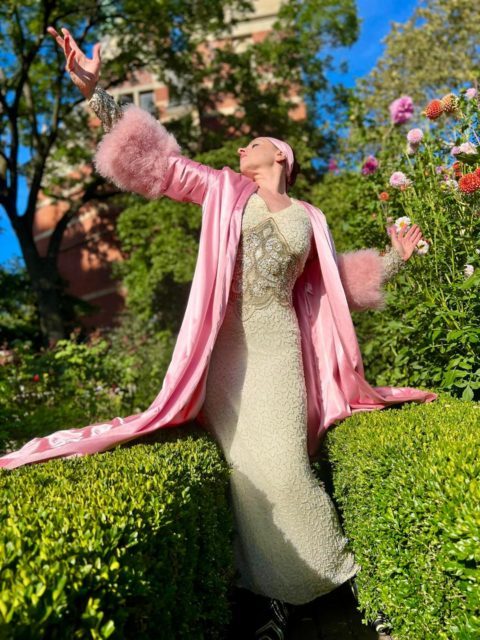
You Are Here takes place across the Lincoln Center campus July 14-30 (photo by Justin Chao)

YOU ARE HERE
The Isabel and Peter Malkin Stage, Josie Robertson Plaza, Hearst Plaza, Paul Milstein Pool and Terrace, Lincoln Center campus
Installation: July 14-23, free
Live performances: July 24-30, free two weeks in advance through TodayTix lottery, 7:00
www.lincolncenter.org

Lincoln Center continues its free Restart Stages program with You Are Here, a multidisciplinary audio and performance installation on Josie Robertson Plaza and Hearst Plaza. From July 13 to 23, the work, conceived by Andrea Miller, the founder and artistic director of the Brooklyn-based Gallim dance company, will be open to the public, who can make their way through a series of sculptures featuring audio portraits of twenty-five New Yorkers affiliated with Lincoln Center and its arts and education community partners. Sharing their experiences over the last sixteen months is a diverse group of individuals, including Bruce Adolphe of the Chamber Music Society of Lincoln Center, Kiri Avelar of Ballet Hispánico, Anthony Roth Costanzo of the Metropolitan Opera, Alphonso Horne of Jazz at Lincoln Center, Egyptt LaBeija of BAAD! Bronx Academy of Arts and Dance, Cassie Mey of the New York Public Library for the Performing Arts, Muriel Miguel of Spiderwoman Theater, Hahn Dae Soo of Korean Cultural Center New York, Taylor Stanley of the New York City Ballet, Gabriela Torres of Juilliard, and Valarie Wong of NewYork-Presbyterian. Other participants are Dietrice Bolden, Jessica Chen, Ryan Dobrin, Jermaine Greaves, Milosz Grzywacz, Lila Lomax, Ryan Opalanietet, Elijah Schreiner, Alexandra Siladi, Paul Smithyman, Jen Suragiat, KJ Takahashi, Fatou Thiam, and Susan Thomasson of Lincoln Center Security, Film at Lincoln Center, the Asian American Arts Alliance, the School of American Ballet, Fiorello H. LaGuardia High School, and other institutions and organizations. The sound sculptures are by Tony-winning scenic designer Mimi Lien, spread across an aural garden created by composer Justin Hicks; costumes are by Oana Botezan, with choreography by Miller and direction by Miller and Lynsey Peisinger.

From July 24 to 30 at 7:00, the audio portraits will be replaced by live performances in and around the Paul Milstein Pool and Terrace that are free through a TodayTix lottery available two weeks in advance; activating the space will be Gallim dancers Lauryn Hayes, Christopher Kinsey, Nouhoum Koita, Misa Lucyshyn, Gary Reagan, Connor Speetjens, Taylor Stanley, Haley Sung, Georgia Usborne, and Amadi Washington. (The audio sculptures will be open to ticket holders at 6:00.) In addition, on July 22 at 6:00, Miller will host the latest edition of the virtual Gallim Happy Hour, a livestreamed discussion with Stanley and Mey about You Are Here, taking place over Zoom and Facebook Live.

BLINDNESS

Blindness plunges in-person audiences into literal and metaphorical darkness (photo by Helen Maybanks)

BLINDNESS
Daryl Roth Theatre
101 East Fifteenth St. at Union Square
Tuesday – Sunday through September 5, $116 per pair
www.blindnessevent.com
www.darylroththeatre.com

The first in-person, extended-run indoor theatrical presentation in New York since restrictions lifted has arrived, and it’s a doozy. British playwright Simon Stephens’s adaptation of Portuguese Nobel laureate José Saramago’s 1995 dystopian novel, Blindness, was long in the works prior to the coronavirus crisis, but its subject matter and staging are tailor-made for this precise moment in time.

The seventy-minute socially distanced sound and light installation debuted at the Donmar Warehouse last August and opened last night at the Daryl Roth Theatre in Union Square. Originally conceived as a fully staged production with a cast of a hundred by Tony winner Stephens and director Walter Meierjohann, it has been reimagined for the pandemic. A maximum of eighty-six masked people are allowed in the theater, seated in chairs in pods of two, either facing the same or opposite directions; each couple is at least six feet away from other pairs.

The set consists of dozens of horizontal and vertical fluorescent lights hanging from above, forming a kind of abstract traffic pattern, warmly changing colors from red, blue, and green to yellow and orange; as the audience enters, the sounds of cars can be heard. The otherwise empty, ominous set is by Lizzie Clachan, with lighting by Jessica Hung Han Yun. Every audience member receives a pair of headphones through which the foreboding tale unfolds. The text is performed by Olivier-winning English actress Juliet Stevenson (Truly, Madly, Deeply; Death and the Maiden), who starts out as the Storyteller before becoming the protagonist. “If you can see, look,” the Storyteller begins. “If you can look, observe.”

The dark parable immerses you in an epidemic in which a man driving down the street suddenly and inexplicably goes blind — everything turns white — and after he goes to an ophthalmologist, the doctor and several of his patients soon lose their sight as well. The contagion spreads, and only the doctor’s wife retains her vision; she takes over the narrative, which turns into an apocalyptic nightmare in which the nation’s leaders turn their back on its citizenry. “If there was a government, it was a government of the blind trying to rule the blind,” the doctor’s never-named wife says. “I didn’t know if there was going to be a future. We needed to decide how we were going to live.”

Juliet Stevenson comes face-to-face with Trevor the binaural microphone while recording Blindness (photo courtesy Donmar Warehouse)

The audio was recorded using a binaural microphone, called Trevor, that is shaped like a human head, similar to the one Simon McBurney used in his 2016 Broadway show, The Encounter. Stevenson’s physical proximity to Trevor affects how we ultimately hear her words, giving it a three-dimensional quality. At times it seems that the doctor’s wife is far away, her voice muffled in the distance, while a minute later you can practically feel her hot breath on your neck as she whispers in your ear, as if she is standing right next to you. It can be unnerving, and it’s supposed to be, melding well with the story, which grows harsher and harsher. The genius sound design is by Ben and Max Ringham, who previously used binaural recordings and silent disco headphones for Ella Hickson’s spy thriller, Anna, at the National Theatre in May 2019. You might be sitting in a space with no stage, no furniture, no props, only chairs and lights, but Stephens’s writing is so descriptive, and Stevenson’s reading so clear and poetic, that you’ll think you are in the quarantine bunker where the blind characters are struggling to survive.

Although the theater does transform into total darkness for several scenes, random flashes of white lights in the second half are distracting, with no apparent connection to the story except to perhaps evoke an instant of white blindness. Depending on where you are sitting, you might be facing another audience member, which can be unsettling; usually at the theater, the only people in front of you who you might make eye contact with are the actors onstage. That said, it’s fabulously exciting to be in a theater with other people, experiencing something together. In addition, everyone gets a flashlight to turn on in case they require technical or personal assistance, although that can be disruptive, particularly when it’s pitch black and someone suddenly flicks the light on. There is no intermission, no bathroom breaks, no gathering in the lobby to chat; if you have to leave for some reason, there is no reentry. And speaking of distractions, the night I was there, I did not see anyone on their cell phone or hear any ringers go off. Sheer bliss.

Blindness, which was adapted into a 2007 play by Godlight Theatre Company, a 2008 film by Fernando Meirelles starring Julianne Moore, Mark Ruffalo, and Danny Glover, and a 2011 opera by Anno Schreier and Kerstin Maria Pöhler — Saramago also wrote a sequel, Seeing, in 2004 — is not simply a technological marvel that explores the breakdown of society in a health crisis that is all too familiar today; it examines how we as a culture interpret how and what we see. It’s merely coincidental that we are watching a show about a pandemic, involving food insecurity, economic distress, governmental refusal to take action, and so much grief and loss, during a pandemic. Blindness delves into the interconnectedness of humanity amid greed, selfishness, and a metaphorical blindness that can lead to racism, hate, militarism, and othering. Stephens follows Saramago’s style of not using proper names for characters or locations; this could be happening to anyone, anywhere, at any time.

In writing the play, Stephens (Sea Wall, Heisenberg, The Curious Incident of the Dog in the Night-Time), who is partially sighted, consulted with Hannah Thompson, a partially sighted professor of French and Critical Disability Studies at Royal Holloway, University of London, who explained ocularcentrism to him, the belief that sight is the most privileged of the five senses and how misunderstood having less vision is. (She prefers the term “vision gain” to “vision loss.”) Early on, the Storyteller says, “Who would have believed it? Seen at a glance, the man’s eyes seemed healthy. The iris looked bright, luminous. The sclera white, as compact as porcelain. The eyes wide open, the wrinkled skin of the face, the eyebrows suddenly screwed up.” As this immersive sound and light installation reminds us, taking life, and all its wonders, for granted comes at your own risk.

THE DARK MASTER

Kuro Tanino’s The Dark Master is a VR treat for the senses (photo © Japan Society)

THE DARK MASTER
Japan Society
333 East 47th St.
June 23-28, $45
212-715-1258
www.japansociety.org

Kuro Tanino’s The Dark Master was originally scheduled to be a fully staged production at Japan Society in January 2021 as part of a four-city US tour. However, because of the pandemic lockdown, Japan Society artistic director Yoko Shioya suggested that Tanino reimagine the piece for virtual reality. The result is a thoroughly satisfying and uniquely tasty experience, a delectable treat for the senses.

Continuing through June 28, The Dark Master is presented to ten audience members at a time, sitting in individual mirrored cubicles on Japan Society’s stage. Wearing headphones and VR headsets (and facemasks), you are taken into a tiny, claustrophobic restaurant where you are served food by a grouchy owner-chef (Kiyobumi Kaneko). He decides that you are to become the next cook, and your training begins as hungry customers come in and sit at the counter, excited for the carefully prepared fare.

Inspired by first-person video games and an indie manga written by Marei Karibu and illustrated by Haruki Izumi, The Dark Master immerses you in a mysterious world that can be as funny as it is creepy. Kaneko is a hoot as a surly smoker who seems relatively disinterested in what he’s doing yet creates miraculous dishes that not only look good but smell great — be prepared for a multisensory adventure. The virtual reality extends about 180 degrees, so be sure to turn to your right and left and up and down to take it all in; you are also given hands that hold a menu, pour a drink, and bring the victuals to your mouth, which could produce a sort of personal AMSR encounter A brief video at the end takes you behind the scenes of how some of it was done.

The Dark Master takes place for only ten people at a time at Japan Society (photo © Keizo Maeda)

A sculptor, painter, and former psychiatrist, Tanino (Frustrating Picture Book for Adults, Fortification of Smiles) literally and figuratively gets into your head for forty-five minutes as performers from his experimental theater company, Niwa Gekidan Penino (NGP), including Kaneko, F. O. Pereira Koichiro, and Bobmi Hidaka, traipse through the restaurant, with narration by Saika Ouchi. The dialogue has been dubbed into English by the original Japanese cast; the fab set is by Takuya Kamiike, with moody lighting by Masayuki Abe, crackling sound by Koji Sato and Shintaro Mastunomiya, and videography and editing by Nobuhiro Matsuzawa. In 2014, NGP made its American debut at Japan Society with The Room Nobody Knows, which featured a spectacular two-level set that represented the unconscious and subconscious minds. With this VR iteration of The Dark Master, Tanino serves up a wonderful physical and psychological meal, one that can be enjoyed together by strangers, just like watching theater or eating in a restaurant, two of life’s necessities (and genuine pleasures) that were unavailable for so much of the last sixteen months.

ANDROMEDA’S SISTERS: AN ARTS & ADVOCACY GALA

Who: The Neo-Political Cowgirls
What: Fifth annual benefit gala
Where: NPC Cowgirls online and Leiber Collection Museum in East Hampton
When: Saturday, June 26, $25 streaming, $125-$250 in person, 5:00
Why: Last summer, the nonprofit organization the Neo-Political Cowgirls hosted the fourth annual “Andromeda’s Sisters” online, two virtual evenings of short performances, workshops, and discussion focused on advocacy, including, most memorably, Catherine Curtin in Joy Behar’s stirring monologue Where Are You At? and Laura Gómez in Dipti Bramhandkar’s Brown Girl’s Guide to Self-Pleasure. This year, “Andromeda’s Sisters: An Arts & Advocacy Gala,” which took place in person in 2019 at Guild Hall, goes hybrid, happening online as well as at the Leiber Collection Museum in East Hampton on June 26 at 5:00.

The 2021 event includes a reading of Kathryn Grant’s one-act play Order My Steps, about a prison inmate reconnecting with her estranged adult daughter, directed by Florencia Lozano and NPC founder Kate Mueth and starring Curtin and Irene Sofia Lucio, followed by a panel discussion on social justice and advocacy with Planned Parenthood Federation of America president and CEO Alexis McGill Johnson, New Hour for Women and Children — Long Island founder Serena Ligouri, and novelist and editor Angie Cruz. Founded in 2007, the Neo-Political Cowgirls “are committed to making work for women and about women — to creating a space where women and girls from all walks of life can share their experiences, joys, concerns, and spirits through professional dance.” The gala gets its name from the legend in which Princess Andromeda, captured by Poseidon, is saved by the daughters of the God of the Sea, leading to the idea that sisters should seek to help one another in these difficult times. Access to the livestream is $25; in-person tickets are $125-$250.

NY CLASSICAL THEATRE: KING LEAR WITH HAPPY ENDING

NY Classical returns to live, in-person performances with King Lear in parks around the city this summer

KING LEAR
Multiple locations
Tuesday – Sunday, June 24 – August 8, free with RSVP, 7:00
nyclassical.org/king-lear

In June 2020, with the pandemic lockdown shuttering live performance around the country, theater companies scrambled for ways to present work in virtual platforms. NY Classical, which has presented more than seven hundred free, mostly outdoor shows since 2000, was working on an adaptation of King Lear for that summer, using Nahum Tate’s 1681 “happy ending.” Instead, they staged an online Zoom reading last June. In a twi-ny talk, artistic director Stephen Burdman explained, “King Lear, with alternating endings (both Shakespeare’s and Tate’s), was always our plan for our 2020 summer season. This is the culmination of a three-year project of investigating how Shakespeare’s company toured their shows outside London. In the time of plague, theaters were closed in Elizabethan London, and while we never expected to have a pandemic of our own. . . . We also had great success with both our six-actor Romeo and Juliet as well as the alternating versions of The Importance of Being Earnest, so this project was a combination of these recent experiments. We auditioned and hired the actors and staff prior to New York State on Pause, and we wanted to make sure to keep our commitments to these wonderful people. In addition to a union salary, they are receiving pension and healthcare. This is an opportunity for us to develop the production with these artists and serve our audience community in the safest way possible.”

With the lockdown over and New York rising from the ashes of a devastating health and economic crisis, NY Classical is ready to stage King Lear the way it originally intended to, in parks across the city. The cast features John Michalski as Lear, Connie Castanzo as Cordelia and the Fool, Jasminn Johnson as Goneril, Aryana Sedarati as Regan, Nick Salamone as Gloucester, Linden Tailor as Edgar, Amar Atkins as Edmund, Michael Stewart Allen as Cornwall, Grant Chapman as Oswald, Cedric Lamar as Kent, and Clay Storseth as Albany, with Ollie Corchado, Evan Moore-Coll, and Saleemah Sharpe. The two-hour production, directed by Burdman, will run Tuesdays to Sundays beginning June 24 through July 11 in Central Park at West 103rd St., followed July 13-18 at MetroTech Commons in Brooklyn, July 20-25 in Carl Schurz Park, and July 27 – August 8 at the Battery. Admission is free, but advance RSVP is strongly suggested, as tickets are limited.