live performance

INTIMATE APPAREL

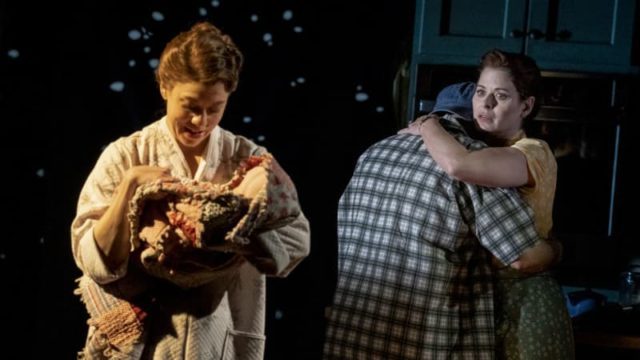
Esther Mills (Kearstin Piper Brown) checks out special fabric saved for her by Mr. Marks (Arnold Livingston Geis) in Intimate Apparel (photo by Julieta Cervantes)

INTIMATE APPAREL
Lincoln Center Theater at the Mitzi E. Newhouse
150 West 65th St. between Broadway & Amsterdam Ave.
Tuesday – Sunday through March 6, $92
212-362-7600
www.lct.org/shows

It takes a special kind of play to become a special kind of opera, but that is just what has happened with two-time Pulitzer Prize winner Lynn Nottage’s Intimate Apparel, continuing at Lincoln Center’s Mitzi E. Newhouse through March 6. The original play debuted at Baltimore’s Center Stage in 2003 and moved the next year to the Roundabout, winning numerous Drama Desk, Obie, Outer Critics Circle, and Lucille Lortel awards.

The new show is a profound transformation, part of the Met/LCT Opera/Musical Theater Commissioning project, the first-ever collaboration between the Metropolitan Opera and Lincoln Center Theater. It began at the Met in 2014 with Nico Muhly and Craig Lucas’s Two Boys and was followed last year by Matthew Aucoin and Sarah Ruhl’s Eurydice. Intimate Apparel features a lovely score by Ricky Ian Gordon and a superb libretto by Nottage that deals with race, class, misogyny, and poverty.

The poignant drama takes place in Lower Manhattan in 1905, where Esther Mills (Kearstin Piper Brown), the daughter of slaves, toils as a seamstress, saving up to someday open her own salon; she has amassed a small fortune, $1700, over seventeen years. At thirty-five, she worries that she is a spinster who will never find true love. She makes clothes for a wealthy white woman, Mrs. Van Buren (Naomi Louisa O’Connell), and lives in a boardinghouse run by Mrs. Dickson (Adrienne Danrich), an older Black widow who feels successful whenever one of her residents leaves to get married.

She asks, “How many girls have left here? / I can’t count them anymore. / They come as mere babies, / And I teach ’em all I know, / So when they leave, / And leave they must, / They leave here as refined ladies.” At the wedding of one of her residents, Corinna Mae (Jasmine Muhammad), Mrs. Dickson encourages Esther to consider Mr. Charles (Errin Duane Brooks) as a potential match, but she’s having none of it. “He been comin’ to these parties for two years, / And if he ain’t met a woman, / It ain’t a woman he after, I fears,” Esther answers. “Pride’ll leave you lonely,” Mrs. Dickson reasons. But Esther doesn’t believe in romance. “Love!? / I hate that word! / Love doesn’t come to no featherless bird. / Love is a music that I never heard,” she opines.

Esther is shocked to learn that George Armstrong (Justin Austin), a Barbadian working on the Panama Canal, has heard about her from the deacon’s son at her church and wants to correspond with her. Esther can’t read or write, but she begins an epistolary relationship with George with the help of Mrs. Van Buren.

Esther occasionally goes to the fabric seller, Mr. Marks (Arnold Livingston Geis), an Orthodox Jew who saves special bolts of cloth for her. There is obvious electricity between them, but when Esther puts her hand on him affectionately, he pulls away. “The color won’t rub off on you!” she declares angrily. Mr. Marks explains that his religion forbids him from touching any woman who isn’t his wife.

When George finally arrives in New York, he and Esther wed, but married life is not a bed of roses for her, as George seems to prefer hanging out with Mayme (Krysty Swann) in a saloon and not working. He wants to buy a dozen draft horses from a guy in the bar, but he needs Esther’s cash to make the purchase. Mayme, who gets her sexy outfits from Esther, dreams of being a pianist performing at Carnegie Hall. “We all wishing on something,” she says. “I smash all social rules. / ’Cause no one does it for us.” It’s not long before Esther, who has never been one to smash social rules, finds herself reevaluating what, and who, she wants in life.

Beautifully directed by Tony winner Bartlett Sher (My Fair Lady, South Pacific), Intimate Apparel is an intimate sung-through chamber opera that feels right at home at the Newhouse. The music is performed by two pianists, associate conductor Nathaniel LaNasa and Brent Funderburk, facing each other on high platforms, with the words projected onto the walls (along with archival footage and photographs from the early 1900s). Gordon, whose previous opera adaptations include The Grapes of Wrath, The Tibetan Book of the Dead, and the just-concluded Yiddish version of The Garden of the Finzi-Continis, has created a moving score that floats through the theater.

Things get intimate at opera adaptation of Lynn Nottage play (photo by T. Charles Erickson)

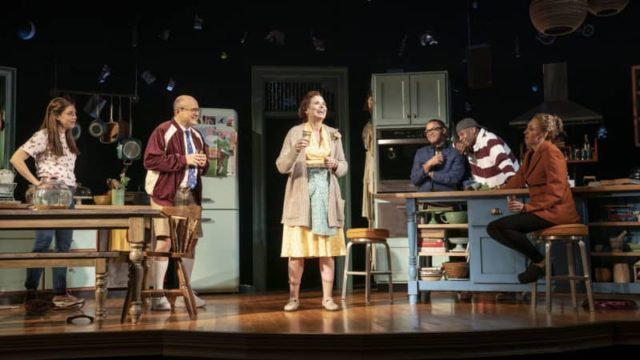
Michael Yeargan’s spare set is centered by a circular wooden floor that rotates, with standing doors, a sewing machine, beds, and other pieces of furniture whisked on and off between scenes, blending in with Dianne McIntyre’s choreography. Catherine Zuber’s period costumes range from ravishing to appropriately dour; Esther sews daring outfits for others but allows herself only boring frocks.

The narrative was inspired by Nottage’s great-grandmother, who was a seamstress, and was written shortly after the death of Nottage’s mother; several characters feel imbued with a haunting loneliness. It also is a sharp representation of the immigrant experience, as men and women with roots from Eastern Europe, the Caribbean, and Africa try to make lives of their own in difficult times, lacking the opportunities available to wealthier white families.

Piper Brown, who has appeared is such operas as Aida, La Traviata, and Carmen and such musicals as Ragtime and Caroline, or Change, has the acting chops to match her wonderful voice. Her expressive eyes and movement display how tired and beat down Esther is, wanting desperately to believe in herself without having to rely on anyone else, especially a man. (Chabrelle Williams performs the role at Wednesday and Saturday matinees.) The rest of the cast, which also includes Tesia Kwarteng, Anna Laurenzo, Barrington Lee, Indra Thomas, and Jorell Williams, is exemplary.

With this new version of Intimate Apparel, Nottage again proves that she is one of America’s most talented and important writers. She has explored the human condition, often through the lens of race, class, and socioeconomic injustice, in such stalwart works as Sweat, Ruined, Mlima’s Tale, and By the Way, Meet Vera Stark, compiling a kind of American quilt of powerful stories that has reached yet another level.

BODYTRAFFIC

Micaela Taylor’s SNAP is part of BODYTRAFFIC program at the Joyce

BODYTRAFFIC
Joyce Theater
175 Eighth Ave. at 19th St.
March 1-6, $41-$61
212-645-2904
www.joyce.org
bodytraffic.com

“There’s nothing quite like coming home,” BODYTRAFFIC artistic director Tina Finkelman Berkett writes in a program note about the LA company’s upcoming presentation at the Joyce. “Growing up in NYC, I dreamt of performing on the Joyce stage, and each time our company returns is incredibly meaningful.”

Finkelman Berkett used the pandemic lockdown to reimagine the troupe, which she founded in 2007 with Lillian Barbeito, and the results can be seen March 1-6. The show begins with the world premiere of Baya & Asa’s The One to Stay With, which takes on corporate greed; the cast consists of associate artistic director Guzmán Rosado, Joan Rodriguez, Katie Garcia, Pedro Garcia, Whitney Schmanski, Jordyn Santago, Tiare Keeno, and dance captain Ty Morrison, with music by Tchaikovsky, Russian Brass Brand, and Béla Bartók.

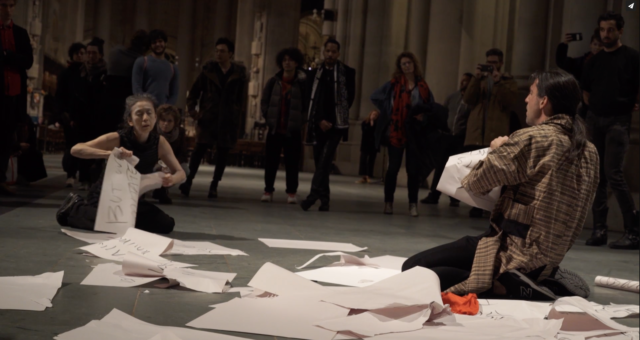
Following a set change, Finkelman Berkett truly returns to the Joyce stage with the New York premiere of Fernando Hernando Magadan’s (d)elusive minds, a duet she will perform with Rosado, set to Schubert’s Trio Pour Piano, Violon Et Violoncelle En Mi Bemol, Op. 100. It was inspired by Dora Garcia’s “All the Stories” and the true story of a man with Capgras syndrome who killed his wife, thinking she was a duplicate, and spent fifteen years in an institution believing his real wife was still alive, writing to her every day. Magadan’s scenic design includes a near-semicircle of paper along with a chair and a typewriter.

After intermission, TL Collective artistic director and former BODYTRAFFIC dancer Micaela Taylor’s SNAP will make its New York premiere, with Alana Jones, Joseph Davis, Katie Garcia, Santiago, Keeno, Rodriguez, and Morrison moving and grooving to James Brown, with original music by Shockey and costumes by Kristina Marie Garnett. The piece is meant to snap people out of their complacency while celebrating the diversity of Los Angeles.

The evening concludes with Alejandro Cerrudo’s PACOPEPEPLUTO, a work for three male soloists originally choreographed for Hubbard Street Chicago in 2011, with Rodriguez, Pedro Garcia, and Rosado or Davis hoofing it to Dean Martin’s “In the Chapel in the Moonlight,” “Memories Are Made of This,” and “That’s Amoré.” In addition, there will be a curtain chat on March 2.

RASHAAD NEWSOME: ASSEMBLY

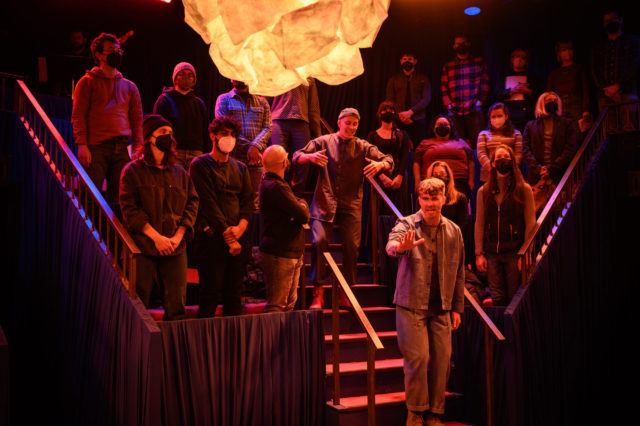
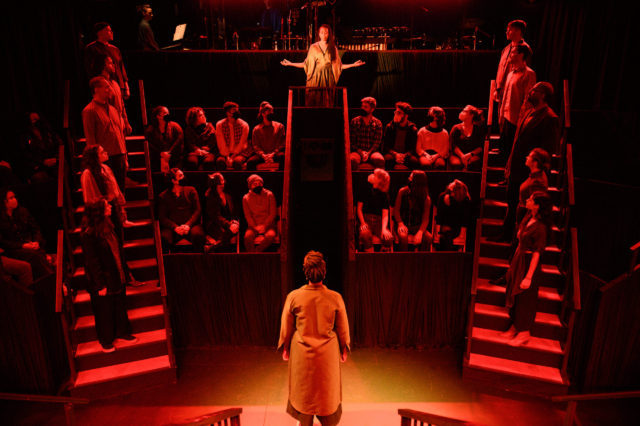
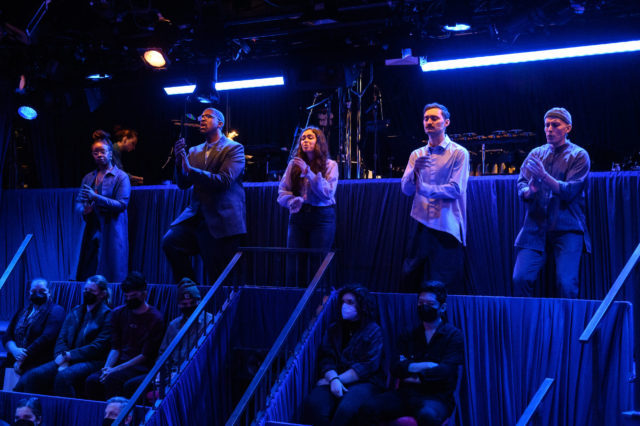
Rashaad Newsome’s Assembly is an immersive multimedia exploration of the intersection of humanity and technology (photo by Stephanie Berger Photography / Park Avenue Armory)

ASSEMBLY
Park Ave. Armory, Wade Thompson Drill Hall
643 Park Ave. at Sixty-Seventh St.
Tuesday – Sunday through March 6, $18 exhibition, $40 performances
www.armoryonpark.org
rashaadnewsome.com

The Muthaship has landed — and taken root inside Park Ave. Armory’s 55,000-square-foot Wade Thompson Drill Hall. New Orleans–born interdisciplinary artist Rashaad Newsome’s immersive multimedia installation Assembly is an open call to end colonialism, white supremacy, systemic racism, homophobia, and other societal ills based in bigotry and inequality, through music, movement, art, and storytelling grounded in Black queer culture. A kind of group healing focusing on opportunity, Assembly is hosted by Being the Digital Griot, an artificial intelligence project Newsome developed at Stanford’s Institute for Human-Centered AI (HAI).

When you enter the hall, you are met by Wrapped, Tied & Tangled, a thirty-foot-tall scrim on which a series of performers in bright red, yellow, and blue costumes appear to be dancing and drawing in space while a robotic voice makes affirmations. “Dig into your mind. Welcome to your insides,” Being offers in a gentle, caring tone. “I am here to listen and provide you with a new beginning for your journey. . . . There is only breath, heartbeat, rhythm, and peace. . . . No matter what, you are enough. . . . You are the most beautiful you. You are the master of your own self. You are radiant. You are divine. Always. Ever. Only. Enough. This is your solution. An infinite everything.” The dancers morph into one another — and then into Being, as if we all are one and the same, a spiritual melding of humanity and technology.

Large screens surround the scrim on three sides; to your right, the dancer in yellow moves proudly, with an army of tiny dancers arranged on their head like cornrows, while to the left, the dancer in blue moves in the universe, where miniature dancers align like stars. The screens in front feature computer-generated diasporic imagery of flowers, fractals, twerking, and abstract shapes seemingly coming to life. And behind you, above the entrance, site-specific projections interact with the wall and windows, from more dancers and flashing lights to a facade evoking a plantation house collapsing and figures emerging in silhouette. The textile-like flower imagery is repeated as wallpaper and across the floors.

Tuesday through Sunday at 1:00, 3:00, and 5:00 (free with general admission), workshops are held on the other side of the far screens, in a 350-seat classroom that also serves as a live performance venue Tuesday through Saturday evenings at 9:00 ($40). In the workshop, the onscreen Being leads the class through a series of movements the AI relates to oppression, suppression, the power of consumption, the culture of domination, the ownership of narrative, and freedom by exploring voguing and its highly stylized modes of catwalking, duckwalking, spin dipping, and ballroom.

Being hosts an interactive workshop as part of Assembly (photo by Stephanie Berger Photography / Park Avenue Armory)

Speaking about how spin dips conclude with falling to the floor, Being explains, “I see that collapse as the transgressive moment when we let go of the binary of imperfect and perfect and engage in the incredible pedagogy of resistance by thinking critically about our process, acknowledging that we don’t have the visionary skills at that moment to make the most liberatory decision and then stop, reflect, and try again.” Workshop participants are invited to come down from their seats and join in the movement. “Floor performance leads into the embodied pedagogy aspects of vogue femme, centering the erotic and rejecting the patriarchal legacy of the mind-body split,” Being says. After Being’s presentation, audience members can share their thoughts and ask questions of the AI, who supplies analytical answers generated by key words and algorithms through which Being continues to learn.

The AI also celebrates their father, Newsome, and declares that author, activist, and feminist bell hooks, who passed away on December 15 at the age of sixty-nine, is their spiritual mother, while strongly suggesting that we read Paulo Freire’s 1968 book Pedagogy of the Oppressed to better understand what we are all facing as a society. The text of the presentation was inspired by the writings of hooks, Audre Lord, Alok Vaid-Menon, and Assembly performer Dazié Rustin Grego-Sykes. Among the other performers are rappers Ms. Boogie, TRANNILISH, and Bella Bags, a ten-piece band, opera singer Brittany Logan, and a six-member gospel choir. The choreography is by Wrapped dancers Kameron N. Saunders, Ousmane Omari Wiles, and Maleek Washington, with music by Kryon El and booboo, lighting by John Torres, scenography by New Affiliates (Ivi Diamantopoulou and Jaffer Kolb), and sound by Robert Aiki Aubrey Lowe and Mark Grey.

Ansista has a leg up in front of Twirl, Isolation, and Formation of Attention (photo by twi-ny/mdr)

Around the back of the classroom is a semicircle of other works by Newsome, who is based in Brooklyn and Oakland. At either end are Ansista and Thee Variant, lifesize iterations of Being, one wearing red heels and a West African print dress, the other styled like a dominatrix with spiky black leather pants, stilettos, and a helmet mask, with warped facial parts that are also evident in nine framed collages featuring such titles as Isolation, Formation of Attention, It Do Take Nerve, O.G. (Oppositional Force), and JOY! In addition, there are monitors at either end of the armory hallway and in the gift shop, showing the twerking video Whose Booty Is This, the 2015 King of Arms parade and coronation, and the 2021 postapocalyptic Build or Destroy. Be sure to check out the cases in the shop, as Newsome has snuck in some hand-carved mahogany and resin African objects alongside the armory’s historic pieces, including Adinkra, Gemini, Brolic, and Unity. On February 20, the armory hosted the salon “Captcha: Dancing, Data, Liberation,” an all-day seminar examining art, technology, and Black queer culture and quantum visual language that you can watch here.

Given the history of hate and oppression that Assembly takes on, it is a surprisingly hopeful, forward-thinking installation, as Newsome envisions a “utopian future [of] beloved togetherness” at the intersection of humanity and technology, where “racial hierarchies and biases” can be overcome through what he calls a “real reboot.” Being and Assembly are only the beginning.

SANDBLASTED

Odessa (Marinda Anderson) and Angela (Brittany Bellizeare) try to keep things together in sandblasted (photo by Carol Rosegg)

SANDBLASTED
Vineyard Theatre
Gertrude and Irving Dimson Theatre
108 East 15th St. between Union Square East & Irving Pl.
Tuesday – Sunday through March 13, $26.25-$103.95
www.vineyardtheatre.org

Charly Evon Simpson’s engaging, if undercooked, sandblasted is no mere day at the beach or breath of fresh air in a freezing cold winter, with Covid still upon us and masks necessary at the theater. The hundred-minute play, which opens today at the Vineyard, takes place on a stage filled with more than seventeen tons of sand, alternately representing the beach or the desert; there are doors in the back and stage right, a window stage left, and a ceiling of fluffy white clouds and blue sky. Matt Saunders’s set offers the characters warm and sunny relaxation, where they can sit in a chair and have a cold drink, as well as a space for unsteady traction, an arid, treacherous landscape. In both locales, Black women struggle to keep themselves together, literally and figuratively.

Thirtysomethings Angela (Brittany Bellizeare), a bundle of fear and anxiety, and the much cooler and hipper Odessa (Marinda Anderson) meet at the beach; brushing off sand, Odessa sees her left arm fall off. She is more disappointed than horrified; it turns out that women, particularly as they age, start losing pieces of their body. They are soon joined by the older and wiser Adah (Rolonda Watts), who offers perspective.

“I thought it would take a while longer for the larger parts of us to . . . to fall,” Angela says almost matter-of-factly. “Longer?” Adah asks. Angela replies, “Yeah, a lot of breaths, months of stewing, soaking, simmering, months of incubation. I thought it would take a large number of sleepless nights for a part so large to . . .” Adah says, “Just like you to trust in something like time and sense.” Angela concludes, “I just trust that time will get us, that time will outlive us.”

Rolonda Watts excels as a celebrity wellness guru in Vineyard/WP world premiere (photo by Carol Rosegg)

Adah is a famous celebrity wellness guru who may or may not have Black lady magic, supplying answers to many of the questions Black women have. When Angela mentions how inconvenient so much of their lives are, Adah explains, “But isn’t it always inconvenient? Isn’t it always the wrong place, wrong time?”

Angela and Odessa, a sort of Alpha and Omega themselves, believe it will take more than sun, tape, glue, spinach, and exercise to hold them together. Thinking that it might be easier to just hide her head in the sand, Angela says, “Sometimes I want to walk around in like one of those bubbles, just be a bubble walker.” Odessa responds, “No life that way, just a bubble life. What’s the point in living?” The allusion to Covid-19, which inequitably affects communities of color, is not lost on the audience. (And there are a few more to come.)

Angela’s hunk of a brother, Jamal (Andy Lucien), accompanies her to an Adah seminar entitled “Girls, stop falling apart!” but Adah doesn’t show up. Angela and Odessa decide to find her, hoping she can provide a cure; they set off on a journey seeking hope, understanding, and resolution, but it’s not going to be easy.

A coproduction with WP Theater, sandblasted evokes Samuel Beckett’s Happy Days and Waiting for Godot and Edward Albee’s Seascape and The Sandbox as well as Chiori Miyagawa’s America Dreaming, the 1994-95 Vineyard play that also took place on sand and dealt with otherness. Simpson’s (Behind the Sheet, Jump) writing is often poetic and works best when the story has a more existential, nonspecific nature, making references to skin color, grief, isolation, and systemic misogyny instead of putting them front and center.

Angela (Brittany Bellizeare) and her brother, Jamal (Andy Lucien), attend a seminar in sandblasted (photo by Carol Rosegg)

There are many beautiful, penetrating lines: “I think getting older isn’t about losing the fears you had as a kid. I think it is about having new fears that overtake them,” Angela theorizes. “Some say they don’t want to learn any new names, meet any new people, because then it is just another person to miss, to worry about, to grieve,” Odessa asserts. “I don’t know which of the many possible fights we’re in the middle of. Is the fight we should be fighting to heal? And no one else seems to know either,” Angela explains. And Odessa admits, “Some nights I think I’m the epitome of Black girl magic, and other nights I think I’m just another version of a magical negro and I wonder what it would be like to just live between the two.”

Anderson and Bellizeare make a classic comic duo, albeit with a very serious edge, as the fun and fancy-free Odessa and the tightly wound Angela, respectively, two women who might not have become friends at another time or another place. Watts, the longtime New York City television journalist and talk show host, is extraordinary as Adah, displaying an infectious confidence that glitters at every turn; she adds sparkle every time she’s onstage. Lucien does what he can as Jamal, a character who quickly becomes superfluous; I’m not sure he was necessary at all, save for providing a forced link between Angela and Odessa.

In her NYC debut, director Summer L. Williams can’t quite steady herself in the sand. The jumps back and forth in time are confusing, and several subplots never come full circle, falling away like body parts that are never reattached. In addition, Simpson can’t quite figure out how to end the show, which feels about ten or fifteen minutes too long; several of the last scenes feel extraneous, as they turn from the existential aspects of the story to provide more specific pathways for the future.

At one point, Angela talks about fulgurites, fragile tubes of glass that are formed when lightning strikes sand; some believe they have magical qualities. “I spent all this time being careful, treated myself like a fucking fulgurite for god’s sake,” Angela says. “So I’d live long, so I’d succeed, so I’d . . . and now this.” The resolution of the fulgurite thread in the play is too firm, too solid; some things are better left unsaid, onstage and on sand.

ENGLISH

Sanaz Toossi’s English takes place in a TOEFL class in Iran (photo by Ahron R. Foster)

ENGLISH
Atlantic Theater Company
Linda Gross Theater
336 West 20th St. between Eighth & Ninth Aves.
Tuesday – Sunday through March 20, $76.50
866-811-4111
atlantictheater.org

Concepts of home and personal identity lie at the heart of Sanaz Toossi’s poignant and involving English, which opens tonight at the Atlantic’s Linda Gross Theater. A coproduction with Roundabout Underground, the play is set in a small classroom in Karaj, Iran, in 2008, where Marjan (Marjan Neshat) is teaching basic English to four students who are planning on taking the TOEFL, the Test of English as a Foreign Language, for very different reasons. Marjan insists that they speak only English in the class rather than Farsi, their native tongue.

Roya (Pooya Mohseni) wants to be able to speak with her new granddaughter, who lives in Canada with Roya’s son and his wife and is not being raised to speak Farsi. “I hope you not forget. Nate is not your name,” she tells her son, who used to be known as Nader.

Elham (Tala Ashe) has passed her MCATs but needs to learn English so she can study gastroenterology in Australia. “My accent is a war crime,” she angrily admits.

Omid (Hadi Tabbal) has an upcoming green card interview in Dubai, but his English is already excellent, nearly accentless. When asked why people learn language, he says, “To bring the inside to the outside.”

Goli (Ava Lalezarzadeh) is an eighteen-year-old girl who wants to speak like Shakira. “People like accent,” she says, not ashamed of who she is.

After a presentation by Goli doesn’t go particularly well, Marjan, a married woman who spent nine years in Manchester before moving back to Iran with her family, says, “Don’t be sorry! We were speaking English with each other. I think it’s one of the greatest things two people can do together.”

Four students and a teacher learn about life and language in English (photo by Ahron R. Foster)

They play word games, do show-and-tell, and discuss English vs. Farsi. “I want to speak English. Before I speak Farsi good, I know I want to speak English,” Goli says. “English does not want to be poetry like Farsi. It is like some rice. English is the rice. You take some rice and you make the rice whatever you want.”

Roya resents having to learn English and is furious that her son has turned away from his culture, projecting that rage onto her teacher. “You talk about Farsi like it’s a stench after a long day’s work. Tell me, Marjan, what is it about where we’re from that you find so repulsive?” she argues.

As Elham’s frustration with English builds — she repeatedly uses Farsi in class, accumulating negative points — she gets into disagreements with everyone else, speaking frankly, without apology. “Goli, people hear your accent and they go oh my god it is so funny you are so stupid. . . . Okay if I have accent, bad TOEFL score. Omid has accent, no green card. Roya’s accent? Disaster.” Some of them equate the attempted erasure of their Iranian accent when speaking English with the loss of who they are, as if they are surrendering their unique culture. “Don’t you think people can do us the courtesy of learning our names?” Elham says to Marjan, who went by “Mary” when she lived in England.

“English isn’t your enemy,” Marjan insists. “English is not to be conquered. Embrace it. You can be all the things you are in Farsi in English, too. I always liked myself better in English.” But Marjan won’t acknowledge to herself that that is exactly the problem. “I feel like I’m disappearing,” she says later to Omid.

Goli (Ava Lalezarzadeh), Elham (Tala Ashe), and Roya (Pooya Mohseni) think about their futures in Atlantic world premiere (photo by Ahron R. Foster)

English is beautifully written by Toossi and gracefully directed by Knud Adams (Paris, The Headlands), giving each character room to develop. Although they go back and forth between English and Farsi, the latter is never heard; whenever they speak English, the actors use Iranian accents, but when they talk in Farsi, they lose the accent, sounding like plain old longtime Americans, a device that serves as a metaphor for colonialism, nation-building, and ethnocentrism. It’s no coincidence that the song Goli plays for show-and-tell is Shakira’s “Whenever, Wherever,” in which the Colombian-born singer and dancer proclaims, “Lucky you were born that far away so we could both make fun of distance / Lucky that I love a foreign land for the lucky fact of your existence.”

Marsha Ginsberg’s revolving cube set is open on two sides, evoking the inside and the outside. Enver Chakartash’s costumes meld traditional Iranian clothing, like head scarves, with American accents. The cast is exceptional, quickly forming a cohesive unit; it probably wouldn’t be too much of a stretch to assume they have each had to deal with the issue of making sacrifices to learn a new language and culture in some way, as all of them, in addition to the bilingual Toossi, were either born in Iran or Lebanon or their parents were. English was actually Toossi’s NYU thesis, written in response to Donald Trump’s Muslim travel ban and anti-immigration policies.

About halfway through the play, Marjan tells the class, “If you are here to learn English, I am going to ask you to agree that here in this room we are not Iranian. We are not even on this continent. Today I will ask you to feel any pull you have to your Iranian-ness and let it go. Keep it outside the wall of this classroom. In this room, we are native speakers. We think in English. We laugh in English. Our inhales, our exhales — we fill our lungs in English. No more Farsi. Can we agree to that? Yes? Thank you.” Toossi understands the kind of sacrifices it takes to make a new life in a new country while also realizing that the play’s audience is likely to be predominantly white non-Farsi speakers.

English continues at the Atlantic through March 20; Toossi’s Wish You Were Here, about a group of women (including one played by Neshat) facing tough choices as the 1978 revolution approaches, begins previews April 13 at Playwrights Horizons.

THE DAUGHTER-IN-LAW

The strained marriage between Minnie Hetherington (Amy Blackman) and Luther Gascoyne (Tom Coiner) is at center of D. H. Lawrence tale (photo by Maria Baranova)

THE DAUGHTER-IN-LAW
New York City Center Stage II
131 West 55th St. between Sixth & Seventh Aves.
Tuesday – Sunday through March 20, $35 – $80
minttheater.org
www.nycitycenter.org

D. H. Lawrence was best known for such novels as Sons and Lovers, Women in Love, and Lady Chatterley’s Lover, but he was also a poet, a painter, and a playwright. The Mint, which specializes in resurrecting long-forgotten, seldom-performed works, returns to the postlockdown stage with a revival of its 2003 adaptation of Lawrence’s 1913 drama, The Daughter-in-Law, which opened tonight at New York City Center Stage II, where it runs through March 20.

The two-act, two-and-a-half-hour show is part of the Nottingham-born Lawrence’s Eastwood Trilogy, which also includes 1909’s A Collier’s Friday Night and 1911’s The Widowing of Mrs. Holroyd. Collier’s and The Daughter-in-Law were not performed in his lifetime; Lawrence died in France in 1930 at the age of forty-four.

Most of the play is a gossipy delight. It takes place during the Great Unrest, as a strike threatens to close down a coal mine in Eastwood (Lawrence’s hometown in Nottingham). Joe Gascoyne (Ciaran Bowling) has broken his arm at the mine fooling around — there’ll be no disability pay for him. He lives with his mother, the domineering Mrs. Gascoyne (Sandra Shipley), who is no fan of marriage, instead preferring to have her boys around her. “Marriage is like a mouse trap, for either man or woman — you’ve soon come ter th’ end o’ th’ cheese,” she tells Joe, who responds, “Well, ha’ef a loaf’s better’nor no bread.” To which his mother advises, “Why, wheer’s th’ loaf as tha’d like ter gnawg a’ thy life.”

Mrs. Gascoyne (Sandra Shipley) and Mrs. Purdy (Polly McKie) have some unpleasantries to discuss in The Daughter-in-Law (photo by Maria Baranova)

Prim and proper Mrs. Purdy (Polly McKie) stops by the Gascoynes, where she beats around the bush before announcing that Mrs. Gascoyne’s oldest son, Luther (Tom Coiner), has impregnated her daughter, Bertha. An engaging conversation ensues, with the upshot being that Mrs. Purdy will get a payoff to save everyone’s reputation and preserve Luther’s weeks-old marriage to Minnie Hetherington (Amy Blackman). Minnie has what is considered a small fortune, acquired from a deceased uncle, and the Gascoynes believe she will have no choice but to cough up the cash for them.

The brutish Luther, covered in dirt and grime from the mine, comes home to Minnie, who likes pretty things and wants everything in its place, from the table and chairs to the silverware and fancy dishes. She has settled for Luther because no one else asked for her hand; she tells her husband, “You’ll be a dayman at seven shillings a day till the end of your life — and you’ll be satisfied, so long as you can shilly-shally through. That’s what your mother did for you — mardin’ you up till you were all mard-soft.” Luther replies, “Tha’s got a lot ter say a’ of a suddin. Thee shut thy mouth.” Minnie: “You’ve been dragged round at your mother’s apron-strings, all the lot of you, till there isn’t half a man among you.” Luther: “Tha seems fond enough of our Joe.” Minnie: “He is th’ best in the bunch.” Luther: “Tha should ha’ married him then.” Clearly, their union is not all sunshine and roses.

Over the course of two weeks, the Gascoynes bicker among themselves as they assume that Minnie will just pay the money and all will be well, with Joe, Luther, and their mother refusing to take responsibility for any of their actions while Minnie recalculates her future. It all leads to a ridiculously overblown, unbelievable, sentimental finale that turns the tables on just about everything that led up to it.

Joe (Ciaran Bowling) explains his situation to this mother (Sandra Shipley) in Mint revival of Lawrence play (photo by Maria Baranova)

Directed again by Martin Platt (The Power of Darkness, A Bold Stroke for a Wife), the production is pristine, a staple of the Mint. Bill Clarke’s set changes neatly from Mrs. Gascoyne’s rickety kitchen and dining room to Minnie’s far more presentable home. Holly Poe Durbin’s period costumes set the mood, along with Jeff Nellis’s soft lighting and Lindsay Jones’s sharp sound design. The play, performed with one intermission, is told primarily in the Ilson dialect, featuring such words as “blackleg,” “butty,” “clunch,” “wringer,” “mard,” “morm,” and “wallit”; it’s worth checking out the glossary in the program in advance.

The Daughter-in-Law often crackles, with a fine cast led by Blackman portraying a kind of early working-class feminist. The story is not complicated, nor is it clichéd; Lawrence told his editor, “It is neither a comedy nor a tragedy — just ordinary.” While the play is not autobiographical, Lawrence’s father was a miner, and his mother died of cancer in 1910; in 1912, he eloped with a married woman who had three children. Thus, the relationships of a son with his mother and lover are an interesting side note while not being definitive. And then comes the ending, which will have you feeling icky as you leave the theater, covered in dirt and grime that you won’t be able to easily wash off.

THE SAME

Walsh sisters Eileen (foreground) and Catherine (background) team up for first time in The Same (photo by Nir Arieli)

THE SAME
Irish Arts Center
726 Eleventh Ave. between Fifty-First & Fifty-Second Sts.
Wednesday – Sunday through March 6, $25-$65
irishartscenter.org

Prior to The Same, the closest award-winning Irish actresses and sisters Catherine and Eileen Walsh had come to working together was in Eugene O’Brien’s Eden; Catherine starred as Breda Farrell in the 2001 play, while Eileen, who is eight years younger, took over the role in the 2008 film. They cannot get much closer than they are in The Same, which opened yesterday at the Irish Arts Center’s lovely new 21,700-square-foot home in Hell’s Kitchen.

The two-character play was written specifically for the siblings by Tony winner Enda Walsh (Ballyturk, The Walworth Farce,) who is not related to them. The show, from the Cork-based site-specific specialist Corcadorca company, premiered in 2017 at the decommissioned Old Cork Prison, then later was staged at Galway Airport; both are fitting locations for the fifty-minute work, an intense psychological drama that explores complex issues of time and place, confinement and freedom, focusing on conceptions of past and present particularly as it relates to loss.

The New York City premiere, which runs through March 6, is set in an intimate space filled with randomly arranged cushioned chairs on a plush rug centered by a rectangular carpet. It’s general admission seating, so you can choose a spot right up front or in one of the rows behind. Around the room are two television monitors, a bingo machine, a bookcase with a boombox, and tables with a fishbowl, plants, magazines, games, and puzzles. Overhead is a light grid of 105 squares, some empty, hanging extremely low, as if closing in on the protagonists. (The immersive scenic design is by Owen Boss, with lighting by Michael Hurley and sound and music by Peter Power.)

All audience members must wear masks, but two women’s faces are not covered as you enter the room; even if you are unfamiliar with Catherine and Eileen Walsh, you instantly realize them as the performers. In character already, they fidget uncomfortably in their seats, looking unhappy and distressed while avoiding eye contact with anyone.

Lisa (Eileen Walsh) tries to figure out just where she is in Enda Walsh play (photo by Nir Arieli)

We soon learn that we are in some kind of medical facility or halfway house where Lisa (Eileen Walsh) is recovering from trauma that led to mental instability. In her opening monologue, she speaks of feeling alarm and apprehension as she arrived in a new city. “The dread was real — was felt real,” she says. “Right at the back of my throat and it slid further and grabbed my heart — and further still it slid and sat in my stomach like a bomb.”

The two women talk about personal choice, destiny, rain, and marzipan, mention such other characters as Claire, Gavin, Howard, and Avril, and serve food at a funeral. As time goes on, they begin to share memories, which include a childhood birthday party and the death of a mother. They engage in lyrical conversations that are as existential as they are poetic.

Lisa: Don’t you think we look the same?
Other Woman: No.
Lisa: Not the exact same — just the…
Other Woman: What?
Lisa: There’s similarities, I said.
Other Woman: No there isn’t.
Lisa: In the eyes — and the head too — and maybe the chin and the nose.
Other Woman: Talking fast.
Lisa: Facially we’re very similar me and you. But not the exact same — but similar only, don’t you see that at all?
Other Woman: No not at all.
Lisa: Or maybe just…
Other Woman: What, I said.
Lisa: Something else — something invisible — don’t you see that?
Other Woman: Don’t I see something invisible?
Lisa: “See” meaning sense, I mean. Don’t you sense a similarity between us?
Other Woman: She said.
Lisa: I felt it immediately when I was in that dead woman’s kitchen — didn’t you feel it too — it started just when I said my mother just died?
Other Woman: Maybe you need to eat something, I said, wanting it to stop.

Walsh sisters Catherine (foreground) and Eileen (background) sizzle in The Same at the new Irish Arts Center (photo by Nir Arieli)

In between scenes, bingo balls fly out of the machine, the radio blasts music, or the television turns on Judge Judy and game shows, which feature winners and losers. The sound of water emanates from various speakers as Lisa tries to keep her psyche from drowning. It might all feel random but it’s not necessarily, evoking the kinds of thoughts and memories that can cloud anyone’s mind. “Where is the start and end of me?” Lisa wonders. It’s a question all of us have asked ourselves.

Original director Pat Kiernan, who helmed Enda Walsh’s 1996 debut, Disco Pigs, starring Eileen Walsh, in addition to his later Misterman and The Ginger Ale Boy, keeps the audience guessing as the characters examine themselves. Nothing comes easy in the intricate plot, which takes so many subtle twists and turns you won’t be able to catch them all. The sisters sizzle together, Eileen (The Merchant of Venice, Phaedra’s Love, both also directed by Kiernan) practically collapsing into her body, Catherine (Sharon’s Grave, Enda Walsh’s The New Electric Ballroom) much more physically open. It all fits into a tight, emotional fifty minutes that feels like a bomb about to go off in your stomach, a play that benefits from being performed by a pair of extraordinary actresses who know each other so well.