this week in literature

RESTORING CHAOS: JAPAN SOCIETY CELEBRATES YUKIO MISHIMA CENTENNIAL

YUKIO MISHIMA CENTENNIAL SERIES: EMERGENCES
Japan Society
333 East 47th St. at First Ave.
September 11 – December 6
japansociety.org

“Only art makes human beauty endure,” Yukio Mishima wrote in his 1959 novel Kyoko’s House.

In his short life — Mishima died by suicide in 1970 at the age of forty-five — the Japanese author and political activist penned approximately three dozen novels, four dozen plays, five dozen story and essay collections, ten literary adaptations, and a libretto, a ballet, and a film.

Japan Society is celebrating the hundredth year of his birth — he was born Kimitake Hiraoka in Tokyo in January 1925 — with “Yukio Mishima Centennial Series: Emergences,” comprising six events through December 6. The festival begins September 11–20 with Kinkakuji, SITI company cofounder Leon Ingulsrud and Korean American actor Major Curda’s theatrical adaptation of Mishima’s intense 1956 psychological novel The Temple of the Golden Pavilion, based on the true story of extreme postwar actions taken by a young Buddhist monk. Creator and director Ingulsrud cowrote the script with Curda, who stars in the play. The stage design is by Japanese visual artist Chiharu Shiota, whose international installations, featuring red and black yarn structures, include “In the Light,” “My House Is Your House,” and “Memory of Lines.” Her latest, “Two Home Countries,” runs September 12 through January 11 in the Japan Society gallery, consisting of immersive, site-specific works created in commemoration of the eightieth anniversary of the end of WWII.

There are unlikely to be many empty seats at Japan Society for Kinkakuji and other Mishima events (photo © Ayako Moriyama)

There will be eleven performances of Kinkakuji, with a gallery-opening reception following the September 11 show, a separate gallery talk on September 12, a lecture preceding the September 16 show, and an artist Q&A on September 17. Each ticket comes with free same-day admission to “Two Home Countries.”

On September 27, Japan Society, as part of the John and Miyoko Davey Classics series, will screen Kon Ichikawa’s 1958 film, Conflagration, based on The Temple of the Golden Pavilion and starring Raizo Ichikawa, Tatsuya Nakadai, and Ganjiro Nakamura.

In conjunction with L’Alliance New York’s Crossing the Line Festival, Japan Society will present Le Tambour de Soie (The Silk Drum) on October 24 and 25, Yoshi Oida and Kaori Ito’s adaptation of Mishima’s 1957 Noh play Aya no Tsuzumi, a dance-theater piece about love and aging featuring downtown legend Paul Lazar and choreographer Ito, with music by Makoto Yabuki. The second show will be followed by an artist Q&A. On November 6, Japanese novelist and cultural ambassador Keiichiro Hirano (Nisshoku, Dawn) and Tufts University Mishima scholar Dr. Susan J. Napier will sit down for a conversation discussing Mishima’s life and legacy.

Le Tambour de Soie (The Silk Drum) will be performed October 24 and 25 at Japan Society (photo © courtesy of the Maison de la Culture d’Amiens)

On November 15 and 16, the Tokyo-based company CHAiroiPLIN brings The Seven Bridges (Hashi-zukushi) to Japan Society, a visually arresting adaptation for all ages of Mishima’s short story about four women seeking wishes during a full moon. The series concludes December 4–6 with the US debut of Hosho Noh School and Mishima’s Muse – Noh Theater, three unique programs of noh and kyogen theater comprising performances of works that inspired Mishima: Shishi (Lion Dance), Busu (Poison), Aoi no Ue (Lady Aoi), Kantan, and Yoroboshi. The December 4 performance will be followed by a ticketed soirée, and there will be an artist Q&A after the December 5 show with Kazufusa Hosho, the twentieth grand master of Hosho Noh School, which dates back to the early fifteenth century. In addition, members of Hosho Noh School lead a workshop on December 6.

“This series revitalizes Mishima’s contributions to the world of the arts through a slate of brand new commissions and premieres adapting his writings, as well as a historic US debut for a revered noh company,” Japan Society artistic director Yoko Shioya said in a statement. “This series recognizes not only Mishima’s critical legacy but the ongoing current influence of this essential postwar author on artists today.”

That legacy can be summed up in this line from his 1963 novel Gogo no Eikō (The Sailor Who Fell from Grace with the Sea): “Of course, living is merely the chaos of existence, but more than that it’s a crazy mixed-up business of dismantling existence instant by instant to the point where the original chaos is restored.”

AN APPETIZING TRADITION: NEW RUSS & DAUGHTERS COOKBOOK

Russ & Daughters cookbook is starting a tasty New York City tour

Who: Niki Russ Federman, Josh Russ Tupper, Gabriella Gershenson
What: Book launch and tasting
Where: Temple Emanu-El Streicker Cultural Center, 1 East 65th St. between Madison & Fifth Aves., and online
When: Thursday, September 11, $43 (includes copy of book), 6:00
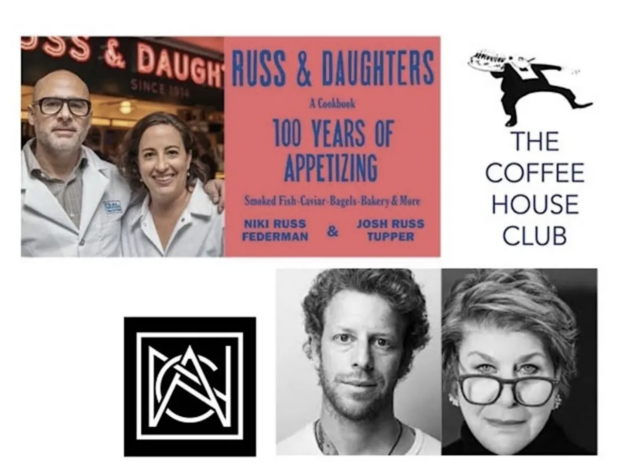
Why: Latkes, matzo ball soup, smoked whitefish chowder, babka, rugelach, black-and-white cookies, bagels — those are only some of the recipes collected in Russ & Daughters: 100 Years of Appetizing (Flatiron, September 9, $39.99). In 1907, Polish immigrant Joel Russ sold Jewish food in a pushcart on the Lower East Side; seven years later he opened J Russ International Appetizers in an Orchard St. storefront before moving in 1920 to 179 East Houston St., changing the name to Russ & Daughters. The business, currently run by cousins Josh Russ Tupper and Niki Russ Federman, the fourth-generation co-owners, expanded to a popular café at 127 Orchard St. in 2014 and has more recently added an outpost near Hudson Yards. The book, a follow-up to 2013’s Russ & Daughters: Reflections and Recipes from the House That Herring Built, by Mark Russ Federman and featuring a foreword by Calvin Trillin, also includes anecdotes and personal reminiscences from the smoked-fish institution’s storied history.

On September 11, Tupper, Niki Russ Federman, and coauthor Joshua David Stein (Notes from a Young Black Chef, The Nom Wah Cookbook) will be at the Temple Emanu-El Streicker Cultural Center for “A Century of Schmears,” a book launch and tasting with James Beard Award–winning food writer and editor Gabriella Gershenson that kicks off the fall Festival of Jewish Ideas & Culture. You don’t have to grab a number when you enter, as tickets are available in advance and come with a copy of the book. You can also livestream the event at home. The book tour then stops at Platform by JBF at Pier 57 on September 14 with Rozanne Gold, the Center for New Jewish Culture in Brooklyn on September 18 with Daniel Squadron, P&T Knitwear on September 20 with a scavenger hunt, walking tours, and more, and the New York City Wine & Food Festival, where Tupper will host a Smoked Fish Master Class on October 19 at the Institute of Culinary Education.

[Mark Rifkin is a Brooklyn-born, Manhattan-based writer and editor; you can follow him on Substack here.]

A DIFFERENT WORLD: A CELEBRATION OF SONGS SHE WROTE

Who: Michael G. Garber, Miss Maybell, Charlie Judkins
What: Book talk with music
Where: Ceres Gallery, 547 West 27th St. between 10th & 11th Aves., #201
When: Thursday, September 11, free with advance RSVP (suggested donation $15), 6:30
Why: “This book celebrates women who wrote popular songs in the early twentieth century. These female composers and lyricists deserved greater opportunities and fame and to be more highly valued. Generations later, the same could be said for many of their sisters in songwriting in the early decades of the twenty-first century. Hopefully, looking at the past will inspire change in the future. To do this, we must travel in our minds back to what was, in effect, a different world.”

So begins historian, professor, scholar, and artist Michael G. Garber’s Songs She Wrote: 40 Hits by Pioneering Women of Popular Music (Rowman & Littlefield, March 2025, $36), an illustrated journey into that different world, focusing on women’s contributions to popular music, including ragtime, jazz, Broadway, and Hollywood. Featuring a foreword by Janie Bradford and Dr. Tish Oney, the book explores such tunes as Lucy Fletcher’s “Sugar Blues,” Lovie Austin and Alberta Hunter’s “The Down Hearted Blues,” Bessie Smith’s “Backwater Blues,” Dorothy Parker’s “Serenade from The Student Prince,” and Billie Holiday’s “God Bless the Child.”

Charlie Judkins and Miss Maybell will perform as part of book event at Ceres Gallery

On September 11 at 6:30, in conjunction with the Tin Pan Alley American Popular Music Project, Garber (My Melancholy Baby: The First Ballads of the Great American Songbook, 1902–1913) will be at the nonprofit feminist Ceres Gallery for a free book talk with live performances by Jazz Age artists Miss Maybell and Charlie Judkins, surrounded by Carlyle Upson’s nature-based “Submerged” watercolors and Marcy Bernstein’s “Evocative Abstractions” paintings, which Bernstein says “invite viewers to look inward. They’re filled with allusions to the raw energy of creation itself,” a fitting sentiment that applies to Garber’s book as well. Admission is free with a suggested donation of $15.

[Mark Rifkin is a Brooklyn-born, Manhattan-based writer and editor; you can follow him on Substack here.]
NOTHING LASTS FOREVER: TRAVELING IN BARDO WITH ANN TASHI SLATER

Ann Tashi Slater will discuss her new book at Rizzoli with Dani Shapiro on September 10

Who: Ann Tashi Slater, Dani Shapiro
What: Book launch with reading, conversation, and signing
Where: Rizzoli Bookstore, 1133 Broadway & West 26th St.
When: Wednesday, September 10, free with advance RSVP, 6:00
Why: “In a world where nothing lasts forever, how do we live?” writer, speaker, and traveler Ann Tashi Slater asks in her new book, Traveling in Bardo: The Art of Living in an Impermanent World (Balance, September 9, $29). Slater will address that question and more at the book launch at Rizzoli on September 10, where she will sit down with Dani Shapiro, author of such books as Signal Fires and Inheritance and host and creator of the podcast Family Secrets and who provided the foreword to the book.

“In my work, I explore how our personal histories and cultural roots shape us and how we find meaning in a world where everything — including we ourselves — changes and ends,” Slater explains on her website. “Traveling in Bardo interweaves explorations of impermanence in relation to marriage and friendship, parents and children, and work and creativity with stories of my Tibetan ancestors and Buddhist perspectives on the fleeting nature of existence, offering a new way to navigate change and live life fully.”

Slater will also give an in-person and virtual talk on September 12 at Columbia’s Weatherhead East Asian Institute with Lauran Hartley and take part in a Q&A and signing on September 16 at Tibet House.

[Mark Rifkin is a Brooklyn-born, Manhattan-based writer and editor; you can follow him on Substack here. Full disclosure: Mark’s wife is Ann Tashi Slater’s literary agent.]

THE LABOR OF LAUNDRY: LYNNE SACHS, LIZZIE OLESKER, AND FRIENDS AT UNNAMEABLE BOOKS

Who: Lizzie Olesker, Lynne Sachs, Silvia Federici, Veraalba Santa
What: Reading and performance
Where: Unnameable Books, 615 Vanderbilt Ave., Brooklyn
When: Monday, September 8, free, 7:00
Why:This is not a play. It is something else. / Call it a blueprint, a map, a documentation / of something that has already happened / but could happen again — / a rendering in book form of a performance. / Making a mark, words on a page instead of bodies in space. / A book that contains what’s remembered and what could be. / All of it written down and placed here, into this / Hand Book: A Manual,” Lizzie Olesker and Lynne Sachs write in the introduction to Hand Book: A Manual on Performance, Process, and the Labor of Laundry (Punctum, June 2025, 425). “We are a playwright and a filmmaker who discovered a shared interest in making work that magnifies quotidian elements of life in the city where we live. We met years ago in Brooklyn while sitting on a bench waiting for our young daughters to finish their music lessons. A conversation began about our lives as mothers and working artists. We couldn’t yet know that those early encounters would lead to a ten-year theater and film collaboration. Now in our sixties, our daughters fully grown, we continue to build an experimental model for making live performance and film, engaging in a dialogue on how art-making can alter our understanding of urban life.”

Olesker, an actor and playwright who has penned such shows as 5 Stages of Grief, A Kind (of) Mother, and Night Shift, and Sachs, a fiction writer and filmmaker who has directed such works as Which Way Is East, Your Day Is My Night, and Film About a Father Who, are the coauthors and codirectors of Hand Book, which Sachs describes as “a collection of writings and images from a performance and film set within a neighborhood laundromat.” In addition to sections by Olesker and Sachs, the illustrated, colorfully designed book (by Vincent W. J. van Gerven Oei) features contributions from Margarita Lopez (“A Thousand Pieces a Day”), Jasmine Holloway (“Taking on a Role”), Stephen Vitiello (“Shake, Rattle, and . . .”), Amanda Katz (“Sound of a Machine Door Closing”), Emily Rubin (“Loads of Prose: From the Beginning”), Veraalba Santa (“Score for a Folding Dance”), and others. The foreword, “A New Refusal and a New Struggle,” is by feminist historian, author, and activist Silvia Federici.

On September 8, Olesker, Sachs, Federici, and Santa will be at Unnameable Books in Brooklyn for a reading and performance. There will also be a reading and signing September 13 at noon at Printed Matter’s NY Art Book Fair
at MoMA PS1 and a performance, reading, and signing September 28 at 2:00 at Torn Page with Tony Torn and Alvin Eng. Sachs continues, “As authors, Lizzie and I along with our many collaborators construct a model for making art about essential work that often goes unrecognized. Turning a page becomes a quasi-cinematic encounter, calling to mind the intimacy of touching other people’s clothes, almost like a second skin, the textural care for things kept close to the body.”

[Mark Rifkin is a Brooklyn-born, Manhattan-based writer and editor; you can follow him on Substack here.]
OEDIPUS REIMAGINED: THE GOSPEL AT COLONUS ON LITTLE ISLAND

Revival of The Gospel at Colonus on Little Island tells story of redemption and retribution (photo by Julieta Cervantes)

THE GOSPEL AT COLONUS
The Amph at Little Island
Pier 55, Hudson River Park at West Thirteenth St.
July 8-26, $10 standing room, $25 seats sold out, 8:30
littleisland.org

One of the grandest theatrical events of the summer is taking place on Little Island, Shayok Misha Chowdhury’s rousing, impassioned adaptation of Lee Breuer and Bob Telson’s The Gospel at Colonus, a spirited, spiritual retelling of the Oedipus and Antigone myths.

In 1983, Obie winner and Mabou Mines founding co-artistic director Breuer (Mabou Mines DollHouse, Peter and Wendy) teamed up with composer Telson (Chronicle of a Death Foretold, Bantú) to reimagine Robert Fitzgerald’s version of Sophocles’s Oedipus at Colonus as a Pentecostal revival meeting. The show debuted at BAM’s Next Wave Festival and was mounted on Broadway five years later, with Morgan Freeman as the Messenger; Oedipus was portrayed by Clarence Fountain and the Five Blind Boys of Alabama.

A tale of witness and testimony, of redemption and retribution, The Gospel at Colonus is a revelation at the Amph, where it begins each night amid the glow of sunset over the Hudson. David Zinn’s set is bathed in red; much of the action occurs in a broken circle in the center surrounding a four-step platform, in front of a yellow foot bridge running between high grass. Stacey Derosier’s lighting, switching from red to green to blue, illuminates Montana Levi Blanco’s loose-fitting purple and sackcloth gray costumes, a combination of Greek togas and Sunday finest. Garth MacAleavey’s sound design allows nature to mingle with the crisp, clear music and dialogue.

Stephanie Berry (On Sugarland, Déjà Vu) is sensational as the Preacher, serving as a kind of narrator and oracle. “Think no longer that you are in command here, / But rather think how, when you were, / You served your own destruction / Welcome, brothers and sisters, / I take as my text this evening the Book of Oedipus,” she announces at the start. “Oedipus! Damned in his birth, in his marriage damned, / Damned in the blood he shed with his own hand! / Oedipus! So pitifully ensnared in the net of his own destiny.”

Stephanie Berry, Davóne Tines, and Frank Senior portray different aspects of Oedipus (photo by Julieta Cervantes)

Oedipus — portrayed as a group by blind jazz vocalist Frank Senior, opera bass-baritone Davóne Tines, and Berry — has already blinded himself for having unknowingly killed his father and married his mother, Jocasta, who then hanged herself, and fathered four children with her, two sons, Eteocles and Polyneices, and two daughters, Antigone (Samantha Howard) and Ismene (Ayana George Jackson). Eteocles is a traitor and Polyneices (Jon-Michael Reese) a usurper, taking opposite sides in an upcoming battle, while Antigone and Ismene seek peace.

“Let every man in mankind’s frailty / Consider his last day; and let none / Presume on his good fortune until he find / Life, at his death, a memory without pain. / Amen,” Evangelist Antigone says.

On his journey, Oedipus encounters Jocasta’s brother, Deacon Creon (Dr. Kevin Bond), the former king, who has been tasked with returning Oedipus to Thebes; a friend (falsetto Serpentwithfeet), who welcomes him to Colonus; Pastor Theseus (Kim Burrell), who vows never to drive him away; and the Balladeer (Brandon Michael Nase), who initially refuses Oedipus and Antigone entry into his church and later questions Testifier Polyneices’s attempt to get back in his father’s good graces.

Kim Burrell rips the roof off the joint several times at Little Island (photo by Julieta Cervantes)

Pulitzer finalist Chowdhury (Public Obscenities, Rheology) beautifully flows Breuer’s poetic dialogue (his book earned him a Tony nomination) into Telson’s gospel, blues, and R&B score, featuring Breuer’s potent, emotional lyrics. (Breuer, who died in January 2021 at the age of eighty-three, and Telson, who at seventy-six is still making music, also collaborated on such other projects as Sister Suzie Cinema, The Warrior Ant, and Bagdad Cafe — The Musical.) “Who is this man? What is his name? Where does he come from?” a choragos (Brandon Michael Nase) demands, as if he could be addressing any of us. “Child, I’m so glad you’re here / There’s hope for me / There’s a prophecy . . . I’ve been waiting for a sign / to ease my troubled mind,” Oedipus (Senior and Tines) sings in “Through My Tears.” Oedipus (Tines) later tells Polyneices, “Once you held the power / And when you did you drove me out / Made me a homeless man / You are no son of mine.” But soon Serpentwithfeet is praying, “Let not our friend go down / In grief and weariness / Let some just God spare him / Any more distress” in “Eternal Sleep.”

Burrell tears the roof off the joint — or she would have if the Amph had a roof — in a pair of rip-roaring numbers, “Jubilee (Never Drive You Away)” and “Lift Him Up,” that gets the crowd moving and grooving, hooting and hollering. Among the other notable songs are “Live Where You Can,” “You’d Take Him Away,” and “Evil,” although the finale, “Let the Weeping Cease,” feels unnecessary. Music directors Dionne McClain-Freeney and James Hall lead a terrific band, consisting of McClain-Freeney on piano, Butch Heyward on organ, Bobby Bryan on guitar, Booker King on bass, Jackie Coleman on trumpet, Taja Graves-Parker on trombone, Jason Marshall and Isaiah Johnson on baritone sax, Kevin Walters on alto sax, and Clayton Craddock on drums; the horns perform on high scaffolds at the corners of the stage nearest the river; the superb James Hall Worship & Praise choir includes Pastor Charles, Schanel Crawford, Jaqwanna Crawford, Jacquetta Fayton, Angie Goshea, Robyn McLeod, TJ Reddick, Teddy Reid, Vischon Robinson, Lenny Vancooten, Eugene Marcus Walker, and Darlene Nikki Washington.

In the closing hymn, Serpentwithfeet declares, “There is no end.” That statement is certainly true of the Greek myth of Oedipus; there is no end to the myriad ways this twisted, heart-wrenching can be told, and The Gospel at Colonus on Little Island is among the most inventive, nourishing the soul for ninety glorious minutes.

[Mark Rifkin is a Brooklyn-born, Manhattan-based writer and editor; you can follow him on Substack here.]
DON’T STOP THAT PIGEON: CELEBRATING JUNE 14 ON THE HIGH LINE

PIGEON FEST
The High Line
Thirtieth St. & the Spur
Saturday, June 14, free, noon – 8:00
www.thehighline.org

What did you do on Saturday, June 14, 2025? It’s looking to be quite a memorable date.

June 14 is Flag Day, when America pays tribute to the Stars and Stripes. Although it’s not a federal holiday, it is, according to Proclamation 1335, signed in 1916 by President Woodrow Wilson, a day “with special patriotic exercises, at which means shall be taken to give significant expression to our thoughtful love of America, our comprehension of the great mission of liberty and justice to which we have devoted ourselves as a people, our pride in the history and our enthusiasm for the political programme of the nation, our determination to make it greater and purer with each generation, and our resolution to demonstrate to all the world its vital union in sentiment and purpose, accepting only those as true compatriots who feel as we do the compulsion of this supreme allegiance.” The flag was approved by the Continental Congress on June 14, 1777.

June 14 is also unofficially known as Cup Day; on June 14, 1994, the New York Rangers ended their fifty-four-year drought and won the Stanley Cup following a tough seven-game series with the Vancouver Canucks. The Broadway Blueshirts won the finale on goals by Brian Leetch, Adam Graves, and captain Mark Messier; Mike Richter stood tall between the pipes.

On June 14, 1969, German tennis champion Steffi Graf was born.

On June 14, 1963, the Soviets launched the manned spacecraft Vostok 5.

On June 14, 1940, the first train carrying Polish prisoners pulled into Auschwitz.

On June 14, 1928, Che Guevara was born.

On June 14, 1811, Uncle Tom’s Cabin author Harriet Beecher Stowe was born.

Oh, also, on June 14, 1946, Donald John Trump was born in Queens.

President Trump has decided to honor his birthday, Flag Day, and the 250th anniversary of the US Army on June 14, 2025, by holding a military parade along the National Mall in Washington, DC, consisting of 6,600 soldiers with historical weapons, 50 military aircraft, 150 vehicles, tanks, helicopters, several dozen horses, and 2 mules; the total cost is expected to be $145 million. There will be protests around the country, from the Women’s March’s “Kick Out the Clowns” to “No Kings” in nearly two thousand congressional districts.

If you’re looking for something different, your best bet might just be Pigeon Fest, a party celebrating Iván Argote’s seventeen-foot-high Dinosaur, a giant pigeon sculpture at the High Line Spur at Thirtieth St. There will be artist talks, workshops, carnival games, music, a puppet show, a pageant, a bazaar, a science fair, and more, with Maria Assis Silva, Julia Rooney, Stephanie Costello, Tina Pina (Mother Pigeon), Machine Dazzle, Jameson Fitzpatrick, Lee Ranaldo, the Bird Is the Word Ensemble, and others.

Below is the complete schedule.

Iván Argote’s Dinosaur is centerpiece of High Line celebration (photo by Timothy Schenck)

The Discovery Fair, with Pop-up Pigeons!, Watercolor Workshop with Food Scraps Ink, the Birdsong Project, the Center for Book Arts, the Cornell Lab of Ornithology, the LES Ecology Center, Lofty Pigeon Books, the Mayor’s Office of Urban Agriculture (MOUA), Monument Lab, Mother Pigeon, NYC Bird Alliance, Pat McCarthy, and the Wild Bird Fund, Eastern Rail Yards, noon – 5:00

Bird Bazaar, with the Coop Carnival, Pigeon Piñata Party, Alternative Monuments for NYC, Pigeon Fan Club, NYPL Bookmobile Station and Storytime, and Best Plants for Birds on the High Line, Coach Passage at Thirtieth St., noon – 5:00

Zumba: Pigeon Dance Party, led by Maria Assis Silva, noon

Mother Pigeon’s Impeckable Puppet Show, 1:00

Pigeon Impersonation Pageant, 2:00

Panel Discussion: Building Bird-Friendly Cities, with Qiana Mickie, Christian Cooper, and Ethan Dropkin, moderated by Richard Hayden, 3:30

Artist Talk: Iván Argote and Cecilia Alemani, 4:15

Musical Concert, with Jameson Fitzpatrick, a string quartet performance by students from the Manhattan School of Music and Juilliard Pre-College Programs, the Bird Is the Word Ensemble organized by Lee Ranaldo, and a special guest headliner, 5:30 – 8:00

[Mark Rifkin is a Brooklyn-born, Manhattan-based writer and editor; you can follow him on Substack here.]