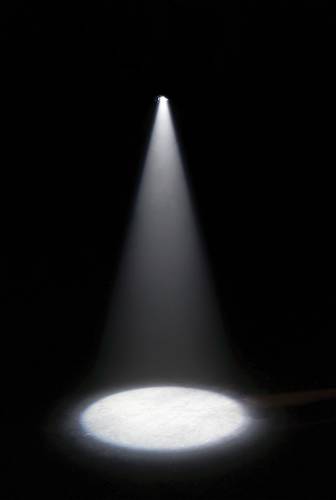
Visitors can exhibit their success and failures at PS 1’s latest Saturday Session (David Lamelas, “Limit of a Projection I,” spotlight in darkened room, 1967, collection Walker Art Center, T. B. Walker Acquisition Fund, 2009)
MoMA PS1
22-25 Jackson Ave. at 46th Ave.
Saturday Sessions free with museum suggested donation of $10 (free with MoMA ticket within thirty days of MoMA visit)
Museum open Thursday through Monday from 12 noon – 6:00 pm
718-784-2084
www.ps1.org
Since the beginning of the year, MoMA PS1 has been hosting “Saturday Sessions,” a series of programs on Saturday afternoons with guest curators putting together special events. On April 2, Triple Canopy and Dalkey Archive Press present “An Afternoon of Failure,” celebrating the release of the Review of Contemporary Fiction’s “Failure” issue, with “attempted readings” by Eileen Myles, Helen DeWitt, Sam Frank, Travis Jeppesen, and Keith Gessen, “mangled covers of pop songs” by US Girls, “a malfunctioning tribute” to American literary classics by Elevator Repair Service, and Derek Lucci trying to resurrect William Gaddis. These works of fiction offer a direct counterpoint to several of the current exhibits at PS1, which turn the concept of participatory reality art and so-called truth inside out and upside down.
In “Only the Lonely” (through August 8), New York-based photographer and filmmaker Laurel Nakadate puts herself front and center as she meets strangers in parking lots and on the road and goes back to these older men’s rooms, taking pictures and videos with them, often involving her shedding much of her clothing. Laced with an overriding fear of potential danger that never happens, Nakadate’s work comments on femininity, loneliness, sexuality, and desire, centering on human contact that is disappearing in this age of social media. The exhibition also features the premiere of her overwhelming “365 Days: A Catalogue of Tears,” comprising photographs Nakadate took of herself crying every day for a year. The pictures line both sides of a long hallway and continue into a back room; just as we all find ourselves watching intensely personal videos posted on YouTube, it is difficult to take your eyes off of these intimate, private, yet clearly staged portraits. Nakadate might bare her body, but she does it with a knowing, tongue-in-cheek candor; interestingly, in her more recent work, she is no longer the main subject, instead directing other women in short films and feature-length narratives.
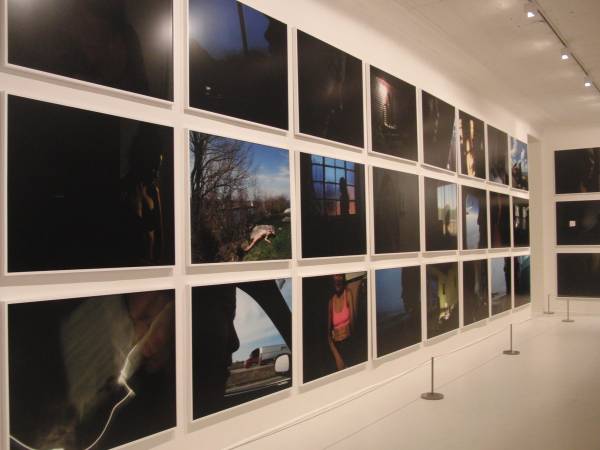
Laurel Nakadate catalogs her tears and more in intimate exhibition at PS1 (photo by twi-ny/mdr)
The viewer becomes more than just the subject in “The Talent Show” (through April 4), a collection of multimedia installations and performance pieces in which some artists let others help create the work, from making a drawing for Adrian Piper’s “Information” to coming up with slogans for Gillian Wearing’s “Signs that say what you want them to say and not Signs that say what someone else wants you to say” to placing the viewer at the center of the work, where they can stand in the spotlight of David Lamelas’s “Limit of a Projection I,” act for the camera while being beamed onto a screen in Peter Campus’s “Shadow Projection,” or posing atop Piero Manzoni’s “Base Magica — Scultura vivente.” Amie Siegel combines YouTube videos of people singing the same song, while Sophie Calle investigates the men and women listed in an address book she found. Presaging reality television, Hannah Wilke documented the last two and a half years of her battle with cancer on film, resulting in a stirring sixteen-channel installation that holds nothing back. PS1 pays tribute to other early female video pioneers in “Modern Women: Single Channel,” comprising seminal work by such cutting-edge artists as Lynda Benglis, Dara Birnbaum, VALIE EXPORT, Joan Jonas, Pipilotti Rist, and Carloee Schneeman, many of whom frequently turned the cameras on themselves well before there was any such thing as American Idol, Survivor, or The Amazing Race. And finally, Feng Mengbo gives the controls over to visitors for “Long March: Restart,” an enormous two-walled video game that mixes Super Mario Bros. and Street Fighter II with Chinese militaristic propaganda imagery, allowing the player to succeed or fail in full view of others.