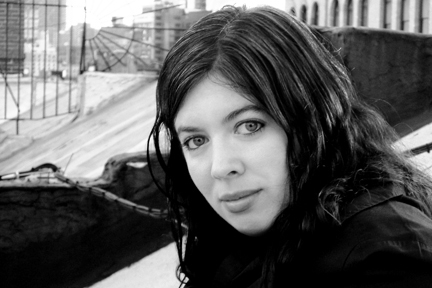
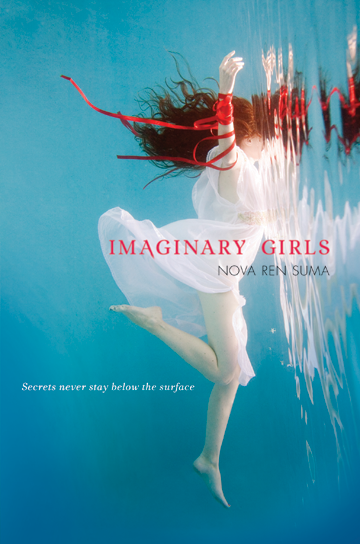
Nova Ren Suma will read from her highly anticipated YA debut, IMAGINARY GIRLS, at twi-ny’s tenth anniversary bash Wednesday night at Fontana’s
Fontana’s
105 Eldridge St. between Grand & Broome Sts.
Wednesday, May 18, free, 7:00 – 9:30
212-334-6740
www.fontanasnyc.com
www.novaren.com
A self-described “easily distracted writer,” “daydreamer,” and “big sister,” New York City-based author Nova Ren Suma is making quite a splash with her debut YA novel, Imaginary Girls (Dutton, June 14, $17.99). Suma agonized over every sentence and every word of the stunning book, resulting in a beautifully written story of the deep bond between two sisters living in upstate New York, not far from where Suma was raised. “Ruby said I’d never drown — not in deep ocean, not by shipwreck, not even by falling drunk into someone’s bottomless backyard pool,” the slightly surreal novel begins. Suma’s first book, the 2009 middle-grade hardcover Dani Noir, was an engaging tale of a thirteen-year-old girl obsessed with film noir, Rita Hayworth, and a suspicious relationship. Suma, a charming young woman who loves talking about music, literature, food, and cats, will be appearing May 23 at the NYC Teen Author Carnival at the Mulberry Street Library, but before that she’ll be giving the first public reading from Imaginary Girls at twi-ny’s tenth anniversary celebration May 18 at Fontana’s, along with Dean Haspiel, Andrew Giangola, and Kyle Thomas Smith and live musical performances from Megan Reilly and James Mastro, Paula Carino and the Sliding Scale, and Evan Shinners. In preparation for the event, Suma chatted with twi-ny about her creative process.
twi-ny: After reading an early draft of Imaginary Girls, I told you not to let your agent or editor change a thing because I found it so beautiful. I’m now poring over an advance reader’s copy, and you have indeed made changes, which make the book even better. You were wise not to listen to me. What was the editing/revising experience like for you, especially when you had so many people lavishing you with praise?
Nova Ren Suma: Imaginary Girls is a surreal novel in which unexplainable things happen, and where reality is in question, which pretty much mirrors my entire experience getting the book published. My agent signed me on just two chapters, sent me off to write more, and then when I had a couple more chapters he quickly sold the novel unfinished to my dream publisher, which meant that I got to work with my editor very early on during the writing of the manuscript. It doesn’t sound real. My editor did say some extremely nice things about those early pages that made me blush, but she also worked me harder than I ever expected, seeing the potential in the story and finding ways to dig it out of me through quite a few revision letters, phone calls, and edit meetings. It was a thrilling, humbling experience to have the help of such a brilliant editor. Even now I suspect that she knows Ruby, one of the main characters, as well as I do. At one point I rewrote about two hundred pages in the middle of the book. At another point I cut about twenty thousand words. I was revising long after I thought I’d be finished. I pulled all-nighters like I haven’t done since college. I laughed, I cried, I wore pajamas out in the street. . . . It was intense. It was also the best experience I’ve ever had writing anything in my life. I love what the book became.
So I have to thank you for not just reading my manuscript at such a rough, raw stage but for saying just the right things. I was about to dive headfirst into a summer and fall of deep revision. I think I really needed that praise to make it through to the other side.
twi-ny: You have a strong online presence, on Facebook, your Distraction no. 99 blog, and other sites, connecting not only with readers but with other teen writers. What are some of the benefits you’ve gained from being part of this growing community of YA authors? What are the drawbacks?
NRS: The YA community online inspires me to no end and I am so grateful to be a part of it — everyone was so welcoming. But it’s also true that all the time spent connecting with other writers and readers and booksellers and bloggers and librarians is time not spent writing. It’s easy to get caught up in being online, to think you need to have a presence on every site, doing every shiny new thing in the way of social networking, and I’m easily swept away by that. I find blogging to be a great way to kick-start my writing — warm up my typing fingers, you know — but sometimes I think longingly of the years before Twitter was invented, wishing I could time-travel back there for a week or two, just to finish this manuscript.
Even so, I do think the benefits outweigh the distractions — at least, we authors have to hope they do. We tell ourselves they do. I happen to believe that if you’re writing for teens in this day and age and you’re not connecting with other authors and readers online, you’re doing yourself a great disservice. Then again, you probably wrote a hundred pages more than I did this month, so what do I know?
twi-ny: You have very eclectic musical tastes. Were there any specific songs or albums that got you going while writing Imaginary Girls? You’re now working on your next novel; has the song list changed for that?
NRS: I write to music, so Imaginary Girls is deeply connected to a series of songs I listened to while writing and revising the book. I often find a song that goes with a certain chapter and then I loop it and play it on repeat whenever I’m working on that particular piece of the manuscript. I play it until the words melt away and I can’t hear them anymore. I’ve been known to play one song over and over again for a week. Imaginary Girls is written in the voice of a sixteen-year-old girl, and the great majority of the songs on the novel’s playlist are sung by women. The first song to make an appearance was “Werewolf” by Cat Power. The first chapter of the book was written to “Hanging High” by Lykke Li — a song my little sister introduced me to. Other songs on the playlist include “Family Tree” by Bellafea, “These White Lights Will Bend to Make Blue” by Azure Ray, “Eighties Fan” by Camera Obscura, “Blinding” by Florence + the Machine, and “Never. Always. Good.” by Today the Moon, Tomorrow the Sun—a song you introduced me to while I was writing the book, if you remember. The only song from my own teenage years that made it to the playlist was an old Jane’s Addiction song, for nostalgia’s sake: “Summertime Rolls.”
As for my next novel — another dark, surreal story . . . but not a sequel — as I write, I build its playlist. Certain sections must be written to certain songs: “Zebra” by Beach House, “Lilac Wine” by Nina Simone, “The Spine Song” by Cake Bake Betty, “Stars” by the Xx. I’m always looking for new music because I never know what piece of the novel a new song might inspire.
twi-ny: As a full-time writer, you now have the freedom to decide when and where you write. So, when and where are your favorite places and times to write? Is it easier or harder to remain disciplined with fewer obligations outside of writing?
NRS: One of my favorite places to write is a particular café downtown. I only like to go in the mornings, before it gets too packed with NYU students. If you’re curious about what the café is, you’ll find it thanked in my book’s acknowledgments. I pick a table against the back wall, near an outlet, order a mocha — they have delicious mochas — and then dive in. The full-time writing life is still very new to me, so I have to treat going to write like I did going to my job. Even though I have a writing desk at home, I only let myself use it at night. I force myself to get up early, put on clothes and not pajamas, leave my apartment, get caffeine, and go to my “office.” That’s the Writers Room in Manhattan, where many other writers work. I like to visit my favorite café before going to the Writers Room because that is the very same routine I had while working my last full-time day job. I used to write in the café every morning before going in to work, so I go there to remind myself. The truth is that it’s harder to stay disciplined when time is so boundless, so if I can trick myself into thinking I don’t have very much time left in the day, I tend to write more.
There are some mornings now when I forget that I’m not supposed to be stopping at a certain point and rushing to the subway to get to work . . . and then reality washes over me: I have all day.
I have all day, I think excitedly. Then comes the weight of it, the responsibility, recalling how much I’ve always wanted this, and that washes over me too: I have ALL day. So I damn well better make good use of it.

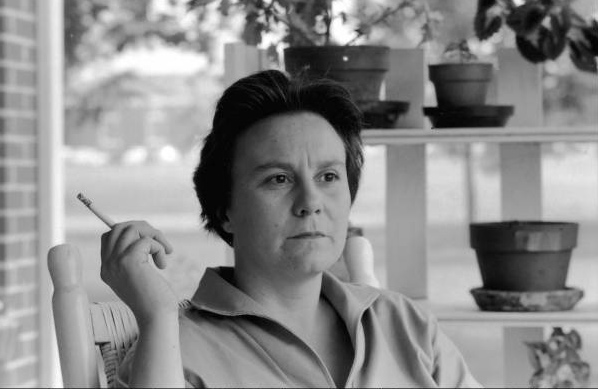
 On May 4, 1961, Harper Lee won the Pulitzer Prize for Fiction for what turned out to be her only novel and an enduring American classic, To Kill a Mockingbird. A captivating tale of racism in a small southern town based on her own, the book was made into a hit film the next year starring Gregory Peck as determined lawyer and single parent Atticus Finch, garnering eight Oscar nominations and three wins, including one for Peck for Best Actor. As famous as the book and film are, very little is known about Lee, who has not given an interview since 1964 and is rarely seen in public. In Hey, Boo: Harper Lee and To Kill a Mockingbird, documentarian Mary McDonagh Murphy sets out to uncover the story behind this mysterious figure. She speaks with Lee’s ninety-nine-year-old sister, Alice; actress Mary Badham, who played Scout in the movie; and Joy and Michael Brown, who helped Lee afford to quit her job as an airline reservation agent so she could concentrate on her book back in the late 1950s. Although they lend insight into Lee’s character and the creation of To Kill a Mockingbird, the rest of Hey, Boo consists primarily of a series of talking heads discussing what the book means to them, coming off more like a PBS special than a feature-length theatrical documentary. Murphy, who has indeed spent most of her career making television documentaries (for PBS, CNBC, and CBS), speaks with Oprah Winfrey, Tom Brokaw, Wally Lamb, Andrew Young, Rosanne Cash, Scott Turow, Richard Russo, James McBride, Anna Quindlen, Allan Gurganus, and other writers, historians, and public figures who discuss various aspects of the book, but it’s mostly filling the time the director — and the viewer — would have rather spent with Lee herself, who declined to participate. Murphy does play excerpts from the 1964 radio interview and reveals interesting tidbits about the editing process Lee and the novel went through, but there’s just not enough new information to sustain the film’s already-brief eighty-two minutes. You’re better off reading the novel again — or for the first time — if you really want to delve into its many wonders.