this week in literature

TWI-NY TENTH ANNIVERSARY TALK: NOVA REN SUMA

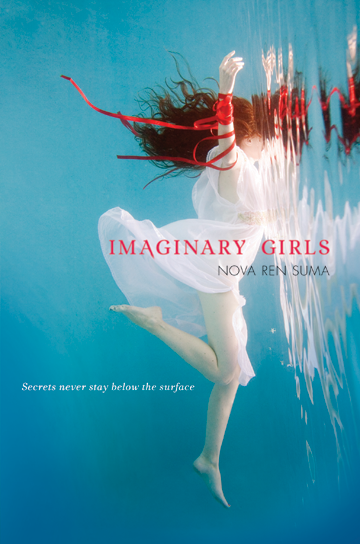
Nova Ren Suma will read from her highly anticipated YA debut, IMAGINARY GIRLS, at twi-ny’s tenth anniversary bash Wednesday night at Fontana’s

Fontana’s
105 Eldridge St. between Grand & Broome Sts.
Wednesday, May 18, free, 7:00 – 9:30
212-334-6740
www.fontanasnyc.com
www.novaren.com

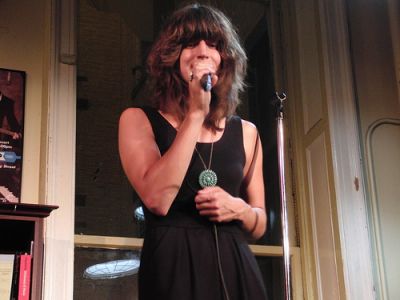
A self-described “easily distracted writer,” “daydreamer,” and “big sister,” New York City-based author Nova Ren Suma is making quite a splash with her debut YA novel, Imaginary Girls (Dutton, June 14, $17.99). Suma agonized over every sentence and every word of the stunning book, resulting in a beautifully written story of the deep bond between two sisters living in upstate New York, not far from where Suma was raised. “Ruby said I’d never drown — not in deep ocean, not by shipwreck, not even by falling drunk into someone’s bottomless backyard pool,” the slightly surreal novel begins. Suma’s first book, the 2009 middle-grade hardcover Dani Noir, was an engaging tale of a thirteen-year-old girl obsessed with film noir, Rita Hayworth, and a suspicious relationship. Suma, a charming young woman who loves talking about music, literature, food, and cats, will be appearing May 23 at the NYC Teen Author Carnival at the Mulberry Street Library, but before that she’ll be giving the first public reading from Imaginary Girls at twi-ny’s tenth anniversary celebration May 18 at Fontana’s, along with Dean Haspiel, Andrew Giangola, and Kyle Thomas Smith and live musical performances from Megan Reilly and James Mastro, Paula Carino and the Sliding Scale, and Evan Shinners. In preparation for the event, Suma chatted with twi-ny about her creative process.

twi-ny: After reading an early draft of Imaginary Girls, I told you not to let your agent or editor change a thing because I found it so beautiful. I’m now poring over an advance reader’s copy, and you have indeed made changes, which make the book even better. You were wise not to listen to me. What was the editing/revising experience like for you, especially when you had so many people lavishing you with praise?

Nova Ren Suma: Imaginary Girls is a surreal novel in which unexplainable things happen, and where reality is in question, which pretty much mirrors my entire experience getting the book published. My agent signed me on just two chapters, sent me off to write more, and then when I had a couple more chapters he quickly sold the novel unfinished to my dream publisher, which meant that I got to work with my editor very early on during the writing of the manuscript. It doesn’t sound real. My editor did say some extremely nice things about those early pages that made me blush, but she also worked me harder than I ever expected, seeing the potential in the story and finding ways to dig it out of me through quite a few revision letters, phone calls, and edit meetings. It was a thrilling, humbling experience to have the help of such a brilliant editor. Even now I suspect that she knows Ruby, one of the main characters, as well as I do. At one point I rewrote about two hundred pages in the middle of the book. At another point I cut about twenty thousand words. I was revising long after I thought I’d be finished. I pulled all-nighters like I haven’t done since college. I laughed, I cried, I wore pajamas out in the street. . . . It was intense. It was also the best experience I’ve ever had writing anything in my life. I love what the book became.

So I have to thank you for not just reading my manuscript at such a rough, raw stage but for saying just the right things. I was about to dive headfirst into a summer and fall of deep revision. I think I really needed that praise to make it through to the other side.

twi-ny: You have a strong online presence, on Facebook, your Distraction no. 99 blog, and other sites, connecting not only with readers but with other teen writers. What are some of the benefits you’ve gained from being part of this growing community of YA authors? What are the drawbacks?

NRS: The YA community online inspires me to no end and I am so grateful to be a part of it — everyone was so welcoming. But it’s also true that all the time spent connecting with other writers and readers and booksellers and bloggers and librarians is time not spent writing. It’s easy to get caught up in being online, to think you need to have a presence on every site, doing every shiny new thing in the way of social networking, and I’m easily swept away by that. I find blogging to be a great way to kick-start my writing — warm up my typing fingers, you know — but sometimes I think longingly of the years before Twitter was invented, wishing I could time-travel back there for a week or two, just to finish this manuscript.

Even so, I do think the benefits outweigh the distractions — at least, we authors have to hope they do. We tell ourselves they do. I happen to believe that if you’re writing for teens in this day and age and you’re not connecting with other authors and readers online, you’re doing yourself a great disservice. Then again, you probably wrote a hundred pages more than I did this month, so what do I know?

twi-ny: You have very eclectic musical tastes. Were there any specific songs or albums that got you going while writing Imaginary Girls? You’re now working on your next novel; has the song list changed for that?

NRS: I write to music, so Imaginary Girls is deeply connected to a series of songs I listened to while writing and revising the book. I often find a song that goes with a certain chapter and then I loop it and play it on repeat whenever I’m working on that particular piece of the manuscript. I play it until the words melt away and I can’t hear them anymore. I’ve been known to play one song over and over again for a week. Imaginary Girls is written in the voice of a sixteen-year-old girl, and the great majority of the songs on the novel’s playlist are sung by women. The first song to make an appearance was “Werewolf” by Cat Power. The first chapter of the book was written to “Hanging High” by Lykke Li — a song my little sister introduced me to. Other songs on the playlist include “Family Tree” by Bellafea, “These White Lights Will Bend to Make Blue” by Azure Ray, “Eighties Fan” by Camera Obscura, “Blinding” by Florence + the Machine, and “Never. Always. Good.” by Today the Moon, Tomorrow the Sun—a song you introduced me to while I was writing the book, if you remember. The only song from my own teenage years that made it to the playlist was an old Jane’s Addiction song, for nostalgia’s sake: “Summertime Rolls.”

As for my next novel — another dark, surreal story . . . but not a sequel — as I write, I build its playlist. Certain sections must be written to certain songs: “Zebra” by Beach House, “Lilac Wine” by Nina Simone, “The Spine Song” by Cake Bake Betty, “Stars” by the Xx. I’m always looking for new music because I never know what piece of the novel a new song might inspire.

twi-ny: As a full-time writer, you now have the freedom to decide when and where you write. So, when and where are your favorite places and times to write? Is it easier or harder to remain disciplined with fewer obligations outside of writing?

NRS: One of my favorite places to write is a particular café downtown. I only like to go in the mornings, before it gets too packed with NYU students. If you’re curious about what the café is, you’ll find it thanked in my book’s acknowledgments. I pick a table against the back wall, near an outlet, order a mocha — they have delicious mochas — and then dive in. The full-time writing life is still very new to me, so I have to treat going to write like I did going to my job. Even though I have a writing desk at home, I only let myself use it at night. I force myself to get up early, put on clothes and not pajamas, leave my apartment, get caffeine, and go to my “office.” That’s the Writers Room in Manhattan, where many other writers work. I like to visit my favorite café before going to the Writers Room because that is the very same routine I had while working my last full-time day job. I used to write in the café every morning before going in to work, so I go there to remind myself. The truth is that it’s harder to stay disciplined when time is so boundless, so if I can trick myself into thinking I don’t have very much time left in the day, I tend to write more.

There are some mornings now when I forget that I’m not supposed to be stopping at a certain point and rushing to the subway to get to work . . . and then reality washes over me: I have all day.

I have all day, I think excitedly. Then comes the weight of it, the responsibility, recalling how much I’ve always wanted this, and that washes over me too: I have ALL day. So I damn well better make good use of it.

TWI-NY TENTH ANNIVERSARY TALK: KYLE THOMAS SMITH

Kyle Thomas Smith will read from his debut novel, 85A, on May 18 at Fontana’s as part of twi-ny’s tenth anniversary celebration

Fontana’s
105 Eldridge St. between Grand & Broome Sts.
Wednesday, May 18, free, 7:00 – 9:30
212-334-6740
www.fontanasnyc.com
www.85anovel.com

“Every detention, every chip of glass piercing my forearm from the inside, every minute the 85A is late drives me that much closer to London.” So begins Kyle Thomas Smith’s harrowing debut novel, 85A (Bascom Hill, August 2010, $14.95), the brutally honest story of Chicago teenager Seamus O’Grady, who is desperate to get out of a city, school, and family that relentlessly beats him down both mentally and physically. Although the plot of the book is not based on Smith’s real life — he was born and raised in Chicago and moved to Brooklyn in 2003, where he currently lives with his partner and cats — the setting is, and he does a marvelous job capturing the heart and soul of the dark underbelly of his hometown over the course of one long day in January 1989. Smith, a passionate, engaging young man with an infectious joie de vivre, has written for websites and magazines including Sentient City: The Art of Urban Dharma, Boston’s Edge, and The Brooklyn Rail, is an ardent Buddhist practitioner and meditator, and is a multidimensional, enthusiastic individual who feels right at home whether at a punk-rock show or a classical music concert, at experimental theater or an opera at the Met. Smith will read from 85A as part of twi-ny’s free tenth anniversary celebration May 18 at Fontana’s, which will also feature readings from Dean Haspiel, Nova Ren Suma, and Andrew Giangola and live performances from James Mastro and Megan Reilly, Paula Carino and the Sliding Scale, and Evan Shinners.

twi-ny: Seamus is a fascinating character who doesn’t quite understand that with actions come consequences, at least not always the desired kind. How much did you play with Seamus’s lack of/dawning self-awareness?

Kyle Thomas Smith: I was always careful to keep Seamus’s naïveté front-and-center. On the one hand, he’s a city kid who coolly assesses every environment he enters. On the other hand, he’s a misfit and a dreamer. He’s in a bad situation at home, he doesn’t have many friends, he’s not learning in school, so he copes by escaping into fantasy. He projects these fantasies on to the wrong people and builds all sorts of castles in the air. I have always been preoccupied with the notion that there are different types of intelligence. Seamus is hopeless when it comes to academics but his imaginative capacities are off the charts. Yet it’s his imaginative intelligence that could also plunge him headlong into an abyss. In order to illustrate that conflict, I had to constantly ground Seamus’s character in “ungroundedness.”

twi-ny: Music plays a key role in 85A, but you have said that the music that inspires Seamus is not the music that inspires you. What music inspired you when you were Seamus’s age, and what music inspires you today?

KTS: Well, when I was Seamus’s age, the music I listened to and the music that inspired me were two different things. In early high school, I let the scene dictate my tastes. So I listened to a lot of Skinny Puppy and Ministry and a lot of their industrial-goth side projects, but inside I was much more drawn to Bauhaus and Joy Division and even softer stuff like the Smiths, Cocteau Twins, and Robyn Hitchcock. But things changed for me when the Pixies’ Surfer Rosa and Jane’s Addiction’s Nothing’s Shocking surfaced. That was incredible shit and it inspired me to abandon what I was supposed to be listening to and go straight for what I wanted. I went way, way, way back to basics at that point and steeped myself in the Stones (pardon my orgasm), Bowie, Lou Reed, John Cale, and Dylan (especially) — my soul was much more in alignment with all of them. I still love them and I still love the Pixies, but I’m more hooked on Miles Davis and Nina Simone these days. My partner is an opera and classical music aficionado, so my ear has become trained on the Brahms and Chopin that he’s always playing. I keep going back in time. I’m afraid I don’t know much about what’s going on in music anymore, though I do like Gnarls Barkley and Danger Mouse a lot. That’s some deep, inventive stuff right there.

twi-ny: You’ve had readings in your native Chicago, where the book is set, as well as in New York City, your adopted hometown. Has reaction to the book been different in each city? Based on your personal experience, what are some of the major differences between the two cities?

KTS: 85A has been well received in New York. Maybe it’s because there’s been too much written about New York already and New Yorkers are sick of always reading about themselves; they want to read about another dynamic American city for a change. And a lot of nostalgic, homesick Chicago transplants in New York tell me how much the book brings them back.

As for Chicago itself, I can’t tell you how over the moon I was when the Chicago Tribune gave 85A a great review. It was one of those hometown-boy-makes-good experiences. But Chicago is another kettle of fish. It’s an extremely proud city, and people in its music, lit, and art scenes can be incredibly territorial. I recently saw a spot-on documentary about Chicago’s 80s punk scene called You Weren’t There. The title perfectly sums up that chest-thumping, I-was-there-you-weren’t attitude that some people still cop to this day. And that attitude was on flagrant display on this one major Chicago website that posted a poorly written review of 85A that bashes Seamus and completely misrepresents the book. It set off a shit-storm of parochial, internecine comments from people who admitted that they’d never even read 85A. The day it was posted, I had just come to town and was supposed to do a reading at Quimby’s Books the following night. I had no idea how I was going to get through it. But when I got up in front of the audience, a more confident spirit overtook me and people couldn’t have been more receptive to what I was reading. So . . . Chicago can be a tough crowd but it can give a lot of love too.

The difference between the two cities — that’s a damned good question. Chicago winters are never easy, but I never knew why they got such a bad rap until I first moved to New York and then went home for a visit. Holy witch’s tit in a steel bra! How I got through daily life for so many years in that town I have no idea. I like Chicago’s modern architecture better, but New York and Chicago are both world-class cities with some of the best cultural offerings on the planet. Many New Yorkers who have moved to Chicago say they don’t miss New York at all. They say they have just as good a time in Chicago and it’s much cheaper and more manageable. I would probably see Chicago the same way if I wasn’t from there, but there just seems to be more here and you never know what you’re going to stumble upon next when you explore New York neighborhoods, no matter how long you’ve lived in its boroughs.

TWI-NY TENTH ANNIVERSARY TALK: DEAN HASPIEL

Dean Haspiel will participate in twi-ny’s tenth anniversary celebration on May 18 at Fontana’s (photo by Seth Kushner)

Fontana’s
105 Eldridge St. between Grand & Broome Sts.
Wednesday, May 18, free, 7:00 – 9:30
212-334-6740
www.fontanasnyc.com
www.deanhaspiel.com

For more than two decades, Dean Haspiel has been a comic book force all his own. A wildly talented and gregarious writer, illustrator, promoter, creator, and organizer, Dino works nonstop to build up his own expansive resume as well as the industry itself. In February 2006, he started ACT-I-VATE, a web-based comics collective that features such series as Josh Neufeld’s “Lionel,” Kevin Colden’s “Fishtown,” Nick Bertozzi’s “Iraq War Stories,” and his own “Billy Dogma” and “Street Code,” the latter a terrific semiautobiographical tale set in New York City, where Dino was born and raised. Along the way, he has collaborated on prestigious projects with Harvey Pekar (American Splendor, The Quitter), Jonathan Lethem (Back on Nervous St.), Michael Chabon (The Escapist), and Jonathan Ames (The Alcoholic), and he contributes drawings and illustrations to Ames’s HBO cable series Bored to Death, which features Zach Galifianakis playing a character inspired by Haspiel’s real life.

On May 14, Ames and Haspiel will be honored at the “100 Works on Paper” benefit at Kentler International Drawing Space in Red Hook, where attendees donate $200 and go home with an original work of art. On May 18, the Emmy-winning Haspiel will be presenting a new Street Code comic as part of twi-ny’s tenth anniversary celebration at Fontana’s, which will also feature readings from Nova Ren Suma, Andrew Giangola, and Kyle Thomas Smith and live performances from James Mastro and Megan Reilly, Paula Carino and the Sliding Scale, and Evan Shinners.

twi-ny: You’ve collaborated with such talented writers as Harvey Pekar, Jonathan Lethem, Michael Chabon, and Jonathan Ames; who is your next dream collaborator?

Dean Haspiel: I’ve been itching to collaborate with author Tim Hall on an original graphic novel and we have something planned. I’d also like to collaborate with mystery writer Joe R. Lansdale on adapting his brilliant Hap and Leonard characters into comics form. Plus, I don’t think my career would feel satisfactory if I hadn’t collaborated with some of my favorite comic book writers, the likes of Mark Waid, J. M. DeMatteis, and a handful of others.

twi-ny: Who is your favorite character to draw, whether created by you or another artist?

DH: My favorite characters to draw are my creator-owned Billy Dogma & Jane Legit. But I love drawing Stan Lee and Jack Kirby’s the Thing from the Fantastic Four, and I was recently afforded the opportunity to write and draw a short Thing story in an upcoming issue of Marvel Comics’ Strange Tales sequel.

Jane Legit shows her love for Billy Dogma in Dean Haspiel’s “Bring Me the Heart of Billy Dogma,” from THE ACT-I-VATE PRIMER

Jane Legit shows her love for Billy Dogma in Dean Haspiel’s “Bring Me the Heart of Billy Dogma,” from THE ACT-I-VATE PRIMER

twi-ny: On Bored to Death, Zach Galifianakis’s Ray Hueston character is based on you. Is it easy to watch him, or does it hit a little too close to home?

DH: The Ray Hueston character on Bored to Death is loosely based on some events that happened to me, but I don’t think Zach Galifianakis was subjected to a parallax view of my life and my behavioral traits by any stretch of the imagination. So, I can safely declare that Zach and Jonathan Ames have wholly created Ray from spirited, albeit inspired, cloth. However, I was recently privy to the filmmaking of a certain scene in the upcoming season and I remarked how bizarre it was to watch my proposed doppelganger play out an important event, something I never got the opportunity to do in my own life, and how frustrating yet weirdly cathartic that was for me.

twi-ny How do you find the time to do all the things you do, including serving as a relentless promoter of the comics industry?

DH: Don’t even get me started. If everyone on their chosen social networking sites would just share what they liked with the simple click of a button rather than whine about this and that and publish what they had for lunch, I might be able to shrug off my self-imposed burden to cheer what is good and, instead, produce more stories and eat dinner before ten pm with the people I love to spend time with. Alas, the internet accesses a dark gene in humanity that encourages some folks to constantly complain and act like jerks and do things they wouldn’t dare do in front of real people. I don’t do anything that we all couldn’t do together if we just took a minute to think straight and understand our information and entertainment values.

HEY, BOO: HARPER LEE AND TO KILL A MOCKINGBIRD

The inside story behind Harper Lee and TO KILL A MOCKINGBIRD still remains elusive in HEY. BOO (photo by Donald Uhrbrock)

HEY, BOO: HARPER LEE AND TO KILL A MOCKINGBIRD (Mary McDonagh Murphy, 2010)
Quad Cinema
34 West 13th St.
Opens Friday, May 13
212-255-2243
www.firstrunfeatures.com/heyboo
www.quadcinema.com

On May 4, 1961, Harper Lee won the Pulitzer Prize for Fiction for what turned out to be her only novel and an enduring American classic, To Kill a Mockingbird. A captivating tale of racism in a small southern town based on her own, the book was made into a hit film the next year starring Gregory Peck as determined lawyer and single parent Atticus Finch, garnering eight Oscar nominations and three wins, including one for Peck for Best Actor. As famous as the book and film are, very little is known about Lee, who has not given an interview since 1964 and is rarely seen in public. In Hey, Boo: Harper Lee and To Kill a Mockingbird, documentarian Mary McDonagh Murphy sets out to uncover the story behind this mysterious figure. She speaks with Lee’s ninety-nine-year-old sister, Alice; actress Mary Badham, who played Scout in the movie; and Joy and Michael Brown, who helped Lee afford to quit her job as an airline reservation agent so she could concentrate on her book back in the late 1950s. Although they lend insight into Lee’s character and the creation of To Kill a Mockingbird, the rest of Hey, Boo consists primarily of a series of talking heads discussing what the book means to them, coming off more like a PBS special than a feature-length theatrical documentary. Murphy, who has indeed spent most of her career making television documentaries (for PBS, CNBC, and CBS), speaks with Oprah Winfrey, Tom Brokaw, Wally Lamb, Andrew Young, Rosanne Cash, Scott Turow, Richard Russo, James McBride, Anna Quindlen, Allan Gurganus, and other writers, historians, and public figures who discuss various aspects of the book, but it’s mostly filling the time the director — and the viewer — would have rather spent with Lee herself, who declined to participate. Murphy does play excerpts from the 1964 radio interview and reveals interesting tidbits about the editing process Lee and the novel went through, but there’s just not enough new information to sustain the film’s already-brief eighty-two minutes. You’re better off reading the novel again — or for the first time — if you really want to delve into its many wonders.

TWI-NY TENTH ANNIVERSARY TALK: ANDREW GIANGOLA

Mario Batali, Andrew Giangola, and Rachael Ray party it up at Texas Motor Speedway

Mario Batali, Andrew Giangola, and Rachael Ray party it up at Texas Motor Speedway

Fontana’s
105 Eldridge St. between Grand & Broome Sts.
Wednesday, May 18, free, 7:00 – 9:30
212-334-6740
www.fontanasnyc.com
www.theweekendstartsonwednesday.blogspot.com

We’ve known Andrew Giangola since we were kids, playing baseball in the street, sledding down what we thought were enormous hills in the local park, and going to semipro football games. Although New York is far from the center of the auto racing world, we did go to the track once, when a cigar-chomping family friend took us behind the scenes and into the pit. That apparently rubbed off on Giangola, who was the director of communications for NASCAR for nine years, traveling around the country chaperoning star drivers and meeting the fans. Last February he turned his adventures into an entertaining book, The Weekend Starts on Wednesday: True Stories of Remarkable NASCAR Fans, which looks at dozens of NASCAR’s most dedicated fanatics, from movie icons and beauty queens to military heroes and astronauts, from news anchors and celebrity chefs to an acrophobic mountain climber and a dude who wears nothing but a tire.

“After sleeping in their buses, watching races in their homes, spending countless hours on the phone, sitting in the grandstands, and walking campgrounds on the circuit,” Giangola writes in the introduction, “I’m convinced NASCAR’s ‘core’ fans are a special, different breed…. I want to perpetuate a new stereotype of NASCAR fans. They are, at their core, very good people.” Giangola, who lives in New York City with his wife, daughter, and dog — and whose last driving ticket was for going zero miles per hour, blocking the box at the Holland Tunnel — will read from The Weekend Starts on Wednesday as part of twi-ny’s free tenth anniversary celebration May 18 at Fontana’s, which will also feature readings from Dean Haspiel, Nova Ren Suma, and Kyle Thomas Smith and live performances from James Mastro and Megan Reilly, Paula Carino and the Sliding Scale, and Evan Shinners.

twi-ny: You grew up on the South Shore of Long Island, not exactly a hotbed of auto racing. You’ve always been a huge sports fan, but tell the truth — what did you think of NASCAR when you first applied for the position, and how do you feel about it now?

Andrew Giangola: Your father took us to a stock car race at the old short track in Freeport, LI, when I was eleven and I loved it. (That track is now a strip mall.) I also watched [Richard] Petty and [David] Pearson and [Cale] Yarborough on Wide World of Sports when NASCAR snippets were shown between Ping-Pong and cliff diving. When I was exposed to the sport, I always liked it. But growing up on Long Island in the ’70s, you didn’t see a lot of NASCAR; the sport might as well have been racing on Mars. There was no ESPN or 24/7 sports coverage. I was by no means a fan.

When I got the job offer, after a quick web search it was pretty clear pretty fast that this was a big, powerful brand with a lot of company involvement. My real shock was at the first race; it happened to be Talladega, NASCAR’s biggest and rowdiest track, in the heart of Alabama. I was wearing black slacks and a black shirt. A fan gripping a large beer yells down from the top of his converted school bus, “When are the aliens coming?” It was immediately clear NASCAR fans were familiar with the film Men in Black and that I’d need to learn the rules of the road, so to speak. Seven years later, I was sleeping with those fans — not in the biblical sense; it was research — and published The Weekend Starts on Wednesday about the most amazing fan stories.

weekend starts 2

twi-ny: You’ve worked in communications for Pepsi and Simon & Schuster, spent nine race seasons at NASCAR, and now are brand new at IMG. What was the hardest part of the NASCAR job? You’re also a wise-ass who was once championed as the savior of the PR business. How do you get away with your sarcastic sense of humor at such giant, serious companies?

Andrew Giangola: I’m not sure anyone ever championed me as a savior but that’s awfully nice of you to say, and please let me introduce you to my new boss. At NASCAR, I really had a blast. Workplace humor is a dicey proposition. You have to pick and choose your spots and make sure you’re overdelivering, because a comedian who puts up weak numbers is nothing but a liability. Of course, we dealt with some serious issues at NASCAR. It’s such a decentralized, multifaceted industry. You have NASCAR the sanctioning body, teams, tracks, drivers, sponsors, licensees, media partners. In a sense, in my job in PR out of NASCAR’s New York office, I had to serve them all. It kept a man busy. I literally wore out about five BlackBerries. (When I left, I offered to donate one to the NASCAR Hall of Fame; no one got back to me.) My daughter, Gaby, once said, “If work were crack, you’d sell me for a bag of it.” The toughest challenge was keeping some semblance of family balance while attempting to make every man, woman, child, and dog in the US of A a stock car racing fan.

twi-ny: You’re a die-hard Rangers fan, but you’ve claimed on your blog and in the book that NASCAR fans are the greatest in the world. Is that a diss to the Garden Faithful?

Andrew Giangola: When the Rangers play on Saturday night, do the fans start sleeping in front of the Garden on a Wednesday? That’s what it’s like in NASCAR. But I think Ranger fans and NASCAR fans have a lot in common in their tremendous passion for their sports. (Go to a NASCAR track like Pocono Raceway or Dover and you’ll see a lot of cops and firemen in the infield who are big Ranger fans.) Remember, on any given Sunday in NASCAR there’s one winner and forty-two losers. Ranger fans can relate to that continual, gut-wrenching, seemingly endless heartbreak. All that said, I still tell my wife, Viviane, that the day we were married was almost as good as that warm night in June of 1994 when the Rangers finally won the Stanley Cup.

FRAN REISNER: THE DOGS OF CENTRAL PARK

Saturday, May 14, under the loggia at the Dairy Visitor Center, Central Park, East Drive and 65th St., free, 12 noon – 2:00
Saturday, May 14, Fetch Bar & Grill, 1649 Third Ave at 93rd St., free, 4:00 – 6:00
www.thedogsofcentralpark.com

“Let Maine have its moose and Florida its manatees!” writes Parks commissioner Adrian Benepe in the preface to Fran Reisner’s The Dogs of Central Park (Rizzoli Universe, May 2011, $19.95). “In the heart of Manhattan, it takes a dog to understand the beauty of autumn leaves, the thrill of new-fallen snow, and the promise of flowers on a rainy spring day.” The Dogs of Central Park features nearly 150 photographs of all kinds of breeds playing, posing, and relaxing in such park locations as the Mall, Belvedere Castle, the Boat House, the Great Lawn, Bethesda Fountain, Conservatory Gardens, the lake, and Cedar Hill. Reisner had been in New York City only twice before an assignment brought her here and she went to Central Park, where, she writes, “What I saw as I crested the first hill on my path was unforgettable: dogs, everywhere! Big dogs, little dogs, and many breeds I’d never seen before.” In the occasional text, Reisner relates brief stories of various canines, including the rescued Obie and Toby, the world-traveling Lenny, the three-legged Scheki, Best in Show couple Mikimoto and Gem, and the hat-munching Brinkley. There will be two special events on Saturday, May 14, celebrating the release of the book. Reisner will be signing copies under the loggia at the Dairy from 12 noon to 2:00, with all dogs welcome, but they have to be left at home for the 4:00 book party at Fetch Bar & Grill. Each gathering will include a raffle for a Central Park photo shoot with Reisner; part of the proceeds from the Dairy event will benefit the North Shore Animal League, with Animal Haven benefiting from the Fetch party. (Winners must be present to claim their prize.)

NEW YORK GALLERY WEEK 2011

William Kentride will be signing books at Marian Goodman on Saturday as part of New York Gallery Week (William Kentridge, “Drawing for ‘Other Faces,’” charcoal and coloured pencil on paper, 2011; courtesy of the artist and Marian Goodman Gallery, New York / Paris)

Multiple locations
May 6-8, free
www.newyorkgalleryweek.com

More than sixty galleries and organizations will be participating in this weekend’s New York Gallery Week festivities, featuring a host of opening receptions, walking tours, and other special events, including being open late Friday night (till 8:00) and all day Sunday, when most galleries are closed. Among the many Saturday highlights are William Kentridge signing books at Marian Goodman from 11:00 to 1:00, Barnaby Furnas and Ivan Witenstein in conversation at Derek Eller at 12 noon, Amy Granat/Cinema Zero and a dance performance by Felicia Ballos at Nicole Klagsbrun at 1:00, an artist talk with Sara VanDerBeek at Leo Koenig at 2:30, the panel discussion “New Directions in Curatorial Models” at Sean Kelly at 3:00, and a live performance by Black Lake at David Nolan at 5:00. On Sunday, Louise Lawler’s Birdcalls will be screening at Metro Pictures from 11:00 to 6:00, Marianne Boesky will host a panel discussion on Salvatore Scarpitta’s “Trajectory” at 12 noon (with Germano Celant, Nicholas Cullinan, James Harithas, Jeff Koons, Nancy Rubins, and Paul Schmmel, moderated by Anne-Marie Russell), Hilton Als and Kara Walker will lead an artist walk-through of Walker’s “Dust Jackets for the Niggerati — and Supporting Dissertation” at Sikkema Jenkins at 2:00, Liam Gillick and Sean Landers will lead a walk-through of Landers’s “Around the World Alone” at Friedrich Petzel at 3:00, and Stephen Vincent will give a talk and poetry reading at Jack Hanley at 6:00.