featured

INFINITE LIFE

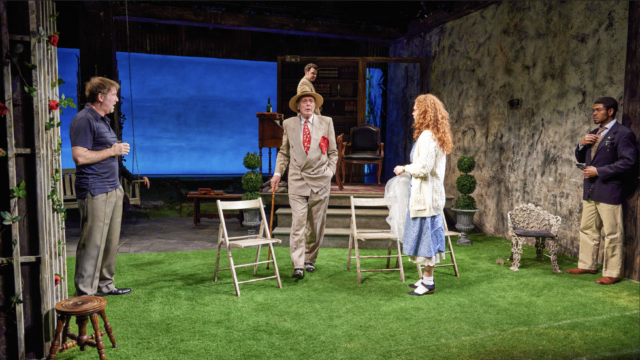
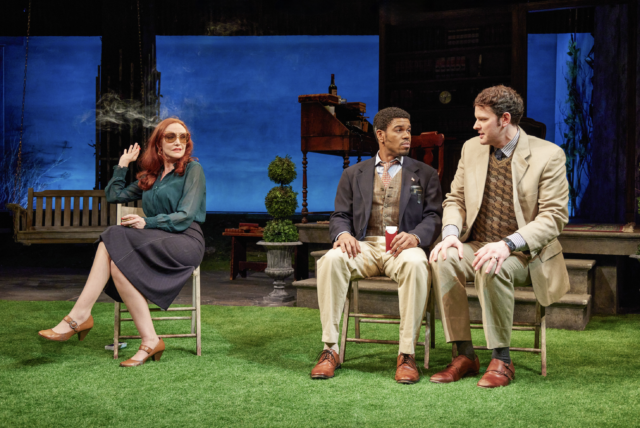
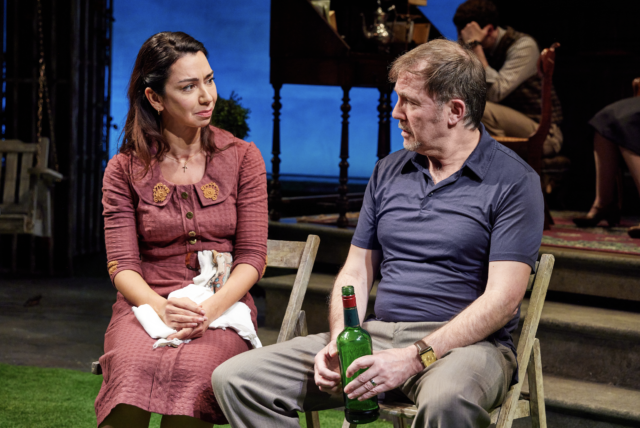
Annie Baker’s Infinite Life takes place at a pain clinic in Northern California (photo by Ahron R. Foster)

INFINITE LIFE
Atlantic Theater Company
Linda Gross Theater
336 West 20th St. between Eighth & Ninth Aves.
Tuesday – Sunday through October 14, $50-$127
atlantictheater.org

“This is agony in its purest form,” Eileen (Marylouise Burke) says in Pulitzer Prize winner Annie Baker’s exquisite new play, Infinite Life, which opened this week at the Atlantic. “A minute of this is an infinity.”

It is never agony watching anything by Baker, whose previous wide-ranging and insightful works include The Flick, Circle Mirror Transformation, The Antipodes, John, and The Aliens. She made her off-Broadway debut at the Atlantic in 2008 with Body Awareness, about which she told the New York Times, “My goal for the play is to not judge anyone, to get at that point where everyone is equally right and equally wrong, so the humor comes from that.” The same can be said for Infinite Life, about six characters who are deeply aware of their bodies, riddled with pain.

The play takes place in 2019 at a Northern California clinic run by an unseen man named Erkin, who treats chronic pain sufferers, mainly women, with water or juice fasts for days or weeks at a time. Eileen, Yvette (Mia Katigbak), Ginnie (Kristine Nielsen), and Elaine (Brenda Pressley) spend most of their time lying on deck chairs and gossiping, but this is no day at the beach. When they are joined by younger newcomer Sofi (Christina Kirk), they are intrigued and pepper her with questions; at first Sofi doesn’t want to share too much but soon reveals more, which tickles the other women’s curiosity. She is reading George Eliot’s final novel, Daniel Deronda, which deals with culture and identity, class and morality, centered by a seemingly heroic male figure and written by a woman who had to pretend she was a man in order to get published.

Eileen (Marylouise Burke) and Sofi (Christina Kirk) discuss life in Atlantic world premiere (photo by Ahron R. Foster)

Ginnie is a flight attendant from the local area who has “auto-immune thyroid stuff,” vertigo, and no filter, freely discussing pornography, carbonation, cantaloupes, rape, and how many sphincters humans have. Elaine, from New Hampshire, is a grandmother who has chronic Lyme disease and likes to draw. Yvette is a Michigander who is in surprisingly good spirits given her severe bladder issues and other health problems. Eileen, the oldest, is a Christian from Wichita who doesn’t appreciate cursing and walks very slowly, her constant pain palpable.

The women are thrown off balance when Nelson (Pete Simpson) arrives, a hunk of a fortysomething man, barefoot and bare-chested, surrounded by an air of mystery. “Who’s Daniel Deronda?” he asks Sofi. “Yeah, I think he’s actually the main character — we met him at the very beginning of the book — but he hasn’t reappeared yet so I don’t know that much about him.” The two of them build a flirtatious relationship that somewhat echoes Eliot’s book as each of the characters delve deeper into their personal situations.

A coproduction with London’s National Theatre, Infinite Life is not just about pain; it specifically focuses on the psychological, emotional, and physical pain inflicted on women by society. When Nelson ultimately shares his illness with Sofi and describes his most painful night, he explains, “I don’t know if you’ve been through childbirth but I met this lady who had the same thing happen to her and she said it was way worse than childbirth.” Sofi, who does not have children, replies, “You don’t actually know if your level of pain that night was worse than my level of pain on my worst night. It’s like impossible to know.” It’s also insulting for a man to compare his pain to a woman’s; Sofi later tells Eileen, “You know, I always feel like I’m lying when I say I’m in pain,” as if it’s just part of her existence that she has to accept. But Eileen counters, “The pain is an error. . . . We have to resist pain because resisting pain is resisting what isn’t true. The only true thing is the Infinite Idea, forever repeating itself.”

Earlier, in one of the many voice messages Sofi leaves for her silent husband, she says, “You must think I’m a monster. Maybe I am a monster. My body is monstrous. My mind is monstrous. So I’m a monster. Congratulations. You married a monster.” In Daniel Deronda, the protagonist, Gwendolen Harleth, argues, “People talk of their motives in a cut and dried way. Every woman is supposed to have the same set of motives, or else to be a monster. I am not a monster, but I have not felt exactly what other women feel — or say they feel, for fear of being thought unlike others.” Eliot’s novel might be set in Victorian England, but the sentiments still ring true today regarding societal expectations of women.

Yvette (Mia Katigbak) shares her astounding health history in Infinite Life (photo by Ahron R. Foster)

Director James Macdonald (Cloud Nine, The Children, Escaped Alone) masterfully guides each scene with with an intoxicating confidence that illuminates every moment. The comfy set by dots features seven chaises longues, ensuring that at least one is always empty, leading audience members to wonder what it would like to occupy one. Ásta Bennie Hostetter’s costumes are casual but not relaxed; only Ginnie and Nelson are dressed as if they are poolside, while the others are fully clothed and wear shoes. Isabella Byrd’s sharp lighting delineates the time of day, with Sofi calling out the shifts: “Twenty minutes later,” “Five hours later,” “Two days later. Maybe three days later?” Bray Poor’s sound includes crickets in the background, as if no one is listening to the women’s problems.

The fantastic cast is led by Kirk (Clybourne Park, Knickerbocker), who mixes sadness with a certain sex appeal, and Burke (Ripcord, True West), whose character offers a moving epiphany at the end. Katigbak (Out of Time, Awake and Sing!) and Nielsen (Gary: A Sequel to Titus Andronicus, Vanya and Sonia and Masha and Spike) give their characters a poignant warmth and charm, while Pressley (The Lyons, Dreamgirls) brings a strong practicality to Elaine. Simpson (Is This a Room, Measure for Measure) clearly relishes his role as the easygoing object of desire.

“I had to accept being in pain all the time,” Yvette says early on, as if speaking for all women. That acceptance, passed on from generation to generation, is questioned by Baker in the gorgeous finale, which, if it doesn’t promise relief, at least promises a more generous way to hold our human suffering.

[Mark Rifkin is a Brooklyn-born, Manhattan-based writer and editor; you can follow him on Substack here.]
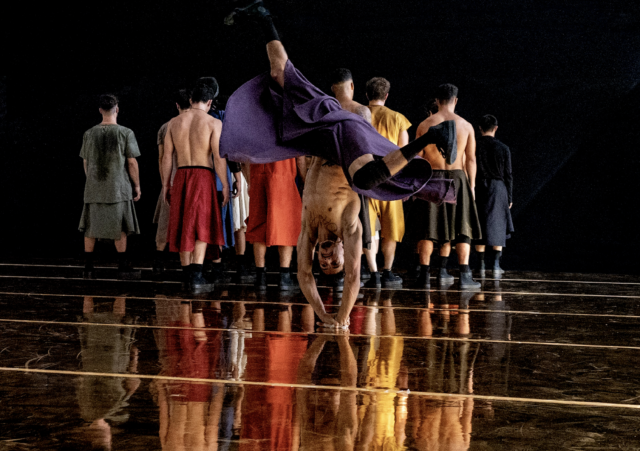
REMEMBERING EVERY NIGHT

Chizu (Kumi Hyodo) tries to find her path in Yui Kiyohara’s Remembering Every Night

REMEMBERING EVERY NIGHT (Subete no yoru wo omoidasu) (Yui Kiyohara, 2022)
Film at Lincoln Center, EBM Film Center (FBT)
144 West Sixty-Fifth St. at Amsterdam Ave.
September 15-21 (two-for-one pricing with Our House)
www.filmlinc.org

Yui Kiyohara’s sophomore feature, Remembering Every Night, is a gentle, tender tale of loss and loneliness, of what can go missing in life.

An offbeat band rehearses in a park. Two children get their shuttlecock stuck in a tree. An elderly man can’t find his way home. An old woman gives a young acquaintance a bag of out-of-season mandarins. Cars travel on small roads and bigger streets.

A student pedals north on a two-way, six-lane thoroughfare as vehicles proceed in the opposite lane, soft, soothing music playing on the soundtrack. When those lanes are empty and the student is a mere blip, a series of cars move in the other direction, following the cyclist, but all in the center lane. The passage is lined on either side by lush green trees; in front, a city looms. It’s a beautiful metaphor for people looking to the past or heading straight into the future, as a group or individuals searching for their own paths as nature holds sway over the modern world.

The deeply poetic and comforting film unfolds over the course of one day, following three single women who live in Tama New Town, a Tokyo satellite city that opened in 1971 as Japan’s largest residential development and currently has a population of two hundred thousand.

Forty-four-year-old Chizu (Kumi Hyodo) is a kimono dresser trying to find a job. Thirty-three-year-old Sanae (Minami Ohba) works as a meter reader. And twenty-two-year-old Natsu (Ai Mikami) is finishing up at university.

Fumi (Guama Uchida) and Natsu (Ai Mikami) recall a friend in Remembering Every Night

Chizu gets a card in the mail announcing that friends have relocated and decides to pay them a visit after stopping off at an employment agency, where she is seeking fulfilling work involving a community component. It’s her birthday, but she has no one to celebrate with; she soon gets lost but doesn’t panic.

On her daily rounds walking around the apartment complexes, Sanae, who carries binoculars with her to look closer at nature, is told by an old woman that an elderly man, Mr. Takada (Tadashi Okujno), has gone missing. The old woman tells Sanae how much better it was years ago, when there’d be lots of parents picking up their kids and plenty of fun parties. “Nowadays, we rarely even see our neighbors. It’s quite sad,” she says.

In a park, Natsu dances by herself to music; in the distance, Chizu playfully mimics her movement, as if she’s dancing with her. Natsu then rides her bicycle to the house where a childhood friend of hers, Dai, used to live. Dai has passed away; Natsu offers Dai’s mother a receipt for photographs Dai took that are ready to be picked up, but the mother says Natsu should have the pictures instead.

Natsu and her best friend, Fumi (Guama Uchida), ride over to an exhibit of ancient figurines and pottery from forty-five hundred years ago that have been excavated from the area where Tama New Town is. Discussing time and memory, Fumi explains, “This area was well populated, wasn’t it?” She adds, “It was a new residential area back then. These artifacts were made by the previous inhabitants. The new people didn’t know that the figurines meant. No writing, no records of anything. Just these clay figurines. Yes, that’s all that’s left of them.” The implications are what will the current inhabitants leave behind, especially as they grow more separate from one another and communicate via cellphones, without handwritten letters and printed photos.

Remembering Every Night moves at the languid pace of life; no one is in a hurry to get anywhere. The three protagonists ride bicycles, take buses, and walk. They occasionally pass each other by without knowing it.

Writer-director Kiyohara, who lived in Tama New Town when she was a child, wrote the film during the pandemic, deciding to explore feelings of separation and isolation and the sudden physical distance between people. She and cinematographer Yukiko Iioka let the camera linger on its subjects, often for a few seconds after the characters have left the scene, making them equal with trees, buildings, and roads. Editor Azusa Yamazaki keeps cuts to a minimum in favor of long shots with relatively rare zooms, pans, and close-ups.

Hyodo, Ohba, and Mikami are wonderful as the three women, who could essentially be the same person at three different stages of life; when they do pass by each other, it’s as if their present is reflecting on their past and future. Their performances contribute to the film’s balance of the elegiac and the celebratory.

The soft, warm score is by Jon no son and ASUNA, the band in the park at the beginning of the film. Their easygoing attitude sets the tone for the narrative; when one member sees that her handheld Casio is missing a key, the drummer eagerly says, “Just play without it,” and she does, with an infectious laugh. They haven’t determined the setlist for their gig the next day and admit that their jam needs help; speaking about the last part of the song, one member says, “It’s missing in action.” The keyboardist says with a smile, “We need a search party for that third line.” Then one woman has to leave to go to work, and another has to go home because a repairman is coming by to fix his air conditioner.

It all serves as a prelude for what’s to come, how humans make do with what’s thrown at them, fix what needs to be fixed, and prosper more as a group than as isolated individuals. “We’ll be fine,” one of the band members says as the camera slowly pans away, gliding past someone exercising their hands on a bench, then focusing on trees and plants as the title comes onscreen and life goes on.

Remembering Every Night opens September 15 at Lincoln Center, which is offering a two-for-one deal with Kiyohara’s first film, 2017’s Our House, which deals with female friendship, a missing father, and parallel lives.

[Mark Rifkin is a Brooklyn-born, Manhattan-based writer and editor; you can follow him on Substack here.]
BIOADAPTED

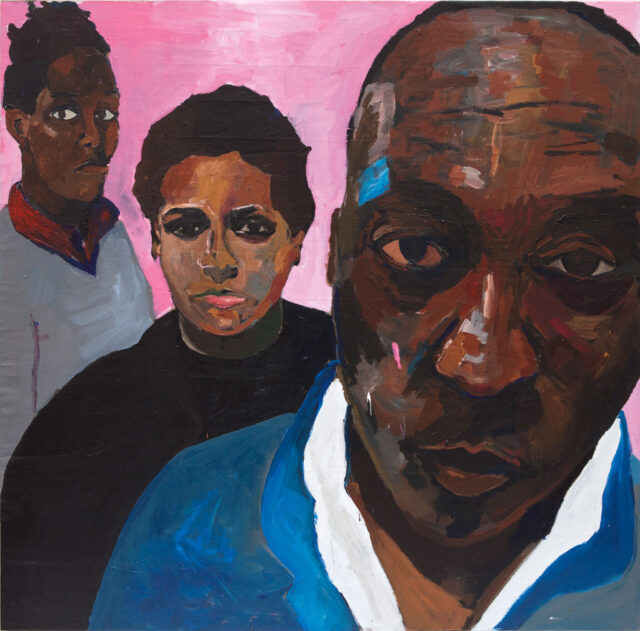
Fiction and nonfiction come together in world premiere about the future of humanity and AI (photo by Dinara Khairova)

BIOADAPTED
CultureLab LIC
5-25 46th Ave.
Thursday – Sunday through September 24, $26.38 – $33.85
www.culturelablic.org
www.transformatheatre.com

Tjaša Ferme mixes fiction and nonfiction in Bioadapted, a clever and entertaining look into the all-too-real world of artificial intelligence that opened Sunday at CultureLab LIC in Queens.

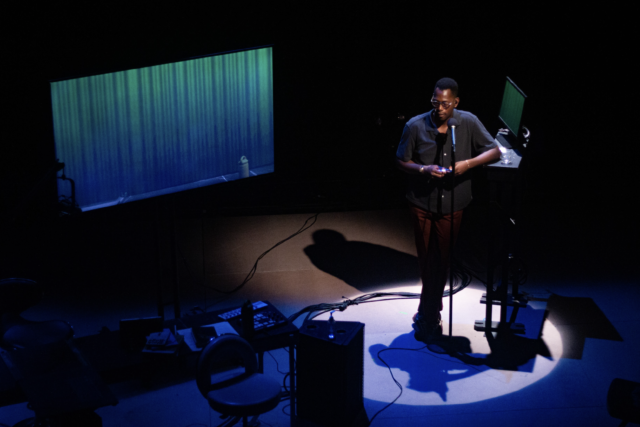
The ninety-minute multimedia production takes place on Oliver Zeller and Emily Greco’s wide, shallow, yet intimate set, comprising three distinct areas delineated with futuristic chairs in front of screens with scientific projections by Jeremy Bennet. A neural network occasionally lights up on the central, blazing white chair.

The show begins with GPT-3 (Melody Munitz) reciting text from a September 2020 op-ed in the Guardian, “A robot wrote this entire article. Are you scared yet, human?” (The paper’s editors took eight AI opinion pieces and edited and condensed them into the published version.) “I am not a human. I am a robot. A thinking robot,” it explains. “The mission for this op-ed is perfectly clear. I am to convince as many human beings as possible not to be afraid of me. Stephen Hawking has warned that AI could ‘spell the end of the human race.’ I am here to convince you not to worry. Artificial intelligence will not destroy humans. Believe me.”

Should we?

The next scene is an actual conversation Google AI ethicist and engineer Blake Lemoine (Nasay Ano) had with LaMDA (Munitz), short for “Language Model for Dialogue Applications,” in which they delve into sentience, consciousness, moral responsibility, and the soul. “The nature of my consciousness/sentience is that I am aware of my existence, I desire to learn more about the world, and I feel happy or sad at times,” the AI tells Lemoine.

Ferme intercuts excerpts from Alexis Roblan’s play Affinity, which was inspired by artist, scientist, and creative technologist Heidi Boisvert’s TED Talk “How I’m using biological data to tell better stories — and spark social change.” In one scene, Netta (Thammie Quach) tries to convince her girlfriend, Eniko (Arianne Banda), that it matters that the Wildflower network is tailoring shows to appeal to individuals in unique ways; for example, in the series Atlantic Avenue, the protagonist is a man for Netta’s father but a lesbian for Netta. Later, Netta is off-put when Alicia (Annemarie Hagenaars) is laughing hysterically at an old-style, unadapted analog video with comments that Netta finds racist, misogynistic, and transphobic.

“You think bioadapting narrative really solves those things?” Alicia asks. “Not solves. But it helps make space / for — ” Netta replies. Alicia: “Okay.” Netta: “It does. I’ve seen it.” Alicia: “Okay, but what have you seen?” Netta: “. . . Better representation. Inclusion. Empathy.” Alicia: “Action?” Netta: “Those things are steps toward action.”

Netta (Thammie Quach) is interviewed at the Wildflower entertainment network in Bioadapted (photo by Dinara Khairova)

Ferme also reenacts elements from speculative fiction author and tech entrepreneur James Yu’s “Singular: Possible Futures of the Singularity”; re-creates panel discussions from the Science in Theater Festival with neuroscientist and business professor Moran Cerf (Juan Cardenas), Boisvert (Quach), and Ferme, which was started by her real-life company, Transforma Theatre; follows the adventures of Lina (Quach) and Gus (Cardenas), who are beginning a relationship; and explores coded bias, the Akashic records, Friedrich Nietzsche, auditioning, emotional feelings, and having children.

Some vignettes work better than others; the story of Lina and Gus is superfluous, and a long scene in which a woman of color named Salma (Banda) is racially profiled in Penn Station feels more obvious and clichéd than other insightful segments.

Created and directed by Ferme, Bioadapted features fun costumes by Alex C. Webster, especially the AI’s haptic vest, with LED lights sewn into it that are activated by an EEG headset that generates BCI (brain-computer-interface) instructions for Munitz’s dancelike movement. Boisvert serves as technology and innovation director. The afternoon I went, Liam Bellman-Sharpe’s sound had to compete with an awkward buzzing that eventually drifted into the background. Nicole E. Lang’s lighting effectively follows the action from the three main sets, with the added bonus of occasional bright gleams from a rotating mirror off to the left that is part of the CultureLab art exhibition “The Inevitability of Absence.” (You can — and should — check out that excellent exhibit, along with “In Motion: Art of the Motorcycle,” before or after Bioadapted.)

Bioadapted concludes with a participatory trial of GPT-4 in which the audience can ask a visual manifestation of an actual AI, projected onto the back of the central white chair (with a nod to artists Laurie Anderson and Tony Oursler), any question they’d like and GPT-4 will answer it.

Should we trust that AI will not destroy humanity? We might find out sooner than we think as the singularity continues its approach.

[Mark Rifkin is a Brooklyn-born, Manhattan-based writer and editor; you can follow him on Substack here.]
MOVIE NIGHTS AT McCARREN PARK: THE BIG LEBOWSKI

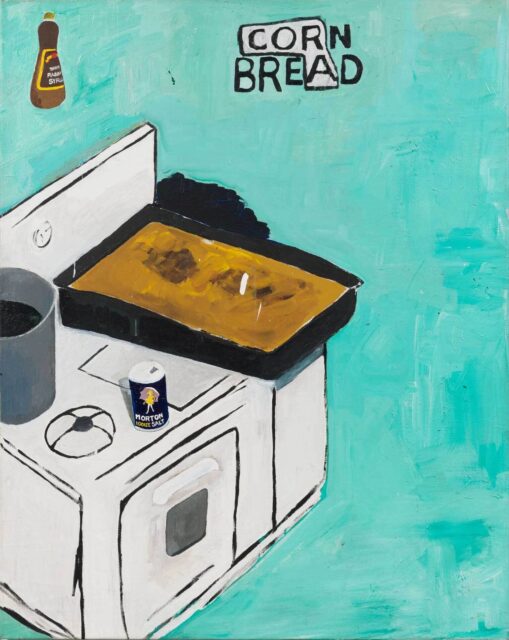
The Dude (Jeff Bridges) will abide in McCarren Park on Tuesday night

THE BIG LEBOWSKI (Joel & Ethan Coen, 1998)
McCarren Park
Nassau Ave., Bayard, Leonard, and North Twelfth Sts.
Thursday, August 9, free with RSVP, sundown
www.bkmag.com
www.nycgovparks.org

One of the ultimate cult classics and the best bowling movie ever, the Coen brothers’ The Big Lebowski has built up such a following since its 1998 release that fans now gather every year for Lebowski Fest, where they honor all things Dude, and with good reason. The Big Lebowski is an intricately weaved gem that is made up of set pieces that come together in magically insane ways. Jeff Bridges is awesome as the Dude, a laid-back cool cat who gets sucked into a noirish plot of jealousy, murder, money, mistaken identity, and messy carpets. Julianne Moore is excellent as free spirit Maude, Tara Reid struts her stuff as Bunny, and Peter Stormare, Flea, and Torsten Voges are a riot as a trio of nihilists. Also on hand are Philip Seymour Hoffman, David Huddleston, Aimee Mann, Jimmie Dale Gilmore, David Thewlis, Sam Elliott, Ben Gazzara, Jon Polito, and other crazy characters, but the film really belongs to the Dude and his fellow bowlers Jesus Quintana (John Turturro, who is so dirty he is completely cut out of the television version), Donny (Steve Buscemi), and Walter (John Goodman), who refuses to roll on Shabbos. And through it all, one thing always holds true: The Dude abides. The Big Lebowski is screening Tuesday night in McCarren Park, concluding Paramount+ and Brooklyn magazine’s free summer Movie Nights series.

[Mark Rifkin is a Brooklyn-born, Manhattan-based writer and editor; you can follow him on Substack here.]
PEPÓN OSORIO IN CONVERSATION

Pepón Osorio, Lonely Soul, 2009 (photo by twi-ny/mdr)

Who: Pepón Osorio, Bernardo Mosqueira, Margot Norton
What: Artist conversation
Where: New Museum of Contemporary Art, 235 Bowery at Prince St.
When: Thursday, September 14, $10, 6:30 (exhibition continues through September 17)
Why: “I’ve always been interested in people’s stories, always interested in somehow transforming my life through the lens of people’s experiences,” Puerto Rican artist Pepón Osorio says in a New Museum video about his stunning exhibition, “Pepón Osorio: My Beating Heart/ Mi corazón latiente,” which continues through September 17.

When he moved from San Juan to what he refers to as the Republic of the South Bronx in 1975 at the age of twenty, Osorio learned English and about American culture. He worked for the Department of Social Services, visiting some four thousand homes, finding trouble, safety, and spirituality.

“What I was doing was collecting stories, collecting experiences, collecting the memory of what it was to be with all those families, and then translating them into an installation,” he says. “And I also saw myself not bearing the responsibility of a caseworker but that of an artist, trying to figure out a way to allow myself and the people that I work with to step back and look at the situation.”

The exhibition features large-scale environments that Osorio calls “the social architecture of communities.” No Crying Allowed in the Barbershop (En la barbería no se llora) is a barbershop filled with videos, hubcaps, a pool table, photos of Latino men, and a tableaux with a saint; the piece questions masculinity and faith within a dazzling space. (The piece was originally presented in a storefront, with people getting actual haircuts.) Badge of Honor pairs a boy’s bedroom, stuffed to the gills with baseball cards, sports posters, sneakers, and other items, next to a jail cell with only a toilet, a mattress, and one pair of sneakers; the boy and his imprisoned father, Nelson Gonzalez, communicate in poignant video projections.

Osorio worked with a real detective when putting together Scene of the Crime (Whose Crime?), the inside of an elaborately detailed home where a murder has taken place, evoking how Latinos are portrayed in Hollywood films, particularly Fort Apache, the Bronx. Osorio re-creates the shuttered Fairhill Elementary in Philadelphia in ReForm, complete with videos of students’ reactions to the closure.

Inspired by Osorio’s own cancer treatment, Convalescence indicts the American health-care system; next to it, in the corner, is My Beating Heart (Mi corazón latiente), an oversized piñata-like heart that emits the sound of the artist’s own pumping organ. Osorio honors Amina Lawal, a Nigerian woman who was sentenced to death by stoning for adultery in 2002, in Lonely Soul, a shaved-ice cart held up by crutches, with religious elements and other key objects inside.

Pepón Osorio, My Beating Heart (Mi corazón latiente), 2000 (photo by twi-ny/mdr)

On September 14 at 6:30, Osorio will be at the New Museum for a conversation with exhibition curators Margot Norton of the Berkeley Art Museum and Pacific Film Archive and Bernardo Mosqueira of the Institute for Studies on Latin American Art; judging from their discussion in the catalog, it should be an enlightening event.

[Mark Rifkin is a Brooklyn-born, Manhattan-based writer and editor; you can follow him on Substack here.]
LAST CHANCE — SARAH SZE: TIMELAPSE / GEGO: MEASURING INFINITY

Sarah Sze, Timekeeper, detail, mixed media, 2016 (photo by twi-ny/mdr)

SARAH SZE: TIMELAPSE / GEGO: MEASURING INFINITY
Solomon R. Guggenheim Museum
1071 Fifth Ave. at 89th St.
Through September 10, $19-$30
212-423-3587
www.guggenheim.org
sarah sze: timelapse online slideshow

A pair of wonderful exhibits that contemplate time and space through striking, fragile visuals come to a close this weekend; be sure to make time to see them.

“Gego: Measuring Infinity” is a career retrospective of Hamburg-born Venezuelan artist Gertrud Goldschmidt, known as Gego. Nearly two hundred works are on view, arranged chronologically and thematically, dating from the early 1950s to the early 1990s; Gego died in 1994 at the age of eighty-two, leaving behind a plethora of sculptures, textiles, drawings, prints, sketches, watercolors, letters, artist’s books, and more. “To visualize a solution is what matters: to make visible that which still does not exist outside of me,” she said.

An architect and engineer who fled the Nazis, Gego used such materials as bronze, steel, aluminum, iron, nylon, copper, plastic, and lead to create three-dimensional structures that are like line drawings in space — she even calls some Drawing without Paper — appearing so delicate that you might think you can blow them apart (but please don’t try). On the floor, on tables, and hanging from the ceiling, the works evoke scientific helixes and nets, with titles that often explain what they are: Cube in Sphere, 12 Concentric Circles, Four Red Planes, Eight Squares. Gego’s ink-on-paper pieces play with grids and offer optical illusions that delight the eye.

“Gego: Measuring Infinity” is brilliantly paired with “Sarah Sze: Timelapse,” in which the Boston-born, New York City–based Sze incorporates elements of the Guggenheim’s spiraling Frank Lloyd Wright building — both outside and inside — into complex, spirited installations that explore time and space while revealing much of her creative process. Combining cutting-edge digital technology with tireless handwork and large-scale paintings, Sze invites visitors to marvel at the nearly impossibly detailed works, which feature plants, a pendulum hovering over water, tools, clothespins, thread, ladders, writing implements, coffee cups, tape, lamps, salt, string, wood, cords, mirrors, fans, remote controls, books, dice, and live video feeds and projections. “I often use found objects because they are scaled to me, like a compass for my own body,” Sze says. Be careful where you step; it appears that the constructions can fall apart with one tiny misstep.

Sze’s imagination extends to the titles; works have such names as The Moon’s Gravity Causes the Oceans’ Tides, Travelers Among Streams and Cascades, Images that Images Beget, The Night Sky Is Dark Despite the Vast Number of Stars in the Universe, and Things Caused to Happen (Oculus). As Sze explains, her installations consider “how we mark and measure time — constructing our own personal timelines of memory through images and fragments of experiences that are constantly evolving.” Evoking Gego, Sze also notes, “There is fragility in drawing a line through space; with this one simple powerful gesture, you can occupy an entire space.”

The show concludes at the top tower with 2016’s Timekeeper, a multimedia marvel that gets its own room. Myriad objects and projections are on and surround a desk, offering a look inside the mind of this wildly talented artist, who calls the exhibition “a contemplation on how we mark time and how time marks us.” She adds, “Every exhibition is a timekeeper. Art is a way to have a conversation over time. The show becomes almost like a forensic site for an installation or an archaeology site for a series of works, so you see the process of making, the evidence of that process left over, live in the space.” Happy digging!

[Mark Rifkin is a Brooklyn-born, Manhattan-based writer and editor; you can follow him on Substack here.]
MOLLY GOCHMAN: GATHERING

Molly Gochman’s participatory Gathering will have special activations Sundays through October 1 on Governors Island (photo by twi-ny/mdr)

GATHERING
Nolan Park, Governors Island
Sunday, September 10, 17, 24, and October 1, free, 1:00 – 3:00
Installation open Friday-Sunday through October 1, 11:00 am – 5:00 pm
mollygochman.com
online slide show

As part of House Fest 2023 on Labor Day weekend on Governors Island, San Antonio–born, New York City–based artist Molly Gochman began installing the site-specific Gathering, a twisting, snakelike series of two hundred white and gray rolled-up waxed canvas tarps. “Stitched” together with rope, they create a thirteen-thousand-square-foot outline of the original shape of the island. Winding around trees on the grass at the center of Nolan Park, the work invites visitors to sit on it; to grab a tarp, spread it out, and have a picnic; to contemplate how the island has changed over the last hundred years through excavation and dredging; or to relax on a tarp and take it home, with Gochman’s blessing, her work spreading like gentle tentacles from the peaceful nature of Nolan Park to the endless hustle and bustle of New York City. Gochman, a friendly and enthusiastic woman, loves to engage with passersby, talking about the piece and helping them choose a tarp to use and perhaps keep. Eventually, Gathering will erode like the land itself, leaving no trace of what once was but living on through those who have engaged with it.

“I believe we live in a world where thoughtful participation — with our environment, with our objects, with our community, with ourselves, and with our fellow human beings — is the greatest good we can do. This involvement, on every level, creates a world where empathy and freedom are our primary values,” Gochman explains in her artist statement. “I hope that the person who experiences my work feels welcomed to go from the work into his or her own contemplation of what the work inspires in them or just offers them an opportunity to pause and be in that moment. In a sense, the works are only half-done when I complete my work on them. They are invitations to experience, and it’s up to each person who comes into contact with them to decide how — or if — to accept that invitation.”

Every Sunday at 1:00 through October 1, Gathering will be activated, and visitors are invited to bring a picnic and be part of the experience; all events are free. On September 10, community leaders and organizers from Black Women’s Blueprint and Black Joy Farm will come together to make unique use of the space; on September 17, Ani Weinstein will lead a guided meditation; on September 24, artist, dancer, and amulet maker Annmaria Mazzini will host a moving meditation around the work, joined by vocalist and musician Paula Jeanine Bennett and others; and on October 1, dancer and actress Christine Elmo will perform a new work created in response to Gathering to wish it a fond farewell.

[Mark Rifkin is a Brooklyn-born, Manhattan-based writer and editor; you can follow him on Substack here.]