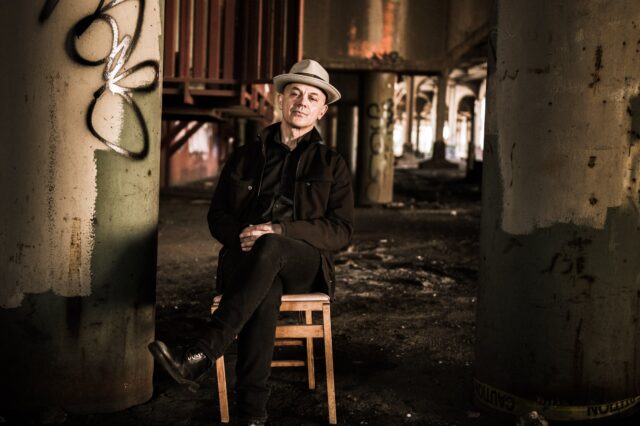
James Mastro will launch his debut solo album February 21 at Bowery Electric (photo by Dennis DiBrizzi)
JAMES MASTRO ALBUM RELEASE PARTY
The Bowery Electric
327 Bowery
Wednesday, February 21, $18.76, 6:30
www.theboweryelectric.com
www.jamesmastro.net
I first met James Mastro in the late 1980s, when he had a side gig as a freelance proofreader and I worked at a small publisher and used to assign him work. I already knew who he was from his time in the iconic Hoboken band the Bongos; he would go on to form Strange Cave and the Health & Happiness Show before joining Ian Hunter’s Rant Band in 2001.
Mastro started playing in New York City when he was teenager in the late 1970s, eventually performing with Patti Smith, John Cale, the Jayhawks, Alejandro Escovedo, Richard Lloyd, Garland Jeffreys, the Feelies, Jesse Malin, Amy Speace, Jill Sobule, and Robert Plant, among so many others throughout his career. He opened Guitar Bar in Hoboken in 1996 as a place where musicians could not only shop but play live and hang out. He has now followed that up with 503 Social Club, an art gallery that hosts live events, including recent concerts by Sobule, Freedy Johnston, and Bobby Bare Jr.; Jon Langford performed there with friends amid his paintings on the walls.
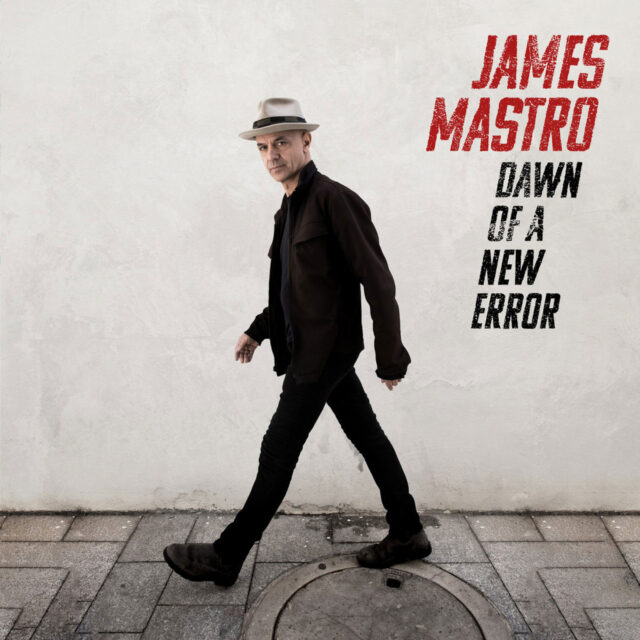
At long last Mastro has made his debut solo album, Dawn of a New Error, out from MPress Records on February 21. The title has multiple meanings, referring to the state of the world, Mastro’s shift to being the main man, and, at least to me, those old days when I was hiring him to find mistakes in kids books. Longtime Smith bassist and New Jersey native Tony Shanahan produced and plays bass and keyboards on the LP, which ranges from jangly pop, acoustic folk, and romantic ballads to gospel and country, celebrating such influences as the Beatles, the Ramones, T-Rex, Roxy Music, Bob Dylan, and David Bowie. Reilly and Hunter each appear on three tracks, with Hunter as “the voice of god” on “The Face of the Sun.” Mastro takes on faith and religion in “My God,” death and loss in “Never Die,” true love in “Gangster Baby” and “Three Words,” and fake news in “Right Words, Wrong Song.” “Trouble” was inspired by Dr. Seuss and Levon Helm.
Mastro will have album release parties on February 21 at Bowery Electric and February 24 at Transparent Clinch Gallery in Asbury Park. We recently spoke over Zoom, discussing music, art, family, hats, and stepping out into the spotlight.
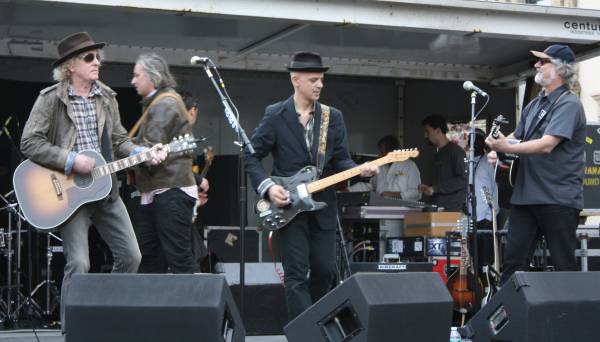
James Mastro plays with Ian Hunter and R.E.M’s Peter Buck and Scott McCaughey of the Baseball Project at the 2011 Hoboken Music & Art Festival (photo by twi-ny/mdr)
twi-ny: We’ve known each other for thirty-five years. Back in the late 1980s and early ’90s, I would send you freelance work while you were out on the road. What was that like to be playing in bands and proofreading children’s nonfiction books?
james mastro: I had a family to feed, by any means necessary. And luckily, I was doing two things that I love to do: playing music and reading books. So it was a good marriage.
For us too; you did both exceptionally well. How has the road changed for you since then?
jm: With Ian Hunter, it definitely got a little bit more comfortable. The things I love about it I still love, always trying to take the dirt road as opposed to the highway. Touring can be a drag, but you can also make it incredibly great and fun. We would plan out an agenda every time. It’s worth it to get up an hour or two earlier to take a little trip and go see a museum or something crazy that a friend told you about.
twi-ny: Back in 2011, you very generously played at twi-ny’s tenth anniversary party with Megan Reilly at Fontana’s, which is gone. New York City has had such a turnover of music venues. Are there specific clubs that you miss from the old days? Obviously, I think we’re going to mention Maxwell’s.
jm: CBGBs especially will always hold a place in my heart, just playing there as a teenager and getting to see some of the bands that inspired me to play and getting to play with some of them. So CBs and Maxwell’s, yes; huge holes that were left. I miss Fez under Time Cafe a lot; it was just a really special place. Usually what makes a place special — I was thinking about Maxwell’s this morning and CBs — are the people that ran it. Maxwell’s, I remember, was one of the first clubs that would feed you, no matter who you were; if you were playing there, they would feed you, which for a musician is huge. You may not get paid, but at least you knew you were getting fed. [Maxwell’s owner] Steve Fallon always treated musicians well, Hilly Kristal at CBGB. It starts at the top if you have great people running a space.
twi-ny: Maxwell’s was such a fan-friendly venue. I saw your bands, Robyn Hitchcock, the Mekons, Bob Mould. So you played that tenth anniversary show with Megan, who sings backup on several songs on your new record. What is it about you and Megan that gels so well over the years?
jm: I think she’s one of the finest singers out there right now. I mean, her voice just kills me. It’s kinda like beauty and the beast. I’m not crazy about my voice, so anything that will complement it, like a voice like Megan’s, I love singing with. And just musically, she’ll show me a song of hers and right away I don’t even have to think about it; these parts come out because the way she writes is so dreamy and from a special place. I connect with that so well. The other day she and I just did a rehearsal together, the two of us playing and singing for my show coming up. And I was just thrilled. I’d be happy just doing that too. She’s a very special person musically, and as a person. Just very talented.
twi-ny: On “Three Words” she really just takes it and builds to that finale.
jm: It’s like from the purr of a lion . . . She starts off so subtle and by the end of that song, she takes it to a place I never would’ve thought of going. I don’t think that that song would’ve made it on the record if she didn’t sing on it. I really think she sells it.
twi-ny: You’re very self-deprecating about your voice. On the record you say a couple of things that really lends insight to you. I’ve been listening to you play for decades. I’ve seen you in bands that you lead and bands that you’re the guitarist, the backup vocalist. So to hear you front and center on an entire record and writing songs that sound very intimate and personal, I’m learning things about you that I never knew.
jm: Therapy begins. [laughs]
twi-ny: On “Right Words,” you sing, “The lead singer at the mic wants so badly to be liked.” And on “Three Words,” you claim, “I’m not a singer and I can’t write songs.”
jm: Mm-hmm.
twi-ny: But clearly you can sing and you can write songs.
jm: Mm-hmm.
twi-ny: Humble as ever. What’s it like to finally have a solo album under your own name? Songs you wrote, songs you’re singing lead on. Why now?
jm: Good question, Why now? Well, I’ve really enjoyed being a side guy all these years, and especially when you’re working with someone like Ian Hunter, or Patti or John, anyone I’ve worked with, Megan. So it’s been nice to go in and try to contribute and watch how other people work. It takes a lot of pressure off. Running a band is a pain in the ass; you gotta make sure the drummer doesn’t get arrested —
twi-ny: Is that a Steve Holley problem?
jm: No, no, not at all. [laughs] At that time in my life, it was very nice to just take some of the responsibility off. Even though I started recording these songs before Covid just kind of as fun, with no pressure or no idea of making a record, when Covid hit, that really made me realize, Well, I’ve got time on my hands. Everything is kind of slowed down. Let’s take a look at these songs and see if we have an album here.
twi-ny: So the songs were already written?
jm: Yes, they were. Most of them were either recorded or just about finished. Tony Shanahan had just opened a studio in Hoboken. He called me up and says, Hey, I wanna just check out the room and the gear and see how things go in here. Do you have any songs? We’ll record. I was like, great. So we went in and it was just me, him, and, for the first few, Louie Appel on drums. Three friends just playing some songs.
I’d show them the songs right then and there. There was a great spontaneity and contribution from them. And it was really fun, so we just did that over a course of a few years, on and off, whenever the studio was open.
twi-ny: No pressure.
jm: No pressure.
twi-ny: So now, not only are you front and center, on lead vocals, you’re turning to people like Ian Hunter to participate. Ian hasn’t been performing because he’s got tinnitus?
jm: Tinnitus, yeah.
twi-ny: What was his reaction when you asked him to be on the album?
jm: He did one track, “Right Words, Wrong Song,” and it was perfect. It’s exactly what I wanted. He sounded just like Ian Hunter, you know? And then he finished that and he’s like, What else you got? And so he sat and I locked the door right away.
twi-ny: Oh, so he was with you in Tony’s studio?
jm: Yeah. He came down to do that. So we played him songs. He is like, “Oh, I hear a part on this. Let me try this. This is great.” He’s a very musical guy, a very giving guy. And so for me, having the guy that inspired me to pick up a guitar sing on my record after I worshiped his, it was a nice little payback.
twi-ny: And then you get to direct him in a video. You directed it, you star in it, you’ve got Tammy Faye Starlite, you’ve got Ian, you put on these great wigs. To me it’s a throwback to the early days of MTV. Is that what you were going for?
jm: Definitely. I think it was a mix of early MTV and the Colbert show and The Daily Show. I guess you could say it could be a serious song, but I think sometimes you can get a point across better by being a little irreverent about it.
twi-ny: It looks like it was fun to shoot.
jm: It was a riot. I usually backpedal at things like this. I’ve been asked to be in other videos, and I’m just like, Oh, no, I can’t. So I went into this with a little trepidation, but we had a great time.
twi-ny: How often before have you gotten to act without a guitar in your hand? Has that happened a lot?
jm: You know, since high school.
twi-ny: So you have a little acting bug inside you?
jm: It’s a good career to have to fall back on if music doesn’t work out. It’s a good safety net. Do some acting.
twi-ny: It looks to me like you’re sitting right now in 503 Social.
jm: I am. Yeah.
twi-ny: In 1996, you started Guitar Bar, which revolutionized the music scene in Hoboken. And now you’ve expanded it with 503 Social Club. How did that get going?
jm: Well, all these projects are done for selfish reasons. Guitar Bar was because I just got tired of going into New York to buy strings, and Social Club, it just popped up. A friend of mine told me about this space that became available for rent, and he’s like, You gotta go see it. The last thing I need is something that takes more sleep away from me. But it was just crying to be something. There are so many talented people in this area and there’s a lack of venues, be it for artists or musicians. So I just felt, let’s give it a shot. It’s selfish because I get to see my friends’ artwork up close and see my friends play. So it’s a labor of love, but it’s been really fun, and the feedback’s been great.
twi-ny: You had a big night there with the great and mighty Jon Langford.
jm: He’s a dynamo in every way. I love his artwork, and so he had a great show. I thought he was just gonna come in solo, but he brought half the Mekons with them, Sally [Timms] and some of the others. And they just tore this place apart.
twi-ny: I’m mad that I missed that.
jm: I understand. Well, he’s coming back. So the fact that I can get people like that here . . . it’s very fun and special for me and inspiring.
twi-ny: Speaking of inspiring, you’ve been married for thirty-one years, you’ve got two daughters, and at least one of them is a musician.
jm: Yeah, Lily is in Long Neck, her professional name and band. [Daughter Ruby, a London-based sound designer and filmmaker, edited the “Right Words, Wrong Song” video.]
twi-ny: So is music just in the Mastrodimos blood?
jm: Neither of my parents were musical. Both my brother and I were, and, my kids by default. There were always guitars in the house, music playing.
twi-ny: Is your wife musical?
jm: She is; she doesn’t play, but she sings great. She has no desire to do that. I truly think the kids get their talent from her, not me.
twi-ny: On February 21, you’ll be at Bowery Electric for the album release party. You’ve told us that you’re gonna be playing with Megan; who else will be joining you?
jm: It’s a great band and people. I’m really happy to be playing with Tony, who produced the record and has been with Patti Smith for years.
twi-ny: He’s doing a special Lunar New Year show with Patti at Bowery Ballroom on February 10.
jm: Yes, I will be there.
twi-ny: Awesome. I will be there too. So you’ve got Tony.
jm: He and I have been playing together for thirty-something years. So that’s easy. Dennis Diken from the Smithereens will be on drums. Megan will be singing, playing some guitar, and I got her playing some keyboards. She’s excited about that. The other guitar player, Chris Robertson, he’s in a band now called Elk City; he was in the Psychedelic Furs side project Feed and played with Richard Butler, just great, another friend. If I’m gonna do this, I want it to be fun for me, and if it’s fun for me, hopefully it’ll be for everybody else. These are good mates to be in a room with.
twi-ny: Okay, so one last question, something I’ve always wanted to ask you. You have always worn hats onstage; how many do you have, and how did the hat thing get started?
jm: I always wore boleros or something. I just I love that era. My dad used to wear hats, and I love that era when you look at old photos of Yankee Stadium, and men are in suits and in hats, like the whole crowd is at a baseball game but they’re dressed to the nines. So I just always have loved hats. How many do I have? Not as many as you would think. Not as many as Alejandro Escovedo — talk about a snappy dresser. I aspire to be him when I grow up. He and I are always going out hat shopping when we’re on the road.
twi-ny: Oh, speaking of which, you’re about to go out on the road with him again.
jm: I am. Yeah.
twi-ny: He previously played with the Rant Band when Ian couldn’t tour.
jm: Right. Alejandro’s got a new album coming out too [Echo Dancing], and it’s really a great, interesting record. He’s kind of revisited some of his old songs but totally deconstructed them. I don’t want to say it’s techno, but it’s unique and great. So it’s gonna be a little different from what people might expect from him. It’s kind of what John — he’s worked with John Cale also — it’s what John would do. Nothing was sacred to Cale. We’d go onstage and he’d be like, You know what, let’s change this song (that we had done the night before). But he would just totally revamp it. And I love that. Nothing should be set in stone. So that’s kind of what Alejandro’s done. I’ll be playing with him in that, but I’m also opening the shows acoustically and, depending on what town we’re in, if I have some friends there, I’ll ask them to come up and join me.
So I’m looking forward to it. Traveling with good friends and playing music, what could be better, you know?
twi-ny: You’re just having a ball, right? Just loving life?
jm: It may sound like a cliché, but if I wake up in the morning, it’s a good day. Anything after that is icing on the cake.
[Mark Rifkin is a Brooklyn-born, Manhattan-based writer and editor; you can follow him on Substack here.]