Drawing by Olivia LaBarre, seen in Isle Wild, 2025, directed, produced, and edited by Anna Moot-Levin & Daniel Schloss (courtesy of the artists)
Who:Adrian Wong,Olivia LaBarre,Rossana Ceruzzi What:Cat Sanctuary and Beyond: Structures of Our Shared Realms Where:CTHQ, 59 East Fourth St., seventh floor When: Wednesday, September 9, free with advance RSVP, 6:00 Why: “There are two means of refuge from the misery of life — music and cats,” Albert Schweitzer wrote. The German polymath would often have to do his writing while one of his cats, Sizi or Piccolo, spread out on his desk in front of him, not making it easy ― but Schweitzer worked around them, giving them preference.
For those of us who completely understand that thought process, Creative Time is offering “Cat Sanctuary and Beyond: Structures of Our Shared Realms,” a program at their East Village headquarters that brings together artist Adrian Wong, telepathic animal communicator Olivia LaBarre, and Wildlife Freedom Foundation founder Rossana Ceruzzi. The special evening is part of the “Toward Sanctuary” series curated by Celine Wong Katzman and Dr. Gervais Marsh with Buffy Sierra, inspired by the practice of transdisciplinary visual artist, choreographer, and healer Guadalupe Maravilla, who is preparing a Creative Time public art commission. At CTHQ, they will discuss animal rescue, communication between animals and humans, and interspecies collaboration. Wong’s mixed-media cat condo, The House That Snoopy Built, dedicated to his late family kitty — who may have been reincarnated as his rabbit Omar — will be on view through September, along with related works and ephemera. Admission is free with advance RSVP.
Adrian Wong’s The House That Snoopy Built will be on view at CTHQ throughout September (photo courtesy of the artist)
“Toward Sanctuary” continues November 5 with “We Keep Us Safe: The Whores Feast and Feeding,” a film screening and live performance by Red Canary Song and collaborators in support of Asian and migrant sex workers and building sustainable communities.
As I write this, our fabulous feline Tuki is spread out on my desk, between my keyboard and monitor, a loving tribute to Schweitzer, Sizi, and Piccolo.
[Mark Rifkin is a Brooklyn-born, Manhattan-based writer; you can follow him on Substack here.]
Taste of Times Square is back with local signature bites September 9 (photo by Michael Hull for the Times Square Alliance)
TASTE OF TIMES SQUARE
46th St. between Broadway & Ninth Ave., Broadway between 45th & 46th Sts.
Wednesday, September 9, dishes $5-$10, 4:00 – 8:00 timessquarenyc.org
The international culinary flavor of the Times Square area will be on display September 9 at the annual Taste of Times Square, where more than three dozen local restaurants will be serving their signature dishes on and around Restaurant Row; there will also be live performances representing several current Broadway shows from the Broadway Dreams Foundation and Ellen’s Stardusters. Most dishes cost five dollars, with a few no more than ten bucks, purchased with “tastes”; you can get 25% off advance wristbands of $25 and $50 through September 8.
The menu lineup includes lobster toast from Rosie O’Grady’s, beef or chicken suya from Lagos, tacos from Toloache, sliders from Schnipper’s, rigatoni Bolognese from Orso, a Cuban sandwich from Havana Central, penne from Becco, escovitch fish fingers from Jasmine’s Caribbean Cuisine, tiramisu from Bond 45, cheesecake from Junior’s, and frrrozen hot chocolate from Serendipity 3. There’s also fare from the Hard Rock Cafe, Planet Hollywood, and Applebee’s but not Olive Garden or Bubba Gump.
[Mark Rifkin is a Brooklyn-born, Manhattan-based writer and editor; you can follow him on Substack here.]
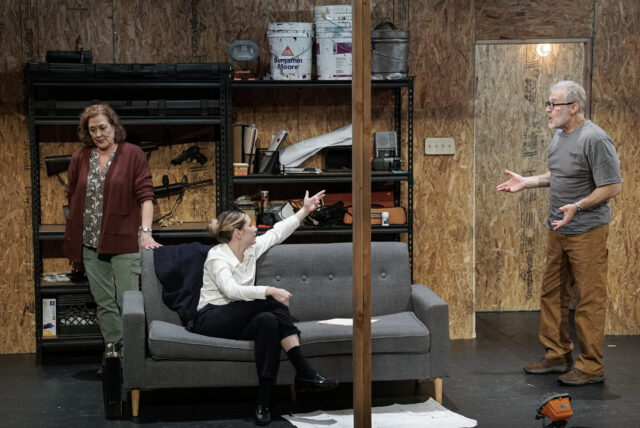
A family faces a series of crises in their new basement bunker in L. B. Browne’s Safe House (photo by Viktorija Mickute)
SAFE HOUSE
Theatre Row
410 West 42nd St. between Ninth & Tenth Aves.
Tuesday – Sunday through September 13, $39-$67 www.splitdecision.co www.theatrerow.org
It’s a shame that L. B. Browne’s Safe House is having such a short run at Theatre Row, playing a mere twelve performances through September 13, because it’s a superb drama, a microcosm of what’s happening in America today.
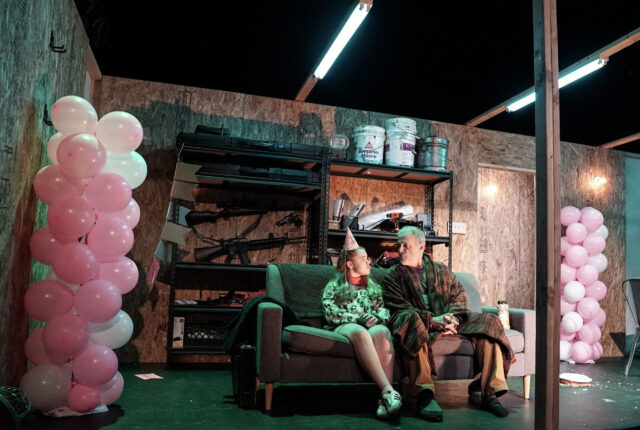
It takes place in a bunker being built by a tough right-winger named Rock (Marc Kudisch) with the assistance of his enabler wife, Slipper (Karen Ziemba), in their suburban Pennsylvania house. Forest Entsminger’s set is a somewhat claustrophobic basement with wood beams, two doors, a couch, a table, shelves of canned goods, tools and other supplies, and several rifles and pistols hanging on a wall.
“I think we’re the only folks around here reinforcing a basement pantry against nuclear fallout,” Slipper says. Rock, a former longtime Department of Defense contractor and army vet, responds, “Pantry? This isn’t soup and flour. It’s infrastructure, it’s freedom.” Rock is concerned that if the upcoming presidential election goes a certain way, a second civil war would be imminent.
They have two daughters: Ashley (Anna Roman) is a prim and proper family court lawyer, while Claire (Grace Church) is a teenager who ran away from home the year before. The twenty-seven-year-old Ashley had been finally planning on getting her own place, but the painful disappearance of her sister, ten years younger, caused her to remain to help her parents deal with the crisis. They hadn’t heard from Claire until she suddenly returns, with a little surprise that sets off everyone’s feelings and beliefs about various hot-button issues; Claire’s left-wing radicalism does not sit well with Rock’s ever-more-extreme views. The hot-headed Rock wants her gone, but Slipper and Ashley convince him to let her stay for at least a few nights.
Dr. Calvin Merritt (Justin Lee Miller) drops by unexpectedly to chat privately with Rock about his alarming diagnosis eleven months earlier and whether he’s told his wife and kids yet. Rock, who has not done so, insists he’s as strong as an ox, pointing out the bunker as proof, despite his occasional twitches and shakes. “You know these tests get mixed up all the time. Nothing like that runs in my family,” Rock says matter-of-factly. “The General, Ma, when their time came, they were healthy enough to make death cruel.”
When Dr. Merritt reminds Rock that his father, the General (Glenn Seven Allen), died in Vietnam when Rock was a child, his father, in uniform, enters from a far corner. Rock talks to the hallucination as if it were real, momentarily forgetting that the doctor is there; the words Rock speaks relate to both his father and Dr. Merritt in a potent way, as exemplified in this exchange:
The General: You couldn’t hold steady enough to hit the broad side of a barn. Dr. Merritt: Your father had the gene; just didn’t live long enough to find out. Rock: I was a boy. Dr. Merritt: Yeah, you couldn’t have known. Are you okay? Rock: I told you, I’m feeling great. Dr. Merritt: Your hand’s shaking. The General: Like the first time you brought a buck to its knees. Rock: I’m not shaking. Dr. Merritt: You don’t even feel it, do you? The General: Shameful sight, the way you shook on that trigger. Rock: I didn’t shake!
It’s a clever plot device that is effectively used several times through the rest of the play, with Rock encountering both the General, as if her were alive in the present, and seven-year-old Claire (Julianna Layne), reliving scenes from the past.
As Claire’s situation grows more dire because of Rock’s unyielding, unsympathetic reactions, the bunker is in danger of collapsing like a house of cards.
The past and present merge for Rock (Marc Kudisch) in timely debut by L. B. Browne at Theatre Row (photo by Viktorija Mickute)
Safe House is a sparkling debut for novelist, editor, Fulbright Fellow, and physician Browne; she has crafted a gripping, timely story with well-drawn characters caught up in circumstances that are not always in their control, fraught in family dynamics and the difficult legacies parents leave for their children. At first, it’s not clear what political side anyone’s on. Rock declares, “Things are only getting worse. Grid’s thinner, egg prices are climbing, and crooks are running the whole damn show. You know I’m right.” He could be talking about the Democrats or the Republicans, although he eventually rails against the Democratic Socialists, referring to them as “commie goons” who are going to steal the election; he gets into a heated argument with Claire, who holds nothing back, while Slipper seeks a détente.
The family itself represents the divides in America today, without ever mentioning any politicians or parties by name: Rock is the far-right fearmonger lacking empathy and compassion for his fellow human being and not trusting science, although that can be perhaps attributed at least in part to his illness; Claire is the Democratic Socialist who believes in universal health care and government programs for the poor; Ashley is the intelligent, successful single woman who knows precisely what is going on but tries to avoid getting overly involved in controversy, focusing on her career instead; and Slipper goes about her business as nice and sweet wife and mother, saying nothing to upset anyone except when she worries that Ashley needs to find a man, something her daughter does not appreciate.
Three-time Tony nominee Kudisch (Thoroughly Modern Millie,The Wayside Motor Inn) gives a powerful, boldly physical performance as the aptly named Rock, a determined, serious man unwilling to accept his vulnerabilities, dead-set on protecting his family even as his delusions threaten to overwhelm him, always on the verge of exploding. Tony winner Ziemba (Contact,Curtains) is gently touching as Slipper, imbuing her with an innate good-heartedness that covers her inability to stand up to her husband. A thoughtful, impressive Roman, who made her off-Broadway debut in July when she took the stage for Juliana Canfield in Girl, Interrupted at the Public, provides a steady balance as Ashley, who the others take for granted as she tries to hold it all together. In her professional theater debut, recent NYU grad Church is deeply affecting as the teenage Claire, an idealist at odds with not only her family but the world itself, searching for her place, wise beyond her years. Miller, Allen, and Layne deliver admirable support in their key roles.
Director Benjamin Viertel (The Peepholeman) expertly navigates the cast through the space, which becomes ever-more confining as the tension mounts, highlighted by a shocking twist. Several beams at the front both allow the audience to see into the bunker and invite us in, implicating us in the conflicts; each one of us either is or knows these fictional characters all too well. Browne’s dialogue is quick-witted and intense, brutally honest in its depiction of 2026 America, where friends and families are torn apart over politics. She also throws in some Easter eggs, beginning with the preshow music, which ends with Woody Guthrie’s “This Land Is Your Land,” the oft-misunderstood patriotic protest anthem that was a response to Irving Berlin’s “God Bless America” and that originally contained two verses critical of the state.
The play could use some tweaking — the night I went, both Viertel and Browne were there, taking notes — but I think that’s why it’s at Theatre Row for only twelve days, hopefully a tryout/showcase for a much longer run, which it richly deserves. That is, if we don’t have another civil war. . . .
[Mark Rifkin is a Brooklyn-born, Manhattan-based writer; you can follow him on Substack here.]
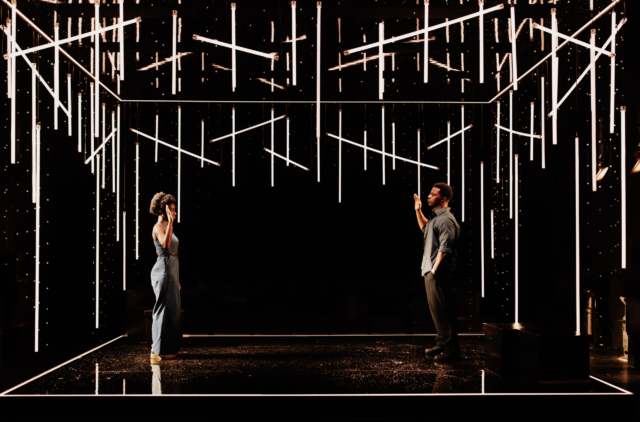
Des and Dre travel through time and space as they explore the past, present, and future of their relationship (photo by Marc J. Franklin)
SHIFTERS
Cherry Lane Theatre
38 Commerce St.
Tuesday – Sunday through September 20, $69-$149 www.cherrylanetheatre.org
Ah, what might have been — or still could be?
Charity Bedu-Addo and Daniel Ezra are electrifying in British Congolese playwright Benedict Lombe’s Shifters, a sizzling two-character drama at the Cherry Lane that posits that destiny is a choice. It begins when Des (Bedu-Addo), short for Destiny, and Dre (Ezra), both thirty-two, meet up at the wake for Dre’s beloved Nana. They’ve known each other since high school, when they were sixteen, but haven’t been in touch for eight years, a period during which their lives changed significantly.
Over the next 105 minutes, Lombe and director Lynette Linton take the audience back and forth from the past to the present as Des and Dre go from sixteen and seventeen to twenty-four and twenty-seven, their relationship shifting from classmates and friends to possible lovers; in the script, scenes are identified by such titles as “Allies,” “Fractures,” and “Fugitives.” Through the play, they each break out of the narrative to recite monologues and make brief points to the audience.
“This is the moment when I finally [see] that time is an illusion,” Dre explains to us after greeting Des. “Because the walls of the world we built, the walls where time is linear and finite — start to crumble. And in this moment, I — you — are both here and there and time is moving and standing still as memory is made skin — yesterday, today, tomorrow — all real, all happening, all at the same time. And suddenly — ”
Des is the new girl in school, and she is in philosophy class with Dre when they get into an argument about the decisions people constantly face as he tries to get her to join the debate club. “There are more than two sides and more than two choices,” Des says. Dre responds, “Still gotta be for something to know what you’re against though, innit?” When Des offers that decisions should not be the most important thing, Dre replies by asking how anything would get done if there were no decisions. “You’re asking the wrong question,” Des says.
The story shifts from the wake to key moments in their life together, when decisions had consequences that brought them together and tore them apart, including some choices that are still haunting them. While Dre sees him and Des as “two little Black kids destined to oppose each other push each other shift each other until they could be formed again,” Des doesn’t believe in destiny, telling us, “If destiny is the path laid out for you — you still have to walk it. Choose it.”
It’s the choices they made when they were younger that brought them to this moment, at the wake, where they continue to dance around asking, and answering, the right questions.
Charity Bedu-Addo has replaced Heather Agyepong in Benedict Lombe’s Shifters at the Cherry Lane (photo by Marc J. Franklin)
Most of the choices made by the cast and crew work extremely well. Alex Berry’s compelling set is a dark, open rectangle with two added rows of seating on the far side of the stage, which is draped with narrow LED tubes of varying lengths and at different angles that change colors based on mood. (The lighting is by Neil Austin.) The characters, in Berry’s contemporary costumes, occasionally move around black storage boxes that they sit on and open to find pieces from their past, as if reaching into their memories and psyche. Tony Gayle’s sharp sound incorporates Xana’s entrancing, award-winning score and John Hiatt’s 1987 track “Have a Little Faith in Me,” heard on an old turntable. “When the road gets dark / And you can no longer see / Just let my love throw a spark / And have a little faith in me,” Hiatt sings.
Shifters evokes Nick Payne’s Constellations and Rajiv Joseph’s Gruesome Playground Injuries, two other outstanding plays in which a man and a woman revisit the past as they explore their relationship. Ezra (Twelfth Night) and Bedu-Addo (The Bolds,Stocking Fillers), replacing Heather Agyepong when the show was extended, as she did in the original London run, have an instant chemistry. Both of the characters are complex and unpredictable, and the two actors imbue them with a fresh, beguiling honesty that keeps the audience’s emotions swirling as Dre and Des seek out their crisscrossing paths.
The play is about ten or fifteen minutes too long, as it gets bogged down with a bevy of revelations of tragedy and trauma in the final scenes; Lombe (Lava, for which she won the 2022 Susan Smith Blackburn Prize) and Lynton (The Boy Who Harnessed the Wind,Not Your Superwoman) already have us invested in Dre and Des, so this added information is unnecessary and detracts from the proceedings. Otherwise, Shifters is a triumph.
In a program note, Lombe writes, “Shifters was born from this intentionality and specificity — a universal love story between a British Congolese woman and a British Nigerian man — that shifts in and out of time and space and feeling, demanding nothing less than to shift the theatrical canon itself.” Lombe is clearly on the right path.
[Mark Rifkin is a Brooklyn-born, Manhattan-based writer; you can follow him on Substack here.]
RADICAL CHIAROSCURO: THE WORK OF DARIUS KHONDJI
Metrograph
7 Ludlow St. between Canal & Hester Sts.
Begins September 4 metrograph.com
Eight years ago, Metrograph held a retrospective of the wide-ranging and diverse work of Iranian-born, Paris-raised cinematographer Darius Khondji, and now they’re bringing him back for “Radical Chiaroscuro,” as he continues to make films that capture the imagination of the public and the industry. The series begins September 4 and includes Jean-Pierre Jeunet’s Alien Resurrection (“a very different kind of Alien movie,” Khondji explains in a program note), Danny Boyle’s The Beach (“a very sharp movie, and I always felt the story was like a blade that cuts and causes you to bleed: There’s blood on the sand and sharks in the water, and the people themselves behave like sharks.”), Alan Parker’s Evita (“a very visual movie, and Alan Parker is probably one of the most exciting and visual directors I have ever worked with.”), Bong Joon-ho’s Okja (“represents a departure toward a different type of image, a different texture and look: Something very blue and metallic, with lots of compressed cityscapes and a bit of gold in the flesh tones.”), and F. J. Ossang’s The Treasure of the Bitch Islands (“The shoot was madness, and some of us risked our lives a few times, especially while doing a scene on the edge of this huge volcano. Ossang was really more like a rock star than a film director. . . . I shot the film completely inspired by him and his energy, even if I was sometimes terrified.”).
Also on the bill are David Fincher’s Se7en, Bernardo Bertolucci’s Stealing Beauty, James Gray’s The Immigrant, and the below films. Khondji will be at Metrograph for Q&As following screenings of Douglas Gordon and Philippe Parreno’s Zidane: A 21st Century Portrait on September 19 and Ari Aster’s underappreciated Eddington on September 26 (joined by Aster).
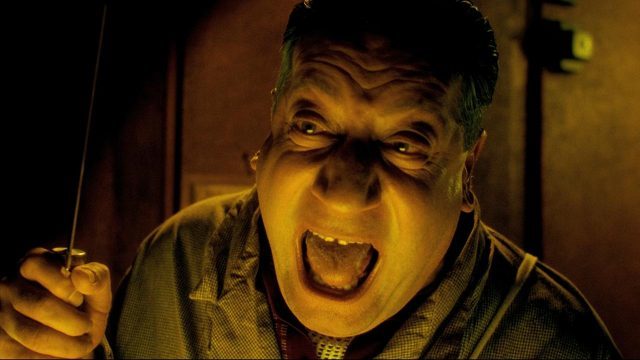
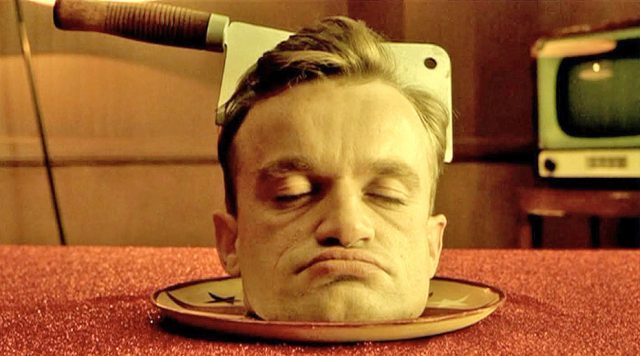
Butcher-landlord Clapet (Jean-Claude Dreyfus) has a unique way of taking care of his tenant-customers in Delicatessen
DELICATESSEN (Marc Caro & Jean-Pierre Jeunet, 1991)
Friday, September 4, 9:35
Monday, September 7, 4:20 metrograph.com
The Metrograph festival kicks off with Marc Caro and Jean-Pierre Jeunet’s epic masterpiece, City of Lost Children, and their delicious debut, Delicatessen. In a bizarre, postapocalyptic future, one apartment complex is surviving via its ground-floor butcher shop, where landlord Clapet (Jean-Claude Dreyfus) carefully wields his giant cleaver, hiring desperate, lonely men to do odd jobs for him before carving them up and selling their flesh and bones to his hungry customers. His latest potential victim is Louison (Dominique Pinon), a mild-mannered clown struggling to get by. But when Clapet’s shy daughter, Julie (Marie-Laure Dougnac), takes a liking to Louison, the butcher has to decide whether someone else should be their next meal. Meanwhile, Aurore Interligator (Silvie Laguna) keeps devising Rube Goldberg-esque ways to kill herself, Marcel Tapioca (Ticky Holgado) tries to prevent Clapet from making mincemeat of his mother-in-law (Edith Kerr), Frog Man (Howard Vernon) has come up with his own curious menu, Clapet gives special treatment to sexpot Mademoiselle Plusse (Karin Viard), and an underground group of Troglodistes are preparing for revolution.
Louison (Dominique Pinon) clowns around in Marc Caro and Jean-Pierre Genet’s brilliant audiovisual feast
Inspired by the work of Terry Gilliam, Delicatessen is a brilliant audiovisual feast, with every sound and image orchestrated for maximum absurdity, courtesy of cinematographer Darius Khondji (Seven, Stealing Beauty), longtime Marguerite Duras composer Carlos d’Alessio (India Song, The Children), and art director Miljen Kreka Klakovic (The Pillars of the Earth, The Order). Caro also did the gorgeous production design and makes a cameo as Fox. Several scenes turn into wildly inventive, hysterical musical numbers with a vaudevillian sensibility. Winner of four César Awards, the film is wickedly funny, taking place in a grim, fantastical, surreal vision of the future that is part Road Warrior, part Brazil, part Monty Python, where even methods of surveillance are downright strange. The cast is appropriately weird, none more so than Caro and Jeunet regular Pinon and his familiar, oddball face. The directors went on to collaborate on the stunning sci-fi gem The City of Lost Children (also screening September 4 and 7) before going their separate ways, Jeunet making such films as Alien: Resurrection, A Very Long Engagement, and Amélie and Caro writing and directing Dante 01.
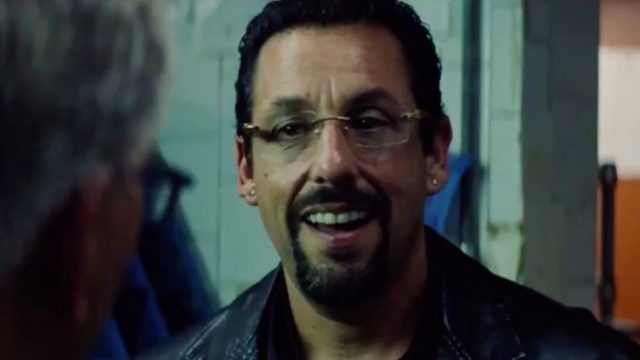
Adam Sandler plays a diamond dealer in danger in Uncut Gems
UNCUT GEMS (Josh Safdie & Benny Safdie, 2018)
Friday, September 11, 10:45
Sunday, September 13, 9:00 metrograph.com a24films.com
“That was manic, pure mania,” the Safdie brothers narrate at the end of a trailer for Uncut Gems, which itself is a magic gem. The film is a furious, unrelenting movie that sucks you into its claustrophobic frenzy and never lets go. Adam Sandler is a force, reaching new heights as Howard Ratner, a Diamond District dealer with a gambling addiction. He’s deep in debt to Arno (Eric Bogosian), who has sent his two goons, Phil (Keith Williams Richards) and Nico (Tommy Kominik), to make sure Howard knows just how much trouble he is in. His wife, Dinah (Idina Menzel), is fed up with him, not in the least because he has an apartment with his mistress, the much younger Julia (Julia Fox), and is not the most reliable father to their children, Eddie (Jonathan Aranbayev, who was discovered on Forty-Seventh St. in front of his parents’ jewelry store), Beni (Jacob Igielski), and Marcel (Noa Fisher).
Howard has a master plan to break free of all his problems by selling a chunk of Ethiopian black opals at an auction, with the help of one of his assistants, Demany (Lakeith Stanfield), who has lured in Boston Celtics center Kevin Garnett (terrific in his acting debut), who is fascinated by the rare, uncut gems, which sparkle with promise. The last half hour of the film is a brilliant, claustrophobic tour-de-force in which everyone onscreen is physically trapped, just like the audience is pinned to their seats, holding on for dear life. The Safdies, whose father worked in the Diamond District, use a mix of professional and nonprofessional actors as well as famous people playing themselves; the cast includes sports-radio legend Mike Francesa as a bookie, Garment District legend Wayne Diamond as a big-time gambler, Judd Hirsch as Howard’s father, Natasha Lyonne and Tilda Swinton as phone voices, and restaurant owner Nino Selimaj, writer Larry “Ratso” Sloman, actor John Amos, the Weeknd, and others as themselves.
Written by the Safdies (Daddy Longlegs, Heaven Knows What) with longtime collaborator Ronald Bronstein, Uncut Gems, which has been in process for ten years, is anchored by a career-redefining performance by Sandler, who previously revealed his significant acting chops in Paul Thomas Anderson’s 2002 Punch-Drunk Love and Judd Apatow’s 2009 Funny People. In a performance that will make you forgive him for The Waterboy, Big Daddy, Little Nicky, and Mr. Deeds, among other silly effluvia, Sandler is a whirlwind throughout the film’s 135 minutes, which fly by. Darius Khondji’s camera is practically glued to him, Sandler’s unshaven, gruff face a character unto itself, Howard’s eyes always at least one step ahead of what’s happening in front of him. He’s a dreamer, and although you can’t not root for him, he is far from a likable hero. He is singlehandedly responsible for the dangerous mess he’s in, whether he admits it to himself or not. But he is also a kind of everyman, peering through the looking glass (in this case, the seductive, multicolored opals in the stone), trying to survive in a hectic, frenetic world that can be overwhelming and spin out of control at any moment. You can’t just sit back, relax, and enjoy Uncut Gems; instead, you can’t help but be fully immersed in its nonstop, feverish intensity. “It was completely unlike anything I’ve done. I would never have thought I would photograph one day a movie like this. But it ended up being my favorite work, probably,” Khondji says.
Jean-Louis Trintignant and Emmanuelle Riva play a married couple facing tragedy in Michael Haneke’s brilliant Amour
Legendary French actor Jean-Louis Trintignant puts an exclamation point on his long, distinguished career with Amour, one of the most beautiful love stories ever told. In his first film in nearly a decade, Trintignant, the star of such classics as Z, My Night at Maud’s, A Man and a Woman, and The Conformist, plays Georges, an octogenarian who is immediately concerned when his wife, Anne (Emmanuelle Riva), suddenly freezes for a few moments, unable to speak, hear, move, or recognize anything. So begins a downward spiral in which Georges takes care of his ailing wife by himself, refusing help from his daughter, Eva (Isabelle Huppert), as he faces the grim situation with grace and dignity. A genuine romance for the ages, Amour is brilliantly written and directed by Michael Haneke, earning the German filmmaker his second Palme d’Or, following 2009’s The White Ribbon. Haneke (Cache, The Piano Teacher) and cinematographer Darius Khondji allow the heartbreaking tale to unfold in long interior shots with very little camera movement, spread across more than two hours.
Despite its length, the film is far from torturous; instead, it is filled with quietly beautiful moments. Trintignant, who was eighty-two when the film was released, is magnificent as Georges, his every physical movement and eye glance rendered with powerful yet gentle emotions, whether he’s preparing food for Anne or trying to catch a bird that has flown into the apartment. It’s an unforgettable performance in an unforgettable film. “I’m actually the one who initially talked to Michael about shooting Amour on digital,” Khondji notes about the film in a Metrograph series note. “I tried to explain to him that for me, Amour was really like a recording, a recording of the lives of these two characters during their final six months together. . . . We could just keep recording with them until the very end.”
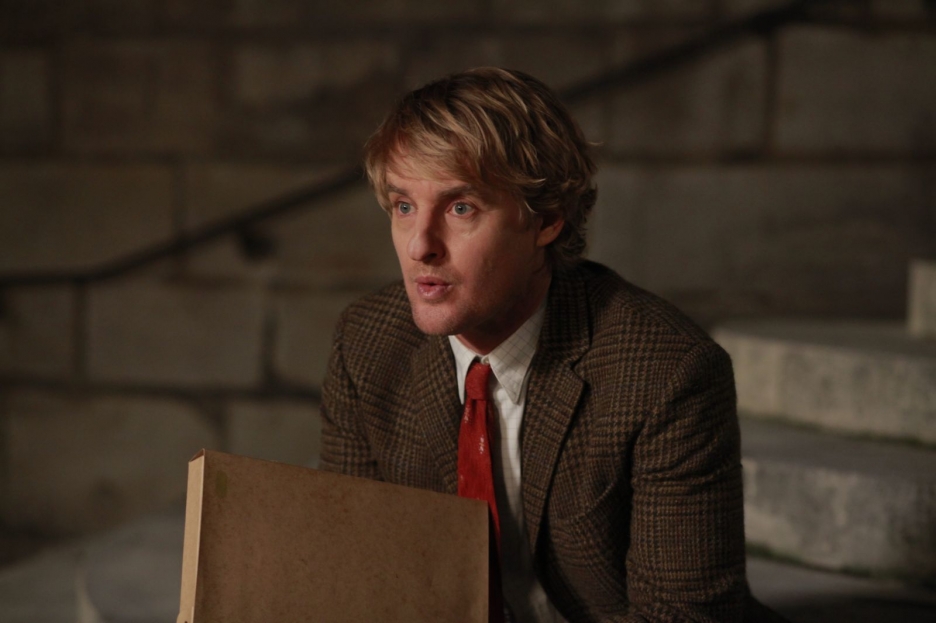
Writer Gil Pender (Owen Wilson) waits to mingle with the Lost Generation in Woody Allen’s Midnight in Paris
In 1979, Woody Allen and master cinematographer Gordon Willis made love to New York City architecture in gorgeous black and white in the stunning opening section of Manhattan set to George Gershwin’s “Rhapsody in Blue.” Allen’s Midnight in Paris begins with Allen and cinematographer Darius Khondji getting intimate with the City of Light in lush color, scanning familiar Parisian landmarks to Cole Porter’s “Let’s Do It, Let’s Fall in Love.” In this beautifully shot love letter to Paris, Owen Wilson stars as Gil Pender, a Hollywood hack screenwriter working on his first novel, about a nostalgia dealer. He and his fiancée, Inez (Rachel McAdams), are vacationing in Paris with her parents, the wealthy, ultraconservative John (Kurt Fuller) and Helen (Mimi Kennedy), who think their daughter can do much better. Gil and Inez bump into their friends Carol (Nina Arianda) and Paul (Michael Sheen), the latter a pedantic know-it-all who begins many an observation with “If I’m not mistaken” and whom Gil can’t stand. Gil is hoping Paris will get his creative juices flowing, and that’s exactly what happens late one evening when he is walking the streets alone at midnight and is invited into an old-fashioned car and taken to what appears to be a throwback party — until he meets F. Scott and Zelda Fitzgerald (Tom Hiddleston and Alison Pill), Cole Porter (Yves Heck), Ernest Hemingway (Corey Stoll), and fashion designer and Picasso muse Adriana (Marion Cotillard). Suddenly he feels more at ease in the swinging ’20s than the 2010s, heading out each night to the same spot, hoping to hang out more with the Fitzgeralds, Hemingway, Gertrude Stein (Kathy Bates), Picasso (Marcial Di Fonzo), and, most importantly, Adriana.
Nostalgia for the past and the promise of the future collide as Gil searches deep inside himself, trying to discover just what it is that he wants and needs out of life. Combining elements of such previous films as The Purple Rose of Cairo, Alice, Everything You Ever Wanted to Know About Sex*, and Everyone Says I Love You with a rather standard Twilight Zone-esque setup and a nod to his mid-’60s Lost Generation joke — in which he hangs out with Hemingway, the Fitzgeralds, Picasso, and Stein talking about art and literature, with a series of punch lines involving Allen getting punched in the mouth — Midnight in Paris is a charming, if at times overwrought and just plain silly, romantic fantasy that evokes Allen’s own fondness for nostalgia and the past. As more and more famous artists keep showing up, it gets more than a tad ridiculous, although it is also kinda fun. Midnight in Paris, which opened the 2011 Cannes Film Festival, follows four Allen films set in London (Match Point, Scoop, Cassandra’s Dream, and You Will Meet a Tall Dark Stranger), one in Barcelona (Vicky Christina Barcelona), and only one in New York (Whatever Works) as Allen continues to travel the world after experiencing a dwindling audience and scandal back home. Wilson is excellent as the nostalgic writer, playing him with an edgy uncomfortablilty that makes him endearing, and Cotillard is sexy and alluring as the quintessential artistic muse. And in an inspired bit of casting, then–French first lady Carla Bruni plays a tour guide who butts heads with the smarmy Paul when discussing Rodin’s The Thinker.
[Mark Rifkin is a Brooklyn-born, Manhattan-based writer; you can follow him on Substack here.]
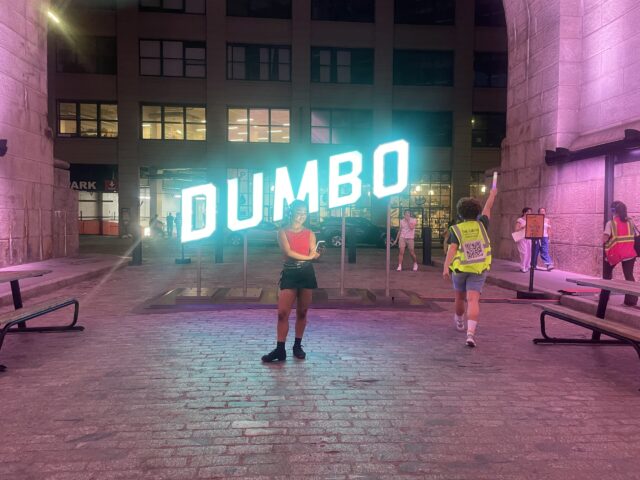
Danielle Louise Bowen portrays the guest in site-specific immersive DUMBO dance journey The Circuit (photo by twi-ny/mdr)
THE CIRCUIT
Begins at Superfine restaurant
126 Front St., Brooklyn
Through September 7, $39.62-$82.20 www.nytheatrecompany.com
So let me get this straight: New York Theatre Company’s The Circuit is a site-specific immersive journey through several of DUMBO’s most spectacular locales, inspired by Arthur Schnitzler’s 1920 play, La Ronde, and Max Ophüls’s classic 1950 film? I’m in! And you should be too.
Ophüls’s French adaptation begins with a new character not in the play, a master of ceremonies elegantly portrayed by Anton Walbrook. In the famous five-minute opening scene, filmed in one continuous take, the emcee walks along the streets of Vienna, telling the audience, “You can tell from the scent in the air that love is just around the corner, can’t you?” Approaching a carousel he calls “the merry-go-round of love” while revealing he is on a movie set, he says, “Love comes calling, sudden and fleeting. And they all dance to love’s same tune.” La Ronde depicts a series of couples meeting up in the city, with one person from each pas-de-deux heading off and encountering another potential romantic partner.
The Circuit: An Immersive Silent Disco Ballet reimagines La Ronde for DUMBO, taking full advantage of the area’s cobblestone passages, iconic views, and unique landscape. Audience members put on silent disco headphones, through which they hear dialogue and EDM, and follow guides who lead them from site to site using multicolored LED batons, as characters find each other, dance while engaging in various aspects of hooking up — or not — and then go on their way.
The tale of bisexual love and loneliness, betrayal and ecstasy, written by Connor Wentworth, starts with the guest (a terrific Danielle Louise Bowen, who alternates with Manatsu Aminaga), who performs a solo in a plaza before joining dancers in the Archway (swing ensemble Kaitwan Jackson, Kurt Horney, dance captain Anna Nader, and Katie Baik). Soon she becomes involved with the doll (Luke Swaller), who harbors a secret; next, the doll chances upon the almighty (Tessa Fungo), who confronts the keeper (Gigi Hausman), who happens upon the gentleman (Fabricio Seraphin), who has a rendezvous with the lover (Arzu Salman). Each couple moves to an original score by Jacob Ryan Smith and choreography by Josh Zacher, who codirects with John Kroft.
It’s part walking tour, part silent disco, part flash mob as the group makes its way among tourists, random passersby, native New Yorkers, and others going about their business, snapping pictures in and around Brooklyn Bridge Park, walking their dog, pushing their baby in a stroller, knitting on a bench, or picking up dinner. Some immediately take videos of the proceedings, some completely ignore them, and others appear to think, well, this is just another night in the city with who-knows-what going on. At one point a young woman was grooving atop a small DOT orange-and-white traffic barricade; a few of us went toward her, believing she was the next character, but it turned out she was simply having fun with friends, perhaps dancing to love’s same tune. With darkness descending, the guides use handheld colored lights and the cast’s smartphones glow, as text messages are incorporated into the plot.
The main independent elements of The Circuit — the narrative, the music, and the choreography — might not necessarily stand out on their own, but they merge beautifully in the tremendously fun and thoroughly engaging show. The title relates to making connections, between people as well as electrical devices, which essentially are running our lives in 2026. A deep connection is also made between the audience, the performers, and DUMBO itself, with a gorgeous, contemplative finale occurring under the Brooklyn Bridge.
Yes, it’s a site-specific immersive silent disco ballet, but it also has a lot of heart as it explores coming together and breaking apart in a city that can be difficult to navigate when one is alone, although love could be waiting right around the corner.
[Mark Rifkin is a Brooklyn-born, Manhattan-based writer; you can follow him on Substack here.]
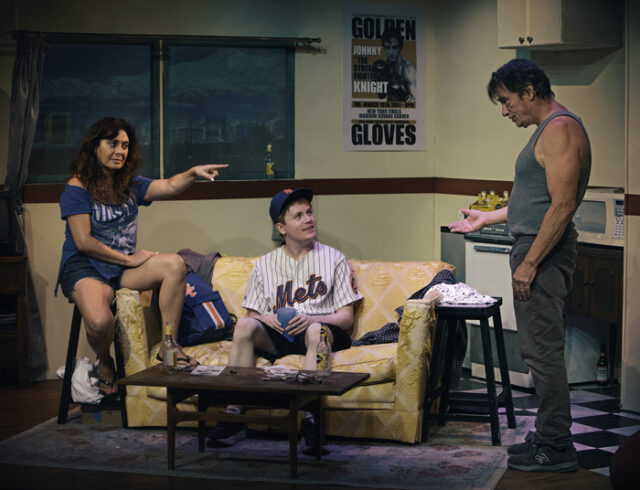
Tina (Kate Miller), Connor (Evan Klein), and Johnny (Dan Patrick Brady) concoct a blackmail scheme in The Bathroom Attendant (photo by Scott Fetterman)
THE BATHROOM ATTENDANT
124 Bank Street Theater
124 Bank St.
Through August 30, $38.10 sparkplugproductions.com
I’ve previously written about my anxieties around public bathrooms and theatrical productions several times, from a show at SoHo Rep in which they waited for me to finish my business to being walked in on prior to a play in a hotel room in which one of the actors made actual use of the facilities, with the door open.
So I absolutely had to see a new play called The Bathroom Attendant, at 124 Bank Street Theater through August 30.
On line to check in, I decided to go to the bathroom; there was a sign saying “Private” on the door, so I asked other people if they knew if we could use this, and one woman said yes, she had just seen someone exit it. I slowly reached for the handle and, feeling that it was unlocked, opened the door — to find a young man sitting on the bowl, not exactly happy that everyone on line could see him.
I closed the door and apologized profusely, completely commiserating with him, and used a second bathroom instead, making sure to lock the door.
I was somewhat disappointed to learn that the play does not take place in a can, and the protagonist’s job is mentioned only a few times: He works part-time as an attendant in the Mob Museum rest room. (There really is such an institution in downtown Vegas.)
Written by Tom Kelly (Bleached Blonde Betty,The Gangster and the Busboy) and directed by Andrew Block (Small Engine Repair,Fat Cat Killers), The Bathroom Attendant is set in a ramshackle apartment in the Dean Martin Houses, not exactly the luxury condo tower known as the Martin on Dean Martin Dr. It’s a sad-sack room with a torn-up icky yellow couch, a microwave, a sorry excuse for a stove, a ridiculously old television playing an episode of the late 1970s series Vegas starring Robert Urich as a PI catching the bad guys in glittering Sin City, and a view of the Strip through dirty windows. Designed by Scott Fetterman, it’s a claustrophobic nightmare, about as lousy as it gets. On the back wall is a poster of Johnny “the Street Fighter” Knight from the 1984 Golden Gloves finals at Madison Square Garden, a constant reminder to the apartment’s resident of his long-ago glory days, of what might have been.
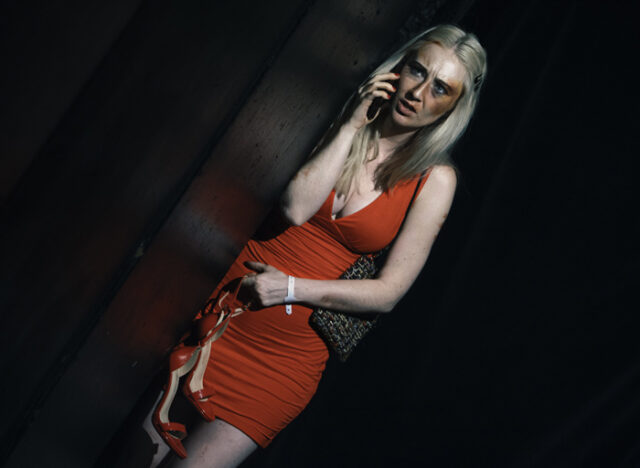
Bambi (Mari Blake) is not quite a femme fatale in gritty crime thriller (photo by Scott Fetterman)
It’s August 2018, but Johnny (Dan Patrick Brady) is still stuck in the past, unable to gain any kind of foothold; he’s three months behind on his rent, is in debt to a local mob, and swills Mike’s Hard Lemonade that he stole from another apartment. His only friend is Tina (Kate Miller), a former porno star who is now part of the evangelical community, focused on helping young women in trouble; she is currently trying to save a teenager named Jade who is being abused by her drunk junkie father. Johnny is shocked when a sixteen-year-old boy named Connor Donahue (Evan Klein) knocks on his door; Connor is the nephew of one of Johnny’s best friends from his Brooklyn days.
Decked out in Mets gear, Connor is in Vegas with his father but has brought along memorabilia for Johnny to sign; he has heard all the old stories from his father about Johnny’s prowess in the 1980s.
He also has an ulterior motive; the previous night, he videotaped Mets superstar Mickey Logan, potentially the first-ever $500 million player, viciously beating up a teenage girl, Bambi (Mari Blake). (The incident recalls Super Bowl winner Ray Rice, who was caught on video attacking his fiancée in 2014, and Sean “Puffy” Combs assaulting his girlfriend in 2016.) Connor, who learned about the underworld by bingeing The Sopranos, has already pitched the video to the National Enquirer and TMZ but believes he could make a much better score by blackmailing Logan, with Johnny’s assistance. Tina asks in as well and they set out to pull off the big haul, although Logan’s right-hand man, Marcus (Jon Krupp), has other ideas, ready to do whatever is necessary to protect Logan.
At more than two hours (including intermission), The Bathroom Attendant is too long and feels far out of time; it starts slowly, has a more gripping middle section, but then devolves into convoluted plot devices and huge plot holes. The acting is hit or miss, the staging gets confusing, and the sound effects (cellphones, barking dogs) are not only way too loud but seem to come from all over the theater, which makes no sense. I did care about a few of the characters, but others have inexplicable motives and are in need of heavy tweaking.
You don’t always know who to root for when you really start thinking about it, which is a good thing, and the show contains some excellent crime-thriller elements, but the finale goes off the deep end, throwing in too many new facts late in the game. It feels more like an episode from a 1970s television series, like Mannix,Cannon,Baretta, or, well, Vegas, where you can get away with various shortcomings, but that’s not the case with live theater.
In the meantime, please double check that you’ve locked the bathroom door.
[Mark Rifkin is a Brooklyn-born, Manhattan-based writer; you can follow him on Substack here.]