If you believe that everything sounds better in Yiddish — as I do — then The Essence: A Yiddish Theatre Dim Sum is for you.
For more than ten years, this eighty-five-minute presentation has been staged in the northeast and Europe, offering a vaudeville-influenced history of Yiddish theater through comedy sketches, songs, and informational background inspired by Nahma Sandrow’s 1977 book, Vagabond Stars. The play’s subtitle works in multiple ways: dim sum means “touch the heart” in Chinese, and Yiddish certainly touches the heart (as well as the soul and the gut); dim sum is a meal made up of small dishes, like skits; and there is a long connection between Jews and Chinese food.
But most of all, it’s a celebration of a language that goes back a thousand years and has supposedly been on its deathbed time and time again but still keeps going. As Leo Rosten wrote in his introduction to his classic 1968 dictionary, The Joys of Yiddish, this book “illustrates how beautifully a language reflects the variety and vitality of life itself; and how the special culture of the Jews, their distinctive style of thought, their subtleties of feeling, are reflected in Yiddish; and how this in turn has enhanced and enriched the English we use today.”
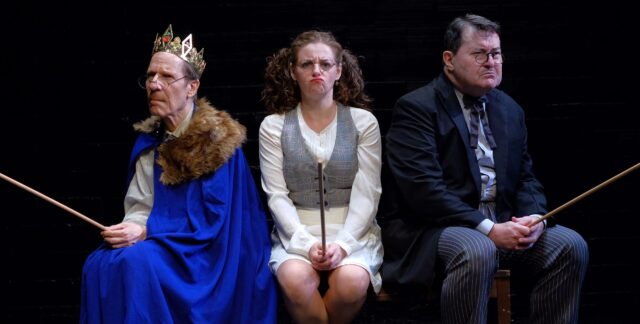
Originally presented by the New Yiddish Rep and now by the Congress for Jewish Culture (CJC), The Essence, the follow-up to CJC’s Bashevis’s Demons at Theater 154, is a tasty chronological performance lecture starring actor, pianist, silent film accompanist, and cruciverbalist Steve Sterner, a native New Yorker who also serves as musical director; actor, audiobook narrator, and pianist Yelena Shmulenson, who was born in Belarus and raised in Ukraine; and Queens native Allen Lewis Rickman, who also wrote and directed the show. All three have worked with the National Yiddish Theatre Folksbiene, which has dazzled audiences with Yiddish productions of The Golden Bride,The Sorceress,Fiddler on the Roof, and more. Rickman (Relatively speaking,The Big Bupkis! A Complete Gentile’s Guide to Yiddish Vaudeville) and Shmulenson (The Megillah for Itzik Manger,The Golem of Havana) previously teamed up in the CJC’s The Dybbuk and Tevye Served Raw and portrayed the nineteenth-century shtetl couple in the prologue of the Coen brothers’ film A Serious Man.
They take the audience on a rollicking journey through such Yiddish songs as “A Shtetele,” “Nit Bashert,” and “Dona, Dona” and scenes from such early Yiddish shows as Di Kishufmakherin,Moshiakh in Amerike, and Dem Shuster’s Tokhter. Some bits work better than others, but there’s plenty here to make you smile, laugh, and nod in agreement. “Yiddish is an amazing language for expressing emotion, and it’s an incredible language for humor,” Shmulenson says.
Yelena: You see, in Yiddish you can’t just say something, you have to make it interesting. You can’t say — Steve: “To be or not to be . . . that is the question.” Yelena: You have to say “Zayn oder nit zayn . . . du ligt der hint bagrubn.” Steve:“To be or not to be . . . that’s where the dog is buried.”
They gleefully discuss how colorful Yiddish curses are and list the many Yiddish words for son,unfortunately, and imbecile. “When the going gets tough, the Yiddish start cursing,” Rickman explains. “It’s opera, it’s poetry . . . Yiddish cursing is sculpture made from hate.”
The cast tells stories about Avrom Goldfadn, the failed newspaper publisher, failed medical student, failed teacher, failed ladies’ hat shop manager, and successful poet who was the Father of Yiddish Theater; describe how amateur groups put on Yiddish plays in concentration camps during WWII; delve into the German Jews known as the Yekes, who wanted to assimilate in America and actively campaigned against Yiddish theater coming here; and how John Barrymore, Paul Robeson, Orson Welles, Al Capone, Cole Porter, and kings and queens were enthralled with Yiddish theater. “In Paris even antisemites went to Yiddish theater,” Sterner points out. Rickman adds, “None of those people understood Yiddish, but they all went, anyhow.”
You don’t have to know any Yiddish to find the joy in The Essence, as English supertitles are projected on a small, framed horizontal screen above a red curtain, behind which the actors change costumes as they move from shtick to shtick, proving that, as Rickman writes in the program, “Yiddish theater is not any one thing, and it never was. It was naturalistic, expressionistic, melodramatic, and intimate. It was — and is — bombast and nuance, singing and silence, art and trash. It’s been around for a century and a half, and it’s been absolutely everything. The only thing that ties it together is its history of innovation, and, of course, the language.”
And as Rosten writes, “What other language is fraught with such exuberant fraughtage?”
Hobn a groys moltsayt!
[Mark Rifkin is a Brooklyn-born, Manhattan-based writer and editor; you can follow him on Substack here.]
“Art is not a mirror with which to reflect society but a hammer with which to shape it” is a popular quote attributed to Bertolt Brecht — and a favorite of contemporary composer David T. Little’s. Born and raised in the New Jersey countryside, Little is a renaissance man when it comes to opera. He was inspired to become a composer after being enthralled by Danny Elfman’s gothic score for The Nightmare Before Christmas, which he saw when he was fifteen; he later played drums in a rock band and got into musical theater and the avant-garde before turning to classical music.
He incorporates these elements and more into each of his works, which explore sociopolitical issues in unique and subtle ways. JFK is a two-hour grand opera that takes place the day before JFK’s assassination; Soldier Songs tells the story of a young veteran suffering from PTSD; and What Belongs to You is based on Garth Greenwell’s novel about an American teacher obsessed with a hustler in Sofia, Bulgaria.
In these and other pieces, Little, a two-time Grammy nominee, reshapes expectations of what opera is and can be while working with a wide range of impressive collaborators in multiple genres of music, movement, and film. This weekend, his seventy-minute industrial opera Black Lodge makes its New York debut, running January 11–15 at BRIC Arts Media in Brooklyn; it’s part of the Prototype festival, a coproduction of Beth Morrison Projects and HERE that focuses on new multidisciplinary opera and musical theater works.
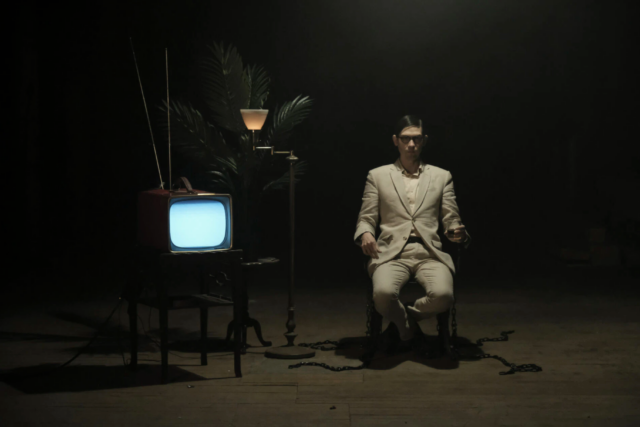
The live multimedia experience, set in a bardo where a writer (Timur Bekbosunov) struggles with his demons and encounters a mysterious woman (Jennifer Harrison Newman), features a libretto by poet Anne Waldman, sound by Garth MacAleavey, lighting by Matthew Steinberg, film written and directed by Michael Joseph McQuilken and photographed by Daniele Sarti, and performances by tenor Timur and the Dime Museum and the Isaura String Quartet, who present such songs as “Electric Cerberus,” “The Hungry Ghost Who Sings in Lamentation,” and “Premonition of the Worm.” Timur and his band appeared at the inaugural Prototype in 2013, as did Little’s Soldier Songs; the opening night of Black Lodge includes an immersive concert by Timur and the Dime Museum, while the January 12 show at 5:00 will be followed by an artist conversation.
In a twi-ny talk, Little discussed his eclectic taste in music, collaboration, bearing witness, and grappling with big questions.
David T. Little navigates through the world of opera in unique and inventive ways (photo courtesy David T. Little / Instagram)
twi-ny: You have composed works for string quartets, percussion quartets, contemporary ensembles, solo cello, church choirs, and others, with music styles ranging from classical and operatic to rock, goth, metal, and punk. What type of music did you listen to growing up? How did your taste become so eclectic?
david t. little: I grew up in a house that was full of music. For one, classic musicals, so music theater was in my DNA from the start. Also in heavy rotation at the time was ’50s/’60s pop (aka “oldies” at the time), Johnny Mathis, the Ink Spots, Dave Brubeck, Peter, Paul, & Mary, and the Kingston Trio. Then a little later — through my stepparents — Harry Chapin, Willie Nelson, and Garth Brooks crept in, all great musical storytellers.
Around age ten or so I started to discover harder/heavier music: Run-DMC and the Beastie Boys, the Cure, and hair metal; then Led Zeppelin; then through friends: Public Enemy, Megadeth, Guns n’ Roses, Nine Inch Nails, Ministry . . . then Pantera, then Napalm Death, Morbid Angel, etc. I also had an aunt who made a copy for me of Pink Floyd’s The Wall, which was life-changing. And when I was fifteen I went to a summer program at Berklee to study jazz drumming, where I heard a Naked City cover band (seriously) which blew my mind. The Rite of Spring came not long after, as would a period of intense obsession with Oingo Boingo, and a few years later a similar obsession with Ani Difranco, Dar Williams, and Utah Phillips.
And this whole time I was also playing in a fife and drum corps, playing Revolutionary and Civil War–era tunes, performing onstage in musicals, and exploring classical music. My grandfather was a great lover of classical music and played the organ. I heard a lot of music for the first time through him. My stepfather also had a lot of records of classical music, which I’d listen to: one that had [Charles Ives’s] “The Unanswered Question” and [Sergei Prokofiev’s] “The Love for Three Oranges Suite” was especially transformative.
So I don’t know, I think I just always loved music! If there was music to be heard, I wanted to hear it. I certainly had likes and dislikes, but it was never about genre per se. It was just about what spoke to me and didn’t — that’s still how I listen, and I still listen to a really wide range.
twi-ny: That wide range is also evident in many of the famous figures who have influenced and/or inspired your work, from JFK, Iggy Pop, and Spalding Gray to Robert Johnson and the Freedom Riders. In the case of Black Lodge, it’s David Lynch, William S. Burroughs, and Antonin Artaud. Do you see any commonalities in these people, specifically the last three?
dtl: Writing a piece of music provides a great opportunity to think about big questions, and I think for me each of these figures you mentioned poses some kind of a big question through their life or their work about something that felt really important to me at the time.
I also want to mention a few others whose names might not be as widely known: Last Nightfall was inspired by Rufina Amaya, the only survivor of the massacre at El Mozote. and the sky was still there was inspired by the story of my friend Amber Ferenz separating from the US military. And of course there are all of the people who lent their voices to Soldier Songs: Amber, of course, but also Justen Bennett, Rich Girardin, my grandfather Joe Little, uncle Gene Little, and stepfather Gene Woznicki. And of course Remedios Varo, Leonora Carrington, and Lou Harrison (in “The Conjured Life”) and Utah Phillips (in “Valuable Natural Resources”). I think some of this may be about documentary, about bearing witness to events, and people, what they did and how they lived.
But sometimes it is less clear. This was definitely the case with Lynch, Burroughs, and Artaud. I was initially drawn to what I saw as common threads in their work, which made me ask whether there was any influence between them. Not finding evidence of that, the really interesting questions started to emerge: If they hadn’t influenced each other, what accounted for the commonalities? This then became about the psychological and the spiritual. That, to me, is where the piece really lives.
These are three figures whose work stares the dark and difficult squarely in the face, and they were doing so — I believed — in search of some kind of spiritual balm. This was something I was grappling with at that time myself, which stemmed from questions to do with depression, escape, transcendence, spirituality, and the darker parts of life, including processing trauma. I found that Lynch, Burroughs, and Artaud all grappled with some versions of these issues (and others) through their work.
As I wrote the piece, winnowing my way through a dark and strange ten-year-long path, I was trying to move toward some sort of light at the end of the tunnel, which I thankfully found. I think those who have traveled a similar road will feel this story in the piece, even as the narrative itself is more abstract.
twi-ny: During the pandemic, you virtually reimagined Soldier Songs with Johnathan McCullough for Opera Philadelphia, where Black Lodge premiered online. What was it like turning Black Lodge into an in-person live presentation in front of an audience — and essentially doing the opposite with Soldier Songs?
dtl: It has been a really thrilling process full of discoveries! It is amazing to see how the brain tries to parse what it is seeing and hearing during the live show. Like, you know that Timur is singing live, but he is so synced with his image on the screen, you start to hear the live sound as recorded. Similarly with the visual world — the live image and the film somehow blur in your perception, making you doubt your senses. It really messes with you in a terrific way that feels totally perfect for what Black Lodge is exploring.
twi-ny: Timur is remarkable in it. Did you always have him and his band in mind when you were putting the show together?
dtl: My partner in crime! Yes — Timur was the voice of the piece from the beginning, absolutely! He’s so amazing. I first heard them perform at Prototype, actually, all the way back in 2013. His performances of both Nine Inch Nails’ “Closer” and Klaus Nomi’s “Total Eclipse” just blew my mind, and I knew immediately that I needed to work with him and the band, who are equally amazing. It has been a real pleasure to build this piece for and with him.
twi-ny: You are program chair at Mannes at the New School, where you teach New Opera Labs. What are your thoughts about the future of opera, based on what your students are doing and the success of such festivals as Prototype? A lot has changed over the last twenty-five years in the world of opera.
dtl: I think the opera world right now is also full of big questions. During the pandemic, there was such an eruption of inventiveness and creativity, because we needed to pivot somehow just to survive. To me that was the “shock doctrine” moment our field really needed, and I had high hopes. But since things reopened, a big part of the field has just gone back to their prepandemic plans, as if pretending that we hadn’t been permanently altered by what we experienced in those years! Add to this the fact that things have become very expensive to produce and you have an industry that has grown more risk averse, which are not great conditions for new work.
The good news is that most artists don’t tend to think or care about this stuff. We’re going to make the work we need to make, that feeds our souls, and then we’ll figure out how to put it onstage. My students at Mannes (and our alums) are doing tremendous work in this area — rethinking what opera can (and will) be moving forward — and, like always, we will find a way to make those pieces happen as a community.
All this to say, the operatic future I imagine is, by and large, the same as the world I came up in: a DIY scene where artists make work they love and make performances happen despite impossible odds. This, to me, is where the most interesting work has always originated, work that then gets taken up by forward-looking opera companies and producers. I’m grateful for festivals like Prototype and producers like Beth Morrison who continue to provide vital support to the artists who really see the future and insist on taking us there.
[Mark Rifkin is a Brooklyn-born, Manhattan-based writer and editor; you can follow him on Substack here.]
Murielle Borst-Tarrant will perform Tipi Tales from the Stoop at PAC NYC this week (photo by Justin Barbin)
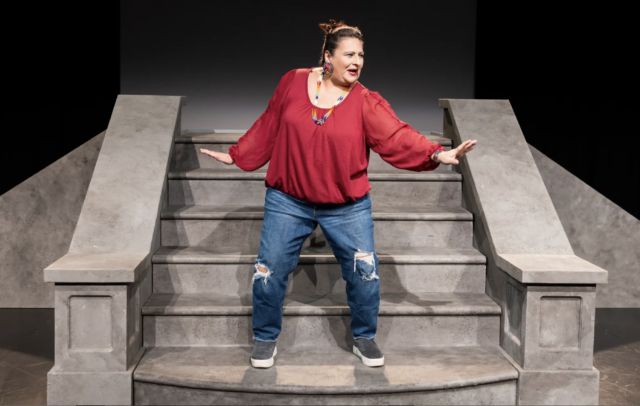
Who: Murielle Borst-Tarrant What:Tipi Tales from the Stoop Where:Perelman Performing Arts Center (PAC NYC), 251 Fulton St., Manhattan When: January 9-11, $20-$40 Why: “New York City has always been a gathering and trading place for many Indigenous peoples, where Native Nations intersected from all four directions since time immemorial. It was a place to gather and sometimes to seek refuge during times of conflict and struggle,” Jersey-based Murielle Borst-Tarrant (Kuna/Rappahannock Nations), who was born and raised in Red Hook, writes about her solo show Tipi Tales from the Stoop, running at PAC NYC from January 9 to 11. “My family first came to New York City in the late 1800s from Virginia and bought a house in Brooklyn and raised four generations. This story is about my family’s blood flow that is here on this land of New York City. How we as a family had to keep tradition alive. The survival of genocide, relocation, the boarding school system, and the outlaw by the United States government that we could not practice our cultural traditions. The story is about my family’s triumph of will, dysfunction, and historical trauma through laughter. My personal tapestry of stories being brought up in Brooklyn in a Mafia-run neighborhood when we were the only Natives on the block. And this is just one Tipi Tale of the city.”
Borst-Tarrant (More than Feathers and Beads,Don’t Feed the Indians — A Divine Comedy Pageant!), an author, playwright, director, producer, cultural artist, educator, and human rights activist, was influenced by such comedians as Richard Pryor, Joan Rivers, and Charlie Hill, who all interspersed sociopolitical issues into their performances. In a talkback following a workshop presentation of Tipi Tales from the Stoop at Brown, where she is the 250th Anniversary Visiting Assistant Professor of the Practice and Visiting Fellow, she explained about audience members who might not like some of the things she brings up: “You’re offended by this, I get it, but Native people spend their whole lives being offended, no matter what. People don’t know we exist.” The sixty-minute piece is directed by Mildred Ruiz-Sapp and Steven Sapp (Purgatory,UniSon) and coproduced with Safe Harbors NYC, where Borst-Tarrant is the founding artistic director, and Spiderwoman Theater, where she started her career. There are five chances to catch the show; Borst-Tarrant will participate in a discussion after the January 9 show.
[Mark Rifkin is a Brooklyn-born, Manhattan-based writer and editor; you can follow him on Substack here.]
FRANZ KAFKA: PROGRAMS
Morgan Library & Museum
225 Madison Ave. at 36th St.
Tuesday – Sunday through April 13, $13-$25 www.themorgan.org
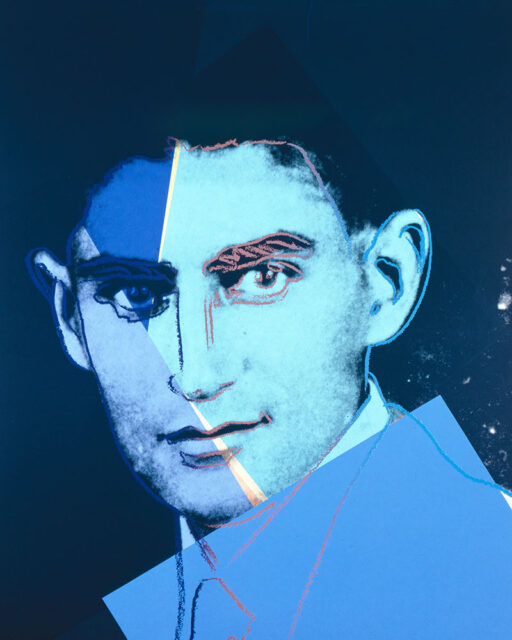
There are not a lot of authors whose name has been acknowledged as a legitimate adjective in Merriam-Webster’s dictionary, and even fewer of those adjectives have been used as the name of a musical. In fact, the only one might be Kafkaesque, which is used for anything that relates to Czech-born German-language writer Franz Kafka and has “a nightmarishly complex, bizarre, or illogical quality.”
Last fall, James Harvey’s musical comedy Kafkaesque! opened off-off-Broadway at Theatre 154 in the West Village, about one American family experiencing predicaments inspired by Kafka’s writings. The first song gets right to the point when Kafka sings, “By age forty I was dead / never had kids and I never wed / the words I wrote were hardly read / but now I’m an adjective.”
Kafka and his work have grown in stature since his passing in June 1924 at the age of forty from tuberculosis, leaving behind a literary legacy that includes the novels The Castle,The Trial, and Amerika and such influential stories as “The Judgment,” “In the Penal Colony,” and “The Metamorphosis.”
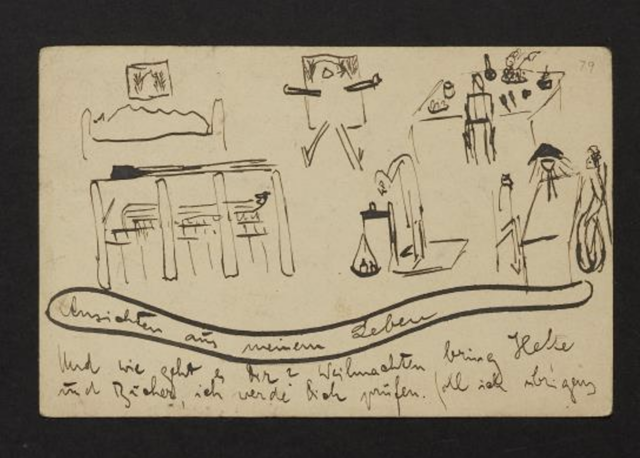
The Morgan Library is celebrating that legacy with the simply titled exhibition “Franz Kafka,” continuing through April 13. The show features original notebooks and manuscripts, letters about vegetarianism and his first hemorrhage, postcards, illustrated pages, family photos, handwritten aphorisms, first editions, architectural models, a diary, and other ephemera, primarily from the Bodleian Library, organized into such sections as “Life and Times: Health and Illness,” “Life and Times: Jewishness,” “Journeys: Around Europe,” and “Journeys: Of the Imagination.”
In his catalogue essay “Kafka’s Life and World,” British editor Ritchie Robertson writes, “Even during his final illness he kept writing. In March 1924 he wrote his last story, ‘Josefine, the Singer or The Mouse-People,’ and on his death-bed he corrected the proofs of the volume, A Hunger Artist: Four Stories, in which the story was included. ‘Josefine’ is a masterpiece of Kafka’s gentle, self-deprecating humour, and ends with the unexplained disappearance of the heroine and the narrator’s reflection that she will not be much missed. She ‘will lose herself happily in the numberless host of our people’s heroes, and, since we don’t go in for history, she will soon, redeemed and transfigured, be forgotten, like all her brethren.’”
Kafka often wrote about the unexplained, but he never disappeared from the public consciousness and will not soon be forgotten. The Morgan exhibition, held in conjunction with the centennial of Kafka’s death, is supplemented by a series of programs that delve further into Kafka’s life and world, ranging from panel discussions to special tours, workshops, lectures, and live music; below is the complete schedule.
Thursday, January 9 Kafkaesque: Creative Responses to Kafka, with Joshua Cohen, Maira Kalman, and Josh Luxenberg, Gilder Lehrman Hall, $25, 7:00
Friday, January 10
Virtual Spotlight Tour | Franz Kafka: The Making of an Icon, Zoom, sold out, 12:30
Wednesday, February 5
Virtual Lecture | Benjamin Balint: Kafka’s Last Trial, with author Benjamin Balint, Zoom, free with advance RSVP, noon
Gallery Tour | Franz Kafka with Benjamin Balint, Engelhard Gallery, free with museum admission, 2:00
Wednesday February 19
Winter Break Family Program | Franz Kafka Storytime and Artmaking, with readings of author Larissa Theule and illustrator Rebecca Green’s Kafka and the Doll, free with museum admission, 2:00
Thursday, March 6
Concert | Philip Glass’s “Metamorphosis,” with pianist Jenny Lin, actor Saroi Tsukada, and bassist Lindsay Rosenberg, followed by a discussion with music publisher Richard Guerin, Gilder Lehrman Hall, $40, 7:00
Friday, March 14
Lecture | “Daylight at the Exit”: Women Translating Kafka, with Michelle Woods, Gilder Lehrman Hall, free (advance RSVP recommended), 6:00
Wednesday, April 9
Lecture | Nahma Sandrow: Kafka and the Vagabonds, with playwright and Yiddish theater scholar Dr. Nahma Sandrow, J. Pierpont Morgan’s Library, $20, 6:00
[Mark Rifkin is a Brooklyn-born, Manhattan-based writer and editor; you can follow him on Substack here.]
The Vivid Unknown uses generative AI and immersive sound to reimagine Godfrey Reggio’s Koyaanisqatsi (photo by twi-ny/mdr)
TECHNE: THE VIVID UNKNOWN
Under the Radar Festival / BAM Next Wave
BAM Fishman Space
321 Ashland Pl.
January 4-7, $10
Series continues through January 19 utrfest.org www.bam.org
“I like people to break things. I’m always interested in how kids interact with things because they’re going to do things that someone else might not do,” artist John Fitzgerald told me at the inaugural presentation of TECHNE: The Vivid Unknown at BAM’s Fishman Space, a multimedia reimagining of Godfrey Reggio’s 1982 documentary Koyaanisqatsi, which means “life out of balance,” “life disintegrating,” and “a state of life that calls for another way of living” in the Hopi language.
Fitzgerald was not referring to the hardware but “the rules of engagement” that he’s designed with an expert team. “Anyone can bring their own story to it. That’s something I learned from Godfrey, who calls it the autodidactic experience of watching Koyaanisqatsi,” he said. “He’s not telling you, ‘technology bad, humans good — the natural world is safe.’ He’s giving you the opportunity to have thoughts about things, to experience things. Everyone will always watch it differently. I’ve seen that movie dozens and dozens of times; there are a lot of different ways that you can interpret it. So I’m excited to see how this evolves and unfolds. People might want to come in here and sit down on the floor, they might want to go out and get some fresh air and come back in; it’s an open experience.”
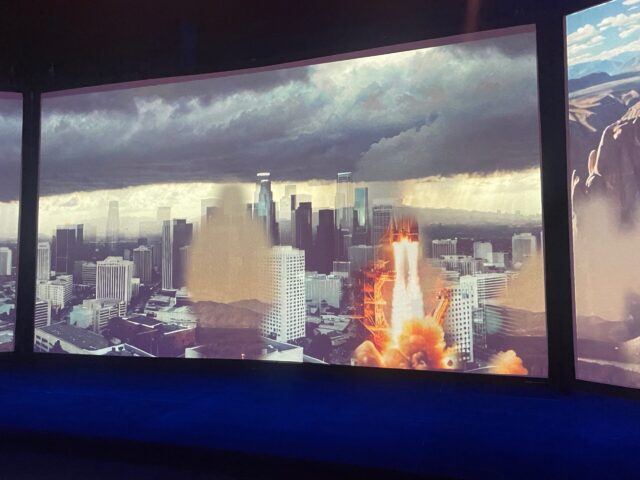
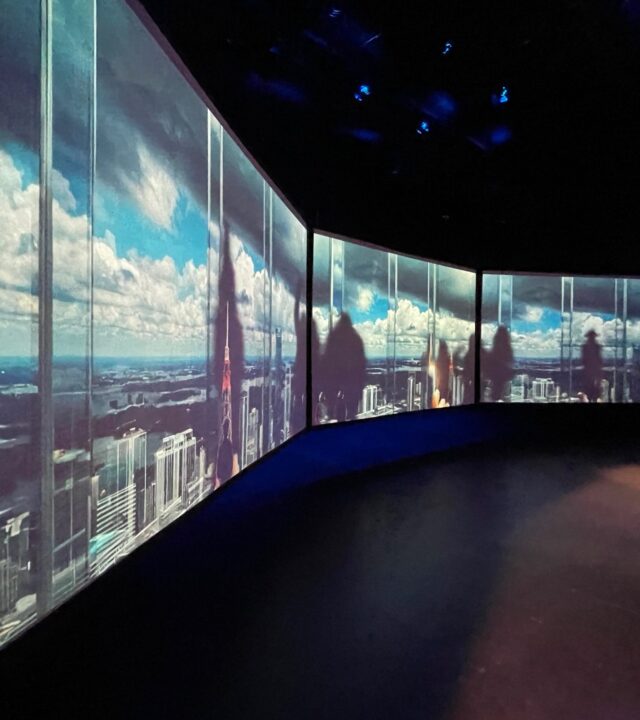
There are numerous ways to experience The Vivid Unknown, and it’s left up to each individual to decide, mimicking how we approach life. AI-generated images speed across three large screens as immersive AI sound envelops the room. You can sit on the floor right in front, move around, or take a regular seat in the back. If you decide to participate — and I highly recommend you do — you will discover that when you are in an oval of light, the shape of your body will be picked up by sensors behind you and your onscreen silhouette will eventually be filled by an image different from what is already being projected.
For example, amid slow-motion and time-lapse shots of beachgoers, mountains, metropolitan cities, airplanes, waterfalls, clouds, traffic, the demolition of a housing project, and other scenes, a rocket taking off fit into my outline and followed me onscreen as I walked across the room. Meanwhile, a woman stood near the middle, moving like a dancer. Couples posed together. A few kids jumped up and down. Humanity fused together with technology and the environment as some of us participated and others merely watched from the back.
Almost all the young boys and girls chose to become involved with the art, which brought out the child in the adults who got up from their seats and interacted with it as well. Noticing that, Fitzgerald, who has a five-year-old and a four-month-old, said that the older one is “the best product tester out there. He’s the first to be, like, ‘That’s too long,’ or ‘I want to see more of that.’ He speaks without a filter.”
Curated by Onassis ONX, TECHNE consists of four digital installations that are part of BAM’s Next Wave Festival and Under the Radar; it begins January 4-7 with The Vivid Unknown and continues January 8-11 with Marc Da Costa and Matthew Niederhauser’s The Golden Key, January 12-15 with Margarita Athanasiou’s Voices, and January 16-19 with Stephanie Dinkins’s Secret Garden. (Tickets for each is $10; a series pass is $35.) BAM Rose Cinemas will be showing Koyaanisqatsi on January 7 at 7:30, with Fitzgerald and Vivid Unknown codirector Reggio on hand for the conversation “Terra techno firma” afterward.
Onassis ONX NY program director Jazia Hammoudi shared information with me about how it all works, but I opted to discover much of The Vivid Unknown on my own, which was extremely satisfying. In the program, she writes, “The refined interactivity of the work’s music and visuals subverts the source material’s linear minimalism and subtly engages the body in epic vistas from mountainscapes to oil fields. Within The Vivid Unknown’s zone of immersion, the connection between individual and collective action reflects the complex relationships between human agency and planetary outcomes.” In addition to TECHNE, Onassis ONX is presenting Christiana Kosiar’s RUNWAY and Viola He’s A {room} of one’s own January 10-14 at the Olympic Tower on Fifth Ave. as part of Under the Radar’s Under Construction series.
Fitzgerald met Reggio about two years ago, when he went out to Santa Fe to visit the now-eighty-four-year-old filmmaker, who also made the sequels Powaqqatsi in 1988 and Naqoyqatsi in 2002; all three films in the series feature original soundtracks by Philip Glass.
Audience participation enhances experience of multimedia The Vivid Unknown by John Fitzgerald and Godfrey Reggio (photo by twi-ny/mdr)
Since this was the first public presentation of the work at BAM, I asked Fitzgerald what he thought about the audience’s response.
“It’s exceeding expectations on all levels,” he said. “We’ve never had this many people in it. One of the things about making creative technology art is that it’s always half broken until it’s not, until you have to press play and make sure everything comes together. The idea was that Koyaanisqatsi is a depiction of the state of the world in the latter half of the twentieth century as chaos unfolded. So I was just playing around with this idea of how you don’t really control anything but you do have an impact on this.”
That concept is also represented by a video sculpture off to one side, a refurbished slot machine that was transformed into an interactive artwork by the fabrication studio Chateau Brooklyn. When you pull down the S2000 lever, images speed by a trio of small monitors; it offers an additional moment of connection, but it has no effect on the film. It exists on its own, but it offers a sense of power and involvement even though the results are random. One boy was having a blast with it, pulling the lever a few dozen times, too young to consider the metaphor of how we gamble in life, taking or avoiding risk.
At several points, the barrage of images dropped out and the screens went dark; only the shapes of the audience members standing in the oval of light could be seen. “I want people to feel like they’re making an impact on the images,” Fitzgerald said. “That’s why the last state is left this way; the film disappears, and it’s fuel to give a reflection of your presence.”
He was also quick to share credit. “This is a project made by a dozen artists; it’s truly a collaborative effort,” Fitzgerald explained. “Everyone is unified behind Godfrey and his vision to show humans where we are right now. It’s like a mirror into ourselves.”
[Mark Rifkin is a Brooklyn-born, Manhattan-based writer and editor; you can follow him on Substack here.]
Japan Society Under the Radar presentation of Duke Bluebeard’s Castle is one of dozens of experimental works in January performance festivals (photo by Yoji Ishizawa)
Every January, many of us begin the new year with resolutions to make positive changes in our lives; I find the best way to start that is by checking out the latest in cutting-edge and experimental theater, music, dance, opera, film, and other forms of entertainment. Performance festivals abound this month, at tiny venues you’ve never heard of, places you’ve always wanted to go to but haven’t yet, and well-known spaces you haven’t been to in years.
You now have the chance to fill those voids at such festivals as Under the Radar, Prototype, Exponential, Out-Front!, Live Artery, Winter Jazzfest, and more, none of them costing nearly as much as a Broadway show. Below are only some of the highlights of this exhilarating time to try something that might be outside your comfort zone — or right up your alley.
New Ear Festival runs January 3-5 at Fridman Gallery on Lower East Side
NEW EAR FESTIVAL
Fridman Gallery
169 Bowery
January 3-5, $20-$30, Festival Pass $50-$70 new-ear.org
“Focused on fostering experimentation in time-based media and interdisciplinary collaboration in New York City and beyond,” Fridman Gallery’s New Ear Festival, which began in 2013, is back with a stellar lineup of musicians and installations, including Henry Threadgill, Ash Fure, and Kyp Malone.
Friday, January 3
Main Room: Henry Threadgill, Justin Cabrillos, relatively special theories of spAcial relativities, medium (Yaz Lancaster & GG200BPM); 8-Channel Audio: New Ear Spatial: Echoes; 4-Channel Video: “Landscape of the Medium” by Marleigh Belsley, 7:30
Saturday, January 4
Main Room: Members of Irreversible Entanglements, Shara Lunon, Kamari Carter & Gladstone Deluxe; 8-Channel Audio: New Ear Spatial: Echoes; 4-Channel Video: \[ the hurricanes in your mouth \] by Johann Diedrick, 7:30
Sunday, January 5
Main Room: Ash Fure, Brian Chase, Kyp Malone, Brian House & Sue Huang (feat. Robert Black); 8-Channel Audio: New Ear Spatial: Echoes; 4-Channel Video: Ash Fure, Studies for the Coming Heat, 7:30
The Brooklyn Exponential Festival is a treat for curious theatergoers
Brooklyn’s month-long Exponential Festival consists of nineteen shows in such venues as the Loading Dock, the Brick, and JACK, highlighting pieces by “participants [who] are committed to ecstatic creativity in the face of commercialism. Exponential is driven by inclusiveness and a diversity of artists, forms, and ideas coupled with utopian resource-sharing, mentoring, and the championing of risky, rigorous work in eclectic fields.”
Friday, January 3
through
Sunday January 5 haircut play :€, by Eulàlia Comas, Loading Dock, 170 Tillary St., $28.52
Thursday, January 9
through
Sunday, January 12 Neck Down, f.k.a. Rainbow’s End, by Nic Adams, We Are Here Brooklyn Studios, 563 Johnson Ave., $12.51-$49.87
Friday, January 10
through
Friday, January 17 MEOW!, by Matthew Antoci & Meaghan Robichaud, Loading Dock, 170 Tillary St., $28.52
Wednesday, January 15
through
Saturday, January 18 Sapphire, by Ella Lee Davidson, the Brick, 579 Metropolitan Ave., $25-$55
Friday, January 17, 7:30
and
Saturday, January 18, 3:00 & 7:30 Braiding Water, by Xiaoyue Zhang, JACK, 20 Putnam Ave., $25-$50
Thursday, January 23
through
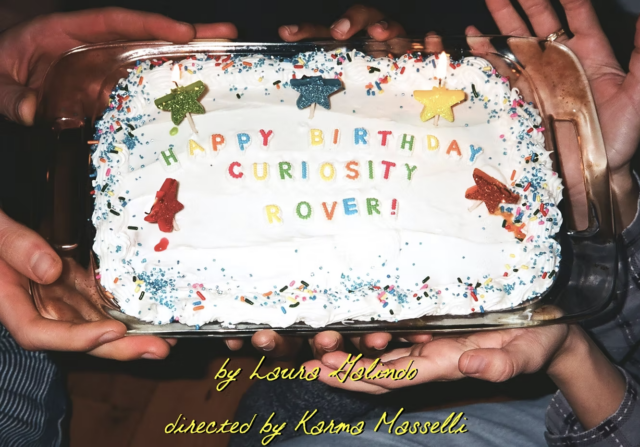
Saturday, January 25 Happy Birthday, Curiosity Rover!, by Laura Galindo, Brick Aux, 628 Metropolitan Ave.,
Friday, January 24, 7:30
and
Saturday, January 25, 3:00 & 7:30 Tongues by Yibin Wang and Yejia Sun JACK, 20 Putnam Ave., $25-$50
UNDER THE RADAR
Multiple venues
January 4-19, free – $120 utrfest.org
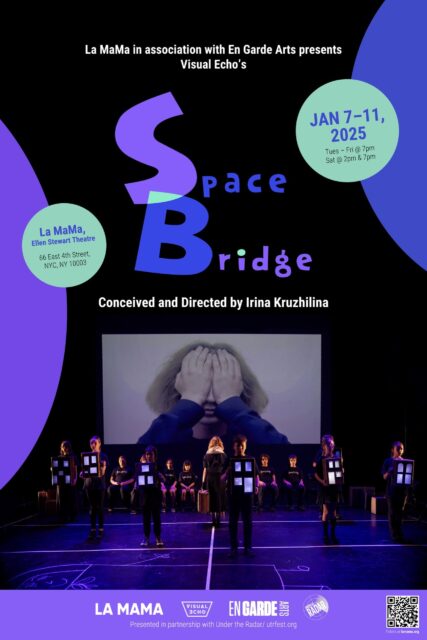
Under the Radar is the glittering gem of performance festivals, two weeks of unique, unpredictable, and fascinating works, many hard to define but need to be seen. Founding director Mark Russell brought it to New York City in 2005, teamed up with the Public Theater’s Oskar Eustis in 2006, and has been presenting intriguing and exciting pieces from around the world ever since. The 2025 UTR, celebrating its twentieth anniversary, takes adventurous theatergoers on a thrilling ride, introducing audiences to high-tech generative AI (the four-part interactive and immersive TECHNE at BAM), a time loop in a small white closet (The 7th Voyage of Egon Tichy at New York Theatre Workshop’s Fourth Street Theatre), a political prisoner in Tehran being visited by her husband (Blind Runner at St. Ann’s Warehouse), actual Russian refugee children who live in US shelters and their American peers (SpaceBridge at La Mama), a pair of skeletons digging for bones in the underworld (Dead as a Dodo at the Baruch Performing Arts Center), a reimagining of a popular musical (Show/Boat: A River at NYU Skirball), a Harajuku makeover of a classic French fairy tale (Duke Bluebeard’s Castle at Japan Society), a pair of rice cookers delving into the last twenty years of Korean history (Cuckoo at PAC NYC), and a marathon funeral for a company’s longtime home (Soho Rep Is Not a Building. Soho Rep Had a Building… at walkerspace). Below are only some of the highlights.
Saturday, January 4
through
Tuesday, January 7 TECHNE: The Vivid Unknown, by John Fitzgerald and Godfrey Reggio, BAM Fisher, Fishman Space, $10
Saturday, January 4
through
Thursday, January 24 Blind Runner, by Amir Reza Koohestani and Mehr Theatre Group, St. Ann’s Warehouse, 45 Water St., $44-$54
Saturday, January 4
through
Sunday, January 26 The 7th Voyage of Egon Tichy [Redux], by Sinking Ship and Theater in Quarantine, New York Theatre Workshop’s Fourth Street Theatre, 83 East Fourth St., $30-$50
Tuesday, January 7
through
Friday, January 11 TECHNE: The Golden Key, by Marc Da Costa and Matthew Niederhauser, BAM Fisher, Fishman Space, $10
Tuesday, January 7
through
Saturday, January 11 SpaceBridge, by Irina Kruzhilina, La MaMa, Ellen Stewart Theatre, 66 East Fourth St., $10-$30
Wednesday, January 8
through
Sunday, February 9 Dead as a Dodo, by Wakka Wakka, Baruch Performing Arts Center, 55 Lexington Ave., $40-$55
A space traveler is trapped in a time loop in The 7th Voyage of Egon Tichy [Redux] (photo by Josh Luxenberg / Sinking Ship / Theater in Quarantine)
Wednesday, January 9
through
Sunday, January 26 Show/Boat: A River, by Target Margin Theater, NYU Skirball Center for the Performing Arts, 566 LaGuardia Pl., $60-$120
Sunday, January 12
through
Wednesday, January 15 TECHNE: Voices, by Margarita Athanasiou, BAM Fisher, Fishman Space, $10
Wednesday, January 15
through
Saturday, January 18 Duke Bluebeard’s Castle, by Shuji Terayama, Japan Society, 333 East Forty-Seventh St., $36-$48, 7:30
Thursday, January 16
through
Saturday, January 18 Cuckoo, by Jaha Koo, Perelman Performing Arts Center, 251 Fulton St., $58-$68
Thursday, January 16
through
Sunday, January 19 TECHNE: Secret Garden,by Stephanie Dinkins, BAM Fisher, Fishman Space, $10
Angie Pittman will present Black Life Chord Changes at Out-FRONT! Festival (photo by Brian Rogers)
OUT-FRONT! FESTIVAL
Judson Church, 55 Washington Square South
BAM Fisher Hillman Studio, 321 Ashland Pl.
January 7-13, free with advance RSVP (suggested donation $25) pioneersgoeast.org
The third edition of Pioneers Go East Collective’s Out-FRONT! Festival features presentations from such choreographers and dance companies as jill sigman/thinkdance, Angie Pittman, and Kyle Marshall Choreography at Judson Church and the BAM Fisher Hillman Studio in addition to an evening of films. “As a grassroots artist-driven collective, we create a high-visibility platform for dance and interdisciplinary artists whose rigorous, playful, and fabulously outrageous creative practices speak to our community in unexpected and beautiful ways,” artistic director Gian Marco Riccardo Lo Forte said in a statement. “We engage known and lesser-known artists to shape a joyful space to celebrate queer art and stories of vulnerability and inclusion.”
Tuesday, January 7
and
Friday, January 10
Miranda Brown + Noa Rui-Piin Weiss: !!simon says~~!:));)$$, and Nattie Trogdon + Hollis Bartlett: Vessels, Judson Church, 7:00
Wednesday, January 8
and
Thursday, January 9
jill sigman/thinkdance: Re-Seeding (Encounter #4), Judson Church, 7:00
Friday, January 10, 8:30
and
Monday, January 13, 7:00
Blaze Ferrer: Dick Biter and Stuart B Meyers: thegarden, Judson Church
Saturday, January 11
Out-FRONT! Film Series: dance and experimental short films by Dominique Castelano, Jueun Kang, Kathleen Kelly, Haley Morgan Miller, Pioneers Go East Collective, and Maamoun Tobbo, Judson Church, 3:00
Angie Pittman: Black Life Chord Changes and Kyle Marshall Choreography: Joan, BAM Fisher Hillman Studio, 7:00
zoe | juniper will present latest work as part of new York Live Arts festival (photo by Anton Karaa)
LIVE ARTERY
New York Live Arts (unless otherwise noted)
219 West 19th St.
January 8-18, $28-$40 newyorklivearts.org
New York Live Arts’ annual Live Artery showcases works by emerging and established choreographers; this year’s impressive lineup includes Ogemdi Ude, zoe | juniper, Joseph Keckler, Leslie Cuyjet, Miguel Gutierrez, and, if you are lucky enough to get an invite, Shamel Pitts, A.I.M by Kyle Abraham, and Bill T. Jones/Arnie Zane Company.
Wednesday, January 8
through
Saturday, January 11 My Body, My Archive, by Faustin Linyekula
Friday, January 10
through
Monday, January 13 The Marthaodyssey, by Jesse Factor
Saturday, January 11 Major, by Ogemdi Ude, 3:00
time/life/beauty, by Michael Sakamoto and Paul Miller aka DJ Spooky, $15, 6:00
Saturday, January 11
and
Sunday, January 12 For All Your Life, by Leslie Cuyjet, CPR — Center for Performance Research, 361 Manhattan Ave., $25
Sunday, January 12
Artist Salon, with Janani Balasubramanian, Gabriela Carneiro da Cunha, Kayla Farrish, Heather Kravas, and Tere O’Connor, free with advance RSVP, 11:00 am
The Missing Fruit (Part I), by Roderick George — kNonAme Artist, $15, 1:00
UNTITLED, by zoe | juniper, with Xiu Xiu, $15, 6:00
Sunday, January 12
through
Saturday, January 18 Super Nothing, by Miguel Gutierrez
Monday, January 13 Turn. Turning.TURNT, by Cynthia Oliver/COCo Dance Theatre, 6:00
A Good Night in the Trauma Garden, by Joseph Keckler, 8:00
SFX FESTIVAL
the wild project
95 East Third St.
January 9-11, $23.33 thewildproject.org
The seventh iteration of the Special Effects Festival (SFX), founded by Caden Manson and Jemma Nelson, takes place January 9-11 at the wild project with three evenings of new works “to rekindle the spirit of the avant-garde and create a shared space to gather for contemporary performance.”
Thursday, January 9
Illuminated Skies: A Night of Puppetry, with Cumulo by Emily Batsford, an excerpt from Shiny One by Jon Riddleberger, Cast from Heaven by Jacob Graham, and Where Did You Go, Connie? by Amanda Card, curated by Amanda Card, 7:00
Friday, January 10
Works by Wonderful Cringe (Nicholas Sanchez), Harlequin (Adonis Huff & Jelani Best), and Lele Dai, curated by Kyla Gordon, 7:00
Saturday, January 11
Gray Spaces, with Idiot Void (working title) by David Commander, double column by Marissa Joyce Stamps, and 5G Maitreya by Glenn Potter-Takata, curated by Lisa Clair, 7:00
Founded in 2005, “Winter Jazzfest celebrates the music as a living entity, wherein history collides with the future in every note. Creative improvisation in the digital age continues to stimulate thought and emotion of its listeners, embracing innovation, defying instrumental boundaries and the old cliches of ‘What is Jazz?’” Among this year’s highlights are poet, writer, lyricist, and activist aja monet, pianist and composer Vijay Iyer, Sun Ra Arkestra, and two days of marathons at such venues as Le Poisson Rouge, Nublu, Mercury Lounge, Baby’s All Right, and the Bitter End.
Thursday, January 9
aja monet, Faye Victor, Sophye Soliveau, LPR, 158 Bleecker St., $45.42, 6:30
Friday, January 10
Manhattan Marathon, multiple venues, including Endea Owens at LPR, Jenny Scheinman’s All Species Parade at City Winery, Vijay Iyer & Wadada Leo Smith at Performance Space NY, the Christian McBride Band at Mercury Lounge, and Sophye Soliveau at the Bitter End, $85
Saturday, January 11
Brooklyn Marathon, multiple venues, including Sun Ra Arkestra at Brooklyn Bowl, Vijay Iyer Trio +1 Featuring Adam O’Farrill at National Sawdust, Peter Apfelbaum’s New York Hieroglyphics at Loove Labs Annex, Matthew Shipp Trio at Loove Labs, Lion Babe at Baby’s All Right, and Ken Butler’s Curious Cave of Anxious Objects at Hybrid Visions, $85
Sunday, January 12
Impressions: Improvisatory interpretations on A Love Supreme, featuring the Ravi Coltrane Quartet with David Virelles, Jeff “Tain” Watts, and Dezron Douglas, with guests Allison Miller, Angelica Sanchez, Ben Williams, James Brandon Lewis, Joel Ross, Kalia Vandever, Kassa Overall, Kenny Warren, Linda May Han Oh, Mali Obomsawin, Melissa Aldana, Nasheet Waits, Orrin Evans, Rafiq Bhatia, Sam Newsome, Theon Cross, Tomoki Sanders, and more, Roulette, 509 Atlantic Ave., $63, panel 6:30, show 8:00
Monday, January 13
Strata-East Rising, A Landmark Concert with Charles Tolliver, Cecil McBee, Billy Hart, Billy Harper, Christian McBride, aja monet, Endea Owens, Steve Jordan, Keyon Harrold, Camille Thurman, and more, Le Poisson Rouge, 158 Bleecker St., $57.47-$105.06, 7:00 & 9:30
Cofounding directors Kristin Marting and Beth Morrison have put together another outstanding group of shows for Prototype, which “is committed to surprising our audiences and confounding their expectations through content, form, and relevance.” This year they will be accomplishing that with eight presentations, including an art bath, concerts, a streaming hip-hopera, and five works at HERE, La MaMa, and the Village East. Watch out for Eat the Document, based on the novel by Dana Spiotta, exploring activists from the 1970s underground to 1990s suburbia, and Black Lodge, inspired by the lives and careers of William S. Burroughs, David Lynch, and Antonin Artaud.
Thursday, January 9
through
Friday, January 17 Eat the Document, alternative opera by composer John Glover and librettist Kelley Rourke, directed by Kristin Marting, HERE Arts Center, 145 Sixth Ave., $35-$150
Thursday, January 9
through
Sunday, January 19 TELEKINETIK, a Catapult Opera production by Khary Laurent, directed by George Cederquist, available on demand, free
Saturday, January 11
through
Tuesday, January 14 Positive Vibration Nation, rock guaguanco opera by Sol Ruiz, with Rey Rogriguez, Alejandro Sierra, Fernando Sanchez Abad, Margarita Arranz, Adonnas Jones, and Shira Abergel, HERE Arts Center, 145 Sixth Ave., $35-$150
Saturday, January 11
through
Wednesday, January 15 Black Lodge, goth industrial rock opera by composer David T. Little, librettist Anne Waldman, starring Timur and the Dime Museum and Isaura String Quartet, film by Michael Joseph McQuilken, BRIC Arts Media, 647 Fulton St., Brooklyn, $40.25-$155.25
Thursday, January 16
through
Sunday, January 19 In a Grove, chamber opera by composer Christopher Cerrone and librettist Stephanie Fleischmann, directed by Mary Birnbaum, and starring Metropolis Ensemble, La MaMa Experimental Theatre Club, Ellen Stewart Theater, 66 East Fourth St., $35-$75
PhysFestNYC
Stella Adler Center for the Arts
65 Broadway
January 9-19, $20 www.physfestnyc.org
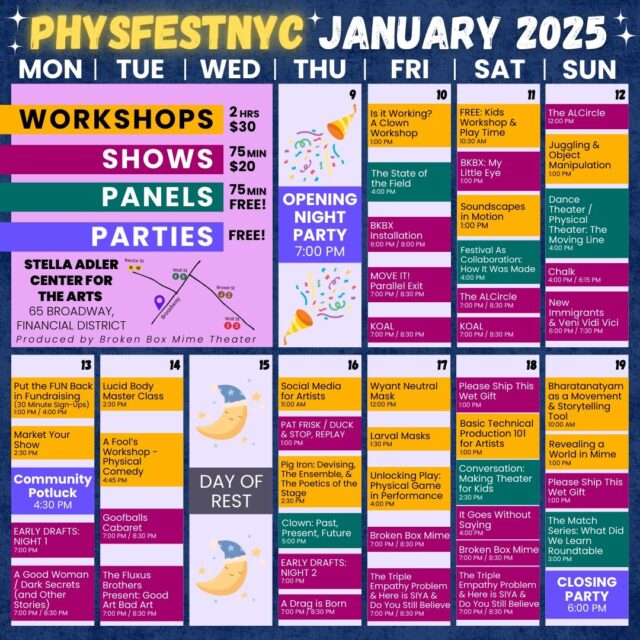
PhysFestNYC was started last year as “a community-focused festival that celebrates, enriches, and envisions our field of physical theater . . . [which] tends to be experimental, innovative, and genre-breaking.” The second annual event, taking place January 9–19 at the Stella Adler Center for the Arts, consists of workshops, panel discussions, masterclasses, and live performances. Below are some of the highlights.
Tuesday, January 14 The Fluxus Brothers Present: Good Art Bad Art, performance art lecture demonstration with Ben Rosenthal, Morgan Rosenthal, and Morgan Fitzpatrick Andrews, $20, 7:00 & 8:30
Thursday, January 16 Pat Frisk/Duck, with Joanne Edelmann, and Stop, Replay, with Abhirami Rao, $20, 1:00
Friday, January 17
and
Saturday, January 18 Broken Box Mime Theater, $20, 7:00 & 8:30
The Triple Empathy Problem, with Noah Ortega and Asa Page, Here Is Siya, with Joey Antonio, and Do You Still Believe?, with Noel Olson, $20, 7:00 & 8:30
Saturday, January 18 It Goes Without Saying, created and performed by Bill Bowers, 20, 4:00
Saturday, January 18
and
Sunday, January 19 Please Ship This Wet Gift, with Marta Mozelle MacRostie, followed by a panel discussion, $20, 1:00
THE FIRE THIS TIME FESTIVAL
FRIGID New York at the wild project
195 East Third St.
January 23 – February 2, $25 www.firethistimefestival.com
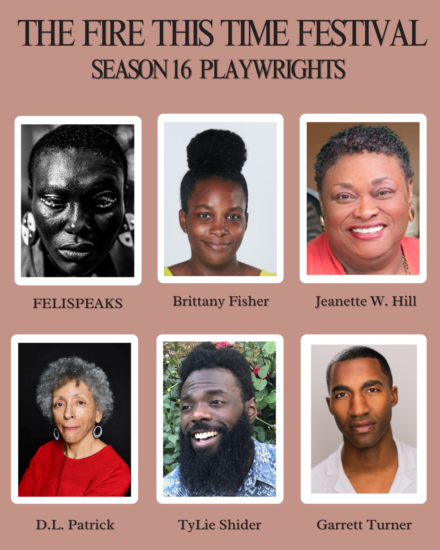
Founded in 2009 by Kelley Nicole Girod, the Fire This Time Festival, now in its sixteenth year, “provides a platform for early career playwrights of African and African American descent.” The 2024 iteration comprises six ten-minute shows at the wild project, presented by FRIGID New York, that take on such topics as Billie Holiday, queer identity, the search for a missing sibling, and an unusual night for Hagar and Abraham.
Thursday, January 23
Friday, January 24, 31
Saturday, January 25
Saturday, February 1
Sunday, February 2 Pound Cake, by Brittany Fisher; OUT, by FELISPEAKS; Just One Good Day, by Jeanette W. Hill; But Not Forgotten, by D. L. Patrick; Security Watch, by TyLie Shider; and Immanentize the Eschaton, by Garrett Turner
[Mark Rifkin is a Brooklyn-born, Manhattan-based writer and editor; you can follow him on Substack here.]
The executive committee at Eureka Day School has its work cut out for it (photo by Jeremy Daniel)
EUREKA DAY
Samuel J. Friedman Theatre
261 West Forty-Seventh St. between Broadway & Eighth Ave.
Tuesday – Sunday through February 16, $48-$321 www.manhattantheatreclub.com
Jonathan Spector’s Eureka Day is the funniest play of the year.
Five years ago, I called Colt Coeur’s East Coast premiere of Eureka Day at walkerspace an “uproarious satire.” It’s even better in the Broadway debut of the Manhattan Theatre Club production at the Samuel J. Friedman, succeeding where a similarly themed show, Larissa FastHorse’s The Thanksgiving Play, about a woke quartet of grown-ups trying to put on an acceptable, PC holiday show for young schoolchildren, failed. The fall 2018 iteration of The Thanksgiving Play at Playwrights Horizons was fresh and original and utterly hilarious; its 2023 Broadway version was stale and outdated, like dried-out leftovers.
That doesn’t happen with Eureka Day, which strikes gold for the second time.
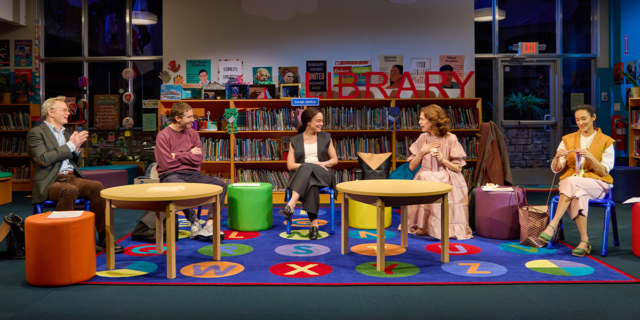
The story takes place in the fall of 2018 in the library of the Eureka Day School in Berkeley, California. The executive committee is meeting, and the opening dialogue sets the stage for what’s to come.
Meiko: Personally no / I don’t find it offensive / the term itself is not offensive. Eli: It’s descriptive. Suzanne: I think she’s saying / I’m not putting words in your mouth / she’s saying it’s not offensive / but when you contextualize it in that way. . . . Meiko: I find / the best way not to put words in someone’s mouth? / is not to put words in their mouth. Don: Okay okay. Suzanne: Sorry sorry. Meiko: It’s fine / what I meant was / that we’d want to make it absolutely clear that it’s optional / that it’s not / Either / Or. Suzanne: Right / and also / that the inclusion of the term on this list at all is / I think / inappropriate? / and that some people may / With Good Reason / find its inclusion offensive. Eli: No no yeah / I just wonder though / by leaving it off / is it possible some people would find its absence offensive? Don: You’re concerned / that it could be a sort of / erasure / of people’s experience? Eli: Right / if our Core Operating Principle here is that everyone should / Feel Seen / by this community. Suzanne: There’s no benefit in Feeling Seen if you’re simultaneously Being Othered / right? Meiko: Well / no yeah. Don: Carina, did you want to / do you want to / offer anything? Carina: Oh, I / I’m happy to defer / I don’t know that I’ve really formed a strong [opinion.] Don: That’s perfectly all right / even just your gut instinct is [welcomed] / this is an Open Room / we welcome your unique perspective.
The discussion is about what to include in the school’s online dropdown menu where parents are supposed to click off their kid’s race/ethnicity/heritage, but it could deal with so many other subjects that are part of the committee’s efforts to be as inclusive as possible in any and all situations.
“Sounds like there’s a lot to unpack here,” Don says, but there’s a lot to unpack everywhere in this outrageously hilarious satire.
The white, childless Don (Bill Irwin) is the head of the committee and prefers not to take sides, ending each meeting with a quote from the thirteenth-century Sufi poet Rumi. The well-off, white Suzanne (Jessica Hecht) is a longtime board member who has put each of her six children through Eureka Day and regularly supplies the library with books. The white, Jewish Eli (Thomas Middleditch) is a wealthy tech bro with an open marriage and one son in the school. He is secretly dating the half-Japanese Meiko (Chelsea Yakura-Kurtz), who has a daughter in the school and spends much of her time knitting rather than actively participating in the committee’s proceedings. And the biracial Carina (Amber Gray) is filling the spot saved for the new member, hesitant to share her views until she can’t stop herself as it all becomes ridiculously absurd.
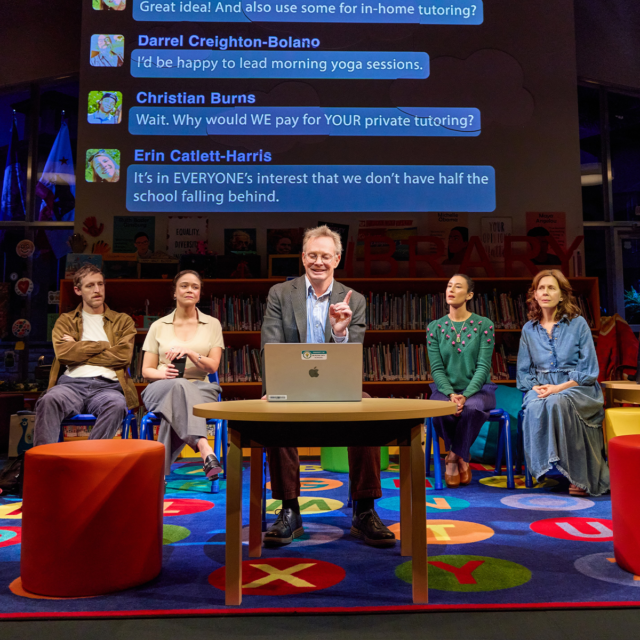
When a student contracts the mumps and the health department sends an official notice explaining that nonvaccinated children will be barred from attending school until they get their shot, the committee calls for a hybrid Community Activated Conversation, with parents commenting from home on the chat, which delves into vaccination efficacy, conspiracy theories, personal and public responsibility, and plenty of vicious name-calling.
Christian Burns: Wait. HALF the school is antivaxxers? Seriously???? Sandra Blaise: “Anti-vaxxer” is not really a term I’m comfortable with. It’s actually something said out of IGNORANCE. Karen Sapp: Exactly! Protect your children by EDUCATING YOURSELVES. Tyler Coppins: OR, Protect your children by VACCINATING THEM. Courtney Riley: Wait what???? Why should we be forced to keep our kids home because you CHOOSE to endanger yours? Doug Wong: Okay here’s another idea: what if we made the quarantine days OPTIONAL. Orson Mankel: Doug, that’s idiotic. If the “problem” is that we won’t have enough kids in class, why make the problem worse??? Christian Burns: TRUE FACTS: Moonlanding wasn’t faked. 9/11 wasn’t an inside job. Global Warming is real. Vaccines Don’t Cause Autism. Karen Stacin: Mock all you want, but I saw so many bad things as a nurse. That’s why I decided I would NEVER subject my children to Western Medicine of any kind. Christian Burns: Remember that time I got crippled from polio? Oh, no, wait. I didn’t. Cause I got FUCKING VACCINATED.
Things only devolve from there in side-splitting ways that are even funnier — and more frightening — now that President-elect Donald Trump has nominated the controversial Robert F. Kennedy Jr. to run the Department of Health and Human Services.
Community Activated Conversation at Eureka Day goes terribly wrong in hilarious Broadway play (photo by Jeremy Daniel)
Ancient Greek polymath Archimedes is often credited with coining the exclamation Eureka! upon discovering what became known as the Archimedes Principle, a scientific theory about buoyancy. So it makes sense that Spector has named the woke school in question Eureka Day. Todd Rosenthal’s set features blue chairs, red, orange, and yellow trapezoid tables that are rearranged into geometric shapes, posters of Ruth Bader Ginsburg, Albert Einstein, Maya Angelou, Sandra Day O’Connor, and Michelle Obama, and a sign that reads “Social Justice” under a placard that proclaims, “Berkeley Stands United Against Hate.” Clint Ramos’s naturalistic suburban costumes are highlighted by the long, fussy frocks worn by Suzanne.
Tony winner Anna D. Shapiro (August: Osage County,This Is Our Youth) directs with a sweet glee, while sound designers Rob Milburn and Michael Bodeen know just when the laughs are coming, particularly during the Community Activated Conversation, when David Bengali’s projections take over and the characters’ discussion fades into the background.
The ensemble is outstanding: Tony nominee Gray (Natasha, Pierre, and the Great Comet of 1812,Hadestown) is cool and collected as the determined Carina, who can’t believe what the board is doing; two-time Tony nominee Hecht (Summer, 1976,Fiddler on the Roof) is delightful as the nervous, jittery Suzanne, punctuating her dialogue with wonderful sighs and grunts; Tony winner Irwin (Who’s Afraid of Virginia Woolf?,On Beckett) is tender as the mild-mannered, oblivious Don; Emmy nominee Middleditch (Silicon Valley) adds humanity to the selfish Eli; and Chelsea Yakura-Kurtz (How the Light Gets In,Unrivaled) beautifully captures Meiko’s evolving value system as she reconsiders being part of the team.
As funny as Eureka Day is, it tackles some hard-hitting subjects, from race and income inequality to religion and health care; the executive committee is so wrapped up in DEI that they miss what is right in front of them, stirring up more trouble with their inability to follow old-fashioned rules and face the truth of what is really happening in their school, to the students.
At one point, the other members of the committee explain to Carina how there was controversy over a recent eighth-grade production of Peter Pan. “I don’t know what they were thinking,” Suzanne recalls. “We came to what I thought was a very [good agreement] / we set the production in Outer Space / and that really solved the [problem],” Don says. “So then all the kids got to fly,” Eli adds, as if that were the only solution, while Carina can barely accept what she has gotten herself into.
Fortunately, Eureka Day does not have to worry about any such controversies, as it gets it all right, flying high from start to finish.
[Mark Rifkin is a Brooklyn-born, Manhattan-based writer and editor; you can follow him on Substack here.]