featured

TICKET ALERT: THE VOICES IN YOUR HEAD ENCORE ENGAGEMENT

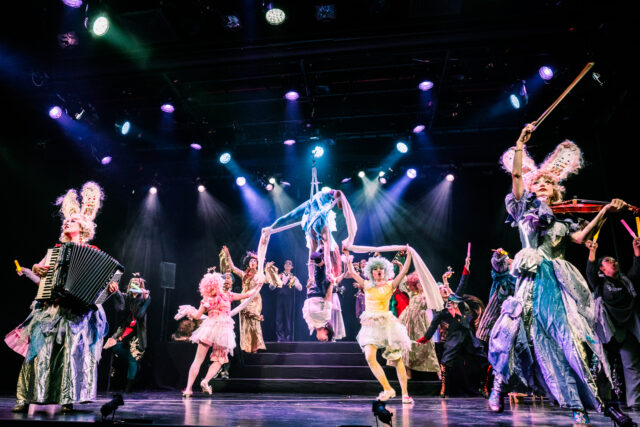
The Voices in Your Head is back for an encore run in a storefront Brooklyn church (photo by HanJie Chow)

THE VOICES IN YOUR HEAD
St. Lydia’s Dinner Church
304 Bond St., Brooklyn
September 9 – October 11, $39.72-$55.20
stlydias.org/events
www.eggandspoontheatre.org

In January, The Voices in Your Head offered a unique view of grief counseling, taking place at St. Lydia’s Dinner Church in Brooklyn. The sixty-minute play sold out quickly, extending its run and adding seats. It’s now back for a return engagement September 9 – October 11, and some nights are already fully booked. For other nights, there are either $39.72 or $55.20 Pay It Forward tickets available, but not both. Christian Caro, Marcia DeBonis, Tom Mezger, Daphne Overbeck, Erin Treadway, and Jehan O. Young reprise their roles in this Egg & Spoon remount, with Alex Gibson, Jamila Sabares–Klemm, and Molly Samson joining the cast.

Below is my original review of the January 2024 edition of this thoroughly involving and entertaining experience.

————————————

Lately I’ve been thinking more than ever about grief and death. I’m not a support group kinda guy, but when I heard about The Voices in Your Head, I knew I had to go.

I found solace — and nearly nonstop laughter — in Those Guilty Creatures’ immersive, site-specific group therapy black comedy, which continues at St. Lydia’s storefront dinner church in Brooklyn through January 29.

The space has been renamed St. Lidwina’s, after the Dutch patron saint of chronic pain and ice skating. The church has a large front window and door, looking more like a cozy shop than a place of worship. When you arrive, you are asked to check off your name on a sign-in sheet; to protect your anonymity, there are no last names, although people passing by outside can peek in and see you.

In the center of the room are more than two dozen unmatched chairs arranged in a large oval. In the back is a working kitchen where the facilitator, Gwen (Vanessa Kai), greets everyone while making tea and cookies. Several attendees engage in friendly conversation and chitchat. Shortly after Gwen calls the meeting to order, it becomes apparent that a handful of the participants are in the cast.

“It’s funny, when I was at my lowest, I was going to all these different meetings; it felt like dating, trying to find the right match, and they were all so . . . maudlin? I thought, there has to be another way. So, I started this group,” Gwen says. “Evidently, there was a need. So, we’re all here, we’ve met the criteria, but, broadly, I like to think of this as a place to share a sensibility. Laughter comes easier for me in here than out there. Everyone has their own relationship to grief; I’ve been considering mine, but what about anti-grief? We seek that through shared stories, activities, and discussions. . . . We aim to hear three stories each week, which, hopefully, helps us exchange some weird-ass joy.”

The audience becomes immersed in the grief of others in The Voices in Your Head (photo by HanJie Chow)

Sharing their sensibilities are the vivacious and outgoing Regina (Daphne Overbeck); Vivian (Marcia DeBonis), who believes in “Death, Embarrassment, Trauma”; Caleb (Christian Caro), who doesn’t want to be sad in college and can’t stop texting; the ultraserious Sandra (Erin Treadway); and the practical Hadiya (Jehan O. Young), who loves “the morbid stuff.”

They are eventually joined by first-timer Blake (Patrick Foley), who is determined to turn his story of loss into a Netflix special, and Ted (Tom Mezger), who actually attends the church and saw a flier.

Over the course of sixty fun, lively minutes, the group discusses Kelly Clarkson, hot cater waiters, self-care, vacuuming, exfoliating, sand, and other items and issues as they explore their personal misfortunes. A role-playing session that puts some of the group members in specific social situations doesn’t go quite as expected. During a break, the characters gossip, revealing more about who they are.

At the center of it all is the arbitrariness of death and Gwen’s assertion that we should “just approach the nature of the loss with a sense of humor. It helps us hold a certain space.”

The Voices in Your Head takes place in the storefront of a Brooklyn dinner church (photo by HanJie Chow)

The cast is uniformly excellent, led by Kai (The Pain of My Belligerence, KPOP) as the not-necessarily-so-stable Gwen, the always terrific DeBonis (Mary Page Marlowe, Small Mouth Sounds) as the chatty but caring Vivian, Treadway (Spaceman, War Dreamer) as the dour Sandra, Young (Speech, The Johnsons) as the purposeful Hadiya, Overbeck (Typed Out: A Princess Cabaret, Nightgowns) as the wonderfully over-the-top Regina, and Caro making his off-Broadway debut as the inattentive Caleb, but Foley (Circle Jerk, The Seagull/Woodstock, NY) nearly steals the show with his unforgettable Christmas story.

Created by Grier Mathiot and Billy McEntee and gleefully directed by Ryan Dobrin, The Voices in Your Head is as smart as it is hilarious. It’s not so much about how we deal with death than how we deal with life. Everyone reacts differently to tragedy and loss, but, as Gwen points out, “We need to hear each other’s laughter.”

The Voices in Your Head is not interactive — the audience should leave the talking to the actors — but feel free to mingle afterward and share your own thoughts about this engaging and involving experience.

[Mark Rifkin is a Brooklyn-born, Manhattan-based writer and editor; you can follow him on Substack here.]
YANIRA CASTRO: EXORCISM = LIBERATION

EXORCISM = LIBERATION
Multiple locations
September 6-28, free
www.acanarytorsi.org

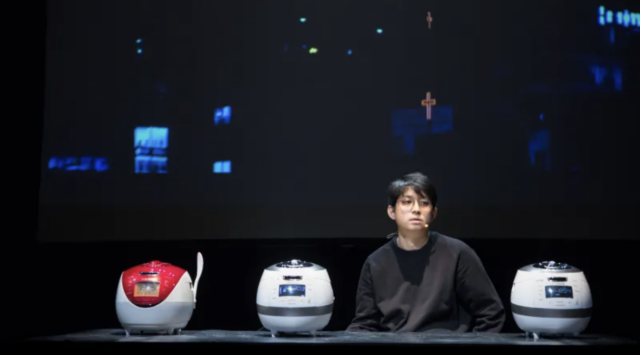
Yanira Castro is a fearless creator always ready to challenge herself and fully engage the audience. Born in Puerto Rico and based in Brooklyn, Castro and her company, a canary torsi (an anagram of her name), have presented such involving, complex, and entertaining multidisciplinary works as Dark Horse/Black Forest, a dance installation for public restrooms; the Jean-Luc Godard–inspired Paradis, a site-specific performance outdoors at twilight at the Brooklyn Botanic Garden; Performance | Portrait, an interactive video installation at the Invisible Dog Art Center; now.here.this, a meditative march of resistance in Prague; and Last Audience, a live communal laboratory at New York Live Arts, a performance manual, and a three-part space-opera podcast.

“Yanira Castro is a structural obsessive. She is an art scientist. She sees the rules and patterns lurking just beneath the surface of things,” Chocolate Factory Theater cofounding artistic director Brian Rogers has written. “The stuff that’s easier not to see . . . chaos staring at itself in the mirror, finding order.”

The Chocolate Factory is one of several venues hosting Castro’s latest project, Exorcism = Liberation, which explores climate change, immigration, land rights, colonialism, and self-determination in activations modeled around political campaigns. Kicking off September 6 and continuing each Saturday this month, the programs, seen through a Puerto Rican lens, include listening sessions, live music, food, and posters, stickers, banners, lawn signs, and pins. (There will also be activations in Chicago, and Western Massachusetts.)

Exorcism = Liberation asks participants to examine three slogans: “I came here to weep,” “Exorcism = Liberation,” and “What is your first memory of dirt?” Conceived, written, and directed by Castro, the project features audio design by Erica Ricketts, graphics by Alejandro Torres Viera and Luis Vázquez O’Neill, voice performances by Melissa DuPrey, josé alejandro rivera, and Steph Reyes, a bomba danced by Michael Rodríguez, and live musical performances by devynn emory and Martita Abril.

In a 2014 twi-ny talk about Court/Garden at Danspace Project, Castro explained, “It is not that I want to challenge the audience. I want to create a scenario for them and to be in conversation with them and I want them to form the picture, craft their experience. Their presence dynamically changes what is occurring. That is what ‘live’ means for me. It is dynamic because of the people in the room.”

In addition to the below events, installations at Abrons Arts Center, the Center for Performance Research (with a November activation date TBD), and the Chocolate Factory will continue into November.

Yanira Castro will present activations of Exorcism = Liberation in multiple locations this month

Friday, September 6, 6:00
I came here to weep: immersive group audio experience with movement score performed by Martita Abril, light refreshments prepared by Castro, stickers and pins available, Abrons Arts Center, 466 Grand St. at Pitt St., Manhattan

Saturday, September 7, 6:00
What is your first memory of dirt?: activation and collective listening session, followed by movement score “Clearing Practice” performed by devynn emory, light refreshments prepared by Castro, stickers and pins available, the Invisible Dog garden, 51 Bergen St., Brooklyn

Saturday, September 14, 7:00
CATCH 76: collective action, followed by a movement score performed by Martita Abril, with ice pops and limbers de coco y limon, the Chocolate Factory Theater (outside), 38-33 24th St., Long Island City

Saturday, September 21, 2:00
I came here to weep: activation and long table discussion with Jeremy Toussaint-Baptiste, Sami Hopkins, and Theodore (ted) Kerr, ISSUE Project Room, 22 Boerum Pl., Brooklyn

Saturday, September 28, 2:00-4:00
Exorcism = Liberation: activation with ice pops, limbers de coco y limon, the Clemente Soto Vélez Cultural & Educational Center, 107 Suffolk St., Manhattan

Friday, October 25, 1:00 – 9:00
OPEN LAB: What is your first memory of dirt? Aural Archiving with Yanira Castro / a canary torsi, advance RSVP required, the Center for Performance Research, 361 Manhattan Ave., Brooklyn

[Mark Rifkin is a Brooklyn-born, Manhattan-based writer and editor; you can follow him on Substack here.]
HOLDING BACK THE TIDE

Holding Back the Tide explores New York City’s oyster history through a queer lens

HOLDING BACK THE TIDE (Emily Packer, 2023)
DCTV Firehouse Cinema
87 Lafayette St.
September 6-12
212-966-4510
www.dctvny.org
www.holdingbackthetidefilm.com

In the hybrid documentary Holding Back the Tide, director and cowriter Emily Packer delves into the long history of New York City and oysters, visiting such spots as the Gowanus Canal, Grand Central Terminal, Governors Island, the Battery Park SeaGlass Carousel, the Brooklyn Children’s Museum, the Staten Island Ferry, the Union Square Greenmarket, Jamaica Bay, and Violet Cove to trace their relation to the delicious mollusks. At each stop, Packer shares details about how oysters are raised, served, and preserved, topics that have taken on new importance during the major expansions of the waterfront that have thrived since the Bloomberg administration.

Packer also highlights oysters’ ability to switch gender — the mollusks are born male, and most become female within a year or two — to honor the LGBTQIA+ community, interspersing numerous scripted scenes into the film, which is “dedicated to the queer future.”

“All things living transform. We build, break, morph, become, and become ourselves again. The tides rise and fall, a rock turns to sand, an island is named, renamed, and made a city,” Aphrodite (Robin LaVerne Wilson aka Dragonfly) says early on, walking barefoot along the rocks. “No river is endless. All oceans meet the shore. And in the end, in the best case, we return to the beginning.”

Exploring harbor restoration, coastal protection, commercialization, and more, Packer meets with a wide-ranging group of environmentalists and entrepreneurs who are never identified, including Mothershuckers founder Ben “Moody” Harney, former WNBA star and current oyster farmer Sue Wicks, commercial fishermen Wade Karlin and Phil Karlin of PE & DD Seafood, Cornell Cooperative Extension shellfish hatchery manager Joshua Perry, CCE SPAT director Kim Tetrault, resilience planner Pippa Brashear, Gowanus Dredgers founder Owen Foote, and Tanasia Swift, Agata Poniatowski, and John Ribaudo of Billion Oyster Project. The nonfiction scenes are fun and informative, filmed on location as the people go about their daily business.

The fiction scenes, featuring actors Aasia Taylor-Patterson, TL Thompson, Hannah Rego, Thomas Annunziata, Meghan Dolbey, Katharine Antonia Nedder, Avery Nusbaum, Hilary Asare, and Marlena Ospina, have a New Age-y atmosphere, like mini-fantasies with poetry, lilting music, and underwater choreography, making it often feel like you’re watching two different films. A nonbinary couple slurp oysters at an otherwise empty Grand Central Oyster Bar, then go to the whisper gallery, hearing the sound of the ocean. A server shucks oysters in front of Delmonico’s in the Financial District. A pair of performers pose like Wisdom and Felicity, two of the figures in the Bailey Fountain at Grand Army Plaza in Brooklyn.

Holding Back the Tide was made with intersectional queer values, queer practices, and LGBTQIA+ collaborators. As a nonbinary queer filmmaker working with a subject that regularly changes its sex as part of its reproductive process, it was important for me to create a vision of the oysters’ cultural economy that celebrated the environmental heroism of the oyster through a queer perspective,” Packer explains in their director’s statement. “Not only are most of the characters and actors queer people, but they also come to see that their gender evolution and self-actualization are reflected in nature. . . . Our creative choices are deeply rooted in our research and incorporate our subjects’ Black Indigenous immigrant and working class histories. We subvert the oyster’s ‘classic’ connotations of wealth and heterosexual aphrodisia reframing old tropes through an intersectional and anti-capitalist lens.”

Holding Back the Tide is running September 6-12 at DCTV Firehouse Cinema, with Q&As September 6 at 7:00 with Packer and Pete Malinowski of Billion Oyster Project, moderated by DCTV’s Dara Messinger; September 7 at 6:30 with comedian Esther Fallick and friends; September 8 at 5:00 with Packer and journalist Bedatri Choudhury; September 10 at 7:00 with Packer and filmmaker Lynne Sachs; and September 11 at 7:00 with Harney, aka the Real Mothershucker.

PEMA TSEDEN

OLD DOG

An old man (Lochey) would rather sell himself than his canine companion in Pema Tseden’s Old Dog

OLD DOG (LAO GOU/KHYI RGAN) (Pema Tseden, 2011)
Museum of the Moving Image
35th Ave. at 36th St., Astoria
Saturday, September 7, 5:00
Series runs September 6-15
718-777-6888
movingimage.org

In June 2016, Tibetan filmmaker Pema Tseden, who lived and worked in Beijing, was arrested by Chinese authorities at Xining airport in western China for “disrupting social order” supposedly over a luggage dispute, then was admitted to a local hospital with various injuries and illnesses. He was shortly freed following international outcry, and he went right back to making films about Tibet. Tseden died in May 2023 at the age of fifty-eight, and the Museum of the Moving Image will be paying tribute to him with a ten-day, ten-film retrospective running September 6-15. The series kicks off with a double feature of The Silent Manistone and The Grassland and will be followed by such works as The Silent Holy Stones, The Search, Balloon, and Snow Leopard.

Screening September 7 at 5:00 is Tseden’s 2011 drama, Old Dog, a beautifully told, slowly paced meditation on Buddhism’s four Noble Truths — “Life means suffering”; The origin of suffering is attachment”; “The cessation of suffering is attainable”; and “There is a path to the cessation of suffering” — that ends with a shocking, manipulative finale that nearly destroys everything that came before it. In order to get a little money and to save the family’s sheep-herding dog from being stolen, Gonpo (Drolma Kyab) sells their Tibetan nomad mastiff to Lao Wang (Yanbum Gyal), a dealer who resells the prized breed to stores in China, where they’re used for protection. When Gonpa’s father (Lochey) finds out what his son has done, he goes back to Lao Wang and demands the return of the dog he’s taken care of for thirteen years. “I’d sell myself before the dog,” he tells his son.

And so begins a gentle tale of parents and children, set in a modern-day Tibet that is ruled by China’s heavy hand. Gonpa’s father doesn’t understand why his son, a lazy man who rides around on a motorized bike and never seems to do much of anything, doesn’t yet have any children of his own, so he pays for Gonpa and his wife, Rikso (Tamdrin Tso), to go to the doctor to see what’s wrong. Meanwhile, the old man keeps a close watch on his dog, wary that Lao Wang will to try to steal it again. Writer-director Tseden (Jinpa, Tharlo, The Sacred Arrow) explores such themes as materialism, family, and attachment in a lovely little film that sadly is nearly ruined by its extreme final scene.

[Mark Rifkin is a Brooklyn-born, Manhattan-based writer and editor; you can follow him on Substack here.]
EDRA SOTO: GRAFT

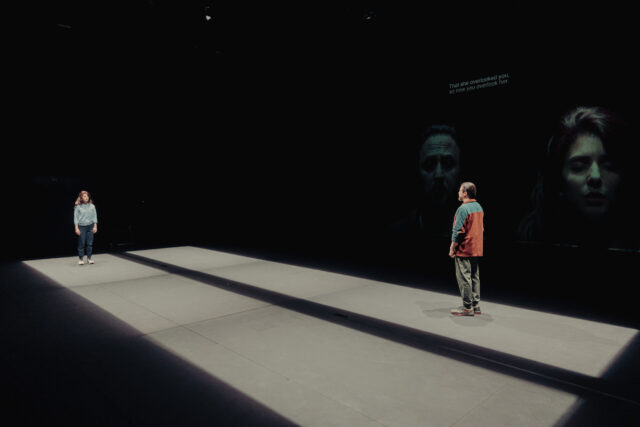
Edra Soto’s Graft will tantalize Central Park visitors through next August (photo by twi-ny/mdr)

GRAFT
Doris C. Freedman Plaza, Central Park
Sixtieth St. at Fifth Ave.
Opening: Wednesday, September 4, 6:00
September 5 – August 24, free
www.publicartfund.org
edrasoto.com
online slideshow

During the Olympics, I was surprised to see Puerto Rico taking on the United States in men’s basketball, since Puerto Rico is a US territory and all Puerto Ricans are American citizens. For some reason, I hadn’t realized that Puerto Rico has been competing as its own entity in the Summer Olympics since 1948 and in the Winter Olympics since 1984. Unfortunately, when I think of Puerto Rico, one of the things that first comes to mind is Donald Trump throwing rolls of paper towels at Puerto Ricans in the aftermath of the destruction wrought by Hurricane Maria in 2017.

That separation between Puerto Rico and the United States is forefront in Edra Soto’s new Public Art Fund commission, Graft, a red terrazzo concrete and corten steel barrier at the Scholars Gate entrance to Central Park. Soto, who was born and raised in Puerto Rico and has lived and worked in Chicago since 1998, has placed architectural interventions at several previous indoor and outdoor locations. This latest iteration, situated on Doris C. Freedman Plaza, looks like a wrought-iron fence that can let people in — and keep them out, referencing immigration, fear of crime, and the prison system.

On the park side of the physical boundary, there are three sets of tables and chairs where people can grab a seat but have no privacy, as they can be seen through the grating, which features an intricate design inspired by rejas, fences that are incorporated into middle-class Puerto Rican houses, based on Caribbean palm leaves and Yoruba symbols from West Africa.

“The rejas make perfect sense to me, as an expression of self. They exist and are understood as a formality in art, but they can live in invisibility because they are not meant to be contemplative,” Soto said in a statement. “As decorative patterns from a common house, they are meant simply to be pleasant enough to be a part of living spaces.”

Graft feels right at home in New York City, with its proud past of rampant corruption and large Puerto Rican communities; the sculpture resides among tall buildings and large, lovely trees, where people from all around the world will pass by, while nearby is Augustus Saint-Gaudens’s golden statue of Civil War general William Tecumseh Sherman astride his horse, Ontario, led by Victory. “Fear is the beginning of wisdom,” Sherman, who was born in Ohio and died in New York City, once said.

Fear is often the reason why walls are built. The inclusion of floral motifs also may be referencing botanical grafts, the process of cutting a branch of one plant and joining it to the stem of another so that they grow together, generating a more robust and beautiful tree or shrub.

Graft at Central Park invites viewers to contemplate the resilience of cultural identity and the diasporic experiences which have infused New York City’s history and present day,” Public Art Fund senior curator Melanie Kress explained in a statement. “Soto’s installation will encourage connection in a communal space where people can reflect on their shared histories and celebrate their diverse cultural heritage.”

The opening celebration takes place September 4 at 6:00 and is open to everyone; future programs will include dominoes tournaments held in conjunction with the Clemente Soto Velez Cultural and Educational Center, and the Public Art Fund usually hosts an artist talk about its commissions. No paper towels necessary.

[Mark Rifkin is a Brooklyn-born, Manhattan-based writer and editor; you can follow him on Substack here.]
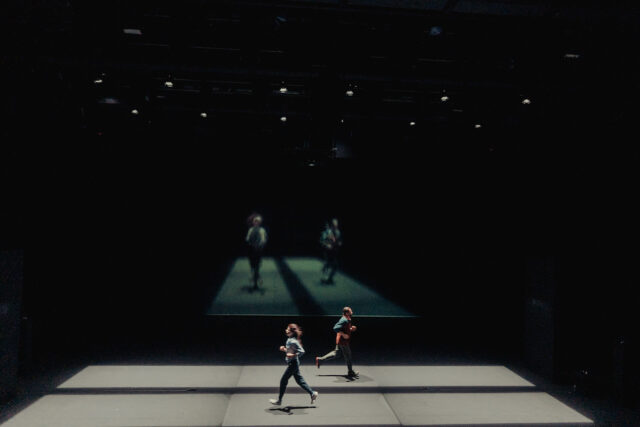
RABBIT ON THE MOON: FOLK TALES, TALL TALES, AND LOCAL MYTHS

RABBIT ON THE MOON
Metrograph
7 Ludlow St. between Canal & Hester Sts.
September 6-29
212-660-0312
metrograph.com

The Metrograph series “Rabbit on the Moon: Folk Tales, Tall Tales, and Local Myths” consists of a dozen international films inspired by folklore from around the world. The works explore traditional stories from Sweden, Japan, Thailand, Georgia, Ireland, Germany, Italy, and South Korea, by some of the most important auteurs of the last seventy-five years.

Among the films are Pier Paolo Pasolini’s The Decameron, Federico Fellini’s Fellini Satyricon, Sergei Parajanov and Dodo Abashidze’s The Legend of Suram Fortress, Apichatpong Weerasethakul’s Mysterious Object at Noon, Werner Herzog’s Nosferatu the Vampyre, Tomm Moore’s Song of the Sea, Na Hong-jin’s The Wailing, and Lois Patiño’s Red Moon Tide. Below is a look at several favorites.

Antonius Block (Max von Sydow) sits down with Death (Bengt Ekerot) for a friendly game of chess in Bergman classic

THE SEVENTH SEAL (Ingmar Bergman, 1957)
Friday, September 6, 2:50
Sunday, September 8, 5:30
metrograph.com

It’s almost impossible to watch Ingmar Bergman’s The Seventh Seal without being aware of the meta surrounding the film, which has influenced so many other works and been paid homage to and playfully mocked. Over the years, it has gained a reputation as a deep, philosophical paean to death. However, amid all the talk about emptiness, doomsday, the Black Plague, and the devil, The Seventh Seal is a very funny movie. In fourteenth-century Sweden, knight Antonius Block (Max von Sydow) is returning home from the Crusades with his trusty squire, Jöns (Gunnar Björnstrand). Block soon meets Death (Bengt Ekerot) and, to prolong his life, challenges him to a game of chess. While the on-again, off-again battle of wits continues, Death seeks alternate victims while Block meets a young family and a small troupe of actors putting on a show. Rape, infidelity, murder, and other forms of evil rise to the surface as Block proclaims “To believe is to suffer,” questioning God and faith, and Jöns opines that “love is the blackest plague of all.” Based on Bergman’s own play inspired by a painting of Death playing chess by Albertus Pictor (played in the film by Gunnar Olsson), The Seventh Seal, winner of a Special Jury Prize at Cannes, is one of the most entertaining films ever made. (Bergman fans will get an extra treat out of the knight being offered some wild strawberries at one point.)

UGETSU

Genjurō (Masayuki Mori) makes his pottery as son Genichi (Ikio Sawamura) and wife Miyagi (Kinuyo Tanaka) look on in Ugetsu

UGETSU (UGETSU MONOGATARI) (Kenji Mizoguchi, 1953)
Friday, September 13, 2:00
Sunday, September 15, 9:30
metrograph.com

The Metrograph series includes one of the most important and influential — and greatest — works to ever come from Japan. Winner of the Silver Lion for Best Director at the 1953 Venice Film Festival, Kenji Mizoguchi’s seventy-eighth film, Ugetsu, is a dazzling masterpiece steeped in Japanese storytelling tradition, especially ghost lore. Based on two tales by Ueda Akinari and Guy de Maupassant’s “How He Got the Legion of Honor,” Ugetsu unfolds like a scroll painting beginning with the credits, which run over artworks of nature scenes while Fumio Hayasaka’s urgent score starts setting the mood, and continues into the first three shots, pans of the vast countryside leading to Genjurō (Masayuki Mori) loading his cart to sell his pottery in nearby Nagahama, helped by his wife, Miyagi (Kinuyo Tanaka), clutching their small child, Genichi (Ikio Sawamura). Miyagi’s assistant, Tōbei (Sakae Ozawa), insists on coming along, despite the protestations of his nagging wife, Ohama (Mitsuko Mito), as he is determined to become a samurai even though he is more of a hapless fool. “I need to sell all this before the fighting starts,” Genjurō tells Miyagi, referring to a civil war that is making its way through the land. Tōbei adds, “I swear by the god of war: I’m tired of being poor.” After unexpected success with his wares, Genjurō furiously makes more pottery to sell at another market even as the soldiers are approaching and the rest of the villagers run for their lives. At the second market, an elegant woman, Lady Wakasa (Machiko Kyō), and her nurse, Ukon (Kikue Mōri), ask him to bring a large amount of his merchandise to their mansion. Once he gets there, Lady Wakasa seduces him, and soon Genjurō, Miyagi, Genichi, Tōbei, and Ohama are facing very different fates.

UGETSU

Lady Wakasa (Machiko Kyō) admires Genjurō (Masayuki Mori) in Kenji Mizoguchi postwar masterpiece

Written by longtime Mizoguchi collaborator Yoshitaka Yoda and Matsutaro Kawaguchi, Ugetsu might be set in the sixteenth century, but it is also very much about the aftereffects of World War II. “The war drove us mad with ambition,” Tōbei says at one point. Photographed in lush, shadowy black-and-white by Kazuo Miyagawa (Rashomon, Floating Weeds, Yojimbo), the film features several gorgeous set pieces, including one that takes place on a foggy lake and another in a hot spring, heightening the ominous atmosphere that pervades throughout. Ugetsu ends much like it began, emphasizing that it is but one postwar allegory among many. Kyō (Gate of Hell, The Face of Another) is magical as the temptress Lady Wakasa, while Mori (The Bad Sleep Well, When a Woman Ascends the Stairs) excels as the everyman who follows his dreams no matter the cost; the two previously played husband and wife in Rashomon. Mizoguchi, who made such other unforgettable classics as The 47 Ronin, The Life of Oharu, Sansho the Bailiff, and Street of Shame, passed away in 1956 at the age of fifty-eight, having left behind a stunning legacy, of which Ugetsu might be the best, and now looking better than ever following a recent 4K restoration.

Tōru Takemitsu “wanted to create an atmosphere of terror” in Masaki Kobayashi’s quartet of ghost stories

KWAIDAN (Masaki Kobayashi, 1964)
Saturday, September 21, 9:30
metrograph.com

Masaki Kobayashi paints four marvelous ghost stories in this eerie collection that won a Special Jury Prize at Cannes. In “The Black Hair,” a samurai (Rentaro Mikuni) regrets his choice of leaving his true love for advancement. Yuki (Keiko Kishi) is a harbinger of doom in “The Woman of the Snow.” Hoichi (Katsuo Nakamura) must have his entire body covered in prayer in “Hoichi, the Earless.” And Kannai (Kanemon Nakamura) finds a creepy face staring back at him in “In a Cup of Tea.” Winner of the Special Jury Prize at Cannes, Kwaidan is one of the greatest ghost story films ever made, four creepy, atmospheric existential tales that will get under your skin and into your brain. The score was composed by Tōru Takemitsu, who said of the film, “I wanted to create an atmosphere of terror.” He succeeded.

[Mark Rifkin is a Brooklyn-born, Manhattan-based writer and editor; you can follow him on Substack here.]
R.O.S.E.

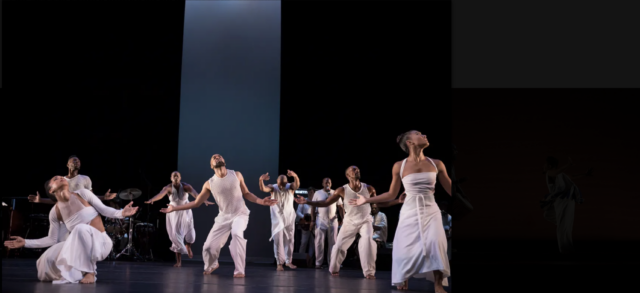
R.O.S.E. premiered last year at the Manchester International Festival (photo by Johan Persson)

R.O.S.E.
Park Ave. Armory
643 Park Ave. at Sixty-Seventh St.
September 5-12, $65
www.armoryonpark.org

Park Ave. Armory’s massive Wade Thompson Drill Hall has been turned into a flashy nightclub for the North American premiere of the immersive R.O.S.E., running September 5-12.

There are no seats for the three-hour production, so the audience will be on their feet and on the move, shaking and grooving to the show, which features cutting-edge choreography by Sharon Eyal, direction by Gai Behar and Caius Pawson of the record label Young, musical curation by Mattis With of Young, stage and creative design by Daphnée Lanternier, lighting by Alon Cohen, costumes by Maria Grazia Chiuri, and music by DJ Ben UFO. (Audience members can take a break on lounge seating in adjoining reception rooms.)

An armory commission that previously played at New Century Hall in Manchester, R.O.S.E. explodes with freedom, energy, and intimacy as audience and performers meld together as one.

There are several special programs being held in conjunction with R.O.S.E. On September 7 at 7:00, there will be a SLINK rave ($35) with DJs Currency Audio, Laenz, Simisea, rrao, and Enayet, while on September 8 at 6:00 the STUNT QUEEN!!! rave will be led by DJs Kilopatrah Jones, MORENXXX, madison moore, and TYGAPAW, hosted by Xander C. Gaines Aviance and with a poetry reading by Abdu Mongo Ali. And on September 8 at 3:00, “Day for Night: A Salon on Art and Nightlife” ($35) features “Music and Deejaying” with madison moore, Kevin Aviance, and Xander C. Gaines Aviance; “Dance and Club Culture” with Ariel Osterweis and MX Oops; and “The Art of Queer Worldmaking” with Gage Spex, Raúl de Nieves, Dosha, and Jacolby Satterwhite.

Some shows are already sold out, so act fast if you want to catch what should be one of the hottest shows of the year.

[Mark Rifkin is a Brooklyn-born, Manhattan-based writer and editor; you can follow him on Substack here.]