featured

A WILD[E] SALOME FROM HEARTBEAT OPERA

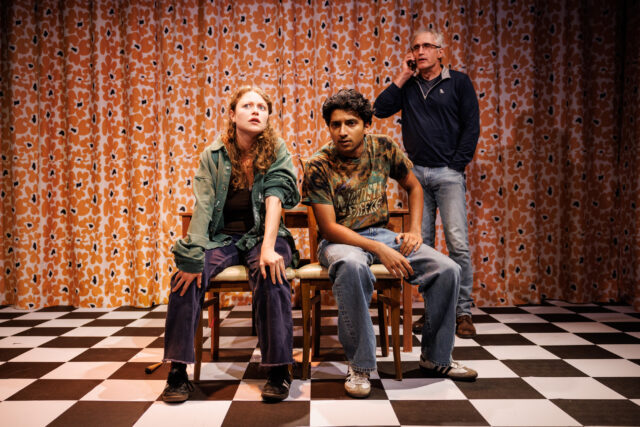
Heartbeat Opera’s English-language Salome continues at the Space at Irondale through February 16 (photo by Russ Rowland)

SALOME
The Space at Irondale
85 South Oxford St., Brooklyn
February 4-16, $21.79-$114.25
www.heartbeatopera.org/salome

“When it premiered, it was extremely shocking to its audiences because it was dangerous and there were so many taboos that get broken in it,” co-adaptor and director Elizabeth Dinkova says about Richard Strauss’s Salome, which Heartbeat Opera is presenting this month in a rare English-language version at the Space at Irondale. In the promotional video, she continues, “There are a few core mysteries at the center of this piece around what it means to be in love, and the great terror and violence that erupts when you’re not.”

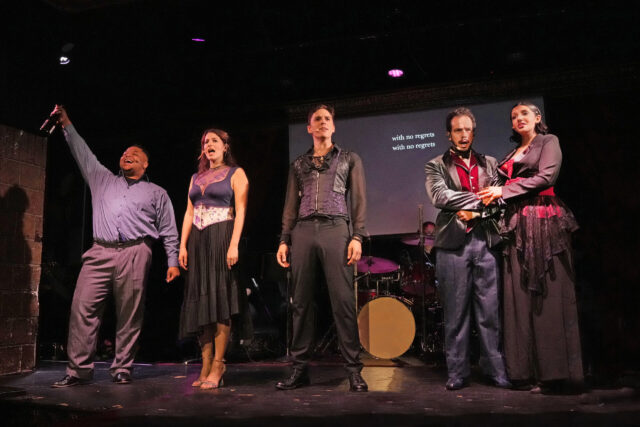
Oscar Wilde’s 1891 play about the first-century Jewish princess who was the daughter of Herodias and stepdaughter of Herod II was translated into German by Hedwig Lachmann and became the libretto for Strauss’s opera, which debuted in Dresden in 1905. Tom Hammond translated the work into English in the late 1980s for the English National Opera, and now Dinkova and co-adaptor, music director, and conductor Jacob Ashworth have collaborated on a new version for seven singers, eight clarinetists, and two percussionists. The cast features Summer Hassan as Salome, Patrick Cook as Herod, Nathaniel Sullivan as Jokanaan (John the Baptist), Manna K Jones as Herodias, David Morgans as Narraboth, Jaharis as Page Melina, and Jeremy Harr as a soldier; Francesca Federico will perform the title role on February 9.

Heartbeat has previously staged unique versions of such classics as Eugene Onegin, Tosca, and Fidelio as well as the original The Extinctionist. Up next is a one-hundred-minute retelling of Charles Gounod’s Faust at Baruch Performing Arts Center in May.

In the video, music arranger Dan Schlosberg explains, “This was a scandal, this piece; [Strauss] wrote it, and he knew that people were going to be scandalized.”

Heartbeat Opera attempts to bring back that sense of shock and scandal in its take on Salome, which promises, among other things, a “Dance of the Seven Veils” like you’ve never seen before.

[Mark Rifkin is a Brooklyn-born, Manhattan-based writer and editor; you can follow him on Substack here.]

WALLA WALLA BANG BANG: JOY BEHAR TAKES ON LOVE AND MARRIAGE

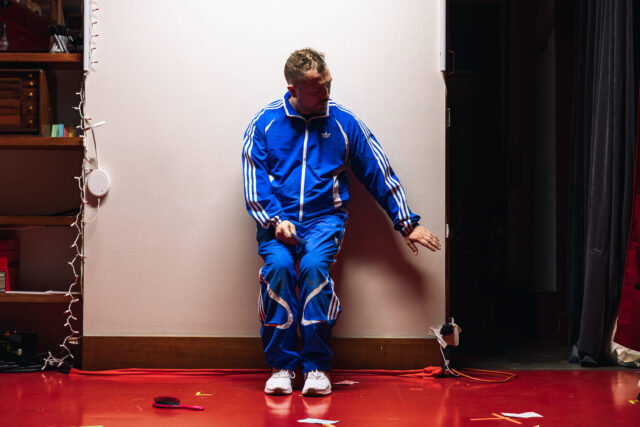
Joy Behar, Adrienne C. Moore, Tovah Feldshuh, and Susie Essman star in My First Ex-Husband (photo by Joan Marcus)

MY FIRST EX-HUSBAND
MMAC Theater
248 West Sixtieth St. between Tenth & Eleventh Aves.
Wednesday – Sunday through May 18, $69-$186
www.myfirstexhusband.com

Joy Behar looks at the lighter side of marital strife in the funny and affecting My First Ex-Husband, which opened last night at MMAC Theater. Based on interviews Behar conducted with numerous women, the eighty-five-minute play consists of eight poignant monologues delivered by four actors, taking turns at the front podium, where the script is there for them to refer to.

Behar, the longtime host of The View who has appeared in such shows as The Food Chain and The Vagina Monologues and written Crisis in Queens, Bonkers in the Boroughs, and Me, My Mouth and I, introduces the play by pointing out that nearly half of US marriages end in divorce. She asks the audience how many of them are divorced, then follows that up by saying, “How many of you wish you were?”

Through February 23, the the initial cast features the Brooklyn-born Behar, who is on her second marriage; two-time Emmy nominee and four-time Tony nominee Tovah Feldshuh (Funny Girl, Golda’s Balcony), a Manhattan native who has been married to the same man sine 1977; NAACP Image Award winner Adrienne C. Moore (The Taming of the Shrew, For Colored Girls . . . ,), who hails from Nashville; and Behar’s bestie of more than forty years, the Bronx-born Susie Essman (Curb Your Enthusiasm, Broad City), who has been married since 2008.

In the first monologue, “Clothes Make the Man?,” Serena (Essman) talks about dealing with her ex-husband’s fetish of wearing women’s clothes. In “The Widow,” June (Feldshuh) shares her abandonment issues and her ex’s obsession with her weight. In “Where Are You At,” Laila (Moore) is a successful actress on the brink of stardom whose husband is cheating on her. And in “The Touch,” Monica (Behar) discovers a new side of herself when her bookie husband is sent to the hoosegow.

Adrienne C. Moore nearly steals the show at MMAC Theater (photo by Joan Marcus)

Behar has a penchant for strong first lines, as demonstrated by the below examples.

“The Widow”: “Okay, my husband’s dead.”
“Walla Walla Bang Bang”: “My shrink says that it’s important to have some things in common with your spouse.”
“The Drummer’s Wife”: “I was on my way to the honeymoon, and I was thinking, ‘How am I gonna get out of this.’”
“Get Off of Me”: “I really don’t belong here tonight because I’m not divorced yet. But I’m on the cusp.”

It’s no surprise that the topic that comes up the most is not money or age or children but sex. “He was respectful and didn’t pressure me to have sex,” Serena says. Laila remembers when her husband asked her, “Can I please have sex on the side? I’ll be discreet.” In “Walla Walla Bang Bang,” Jessica (Essman) explains about her ex, “He also was a product of his strict Catholic upbringing, and he didn’t function very well sexually. In my opinion, religion can fuck up your libido.” In “Wigged Out,” an arranged Orthodox marriage between Rebecca (Feldshuh) and a teenage boy is complicated by her vaginismus. And in “Get Off of Me,” Gloria (Moore) thinks her husband might be a sex addict.

Under the unobtrusive direction of Randal Myler (Hank Williams: Lost Highway, Love, Janis), the ensemble, all dressed in black, is excellent, but Feldshuh and Moore deserve extra accolades for their performances, Feldshuh for injecting a sly sense of humor and Moore for bringing down the house several times with her energetic movement and overall enthusiasm, even when she’s sitting in the back watching the others, waiting for her turn.

From February 26 to March 23, Judy Gold, Susan Lucci, Cathy Moriarty, and Tonya Pinkins take over, followed March 26 to April 20 by Veanne Cox, Gina Gershon (April 2–20), Jackie Hoffman, and Andrea Navedo, and then Marilu Henner, Marsha Mason, Benja K Thomas, and Julia Sweeney from April 23 to May 18.

You should go no matter what state your own relationship is in, but don’t get any ideas.

[Mark Rifkin is a Brooklyn-born, Manhattan-based writer and editor; you can follow him on Substack here.]

THE ROAD TO FREEDOM: FAITH RINGGOLD’S FOR THE WOMEN’S HOUSE

Formerly incarcerated women Enid “Fay” Owens, Nancy Sicardo, and Mary Baxter check out Faith Ringgold’s For the Women’s House in Paint Me a Road Out of Here

PAINT ME A ROAD OUT OF HERE (Catherine Gund, 2024)
Film Forum
209 West Houston St.
Opens Friday, February 7
212-727-8110
www.filmforum.org

“No one and nothing is safe at a prison, including the guards, the inmates, the walls, the furniture, and especially that painting,” author and activist Michele Wallace says in Catherine Gund’s moving and passionate documentary Paint Me a Road Out of Here, opening February 7 at Film Forum.

Author of such books as Black Macho and the Myth of the Superwoman and Dark Designs and Visual Culture, Wallace is the daughter of children’s book writer, painter, sculptor, and performance artist Faith Ringgold. The work she is referring to is her mother’s 1972 For the Women’s House, an eight-foot-by-eight-foot mural that was commissioned for the New York City Correctional Institution for Women on Rikers Island.

Before starting the mural, Ringgold visited the institution and met with some of the women. “I knew that each one wanted to be inspired, to renew their life,” she says in the film. “They wanted to be out of there, of course. And it was obvious to me that the reason why many of them were there was because they had a lack of freedom. I asked the women, ‘What would you like to see in this painting that I’m going to do to inspire you?’ And one girl said, ‘I want to see a road leading out of here.’”

The large canvas is divided into eight triangular sections depicting women in nontraditional roles, including as professional basketball players, a bus driver, a police officer, a priest, a lawyer, a construction worker, and US president, accompanied by quotes from Rosa Parks and Coretta Scott King.

“Almost every single profession in that painting was not open to women in 1971,” curator Rujeko Hockley points out. She also equates prisons with museums, noting, “Black people were held captive in one institution and excluded from the other.”

Gund traces the history of For the Women’s House, delving into its conception, detailing how it was painted over in white by prison employees in 1988, and examining its restoration and the very strange journey it took as the Brooklyn Museum attempted to acquire it in order to save it from potential oblivion. She also places it in context within Ringgold’s career, looking at her seminal 1967 breakthrough gallery show, featuring such powerful and important works as Die, The Flag Is Bleeding, and The American People Series #19: US Postage Commemorating the Advent of Black Power. She meets with Ringgold in her studio, on her porch, and at the New Museum, which eventually hosted her revelatory career retrospective, “American People,” in 2022.

The director balances that narrative with the inspirational tale of Mary Enoch Elizabeth Baxter, who gave birth while incarcerated and fought to right her life through art and activism after serving time. Baxter returns to the Riverside Correctional Facility in Philadelphia in 2022 and installs a mural comprising multiple affirmations, providing hope for the women there through art. She also developed a friendship with Ringgold.

Gund (Born to Fly: Elizabeth Streb vs. Gravity, Chavela), who participated in freeing the painting after first encountering it in late 2021, speaks with Michael Jacobson, who was the commissioner of the Dept. of Corrections in the mid-1990s when the painting virtually disappeared; artist and author Michelle Daniel Jones, who teamed up with Baxter to put on an exhibition; curators Hockley and Catherine Morris, who staged “We Wanted a Revolution: Black Radical Women, 1965–85” at the Brooklyn Museum in 2017; Rikers corrections officer Barbara Drummond, who led the fight to preserve For the Women’s House; and ACA gallerist Dorian Bergen, who explains about Ringgold’s early work, “These are among the most important paintings of the twentieth century. History had to catch up with Faith.”

The artworks shown in the film will be eye-opening to viewers who are not familiar with Ringgold’s oeuvre, from the aforementioned pieces to Childhood, The Fall of America, Sojourner Truth Tanka: Ain’t I a Woman, Uptight Negro, and Flag Is Bleeding. “I became an artist so that I could tell my story,” Ringgold, who dressed in splashy outfits with sparkling accoutrements, says, and what a story it is.

A New York City native, Ringgold passed away in New Jersey in 2004 at the age of ninety-three. Her remarkable legacy will live on in the hearts and minds of her many fans, fellow artists, and incarcerated and formerly incarcerated women who find freedom in what she stood for.

As curator and author Nicole R. Fleetwood declares, “I think art is disruptive, and I think art disrupts lazy thinking.”

There is no lazy thinking when it comes to Faith Ringgold.

[There will be a series of postscreening discussions at Film Forum, presented by the New Museum and the Women’s Community Justice Association on February 7 at 7:00, the Center for Art & Advocacy on February 8 at 7:00, the Vera Institute of Justice and Silver Art Projects on February 13 at 7:00, the New York Women’s Foundation and the Center for the Study of Women and Society at the Graduate Center on February 18 at 6:30, and the Guggenheim on February 20 at 6:30.]

[Mark Rifkin is a Brooklyn-born, Manhattan-based writer and editor; you can follow him on Substack here.]

GONE FISHING: ROB TREGENZA BRINGS UNIQUE WWII DRAMA TO MoMA

Anna Kristiansen (Ellen Dorrit Petersen) and Adam Honderich (Andreas Lust) are caught up in WWII intrigue in Rob Tregenza’s The Fishing Place (courtesy Cinema Parallel)

THE FISHING PLACE (Rob Tregenza, 2024)
MoMA, the Museum of Modern Art
The Debra and Leon Black Family Film Center
11 West Fifty-Third St. between Fifth & Sixth Aves.
February 6-12
www.moma.org

Rob Tregenza’s The Fishing Place is a tour de force of filmmaking, and the writer-director isn’t shy about making sure the audience knows it. The movie, divided into three sections that Tregenza refers to as “flows,” opens with a shot of a boat out at sea, shown in the negative, a ghostly white in a gray, gloomy seascape that slowly reverses into color over Earecka Tregenza and Jason Moody’s melancholic score. We are then introduced to the three protagonists via superimpositions and fades that point toward memory, as well as through mysterious, virtually impossible camera movements forward.

It’s 1945 in a small Norwegian town, and Anna Kristiansen (Ellen Dorrit Petersen) is a Nazi prisoner working as a housekeeper for Klaus (Eindride Eidsvold), a wealthy collaborator. Adam Honderich (Andreas Lust) is a newly arrived German Lutheran priest. Nazi officer Aksel Hansen (Frode Winther) orders Anna to work for Honderich for three days and spy on him, as it’s suspected that the priest is part of the resistance.

Anna becomes the focus in a stunning six-and-a-half-minute scene at a small party being thrown by Klaus for Aksel; Anna works with the cook (Lena Barth-Aarstad) and a maid (Ingvild Holthe Bygdnes), serving Klaus and Aksel in addition to Willie (Peder Herlofsen), a young man who would rather be reading his book; a man (Jonas Strand Gravli) trying to convince Klaus to invest in his electronic gadgets; the elegant, wheelchair-bound Margit (Gjertrud L. Jynge) and her doctor (Ola Otnes); among others. It’s intense and almost interminably slow-paced; every sound — a footstep, a glass being put on a tray, background music — feels as if we’re on a precipice, every element desperate to break free. The stunning sound design, also highlighted by boots in the snow, a crackling fire, and gunshots, is by Øyvind Rydland.

Soon after the party, Anna finds a frightened child named Ada (Ella Maren Alfsvåg Jørgensen) hiding out in a shack on Honderich’s property. Later, a local man visits Honderich, bringing him a fish that seems to be more of a threat than a gift, and comments on his priestly dress. Honderich says, “Unfortunately, I didn’t have much choice.” The man responds in an ominous tone, “We all have a choice, don’t we?”

Margit makes a surprising confession to the priest. The doctor takes Anna for a ride in his automobile and shares his suspicions of who she is and what she is doing there. In his church, which bursts with colors that stand out in the otherwise bleak but beautiful snowy winter landscape, Honderich suddenly is filled with fire and brimstone. As the camera circles an old fishing boat where Honderich and Aksel have cast out their lines, the colors morph into a hellish red. “Are you happy with yourself?” the priest asks. The Nazi officer replies, “No. And you know it.”

In another dazzling sequence, the camera goes down a horizontal row of characters who one at a time share brief thoughts and then appear again at the other end, with no cuts. “Don’t look back,” the priest prophetically warns us.

Later, after a fadeout, we can hear talking behind-the-scenes as a scene is readied; a man claps the slate and we see the cast and crew in action in a virtuosic twenty-minute crane shot that starts with indoor close-ups before heading outside and almost flying away. Tregenza is the cinematographer, but camera operators Pål Bugge Haagenrud and Art Eng deserve huge kudos, as does editor Elise Olavsen.

Kansas native Tregenza (Talking to Strangers, Gavagai) mixes in a little Ingmar Bergman and Jean-Luc Godard in The Fishing Place, which was partly inspired by the work of philosophers Henri Bergson and Gilles Deleuze. “The self is only a threshold, a door, a becoming between two multiplicities,” the latter wrote in A Thousand Plateaus: Capitalism and Schizophrenia, as well as “Bring something incomprehensible into the world!”

The Fishing Place is making its North American theatrical premiere February 6–12 at MoMA; Tregenza will be at the museum for a Q&A following the 6:30 show on opening night.

[Mark Rifkin is a Brooklyn-born, Manhattan-based writer and editor; you can follow him on Substack here.]

KINESTHETIC EMPATHY: DOWNTOWN RADIO AND THE AVANT-GARDE

Five actors re-create 1970s WNYC programs in documentary play (photo by Hunter Canning)

RADIO DOWNTOWN: RADICAL ’70s ARTISTS LIVE ON AIR
59E59 Theaters
59 East 59th St. between Park & Madison Aves.
Tuesday – Sunday through February 9, $44
212-279-4200
www.59e59.org

The Civilians’ Radio Downtown: Radical ’70s Artists Live on Air is an odd documentary play that is difficult to decipher. Conceived and directed by Steve Cosson and written by Cosson and Jocelyn Clarke, it consists of five actors re-creating segments from three 1970s programs on WNYC: Arts Forum, Artists in the City, and Poetry of the Avant-Garde.

The conceit is that, as the audience is told at the start, “The actors do not know their lines. This is made from archival recordings. The actual words, pauses, and sounds from back then will be fed into the actor’s ears.” I’m not quite sure why Cosson decided to present the dialogue that way; it makes for an uneasy experience, as I found myself on edge every time an actor paused, wondering whether the hesitation was in the original interview, there was a technical glitch, or the performer lost their place. In addition, these are professional actors, and one would think that, especially after several weeks of performance, they would know their lines, complete with pauses and hesitations.

Robert M. Johanson, Jennifer Morris, Joshua David Robinson, Maya Sharpe, and Colleen Werthmann portray a who’s who of the avant-garde scene: film theorist and historian P. Adams Sitney, experimental choreographer, dancer, and visual artist Yvonne Rainer, filmmakers George Kuchar and Kenneth Anger, poets Leroi Jones and Lorenzo Thomas, critic and academic Annette Michelson, polymath Harry Smith, and actress, dancer, and singer Kimako Baraka, among others. The seventy-minute production takes place in a room with numerous chairs, lamps on the floor (did they run out of tables, or was this how it was at WNYC?), and a back wall featuring a large image of part of a naked human body with a fly on its mouth.

The actors switch between characters by making small clothing adjustments, selecting jackets, vests, and other apparel hanging from hooks on each side of Andrew Boyce’s set. (The costumes are by Emily Rebholz.) Attilio Rigotti’s projections identify the speakers and include newspaper headlines, snippets from a Rainer dance rehearsal, and clips from Anger’s 1967 Lucifer Rising, which starred Bobby Beausoleil, who committed murder the next year as an associate of the Manson family and is still serving life in prison.

The highlight of the show is Anger discussing fellow filmmaker Maya Deren’s apparent disgust of his work. Deren had sent a letter to Anger explaining why she chose not to award a film of his a prize at a festival; in response, Anger describes, “I wrote her back and I said, ‘The whole thing was a joke.’ And she wrote me back and said, uh, she said, ‘You are guilty of confounding the public, and you are also guilty of pulling my leg, [laughter] and I will never forgive you.’ And I said, well, if she has — if she has such a lack of a sense of humor. . . .”

As far as a sense of humor goes, I was questioning mine throughout Radio Downtown, particularly when Werthmann, as Rainer, mimicked some of the choreographer’s slow, angular movement. While my theater companion found it hilarious in a good way, I was perplexed, uncertain whether it was a pretentious tribute or a playful parody of Rainer and the whole underground scene.

That was essentially my takeaway from the show, a constant level of confusion. Later, I checked out The NYPR Archive Collections, where you can listen to the original recordings and read the transcripts.

When I heard Rainer talk to Michelson about “kinesthetic empathy,” I knew just what she meant.

[Mark Rifkin is a Brooklyn-born, Manhattan-based writer and editor; you can follow him on Substack here.]
LOOK ALIVE: EXPLORING THE MUSEUM OF LATE HUMAN ANTIQUITIES

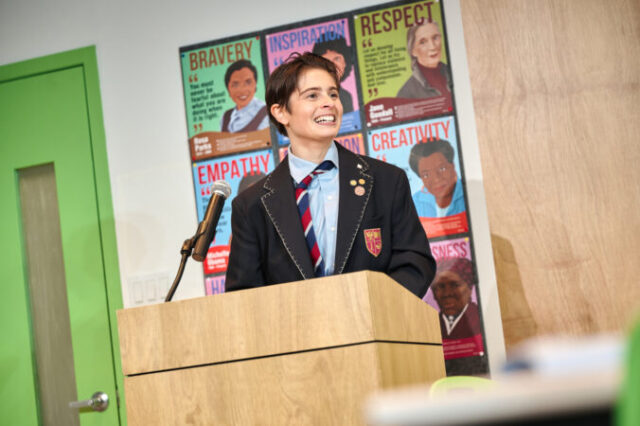
Two ancient women introduce the audience to Jordan Harrison’s The Antiquities at Playwrights Horizons (photo by Emilio Madrid)

A TOUR OF THE PERMANENT COLLECTION IN THE MUSEUM OF LATE HUMAN ANTIQUITIES or, just THE ANTIQUITIES
Playwrights Horizons, the Judy Theater
416 West 42nd St. between Ninth & Tenth Aves.
Tuesday – Sunday through March 2, $62.50 – $102.50
www.playwrightshorizons.org

“It’s alive, it’s alive!” a mad scientist cries out in the 1931 sci-fi classic Frankenstein, as he watches electricity breathe life into a creature made of stitched-together body parts from corpses. People have been searching for the fountain of youth essentially since the beginning of time, on an endless quest to defeat death and live forever.

Pulitzer Prize finalist Jordan Harrison traces that journey, focusing on our role in our own destruction, in A Tour of the Permanent Collection in the Museum of Late Human Antiquities or, just The Antiquities, an intensely clever and prescient warning shot that opened tonight at Playwrights Horizons, in a coproduction with the Vineyard and the Goodman.

Harrison (Marjorie Prime, The Amateurs) and codirectors David Cromer (A Case for the Existence of God, Tribes) and Caitlin Sullivan (Find Me Here, The Good John Proctor) lead the audience between 1816, when Mary Wollstonecraft Godwin shares a ghost story that would become her Gothic novel Frankenstein; or, The Modern Prometheus, and 2076, when AI has taken over in the postapocalyptic nightmare we all fear is coming.

The hundred-minute play begins with two women from the Museum of Late Human Antiquities surveying the audience, as if we are objects in a gallery.

A mother and son contemplate death in Jordan Harrison’s The Antiquities (photo by Emilio Madrid)

Woman 1: “Thank you for coming.” That’s what we’d say, if we were them. Thank you for coming. It’s good to see your faces. Fasten your seatbelts. Look alive.
Woman 2: “Look alive.”
W1: That’s one of my favorites. As if it were necessary to pretend.
W2: [To the audience, trying it out.] Look alive.
W1: [Regarding us.] They do, don’t they. You all look perfect. It’s like we’re really here. [A beat. She takes in the room.] Imagine we’re actually here in these seats in this room in the Late Human age. Imagine you have a body. Imagine that’s your body.

Cindy Cheung, Marchánt Davis, Layan Elwazani, Andrew Garman, Aria Shahghasemi, Kristen Sieh, Ryan Spahn, Julius Rinzel, and Amelia Workman portray multiple characters throughout the centuries, with quick costume and set changes; the effective period dress is by Brenda Abbandandolo, while Paul Steinberg’s cold, metallic set shifts for every scene as props are added and subtracted, from a bar and a kitchen refrigerator to an early home computer and a conference room. In 1816, Mary, Percy Bysshe Shelley, Claire Clairmont, Dr. Thomas Briggs, and Lord Byron gather around a campfire and try to scare one another. Early on, Mary offers, “What if I could bring back the dead.” Mary’s mother died ten days after her daughter was born, and Mary suffered several miscarriages and lost three children after birth, so her desire to bring back the dead was deeply personal.

In 1910, a father drops off his ten-year-old son to work in a factory where he might lose a finger or two if he’s not careful. In 1978, Stuart has built a robot that can learn, on its way to being sentient. “It’s life. I created life,” he boasts to a bartender. In 1994, a family of three bask in the glow of their new computer and prepare to connect to the internet for the very first time, via a loud dial-up modem. “Did you ever think you’d live in the future?” the mother asks. In 2008, a young woman teaches her grandfather how to use his iPhone to access the World Wide Web. In 2023, a woman is offered a big payout if she agrees to an NDA to silence her complaints about out-of-hand technology at her firm. She argues, “Doesn’t anybody get it? I’m telling you I made this thing, I helped make this thing, and now . . . We’re the dinosaurs. We’re the dinosaurs and this is the meteor.”

And then, in 2076 . . .

Humankind finds itself at a precipie in prescient new play (photo by Emilio Madrid)

Among the outdated items accumulated at the Museum of Late Human Antiquities are a pen, a rotary phone, a Betamax videocassette, a musical instrument, and a butter churn, pieces of a past that is now long gone. There’s also a ghostlight, a bulb that is placed on stages overnight to ward off troublesome spirits and/or provide light to the theater ghosts who inhabit the space, as if acknowledging that even if humans come to an end, their spirits might still remain. Woman 2 discloses, “So much has been lost, but we have recovered fragments. Scraps of language, abandoned devices. We have endeavored to fill in the gaps; to bring them to life again.”

Filling in some of the gaps, Harrison regularly reminds us that humanity’s time on earth has been squandered by our desperate fear of death, of what might be next, including nothing — and we only have ourselves to blame.

Stuart’s sister confesses to her son, “Everybody dies, baby,” referring to each person. But when Woman 1 promises, “One day you Began, and one day you will End,” she’s talking about the human species as a whole. Our addiction to technology in the pursuit of longevity might very well be our doom, as is already being predicted by many people involved in AI.

But perhaps there’s a glimmer of hope. In the future, a man named Len wonders, “All the while we’ll be getting stronger. We’ll remember the things people used to know, a thousand years ago. The plow. The candle. Probably people will become religious again. They’ll look up in the sky and want to explain a storm. Our kids will grow strong, out in the weather. And all the while, we’ll teach them to hate the inorganics. And eventually, though maybe not in our lifetimes, eventually human beings will rise again. We made the computers and we’ll destroy them.”

Famous last words?

[Mark Rifkin is a Brooklyn-born, Manhattan-based writer and editor; you can follow him on Substack here.]
CHRISTMAS IN CONNECTICUT: A (DYS)FUNCTIONAL FAMILY SATIRE

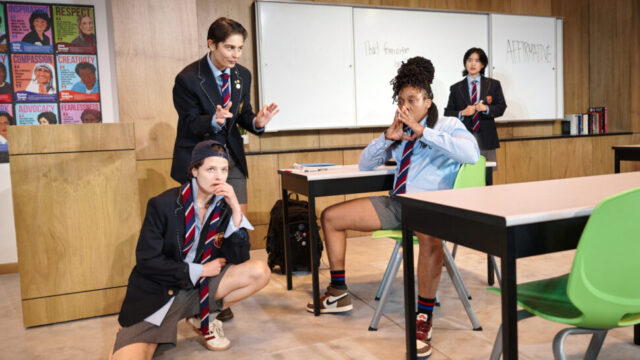
The Dahls have a Christmas to remember — or forget — in Cult of Love (photo by Joan Marcus)

CULT OF LOVE
Hayes Theater
240 West 44th St. between Broadway & Eighth Ave.
Through February 2
2st.com

I started to call Leslye Headland’s hilarious, on-target Broadway debut, Cult of Love, the story of a dysfunctional family at Christmas, but I stopped myself because it sounded redundant; has there ever been a holiday-themed play about a functional family?

Directed with plenty of pizzazz and panache by Obie winner and two-time Tony nominee Trip Cullman, the hundred-minute satire introduces us to the musical Dahl family, who come together on Christmas Eve at their farmhouse in Connecticut to sing songs and do battle. Patriarch Bill (David Rasche) is a piano-playing Pollyanna and a hugger who prefers to avoid arguments; his children think he might be suffering from dementia, because how else can he be so positive? Matriarch Ginny (Mare Winningham) strums the guitar, sings songs about Jesus, and plays favorites with her children, even though she fails to see it.

The Dahls’ eldest progeny, Mark (Zachary Quinto), is a law clerk in DC, almost became a priest before abandoning Christianity, and is having marital problems with his wife, Rachel (Molly Bernard), who converted from Judaism and drinks too much at family events.

Older daughter Evie (Rebecca Henderson) recently got back from her Italian honeymoon with her new spouse, Pippa Ferguson (Roberta Colindrez); both have successful careers in brand management.

Third child Johnny (Christopher Sears) is the ever-late prodigal son who has been in and out of rehab for years; everyone is excited when they learn he is bringing a mystery guest, Loren Montgomery (Barbie Ferreira).

The baby of the group, twentysomething Diana Dahl Bennett (Shailene Woodley), is a Bible thumper with a six-month old son with her husband, Episcopal priest James Bennett (Christopher Lowell), and she is pregnant again.

Music is the only thing a Connecticut family can agree on in hilarious Broadway satire (photo by Joan Marcus)

Over the course of a fretful, highly volatile evening, the Dahls and their significant others discuss racism, homophobia, smoking, molestation, mental health, the Mexican wedding cookies known as polvorones, and tolerance in between picking up instruments (guitars, banjo, ukulele, melodica, washboard, sleigh bells, maracas) and breaking into traditional religious songs as well as tunes by Radiohead, the Fleet Foxes, and Sufjan Stevens, displaying gorgeous harmonies and pure joy that, momentarily, put aside their seemingly endless issues with one another.

“Evie! Are you picking a fight during Christmas carols?” Mark cries out. Evie responds, “I’m questioning the problematic lyrics, Mark!” Diana concludes, “You ruin it when you do that.”

When Evie wants to talk about Bill’s health, Mark argues, “Is Christmas really the best time for that?” Evie explains, “Christmas is exactly the time to talk about the things we never talk about.”

John Lee Beatty’s cluttered Christmas-themed set feels homey and lived in, with windows and glass doors that offer peaks at what is going on in the outside world, where perhaps sanity is possible. Jacinth Greywoode’s expert musical direction will make you wonder if there will be a cast album. The ensemble is terrific as Cullman guides them through an ever-more-claustrophobic situation.

“You must be having a wonderful time,” Bill says to Loren, who answers for her and the audience when she replies, “Oh, sure. I love the singing, the lesbian drama. It’s all great.”

[Mark Rifkin is a Brooklyn-born, Manhattan-based writer and editor; you can follow him on Substack here.]