featured

LIFE IS LIKE A BOX OF MATZAH: MOST PEOPLE DIE ON SUNDAYS

A Jewish family in Buenos Aires faces death and desperation in Most People Die on Sundays

MOST PEOPLE DIE ON SUNDAYS (LOS DOMINGOS MUEREN MÁS PERSONAS) (Iair Said, 2024)
Quad Cinema
34 West 13th St. between Fifth & Sixth Aves.
Opens Friday, May 2
quadcinema.com

In his 2019 debut feature-length documentary, Flora’s Life Is No Picnic, Buenos Aires–born filmmaker Iair Said looked at his concern about his great-aunt Flora’s apartment; he was hoping that she would leave it to him in her will, but instead she planned to donate it to the Weizmann Institute of Science.

In his 2024 debut feature-length narrative film, Most People Die on Sundays, writer-director Said stars as David, a thirtysomething man-child who who can’t find his place in a world he doesn’t know how to navigate. Inspired by the death of Said’s father, the story follows David as he returns home to Buenos Aires for the funeral of his uncle. David has been in Italy for a year studying, of all things, communication; he could not be more awkward speaking with others, be it his beloved mother, Dora (Rita Cortese), his sister, Silvia (Juliana Gattas), his cousin, Elisa (Antonia Zegers), or anybody else, from his driving instructor to his mother’s next-door neighbor to a flight attendant — to his own father, who lies in a coma at a clinic.

Queer, Jewish, and schlubby, David moves slowly, talks slowly, and thinks slowly, his face almost always in a deadpan stare, resembling Jimmy Kimmel mixed with Fatty Arbuckle. David keeps finding ways to avoid visiting his father even as the family discusses euthanasia — as well as ways to afford his uncle’s funeral and burial.

David is far from oblivious to what is happening; he just seems unable to take reasonable action, wandering through life in a kind of haze, relying on others to take care of him.

“I think I am a little sad,” he narrates as he goes through a battery of health tests. “To be back home, to have to live with my mom. . . . The house is somehow in bad shape. I feel bad for her. She is so alone. My dad’s condition is not going to change. He is practically dead. Him dying means all of us are going to die too, that everything has an ending. I can’t imagine living my life without him. If Dad remains like that for many years, my mom will not get to know anyone else, she won’t stop looking after him . . . That is a lot for her. I chose to be alone. She hasn’t.”

David might say that he chooses to be alone, but as Said shows particularly in the first and last scenes, that is actually the last thing David wants.

Most People Die on Sundays moves at the pace of David’s mind, slowly yet earnestly, with a subtle, carnivalesque score by Ascari that mimics David’s stunted emotional understanding and often pathetic, sad-sack choices. He is terrified of death, be it that of others or his own, and it haunts his thoughts. He is so desperate to be loved that he comes close to stalking several men he is attracted to. Just about the only time the family has any fun is during a Passover seder, where the wine is spoiled and David complains that the fish smells, well, like fish.

Earlier, Dora gives a doctor at the clinic some matzah, telling him, “It’s an unleavened, unsalted flatbread, but it’s tasty. If you want to be a Jew, you must know how to suffer.” The doctor asks her what happened and she answers with a dejected, downtrodden look, “My son’s back.”

David and Most People Die on Sundays are like a whole box of matzah.

[Mark Rifkin is a Brooklyn-born, Manhattan-based writer and editor; you can follow him on Substack here.]
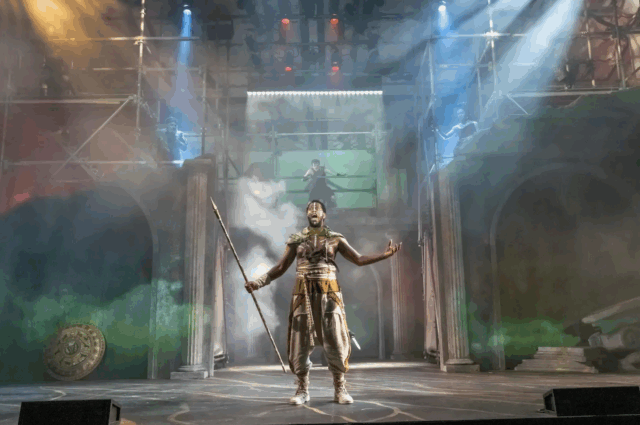
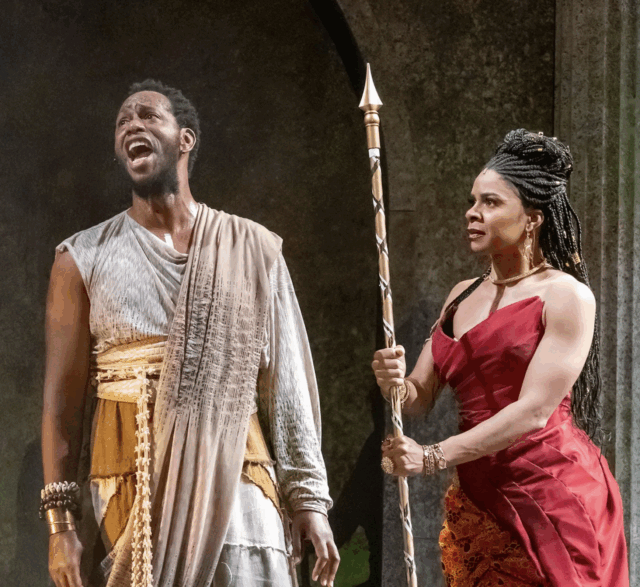
SEARCHING FOR HAPPINESS: ANDREW SCOTT AND SARAH SNOOK GO SOLO

Andrew Scott reaches for dying hope in Vanya at the Lucille Lortel (photo by Julieta Cervantes)

VANYA
Lucille Lortel Theatre
121 Christopher St. between Bleecker & Hudson Sts.
Tuesday – Sunday through May 11
lortel.org/currently-playing

There are currently two extraordinary solo shows, one on Broadway, one off, based on classic literary works from the 1890s, and they could not be more different.

Both feature extremely talented and sexy award-winning actors from English-speaking countries overseas; in one, the performer creates a warm, intimate space, attempting to make individual eye contact with each of the 299 audience members, while in the other the star spends nearly the entire show looking directly into onstage cameras, although every one of the 1,025 audience members will feel the power and intelligence in that gaze.

At the Lucille Lortel in the West Village, Dublin-born Andrew Scott, a three-time Emmy nominee and two-time Olivier winner who has portrayed Moriarty in Sherlock, the hot priest in Fleabag, the title character in Ripley, and Adam in Andrew Haigh’s well-received 2023 film, All of Us Strangers, is taking on all eight roles in Simon Stephens’s adaptation of Anton Chekhov’s 1899 Uncle Vanya, called simply Vanya.

Meanwhile, Adelaide-born Sarah Snook, an Emmy and Olivier winner who is most well known as Siobhan “Shiv” Roy in Succession, plays all twenty-six parts in Kip Williams’s adaptation of Oscar Wilde’s 1890 novella, The Picture of Dorian Gray.

Under the whimsical direction of Sam Yates — who created the show with Scott, writer Stephens, and scenic designer Rosanna Vize — Scott, whose only previous New York stage appearance was in David Hare’s The Vertical Hour in 2006–7, employs only subtle shifts in his performance to indicate which character he is at any given moment, with slight vocal changes and the use of such objects as a tennis ball, sunglasses, a necklace, and a scarf. Vize’s attractive set includes a kitchen with a working sink, a door standing by itself in the center, a piano with a small Christmas tree on it, a glowing orb, a table with a lamp and bottle of booze, a large swing, and a curtained back wall that opens to reveal a mirror in which the audience can glimpse themselves, a way to combat the solitude of the solo performer and involve the audience even further.

It definitely helps to know the basics; as one colleague noted to me after the show, “I enjoyed it, but was it Uncle Vanya?” Over the years, the play has proved to be malleable, reshaped and reimagined into various time periods and locations and methods of storytelling. Tony winner Stephens, who has written such diverse presentations as The Curious Incident of the Dog in the Night-Time, Heisenberg, and Blindness, sets his version in an undefined time and place, although it seems to be the latter part of the twentieth century, before cell phones and home computers; he has Anglicized the names, added nearly three dozen F-bombs, and references the 1994 Johnny Depp movie Don Juan de Marco.

Ivan (Ivan Petrovich “Vanya” Voynitsky) and his niece, Sonia (Sofya Alexandrovna), run the family estate owned by Alexander (Aleksandr Vladimirovich Serebryakov), Sonia’s father; a pompous film director, he was married to Anna, Ivan’s late sister and Sonia’s mother. Alexander has arrived with his much younger second wife, Helena (Yelena Andreevna), who is lusted after by Ivan and the local country doctor and environmentalist, Michael (Mikhail Lvovich Astrov). Ivan’s cranky, well-read, aging mother, Elizabeth (Maria Vasilevna Voynitskaya), lives at the estate, along with the old nurse Maureen (Marina Timofeevna) and Liam (Ilya Ilich “Waffles” Telegin), a poor landowner and family friend who has not gotten over his wife’s desertion with another man years before, opting to remain faithful to her until her utterly unlikely return.

Andrew Scott takes a swing and scores as eight characters in solo Uncle Vanya (photo by Julieta Cervantes)

The play opens with a conversation between Michael and Maureen that relates to all the characters:

Michael: How long have we known each other, Maureen?
Maureen: Oh my god, Jesus. Let me think. You came here for the first time, when was it, when Anna, Sonia’s mother, was sick? Then you had to come again the next year. That was two visits in two summers before . . . before she died. So that’s eleven years, is it?
Michael: Have I changed, do you think?
Maureen: Oh god yeah. You have. You used to be so handsome. And you were so young then, Michael, and now you’re old. And of course you drink more than you used to, Michael.
Michael: Yeah . . . Yeah I’ve worked myself to the bone. I’m on my feet all day. I never rest. And then you get home and you pray to God a patient isn’t going to call you out again. But they do, they always do. So in all the time I’ve known you, Maureen. In the last decade. I’ve not had a single day off. What do you expect me to do but get old? And then you look around you and all you can see are lunatics. The people here are lunatics, Maureen. Every single one of them. And when you surround
yourself with lunatics, after a while, you become a lunatic too. I’ve started growing my own carrots. Little tiny carrots. How did that happen? See, I’ve become a lunatic too. It’s not that I’m losing my mind. My brain is still largely in the right place. But my feelings are dull and dead. I don’t want anything. I don’t need anything. I don’t love anybody. Except you. I love you, Maureen.
Maureen: Are you sure you don’t want a drink?

Shortly after that, Ivan, who deeply resents Alexander, explains to Michael and Maureen that he hasn’t been sleeping well, “ever since Alexander and his new wife got here. They’ve knocked our lives completely out of kilter. I sleep really deeply at absolutely the wrong times of day. I’m eating all this weird food. From, like, Kabul. I’m drinking wine in the day. It’s not good for me, Doctor. It’s not good for me at all. Before they got here I didn’t have a moment to spare, did I, Maureen? I was working all the time. Me and Sonia were. Preparing the harvest. Managing the orders. Making deliveries. Now it’s just Sonia that’s doing everything, because all I do is eat, sleep, drink, repeat, eat, sleep, drink, repeat!”

But when Alexander reveals his plans for the estate and Ivan catches Michael with Helena, one of the most famous guns in the history of theater explodes.

Vanya is a unique and thrilling experience. Scott is absolutely magnetic; you won’t be able to take your eyes off him, just as it feels like he can’t take his eyes off you. There are odd moments; turning Alexander into a film director feels unnecessary, and a sex scene is both steamy and awkward, given that Scott is playing both roles.

But overall, the hundred-minute show is as wistful and funny as it is heart-wrenching and touching. The incorporation of the piano to recall Anna is haunting, and the swing evokes a more innocent childhood for Ivan, Scott, and the audience.

Early on, Elizabeth tells Ivan, “You’ve changed, Ivan. Sorry, Sonia, but it’s true. You’ve become cynical. I barely recognize you these days. You had a good soul. You used to be so clear in your convictions. They used to shine from you. . . . What’s odd, Ivan, is that it’s like you blame your misery on your convictions. Your convictions aren’t the problem. You’re the problem. You never put your convictions into practice. You could have gone out and done something. You never did.” Vanya responds, “Done something? Do you have any idea, Mother, how difficult it is to go out and ‘do something’ nowadays?” That’s an exchange everyone can relate to in 2025.

So is it Uncle Vanya?

In Andrew Scott’s capable hands, does it matter?

Sarah Snook portrays all the characters in unique staging of Oscar Wilde classic (photo by Marc Brenner)

THE PICTURE OF DORIAN GRAY
Music Box Theatre
239 West 45th St. between Broadway & Eighth Aves.
Tuesday – Sunday through June 29, $74–$521
doriangrayplay.com

Sarah Snook is sensational in her New York stage debut, portraying all the characters in Kip Williams’s exciting solo adaptation of Oscar Wilde’s beloved homoerotic gothic horror morality tale, The Picture of Dorian Gray. For two hours without intermission, Snook, who won an Olivier for her performance in London, ambles across the stage, followed by several mobile cameras operated by Clew, Luka Kain, Natalie Rich, Benjamin Sheen, and Dara Woo, dressed in black, stopping behind and in front of several large screens hanging from the ceiling. A giant Snook is projected onto the screens, dominating the theater as she smiles, winks, and nods knowingly while the dark story unfolds.

The genius in the Sydney Theatre Company production is that the onstage Snook interacts with prerecorded versions of herself as the other characters; thus, the live Snook is seen having conversations with the others on the screens, sometimes several at a time, all aware that they are being looked at and reveling in that connection.

Artist Basil Hallward has painted a portrait of a beautiful young man named Dorian Gray. Showing the work to his aristocratic friend Lord Henry “Harry” Wotton, who wants it to be shown publicly at a prestigious event, Hallward declines, explaining, “I know you will laugh at me, but I really can’t exhibit it. I have put too much of myself into it. . . . Harry, every portrait that is painted with feeling is a portrait of the artist, not of the sitter. The reason I will not exhibit this picture is that I am afraid that I have shown in it the secret of my own soul.”

Dorian arrives at the studio to continue to pose for Basil, who does not want Lord Wotton to corrupt his innocent young model and new friend. He tells Harry to stay away from him, offering, “He has a very bad influence over all his friends, with the single exception of myself.” Dorian asks, “Have you really a very bad influence, Lord Henry? As bad as Basil says?” Lord Wotton replies, “There is no such thing as a good influence, Mr. Gray. All influence is immoral.” Saying he is glad to have met Lord Wotton, Dorian admits, “I wonder shall I always be glad?”

Upon seeing the finished portrait, Dorian is blissful yet taken aback. “How sad it is! How sad it is! I shall grow old, and horrible, and dreadful. But this picture will remain always young. It will never be older than this particular day of June,” he declares. “If it were only the other way! If it were I who was to be always young, and the picture that was to grow old! For that — for that — I would give everything! Yes, there is nothing in the whole world I would not give! I would give my soul for that!”

And thus, the deal is done.

Sarah Snook briefly takes a seat in The Picture of Dorian Gray (photo by Marc Brenner)

Dorian is taken under the wing of Lord Wotton’s aunt, Lady Agatha, and meets such high-society types as the Duchess of Harley, parliamentarian Sir Thomas Burdon, the charming gentleman Mr. Erskine of Treadley, and the silent Mrs. Vandeleur, an old friend of Lady Agatha’s who decided she had “said everything that she had to say before she was thirty.” Among the others who enter Dorian’s kaleidoscopic world are his housekeeper, Mrs. Leaf; actress and puppeteer Sibyl Vane; Francis Osborne, the doorman; chemist Alan Campbell; Dorian’s friend Adrian Singleton; and Sybil’s younger brother, sailor James Vane.

Murder, suicide, and other forms of mayhem ensue as Dorian’s bloom of youth and beauty never seem to fade despite his depravities while the portrait depicts an ever older and more decrepit figure.

Marg Horwell’s set is mostly spare except for a few props that appear briefly, such as a long table, a puppet show, and an elegant couch with flowers; Horwell’s period costumes and the many wigs Snook wears are fanciful and ornate. The pinpoint precision of Nick Schlieper’s lighting, Clemence Williams’s sound and music, and David Bergman’s video makes it all feel real, especially one scene in which a group is seated at a long table; it is not immediately clear which Snook is the live one. Williams and Bergman also have fun using face filters as Snook cheekily poses for the camera.

The only time Snook is not looking directly into the camera is when she is in the nursery, admiring herself in a handheld mirror; in one corner is a collection of portraits based on paintings by such artists as Sebastiano del Piombo, Jean-Étienne Liotard, and Bronzino, but each now with Snook’s face.

Snook is remarkable as the narrator and all the characters, able to engage with an audience she never actually looks at, acting to be seen on a screen as if the audience is watching a morphing portrait. Despite our being well aware of the artificiality of it all, we fall for the gambit hook, line, and sinker, sucked into this technological marvel; it is a Dorian Gray made for 2025.

It is also an excellent companion piece to Andrew Scott’s Vanya. Just as multiple characters in Stephens’s Chekhov retelling discuss how much others have changed, that concept is key to Dorian Gray as well, and not just in how the man in the portrait deteriorates but Dorian does not. “It’s nigh on eighteen years since I met him. He hasn’t changed much since then. I have, though,” Violet acknowledges. “You are quite perfect, Dorian. Pray, don’t change,” Lord Wotton insists. And Dorian asks of himself, “Was it really true that one could never change?”

In addition, an elusive happiness hovers over Vanya. “I may not have my happiness, Ivan. But I’ve got my pride,” Liam says. Michael debates whether he is happy or not. Sonia asks Helena if she is happy and she answers no. And Alexander brags, “I’m the only happy one in this whole bloody house.” Meanwhile, Lord Wotton says, “Pleasure is Nature’s test, her sign of approval. When we are happy, we are always good, but when we are good, we are not always happy.” And Dorian admits, “I have never searched for happiness. Who wants happiness? I have searched for pleasure.”

In completely different ways, both shows offer pleasures galore, delivering a happiness that will stay with you long after you leave the theater.

[Mark Rifkin is a Brooklyn-born, Manhattan-based writer and editor; you can follow him on Substack here.]

FOOTBALL AS AMERICA: MATTHEW BARNEY AT METROGRAPH

Matthew Barney’s multichannel Secondary will be shown on a single screen at Metrograph (image © Matthew Barney, courtesy of the artist, Gladstone Gallery, Sadie Coles HQ, Regen Projects, and Galerie Max Hetzler)

SECONDARY
Metrograph
7 Ludlow St. between Canal & Hester Sts.
Saturday, May 3, 5:00
metrograph.com
secondary.matthewbarney.net
online slideshow

It was the hit heard round the world.

On August 12, 1978, the New England Patriots were playing a preseason game against the Oakland Raiders at Oakland-Alameda County Coliseum. Late in the second quarter, the Pats have a third and eight at the Raiders twenty-four-yard line. QB Steve Grogan calls the 94 Slant, and wide receiver Darryl Stingley heads downfield. At the ten-yard line, Stingley reaches for the overthrown pass and is crushed in midair by two-time Raiders All-Pro safety Jack Tatum, known as the Assassin for his punishing style of play. Stingley immediately crumples to the ground. Four Oakland defenders look down at Stingley and walk away; Patriots wide receiver Russ Francis stands over his fallen teammate, knowing something is wrong. The twenty-six-year-old Stingley is wheeled off the field on a stretcher, a quadriplegic for the rest of his life; he died in 2007 at the age of fifty-five. Tatum wasn’t penalized on the play and never apologized to Stingley, claiming it was a legal hit and that he had done nothing wrong. Tatum, who died in 2010 at the age of sixty-one, was also involved in the Immaculate Reception on December 23, 1972, in a playoff game against the Steelers; with twenty-two seconds left and Pittsburgh down by one, future Hall of Famer Terry Bradshaw was facing a fourth and ten from his own forty. He ran to his right and threw a pass down the middle. Tatum smashed into Steelers running back Frenchy Fuqua, the ball popped up into the air, and future Hall of Famer Franco Harris picked it up by his shoestrings and ran forty yards into the end zone for the winning score.

Filmmaker and installation artist Matthew Barney was eleven years old when Tatum pummeled Stingley. Seeing the collision over and over again on replay did not prevent Barney from becoming a star quarterback in high school in Idaho. But at Yale, he switched from sports to art, beginning his “Drawing Restraint” series in 1987 and making his Jim Otto Suite in 1991–92, about orifices, bodily fluids, energy, Harry Houdini, and Raiders Hall of Fame center Jim Otto, who wore the number double zero, mimicking the letters at the beginning and end of his palindromic last name.

Violence in football takes center stage as a metaphor for America in Matthew Barney’s Secondary (image courtesy Matthew Barney Studio, © Matthew Barney / photo by Julieta Cervantes)

In 2023, Barney said farewell to his longtime Long Island City studio with Secondary, a five-channel video installation that used the Tatum-Stingley play to explore violence in athletic competition. Barney transformed the studio, which was right on the East River, into a football stadium, with a long, artificial turf surface divided into geometric patterns of different colors, centered by his “Field Emblem,” his Cremaster logo, an ellipse with a line going through it, evoking –0-. There were monitors in all four corners of the field, along with a three-sided mini-jumbotron hanging from the ceiling. Visitors could sit on the field or a bench; there was also a painting on the wall, an owners booth filled with football paraphernalia, and a ditch with broken piping and mud dug into the concrete. Outside, on the facade facing the water, there was a digital countdown clock next to graffiti that said, “Saboroso,” which means “delicious.”

Written and directed by Barney, photographed by Soren Nielsen, and edited by Kate Williams, the film — which lasts sixty minutes, the length of a football game — has now been reimagined on a single screen, where it will be shown at Metrograph on May 3 at 5:00, in conjunction with the publication of a two-volume companion book (Rizzoli, April 2025, $115), featuring contributions from Eric Banks, Jonathan Bepler, Raven Chacon, Mark Godfrey, Juliette Lecorne, Helen Marten, Maggie Nelson, and David Thomson; Barney will be at Metrograph for a postscreening discussion with book editor Louise Neri and Banks, followed by a reception with signed books available for purchase.

The multichannel version kicks off with indigenous rights activist Jacquelyn Deshchidn, a Two-Spirit Chiricahua Apache and Isleta Pueblo soprano, composer, poet, and public speaker, performing an alternate national anthem, a none-too-subtle jab at a league that still has teams using offensive Native American names and imagery. The cast, primarily consisting of dancers and choreographers, features movement director David Thomson as Stingley; Raphael Xavier as Tatum; Shamar Watt as Raiders safety Lester “the Molester” Hayes; Wally Cardona as Grogan; Ted Johnson as Francis; Isabel Crespo Pardo, Kyoko Kitamura, and Jeffrey Gavett as the line judges and referees; Barney as Raiders Hall of Fame QB Ken “the Snake” Stabler, who died of colon cancer but was discovered to have had high Stage 3 chronic traumatic encephalopathy (CTE), the disease that affects so many football players, brought on by getting hit so much in the head; and Thomas Kopache as Raiders owner Al Davis, whose motto was “Just win, baby,” no matter the cost. (Football fans will also notice cameos by actors portraying such Raiders favorites as wide receiver Fred Biletnikoff and defensive end John “the Tooz” Matuszak, who became an actor and died in 1989 at the age of thirty-eight from an opioid overdose.) The actors are generally much older than the people they represent, several of whom never made it to the age the performers are today.

The experimental film does not have a traditional chronological narrative; instead, Barney focuses on Tatum, Hayes, and Stingley training in slow motion in equipment rooms as if preparing for a ballet, Grogan making a football out of a gooey substance and then practicing with it, members of Raiders Nation shouting and cheering in fierce black-and-silver Halloween-like costumes, and players venturing into the muddy ditch, the broken pipe echoing Stingley’s shattered body. The music, by sound designer Jonathan Bepler, envelops the audience in a parade of noises, from hums and breathing to clangs and screams. Shots of the Manhattan skyline and the East River beckon to another life outside. The screens sometimes display the same footage, while other times they are different; it is like the viewer is at a football game, with the choice whether to watch the quarterback, the defensive alignment, or other fans in the stands. There is no actual pigskin in the film.

Matthew Barney turned his LIC studio into a multimedia installation (photo by twi-ny/mdr)

The game of football has always been lionized for its violence. Even as the league changes rules to try to protect the quarterback, kick returners, and receivers, the sports networks repeatedly show brutal hits like the one on Dolphins quarterback Tua Tagovailoa against the Cincinnati Bengals that resulted in severe head and neck injuries. When we think of Washington Redskins quarterback Joe Theismann, the first thing we remember is the career-ending injury he suffered on Monday Night Football in 1985 at the hands of New York Giants linebackers Lawrence Taylor and Harry Carson, brutally shattering his leg, and not his 1982–83 MVP season when he led his team to a Super Bowl victory over the Dolphins.

But Barney (River of Fundament, “Subliming Vessel”) is not merely commenting on football. Secondary is about America itself, its rituals and celebrations, its embracing of violence on and off the field. It’s about our lack of respect for the human body and one another, about a country torn apart into blue and red states like opposing teams, ready to do whatever is necessary to just win, baby.

[Mark Rifkin is a Brooklyn-born, Manhattan-based writer and editor; you can follow him on Substack here.]

ANANSI’S GOLD: YEPOKA YEEBO AT THE AFRICA CENTER

Who: Yepoka Yeebo, Stuart A. Reid
What: Anansi’s Gold: In Conversation with Yepoka Yeebo and Stuart Reid
Where: The Africa Center, 1280 Fifth Ave. between 109th & 110th Sts., and online
When: Wednesday, April 30, free with advance RSVP, 6:30
Why: “In a castle by the sea in Accra, our man was telling his story. Outside, the sky was so bright it was almost white. In the shallows next to the castle, the waves were pale gray with white caps. Farther out to sea, they turned a shimmering blue. Huge fishing canoes rocked gently, close to shore. On the horizon, container ships lined up, waiting to dock. The air smelled of salt and smoke and brine. The castle — Osu Castle — was cut off from the rest of Accra by palm trees and checkpoints. It was a maze of archways and staircases and parapets, patched together over four centuries. Some of its walls were brightly whitewashed. Others were gray concrete, slick with algae. Ancient cannons and soldiers with assault rifles lined the castle’s walls. Even without stepping into its underground dungeons, you could tell that unspeakable things had happened here. In a heavily guarded room at the heart of the castle, a haze hung in the air as our man began. The history of Ghana, he said, had a secret chapter. Kwame Nkrumah, the country’s first president, had revealed it on his deathbed in 1972.”

So begins British-Ghanaian journalist Yepoka Yeebo’s true-crime bestseller, Anansi’s Gold: The Man Who Swindled the World (Bloomsbury, April 2025, $19.99), which tells the story of con artist supreme John Ackah Blay-Miezah, who perpetrated a long, complicated financial fraud that involved a CIA-funded military junta, Ghanaian statesman Ako Adjei, former Nixon attorney general John N. Mitchell, and several of Kwame Nkrumah’s cabinet ministers, among others, stretching from Ghana to Philadelphia.

In conjunction with the release of the paperback edition of the book, which won the Jhalak Prize and the Plutarch Award for Biography, Yeebo will be at the Africa Center on April 30 at 6:30, speaking with writer and editor Stuart A. Reid, author of The Lumumba Plot: The Secret History of the CIA and a Cold War Assassin.

Admission is free with advance RSVP; the event will also be livestreamed on YouTube and Facebook.

[Mark Rifkin is a Brooklyn-born, Manhattan-based writer and editor; you can follow him on Substack here.]

RIFF’S RANTS & RAVES: SIX SHOWS TO SKIP

Lily Rabe and Billy Crudup star in Lincoln Center revival of Henrik Ibsen’s Ghosts (photo by Jeremy Daniel)

GHOSTS
Lincoln Center Theater at the Mitzi E. Newhouse
150 West 65th St. between Broadway & Amsterdam Ave.
Tuesday – Sunday through April 26, $98-$182.50
212-362-7600
www.lct.org

Lincoln Center Theater’s current revival of Ghosts, directed by three-time Tony winner Jack O’Brien from a new translation by Mark O’Rowe, begins with two actor/characters reading from the script, repeating lines with slight changes, as if rehearsing in front of the audience, before putting the pages away and starting the play proper. It’s an awkward start.

The play concludes, about 110 minutes later, with a painful, seemingly endless, overly melodramatic scene between a mother and her son, followed by the full cast returning their scripts to the center table. No, we did not just witness a dress rehearsal but a final presentation — one that seems to still need significant work.

In between is a clunky adaptation that is unable to capture the essence of Henrik Ibsen’s original 1881–82 morality tale, which has been seldom performed in New York, save for a Broadway run in 1982 and two versions at BAM, by Ingmar Bergman in 2003 and Richard Eyre in 2015.

The story unfolds on John Lee Beatty’s elegant dining room set. Painter Oswald Alving (Levon Hawke), the prodigal son, has returned home from Paris to his widowed mother, the businesslike Helena (Lily Rabe), who is in the process of signing over an orphanage to the church, represented by Pastor Manders (Billy Crudup). This man of the cloth has convinced Helena not to insure it because to do so would be evidence that she and the pastor “lack faith in God . . . in his divine protection.”

Oswald is attracted to the young maid, Regina (Ella Beatty), whose father, Jacob (Hamish Linklater), is a carpenter working for Mrs. Alving. Jacob’s goal is to open a classy boardinghouse for sailors on the mainland and have Regina join him there. Manders, who enjoys playing both sides against the middle, as if he knows things the others don’t and always has a secret up his sleeve, does not consider Jacob a man of the strongest character.

At one moment the pastor can praise someone, then tear them down in the next, as when he tells Helena, “Your impulses and desires have governed you all your life, Mrs. Alving. You’ve always resented authority and discipline, and as a result, you often rejected or ran away from things that were unpleasant to you. When being a wife became so, you abandoned your husband. When being a mother became so, you sent your son away to live with strangers … and as a result, you’ve become a stranger to him.”

A tragic event shifts the relationships as devastating facts explode all over.

Ghosts feels like a ghost of itself; while it has its moments, in the end nothing solid remains. The show merely dissipates into the air; failing to resonate today, it seems to get lost in the ether. The performances are uneven, and the conclusion is the final nail in the coffin.

Two couples face a possible apocalypse in Eric Bogosian’s Humpty Dumpty (photo by Matt Wells)

HUMPTY DUMPTY
The Chain Theatre
312 West Thirty-Sixth St. between Eighth & Ninth Aves., third floor
Wednesday – Sunday through May 3, $35
www.chaintheatre.org

Written in 2000 in the wake of the Y2K fears that life as we knew it on planet Earth would end, Eric Bogosian’s Humpty Dumpty is finally getting its New York City premiere, at the Chain Theatre; it’s easy to see what took so long.

Two couples have decided to take a break from their busy lives and head up to a vacation house in upstate New York, in the middle of nowhere. First to arrive are book editor Nicole (Christina Elise Perry) and her novelist husband, Max (Kirk Gostkowski); they are soon joined by Max’s best friend, successful screenwriter Troy (Gabriel Rysdahl), and his actress girlfriend, Spoon (Marie Dinolan). Occasionally stopping by is the property’s handyman, Nat (Brandon Hughes).

“No cable up here. And no fax machine anywhere. Cell phone barely works. And how do we do email?” Nicole complains. Max responds, “We don’t. That’s the point. For one week, we don’t do anything. No faxes. No email.”

They get a whole lot more than they bargained for when the power goes out for an extended period of time and the world outside threatens to turn into a battle zone they have no idea how to deal with, or with all the eggs that come their way.

Soon the five characters are at one another’s throats, but you’re not likely to care, as there’s nothing you’d rather do less than spend any time with these five annoying, self-absorbed nut cases. Because we have no affection for them in the first place, there’s no change in their development as the inexplicable and ever-more-confusing crisis worsens, just more of the same. And there’s not much director Ella Jane New can do on David Henderson’s cramped set.

When Max screams, “Troy, will you shut the fuck up!,” it’s too bad they all don’t listen.

Leonard Bernstein (Helen Schneider), waiter Michael (Victor Petersen), and Herbert von Karajan (Lucca Züchner) share an odd evening in Last Call (photo by Maria Baranova)

LAST CALL
New World Stages
340 West Fiftieth St. between Ninth & Tenth Aves.
Wednesday – Monday through May 4, $39-$159
lastcalltheplay.com
newworldstages.com

Peter Danish’s Last Call is a befuddling new play about an accidental meeting between a pair of giant maestros for the first time in decades. In 1988, American conductor and composer Leonard Bernstein (Helen Schneider) bumped into Austrian conductor Herbert von Karajan (Lucca Züchner) at the Blaue Bar in the Sacher Hotel. The eighty-year-old Karajan was in Vienna to conduct Brahms’s Symphony Number One “for the millionth time,” while the seventy-year-old Bernstein was there to receive “some silly award” — and attend his longtime colleague/rival’s concert. Within two years, they would both be dead.

Their fictionalized conversation was inspired by the recollections of the waiter who served them that night, named Michael (Victor Petersen) in the play, who shared the tale with Danish. Over the course of ninety slow-moving minutes, Bernstein, a Jew who composed such scores as On the Town, Wonderful Town, and West Side Story and conducted extensively with the New York Philharmonic and the Vienna Philharmonic, and Karajan, a onetime member of the Nazi Party who had long associations with the Berlin Philharmonic and London’s Philharmonia Orchestra, needle and praise each other relentlessly; Bernstein tells Michael that Karajan “is the second greatest conductor in the world,” while Karajan suggests that Bernstein, who has stopped conducting because of prostate issues, “could wear a diaper.”

Here’s a sample exchange regarding how Karajan has cut his intake to only one cigarette and one shot of whiskey a day:

Lenny: I find your restraint positively —
Herbert: Admirable? Impressive?
Lenny: Unbearable.
Herbert: It’s called discipline, Leonard! You should try it.
Lenny: Discipline? Oh, please! I speak six languages, play a dozen musical instruments, and have half the classical repertory committed to memory.
Herbert: Only half?
Lenny: Anyway, at this point in my life, I certainly don’t need a lecture about discipline! Look where all your discipline has gotten you! A half dozen strokes, crippling arthritis, bum kidneys!

That might very well be the best moment of the play, which otherwise grows laborious fast. Krajan and Michael occasionally speak in German, with the English translation projected onto a back wall, but it was very difficult to read from my seat. Turning the bar into a urinal — twice — made little sense, especially when the actors portraying the conductors stood way too close to the porcelain, which might be explained at least in part because those actors are both, inexplicably, women. Bernstein repeatedly refers to his fellow conductor as “von Karajan” when it should have been just “Karajan.” And director Gil Mehmert cannot get the actors and action in sync, failing to make the best use of Chris Barreca’s long, narrow set.

It should be last call for Last Call.

A cast of five tries to climb its way out of a deep hole in Redwood (photo by Matthew Murphy & Evan Zimmerman)

REDWOOD
Nederlander Theatre
208 West Forty-First St. between Broadway & Eighth Ave.
Tuesday – Sunday through May 18, $99.75-$397
www.redwoodmusical.com

Idina Menzel’s heavily anticipated return to Broadway after a ten-year absence is a major disappointment, a vanity project that looks great but never achieves the necessary narrative flow.

Tony winner Menzel (Rent, Wicked) conceived of the show with Tony-nominated director Tina Landau (SpongeBob SquarePants, Superior Donuts), inspired by the true story of Julia Butterfly, the American activist who lived in a giant California redwood tree for more than two years in the late 1990s. Menzel stars as Jesse, a middle-aged woman in need of healing who is escaping her hectic life in New York City and an undisclosed tragedy and fleeing across the country. “I have to find somewhere else to be / where I’m no longer me,” she sings. “So I will drive down these broken lines / past the endless signs — keep on going —” And keep on going she does, with Menzel showing off her truly spectacular pipes, although it seems that Jesse’s wife, Mel (De’Adre Aziza), was left with no explanation, much like the audience at this point.

When she finally makes it to the Redwood Forest, she can’t stop annoying a pair of canopy botanists, Finn (Michael Park) and Becca (Khaila Wilcoxon), who are working there. Stilted explicative dialogue (Landau wrote the stultifying book, with lyrics by her and Kate Diaz) ensues, such as the following:

Jesse: Oh, well, um . . . wow, speaking of color . . . How did all these tree trunks become this . . . deep, deep black? Charcoal, onyx, jet, licorice —
Finn: Excuse me?
Jesse: Eigengraui! Bet you never heard of that color. Oh, it’s a game we play at work — who can think of the most synonyms for a particular descriptor. I always win. I’m better than a thesaurus.
Finn: The trees are black because they’ve been burned. Wildfires and prescribed fires. Did you know that redwoods are one of the most fire-resistant species in the world?
Becca: (To herself) And so it begins . . .
Finn: The bark on that tree is over a foot thick —
Becca: He’d lecture a rock if it listened.
Finn: (To Jesse) Yeah, it holds water, and protects the inner heartwood —
Jesse: Heartwood?
Finn: The wood at the center of the tree —
Jesse: The tree has a heart? Like a heart heart?
Finn: Except it’s dead.
Jesse: Dead?
Finn: The heartwood doesn’t carry water or nutrients anymore, but — it’s the strongest part of the tree.
Becca: This is part of the spiel he gives on his tours — you could sign up for one online in the spring — but right now, I’m so sorry, we really do have to get to work.

The plot goes back and forth between the past and the present, from Jesse and Mel’s first date to Jesse’s relationship with her son, Spencer (Zachary Noah Piser), attempting to explain how Jesse ended up in an off-limits tree in a California forest. References to Jewish sayings and prayers, such as Lo Tash’chit (“Do not destroy nature. You must feel for the trees as you do for humans.”) and Tikkun Olam (“repair the world”), bring the proceedings to a head-scratching halt. Plot holes grow so big that you can, well, fit a giant redwood through them.

However, the production can be spectacular, anchored by a huge tree in the center of Jason Ardizzone-West’s tilting set, surrounded by screens on which Hana S. Kim’s immersive projections transport the audience into the forest, all beautifully lit by Scott Zielinski. Mezzanine seating is suggested to take it all in, but even the visuals start to feel repetitive as the story becomes more and more stagnant. The fine cast, also hindered by Diaz’s overbearing score, can’t save the show, which is in need of big-time repairs.

BOOP! The Musical gets off to a great start before falling apart (photo by Matthew Murphy and Evan Zimmerman)

BOOP! THE MUSICAL
Broadhurst Theatre
235 West Forty-Fourth St. between Broadway & Eighth Aves.
Tuesday – Sunday through July 13, $58-$256
boopthemusical.com

BOOP! The Musical opens with a spectacular series of scenes in which Betty Boop (Jasmine Amy Rogers), the classic star of 1930s animated black-and-white shorts, is filming Betty Saves the Day, singing, “I may be one of Hollywood’s ‘It’ girls / But when there’s trouble afoot / This tiny tornado in spit and curls / Goes at it till the trouble’s kaput.” She works with her loyal director, Oscar Delacorte (Aubie Merrylees), and his assistant, Clarence (Ricky Schroeder), and enjoys spending time with her fellow cartoon characters Grampy (Stephen DeRosa), an eccentric Rube Goldberg–esque inventor, and his dog, Pudgy (a puppet operated by Phillip Huber).

When reporter Arnie Finkle (Colin Bradbury) asks her, “Who is the real Betty Boop?,” Betty suddenly begins examining her life. She tells Grampy, “It’s not something a girl like me has any right to complain about. I just . . . well, the attention is getting to be a little much. I’m not talking about men chasing me around a room with drool spilling out of their mouths. A good heavy frying pan takes care of them. I’m talking about being famous. People staring at me, taking my picture and wanting my autograph, or one of my shoes.” She adds, “I’ve played so many roles, I don’t know who I am anymore!”

Dreaming of spending one ordinary day as “Miss Nobody from Nowhere,” she sneaks into Grampy’s trans-dimensional tempus locus actuating electro-ambulator and finds herself at Comic Con 2025 in the Javits Center, where everything is in full color, including her. As she deals with the shock, she is helped by a kind man named Dwayne (Ainsley Melham) and superfan Trisha (Angelica Hale). Everyone breaks out into the roof-raising “In Color,” featuring dazzling costumes by Gregg Barnes, superb lighting by Philip S. Rosenberg and sound by Gareth Owen, fab projections by Finn Ross, and exciting choreography by two-time Tony winner Jerry Mitchell, who also directs. “It’s gonna lift you ten feet off the ground!” an attendee dressed as the Scarlet Witch proclaims, and that’s just how the audience feels as well, being lifted above David Rockwell’s terrific sets.

However, it all comes crashing down back to earth, and the rest of the show is a disappointing slog as the narrative falls apart and book writer Bob Martin, who cowrote Smash, decides the plot doesn’t have to make a bit of sense. Grampy propels himself and Pudgy into the color-future, where he reconnects with his lost love, Valentina (Faith Prince). Trisha brings Betty — now calling herself Betsy, not admitting she is the real Betty Boop — back to her house in Harlem, where she lives with her aunt Carol (Anastacia McCleskey) and her jazz-loving older brother, Dwayne. Carol is the campaign manager for the slimy Raymond Demarest (Erich Bergen), a mayoral candidate obsessed with sanitation. “When you think of solid waste, think Raymond Demarest” is one of his slogans.

Jokes repeat. Songs are unnecessary. Plot twists meander and confuse.

Yes, Max Fleischer’s original Betty Boop films might not have had the tightest scripts, but they had to fill seven minutes; the musical runs two and a half hours (with intermission) and, despite a lovely lead performance by Rogers in her Broadway debut, is unable to sustain itself, losing focus again and again, choosing style over substance, trying to stuff too much into a show that had tremendous potential.

Smash ends up being more of a dud on Broadway (photo by Matthew Murphy)

SMASH
Imperial Theatre
249 West 45th St. between Broadway & Eighth Ave.
Tuesday – Sunday through June 22, $69-$321
smashbroadway.com

Is Smash a smash?

After seeing Smash on Broadway, I did some research on the 2012–13 series it is based on, which I had never watched. Created by Theresa Rebeck, who has written such plays as Seminar, Bernhardt/Hamlet, and I Need That, the NBC show offered a backstage look at the making of a musical based on Marilyn Monroe, called Bombshell, and featured a wide-ranging cast of theater performers, including Debra Messing, Christian Borle, Megan Hilty, Brian d’Arcy James, Jeremy Jordan, Leslie Odom Jr., Krysta Rodriguez, Will Chase, and Katharine McPhee. Rebeck got fired after the first season, and the program was canceled after the low-rated, problematic second season.

The criticisms about the Broadway musical that kept popping up in the reddit threads coalesced around major changes in the central plot, altering character motivations, keeping songs that were now irrelevant, and the inability to decide whether it is camp, a farce, or a more serious look at backstage shenanigans. Many fans also said they’d rather have seen Bombshell itself as a fully fledged Broadway musical instead of the current adaptation which they found undercooked and overwrought, in need of more tinkering and workshopping.

It wasn’t so much the content of the complaints that grabbed my attention as the general chaos they all alluded to and confirmed my thoughts that the Broadway Smash is a dud, a complete mess that is not ready for prime time on the Great White Way.

Robyn Hurder stars as Ivy Lynn, a Broadway fave who has been tapped to play Marilyn in Bombshell, which is being written by the married team of Tracy Morales (Krysta Rodriguez) and Jerry Stevens (John Behlmann) and directed and choreographed by Nigel Davies (Brooks Ashmanskas). Ivy Lynn’s longtime, loyal understudy is the extremely talented Karen Cartwright (Caroline Bowman), whose husband, Charlie (Casey Garvin), is playing Joe DiMaggio and likes to bring homemade cupcakes to the set; Nigel’s assistant, Chloe Zervoulian (Bella Coppola), is charged with trying to hold it all together; and producer Anita Molina Kuperman (Jacqueline B. Arnold) keeps her eyes on the budget, followed along by her social media assistant, Scott (Nicholas Matos).

It’s all thrown into disarray when Tracy and Jerry give Ivy Lynn a book on method acting by Susan Proctor (Kristine Nielsen), who Ivy Lynn hires as her coach; Susan, looking like a witch from The Crucible, convinces Ivy Lynn to remain in character 24/7 and whispers advice in ther ear, often contrary to what the director, cast, and crew are doing. As Ivy Lynn, who is popping pills Susan gave her, becomes more and more nasty and demanding, Karen spends more and more time in the limelight, along with Chloe, as they prepare for a critical dress rehearsal for investors and influencers.

The songs, by Marc Shaiman and Scott Wittman, are repurposed from the TV series but often feel out of place here, with uninspiring orchestrations by Doug Besterman. The book, by Bob Martin and Rick Elice, lacks any kind of cohesion, as characters repeat themselves, relationships grow stale, subplots come and go, jokes about drinking and drugging are offensive, and, basically, most of what happens is hard to swallow, as Tony-winning director Susan Stroman has no chance of making any of it work and choreographer Joshua Bergasse can’t kick it into high gear.

No, Smash is no smash.

[Mark Rifkin is a Brooklyn-born, Manhattan-based writer and editor; you can follow him on Substack here.]
TIME AND “TIME AGAIN”: TRISHA BROWN AT THE JOYCE

Opal Loop / Cloud Installation #722503 is part of Trisha Brown season at the Joyce (photo by Maria Baranova)

TRISHA BROWN DANCE COMPANY
The Joyce Theater
175 Eighth Ave. at Nineteenth St.
April 29 – May 4, $52-$72
www.joyce.org

For its 2025 season at the Joyce, Trisha Brown Dance Company looks back at its seminal Unstable Molecular Structure Cycle while also forging ahead into the future.

Running April 29 through May 4, the program features three dances, beginning with the world premiere of Time again, which explores the concept of change, repetition, chance, and familiarity. Choreographed by Lee Serle, who was mentored by Brown in 2010 through the Rolex Mentor and Protégé Initiative, the work features set and visual design by Mateo López, who was mentored by William Kentridge in 2012–13 in the Rolex program, lighting by Jennifer Tipton, and music by Australian sound artist Alisdair Macindoe. It will be performed by TBDC members Savannah Gaillard, Rochelle Jamila, Burr Johnson, Ashley Merker, Patrick Needham, Jennifer Payán, and Spencer James Weidie.

Following intermission, the company returns with two pieces from the Unstable Molecular Structure Cycle, which executive director Kirstin Kapustik calls “a series of works that embrace fluidity, unpredictability, and the beauty of constant change.” First up is 1980’s Opal Loop / Cloud Installation #722503, a collaboration with Japanese fog artist Fujiko Nakaya that invites the audience “to bring together images within themselves.” Merker, Needham, Payán, and Weidie perform to the sounds of water passing through high-pressure nozzles, with costumes by Judith Shea and lighting by Beverly Emmons.

The evening concludes with 1981’s Son of Gone Fishin’, which Brown called “a doozey. In it I reached the apogee of complexity in my work.” The full ensemble randomly selects sections of Robert Ashley’s score from his three-opera opus Atalanta, with costumes by Shea and lighting by Emmons evoking the original set design by Donald Judd.

To dive deeper, there will be a Curtain Chat following the April 30 performance.

[Mark Rifkin is a Brooklyn-born, Manhattan-based writer and editor; you can follow him on Substack here.]

NOT JUST PASSING THE TIME: GRAHAM PARKER AND JAMES MASTRO SOLO AT CITY WINERY

Graham Parker and James Mastro will be playing solo gigs at City Winery on April 28 (photo courtesy James Mastro)

GRAHAM PARKER ‘SOLO’ WITH JAMES MASTRO
City Winery New York
25 Eleventh Ave. at Fifteenth St.
Monday, April 28, $38-$58 (plus $25 per person minimum), 8:00
citywinery.com
www.grahamparker.net
www.jamesmastro.net

On December 2, 2012, the Paramount in Huntington hosted a memorable show by a pair of British ex-pats. First up was the reunited Graham Parker and the Rumour, followed by Ian Hunter and the Rant Band, the latter featuring James Mastro on guitar, sax, and mandolin.

On April 28, Parker and Mastro will be at City Winery, with Parker playing songs from throughout his illustrious fifty-year-career, during which he has been backed by the Rumour, the Shot, the Figgs, the Small Clubs, and the Goldtops. His most recent album, 2023’s Last Chance to Learn the Twist, is classic GP, a phenomenal package of incisive tunes, from the bluesy rocker “The Music of the Devil” to the throwbacks “Grand Scheme of Things” and “Wicked Wit” to a love song to weed, “Cannabis.”

An expert raconteur, Parker came out of the gate with a remarkable string of records between 1976 and 1979 — Howlin’ Wind, Heat Treatment, Stick to Me, and Squeezing Out Sparks — and he has never stopped releasing terrific new music while also writing the short story collection Carp Fishing on Valium and the backstage novel The Thylacine’s Lair and acting in Judd Apatow’s This Is 40. I’ve seen him numerous times over the decades and he has never failed to work wonders; one of my favorite evenings was a house concert in New Jersey in which Parker performed one deep cut from each of his albums, in chronological order, introducing each song by talking about what was going on in the world when he wrote it.

In an interview on his website, he explains, “I can’t say I ever think I’m doing anything more with each song or each album other than throwing another pebble into the stream where it swirls around for a bit until it eventually gets picked up by the current and flows off downstream. Bye bye, thanks for helping pass the time.”

Graham Parker joins James Mastro, Ian Hunter, and the Rant Band at the Paramount in 2012 (photo by twi-ny/mdr)

I’ve also had the good fortune to see Mastro play in numerous configurations over the years, with the legendary Hoboken band the Bongos, the underappreciated Health & Happiness Show, Patti Smith, Richard Hell, Syd Straw, Megan Reilly, Amy Speace, and others. But last year the consummate sideman released his highly praised debut solo album, Dawn of a New Error, with Mastro taking on faith and religion in “My God,” death and loss in “Never Die,” true love in “Gangster Baby” and “Three Words,” and fake news in “Right Words, Wrong Song.”

In a February 2024 twi-ny talk, Mastro, who also runs the the Hoboken art gallery and live event space 503 Social Club, explained, “I’ve really enjoyed being a side guy all these years, and especially when you’re working with someone like Ian Hunter, or Patti or John [Cale], anyone I’ve worked with, Megan. So it’s been nice to go in and try to contribute and watch how other people work. It takes a lot of pressure off. Running a band is a pain in the ass; you gotta make sure the drummer doesn’t get arrested.”

Parker and Mastro will be more than passing the time at City Winery, and there will be no drummers needing protection from the law.

[Mark Rifkin is a Brooklyn-born, Manhattan-based writer and editor; you can follow him on Substack here.]