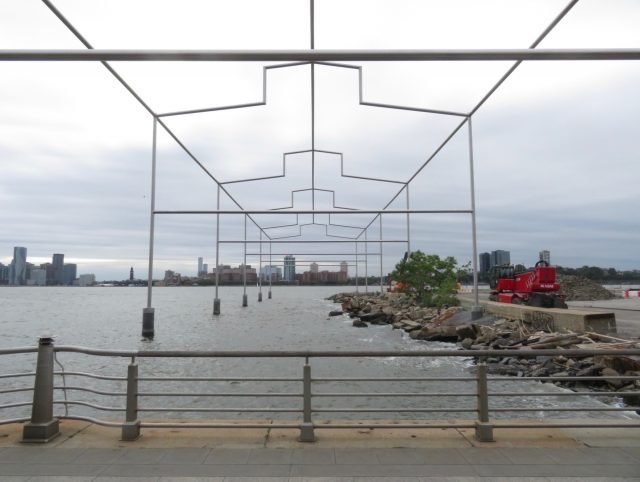
David Hammons’s Day’s End pays homage to Gordon Matta-Clark’s 1975 deconstruction of an abandoned warehouse (photo by twi-ny/mdr)
Who: Adrienne Edwards, Elisabeth Sussman What: Live virtual discussion about David Hammons, Gordon Matta-Clark, and Day’s End Where:Whitney Zoom When: Wednesday, June 30, free with RSVP, 6:30 Why: The Whitney’s “Ask a Curator” series continues June 30 with “David Hammons and Gordon Matta-Clark in the Whitney’s Collection,” a live Zoom discussion about Hammons’s recently installed permanent work, Day’s End, an homage to Matta-Clark’s 1975 similarly named intervention in an abandoned industrial building on Pier 52 at the southern edge of Gansevoort Peninsula. Whitney curators Adrienne Edwards and Elisabeth Sussman will also explore other works in the museum’s collection by the two artists, some of which were on display last fall in “Around Day’s End: Downtown New York, 1970–1986.”
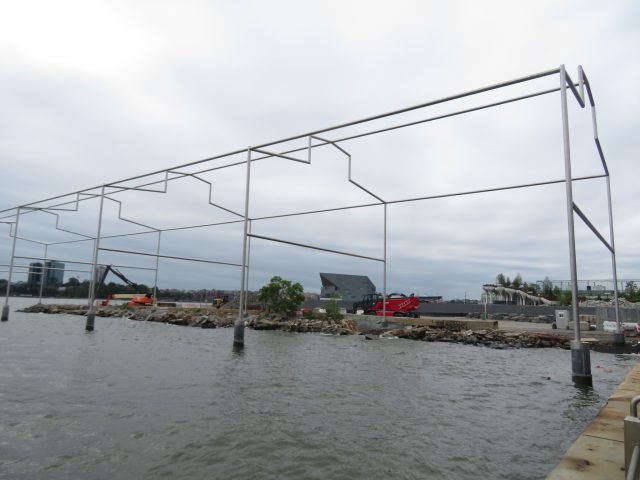
The Whitney and Hudson River Park collaborated on David Hammons’s Day’s End (photo by twi-ny/mdr)
Over the course of seven years, Hammons created a 325-foot-long brushed-steel outline of the warehouse, placed in its exact same former location, a ghostly reminder of what — and who — is no longer there, a reference to the gay community that congregated in the area in the 1970s and 1980s until the AIDS crisis took so many lives. “I look at it as a statue because I’ve seen so many statues in the city and they’re all about memories,” Hammons says in a Whitney video of the dedication ceremony, which he chose not to attend. Half on land and half in the water, it’s a powerful work — officially part of Hudson River Park, not the Whitney — filled with mystery that draws the attention of passersby, many of whom may think it is the skeleton of a new building, especially since there is construction under way right next to it. Down the pier is Little Island, Barry Diller and Diane von Furstenberg’s lovely oasis, and across the street is the Whitney itself. (The Diller-von Fürstenberg Family Foundation was one of many donors who helped fund Hammons’s piece as well.) Admission is free with advance RSVP; Edwards and Sussman will be taking questions from the audience during the event.
AGAINST THE CURRENT (Óskar Páll Sveinsson, 2020)
Quad Cinemas
34 West 13th St. between Fifth & Sixth Aves.
Through July 1
212-255-2243 quadcinema.com
After watching Óskar Páll Sveinsson’s Against the Current, you may not want to kayak around the entire island of Iceland, but you’ll probably want to start planning a trip to this extraordinary Scandinavian nation. In May 2019, Veiga Grétarsdóttir set off from her picturesque hometown of Ísafjörð on a three-plus-month, 1,250-mile journey circumnavigating the entire country in a sixteen-foot solo kayak, paddling counterclockwise, against the current, something that had never been done before. Following her along the coastline, in a fishing boat, and using drones, director and cinematographer Oskar Pall Sveinsson documented the hazardous expedition in vivid detail in the new documentary Against the Current, a film that features a barrage of spectacular shots not only of the sea and the topography of Iceland but of humanity’s tiny place in the world, set to a score by Högni Egilsson.
Along the way, Sveinsson also tells the story of Grétarsdóttir’s recent transition to becoming a woman; born male, she participated in rugged sports when she was younger but also hid what she considered a shameful secret: a compulsion to wear women’s clothing. As a man, she married a woman and had a daughter, but she ultimately decided to go through the surgery to change her gender and then prove to herself and others her physical and emotional strength by kayaking around Iceland. Sveinsson cuts between the treacherous trip and photographs and videos from Grétarsdóttir’s childhood and marriage, with her parents, friends, daughter, and doctors sharing stories about her; every single one accepts her transition, although it was perhaps most difficult for her ex-wife. “I often say that switching your gender like that is the biggest and most complex change you can make in your life,” psychiatrist Óttar Guðmundsson, who was part of Grétarsdóttir’s transgender team, explains. “You can’t change your life more drastically than that.”
Against the Current documents Veiga Grétarsdóttir’s remarkable story
Grétarsdóttir was initially joined by three kayakers, including Örlygur Sigurjónsson, who stuck around the longest, but ultimately she was left on her own, as expected. She would paddle for as many as thirteen hours a day, then pull over onto the coast, eat, and sleep in a tent, occasionally coming into contact with local people. One such supporter was sheep farmer Elisabet Petursdottir, who says, “I feel, regarding all the prejudice, that you’re not supposed to discuss things. All talk is shut down. It would be better to talk about things and solve the problems instead of creating them. In my opinion, everybody should have an open mind. Thank God we are all not made from the same mold. People must be allowed to be as they are.”
Grétarsdóttir holds nothing back, delving deep into aspects of her life that involved depression and even suicide attempts. She hopes that completing the circumnavigation will help her as well as others dealing with issues of personal identity. “I’ve dreamed of it for a long time, but having gone through everything, the transitioning, I decided to live my life, make my dreams come true,” she says. And every step of the way, there are visuals that will take your breath away. The film continues at the Quad through July 1; you can watch a Zoom interview with Grétarsdóttir and Sveinsson (Under the Surface,Ransacked) hosted by the Gene Siskel Film Center here.
Who: Taylor Schilling, Bill Camp, David Strathairn, Nyasha Hatendi, Bryan Doerries What: Livestreamed Zoom reading and discussion Where:Theater of War Zoom When: Wednesday, June 30, free with RSVP, 8:30 Why: Theater of War continues its extraordinary pandemic programming with “Frontline,” an evening of dramatic readings featuring Taylor Schilling, Bill Camp, David Strathairn, and Nyasha Hatendi of scenes from ancient Greek plays by Sophocles (Ajax, Oedipus the King, Philoctetes, Women of Trachis) that relate to today’s health care crisis. Following the reading, there will be a discussion facilitated by director, translator, adapter, and artistic director Bryan Doerries focusing on nurses, doctors, first responders, and other health care professionals, hosted by Michigan Health & Hospital Association and Blue Cross Blue Shield Blue Care Network of Michigan. Admission is free; if you haven’t seen any of Theater of War’s events, now is the time; among their other recent presentations are The Oedipus Project exploring the pandemic and the climate crisis, Antigone in Ferguson looking at racialized police violence, End of Life and King Lear Project examining caregiving and death, and Poetry for the Pandemic.
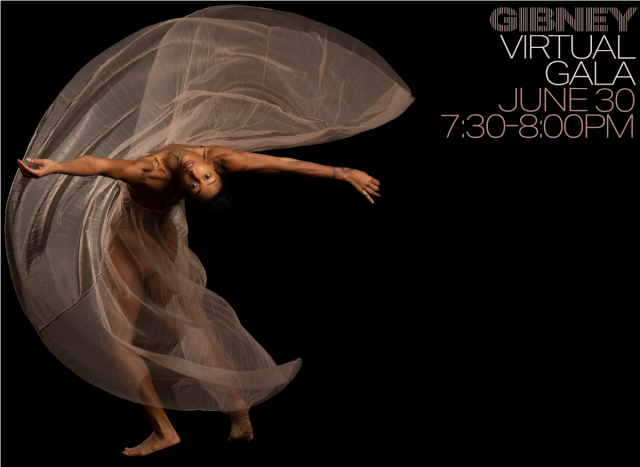
Who:Gibney Company What: Thirtieth anniversary benefit gala Where:Gibney online When: Tuesday, June 30, free – $30, 7:30 Why: Founded in 1991 by choreographer Gina Gibney, Gibney Dance will be celebrating its thirtieth anniversary as a socially active company with a virtual gala on June 30 at 7:30. The evening will feature the world premiere of the dance film Dream Scenarium, by choreographic associate Rena Butler and performed by the newly expanded troupe, along with a look at both the history and future of Gibney Dance. Admission is free, although donations of $30 (or any amount) will gladly be accepted.
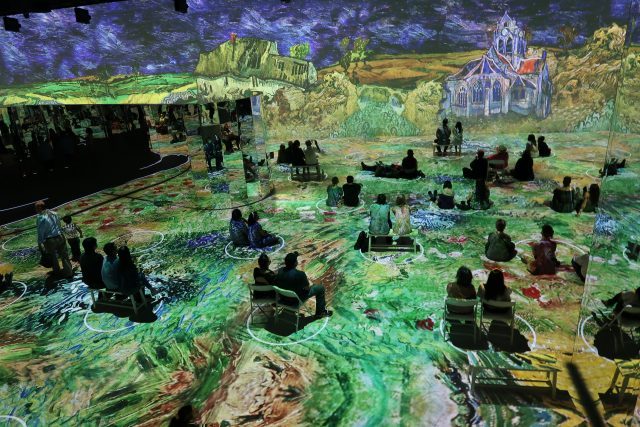
“Immersive Van Gogh” features three rooms of music and large-scale projections (photo by twi-ny/mdr)
IMMERSIVE VAN GOGH EXHIBIT NEW YORK
Pier 36, 299 South St.
Daily through September 6, $29.99-$99.99 (return engagement November 17 – January 2) www.vangoghnyc.com
VAN GOGH: THE IMMERSIVE EXPERIENCE
Skylight on Vesey, 300 Vesey St.
Daily through September, $49.90 vangoghexpo.com/new-york
Discussing the success of a 1935–36 eponymously titled Vincent van Gogh exhibition at the Museum of Modern Art, a MoMA press release explained, “In the opinion of Alfred H. Barr, Jr., Director of the Museum, van Gogh’s popularity is just what the artist himself would most passionately have desired. ‘Again and again,’ said Mr. Barr, ‘van Gogh wrote of his desire to make pictures for laborers, peasants, miners, weavers, fishermen, postmen, seamen, and shopkeepers — in short, for the great aesthetically naive public. It is the central miracle of van Gogh’s artistic career that with such an evangelical desire for popularity he never for a single moment compromised with the popular taste of his time — which was then even more lazy, conventional, and unadventurous than it is now.’ . . . van Gogh’s work itself is the cause of his popularity — and the interest aroused in the tragic life of the artist due more to the appeal of his art than vice versa.”
Over the last several decades, van Gogh exhibitions at MoMA and the Met have deservedly been hugely popular, must-see events that draw long lines and come with a certain cache. When I posted on social media about my visit to one of two concurrent shows in New York City right now that re-create van Gogh’s work using immersive technology, I was surprised by how many of my friends, from across the socioeconomic and political spectrum, had already purchased tickets (primarily between $30 and $60) to at least one of the exhibits, well in advance of their openings. It is impossible to know what van Gogh or Barr would have thought of the idolizing demand; I can only tell you what I think about what turns out to be a pair of Instagram-friendly presentations that are not necessarily worth the price of admission. I suggest instead taking the money and going to a real museum, with real art, although you might not end up with such awesomely cool photos and videos to share online.
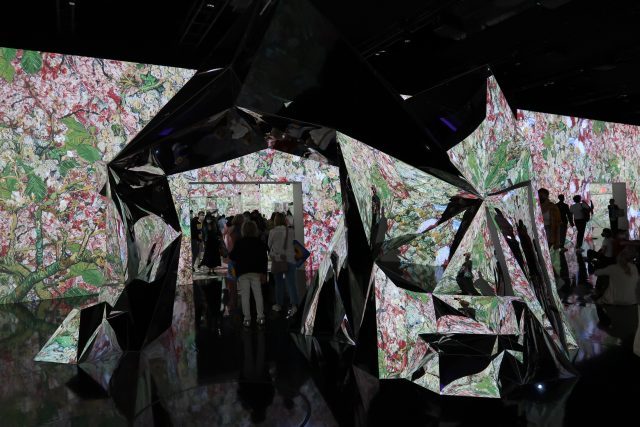
Mirrored sculptures offer Instagram-friendly opportunities at van Gogh show at Pier 36 (photo by twi-ny/mdr)
At Pier 36 on South St., “Immersive Van Gogh,” designed by creator Massimiliano Siccardi and New York City creative director David Korins, consists of three rooms, each larger than the previous, boasting more than half a million square feet of animated projections of the artist’s work. You enter through a narrow hallway lined with very basic facts about the painter’s life and career, along with brief audio narration. As you enter the first room, you are bombarded with a curiously random score consisting of familiar tunes as well as new music composed and curated by Luca Longobardi, echoing through the full venue, including Thom Yorke’s “Dawn Chorus,” Edith Piaf’s “Non, je ne regrette rien,” and Mussorgsky’s “Pictures at an Exhibition: The Great Gate of Kiev,” as dozens of van Gogh’s paintings come to life on four walls and the floor. Irises and sunflowers bloom, clouds swirl and stars dance, crows and cicadas soar, trees and wheat grow, and self-portraits emerge.
The songs are timed to each individual painting — Starry Night, The Potato Eaters, Bedroom at Arles, Café Terrace at Night — evoking the feeling of watching fireworks with the radio simulcast; one blast ends, and you wait with anticipation for the next flurry. It’s hunky-dory and all, silly fun, but it’s primarily a grand gimmick. Each room has mirrored sculptures that are not exactly organic to van Gogh in any way, instead merely offering the opportunity to take swell pictures of the works distorted in the reflections, along with selfies of you and your friends. Good luck trying to take a picture or video without someone else taking a picture or video in yours.
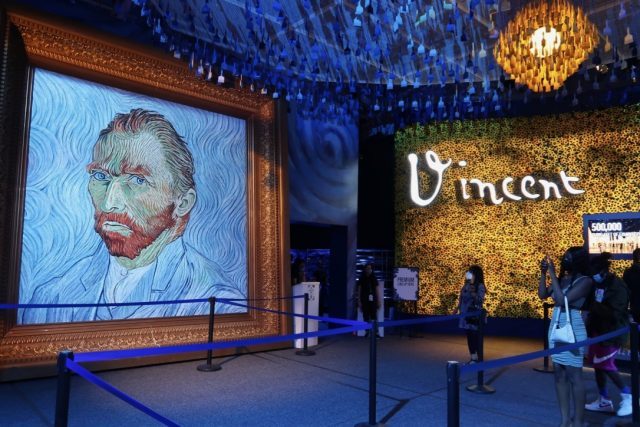
Lobby at Pier 36 installation includes oversized reproduction of van Gogh self-portrait (photo by twi-ny/mdr)
The third and largest room features an observation platform and benches to sit on and take it all in; putting away your camera and relaxing for a while, letting it flow over you, is not unpleasant, but so much of the animation is arbitrary and frivolous that it becomes tiresome. In the lobby and enormous gift shop, there is also a ceiling constructed of nearly eight thousand paintbrushes re-creating Starry Night, a Pocket Gallery where paint splotches explode off canvases and become famous van Gogh paintings using AR, an interactive sculpture in which visitors can ask a question and get a letter from Vincent, and a walk-in circular installation of ten booths that uses color, light, and sound to deliver a “chromesthesia experience” inspired by the possibility that van Gogh had a form of synesthesia, allowing him to hear color and see sound. Oh, I almost left out the fashion show in the exit hallway, a seeming afterthought in which mannequins are adorned with clothing inspired by van Gogh’s imagery. Or something like that. There are also jokes on signs using the pronunciation “van go,” which would confuse Diane Keaton’s character in Woody Allen’s Manhattan, who pronounces the artist’s name as “van gokh.”
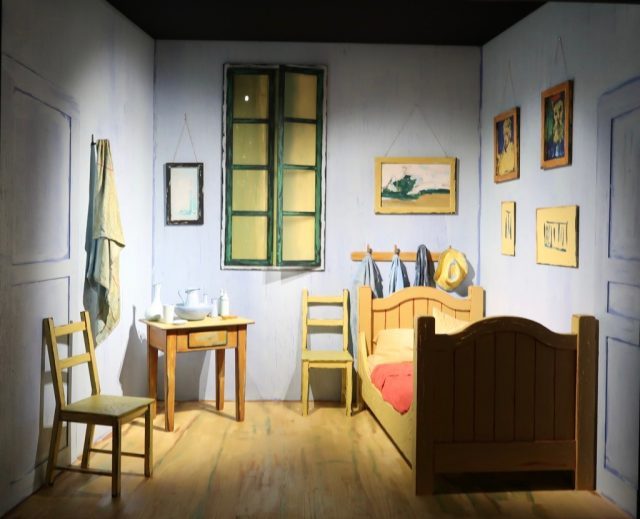
Meanwhile, on the third floor space known as Skylight on Vesey, near Brookfield Place, the competing “Van Gogh: The Immersive Experience” offers a somewhat different trip into the work of the Dutch master, with a greater appreciation and understanding of Vincent as an artist, although not the kind of deep dive you’d get in a museum or gallery. You first make your way through several rooms that detail the influence Japanese prints had on him, his friendship with onetime roommate Paul Gauguin, his vase paintings (projected in 3D), his relationship with his brother, Theo, and his stay at the Saint-Paul de Mausole asylum in Saint-Rémy, complete with a nifty (but necessary?) re-creation of his bedroom at Arles. Digital reproductions of seminal works are hung on the walls (and are available in the gift shop). Quotes abound, both in the labels and on the soundtrack, narrated by an unnamed man who sounds like Jeremy Irons: “The way to know life is to love many things,” “I put my heart and my soul into the work and have lost my mind in the process,” “I dream of painting and then I paint my dream.”
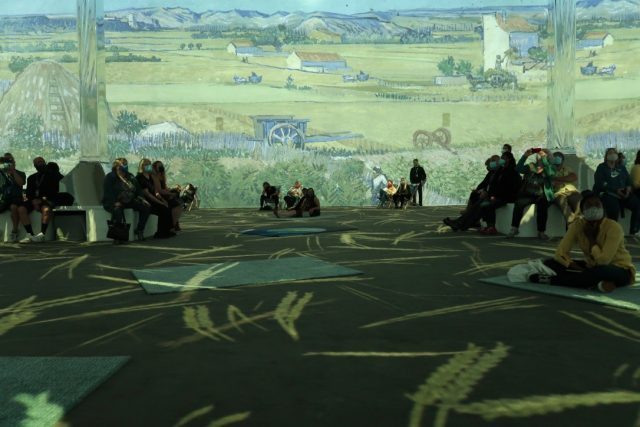
In the central two-story, twenty-thousand-square-foot room, comfy beach chairs with Starry Night on them allow you to sit and watch a thirty-five-minute massive projection display on four walls and the floor as paintings come to life against architectural backgrounds. Rows of Van Gogh’s self-portraits, landscapes, flowers, and other works appear and disappear, sometimes with animation that makes it look like the canvas itself falls to the ground, revealing new works underneath. As opposed to the Pier 36 show, the one on Vesey St. concentrates more on van Gogh’s actual paintings; the works are usually seen within their frames, not busting dramatically out of nowhere, although a few do.
Skylight on Vesey van Gogh show has different perspectives that Pier 36 presentation (photo by twi-ny/mdr)
The bony figure in Skull of a Skeleton with Burning Cigarette takes a drag off his butt, smoke from a train envelops the space, vehicles move in Landscape with Carriage and Train and farm scenes, pages flip in Still Life with Bible, and a windmill turns in Le Moulin de la Galette, to the sounds of gentle classical music.
A series of self-portraits leads to an interactive workshop where you can draw your own van Gogh, followed by a virtual reality room where you are taken on a colorful 360-degree VR adventure through eight of van Gogh’s most important paintings, displayed in frames as you meander through nature and toward the sea in Arles, as if you are seeing the world as van Gogh saw it, and then painted it. Finally, the gift shop is tiny, which is a relief after the grandiosity of the competing exhibit’s extensive merch.
Vesey St. van Gogh show includes 3D reproduction of van Gogh’s Bedroom in Arles (photo by twi-ny/mdr)
“Success is sometimes the outcome of a whole string of failures,” van Gogh said. While the artist did not make much money from his art during his lifetime — the only recorded sale was of The Red Vineyard at Arles — his 1890 Portrait of Dr. Gachet sold for $163.4 million a century later. Now people around the world — these immersive experiences are being held in more than fifteen US cities and half a dozen countries — are paying upwards of $99 for VIP access to watch digital manipulations of his work that will look great on social media, but the experience is fleeting. Better to spend your money on immersing yourself in the real thing at the Met or MoMA, losing yourself in actual van Gogh canvases that will take you to another place, the crows and cicadas, irises and sunflowers, portraits and self-portraits, and wheatfields and starry nights invigorating your mind and penetrating into your heart and soul.
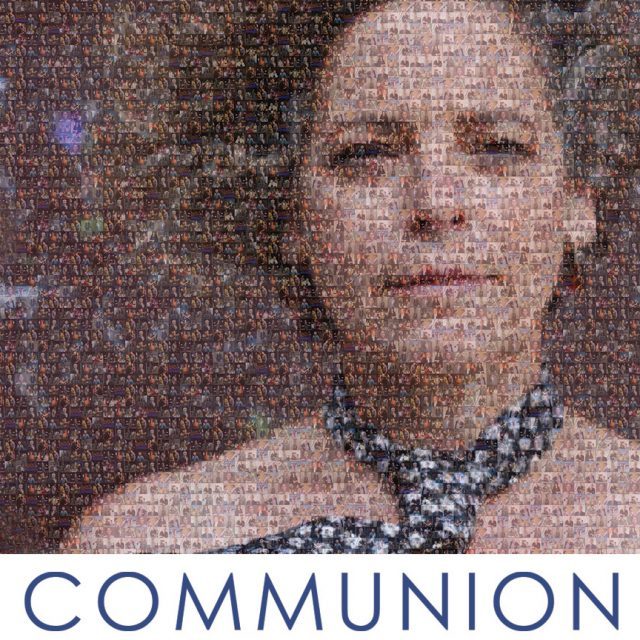
Stacy Ross guides a live audience through a Zoom gathering in Communion
COMMUNION
American Conservatory Theater (A.C.T.)
Through June 27, $60 www.act-sf.org
“Can we build a true sense of community over Zoom in one evening?” Stacy Ross asks in Christopher Chen’s Communion, a live, interactive presentation from A.C.T. in San Francisco. Continuing through June 27, the seventy-minute Zoom production is hosted by the popular Bay Area actress, who has played such characters as Hedda Gabler, Malvolio, Clytemnestra, Ophelia, Candida, and Leni Riefenstahl. In Communion, she’s herself — or is she? — speaking directly into the camera from a small, cluttered room. She wears a green felt hat and braids, asking us questions, discussing bliss and tacos, and considering Zoom as a tool for intimacy.
Prior to the show, attendees are given several prompts, one involving a guiding principle you have, another a person you’ve allowed to get inside your head in a bad way. Volunteers come forward and share their answers, with Ross commiserating. Viewers are also sent to breakout rooms to talk about the idea of “communion” in smaller groups. Thus, a good part of your experience will be impacted by how much you and others choose to participate. Ross may be a consummate host, but she can control only so much of what happens.
Obie winner Chen (The Hundred Flowers Project,The Headlands) and Tony-winning director Pam MacKinnon (Clybourne Park,Who’s Afraid of Virginia Woolf?) navigate through Zoom fatigue — with America opening up, is the end coming for entertainment via little onscreen boxes? — with a wink and a nod, holding back a surprise (which one of the people in my breakout room guessed). To say any more would be to say too much.
Most Zoom theater has been created as an alternative to live, in-person shows, where strangers congregate in dark spaces, suspending disbelief as they are temporarily transported to different worlds. Communion was made specifically for Zoom, challenging us to look at who we are, as individuals and as theater lovers, as we come out of a pandemic that has changed us all, for better or worse.
THE DARK MASTER
Japan Society
333 East 47th St.
June 23-28, $45
212-715-1258 www.japansociety.org
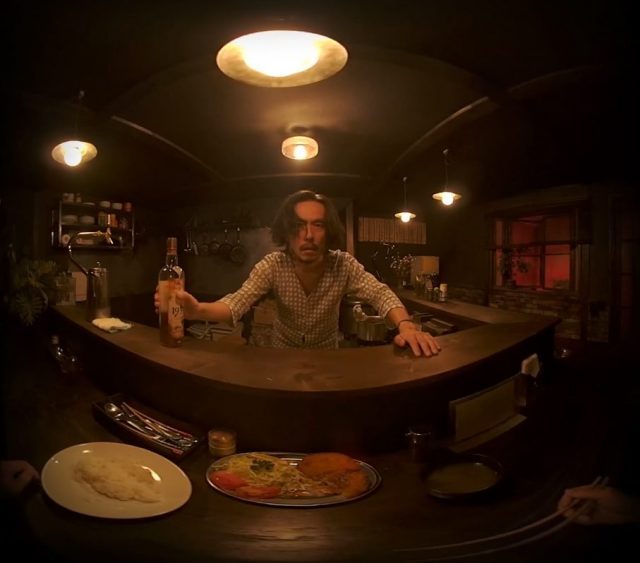
Kuro Tanino’s The Dark Master was originally scheduled to be a fully staged production at Japan Society in January 2021 as part of a four-city US tour. However, because of the pandemic lockdown, Japan Society artistic director Yoko Shioya suggested that Tanino reimagine the piece for virtual reality. The result is a thoroughly satisfying and uniquely tasty experience, a delectable treat for the senses.
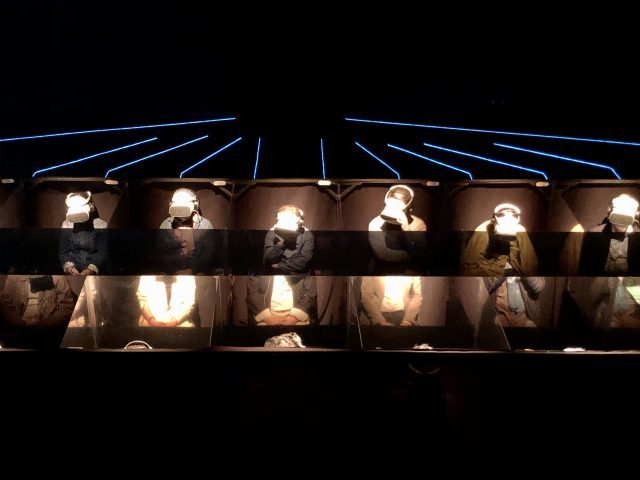
Continuing through June 28, The Dark Master is presented to ten audience members at a time, sitting in individual mirrored cubicles on Japan Society’s stage. Wearing headphones and VR headsets (and facemasks), you are taken into a tiny, claustrophobic restaurant where you are served food by a grouchy owner-chef (Kiyobumi Kaneko). He decides that you are to become the next cook, and your training begins as hungry customers come in and sit at the counter, excited for the carefully prepared fare.
Inspired by first-person video games and an indie manga written by Marei Karibu and illustrated by Haruki Izumi, The Dark Master immerses you in a mysterious world that can be as funny as it is creepy. Kaneko is a hoot as a surly smoker who seems relatively disinterested in what he’s doing yet creates miraculous dishes that not only look good but smell great — be prepared for a multisensory adventure. The virtual reality extends about 180 degrees, so be sure to turn to your right and left and up and down to take it all in; you are also given hands that hold a menu, pour a drink, and bring the victuals to your mouth, which could produce a sort of personal AMSR encounter A brief video at the end takes you behind the scenes of how some of it was done.
A sculptor, painter, and former psychiatrist, Tanino (Frustrating Picture Book for Adults,Fortification of Smiles) literally and figuratively gets into your head for forty-five minutes as performers from his experimental theater company, Niwa Gekidan Penino (NGP), including Kaneko, F. O. Pereira Koichiro, and Bobmi Hidaka, traipse through the restaurant, with narration by Saika Ouchi. The dialogue has been dubbed into English by the original Japanese cast; the fab set is by Takuya Kamiike, with moody lighting by Masayuki Abe, crackling sound by Koji Sato and Shintaro Mastunomiya, and videography and editing by Nobuhiro Matsuzawa. In 2014, NGP made its American debut at Japan Society with The Room Nobody Knows, which featured a spectacular two-level set that represented the unconscious and subconscious minds. With this VR iteration of The Dark Master, Tanino serves up a wonderful physical and psychological meal, one that can be enjoyed together by strangers, just like watching theater or eating in a restaurant, two of life’s necessities (and genuine pleasures) that were unavailable for so much of the last sixteen months.