featured

NARRATIVE MATERIALITY: DAWOUD BEY AND TORKWASE DYSON IN CONVERSATION

Dawoud Bey, A Man in a Bowler Hat, Harlem, NY, from “Harlem, U.S.A.,” gelatin silver print, ca. 1976 (collection of the artist and Sean Kelly Gallery, New York; Stephen Daiter Gallery, Chicago; and Rena Bransten Gallery, San Francisco / © Dawoud Bey)

Who: Dawoud Bey, Torkwase Dyson, Elisabeth Sherman
What: Live online discussion
Where: Whitney Museum Zoom
When: Thursday, July 8, free with advance RSVP, 6:00 (exhibit continues through October 3)
Why: One of the many pleasures of “Dawoud Bey: An American Project,” the exemplary survey of the work of Queens-born photographer Dawoud Bey, is listening to him describe his process on the audio guide. The sixty-eight-year-old artist and Columbia College Chicago professor shares detailed aspects of his career while discussing numerous photos and series. You can hear more from Bey on July 8 at 6:00 when he participates in the Zoom talk “Narrative Materiality” with interdisciplinary artist Torkwase Dyson, moderated by exhibition cocurator Elisabeth Sherman.

On the audio guide, Bey talks about about his series “Night Coming Tenderly, Black,” a 2017 commission for the Front Triennial in Cleveland consisting of photos taken along what was the Underground Railroad in Ohio, dark shots of houses, trees, and the sea without people, “Of necessity, those locations, most of them were never known. They couldn’t be. They weren’t supposed to be. So there is that layer of invisibility built into the history. And so what I did was through research finding a few sites that are in fact known to be related to the Underground Railroad and then began to look at the landscape around those sites imagining a fugitive African American moving through that landscape, what that landscape might have looked like and felt like.”

In her catalog essay “Black Compositional Thought: Black Hauntology, Plantationscene, and Paradoxical Form,” Dyson writes, “Blackness will swallow the whole of terror to be free. It will move across distances, molecules, units — through atmospheres and concrete, in magic and bloodstreams to self-liberate. To image and imagine movements and geographies of freedom, known and unknown, is to regard this space as irreducible, or to regard black spatial geography as irreducible. ‘Night Coming Tenderly, Black’ is attuned to the irreducible place of black liberation inside terror. Each photograph makes manifest in the viewer a full-body, ongoing refusal to belong to a nation, land, person, or state under a system of terror, as conditioned by architecture, agriculture, modernity, or industrialized white supremacy. The process of freeing a full black body from spatial terror while black flesh holds and is seen as material and terror is liberation.”

Bey continues, “They’re all about the imagination. Looking closely at a piece of the land and noticing all of these thorns that certainly make the landscape so much more threatening if one had to move through it. So when I thought about it through that particular narrative, the landscape became for me a very transformed space. And that’s the space and place that I want the viewer to think about when they look at that work. I want them to completely forget about the present. This work is not about the present, which is why those photographs are all so large. I wanted to create a physical space for the viewer to enter into that, allow them just to be in that landscape.”

Named after a quote from Langston Hughes’s poem “Dream Variation” — “Rest at pale evening. . . . / A tall, slim tree. . . . / Night coming tenderly / Black like me.” — the series is notable in that there are no people in these dark, mysterious photographs, which more than hint at the ghosts of those who escaped slavery through the Underground Railroad as well as their descendants. These large-scale works demand and reward intense viewing, beautiful in and of themselves while imbued with the narrative of this country’s original sin.

“Night Coming Tenderly, Black” is one of only several powerful series in the show, which continues on the first and eighth floors of the Whitney through October 3. Bey’s 2012 “Birmingham Project,” which was included in the New Museum’s recently closed “Grief and Grievance: Art and Mourning in America,” features black-and-white diptychs that pair a photo of a child the same age as one of the four Black girls (Addie Mae Collins, Denise McNair, Carole Robertson, Cynthia Wesley) killed in the 1963 KKK bombing of the 16th Street Baptist Church in Alabama and the two boys (Johnny Robinson, Virgil Ware) murdered in the aftermath with an image of a grown woman or man the age the victims would have been in 2012 had they lived. It’s a brutal reminder of what racism continues to take away, evoking the missing men, women, and children in “Night Coming Tenderly, Black.”

Bey’s first series, “Harlem, USA,” invites viewers into the Harlem of the mid- to late-1970s, with 35mm black-and-white photographs of Deas McNeil in his barbershop, two girls having fun posing in front of a local restaurant, three well-dressed women leaning on a “Police Line” barrier during a parade, and a dapper old man wearing a white bowtie and a black bowler.

In the 1980s, Bey headed upstate to Syracuse, where he again focused on the Black community in its natural surroundings. “It was a deliberate choice to foreground the Black subject in those photographs, giving them a place not only in my pictures . . . but on the wall[s] of galleries and museums when that work was exhibited,” Bey notes. He moved from the 35mm wide-angle-lens camera to a tripod-mounted 4 × 5-inch-format camera for his Polaroid street portraits of strangers he met, including a boy eating a Foxy Pop, a young man and woman hugging in Prospect Park, and a young man on an exercise bicycle in Amityville, all looking directly at the camera. Bey would give the instant Polaroid picture to his subjects, then print them later from the negative; for this exhibit, they can now be seen nearly life-size.

Dawoud Bey, Martina and Rhonda, Chicago, IL, six dye diffusion transfer prints (Polaroid), 1993 (Whitney Museum of American Art; gift of Eric Ceputis and David W. Williams 2018.82a-f / © Dawoud Bey)

In 1991, Bey turned to a two-hundred-pound, six-foot-tall, five-foot wide Polaroid camera to photograph friends and such fellow artists as Lorna Simpson, putting together two, three, and as many as six exposures for each, the edges of the Polaroids visible, letting us inside his process as he emphasizes the complexities of the people in these color images.

Another room is dedicated to Bey’s “Class Pictures,” color photos of marginalized teenagers whose words are seen alongside the pictures. “Sometimes I wonder what color my soul is. I hope that it’s the color of heaven,” Omar says. Kevin admits, “Thanks to the death of my father I grew up much too fast and never learned how to ask anyone for help. I carry my own burdens . . . alone. This is my curse.”

Bey returned to Harlem in 2014–17 for “Harlem Redux,” pigmented inkjet prints that focus on place rather than people in a changing neighborhood that is very different from the Harlem he photographed four decades earlier, best exemplified by Girls, Ornaments, and Vacant Lot, NY, which depicts two hair advertisements of smiling Black girls next to an abandoned, litter-strewn, fenced-in area. “One of the things that was beginning to happen in Harlem was that there were these, as I called them, spaces where something used to be,” Bey says on the audio guide. “And when those places are completely obliterated, when they’re torn down and you end up with a vacant lot, there’s a kind of disruption of place memory. Because at some point, even if you know the community well, you can’t quite remember what used to be there. And that to me was a profound experience.” A visit to the Whitney to see “Dawoud Bey: An American Project” is a profound experience itself, reminding us of what was, and projecting what might be.

WE’RE GONNA DIE

Regina Aquino stars in Round House Theatre’s virtual version of Young Jean Lee’s We’re Gonna Die

WE’RE GONNA DIE
Round House Theatre online
Available on demand through July 25, $32.50
www.roundhousetheatre.org

One of the last in-person plays I saw before the pandemic lockdown was Second Stage’s dynamic, ebullient version of Young Jean Lee’s We’re Gonna Die. Near the end, silver balloons bearing the name of the show were released from the ceiling of the Tony Kiser Theater, gently drifting down on the audience. I brought two home, and, remarkably, one of them is still partially filled, resting on top of a shelf where I see it every day. It is a symbol of the resilience of the human spirit, and of theater itself, which is on its way back after a difficult time.

Sixteen months later, Maryland’s Round House Theatre has mounted a more subdued but still powerful virtual version of the sixty-five-minute show, filmed live with a masked, limited, socially distanced audience and streaming through July 11. We’re Gonna Die consists of a series of first-person true stories and accompanying songs that look at how we approach and deal with impermanence. It was originally staged by Lee and her band, Future Wife, at Joe’s Pub in 2011 and then at Lincoln Center’s Clare Tow Theater in 2013. Raja Feather Kelly tore the roof off with his production at Second Stage, which took place in a hospital waiting room and featured a breakout performance by Janelle McDermoth.

At Round House, Regina Aquino stars as the narrator and singer, who relates the tales as if they all happened to her. (They were actually compiled from friends and relatives of Lee’s.) She runs up the steps, writhes across the floor, and jumps up and down on Paige Hathaway’s two-level set, which features bold colors and graphic symbols, with the musicians of the Chance Club each in their own large, homey cubicle: bassist Jason Wilson, keyboardist Laura Van Duzer, guitarist Matthew Schleigh, and drummer Manny Arciniega. The evening begins with an original composition by the Chance Club, “Wagons and Stars,” to set the mood, and then the show kicks off with the first of six vignettes that cover a wide spectrum of age and health, from the innocence of children to the isolation of growing old, exploring insomnia, the health-care system, family responsibilities, friendship, and generational angst, including “Lullaby for the Miserable,” “Comfort for the Lonely,” “When You Get Old,” and “Horrible Things.”

“I would have horrible nightmares and wake up with this feeling of dread that I was gonna die the exact way my father did,” Aquino says, talking about having trouble sleeping. “And if anyone tried to help me, I would just get angrier and angrier, and no one could do anything.” In the propulsive “I Still Have You,” she declares, “You still have me / I’m in your bed / I’ll hold your hand / until you’re dead / If I die first / you’ll be alone / but until then / you’ll have a home.”

Regina Aquino shares stories of loneliness and loss amid rocking songs in We’re Gonna Die

The show is fluidly directed and choreographed by Paige Hernandez, with cinematography by Maboud Ebrahimzadeh, costumes by Ivania Stack, sound by Mathew M. Nielson, and lighting by Harold F. Burgess II, making it a successful hybrid that is anchored by Aquino’s (The Events, Eureka Day) warm, intimate performance that will have you hanging on her every word.

In the grand finale, “I’m Gonna Die,” everyone joins in for a celebratory chorus that is filled with hope after a year in which more than six hundred thousand American died of Covid-19. The show has always had a positive outlook, but it hits a little deeper now. We all have developed a very different relationship with mortality, so don’t be surprised when you join in, with a smile on your face, as Aquino sings, “I’m gonna die / I’m gonna die someday / Then I’ll be gone / And it’ll be OK.”

In my March 2020 review of Kelly’s production at Second Stage, I wrote, “‘There’s a very good chance you’re not going to die,’ President Trump said when news about the coronavirus crisis was first spreading. While that might be true when it comes to Covid-19, it’s not true in general.” Indeed, what a year and a half it has been, as that balloon can attest.

The stream is available on demand through July 25; you can watch a panel discussion with Aquino, dramaturg Naysan Mojgani, and others here.

TINY HOUSE

Westport Country Playhouse’s virtual Tiny House is streaming through July 18

TINY HOUSE
Westport Country Playhouse
Through July 18, $25 per viewer, $100 per household
www.westportplayhouse.org

In Westport Country Playhouse’s virtual version of Michael Gotch’s first full-length play, Tiny House, Sam (Sara Bues), referring to her childhood, says, “I still hate fireworks.” Her mother, Billie (Elizabeth Heflin), asks, “You do?” Sam responds, “Yeah, they scare me. Like gunshots. Or someone jumping out and yelling boo! They don’t feel like a celebration. They feel like bad surprises.”

There are a lot of fireworks and bad surprises in store for the wisecracking Billie, the ultraserious Sam, Sam’s snarky husband, Nick (Denver Milord), and Billie’s second husband, the goofy but likable Larry (Lee E. Ernst), as the family comes together for the Fourth of July holiday at Sam and Nick’s new, and extremely small, eco-conscious house in the mountains. Billie is used to the finer things in life, which changed when her first husband was sent to prison; she also has very different political views than Nick does, leading to some vicious battles.

“Solar, bio-friendly, 100% recycled materials, tiny carbon footprint, completely self-sustaining. We’re like pioneers, I guess,” Nick explains. “My firm got Interior Design magazine up here after we finished the build, did a shoot; they’re going to follow the story for the first year or so. In installments.”

“Nice,” Larry says.

Nick adds, “Sam’s writing the copy for it —”

“—in monthly installments —” Sam cuts him off.

“Nice!” Larry repeats.

“— like a real-time journal,” Nick says.

“The Donner party kept a journal, too,” Billie snipes. “For a while.”

They are soon joined by neighbors Win (Stephen Pelinski) and Carol (Kathleen Pirkl-Tague), Renaissance Faire veterans who arrive in Medieval (and, later, Middle-Earth) costumes and make such pronouncements as “Hear ye! Hear ye! Kingdoms Major and Kingdoms Minor! Your Monarch
approacheth! Tremble and be amazed!” and “Zounds, he knows! / A fellow traveller!”

Meanwhile, another neighbor, Bernard (Hassan El-Amin), is a Keats-spouting, marmot-offering, well-armed survivalist who believes the end of the world is coming. “My sources are active. Triangulated and triple sourced,” he warns Nick and Sam, continuing, “Verifiable intel, not misdirection. Multiple potential flash points worldwide. Zero Hour feel to it.” Nick responds, “I don’t know, you know? Stuff I’m hearing just feels like garden-variety neo-Cold War saber rattling if you ask me.” As the fireworks approach, so does the sturm und drang as dark family truths emerge amid one key piece of advice for all to heed: “Don’t fuck with an elf.”

The show was originally workshopped with a different cast at Westport in 2018 and performed in January 2019 by the Resident Ensemble Players at the University of Delaware under the title Minor Fantastical Kingdoms, with that cast reuniting for this virtual edition, with playhouse artistic director Mark Lamos helming all three iterations. Part of Westport’s ninetieth anniversary virtual 2021 season, the one-hundred-minute Tiny House is tailor made for this moment in time as we emerge from lockdown, when we faced isolation and loneliness, unable to see friends and family for more than a year as we fought over politics and sought bits of joy in unexpected places.

Tiny House was filmed by Lacey Erb with the actors in different locations, performing in front of green screens, employing methods mastered by the Irish Rep; in fact, the digital design, which includes benches, chairs, and couches that make it appear that the actors are together in the same space and looking out at the forest and a vast mountain landscape, is by longtime Irish Rep designer Charlie Corcoran, based on Hugh Landwehr’s original set. Dan Scully served as editor, with costumes by Tricia Barsamian (Will and Carol’s getups are particularly fun and fanciful) and music and sound by Rob Milburn and Michael Bodeen.

The cast is highlighted by a wickedly delicious turn by Heflin (The Government Inspector, The Odd Couple), who never misses a beat as we learn more about her character’s situation, and Bues (Falling Away, The Sign in Sidney Brustein’s Window) as Billie’s daughter, who is having issues dealing with the sins of her parents. The show will be available on demand through July 18; you can check out a symposium about the work here, and there will be a talkback on July 12. Next up for Westport is John Patrick Shanley’s Doubt: A Parable in November.

COUSINS

Cousins follows a Māori family over more than half a century

COUSINS (Ainsley Gardiner & Briar Grace-Smith, 2021)
Angelika Film Center
18 West Houston St.
Opens Friday, July 2
www.angelikafilmcenter.com
www.arraynow.com/cousins

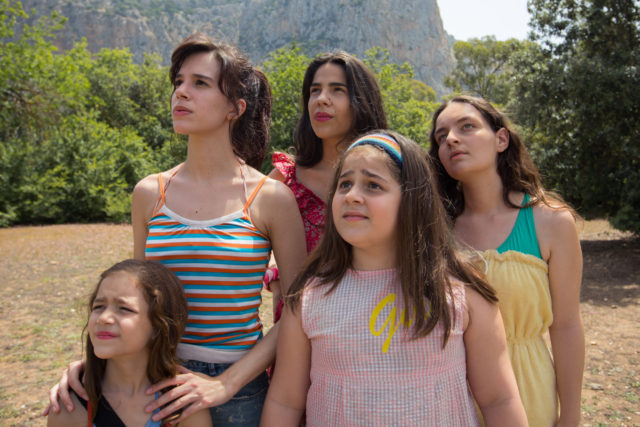
The Māori film Cousins is a heart-wrenching story of an indigenous family in New Zealand (Aotearoa) torn apart by colonialism and bigotry as they try to hold on to their traditions. The film, directed by the award-winning Māori duo Ainsley Gardiner and Briar Grace-Smith, opens in the mid-twentieth century with Mata (Te Raukura Gray) in green, Makareta (Mihi Te Rauhi Daniels) in blue, and Missy (Keyahne Patrick-Williams) in red playing on a lush landscape of rolling hills and a twisting river. “Three cousins,” a narrator says in Māori. “Their paths woven across time. Their lives separate. Their lives converge. They separate again. This is how it must be.”

The scene cuts to the modern day, as Mata (Tanea Heke), walking down a city street, stops at a corner, waits for the light to turn green, slowly removes her shoes while reciting a nursery rhyme in her head, and begins to cross only when the red walk sign starts flashing, as if she is inviting danger. Wandering through an outdoor market, she appears to be homeless and broke. Meanwhile, Markareta (Grace-Smith, who also wrote the screenplay) and Missy (Rachel House) are fighting the government’s attempts to take some of their land — and wondering where Mata is. Sent to an orphanage by her father (Jack Sergent), Mata was “adopted” by a white New Zealander, Mrs. Parkinson (Sylvia Rands), who changed her name to May Parker and used her as a servant, keeping her away from her family, who have been searching for her for fifty years.

Gardiner and Grace-Smith go back and forth between three central time periods, following the cousins as children, young adults (with Ana Scotney as Mata, Tioreore Melbourne as Markareta, and Hariata Moriarty as Missy), and in the present as they try to maintain their heritage in a world that wants to pass them by. Awarded the 2021 People’s Choice for Best Feature Drama at the Māoriland Film Festival in New Zealand, Cousins, adapted from the 1992 novel by Patricia Grace, is infused with many elements of the Māori way of life, including whakapapa (unbreakable genealogical links), kaupapa (philosophy), whānau (family), kaitiaki (guardianship of the land), Te Ao Māori (world view), whenua (land), and Tikanga Māori (cultural practice), treating them with honesty and respect, not othering them. It was shot in Te Waiiti Marae on Lake Rotoiti with the guidance of Muriwai Ihakara, who plays Wi, and the local Ngāti Hinekura and Ngāti Pikiao people, many of whom appear in small roles.

Raymond Edwards’s cinematography is gentle and beautiful, accompanied by composer Warren Maxwell’s subtly emotional score. The nine actresses who portray the three cousins are exceptional, but Gray, Scotney, and Heke stand out as Mata, who rarely speaks, overwhelmed by her childhood trauma; Heke’s eyes are particularly haunting. By the end of the film, which runs July 2–9 at the Angelika, you’ll feel like you’re part of the family, feeling their pain and love as tears well up.

BIG SCREEN SUMMER NYFF58 REDUX: FLOWERS OF SHANGHAI

Hou Hsiao-hsien gem Flowers of Shanghai explores complex relationships between wealthy patrons and courtesans

FLOWERS OF SHANGHAI (HAI SHANG HUA) (Hou Hsiao-hsien, 1998)
Walter Reade Theater
165 West 65th St. between Broadway & Amsterdam Aves.
July 2-20, $15
www.filmlinc.org

Taiwanese New Wave master Hou Hsiao-hsien might be the best filmmaker whose work you’ve never seen. For more than thirty-five years, he has been telling intimate, meditative stories about life, family, and relationships with a gentle, deeply intuitive style, infused with gorgeous visuals and subtly beautiful soundtracks. Film at Lincoln Center’s wide-ranging “Big Screen Summer: NYFF58 Redux” continues with one of the New York Film Festival staple’s most elegant tales, Flowers of Shanghai. The 1998 film, being shown in a dramatic 4K restoration, is set in brothels, known as flower houses, in 1884 in the British Concession, where men and women congregate for social interaction and develop long-term bonds and responsibilities to one another based on much more than just sex. The men play drinking games, smoke opium, and buy the women gifts. The story, told in a series of vignettes as Mark Lee Ping Bin’s camera slowly moves through dark, lush, reddish gas-lit interiors, focuses on Master Wang (Tony Leung Chiu-wai), who has promised to be the sole patron of Crimson (Michiko Hada) but who has also been secretly seeing the younger Jasmin (Vicky Wei) and lavishing her with presents. The elder Master Hong (Luo Tsai-erh) and Auntie Huang (Rebecca Pan), the madam, discuss the situation, bringing up issues of responsibility and honesty, attempting to come to some kind of understanding in an exchange that shows respect for both the men and women who are a far cry from the Western conception of johns and prostitutes.

Most scenes end by fading quietly to black, then introducing the woman protagonist of the next section — Crimson, Jasmin, Pearl (Carina Lau), Jade (Shuan Fang), and Emerald (Michelle Reis) — as the women gossip and Crimson and Hong, and other pairs, try to figure out what they want out of life and from one another. In Flowers of Shanghai, Hou explores class differences, gender roles, the Asian notion of saving face, and intimacy with grace and sophistication. When the film fades out for the final time, viewers are left knowing they’ve just experienced something special, a stunning work that uses the technologies of cinema to delve into the very nature of humanity.

“Big Screen Summer: NYFF58 Redux” runs through August 26 with such other 2020 film festival favorites as Joyce Chopra’s Smooth Talk, Eugène Green’s Atarrabi and Mikelats, John Gianvito’s Her Socialist Smile, William Klein’s Muhammad Ali, the Greatest, Nuria Giménez’s My Mexican Bretzel, Philippe Lacôte’s Night of the Kings, and Orson Welles’s Hopper/Welles, an epic conversation between Welles and Dennis Hopper.

KENNY SCHARF: WHEN WORLDS COLLIDE

Min Sanchez, Kenny Scharf, and Oliver Sanchez pose in front of Scharf’s artwork in Bahia, Brazil (photo by Tereza Scharf)

KENNY SCHARF: WHEN WORLDS COLLIDE (Malia Scharf & Max Basch, 2020)
Available on demand
www.kennyscharfmovie.com

“I have a balancing act between being a responsible adult and the Peter Pan syndrome because I just feel like life is so much about the moment, so I want every moment fun and beautiful,” Kenny Scharf says in the new documentary Kenny Scharf: When Worlds Collide. “It’s not reality.” Codirectors Max Basch and Malia Scharf — one of the artist’s daughters — try to make every moment of the film, now streaming on demand, fun and beautiful, often reaching that goal.

Shot over a period of eleven years, When Worlds Collide follows Scharf, who was born in 1958 in Los Angeles and moved to Manhattan to attend SVA, from his early days as a graffiti artist and muralist, when he met and became great friends with Keith Haring and Jean-Michel Basquiat and hung out with Andy Warhol at the Factory, to his vast popularity creating fantastical, colorful creatures in paintings and sculptures, from the lean years to his current obsession with recycling. “Use everything,” he says, extolling us to ”not waste precious plastic when you can turn it into bathroom sculpture” as he adds a plastic cup and straw to an ever-evolving work above his toilet.

Scharf and Basch, who also served as editor and one of the cinematographers, speak with former Ferus Gallery owner Irving Blum, art collector Peter Brant, gallerists Jeffrey Deitch and Tony Shafrazi, writer and poet Carter Ratcliff, art historian Richard Marshall, Whitney curator Jane Panetta, former Scharf assistant Min Sanchez, author and psychologist Gabor Maté, collectors Andy and Christine Hall, real estate developer Tony Goldman, and curator Dan Cameron, who all offer unique perspectives on Scharf as a person and an artist. “There’s no separation between Kenny and his art,” his friend and fellow artist Kitty Brophy says. There are also old and new interviews with such artists as Bruno Schmidt, Ed Ruscha, Samantha McEwen, Robert Williams, Marilyn Minter, KAWS, Dennis Hopper, and Yoko Ono as well as Scharf’s mother, Rose; wife, Tereza; daughters, Zena and Malia; and grandkids Jet and Lua, who share their thoughts and are seen in home movie footage.

“He just created a family where we felt we were understood and accepted for who we are,” actress and performance artist Ann Magnuson says. “The main way to communicate was to get out on the street, and the message got out there and of course the attention came, and then it started to unravel a bit when the success, the money, the fame, and the uptown world started paying attention to the downtown world. Some of that wonderful, naïve idealism was lost.”

The film doesn’t shy away from the devastation of the AIDS crisis or Scharf’s dry periods, when his style of surreal Pop art was out of favor, but he continues to create and is a fan favorite at international art fairs with his eye-catching work. He gets tearful when talking about Haring, shares his love of nature and cartoons (especially The Flintstones and The Jetsons), collects trash on the beach, remembers the influential Club 57, discusses his breakthrough painting, 1984’s When the Worlds Collide, and describes his penchant for pareidolia, seeing faces everywhere. It’s fascinating to watch him stand in front of a canvas, painting right from his imagination, without preparatory sketches. He comes off as a driven artist and dedicated family man who can be an endearing mensch. “Many people think I’m crazy, and I think that’s okay,” he says with a laugh.

GHOSTING: A PERFORMANCE ON SCREEN

Who: Anne O’Riordan
What: One-woman online play
Where: #IrishRepOnline
When: Through July 4, free with RSVP (suggested donation $25)
Why: The Irish Rep continues to be the most consistently innovative and creative company on the planet during the Covid-19 crisis with Anne O’Riordan and Jamie Beamish’s Ghosting, its latest “performance on screen.” The one-woman show debuted in London and made its Irish premiere at Theatre Royal in Waterford in 2019; O’Riordan returned to that stage in April 2020 for a livestreamed production that is now available on demand through July 4 via the Irish Rep, in conjunction with Throwin Shapes. O’Riordan plays Sí, a young Irish woman working in London when a strange visitor materializes in her apartment in the middle of the night. “I lie in bed and think. I know no one likes that these days but it’s ok to be on your own, with just your thoughts,” she tells us early on. “I like it. In the dark. No lights, no sound, no one to annoy me. You can lie there and hold your breath and wonder; is this it? Is this what it will be like to be dead? That’s all I was doing last night, the same thing I’ve done every night since I came to London five years ago. I was lying there awake, on my own. That’s fine sure. Who else do I want? Who else do I need? I don’t need anyone else in my life. I was thinking that exact thought last night when I realised that someone was in the bedroom with me.”

It turns out to be Mark Kelly, her onetime boyfriend who had ghosted her six years before, suddenly refusing to see her or speak with her, with no explanation. The next morning, Sí gets a text from her sister, Aisling, letting her know that Kelly died two days before. Sí says, “I feel a huge knot in my stomach. I don’t know why I’m even remotely bothered, sure he’s been dead to me for six years. He’s been blocked out of my mind for . . . well, until last night. When he . . .” At the spur of the moment, she decides to fly back home to attend the funeral, going back to her sister and father and hometown that she has been ghosting ever since she left for London. Once there, she learns more about her family and Kelly, complicating her situation and providing just as many questions as answers.

The seventy-five-minute play was written by O’Riordan and Beamish, who also serves as director, composer, and sound and projections designer, with lighting by Dermot Quinn and live video editing by Seán O’Sullivan. O’Riordan (Call the Midwife, Doctors) traverses the dark, empty set, the camera sometimes coming in for a close-up, then pulling back for a longer shot as if we’re sitting in the audience, which is empty. The projections take us from Sí’s office, the airport, and a smokey bar to a funeral home and the beach as Sí deals with a London colleague she calls Hobbit Tom; Laura, a high school acquaintance; the tall Lorcan, who works at the funeral parlor; and Mark’s mother, who has a surprising story to share. All the while, Sí considers whether she should see her father for the first time in what has been too long.

O’Riordan is mesmerizing as she examines her life not unlike how many of us have done over the last year and a half, as the coronavirus pandemic shuttered us in our homes, eliminated public gatherings, kept us far from loved ones, and was the cause of too many funerals. “We never really go away, do we?” the lonely Sí asks. “There’s always something left behind. Never mind them ghosts. I don’t believe in them anyway.” But with plays like Ghosting, we can still believe in the power of theater to help us face the world and get through the darkness.