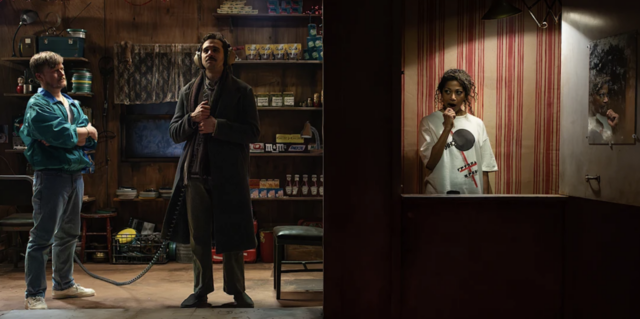
Who:Rodd Cyrus,Carl Raymond What: Inaugural Friday lunch conversation Where:The Coffee House at the National Arts Club, 15 Gramercy Park South When: Friday, March 20, $85, 11:30 am Why: Back in November, I wrote in a Substack post about meeting actor Rodd Cyrus after seeing Ragtime at Lincoln Center; I was there with a group of women from Wellesley organized by Rodd’s mother. Cyrus plays Harry Houdini, who enters by dangling on a wire and declaring, “He made his mother proud.”
Now you can meet Cyrus as well when he is the special guest at the inaugural Coffee House Club lunch at the National Arts Club. He will be interviewed by writer, lecturer, tour guide, and social and culinary historian Carl Raymond, host of the Gilded Gentleman podcast.
Cyrus was born in Boston and raised in the San Francisco Bay Area and is of Iranian-English-Irish-Welsh-Italian-American heritage. In addition to starring in Ragtime, he is a regular on Elsbeth, has appeared in such plays as James Joyce’s Exiles and Maija García’s Valor and such films as Doctor, Doctor and 72 Hours, and portrayed Giuseppe Naccarelli in The Light in the Piazza at Encores!
“Rodd’s story is not only a great theatrical story; it’s a uniquely American story,” Raymond told twi-ny. “To be playing the role of immigrant superstar Harry Houdini in this revival along with his own personal story makes his portrayal unique and deeply important.”
The prix fixe lunch includes beet and mixed green salads, a choice of a turkey club sandwich, mushroom power bowl, rigatoni alla Bolognese, or chicken Marsala, and nostalgic sweets for dessert.
Only a few tickets remain to be part of this exciting event.
[Mark Rifkin is a Brooklyn-born, Manhattan-based writer; you can follow him on Substack here.]
Director Leigh Carver (Max Baker), playwright Ruth Davenport (Geraldine Hughes), and actor Jay Conway (Matthew Broderick) meet for the first time in David Ireland’s Ulster American (photo by Carol Rosegg)
ULSTER AMERICAN
Irish Repertory Theatre, Francis J. Greenburger Mainstage
132 West Twenty-Second St. between Sixth & Seventh Aves.
Wednesday – Sunday through May 24, $55-$125 irishrep.org
Among the topics raised in the US premiere of David Ireland’s Ulster American are the n word, rape, murder, the Troubles, car crashes, religion, Brexit, alcoholism, and self-identity.
Oh, did I mention that it’s a comedy — and a hilarious one at that?
The eighty-minute play takes place in real time on a Sunday night in the cozy living room of British theater director Leigh Carver’s (Max Baker) London home, decorated by set designer supreme Charlie Corcoran, with two armchairs, a couch, several small tables, a writing desk, a window in a rear nook, theater posters for The Mousetrap,Camelot,London Assurance,Macbeth, and the National Theatre, and several bookcases filled with tomes about Noël Coward, Samuel Beckett, and other theater legends.
Leigh is meeting with Jay Conway (Matthew Broderick), an Oscar-winning American actor who is starring in a new work Leigh is directing, by Irish playwright Ruth Davenport (Geraldine Hughes). Rehearsals are set to begin the next day, and Leigh wants the three of them to get to know each other more first. Jay is on the couch, in the middle of a conversation with Leigh, telling him, “Is there homophobia in Hollywood? Of course. And misogyny? How can we deny it? It’s reflected in so much of our output. Narrative upon narrative centered around the abuse of women, the violent abuse of women. And racism? Only a fool could pretend otherwise.”
Leigh is surprised when Jay asks, “You ever use the n word?” After discussing James Baldwin, power dynamics, and the Bechdel test — a measure, proposed by cartoonist Alison Bechdel, that judges a fictional work based on whether it includes scenes in which at least two women talk about something other than men — Jay adds, “Why should I, a man, dictate to Bechdel, a woman, what should or should not be part of her fucking theory? This is me, learning from my mistakes, learning to shut the fuck up. . . . And that’s what I’m saying, this is where we’re at. Guys like me and you taking a back seat. Allowing the Ruth Davenports of the world to have their say. Fucking white heteronormative, privileged fucking uh . . . cis . . . motherfuckers like you and I who have to stand aside now. We have a moral responsibility to . . . I mean not me. Obviously. I’m Irish Catholic, so I can’t . . . I’m not part of that – the equation of – . . . I have an intersectional exemption.”
Jay speaks in a calm manner but with an undercurrent of excitement as he attempts to show off what he believes to be his supreme knowledge of society and his allyship with women and people of color. Leigh gets bored quickly but jumps in every once in a while to agree with Jay or correct a mistake, but nothing is going to stop Jay from making his points. He’s clearly a superstar who is used to being coddled and listened to.
Leigh is then shocked when Jay determinedly asks, “Do you think there are any circumstances where it’s morally acceptable to rape someone?” The audience is shocked as well as Jay describes a situation, inspired by a movie plot, when it might actually benefit a certain kind of woman; he names the person he would rape, then forces Leigh to choose his victim. The director squirms in his chair as they debate the validity of the question, but Jay is not about to give up until Leigh finally gives him a name, trapped by his need to suck up to Jay, since a lot is riding on this play.
A few minutes later, Ruth arrives, and things get really bizarre. She apologizes for being late, explaining that her mother had just gotten into an accident and is in the hospital. Her mother was driving Ruth to the airport and they were arguing about a friend of Ruth’s who was killed in the Troubles. Ruth tells the men, “I just lost it with her and — I don’t know what came over me, I just said, ‘Mummy — why do you always have to be such a cold-souled, blackhearted thoughtless fucking bitch?’” That was followed by the crash.
Initially, the three of them heap praise on one another. Ruth gushes that she’s Jay’s biggest fan and feels like she already knows him. Jay thanks her for writing him the role of a lifetime, saying, “Your script. Your fucking script, Ruth. Is the single best script I’ve read for ten fucking years.” Leigh believes that, given the quality of the script and the beloved star, they are critic-proof. “Hey, fuck the critics, I don’t give a fuck about the critics,” Jay declares. “They’re fucking animals, Leigh. They’re animals, Ruth. And we should do with them what we do with animals. Kill them and eat them. And the good ones keep as pets.”
But when Ruth says that, although she is from Northern Ireland, she considers herself British and that the protagonist of her play is the same, both Jay and Leigh are infuriated, and the real fireworks begin.
Jay: Are you British because Britain used to own Ireland? So they used to own you, like a slave, so you’re British? Leigh: Exactly! Ruth: They never owned me. I was never a slave! Jay: It’s confusing because to me you sound Irish.
The confusion only increases as the battle lines are drawn.
History and identity collide in superb dark comedy at Irish Rep (photo by Carol Rosegg)
Ulster American debuted at the 2018 Edinburgh Fringe and had a highly touted 2023 London revival starring Woody Harrelson, Louisa Harland, and Andy Serkis. Director Ciarán O’Reilly’s (The Weir,The Emperor Jones) adaptation is a sizzling slow build, balancing humor with pathos and bravado until all hell breaks loose. Leigh, Ruth, and Jay dig deep into their personal sense of identity while also judging the others’. “You don’t get to decide who’s British and who isn’t,” Ruth says to Leigh, who replies, “Well, we sort of do. That’s the point.” A bewildered Jay chimes in, “This is more complicated than I thought.”
The argument relates to what is happening in the United States right now, as liberals and conservatives, both in the government and private citizens, feud over the status of legal and illegal immigrants.
The three characters also all bring up the subject of history, as if that will provide the answers they are seeking. “History is so important to this. For this play, I feel like I need to know the history of Ireland like I know my own ball sack,” Jay says. But even history is subjective these days.
Tony winner and New York City native Broderick (Shining City,Evening at the Talk House) is brilliant as Jay; his singsong delivery and stiff posture imbue the Hollywood icon with a sense of invulnerability, but in this case he is on his own, not surrounded by a sycophantic entourage he is probably used to. He glories in stating his opinions and flaunting his progressive ideals, but they are essentially only lip service, with curses casually thrown in not for emphasis but just because.
The Belfast-born Hughes (Molly Sweeney,Jerusalem) is a powder keg as Ruth, who is beyond thrilled to be working with Leigh and Jay until she starts learning more about them and some of their views; she’s not about to just sit back and let them run all over her, instead going toe-to-toe.
And Baker (Continuity,The Low Road), who hails from Baton Rouge, Louisiana, is completely convincing as the British Leigh, who has to walk the fine line between Jay and Ruth but is more conniving than he likes to admit, unable to remain neutral even as he attempts to befriend and care about each of them.
Ireland (What The Animals Say,Most Favoured) and O’Reilly (The Weir,The Emperor Jones) know what of they speak; both are from the north of Ireland, but the former is from Belfast and Ballybeen in Northern Ireland, while the latter is from Cavan, in the Republic of Ireland. In one of his previous, plays, the darkest of dark comedies Cyprus Avenue, Ireland also examines the issue when the protagonist insists, after calling another character the n word, “The last thing I am is Irish. I am anything but Irish. I am British. I am exclusively and non-negotiably British. I am not nor never have been nor never will be Irish.”
Ireland and O’Reilly take that to the next level in Ulster American, along with a sensational cast, critics be damned.
[Mark Rifkin is a Brooklyn-born, Manhattan-based writer; you can follow him on Substack here.]
David Turner stars as the title character in Lauren Yee’s Mother Russia (photo by HanJie Chow)
MOTHER RUSSIA
The Pershing Square Signature Center
The Romulus Linney Courtyard Theatre
480 West 42nd St. between Tenth & Eleventh Aves.
Tuesday – Sunday through March 22, $74-$162 signaturetheatre.org
Asian American playwright Lauren Yee continues her geographic theatrical journey with the New York premiere of Mother Russia at the Signature, the third of what she calls her “cycle of communism plays in Asia in the twentieth century and its intersection with Western pop culture.” Cambodian Rock Band was a play with music about the second-generation immigrant experience and the Cambodian genocide of 1975–79, while The Great Leap was a culturopolitical fantasy about a basketball “friendship game” between American and China in 1981 that delved into the Chinese Cultural Revolution and the Tiananmen Square uprising.
In Mother Russia, Yee explores that nation’s conversion to capitalism in the wake of Mikhail Gorbachev’s introduction of Glasnost and Perestroika in the mid-1980s, the tearing down of the Berlin Wall in 1989, and the 1991 collapse of the Soviet Union. It’s 1992, and the character Mother Russia, hilariously portrayed by David Turner in an all-red nun’s habit / opera clown costume, prepares the audience for what’s to come.
“Do not bother to check. I am not in program. So you will not find me. Don’t worry, I am no one,” she says by way of introduction. “They think I will die before long. But! What do they know? . . . I have been let down by so many shitty men. Have you ever loved a shitty man? My life — if you can call this a life — has been one shitty man after another. So now I am here. With you sluts. You have kids? Never have kids. You are only as happy as your unhappiest child, and me? I have so many. And no matter what you do, they will never be happy.”
The only son of a lowly widow, twenty-five-year-old Dmitri Petrovich (Steven Boyer) thinks he is happy and successful; he runs a little metal-shack kiosk in St. Petersburg, selling condoms, bullets, candy bars, Nestlé’s Quik, Heinz Ketchup, Marlboro cigarettes, Coca-Cola, and other American goods, and he is in love with his girlfriend, Masha, the name of characters in Russian playwright Anton Chekhov’s Three Sisters and The Seagull. The shack has an ad for Folger’s coffee on its facade, in Russian except for the company logo, an example of the intrusion of capitalism. Meanwhile, Dmitri still dreams of being a spy for the KGB. One day a man enters the shop and Dmitri instinctively pulls a (Chekhovian) gun on him until he recognizes it is his old pal Evgeny Evgenievich (Adam Chanler-Berat), who had moved to Moscow three years earlier with his father, a powerful party leader who has now become “a burgeoning capitalist.”
“Oh, seems like just yesterday my mom was scrubbing the horseshit out of the floor of your dad’s government dacha!” Dmitri proclaims.
However, it turns out that Evgeny is not there to say hello to Dmitri but to shake him down, which is the job his father has forced him to do even though he is no good at it. Nonetheless, the naive Dmitri trusts Evgeny enough to let him in on a secret: that he is being paid handsomely in vouchers to secretly record the comings and goings of Yekaterina Mikhailovna Shevchenko (Rebecca Naomi Jones), a former famous activist and singer known as Katya M who defected to the West but has now returned as a quiet teacher whose past has been forgotten — except for the man who is paying Dmitri to track her.
Evgeny declares that he is a big fan of Katya M’s and wants to participate in the surveillance, begging Dmitri to hire him. “You want to be my servant?” Dmitri asks. Evgeny responds, “More like an employee,” having a hard time forming that last word.
Soon Evgeny is not only listening in on Katya at home and school but also following her on the bus, where they strike up a conversation. His obsession grows as he seeks relationship advice from Dmitri while hiding his identity from Katya. Both he and Katya are plagued by unseen fathers: Evegeny seeks approval from his ever-silent father, closed off from him behind a door, while Katya wants the truth about what happened to her father, a poet who was disappeared many years before.
In one of the funniest moment of the play, Dmitri and Evgeny devour a McDonald’s “filettofish” sandwich together. “Is this what capitalism tastes like?” Dmitri says with a rush of excitement.
It isn’t long before everyone is getting a taste of capitalism and Western society, filtered through Adam Smith’s theory of the invisible hand.
Dmitri (Steven Boyer) and Evgeny (Adam Chanler-Berat) spy on Katya (Rebecca Naomi Jones) in New York City premiere at the Signature (photo by HanJie Chow)
“There is not enough of me in this play,” Mother Russia says at one point. “Have you noticed this? Right?”
We noticed; there’s not enough of Mother Russia, and David Turner, in the play. She shows up in various places in interstitial scenes — sitting in the audience or on the ledge of Dmitri’s shack — to share her wisdom about the nation, embodying it with humor and angst while delving into history. “Back in the day, we would all have same couch. This is true!” she recalls. “Now you go to store, and all you see are choices.” After Evgeny claims that these are “unprecedented times,” Mother Russia goes into a riotous monologue about the history of Russia, arguing, “What bullshit. You know what was a hard year? Seven. Seven was a hard year.”
Turner (By the Way, Meet Vera Stark,Arcadia) is enchanting as the acerbic Mother Russia; he also portrays Katya’s mother in one critical scene. Boyer (Hand to God,Moscow Moscow Moscow Moscow Moscow Moscow) is sweetly appealing as the not-too-smart Dmitri, Chanler-Berat (Next to Normal,Nantucket Sleigh Ride) is steady as the deeply conflicted Evgeny, and Jones (Big Love,Oklahoma!) is alluring as Katya, although her story has a few key plot holes. As funny as the play is, there are several overly goofy and silly scenes and awkward moments, but it all works out in the end.
Western pop culture is central to the play, more than in just Katya’s former life as a pop star. Outside the theater, in the lobby, is a poster for “The Mother Russia Mixtape,” which notes, “The musical genre heightened the appeal of anti-Soviet countries, causing dissent and the rise of counterculture among Russian youth.” It includes sixteen influential tracks, from the Beatles’ “Back in the USSR” and Prince’s “Ronnie, Talk to Russia” to Sting’s “Russians” and Billy Joel’s “Leningrad” along with Sergey Kuyokhin’s “Intro Pop-Mechanics” and Kino’s “I Want Changes.”
The preshow music features such late-1980s, early 1990s Russian rock songs as Mumiy Troll’s “Медведица” (“A Bear”) and Kombinatsiya’s “Бухгалтер” (“Accountant”); Yee and director Teddy Bergman (KPOP,Empire Travel Agency) shape the play like a pop song, with Mother Russia serving as a kind of chorus and bridge to the stanzas by Dmitri, Evgeny, and Katya, with a bonus dance number set to a pumped-up version of the theme from Swan Lake. The play also references Vanilla Ice, Die Hard,Rambo, Robert De Niro, American baseball teams, and Meryl Streep as well as Anton Chekhov and his wife, Olga Knipper.
“I miss communism!” Dmitri shouts near the grand finale.
In today’s world, maybe that’s what capitalism tastes like.
[Mark Rifkin is a Brooklyn-born, Manhattan-based writer; you can follow him on Substack here.]
Noah Galvin displays an infectious charm as Josh in The Reservoir at the Atlantic (photo by Ahron R. Foster)
THE RESERVOIR
Atlantic Theater Company, Linda Gross Theater
336 West 20th St. between Eighth & Ninth Aves.
Tuesday – Sunday through March 22, $56.50-$131.50 atlantictheater.org
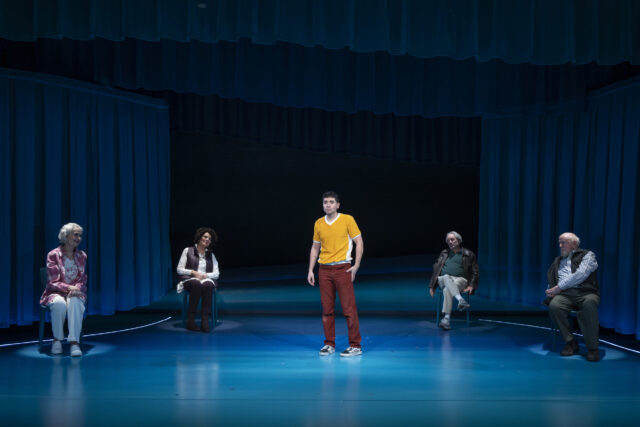
As the audience enters the Atlantic’s Linda Gross Theater to see Jake Brasch’s off-Broadway debut, The Reservoir, they are met by an unusual sight: An actor is flat on his back on the floor, as if dead. Next to him is wheeled luggage. There are two empty chairs on either side of the stage, in front of curtains, more of which hang high in the back, above a curving piece of scenery that represents water, as if the young man has washed onshore, perhaps having drowned. The night I went, most of the crowd paid little attention to the actor, instead checking their phones and engaging in conversation, as life goes on without him. It’s an apt metaphor for the play itself, which is an engaging and clever foray into family and addiction until it starts drowning in melodrama in the second half.
The young man is Josh (Noah Galvin), an alcoholic college student on leave because of his blackout benders and subsequent disappearances. After Josh awakes, appreciating the sunrise, a park ranger (Matthew Saldívar) tells him he can’t sleep there. Josh turns to the audience and says, “Focus on the cop, speak to the cop. But how did I get here? Did I get on a plane? A greyhound? Wouldn’t be the first time. One time I went to a club in Brooklyn and woke up three days later at a Chick-fil-a in West Virginia.”
A moment later he adds, “Okay. Focus. Morning. Bleeding. Suitcase. Denver. What’s the last thing I remember? The hot rehab worker breathalyzed me and drove me into Miami and then . . . Here we go. Here comes the sober. I hate this part, when the dam breaks and the questions come pouring in.”
He has mysteriously returned home, where his mother, Patricia (Heidi Armbruster), wants him back in rehab. He begs her for one last chance and she agrees to let him stay in his room if he promises to remain sober, take a job at the independent bookstore she owns, and go back to school in the fall.
For most of the play, the four chairs are occupied by Josh’s grandparents, the easygoing Catholic Irene (Mary Beth Peil) and Hank (Peter Maloney) on Patricia’s side, the talkative Jewish Beverly (Caroline Aaron) and Shrimpy (Chip Zien) on his father’s. Despite being surrounded by family and working for a mellow boss, Hugo (Saldívar), Josh can’t get his life in order, especially when Irene’s dementia gets worse. When she suddenly breaks into a lovely version of “O Come, All Ye Faithful,” he starts understanding that she is seriously ill, telling Beverly about it. Grandma Beverly is very different from Grandma Irene:
Beverly: So this was truly, completely out of nowhere? Josh: Unprompted. It felt channeled. Like a spirit was moving through her or something. Beverly: Christ. Josh: Yeah, maybe, could have been him. I mean really though, it was actually kinda beautiful. Beverly: Well, if I ever get like that, if I start randomly singing at lunch, you have to shoot me, understand? Josh: What? Beverly: I’m serious. It’s not hard. This is Colorado. Use my credit card, go to Walmart, buy a rifle. Josh: Dark. Beverly: I’ll tell you what’s dark: old age. That’s why you’ll help your granny when the time is right. Josh: I won’t. Beverly: If I’m all but three words into “O Come, All Ye Faithful” — Josh: I doubt that would be your song of choice. Beverly: “Mi Chamocha” whatever. Push me off a cliff.
Meanwhile, Shrimpy, long divorced from Beverly, is planning on having his second bar mitzvah, at the age of eighty-three, and wants Josh to help him prepare, but he has a tendency to speak a little too openly, particularly when it comes to sex. Acknowledging that Josh is gay, Shrimpy asks him whether he has ever had a threesome, then explains, “I’m straight. Mostly. But, you know, sometimes I look at dicks on my computer. What can I say? I do. I look at the dicks. Hey, what do you say you help me with my bar mitzvah prayers?”
Josh, who has no friends his own age and is not dating, joins Beverly at her senior aerobics class at the JCC taught by Lenni (Armbruster), who says things like “Okay, my beautiful Jewish women, let’s start with a step touch. . . . And five six seven eight . . . Goyim style!” He spends nearly all his free time with his grandparents, but when Irene takes a turn for the worse, Josh’s life once again spirals out of control.
Josh (Noah Galvin) is surrounded by his grandparents in Jake Brasch’s The Reservoir (photo by Ahron R. Foster)
In my recent review of Jacob Perkins’s The Dinosaurs, which just ended its run at Playwrights Horizons, I wrote, “If I never see another play set entirely at an AA or grief counseling meeting consisting of a group of people sitting on folding chairs near some coffee and donuts, it will be too soon.”
A coproduction with Ensemble Studio Theatre and the Alfred P. Sloan Foundation, The Reservoir is not set entirely at an AA or grief counseling meeting, but much of the second half feels like it does as Josh battles to remain sober while all of his grandparents experience health declines. The first act had a sharp, very funny, and relatable tone and mood, but after intermission it all falls apart as Brasch heaps on the soapy melodrama, sucking the life out of the story and hamstringing each of the actors and characters, which also include Josh’s imaginary doctor, Yaakov Stern (Saldívar), a real neuroscientist who discusses the concept of cognitive reserve and offers such advice as “Listen, Joshua. Alcoholism and Alzheimer’s? Not the same thing. You can rebuild, they cannot,” as well as Rabbi Silver (Armbruster), who leads Josh and Shrimpy in a wholly improbable scene in a temple.
Director Shelley Butler (The Scarlet Letter,This Is Fiction) can’t rein in a narrative that gets lost at sea as various pieces of furniture and book carts are wheeled on- and offstage through the sheer curtains, which turn color based on Jiyoung Chang’s lighting shifts. (The set is by Takeshi Kata, with casual costumes by Sara Ryung Clement and sound and incidental music by Kate Marvin.)
Independent Spirit Award nominee Galvin (Waitress,Dear Evan Hansen) is a delight to watch, infusing Josh with a bittersweet complexity that makes you want to root for him in spite of his many serious mistakes. Helen Hayes Award nominee Aaron (A Kid Like Jake,Madwomen of the West) and three-time Drama Desk nominee Zien (Harmony,Caroline, or Change) nearly steal the show as the madcap Jewish relatives, while two-time Tony nominee and Obie winner Peil (Dying for It,Cornelia Street) and Drama Desk nominee Maloney (I’m Revolting,On the Shore of the Wide World) are touching as the gentle old goyim. Armbruster (Boy,Man from Nebraska) and Saldívar (Junk,The Wild Duck) do what they can with underwritten, overly clichéd roles.
Brasch, who describes themself as “a queer, sober, Jewish clown,” was inspired to write the play based on a year in his own recovery during which he reconnected with his grandparents. The Reservoir feels almost too personal, with too many plot holes and too many off-color jokes that start sounding repetitive as the protagonist faces ever-harder truths.
Talking about a metaphorical river, Josh says, “Nothing can get past the dam. And we’ll never know where the water was heading. We’ll never know what lurks beyond. Immense dryness. A great expanse. Terrifying. What do we remember? What have we forgotten? All of the things that we do not know that we do not know. That gnawing feeling that there’s something missing. Something small. Something minor. Or maybe something huge?”
The first half of The Reservoir is rich and free flowing, but there’s too much missing in the second half, preventing it from getting past that dam.
[Mark Rifkin is a Brooklyn-born, Manhattan-based writer; you can follow him on Substack here.]
“Oh no,” the person sitting next to me said at the start of Benjamin Millepied’s Romeo & Juliet Suite at Park Ave. Armory.
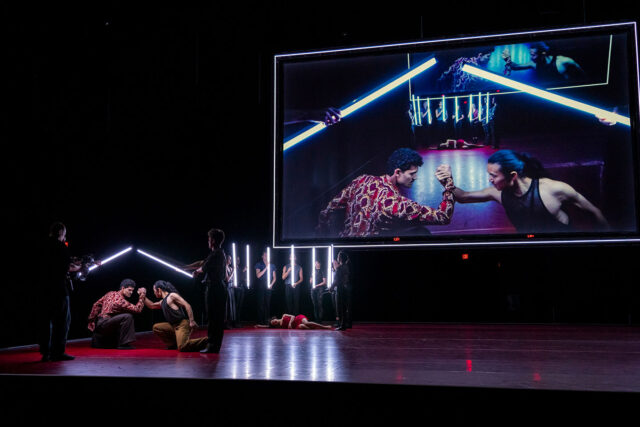
I couldn’t help but agree as we watched two dancers move a couch on a platform stage, followed by a cameraman in black who was documenting the action, the live video projected on a large screen. The men got onto the couch, which was facing away from the audience, but we could see what they were doing onscreen, since the cameraman was now in front of them. It was an odd way to begin the ballet, a multimedia adaptation of Sergei Prokofiev’s 1930s classic Romeo and Juliet, but it also signaled what was to come: ninety minutes of not knowing where to look as mostly unidentified characters — current and former members of Millepied’s LA Dance Project — performed on the stage, on the sides, and in various hallways and period rooms throughout the armory.
The score is bold and majestic. The choreography is often moving and beautiful. Camille Assaf’s naturalistic costumes, primarily blacks, brown, and grays, are set off by the usually heart-red platform and glow when the performers grab fluorescent light tubes and incorporate them in both inventive and curious ways. We get an inside look at various locations in the historic building, some not open to the public. A dark, mysterious masked ball with mirrors is held in a tight space. Romeo and Juliet (portrayed by three different pairs at each show: a man and a woman, two men, or two women) pose in silhouette against a white screen. A chase scene takes place under the rafters.
The problem is that we’re at a live performance and we spend much of the show’s eighty minutes essentially watching a movie, although it’s happening live. Even when the dancing is occurring on the stage, it is often being projected simultaneously, with cameraman Sebastien Marcovici, the company’s associate artistic director and rehearsal director, running about to capture it; it’s particularly intrusive during several duets between Tybalt (Renan Cerdeiro) and Mercutio (Shu Kinouchi) and Romeo (Daphne Fernberger) and Juliet (Rachel Hutsell). Many of the story’s most critical scenes can be seen only onscreen; in addition, no plot is ever described, so it helps if you know at least the basics of the Shakespeare play. There’s also a camera above the platform that offers a bird’s-eye view that is awe inspiring the first time but quickly becomes more like a scene from a Busby Berkeley movie starring Esther Williams. When the screen isn’t being used, it’s cast in shapes and colors that resemble a blurry Mark Rothko painting, as if hinting at the suicides to come.
And then there’s the balcony scene, which for me summed up the entire experience. (Just as an fyi, there was no balcony scene in the original play, which merely called for Juliet to be at a window.) Romeo and Juliet celebrate their newfound love by dancing in the glorious Veterans Room, then run upstairs and suddenly emerge on the upper ledge behind the screen. It’s a breathtaking moment — until Marcovici joins them, getting close to them so he can zoom in on their first kiss.
Mercutio (Shu Kinouchi) and Tybalt (Renan Cerdeiro) are at odds in multidisciplinary Romeo & Juliet Suite (photo by Stephanie Berger)
I’m sorry if I sound snarky; overall, I enjoyed the production, and there are numerous memorable moments that will stay with me. Fernberger and Hutsell are terrific, their movement packed with emotion, and the rest of the cast has a powerful energy. But it could have been so much more without all the bells and whistles; Millepied may have fared better had he incorporated the cinematic elements without getting camera happy, instead focusing more on the dance happening on the platform, in the room where the audience is sitting.
“Of all the places I’ve shown Romeo & Juliet Suite, the armory is by far the most fitting, as it provides the massive scale, flexibility, and grandeur needed to present this work at its fullest potential,” Millepied said about this iteration; previous versions have been presented at the Sydney Opera House, La Seine Musicale in Paris, and the Spoleto Festival in Charleston. He may have gotten a little carried away by the glorious armory, but there’s still a worthwhile dance to be found in his radically reimagined tale, if you know where to look.
[Mark Rifkin is a Brooklyn-born, Manhattan-based writer; you can follow him on Substack here.]
MABOU MINES CINEMA
Anthology Film Archives
32 Second Ave. at Second St.
March 13 – March 19 www.anthologyfilmarchives.org
“Do I owe a debt to the cinema?” a character asks in Lee Breuer’s 1974 forty-minute video The Red Horse Animation, part of the weeklong Anthology Film Archives series “Mabou Mines Cinema.”
Actually, lovers and creators of experimental avant-garde film and theater owe a huge debt to Mabou Mines.
Founded in 1970 by Breuer, JoAnne Akalaitis, Philip Glass, Ruth Maleczech, and David Warrilow, Mabou Mines has been presenting unique, wholly original live works onstage for more than half a century, but the collective, currently under the artistic leadership of Mallory Catlett, Karen Kandel, and Carl Hancock Rux, also has a long history of low-budget DIY films that pushed the boundaries of what cinema can be.
From March 13 to 19, Anthology will be screening nine films across seven programs, with numerous shows followed by Q&As with special guests. Perhaps the most unusual work in the series is the theatrical premiere of Jill Godmilow’s 2001 Mabou Mines’ Lear ’87 Archive (Condensed), a nearly six-hour documentary of the making of the troupe’s 1990 adaptation of Shakespeare’s King Lear, which won multiple Obies and starred Maleczech as Lear, Greg Mehrten as the Fool, Ellen McElduff as Elva, Bill Raymond as Goneril, Ron Vawter as Regan, and Lute Ramblin’ as Cordelion. It will be shown in two parts; the March 14 show will be followed by a Q&A with Mehrten and journalist Alisa Solomon.
In Godmilow’s 1984 hybrid Far from Poland, the director, who passed away last September at the age of eighty-two, is determined to make a documentary about the Polish Solidarity movement despite being denied a visa, so she takes viewers behind the scenes into her process as she discusses the possibilities with Mark Magill, incorporates archival news footage, and re-creates interviews with Anna Walentynowicz (played by Ruth Maleczech), Elzbieta Komorowska (Hanna Krall), reporter Barbara Lopienska (Honora Fergusson), government censor K-62 (Bill Raymond), Polish dictator Wojciech Jaruzelski (David Warrilow), journalist Richard Fraser (John Fitzgerald), and shipyard worker Adam Jarewski (Mark Margolis). The March 17 screening will be followed by a Q&A with film historian Susan Delson and film scholar Ricky Herbst.
In 2009, I saw Mabou Mines Dollhouse at St. Ann’s Warehouse; in my review, I wrote, “Winner of two Obies — for director (and company cofounder) Lee Breuer and star Maude Mitchell — this unique reimagination of Henrik Ibsen’s controversial 1879 feminist classic features three leading men who are all under four and a half feet tall, with the three main women approaching six feet, immediately calling into question issues of strength, power, and social status.” The previous year, Breuer directed a film of the stage work, which Anthology will be screening on March 15 at 7:45, followed by a Q&A with professor Olga Taxidou and co-adaptor Mitchell.
The series was programmed by Breuer’s son Mojo Lorwin; below is a look at other highlights.
Mojo Lorwin finishes his father’s film, Moi-même, after more than half a century
MOI-MÊME (Mojo Lorwin & Lee Breuer, 1968/2024)
Friday, March 13, 6:30
Wednesday, March 18, 6:30 www.anthologyfilmarchives.org
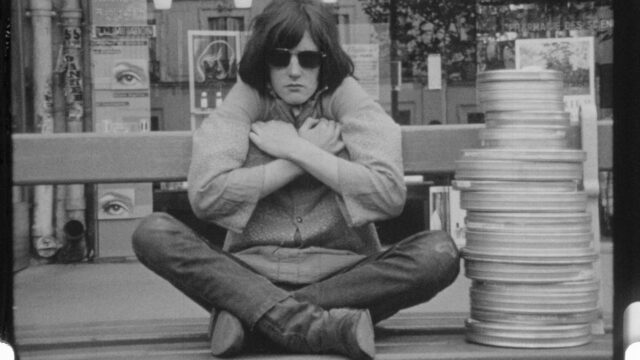
In 1968, experimental theater director, playwright, and poet Lee Breuer began making a black-and-white improvised film during the May 1968 Paris riots, where he was living at the time. He and cinematographer John Rounds shot the footage but never added sound, edited it, or wrote a script. In 1970, Breuer cofounded the seminal New York City company Mabou Mines with Philip Glass, Ruth Maleczech, JoAnne Akalaitis, David Warrilow, and Frederick Neumann, winning numerous Obies among other accolades over the next half century, but he never finished the movie, which itself is about making a movie.
Breuer died in January 2021 at the age of eighty-three; one of his children, Mojo Lorwin, decided to complete the project, hiring voice actors and musicians and serving as writer, director, editor, and producer. The result is the hilarious Nouvelle Vague satire Moi-même (“Myself”), a sixty-five-minute foray into the world of François Truffaut, Jacques Rivette, Jean-Pierre Melville, Agnès Varda, William Klein, and Jean-Luc Godard, who makes a cameo, walking backward as Kevin shares a series of statements ending with “Everything is a movie.”
Kevin Mathewson stars as Kevin (voiced in 2024 by Declan Kenneally), an adolescent who is making a film with his alter ego (Patrick Martin). As he proceeds around town, he meets up with a strange driver (executive producer Russ Moro / 2024 composer Olivier Conan), a movie producer (Frederick Neumann / David Neumann, Frederick’s son), a starlet (Ginger Hall / Clove Galilee, Breuer and Maleczech’s daughter), the son of a baron (Warrilow / David Neumann), an Italian heiress (Renata / Tessie Herrasti), a revolutionary actress (Anna Backer / Tiera Lopper), her replacement (Judy Mathewson, Kevin’s younger sister / Ruma Breuer, Lee’s granddaughter), a sleazy agent (Mark Smith / Alon Andrews), a couple of goons (Pippo and Mike Trane / Frier McCollister), and the owner of a film shop (Lee Pampf / Thomas Cabus). He is often accompanied by his conscience (Maleczech / Alexandra Zelman-Doring) as he faces financial and creative crises.
Lorwin has fun with cinematic and societal tropes while maintaining the underground, DIY feel; for example, he doesn’t match the dialogue exactly to the movement of the characters’ mouths as they make such proclamations as “The movies aren’t fair,” “The movies are a game and everyone who plays is a cheater,” and “All I want is to be seen and heard.” The soundtrack consists of unexpected sound effects and songs and music by Frank LoCastro, Alex Klimovitsky, Eliot Krimsky, Conan, and others.
There’s lots of drinking and smoking, violent shootings, political ranting, discussions of art and love, vapid gatherings, a heist, a touch of psychedelia, and superfluous nudity, nearly everything you could possibly want in a French film.
“Film costs money, more than you’ve got,” the driver barks at Kevin. “Producers are perverts,” Kevin tells the actress while preparing a baby bottle of milk. Unable to afford film reels, Kevin says, “Film is more expensive than love and revolution.”
Describing the film to the agent, Kevin explains, “Here it is: It’s me, but it’s not me. You dig? I mean, it’s the film adaptation of me. I just need a little bread to turn boring old me into moi-même. Feels like doors are finally opening for me.” He delivers the last line as a door opens in front of him.
Perhaps the most important line of dialogue is given to Kevin from a man on the street, who tells him, “There are no rules.” I would add, “Viva la revolución!”
Moi-même is being shown March 13 and 18 at 6:30 at Anthology Film Archives and will be followed by Q&As with professor emeritus Arthur Sabatini, Kevin Mathewson, and Lorwin.
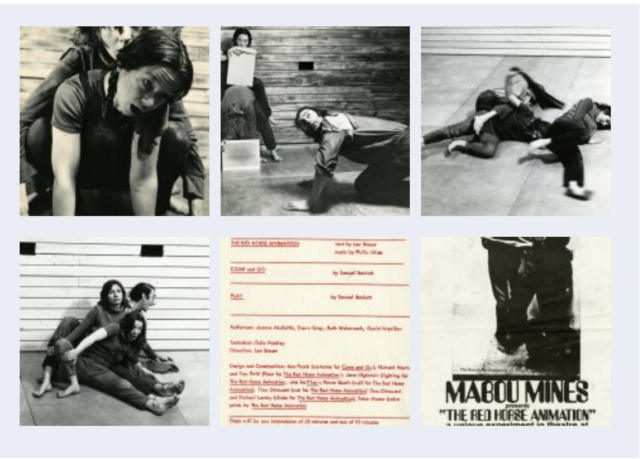
The Red Horse Animation captures a live Mabou Mines performance with cinematic additions
THE RED HORSE ANIMATION (Lee Breuer, 1974) / B. BEAVER ANIMATION (Lee Breuer, Chris Coughlan, and Craig Jones, 1979) / SISTER SUZIE CINEMA (Lee Breuer, 1982)
Friday, March 13, 8:45
Wednesday, March 18, 8:30 www.anthologyfilmarchives.org
The second program in the “Mabou Mines Cinema” series brings together a trio of cutting-edge shorts that embody the Mabou Mines approach to art while challenging the audience to adjust their expectations. The thirty-eight-minute Horse Animation captures Mabou Mines’ inaugural production, a piece that melds together movement, music, and text by Breuer that is a kind of manifesto as JoAnne Akalaitis, Ruth Maleczech, and David Warrilow crawl over one another across the floor, recite words in robotlike fashion (“I’m not myself. How in my illness I see something, my life, somewhere. And now it comes to me that I am a representation”), laugh, and turn into ghostlike digital projections by DeeDee Halleck, whose camera shoots the rest of the film in grainy black-and-white from a multitude of angles; the live music is by Philip Glass. In a 1970 Guggenheim program note, Breuer wrote about the piece, “The red horse, in its representational form, materializes and falls apart in the course of the performance. It lives in real time. ‘Lives’ in this sense means conveys meaning to its creators and observers. It tries to create its life outside the real performance time. It tries to live in dramatic time.”
In B. Beaver Animation, Breuer, Chris Coughlan, and Craig Jones zoom close in on Fred Neumann as he delivers a thirty-minute monologue about floods, snow, beavers, and dams; when he says early on, “To be specific, a force of nature,” he could be speaking about himself as he tears through the words like he’s in a race against time, with stutters and occasional breaks so he — and the audience — can catch a breath until he slows down for the dramatic finale.
And in Sister Suzie Cinema, the a capella quintet 14 Karat Soul performs gospel-tinged doo-wop songs while in a movie theater, the flickering light illuminating them in the darkness until they take flight in a nineteen-minute cinematic fantasia directed by Breuer in muted colors and written by Breuer and composer Bob Telson. The March 18 screening will be followed by a Q&A with Carl Hancock Rux, Telson, and singer Glenny T of 14 Karat Soul.
Dead End Kids is an unusual, haunting look at nuclear war from JoAnne Akalaitis
OTHER CHILDREN (JoAnne Akalaitis, 1979) / DEAD END KIDS: A HISTORY OF NUCLEAR POWER (JoAnne Akalaitis, 1986)
Monday, March 16, 7:00
Thursday, March 19, 7:00 www.anthologyfilmarchives.org
Other Children, JoAnne Akalaitis’s first film and not a Mabou Mines production, is a visually rich, poetic adaptation of Jane Bowles’s last work of fiction, the coming-of-age short story “A Stick of Green Candy.” The nineteen-minute film was shot in Cape Breton, Nova Scotia, in a small house, on the streets, and at a rocky clay pit. Juliet Glass stars as Mary, Erik Moskowitz as Franklin, George Rosenblatt as her father, and Joan Jonas as his mother; the verbatim dialogue is overdubbed by Glass, Moskowitz, Bill Raymond as the man, and Ellen McElduff as the woman and features such gems as this from Franklin’s mother: “I’d rather have a girl than a boy. There’s nothing much I can discuss with a boy. A grown woman isn’t interested in the same things a boy is interested in. My preference is discussing furnishings. Always has been. I like that better than I like discussing styles. I’ll discuss styles if the company wants to, but I don’t enjoy it nearly so well. The only thing about furnishings that leaves me cold is curtains. I never was interested in curtains, even when I was young. I like lamps about the best. Do you?” Jacki Ochs’s camera lovingly follows Mary, bringing her imaginary adventures to life as she leads an army of mountain-goat fighters, with gentle editing by David Hardy. In a rare title card with narration from the original story, we are told, “All at once she had had the fear that by looking into her eyes the soldiers might divine her father’s existence. To each one of them she was like himself — a man without a family.” The 16mm film, which was restored in 2022, concludes with the Hackberry Ramblers’ jaunty Cajun country instrumental “Just Once More.”
Other Children is screening on March 16 and 19 with Akalaitis’s 1986 feature Dead End Kids: A History of Nuclear Power, which captures Akalaitis’s Obie-winning 1980 play that incorporates numerous elements as it assesses the future of the world, with a cast that includes McElduff, Ruth Maleczech, Terry O’Reilly, Greg Mehrten, Fred Neumann, Glass, and Lee Breuer and Maleczech’s children Clove Galilee and Lute Ramblin’ in addition to David Byrne, who composed the synth soundtrack. The March 19 screening will be followed by a Q&A with journalist Don Shewey and McElduff.
Meanwhile, Mabou Mines is still going strong, having recently staged Samuel Beckett’s All That Fall, directed by Akalaitis, with such promising upcoming shows as the opera Barcelona, Map of Shadows and Rux’s Etudes.
[Mark Rifkin is a Brooklyn-born, Manhattan-based writer and editor; you can follow him on Substack here.]
Upon entering the downstairs theater at the new Bowery Palace, audience members are greeted by an unusual sight: At the front and center of the small, crowded stage, surrounded by various chairs, tables with lamps, a drum kit, and vertical white fluorescent lights on a shimmering curtain, is an empty wheelchair.
It’s a haunting image, made all the more palpable when singer-songwriter Jesse Malin makes his grand entrance, carried down the aisle on a stretcher, his hands folded across his chest as if dead. But the Queens native, along with the crowd, is about to be resurrected by the power and glory of rock and roll in the heart-wrenching yet exhilarating Silver Manhattan.
“I love walking in New York,” Malin says after being placed in the wheelchair. “You hit the street, no plan, no agenda — then you bump into someone, talk to a stranger, make a new friend. You see a poster, you run into a show, a movie — you hear music from a bar, it draws you in. Next thing you know, you’ve danced all night, fallen in love, learned a good joke from a homeless person, fed a stray cat, and jumped back into bed as the sun comes up and the last garbage truck rolls by. Anything’s possible here.”
Some of those things might never be possible for Malin again, but that’s not preventing him from living his life to the fullest he can.
“The last time I walked down a New York street was May 4, 2023,” he says shortly before launching into his 2015 song “Turn Up the Mains” while sharing the story of the day he suffered a spinal stroke on his way to a one-year memorial party he was hosting and DJing for his late friend and former bandmate Howie Pyro, who he calls an “occasional Satanist.” Malin describes the event in graphic detail as the pain shot through his legs, he got down on the ground, and then was taken by ambulance to the hospital, where he received the awful diagnosis and was told that he’s “effectively paraplegic,” that he might never walk again without assistance.
The band — keyboardist Rob Clores, bassist James Cruz, drummer Paul Garisto, and musician and vocalist Bree Sharp — then kicks into the Rolling Stones’ 1971 track “Sway” and Malin picks up a guitar.
Doctor: Did you ever wake up to find / A day that broke up your mind? / Destroyed your notion of circular time. Band: It’s just that demon life / Got you in its sway / It’s just that demon life / Got you in its sway. Malin: Ain’t flinging tears out on the dusty ground / For all my friends out in the burial ground / Can’t stand this feeling, getting so brought down.
Malin, who was born in 1967, then returns to his childhood in Whitestone, where his single mother raises him and his sister. He recounts jumping on his bed to songs by Elton John and Paul Simon, being bullied because he has to wear an eye patch, and discovering such bands as KISS, the Sex Pistols, the Dead Boys, and the Ramones.
He sings, “Waiting on a midnight bus / To get me to the 7 train / Running from the chicken hawks / And I never went back . . . never went back . . .” in “Whitestone City Limits.”
As a teenager, he first forms the band Heart Attack (“Trendies”), then downtown punk legend D Generation (“No Way Out”). He goes solo in 2000, releasing such albums as Glitter in the Gutter,Love It to Life, and New York Before the War. He collaborates with Bruce Springsteen, Billie Joe Armstrong, Ryan Adams, and Lucinda Williams. He opens a club in the city.
And then, at the age of fifty-six, he learns that he might lose everything.
Jesse Malin is joined by his bandmates while telling his poignant story (photo by Ehud Lazin)
The preshow setlist blasting through the speakers sets the stage for the music that follows, from the Dead Boys’ “Sonic Reducer” and the Ramones’ “She’s the One” to Carly Simon’s “You’re So Vain” and Simon & Garfunkel’s “My Little Town,” letting the audience know that this is not going to be just a punk concert. Over the course of ninety pulsating minutes, Malin reaches deep into his back catalog, performing songs not in chronological order but how they relate to the narrative, which switches between his history and his efforts to not give in to his diagnosis, including seeking out special treatment in Argentina. He is joined several times by Satish Indofunk and Danny Rey on horns, adding another dimension to the songs. The often warm lighting is by Brian Scott, with propulsive sound by Angela Baughman.
Just as Marsha Ginsberg’s scenic design is cramped, so is the audience, seated in folding chairs on the floor or balcony and on narrow benches or standing in the back; it’s not the most comfortable way to enjoy music, but it works here, especially as Malin makes eye contact with as many audience members as he can as he chronicles his wild adventures, baring his heart and soul. And he never becomes treacly, even when adopting a mantra from his friend HR of Bad Brains: PMA, or Positive Mental Attitude. “Before him, I never thought how my outlook might effect where I end up,” Malin acknowledges.
He doesn’t wallow in self-pity or ask for sympathy but instead forges ahead, determined to beat the odds and, primarily, keep making music. His band doubles as characters from his life: DJ Jonathan Toubin, his doctor, his mother, Jack Flanagan, his physical therapist. As the evening progresses, he gets more and more pumped, waving his arms in the air and shaking his body in the chair. He has an infectious enthusiasm that dances over the room like a swirling disco ball. You don’t have to know anything about Malin or his music to fall for him and the presentation, which is reminiscent of Springsteen on Broadway and Bono’s Stories of Surrender, both of which were tied to memoirs; Malin’s Almost Grown (Akashic Books, $28.95) will be published on April 7.
Passionately directed by Ellie Heyman (Space Dogs,The Tattooed Lady), Silver Manhattan — named for Malin’s 2004 song that does not appear in the show; nor does his 2002 track “Almost Grown” — is an intimate journey into one man’s refusal to take no for an answer, through his entire life. It’s a thrilling, no-holds-barred celebration, tinged with loss and sadness, but ultimately it’s a triumphant homecoming for a man who has been part of the New York City music scene for five decades and is not about to stop now.
He saves some special surprises for the very end, then, as an encore, brings out a different friend each night; I saw Tony-winning actor and musician John Gallagher Jr. (American Idiot,Spring Awakening) playing the Replacements’ hit “Alex Chilton,” which features the line “I’m in love / with that song.”
Well, I’m in love / with this show.
[Mark Rifkin is a Brooklyn-born, Manhattan-based writer and editor; you can follow him on Substack here.]