featured

FROM PONG TO AI: CHILLING DATA AT THE LUCILLE LORTEL

Maneesh (Karan Brar) and Jonah (Brandon Flynn) take a break from work by playing ping-pong in Data (photo by T. Charles Erickson)

DATA
Lucille Lortel Theatre
121 Christopher St.
Tuesday – Sunday through March 29, $61-$126
www.datatheplay.com
lortel.org

The New York debut of Matthew Libby’s chilling Data feels like it’s been ripped from today’s headlines, but the playwright first started thinking about it in 2017, after interviewing for and not getting an internship at Palantir — one of the tech companies at the center of the current massive expansion of artificial intelligence — then reading an Intercept article about the firm’s plans, the title of which would be a major spoiler.

Data premiered in the fall of 2024 at Arena Stage in Washington, DC, directed by Margot Brodelon; director Tyne Rafaeli’s skillful adaptation opened at the Lucille Lortel on January 25 and has been extended through March 29. Karan Brar reprises his role as Maneesh Singh, a twenty-two-year-old Indian American working in the User Experience (UX) department of the fictional, highly prestigious Silicon Valley company Athena Technologies.

The play begins with Maneesh playing ping-pong in the almost blindingly white break room with fellow UX employee Jonah (Brandon Flynn), who has been assigned to be his mentor. They are not competing at championship-level table tennis but instead are hitting the ball back and forth slowly and casually, reminiscent of Pong, the 1972 Atari video game that brought digital technology into the mainstream and people’s homes. While the somewhat goofy Jonah gossips about secrecy, cutting-edge software, potential layoffs, Taco Tuesday, and an engineer in Data Analytics who left the company under mysterious circumstances, the very serious Maneesh has no interest in networking, listens to what his parents tell him to do (or not do), and, despite his obvious abilities, seems happy to stay in UX and not be promoted to Data Analytics, where the real work is being done.

When he bumps into Riley (Sophia Lillis), a college classmate now in Analytics, she is shocked that he is in UX. Next he is meeting with Alex Chen (Justin H. Min), the charming, fast-talking analytics head who used to work with Maneesh’s brother and now wants Maneesh to team up with Riley on a special project that involves signing an NDA. Maneesh is hesitant and uncomfortable, especially when Alex insists on knowing more about his breakthrough predictive algorithm, which Maneesh developed as a way to anticipate the success of baseball players and has since made it closed source, preventing access to it.

“Talk to me, bro. Cone of silence,” Alex says. Maneesh responds, “Look. As I got further and further into my thesis, and I realized what exactly it was I was creating . . . I, like, saw this conversation. Like, this exact conversation we’re having right now. Right down to the joking about baseball, because of course, the algorithm has nothing to do with baseball. The rare event model can be applied, hypothetically, to predict . . . anything, really. And so, after I presented the initial results, I started getting emails. But not from sports teams. They were from headhunters, trying to poach me, poach the project — investment firms, lobbying groups, even an oil company. And that . . . I guess I realized that scared me. I just mean — I felt it. That it’s not what I wanted.”

But it’s exactly what Alex and Athena want.

Riley (Sophia Lillis), Maneesh (Karan Brar), and Alex Chen (Justin H. Min) have different grand plans in New York City premiere (photo by T. Charles Erickson)

According to the script, the story takes place in the mid-2020s, but “it might already have happened.” The plot will make you think not only of Palantir but also about Mantic, Anthropic, OpenAI, Cambridge Analytica, and other such tech firms in the news. One of the script’s epigraphs is a quote from OpenAI CEO Sam Altman: “AI will probably most likely lead to the end of the world, but in the meantime, there’ll be great companies.” Last month, Anthropic safety researcher Mrinank Sharma quit, writing in an open letter, “The world is in peril. . . . We appear to be approaching a threshold where our wisdom must grow in equal measure to our capacity to affect the world, lest we face the consequences.”

Data marks Libby’s off-Broadway debut, and it’s an exciting one. The dialogue is keenly pointed, the characters believable, and plot twists and surprises abound in a taut hundred minutes. Only Jonah’s sexual pursuit of Riley rings false and feels forced, but otherwise Rafaeli (Weather Girl, Becoming Eve) maintains a deft touch.

Marsha Ginsberg’s set morphs from the break room to Alex’s spare, pristine office to a fascinating late shift; the whiteness recalls the streaming hit Severance, where employees are not sure what their jobs are for or what the company does while they keep their working and personal lives completely separate, one knowing nothing about the other. Scene changes are made in darkness as fluorescent lights speed around a rectangular frame accompanied by 8-bit digital music. (The lighting is by Amith Chandrashaker, with sound and music by Daniel Kluger and contemporary casual costumes by Enver Chakartash.)

Brar makes a terrific theatrical debut as Maneesh, capturing his deep unease at where his life appears to be going against his better judgment. Despite his vast tech knowledge and abilities, he represents all of us who are more concerned about the future of humanity than the success of a business, or a government. Lillis (Heroes of the Fourth Turning, A Midsummer Night’s Dream) brings a beguiling nuance to the complicated Riley, Min nails the bold, forward-thinking, eminently likable but ethically questionable tech boss, and Flynn (Kowalski, Kid Victory) lends Jonah the right balance, aside from the pervy subplot.

Libby studied cognitive science and symbolic systems at Stanford, so he knows what he’s talking about when Alex says, “It’s a geopolitical reality. Data is the language of our time. And like all languages, its narratives will be written by the victors.” But he’s also on target when Maneesh considers that AI can make “the world a worse place.”

It may have taken more than a half century to proceed from Pong to today’s video games, but so many elements of AI are moving so fast, Data could potentially be an ancient relic — like Pong — by the time it completes its run at the Lortel.

Thus, it’s better to see it now, while it’s still a legitimate cautionary tale and not a portent that the end is near, brought on by humanity itself.

[Mark Rifkin is a Brooklyn-born, Manhattan-based writer; you can follow him on Substack here.]
HIGH LINE COWBOYS AND WOMAN WARRIORS: RAVEN HALFMOON IN CONVERSATION WITH CECILIA ALEMANI

Raven Halfmoon will discuss High Line commission West Side Warrior on March 3 (photo by twi-ny/mdr)

Who: Raven Halfmoon, Cecilia Alemani
What: Artist talk about West Side Warrior
Where: Friends of the High Line Headquarters, 820 Washington St., fourth floor
When: Tuesday, March 3, free with RSVP, 12:30
Why: In a July 2023 interview with Forbes, artist Raven Halfmoon (Caddo Nation) explained, “When I was in those anthropology classes [at the University of Arkansas], not only was I learning about my own tribe and our histories, but also about the Olmec heads in Mexico and the Easter Island heads and then not only that, but the earthworks that are in America: Spiro Mounds in Oklahoma, Moundville in Alabama, Serpent Mound in Ohio. A lot of those earthworks my ancestors made, Caddo ancestors, especially in the Mississippi region, so I was always interested in large scale works and being a part of that, the idea of community being in those works.”

That description fits well with her latest piece, the High Line commission West Side Warrior, in which Halfmoon employs the ancient coiling method as she honors tradition and her heritage while exploring gender and personal experience. Located on the old railway at Little West Twelfth St., the bust, sitting on a plinth, depicts a Native American female horse rider in a cowboy hat, her left side white, her right side black; there are four vertical tattoos on her face and three stars on the back of her head, representing the Red River. In addition, the hand of the artist is present in the clay, which is not smooth. The piece refers not only to the American West, where she is from, but also to the West Side Cowboys, who protected pedestrians and carriages on Death Avenue by guiding New York Central freight trains down the street beginning in the 1850s.

(photo by twi-ny/mdr)

Raven Halfmoon’s West Side Warrior explores indigenous culture, the Old West, gender, and High Line history (photo by twi-ny/mdr)

On March 3 at 12:30, Halfmoon, who is based in her hometown of Norman, Oklahoma, will discuss West Side Warrior with High Line Art chief curator Cecilia Alemani inside the Friends of the High Line Headquarters on Washington St.; admission is free with advance RSVP. The next scheduled talk takes place March 12 at 6:30, when Saba Khan will discuss her three videos, Leaking Ocean, Water Lords, and The Dolphin, with High Line associate curator Taylor Zakarin.

[Mark Rifkin is a Brooklyn-born, Manhattan-based writer; you can follow him on Substack here.]

THANKS, OBAMA: CHINESE REPUBLICANS GOES OFF-MENU

Four businesswomen toast to their success in Alex Lin’s Chinese Republicans (photo by Joan Marcus)

CHINESE REPUBLICANS
Laura Pels Theatre
Harold and Miriam Steinberg Center for Theatre
111 West 46th St. between Sixth & Seventh Aves.
Tuesday – Sunday through April 5, $69-$102
www.roundabouttheatre.org

Despite an intriguing title and a promising premise, Alex Lin’s Chinese Republicans turns out to be a disappointing, clichéd, problematic melodrama with ill-defined characters and subplots.

In a September 2022 study, the Association of Asian American Investment Managers reported that “more than 80% of Asian American and Pacific Islander (AAPI) women say the bamboo ceiling effect is real. Additionally, 65% of AAPI women disagree that opportunities for advancement are equitable regardless of race or gender. This new report aims to reveal the unique challenges faced by AAPI women who struggle to break through the ‘bamboo glass ceiling.’”

In the ninety-five-minute Roundabout production, making its world premiere at the Laura Pels Theatre through April 5, it’s 2019, and four politically conservative women who work at the Friedman Wallace investment bank meet every third Tuesday of the month at the Golden Unicorn in Chinatown in an “affinity group” one of the members calls “Asian Babes Changing the Game.” Phyllis Ong (Jodi Long) is an elegant but tough-talking sixty-five-year-old bad-ass who was the first Chinese woman to be managing director in New York City and has no time for bleeding-heart liberals. Her protégée, forty-eight-year-old Chinese American Ellen Chung (Jennifer Ikeda), initially joined the firm to help Chinese people who don’t speak English, like her parents, with loans, mortgages, credit, and other financial needs; she is divorced and childless, concentrating fully on her career, even Anglicizing her name from Ailin in order to fit in and eventually make partner. Iris (Jully Lee) is a thirty-one-year-old Chinese immigrant and software engineer in America on an H1b visa who’s preparing to apply for a green card, so she is not seeking any trouble. Twenty-four-year-old Chinese American Katie Liu (Anna Zavelson) is the new kid on the block, a former intern who is eagerly and excitedly on the fast track to success.

They sit at a table in front of a black-and-white calligraphic painting and show they can be just as snarky and vindictive as their male counterparts, needling one another on their Mandarin, their personal lives, and even how they treat the waiter (Ben Langhorst). An early exchange sets the tone.

Iris: Oh my god, your Mandarin is so bad. It sounds like diarrhea in your mouth —
Ellen: Just get it —
Iris: Why —
Ellen: Katie’s a vegetarian now.
Iris: Since when?
Phyllis: Are animal products slowing her down?
Ellen: No, she’s on the up and up! Hired straight from intern to research associate level two last year — and already up for a promotion — doesn’t happen every day. Get the turnip cake, too, that’s her favorite.
Iris: Turnip cake has meat, Ellen.
Phyllis: Just don’t tell her.
Ellen: Tricking a vegetarian into eating meat, sounds real ethical.
Phyllis: She needs to build strength. Or her annual review will grind her to dust.

Ellen takes Katie under her wing, much as Phyllis did with her, stressing the important tenet, “You can’t help others if you can’t help yourself.” But where Ellen envisions a future in which the firm is renamed Friedman Wallace Chung Liu, Phyllis is critical of Katie’s desire to have a life and a boyfriend along with her career.

“Honestly, I feel bad for your generation. All you want is instant gratification — ‘You can have it all!’ Yeah, they pulled the same stunt with me,” Phyllis tells Katie. “They’ll throw you a bone by paying you a little more or make you feel safe with these little affinity groups. But you still have to wear makeup, don’t you? You still have to fix your hair, wear the right shoes, be feminine enough without being a woman — and don’t even get me started on having kids. . . . The moment you think the world is making progress is the moment you become outdated.”

In addressing that progress, the play itself is outdated.

A game-show dream sequence tests the proper usage of Mandarin (photo by Joan Marcus)

The title, Chinese Republicans, feels more like click bait than a good name for the play. The women do praise Ronald Reagan and Rudy Giuliani and disparage Barack Obama, Bill de Blasio, and “weird PC crap,” and Phyllis notes, “Once a Democrat, always a Democrat,” when Ellen admits that she was blue until 2001, but Lin (Laowang: A Chinatown King Lear, Bad Chinese Daughter), who made 2026’s Forbes “30 Under 30” list in the Hollywood & Entertainment category (along with Mikey Madison, Chase Infiniti, and Emma Myers) focuses far more on their being Chinese than GOP cheerleaders. And the plot takes a bizarre diversion when Katie becomes a rabble-rousing Libertarian-Socialist Conservative intent on unionizing the company. “You guys, all of the greatest Republicans in America have been Socialists!” she declares.

Oddly, there is no mention of Donald Trump, who had a lot to say about the financial sector and, particularly, China even before the pandemic.

Director Chay Yew (Mojada, Good Enemy) stumbles through Lin’s choppy narrative as Wilson Chin’s set revolves between the restaurant — which recalls David Mamet’s toxic-masculinity-heavy Glengarry Glen Ross, although the women here are not so profane and desperate — and inside and outside Friedman Wallace, where one-on-one discussions take place. The four women are sharply dressed in Anita Yavich’s costumes, with unobtrusive lighting by Jeanette Oi-Suk Yew and original music and sound by Fabian Obispo. Hanah Kim’s projections get out of hand during a surreal game-show scene about Mandarin usage that takes place inside Ellen’s mind. That strange dream sequence and several moments involving some of the women going into the kitchen to chastise the waiter are unnecessary, adding to the erratic structure.

The quartet of Ikeda (Vietgone, BAD NEWS! I was there . . .), Lee (KPOP The Musical, Hannah and the Dread Gazebo), Emmy winner Long (Flower Drum Song, Fern Hill), and Zavelson (The Notebook, Masquerade) never achieve the kind of rhythm or balance among the characters; it’s difficult to understand what the women get out of the meeting, except for Phyllis, who revels in dishing out verbal abuse.

While the play attempts to tackle such issues as bigotry, misogyny, partisan politics, assimilation, and intergenerational conflict, it runs roughshod over itself as it loses control and becomes more and more scattershot and disorganized.

As Phyllis likes to say, “Thanks, Obama.”

[Mark Rifkin is a Brooklyn-born, Manhattan-based writer; you can follow him on Substack here.]

THE TIME IS NOW: CELEBRATING RONALD K. BROWN, WUNMI, AND TONI PIERCE-SANDS AT THE JOYCE

Ronald K. Brown/EVIDENCE returns to the Joyce for fortieth anniversary celebration

Ronald K. Brown/EVIDENCE, a Dance Company
Joyce Theater
175 Eighth Ave. at 19th St.
February 25 – March 1 (Curtain Chat February 25), $32-$82
212-645-2904
www.joyce.org
evidencedance.com

Ronald K. Brown/EVIDENCE celebrates its past while looking toward the future in its annual winter season at the Joyce, running February 25 through March 1. Because of the blizzard, opening night, February 24, has been canceled, but a 7:00 show has just been added, and great seats are available if you hurry.

The Brooklyn-based company will be presenting two exciting programs as part of its fortieth anniversary. The first honors longtime collaborator Wunmi Olaiya, a composer, costume designer, dancer, and visual artist who has been working with Brown since 1992, while the second pays tribute to TU Dance cofounding artistic director Toni Pierce-Sands, who danced with Alvin Ailey and EVIDENCE and would begin every TU Dance production with the Ulysses Dove mantra “Nothing to prove, only to share”; Pierce-Sands passed away in November at the age of sixty-three.

“Celebrating Wunmi” — born in London and raised in Lagos, she goes by one name — begins with Ebony Magazine: To a Village, a 1996 piece for Cleo Parker Robinson Dance Ensemble that EVIDENCE debuted in March 1998, featuring music and costumes by Wunmi centered around the repeated phrase “do you see what I see.” Clear as Tear Water is a 2006 solo originally choreographed for Pierce-Sands; at the Joyce, six different dancers will perform the work, which will be set to Wunmi’s “Woman Child” in Program A and Meshell Ndegeocello’s “Heaven” in Program B. Next is 1999’s Gatekeepers, a piece originally for Philadanco that delves into Native American mythology and African traditions, with music and costumes by Wunmi. Following intermission, the evening concludes with the rousing, nonstop Upside Down, an exhilarating excerpt from Brown’s 1998 Destiny, in which the company cuts loose to music by Wunmi, which she will play live with two drummers.

“With the trust Ron affords me, I dare to dream and visualize what the work he is creating is speaking on,” Wunmi explains in a Joyce interview. “Ron tells stories of human beings making their way . . . and, in there, I create costumes to make them visible. Thankful, trust is alive and well.”

Ronald K. Brown, Wunmi Olaiya, and Arcell Cabuag at the 2024 Alvin Ailey American Dance Theater gala

Planned prior to Pierce-Sanders’s death from cancer, “A Celebration of the Life and Legacy of Toni Pierce-Sands” kicks off with 2012’s Torch, a touching tribute to former Brown student and dance enthusiast Beth Young, who passed away in January 2012, followed by Clear as Tear Water. The company premiere of 2017’s Where The Light Shines Through, originally commissioned for TU at the Ordway, is choreographed by Brown and his partner, Arcell Cabuag, and set to music by Ndegeocello, Susana Baca, Ballet Folklórico Cutumba de Santiago, and Black Motion. The finale is the spectacular 1999 favorite Grace, originally choreographed for Alvin Ailey, which features twelve dancers moving, in costumes by Wunmi, to a melding of modern dance and West African idioms as only Brown and Cabuag can do, with music by Duke Ellington, Roy Davis Jr., and Fela Aníkúlápó Kuti and live vocals by Gordon Chambers; the beats will stay with you long after the show is over.

“This celebration is long overdue and I am happy the time is now,” Brown says in a program note.

The time is always now to see this extraordinary company, still going strong after forty marvelous years.

[Mark Rifkin is a Brooklyn-born, Manhattan-based writer; you can follow him on Substack here.]
UNDER YOUR SKIN: BUG ON BROADWAY

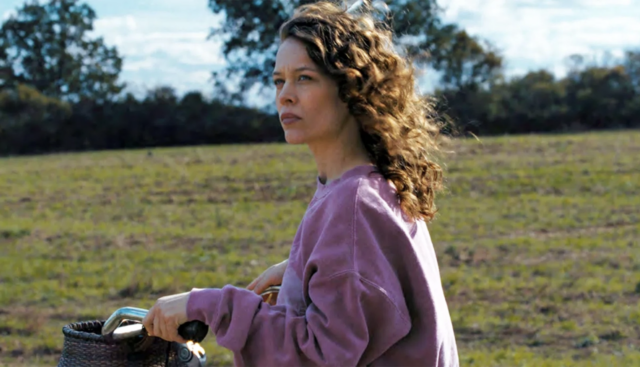
Agnes White (Carrie Coon) finds more danger inside than outside in Tracy Letts’s Bug (photo © Matthew Murphy)

BUG
Samuel J. Friedman Theatre
261 West Forty-Seventh St. between Broadway & Eighth Ave.
Tuesday – Sunday through March 8, $92-$407
www.manhattantheatreclub.com

It’s been several weeks since I saw the Broadway debut of Tracy Letts’s Bug, and I’m still feeling all itchy and out of sorts, scratching myself all over, thinking I’m being invaded by tiny killer insects.

Straight psychological horror plays don’t have a particularly impressive history on Broadway. While there have been plenty of successful spooky musicals, the same has not been true of legitimately frightening dramas. Recently, Levi Holloway’s thrilling Grey House got short shrift, closing early, and while Stranger Things: The First Shadow keeps going strong at the Marquis, it’s not pure horror, especially with its awkward Oklahoma! high school musical subplot. The last time I felt so shuddery after a Broadway play might go all the way back to watching Frank Langella from the front row of the Martin Beck Theatre in the 1977 smash Dracula.

Bug premiered in London in 1996 and came to New York eight years later, starring Shannon Cochran, Michael Shannon, Michael Cullen, Amy Landecker, Brían F. O’Byrne, and Reed Birney. It was adapted into a film in 2006, directed by William Friedkin (The Exorcist, The French Connection) and featuring Ashley Judd, Harry Connick Jr., and Michael Shannon.

Its Broadway bow at the Samuel J. Friedman is led by the sizzling hot Carrie Coon, Letts’s wife, a four-time Emmy nominee who has delighted in such series as The White Lotus, The Leftovers, Fargo, and, currently, The Gilded Age. In Bug she plays Agnes White, a forty-four-year-old woman living in a motel room outside of Oklahoma City. The opening moment is stark and beautiful: Agnes stands near the door, smoking a cigarette and holding a wineglass, looking outside as if the world is not for her. The phone rings but nobody says anything on the other end; Agnes assumes it’s her ex-husband, Jerry Goss (Steve Key), calling from prison. “I got a gun,” she warns the caller.

Next she’s having a crack, coke, and booze party with her best friend, the wild R.C. (Jennifer Engstrom), and a guy R.C. just met, a veteran named Peter Evans (Namir Smallwood). Agnes is suspicious of Peter, saying, “He’s a fuckin’ maniac, for all I know. . . . He’s a maniac DEA ax murderer, Jehovah’s Witness.” R.C. assures her he’s okay, as does Peter, whose first words are, “I’m not an ax murderer.” Agnes takes a liking to Peter and lets him stay while R.C. goes off to another shindig.

Peter explains to Agnes that he makes people nervous and uncomfortable with his talent for picking up on things, telling Agnes that he is a preacher’s son just looking for a connection to other people. When Peter starts hearing a chirping he can’t identify, Agnes at first thinks it’s a cricket. “Don’t kill him. It’s bad luck,” she says. It turns out to be the battery in the smoke alarm, which Peter claims is “more radioactive than plutonium.” He gets rid of it outside, disposing of a warning system that both of them will need as they go down a rabbit hole of conspiracy theories centered around Peter’s insistence that the room is crawling with dangerous bugs that are immune to standard sprays. “They’re blood-sucking aphids,” he later tells R.C. and Agnes, “and we’re infested.”

By the time Dr. Sweet (Randall Arney) arrives, it might already be too late.

Agnes (Carrie Coon) and Peter (Namir Smallwood) get creeped out in Bug on Broadway (photo © Matthew Murphy)

A Steppenwolf production presented by Manhattan Theatre Club, Bug is a dark dive into paranoia, perhaps even more relevant today than it was in 1996 or 2006, given the vast reach of social media, where anyone can say anything about whatever they want and watch their beliefs, regardless of facts and the truth, spread across the internet and, potentially, into mainstream society — and the government.

The play is like the bizarre offspring of Francis Ford Coppola’s brilliant 1974 The Conversation, in which Gene Hackman stars as Harry Caul, a surveillance expert who soon thinks he himself is the target being bugged, and — stay with me, now — the 1941 Popeye cartoon Flies Ain’t Human, in which the spinach-gulping hero tries his darnedest to kill flies in his home, even using a rifle.

Takeshi Kata’s hotel-room set is appropriately claustrophobic, especially in the second act. Heather Gilbert’s lighting maintains the dark mysteries hovering over it all, while Josh Schmidt’s sound ranges from a chilling quiet to brash noises.

Tony winners Letts (The Minutes, Mary Page Marlowe) and director David Cromer (Meet the Cartozians, Prayer for the French Republic) allow the plot to slowly slither along until some major set changes during intermission — which the audience can watch — ratchet up the tension for the even creepier second act as the characters’ perspectives on reality shift dramatically.

Tony nominee and Obie winner Coon (Mary Jane, Who’s Afraid of Virginia Woolf?) is hypnotic as Agnes, a strong-minded, independent woman who gets caught up in something she may not be able to get out of; you can’t take your eyes off her as her immediate future grows more and more ominous. Smallwood (Pass Over, Pipeline) portrays Peter with a keen ambiguity; you never know what he’s going to say or do. Their long nude scene together — the reason audience members must place their phones in Yondr pouches for the duration of the show — binds them to each other in a moving and emotional way. (The naturalistic costumes are by Sarah Laux.)

Bug is a taut, involving thriller, with authentic scares that get under your skin. It will also make you feel genuinely threatened the next time you’re itchy, searching for a creepy crawly creature — or following a military industrial complex conspiracy theory — with an unusual taste for human blood.

[Mark Rifkin is a Brooklyn-born, Manhattan-based writer; you can follow him on Substack here.]

NOT JUST CLOWNING AROUND: MARCEL ON THE TRAIN AT CLASSIC STAGE

Ethan Slater cowrote and stars as a famous French mime in Marcel on the Train (photo by Emilio Madrid)

MARCEL ON THE TRAIN
Classic Stage Company, Lynn F. Angelson Theater
136 East 13th St. between Third & Fourth Aves.
Tuesday – Sunday through March 22, $66-$136
www.classicstage.org

In his 1997 film Life Is Beautiful, cowriter-director Roberto Benigni portrays a Jewish Italian bookstore owner who protects his young son from the horrors of the Holocaust and a concentration camp by bravely performing silent, physical comedy for him. Although fictional, the movie was inspired by the real experiences of Italian author Rubino Romeo Salmonì in Auschwitz. Life Is Beautiful was nominated for seven Oscars and won three, for Best Music, Best Foreign Language Film, and Best Actor.

In Marcel on the Train, making its world premiere at Classic Stage, cowriter Ethan Slater portrays Jewish French mime Marcel Marceau, who was part of the resistance during WWII, joining with his cousin Georges Loinger and the OSE (Oeuvre de Secours Aux Enfants) to help save Jewish children, bravely performing silent, physical comedy for them as they tried to escape the Nazis. However, Marcel on the Train sputters, a bumpy ride that loses gas while sharing its remarkable tale.

The hundred-minute play opens with the twenty-year-old Marceau — born Marcel Mangel in Strasbourg, son of a Polish kosher butcher and Ukraine-born mother — performing mime on a bare wooden platform stage. He plucks a flower and follows some butterflies before a train whistle blows, several benches rise up from the floor, and he is joined by four hungry, tired children disguised as boy scouts: the serious, intelligent Berthe (Tedra Millan), the knowledgeable but cynical Adolphe (Max Gordon Moore), the talkative Henri (Alex Wyse), and Etiennette (Maddie Corman), who never speaks.

“Sorry. I was having a dream,” Berthe says to Marcel. “I’ve had it before, I think. It’s the future and everyone I know is old. But I’m twelve still because I never got to get old.” Marcel can’t hear her because of the train noise, so he mimics slamming the window shut, then makes a joke that Berthe doesn’t laugh at. “Don’t worry, I have others,” he promises. The exchange sets the tone for the show, which explores the loss of childhood innocence, communication between children and adults, and courage in the fight against fascism.

Marcel Marceau (Ehan Slater) entertains four adolescents as they try to escape the Nazis in fictionalized play (photo by Emilio Madrid)

The drama switches, sometimes awkwardly, to the past and the future. The first such time shift is told from the point of view of Georges (Aaron Serotsky), who tells Marcel, who is expertly forging documents for the cause, “Ooh, we’d be fucked without you, cousin. . . . Your artistry is a gift.” Marcel replies, “I am gifting the resistance my skill, my attention to detail, not my artistry. Charlie Chaplin wouldn’t just forge thirty identification papers, he’d turn them into, I don’t know, thirty baby ducks farting on Hitler.” (Ouch.)

They design a plan to meet up in Roanne, then make their way through the woods into Switzerland. Back in the present, Marceau mimes juggling apples to keep the four twelve-year-olds’ minds off their dire situation. A second trip to the past introduces Marcel’s father, Charles, (Serotsky), who is not thrilled by his son’s heroic exploits. “You know what you should do? Return to Warsaw, play the Grand, could you imagine?” Charles says, but Marcel is determined to be part of the resistance, even as the present-day journey grows more serious when they discover Georges is not waiting for them at Roanne and a Nazi officer (Serotsky) is approaching on the train.

Marcel on the Train, begins and ends with Marceau alone, miming to the audience; the emotional impact has changed because of what has happened in between, but it feels outside of the play. While it’s a showcase for Slater’s talent and virtuosity as Marceau’s alter ego, Bip the Clown, both frame pieces go on too long. Tony nominee Slater (SpongeBob SquarePants, Wicked) and cowriter and director Marshall Pailet (Private Jones, Who’s Your Baghdaddy) never find quite the right track for the narrative, which presents a surprising, relatively new, and utterly fascinating part of Marceau’s life to explore, previously detailed in several books and films over the last fifteen years, including Jonathan Jakubowicz’s fictionalized 2020 Resistance, starring Jesse Eisenberg as Marceau.

The pace stops and starts and gets caught up in tangents that are difficult to recover from, and the tension is overly manufactured. Jill BC DuBoff’s sound, Studio Luna’s lighting, and Sarah Laux’s costumes create the right atmosphere on Scott Davis’s spare set, but adult actors Corman (Accidentally Brave), Millan (Leopoldstadt), Moore (Tammy Faye), and Wyse (Good Night, Oscar) are hamstrung as the four adolescents by the inconsistent dialogue, as is Serotsky (August: Osage County), who plays everyone else.

Marceau and his brother and cousin were members of the French resistance, rescuing children, but the play has been fictionalized into disparate elements that don’t form a solid whole. There’s a great story to be told, but unfortunately Marcel on the Train too often gets diverted as it shows that life can also not be beautiful.

[Mark Rifkin is a Brooklyn-born, Manhattan-based writer; you can follow him on Substack here.]
HE WAS SO BEAUTIFUL: BILLY PRESTON AND GOD’S PLAN

The life and career of Billy Preston held many surprises revealed in documentary

BILLY PRESTON: THAT’S THE WAY GOD PLANNED IT (Paris Barclay, 2024)
Film Forum
209 West Houston St.
Opens Friday, February 20
filmforum.org

“Will it go ’round in circles? / Will it fly high like a bird up in the sky?” Billy Preston sang in his 1973 smash hit. He might not have realized it then, but that line foretold his career, which had a seemingly endless series of ups until it all came crashing down.

The rise and fall of one of popular music’s most talented and beloved figures is intimately detailed in Paris Barclay’s revelatory documentary, Billy Preston: That’s the Way God Planned It.

Born in 1946 and raised in the church by his mother, gospel singer Robbie Lee Williams, Preston began playing the piano at age three, appeared on The Nat “King” Cole Show in 1957, accompanied Mahalia Jackson and Pearl Bailey on keyboards in the 1958 film St. Louis Blues, played with the gospel group the Cogics (Church of God in Christ), and as a teenager toured with Little Richard and the Rolling Stones. An enthusiastic man with an infectious gap-toothed smile and a collection of impressive wigs, Preston was soon recording with the Stones, Sam Cooke, Sly Stone, Ray Charles, and Aretha Franklin.

He singlehandedly rescued the Beatles when the Fab Four was preparing the Let It Be album and concert, just dropping by to say hello but then taking a seat at the organ and starting to improvise with John, Paul, George, and Ringo, infusing them with the energy they had been previous lacking as rumors swirled that the band was breaking up. The tabloids nicknamed him the Fifth Beatle and the Black Beatle. “He never put his hands in the wrong place,” Starr says in the film.

Preston might have been the ultimate sideman, but when performing he couldn’t help himself, often getting up and dancing wildly, joy emanating out of every pore. He couldn’t read music and never used charts but just felt the music blaze through him, even when playing backup. “He would steal the record without you even knowing until later, and you’d go, ‘He’s done it again,’” Clapton explains.

When Preston brought an original song to George Harrison for a potential solo LP, the Quiet Beatle quickly assembled an all-star roster to back him up: Harrison, Eric Clapton, Keith Richards, and Ginger Baker.

In the 1970s, he hit the charts with such songs as “Outa-Space,” “Will It Go Round in Circles,” “Nothing from Nothing,” and “With You I’m Born Again,” all of which are featured prominently in the film. He was a musical guest on the very first episode of Saturday Night Live. Most people don’t realize that Preston wrote and originally recorded “You Are So Beautiful,” made famous by Joe Cocker; one of the highlights of the documentary is Preston’s performance of the song at the Apollo 50 celebration, joined by Cocker and Patti LaBelle on vocals. We also learn that it is a love song — to his mother, who he also plays it with in the film.

But his life started falling apart as he got lost in a haze of drugs and alcohol (Courvoisier, coke, eventually crack), starred as Sgt. Pepper in the ill-fated movie Sgt. Pepper’s Lonely Hearts Club Band, and continued to hide his sexuality, even though his friends, family, and musical colleagues knew he was gay going back to his youth. He was often seen with young men he referred to as cousins, but he was overcome with loneliness.

In their debut documentary, three-time Emmy winner Barclay (NYPD Blue, Glee) and cowriter Cheo Hodari Coker (Ray Donovan, Luke Cage) also delve into the sexual abuse Preston suffered as a child, which added to his problems as an adult. In the 1990s, he was arrested for DUI, charged with assault and child molestation, and spent time in prison, but he kept on playing music until his death in 2006 at the age of fifty-nine.

“He couldn’t move on,” soul and gospel singer Merry Clayton says. “No one knew what had transpired but us, the inner circle, family people. He’d have that smile, but his heart would be broken.”

Producer Suzanne de Passe notes, “Billy Preston was a gifted, genius, wonderful, talented human being, and he had a very, very self-destructed aspect to who he was. I wish I could have been more of a help in the parts that weren’t any of my business.”

Similarly, engineer Bob Margouleff says wistfully, “I don’t think anyone, including me, knew how to help him.”

The film has a bevy of revelatory archival material, from photographs and home movies to rare clips of Preston from childhood through his entire career, including key segments from a 2004 live appearance. Barclay also speaks with Billy Porter, producer Tony Jones, recording artists Gloria Jones and Blinky Williams, Pastor Sandra Crouch, musician Cory Henry, A&M publicist Don Mizell, biographer David Ritz, Preston’s cowriter Bruce Fisher, his nephew Derrick Preston, his managers Bob Ellis and Joyce McRae Moore, and numerous members of his bands, who all share poignant stories of Preston as a performer and a human being, a man bursting with life but hiding so much inside.

“I just want to be free, to play the music that God’s given to me,” Preston says.

It’s a tragic, if not unfamiliar, story, in this case happening to a cherished person who could not conquer his demons. But as he sang in his first big hit: “Let not your heart be troubled / Let mourning sobbing cease / Learn to help one another / And live in perfect peace.”

[Billy Preston: That’s the Way God Planned It opens February 20 at Film Forum, with Q&As with the filmmakers and special guests at the 7:00 shows on Friday and Saturday.]

[Mark Rifkin is a Brooklyn-born, Manhattan-based writer; you can follow him on Substack here.]