featured

NYFF59 MAIN SLATE: TITANE

Agathe Rousselle makes a sizzling debut in Julia Ducournau’s Titane

TITANE (TITANIUM) (Julia Ducournau, 2021)
New York Film Festival
Sunday, September 26, Alice Tully Hall, 9:00
Monday, September 27, Alice Tully Hall, 8:45
Wednesday, September 29, Walter Reade Theater, 3:45
www.filmlinc.org

Julia Ducournau’s Titane is a dark, disturbing body horror thriller about family, fetishization, and obsession, a pulse-pounding, high-octane mash-up of David Cronenberg’s Crash, Donald Cammell’s The Demon Seed, and Mervyn LeRoy’s The Bad Seed.

Winner of the Palme d’Or at the 2021 Cannes Film Festival, Titane features newcomer Agathe Rousselle in a revved-up performance as Alexia, a young woman whose life changed dramatically after getting seriously hurt in a car accident when she was a little girl (Adèle Guigue), having a titanium plate put in her head, an odd scar left over her right ear. The teenage Alexia is drawn to raging fires and the cool, metallic smoothness of cars. She has become somewhat of a star at auto shows, where she dances alluringly, touching and mounting cars like they are lovers, attracting a fan base of men who would do just about anything for an autograph, a selfie, or a kiss, and is befriended by fellow dancer Justine (Garance Marillier). But she’s also prone to taking out her long, sharp hairpin and stabbing people to death.

With the cops closing in, she radically changes her appearance — just try not to look away when she purposely breaks her nose — and pretends to be Adrien, a boy who has been missing for more than ten years. Adrien’s fire-captain father, Vincent (a stoic Vincent Lindon), takes her in, overjoyed that he has his son back. Alexia stops speaking and hides her breasts and stomach from Vincent — a belly that is growing by the day, leaking oil instead of blood, as something unusual seems to be developing in her womb. Despite her PTSD and addiction, Alexia tries to have a normal life, but danger lurks around every corner.

Writer-director Ducournau burst onto the scene with her 2016 debut, the FIPRESCI Prize–winning Raw, which involved vegetarianism, blood galore, and, like Titane, main characters named Adrien, Alexia, and Justine. (In fact, Marillier has played women named Justine in these two films as well as Ducournau’s 2011 short, Junior.). Body metamorphosis is a continuing theme in Ducournau’s oeuvre, and it is at the center of Titane. At first, Alexia is a tall blond with a body to die for and rad tattoos — one on her chest proclaims, “Love is a dog from hell” — but as time goes on, she is barely recognizable, her breasts sagging, her skin breaking open, motor oil leaking out. Alexia is often seen naked as Ducournau documents her change.

Vincent London shows off his bod and his acting chops in body horror thriller Titane

Award-winning French star Lindon (Welcome, The Measure of a Man), in a role specifically created for him, gets to show off his (dad) bod as well; he worked out for a year to get into great shape to play a haunted man obsessed with his abs, shooting hormones into his bruised butt every night to help him keep up with the younger generation. Where Alexia hides her body, Vincent enjoys being bare-chested any chance he gets.

Titane won the People’s Choice Award for Midnight Madness at the 2021 Toronto International Film Festival, and it’s easy to see why. But there’s a method to its madness; Ducournau, whose parents were both doctors, is not just shocking the audience but making it look at things it usually would turn away from or think differently about, pulling back the curtain on gender and body issues and the relationship between parents and children. The fierce soundtrack by Jim Williams is bookended by two versions of the folk gospel standard “The Wayfaring Stranger,” about a lost soul on the road home to Jordan, to meet their mother and father.

Despite the nastiness that Alexia does, and she does a whole lot of nastiness, we continue to root for her, and not merely out of sympathy for her past. (We also forgive Ducournau her plot holes and extended dance scenes.) In a man’s world, she’s been forced to give up who she is. She refuses to be yet another classic car to be gazed upon, an inanimate metal object to be worshipped. In the end, all she’s really looking for is to be loved and understood.

Titane is screening September 26, 27, and 29 at the New York Film Festival, with Ducournau, only the second female director to win the Palme D’Or — Jane Campion, whose new western, The Power of the Dog, is the centerpiece selection for NYFF59, won the award in 1993 for The Piano — participating in Q&As after the first two show, before opening theatrically October 1.

BOOMERANG THEATRE COMPANY: THE COMEDY OF ERRORS

Who: Boomerang Theatre Company
What: Live, free Shakespeare
Where: The Ladies Tea Room at the Prince George Hotel, 15 East Twenty-Seventh St.
When: September 24-26, free with advance RSVP (donations accepted)
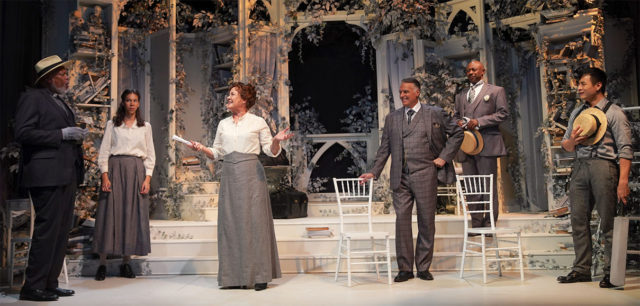
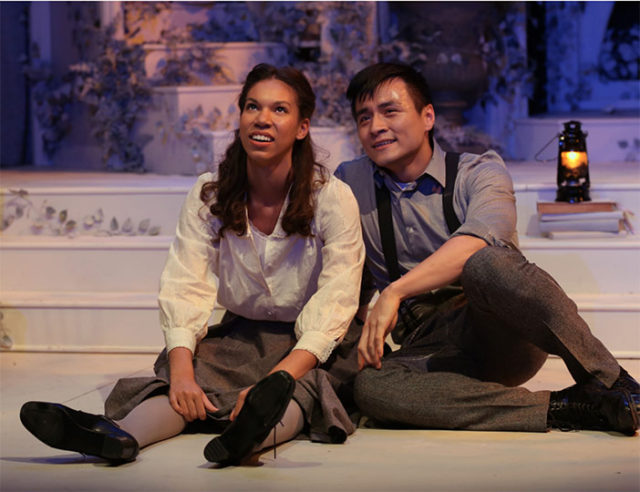
Why: Just because summer is officially over on September 22 doesn’t mean that there will be no more free Shakespeare. Boomerang Theatre Company, the troupe that has been bringing the Bard to city parks since 1999, is kicking off its fall season with a free, indoor, modern-day production of William Shakespeare’s popular farce, The Comedy of Errors. The show will have four performances September 24-26 in the elegant Ladies Tea Room at the Prince George Hotel, featuring Erika Amato as the Abbess, Emily Ann Banks as Angelo, Nicholas-Tyler Corbin in several roles, Amy Crossman as Dromio of Syracuse, Jessica Giannone as Dromio of Ephesus, Anthony F. Lalor as Antipholus of Ephesus, Roger Lipson as Balthazar, Anthony Michael Martinez as Antipholus of Syracuse, Lance C. Roberts as Egeon and Pinch, Shannon Stowe as the Courtesan, Yeena Sung as Adriana, Logan Thomason as Luciana, and Viet Vo as Duke Solinus.

The Comedy of Errors, which is at its heart about mistaken identity, reconciliation, and new possibilities, reminds us that comedy and escapism can be a way to cope with the challenges life presents us. At this moment of reopening, it is important to not only reflect on the last eighteen months but also celebrate coming together again,” director Scott Ebersold said in a statement. “So, that is exactly what the ensemble and I are doing: We’re getting all dressed up, and we’re throwing a party! We’re celebrating the return of live theater, the joy of artistic collaboration, and just how fun it is when things go terribly wrong!” Although advance tickets are sold out for what is Boomerang’s twentieth free Shakespeare production, there is a waiting list and walk-up possibilities. As Balthazar says in Act 3, Scene 1, “Small cheer and great welcome makes a merry feast.”

IN CONVERSATION WITH MERCE: LANDROVER

Jacquelin Harris and Chalvar Monteiro perform excerpts from Merce Cunningham’s Landrover in online celebration (photo by Maria Baranova)

Who: Jacquelin Harris and Chalvar Monteiro, Mariah Anton and Cemiyon Barber, Claude “CJ” Johnson and Donovan Reed, Patricia Lent, Kyle Abraham, Liz Gerring
What: Celebration of Merce Cunningham’s Landrover
Where: Baryshnikov Arts Center online
When: September 20-30, free
Why: In honor of the upcoming fiftieth anniversary of Merce Cunningham’s Landrover, which premiered at BAM on February 1, 1972, the Baryshnikov Arts Center is presenting the free online program “In Conversation with Merce,” available on demand through September 30 at 5:00. The work, described by Cunningham as “people moving in different landscapes. American perhaps in the sense that we move in our country — across varied spaces — with varied backgrounds,” featured an original score by John Cage, David Tudor, and Gordon Mumma, boasted costumes by Jasper Johns, and was performed by Carolyn Brown, Ulysses Dove, Douglas Dunn, Meg Harper, Nanette Hassall, Susana Hayman-Chaffey, Chris Komar, Sandra Neels, Chase Robinson, Valda Setterfield, and Cunningham.

Mariah Anton and Cemiyon Barber perform in Liz Gerring’s Dialogue as part of BAC’s Merce tribute (photo by Maria Baranova)

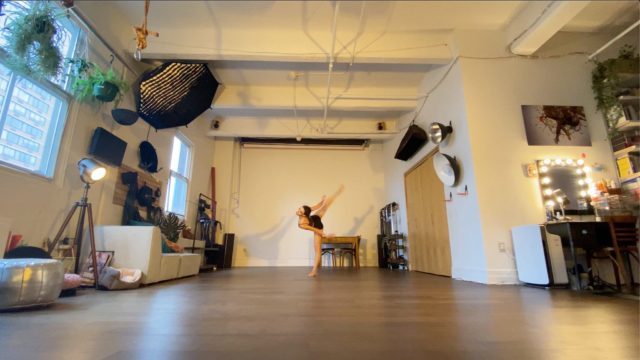
“This program is the latest realization of a concept we began experimenting with during Merce Cunningham’s centennial,” Merce Cunningham Trust trustee Patricia Lent says in an introduction. “At its core is the idea of exploring Merce’s work as a resource for generating new work by contemporary artists.” Beautifully filmed by Tatyana Tenenbaum at BAC’s John Cage & Merce Cunningham Studio, “In Conversation with Merce” starts with a thirteen-minute excerpt of Landrover, a series of solos performed by Alvin Ailey American Dance Theater members Chalvar Monteiro in green and Jacquelin Harris in brown, moving about the spare space dominated by large windows and a mirrored wall, as the music fades to silence. (The lovely costumes for all three pieces are by Reid Bartelme and Harriet Jung.)

That is followed by two specially commissioned works made in response to Landrover, each introduced by the choreographer, beginning with Liz Gerring’s nine-minute Dialogue, in which Mariah Anton in yellow and Cemiyon Barber in white display numerous geometric possibilities of the human body, set to minimalist music by Michael Schumacher. “In Conversation” concludes with Kyle Abraham’s fourteen-minute MotorRover, a slow, intimate duet performed by Claude “CJ” Johnson and Donovan Reed in loose-fitting two-color costumes, the only sound that of the air-conditioning. BAC has presented a bevy of terrific filmed programs during the pandemic, and this is yet another winner; coming up next are digital works by Mats Ek and Ana Laguna, River L. Ramirez, Sooraj Subramaniam, Jordan Demetrius Lloyd, Ella Rothschild, and Molly Lieber and Eleanor Smith.

NYFF59 MAIN SLATE: BAD LUCK BANGING OR LOONY PORN

Emi (Katia Pascariu) goes on a strange journey in Rade Jude’s Bad Luck Banging or Loony Porn

BAD LUCK BANGING OR LOONY PORN: A SKETCH FOR A POSSIBLE FILM (BABARDEALA CU BUCLUC SAU PORNO BALAMUC) (Radu Jude, 2021)
New York Film Festival, Lincoln Center
Saturday, September 25, Alice Tully Hall, with virtual Q&A, 9:00
Sunday, September 26, Francesca Beale Theater, 8:00
www.filmlinc.org

Radu Jude’s brilliantly absurdist Bad Luck Banging or Loony Porn lives up to its title, a wildly satiric takedown of social mores that redefines what is obscene. Winner of the Golden Bear for Best Film at the 2021 Berlinale, the multipart tale begins with an extremely graphic prologue, a XXX-rated homemade porn video with a woman and an unseen man holding nothing back. In the first main section, the woman, a successful teacher named Emi (Katia Pascariu), is distressed to learn that the video is threatening to go viral. She determinedly walks through the streets of Bucharest, buying flowers (which she holds upside down), discussing her dilemma with her boss, the headmistress (Claudia Ieremia), and calling her husband, Eugen, trying to get the video deleted before her meeting with angry parents at the prestigious private school where she teaches young children.

Jude and cinematographer Marius Panduru follow the masked Emi — the film was shot during the pandemic, so masks are everywhere — on her journey, the camera often lingering on the scene well after Emi has left the frame, focusing on advertising billboards, couples in the middle of conversations, people waiting for a bus, and other random actions, before finding Emi again. She sometimes fades into the background, barely seen through the windows of a passing vehicle or amid a crowd crossing at a light. She gets into an argument with a man who has parked on the sidewalk, blocking her way; she insists that he move the car, but he unleashes a stream of misogynistic curses. Swear words are prevalent throughout the film, mostly adding poignant humor.

The second segment consists of a montage of archival and new footage that details some of Romania’s recent history, involving the military, the government, religion, fascism, Nazi collaboration, patriotism, the two world wars, the 1989 revolution, Nicolae Ceaușescu, domestic violence, jokes about blondes, and the value of cinema itself. The bevy of images also points out which NSFW word is most commonly looked up in the dictionary, as well as which is second. (The film is splendidly edited by Cătălin Cristuțiu, with a fab soundtrack by Jura Ferina and Pavao Miholjević.)

It all comes together in the third section, in the school garden, where Emi faces a few dozen masked, socially distanced, very angry parents and grandparents who want her fired immediately, while the headmistress demands a calm discussion. The masked Emi is a stand-in for all of us, facing the wrath of the unruly mob forcing its sanctimonious platitudes on others when it really needs to look at itself. It’s a riotously funny sitcomlike debate in which Jude roasts many common, hypocritical beliefs held by Romanians (and people all over the world) that have not necessarily changed much from the news clips shown in the previous part.

The cartoonish cast, which includes Olimpia Mălai as Mrs. Lucia, Nicodim Ungureanu as Lt. Gheorghescu, Alexandru Potocean as Marius Buzdrugovici, and Andi Vasluianu as Mr. Otopeanu, really gets to strut its stuff while making sure their masks are properly covering their mouths and noses. They argue about beloved national poet Mihai Eminescu and Russian writer Isaac Babel, delve into various sexual positions, repeat Woody the Woodpecker’s trademark call, and quote long, intellectual passages from the internet as Jude (I Do Not Care If We Go Down in History as Barbarians, Aferim!) reveals where society’s true obscenities lie. It’s an irreverent tour de force that offers three distinct endings to put a capper on the strangely alluring affair, turning a scary mirror on the sorry state of twenty-first-century existence.

Playfully subtitled A Sketch for a Possible Film in a reference to André Malraux’s description of Eugène Delacroix’s belief that his sketches could be of the same quality as his paintings, Bad Luck Banging or Loony Porn is making its US premiere September 25 and 26 at the New York Film Festival; the first screening will be followed by a virtual Q&A. The film opens in theaters November 19.

SUN & SEA (MARINA)

Sun & Sea brings the beach to BAM in thrilling production (photo by Barbara Pollack)

SUN & SEA (MARINA)
BAM Fisher, Fishman Space
321 Ashland Pl.
September 15-26, $25
www.bam.org

The summer beach season might unofficially come to a close on Labor Day weekend, but BAM has extended it through September 26 with the US premiere of Sun & Sea, a wonderfully engaging indoor presentation that brings fun in the sun to Fort Greene. Winner of the Golden Lion at the 2019 Venice Biennale, the hour-long opera takes place on the 57×46-square-foot floor of BAM Fisher, where twenty-one tons of sand have been trucked in from South Jersey and spread out two inches deep. One hundred audience members at a time watch the show from the balcony that surrounds the stage on all four sides; you can walk around to see it from numerous angles as thirteen vocalists and about two dozen locals sing about the environment, bananas, colonialism, the threat of drowning, exhaustion, running out of water, tourism, littering, work, and vacation.

The unnamed characters do what people on the beach generally do: eat, drink, read books and magazines, apply suntan lotion, talk with one another, snooze, and catch rays. Kids play badminton, two men battle it out in a friendly game of ring toss, people check their cell phones, and a dog (Beans or Grimaldi) wanders about while certain characters break into song as the action continues around them. Wealthy Mommy (Kalliopi Petrou) confesses, “What a relief that the Great Barrier Reef has a restaurant and hotel!” Her husband, Workaholic (Vytautas Pastarnokas), surmises, “Suppressed negativity finds a way out unexpectedly.”

The Philosopher (Claudia Graziadei) asks, “Is this not a parody of the Silk Road?” Complaining Lady (Eglė Paškevičienė) declares, “What’s wrong with people?” And one of the young men from the Volcano Couple (Marco Cisco and Lucas Lopes Pereira) opines, “Not a single climatologist predicted a scenario like this / Maybe someone had a feeling.” Hope is embodied by Chanson of Admiration (Nabila Dandara Vieira Santos), who gently conveys, “O la vida.”

Among the others chiming in on income inequality, lava, shrimp, 3D printers, the extinction of the mammoth, and the end of the world are Bossanova Woman (Svetlana Bagdonaitė) and Bossanova Man (Jonas Statkevičius), Dreamer (Artūras Miknaitis), Siren (Ieva Skorubskaitė), 3D Sisters (Auksė Dovydėnaitė and Saulė Dovydėnaitė), and two Choir Singers (Aliona Alymova and Evaldas Alekna). The singing is all matter-of-fact, as if the characters’ thoughts are calmly emerging, one no more urgent than another, set to a shimmering score, mixed live by Salomėja Petronytė, that glistens like sunlight on the ocean. Each audience member is given a printout of the libretto; I got a kick out of peeking at who was next and guessing who the performer would be. (I batted about fifty percent.) Photos are allowed (but not video), and you can stay as long as you want, as the performance repeats for five hours.

Commissioned for the Lithuanian Pavilion at the fifty-eighth Venice Biennale and featuring an all-female creative team, the ingenious Sun & Sea is the second collaboration between director and set designer Rugilė Barzdžiukaitė, librettist Vaiva Grainytė, and composer and musical director Lina Lapelytė, the Lithuanian trio’s follow-up to its 2013 show, Have a Good Day!, in which ten cashiers took on capitalism and consumption. It’s a seamless production, like a day at the beach; you can imagine yourself on the sand with the cast, hearing snippets of conversations here, admiring bathing suits there, wishing the kids wouldn’t run across your blanket, and turning over to get an even tan.

But as relaxed as you might feel, there is a rising tide of fear at the future of the planet if we remain on our current path. As the Vacationers’ Chorus intones, “Today they have raised the red and yellow flag up high / The whirlpools of the sea, / drop-offs / riptides / undertows. / You’re not allowed / to wade in / deeper than your knees!” If we don’t start doing something about our environment fast, there’ll be no more beaches or oceans for safe wading at all.

WIFE OF A SPY

Yû Aoi and Issey Takahashi star as a couple caught up in intrigue and suspicion in Kiyoshi Kurosawa’s Wife of a Spy

WIFE OF A SPY (スパイの妻) (Kiyoshi Kurosawa, 2020)
IFC Center
323 Sixth Ave. at West Third St.
Opens Friday, September 17
212-924-7771
www.ifccenter.com

Japanese master filmmaker Kiyoshi Kurosawa follows up his gorgeous, haunting To the Ends of the Earth with the tense and gripping thriller Wife of a Spy, opening September 17 at IFC. Photographed in 8K — though screened in 2K — the striking film is set in Kobe, Japan, in 1940, where successful merchant Yusaku (Issey Takahashi) lives with his devoted wife, Satoko (Yû Aoi); the two have also just made an amateur movie together.

With Yusaku off on a business trip in Manchuria with his nephew, Fumio (Ryôta Bandô), Satoko is visited by her childhood friend, Taiji (Masahiro Higashide), who has just accepted a position as head of the military police in Kobe. He is suspicious of Yusaku and advises Satoko that it is not proper for her to wear modern clothing instead of kimono. After a long delay, Yusaku and Fumio return to Kobe with the mysterious Hiroko Kusakabe (Hyunri), but something clearly has changed. Satoko begins to think that her husband might be a spy and a traitor, so she must decide whether to stand by him while under the suspecting watch of Taiji. When she first confronts Yusaku, demanding that he tell her exactly what is going on, he responds, “Don’t ask. I beg you. I haven’t done anything shameful. I’m not made to lie to you, so I’ll be silent. Don’t ask, because I’ll have to answer.” Satoko soon makes her choice, but there are eloquent twists and turns galore as dangerous secrets unfold.

In Wife of a Spy, Kurosawa, who has made such well-regarded suspense films as Pulse and Cure as well as the moving Tokyo Sonata, evokes elements of such classics as Carol Reed’s The Third Man, Michael Curtiz’s Casablanca, Andrew Lau and Alan Mak’s Infernal Affairs trilogy, Masako Kobayashi’s ten-hour The Human Condition, and several Alfred Hitchcock standards — including Suspicion, Notorious, and North by Northwest — none of which makes it feel derivative but instead fits in with the use of film itself in the narrative. The deliberate pace is wholly effective, with a tight screenplay written by Kurosawa, who won the Silver Lion as Best Director at the Venice Film Festival, with Ryûsuke Hamaguchi and Tadashi Nohara, two of his students at Tokyo University of the Arts. Although the story is fictional, the information about what the Kwantung Army was doing in Manchuria is based on fact, something Japan tried to keep under wraps for many decades.

Aoi (Hula Girls, Birds without Names) and Takahashi (Kill Bill, Whispers of the Heart), who previously starred together in Yuki Tanada’s Romance Doll, are both terrific, slowly allowing their characters’ motives to come out as the cat-and-mouse game between Yusaku and Sakoto, Yusaku and Taiji, and Taiji and Sakoto continues. And it’s always a treat to see Takashi Sasano (Nobuhiko Ōbayashi’s Casting Blossoms to the Sky and Labyrinth of Cinema, Kurosawa’s Bright Future and Creepy), who makes a cameo as Doctor Nozaki. The period piece is beautifully filmed by Tatsunosuke Sasaki, successfully capturing the era, and highlighted by an unforgettable moment near the end involving Sakoto, part of what makes Wife of a Spy much more than just another WWII espionage drama.

IN BALANCHINE’S CLASSROOM

New documentary focuses on George Balanchine’s teaching methods (photo by Martha Swope)

IN BALANCHINE’S CLASSROOM (Connie Hochman, 2021)
Film Forum
209 West Houston St.
Opens Friday, September 17
212-727-8110
filmforum.org

This summer, dance fans have been treated to behind-the-scenes glimpses at the creative process of three legendary choreographers. First was Bill T. Jones in Rosalynde LeBlanc and Tom Hurwitz’s Can You Bring It: Bill T. Jones and D-Man in the Waters, followed by Alvin Ailey in Jamila Wignot’s Ailey. Now comes an exciting look at New York City Ballet cofounder George Balanchine in Connie Hochman’s In Balanchine’s Classroom, opening September 17 at Film Forum. Hochman, who trained at Balanchine’s School of American Ballet and danced with the Pennsylvania Ballet, has been working on the film since 2007, interviewing one hundred people who worked with Balanchine and gaining access to the archives of the George Balanchine Trust, incorporating rare, never-before-seen footage of Balanchine teaching his company in his unique style.

Several prominent former NYCB dancers share their experiences of the classes, in which Balanchine would focus on every minute aspect of movement, from the hands and the feet to the size of jumps. “He not only started a company; he changed the whole look of ballet,” says Gloria Govrin, artistic director of Eastern Connecticut Ballet. “It was more than just technique that he taught. It’s everything together that made the dancer,” Suki Schorer, senior faculty member of the School of American Ballet, explains. “The classroom was where he went to see how far he could make his dancers go,” Balanchine coach and stager Merrill Ashley notes. “He was our artistic father,” Edward Villella, founding artistic director of Miami City Ballet, says, pointing out how important it was for everyone to try to please him.

Hochman also speaks extensively with Balanchine-method coach and mentor Heather Watts and Jacques d’Amboise, the founder and president of National Dance Institute, who passed away in May at the age of eighty-six. (Sadly, twenty of Hochman’s subjects are no longer with us.) Photographs and film clips of all of the above show them dancing for the NYCB, interacting with Balanchine, and keeping his legacy alive by teaching such dancers as Tiler Peck, Stella Abrera, and Unity Phelan of NYCB, Calvin Royal III of ABT, and other professionals as well as young kids. “I think as teachers we have an obligation to share with the younger generation the way that he advocated, but it’s become the problem,” Ashley says. “We’re not Balanchine.”

There’s terrific, though grainy, black-and-white footage (and some later color) from such classic Balanchine ballets as Apollo, Prodigal Son, Serenade, Symphony in C, Orpheus, Agon, Jewels, and Stravinsky Violin Concerto while Hochman also explores Balanchine’s early years: He was born in St. Petersburg, Russia, in 1904, started dancing when he was nine, was hired as a choreographer by Serge Diaghilev for the Ballets Russes, was brought to American by Lincoln Kirstein, who cofounded the NYCB with Balanchine and helped fund the construction of the company’s home at the New York State Theater at Lincoln Center, and developed a fruitful working relationship with composer Igor Stravinsky. Balanchine is heard in numerous audio clips unearthed by Hochman. “I don’t accept the way it looks and it’s very difficult to discuss why,” he says. “I can’t say what inspires, if you use that high-class word, ‘inspiration.’ It’s your past, where you were born, what you’ve done in your life.”

All of the interview subjects agree that Balanchine could be extremely hard on his dancers, but he also gave them a freedom, appreciating them as individuals. They are also afraid of what might become of his ballets in the future, but Balanchine’s legacy seems safe in their capable hands. Film Forum will host three in-person Q&As opening weekend, with Hochman and Ashley on September 17 at 6:30 and September 19 at 5:20 and with Hochman and Villella on September 18 at 6:30. The 2021–22 NYCB season opens September 21 and will include Balanchine’s Serenade, Symphony in C, Western Symphony, Agon, La Valse, and The Nutcracker.