LUNGS HARVEST ARTS FESTIVAL
Multiple locations
Daily through October 3, free
“The Great Aria Throwdown #2 — LES Edition”
Campos Community Garden, 640-644 East Twelfth St. at Ave. C
Friday, October 1, 6:30 www.lungsnyc.org
In 2011, community gardens in Loisaida, the Lower East Side, and the East Village came together and formed LUNGS, the Loisaida United Neighborhood Gardens; its mission is “to promote, protect, and preserve gardening and greening through cooperation, coordination, and communication.” The group is now hosting its tenth annual LUNGS Harvest Arts Festival, which runs through October 3 with free music and dance, knitting, activism, art exhibits, yoga, a dominos tournament, interactive workshops, classes, a treasure hunt, and more, in such locations as Green Oasis, Carmen’s Garden, LaGuardia Corner Gardens, Orchard Alley Community Garden, Creative Little Garden, La Plaza Cultural de Armando Perez, 6BC Botanical Garden, and other lovely oases.
One of the highlights is “The Great Aria Throwdown #2 — LES Edition,” taking place October 1 at 6:30 in Campos Community Garden on Twelfth St. & Ave. C. Presented by dell’Arte Opera Ensemble (dAOE), the evening features sopranos Bahati Barton and Diana Charlop, mezzo-soprano Perri di Christina, countertenor Jeffrey Mandelbaum, and pianist Pablo Zinger performing works by Bellini, Donizetti, Mozart, Purcell, and others.
“Dell’Arte Opera Ensemble is a bridge for emerging opera singers to work with accomplished professionals in the field,” dAOE executive director Marianna Mott Newirth explains. “‘The Great Aria Throwdown’ is a fun and free event that gives ‘stage’ to three sopranos and an outstanding countertenor singing with widely acclaimed pianist Pablo Zinger, producing a growing garden of sound on East Twelfth St. From Bellini to Monteverdi, we’re bringing opera to the LES! Campos Garden even has a chandelier they plan to raise just as the show begins — a nod to the new season starting at the Met after a year of darkness.” Below is the full program.
Diana Charlop: “Quel guardo il cavaliere” from Don Pasquale (Bellini)
Perri di Christina: “Deh, non voler costringere” from Anna Bolena (Donizetti)
Bahati Barton: “Ruhe Sanft” from Zaide (Mozart)
Jeffrey Mandelbaum: “If Music Be the Food of Love” (Purcell, Third Version)
Diana Charlop: “Padre germani addio” from Idomeneo (Mozart)
Perri di Christina: “Voi che sapete” from Le nozze di Figaro (Mozart)
Jeffrey Mandelbaum: “Sprezzami quanto sai” from L’incoronazione di Poppea (Monteverdi)
Perri di Christina: “Faites-lui mes aveux” from Faust (Gounod)
Bahati Barton: “Think of Me” from The Phantom of the Opera (Lloyd Webber)
Diana Charlop: “Obéissons quand leur voix appelle” from Manon (Massenet)
Jeffrey Mandelbaum: “Fra tempeste” from Rodelinda (Handel)
“Wong Ping: Your Silent Neighbor” continues at the New Museum through October 3 (photo by Dario Lasagni)
WONG PING: YOUR SILENT NEIGHBOR
New Museum of Contemporary Art
235 Bowery at Prince St.
Tuesday – Sunday through October 3, $12-$18 www.newmuseum.org
WONG PING: THE GREAT TANTALIZER
Tanya Bonakdar Gallery
521 West 21st St. between Tenth & Eleventh Aves.
Tuesday – Saturday through October 23, free, 10:00 am – 6:00 pm www.tanyabonakdargallery.com
Multimedia artist Wong Ping’s current shows at the New Museum in SoHo and Tanya Bonakdar in Chelsea are filled with lovable animated pandas, colorful cartoons, a retelling of Pinocchio, and playful sculpture and installation. But you might want to think twice before bringing the kids, as Wong’s work tackles income inequality, sexual repression and expression, police corruption, dating and desire, climate change, and sociopolitical aspects of contemporary life, particularly in his native Hong Kong as its battles with Mainland China since the 1997 handover from the British grow ever-more dangerous, all told in a DIY style inspired by video games and narrated by Wong himself.
At the New Museum, An Emo Nose (2015) reimagines Pinocchio’s proboscis, resembling both a heart and a penis, as its own sentient being, reacting to the protagonist’s negative thoughts by stretching out and going off on its own, depicting humanity’s vulnerability of both mind and body. In the two-channel The Other Side (2015), projected onto a screen and a small television monitor in front of it, the narrator journeys across treacherous terrain, has soup with Granny Meng (forgetfulness goddess Meng Po), and ponders his future, a parable of emigration from Hong Kong filtered through the Beatles’ Yellow Submarine. A 3-D printed text panel relates self-affirmations in tiny letters, including “I am the last drop of period blood before menopause” and “I am the last rebellious punk.”
The retrospective is centered by four videos projected onto four screens on all sides of one large room; visitors sit on comfy beanbag chairs or a round couch as they rotate to watch the short films, which total forty-three minutes. In Jungle of Desire (2015), an impotent man is powerless when his wife becomes a prostitute to satisfy her sexual desire and is exploited by a cop. In Who’s the Daddy? (2017), a man considers himself an outcast because his penis is straight, not bending to the left or right, and confuses politics and sex as things go wrong with a woman he hooked up with on a dating app. “People even deny its existence,” he opines about his member.
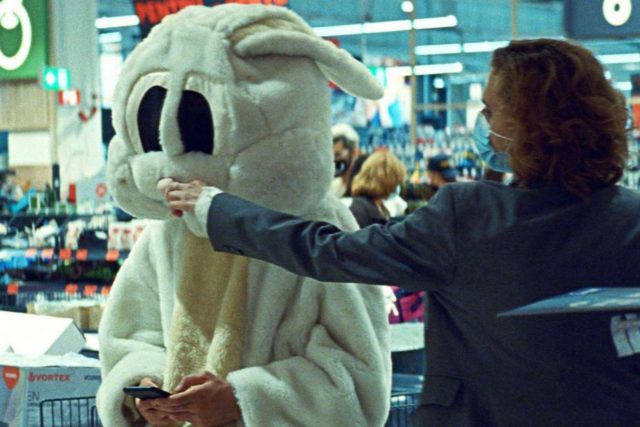
Wong Ping’s Fables 2 (2019) follows the trials and tribulations of a special cow and three conjoined rabbit siblings attempting to make their own way in life. And in Sorry for the Late Reply (2021), commissioned for this show, a fisherman becomes obsessed with an elderly saleswoman’s varicose veins. “If you’ve ever stepped into the supernatural world during a hike, or have gotten lost in the parking lot and couldn’t find the exit, or have stared into the eyes of a black chicken standing outside your door through the peephole late at night, then you would know how I feel,” he says.
Wong Ping is a curator researching the Great Tantalizer in show at Tanya Bonakdar
Over at Tanya Bonakdar, Wong’s “The Great Tantalizer” is a multimedia installation structured around a mockumentary about a scientist who had been determined to increase sexual desire in pandas and bring that information on their mating techniques to humans, particularly in China, given its former one-child policy and overall preference for boys. The relentless drive to tantalize may be commenting as well on the current tangping movement, or “lying flat,” in which many younger Chinese have opted out of the pressures of modern life by declining to engage in the endless competition for personal and professional success, a high-quality education, a good job, a happy marriage, a beautiful home, and lovely children.
The gallery has been reimagined as the Great Tantalizer’s abandoned laboratory, with a stack of white plastic chairs and a labcoat, an exhibition poster and bamboo pole that declare, “EAT.SLEEP.POOOOOP.DIE,” and The Tender Rider, a cute old kiddie vehicle with a panda head that now serves as a projector, beaming highly sexualized images onto the walls in a back room. It’s all organized around a screen showing a Zoom-like panel discussion featuring Wong in a panda outfit, hosting the virtual talk with the GT’s former laboratory staff, one-night stand, and main competitor, whose identities are disguised. Visitors can sit on rolls of bound bamboo sticks as Wong explores who the GT was and what his legacy is.
The thirty-seven-year-old Wong is quickly building up an impressive legacy of his own with these presentations at the New Museum and Tanya Bonakdar, expanding his breadth with his distinctive approach to exposing society’s ills.
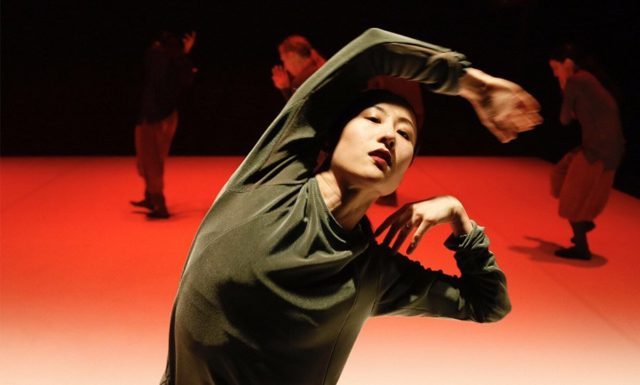
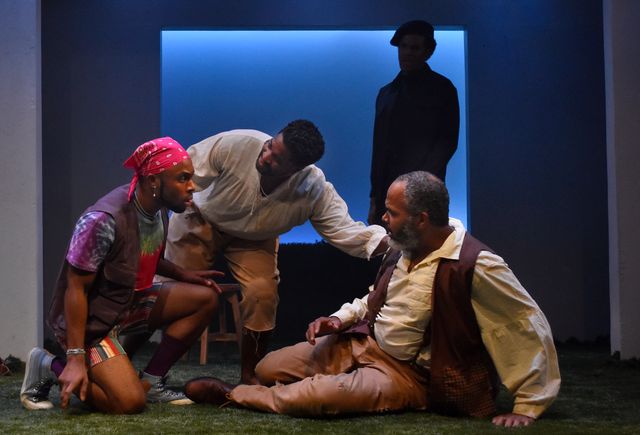
Aya Ogawa portrays their son and father in new play at Japan Society (photo by Maria Baranova)
THE NOSEBLEED
Japan Society
333 East 47th St. at First Ave.
October 1-3 & 7-10, $30
212-715-1258 www.japansociety.org ayaogawa.com
“The Nosebleed chronicles my journey of confronting what I think is one of the biggest failures of my life, which is that when my father died almost fifteen years ago, I failed to do anything to honor him or his life because of the nature of our relationship,” Japanese American playwright-director Aya Ogawa says in a promotional video for their latest work, the final version of The Nosebleed, running October 1-3 and 7-10 at Japan Society. The absurdist, comic show, previously known as Failure Sandwich and in which four actors play Ogawa while Ogawa portrays their own son and father, serves as a healing ritual for Ogawa and the audience, especially as the coronavirus crisis continues and nearly everyone has experienced some kind of loss.
Over the summer, the Tokyo-born, Brooklyn-based Ogawa, a 2021 Barbara Whitman Award finalist, mounted an online version of Ludic Proxy, an interactive virtual play that takes place in the past (Pripyat, post-Chernobyl), the present (Fukushima, post-disaster), and the future (New York, underground), inspired by the death of their mother. Ogawa previously adapted the text for Alec Duffy’s Our Planet, an immersive production that led a small audience through the historic Japan Society building; they have also directed Haruna Lee’s Obie-winning Suicide Forest at the Bushwick Starr and A.R.T./New York Theatres (where its run was cut short by the March 2020 lockdown) and have written and directed Oph3lia at HERE, Journey to the Ocean at the Rubin Museum, Artifact at the Performance MIX Festival, and A Girl of 16 at Clemente Soto Velez’s Latea Theater.
Copresented with the Chocolate Factory,The Nosebleed is performed by Ogawa, Lee, Drae Campbell, Peter Lettre, Aya Saori Tsukada, and Kaili Turner. I have seen Ogawa at numerous events at Japan Society, where they used to work in the Performing Arts department, but now they are returning as the center of attention. “To be able to come back there, as an artist, and to be so welcomed by former colleagues, is a huge blessing,” they explained. Opening night will be followed by a reception with the artists.
Taking a break from rehearsals, Ogawa discussed motherhood, family relationships, the immigrant experience, theater during the pandemic, and more with twi-ny.
twi-ny: The Nosebleed deals with your complex relationship with your father; Ludic Proxy was partly inspired by the loss of your mother. In researching and writing each work, did your thoughts about your parents, and your relationship with them, change?
aya ogawa: Ludic Proxy was an exploration of my own grieving process — an exercise in imagining how to find the strength to continue living after the death of my mother — had I not had children of my own. It was less about my actual relationship with her, so I would say in that case, my relationship with her did not change.
The Nosebleed, however, is explicitly about my father and my relationship with him — my perceptions and memories of him (which are subjective and flawed). The process of writing the play forced me to recall and examine a lot of things I had not thought of for many years, and this revisiting and especially the embodying of his character has definitely changed my feelings toward him.
twi-ny: How has The Nosebleed developed from earlier iterations at BAX and the Public?
ao: The script is not that different from when it was presented at the Public. (I wrote in a new character after my showing at BAX). However, the staging for each presentation has been unique and tailored to each space. I’ve been blessed to retain most of the original cast. I’ve had to replace one actor (who is now in grad school abroad), and I feel blessed again to have found someone who is not only a stellar performer but a collaborator who is able to bring her whole self and lived experience into the rehearsal room.
twi-ny: What was the rehearsal room like?
ao: We have very strict COVID safety protocols in place, which I discussed with the company before we began this process. I’d heard nightmares about other shows shutting down or having to replace actors, etc. I can’t afford to replace actors, or stop a rehearsal process and pick it up again at another time, so I had to plan for the most conservative measures to keep us all safe. Everyone on my team is fully vaccinated, rehearse masked, take PCR tests every week, and have rapid home tests available if anyone is feeling under the weather.
Despite all of these measures, or perhaps because of the assurance and safety they provided, the process has been joyful and very productive. The piece was originally conceived as an immersive performance, but we have decided to prioritize safety and put the audience in the house.
twi-ny: In the show, you play your son and your father, linking three generations. What is that experience like every night onstage?
ao: This is the first time I have ever appeared in my own play. It was never something I craved doing; in fact, the thought is kind of embarrassing. I decided to appear in the play as my father because the piece demanded it. The crux of this piece, and for it to work as it was intended — as something transformative and healing — I had no choice but to take responsibility for it and play the part. The experience of playing my son and my father is cathartic and exhausting.
One thing that really came to the forefront when creating an autobiographical play was just how violent the act of embodying a character can be. It takes a great deal of responsibility and trust to hand over the portrayal of my life to other people, and trust is needed in both directions.
twi-ny: For your work in progress Meat Suit, you describe motherhood as a “shit show.” You have two children; what was the pandemic lockdown like for you and your family?
ao: At first, it was kind of wonderful. Suddenly we had so much time together, so much unstructured time. There was no panic to make lunches or rush to get them to school on time, etc. We spent time gardening, cleaning the house, cooking. But then, of course, we figured out how to function in the lockdown. School happened on Zoom, as did a lot of my work. I was grateful to have work, and it was a fruitful time, in many ways, to be forced to develop work with great limitations, but it was also exhausting. Pandemic parenting continues right now — and remains pretty trying.
twi-ny: Do you still have family in Tokyo? If so, how often do you generally go back, and have you been able to do so recently?
ao: I am the only person in my immediate blood family living in the U.S. All of my relatives and family are in Japan. Since having kids, I have made it a point to visit every summer. We have not been able to visit since 2019 and it’s really painful.
twi-ny: This past March, you reimagined Ludic Proxy as an interactive online production. What are your thoughts about streaming theater? Do you see it as just a stopgap, or do you anticipate creating more online work in the future?
ao: The second act of Ludic Proxy was conceived with video game mechanics embedded into the script, so it was clear to me that it could very naturally translate to the screen as long as we could retain the audience interactivity. I actually don’t think the pandemic is going to ever “go away,” so it is important for theater-makers to think about how our medium is being transformed. As soon as The Nosebleed closes, I’m going into a video shoot for a puppet play that was originally conceived as a live, in-person puppet show but is now a performance film made for camera.
twi-ny: One of your themes throughout your career has been immigration and cultural identity. How has that changed for Japanese Americans since your first works, going back twenty years?
ao: The experience of the immigrant is not a static, monolithic story. It is varied and complex and ever-changing — so I can only speak for myself, not the larger Japanese-American population. I happen to be positioned in a particular place where I feel like I have access to multiple lenses — I am an immigrant myself but pass as a child of an immigrant. I have Japanese-Taiwanese-American children who I’ve made sure have access to their Japanese culture, but I’m also torn between wanting them to have their own experiences and interactions with the culture and sharing my experience of leaving Japan, a deeply sexist culture. Japan can be rich and beautiful. It can also be toxic and suffocating. So can America.
Who:Stevie Van Zandt, Bruce Springsteen, Jay Cocks, Joel Selvin, Chris Columbus, Budd Mishkin What: Interviews with Stevie Van Zandt in conjunction with the launch of his new memoir, Unrequited Infatuations (Hachette, $31) Where: Multiple sites online and in person When: September 28 – October 3, $5-$100 Why: “Silence. He was under a blanket in the back of the car on the floor in the crazy spooky silence. Nobody spoke. No radio. Just the lazy hum of the motor, and him alone with his thoughts. And ooh daddio, that was not his favorite thing. His two coconspirators were sneaking him past the military blockade into the black township of Soweto. The ‘native unrest,’ as the government liked to call it, erupted every few years, but lately it had become more frequent, and now, constant.” So begins Stevie Van Zandt’s new memoir, Unrequited Infatuations: Odyssey of a Rock and Roll Consigliere (A Cautionary Tale), as he writes in the third person about his secret trip into South Africa in 1984. “How the fuck did a half-a-hippie guitar player get here? For seven glorious years, Bruce Springsteen and the E Street Band were Rock and Roll’s Rat Pack, and he happily and naturally played the Dean Martin role. If you were even thinking of throwing a party, you called him. That was the extent of his politics. He was the fun guy. The court jester. Always good for a laugh. Sex, booze, drugs, Rock and Roll, and . . . more sex. Yo bartender, another round for the house! A whole lot had to go sideways to find him under that blanket. . . . He chose to take the adventure instead of the money. What a putz.” Among the chapters in the book are “Epiphany,” “The Boss of All Bosses,” “The Punk Meets the Godfather,” “Freedom — No Compromise,” “Seven Years in the Desert,” and “Summer of Sorcery.”
Alternately known as Miami Steve, Little Steven, and Stevie for the last fifty years, Van Zandt is now detailing his unique life and career in the book, which launches this week with a series of in-person and online events. The memoir takes readers from the Jersey Shore to Sun City, from South Africa and Hollywood to Norway and the Super Bowl. A longtime member of the E Street Band and a ferocious political activist, Van Zandt also starred as Silvio Dante in The Sopranos — a role he helped create after HBO said no to him as Tony — wrote and produced songs for Southside Johnny and the Asbury Jukes, has been hosting the nationally syndicated radio show Little Steven’s Underground Garage since 2002, started Wicked Cool Records, played the lead in the Norwegian crime drama Lilyhammer, founded the nonprofit TeachRock to promote music education in schools, records and tours with his own band, Little Steven and the Disciples of Soul, and is the founder of Renegade Nation, the umbrella company for many of his wide-ranging pursuits. I’ve had the privilege of meeting him several times over the years, interviewing him, and seeing him play live with the E Street Band and with the Disciples going back to the 1970s and ’80s, and he has never failed to impress as a performer and a straight-shooting human being.
There are five programs being held in conjunction with the publication of Unrequited Infatuations, pairing him with film critic and screenwriter Jay Cocks, music critic and author Joel Selvin, director and screenwriter Chris Columbus, broadcast journalist Budd Mishkin — oh, and Stevie’s boss and best friend, Bruce Springsteen. Below is the full schedule; take note of which events come with a copy of the book, in some cases pre-signed as well.
Tuesday, September 28
Stevie in conversation with Bruce Springsteen, $35 with unsigned book, $45 with signed book, 8:00
Wednesday, September 29
Stevie in conversation with Jay Cocks, online and at the 92nd St. Y, $20 online, $35 in person with book, 7:30
Thursday, September 30
Stevie in conversation with Joel Selvin, Commonwealth Club online, $5 general admission, $35 with book, 8:00
Friday, October 1
Stevie in conversation with Chris Columbus, Book Soup at the Colburn Music School, $40 with book, 7:00
Sunday, October 3
Stevie in conversation with Budd Mishkin, Montclair Literary Festival, $40 with signed book, $100 with signed book and VIP seating, 5:00
Bill Morrison explores Russian and Soviet cinematic history from a unique angle in The Village Detective
THE VILLAGE DETECTIVE: a song cycle (Bill Morrison, 2021)
IFC Center
323 Sixth Ave. at West Third St.
September 22-30
212-924-777 www.ifccenter.com
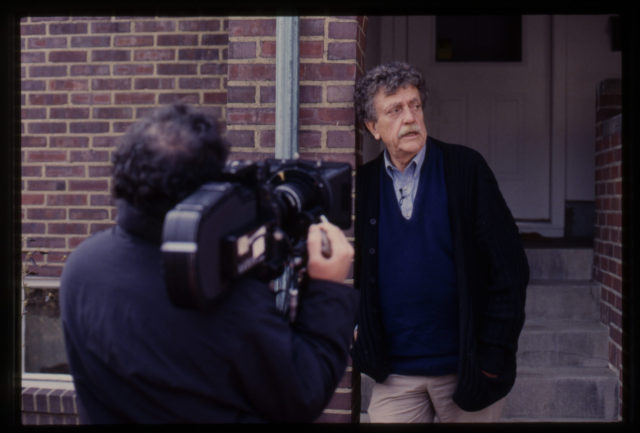
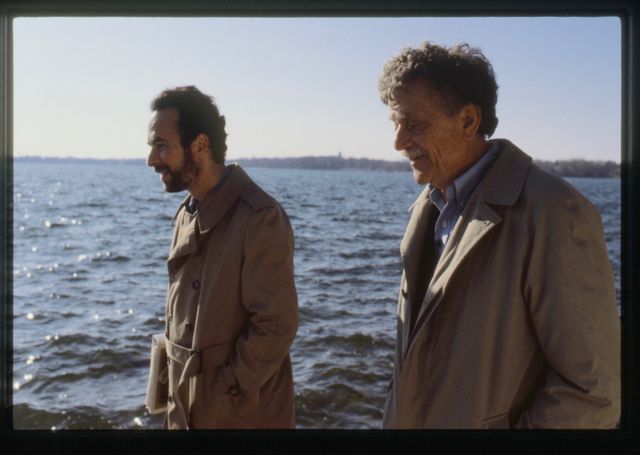
In the 1970 documentary Zharov Tells, longtime Russian film favorite Mikhail Zharov says, “Remembering my life, I am trying to follow, to find for myself, and for others too, especially the young, the answer to the question of how life gets woven into art and how art reflects life.” When it comes to cinema, Chicago-born, New York City–based filmmaker Bill Morrison has been excavating this connection for more than thirty years, in such masterworks as Dawson City: Frozen Time and Decasia.
Morrison uses found footage, often in terrible shape, the celluloid practically disintegrating in his hands and before our eyes onscreen, to examine sociocultural issues and film history itself. So when his friend Jóhann Jóhannsson, the Icelandic musician and composer who passed away in 2018 at the age of forty-eight, emailed him in July 2016 about a lobster trawl that had scraped up a film canister, Morrison jumped at the opportunity to explore its contents. Fishing in Faxaflói, about twenty nautical miles southwest of the Snæfellsjökull glacier, near the Mid-Atlantic Ridge where the North American and Eurasian plates meet — what Morrison calls in the film “the deep divide between East and West” — the lobster boat Fróði had scooped up four reels containing an incomplete copy of Ivan Lukinsky’s 1969 Soviet crime comedy Derevenskiy Detektiv (Village Detective), starring Zharov as local rural policeman Fyodor Ivanovich Aniskin, who is investigating the theft of an accordion.
While there is nothing special about the movie, which is not some long-lost treasure but just a mediocre-at-best tale that led to two sequels, Morrison decided to become a kind of detective himself, doing a deep dive into Zharov’s oeuvre, producing a unique look at twentieth-century Soviet and Russian history as seen through its cinema. And he centers his film on the found reels of Derevenskiy Detektiv, with all their glips, blotches, dirt, and grime instead of using a cleaner print (which is available), adding an extra layer of commentary on the changes occurring from multiple revolutions, two world wars, and the transition from tsars to Vladimir Lenin and Joseph Stalin.
Serving as producer, director, and editor, Morrison includes numerous clips of Zharov, who was born in 1899 and died in 1981, having appeared in more than five dozen films and a hundred theatrical productions, beginning with his debut as a soldier in 1915’s Tsar Ivan the Terrible and including 1931’s Road to Life, in which Zharov, as a thief named Zhigan, became the first actor to sing in Russian on camera. Morrison concentrates on the clips themselves; there are only a few moments of commentary, from Erlendur Sveinsson, the former director of the National Film Archive of Iceland who supervised the preservation of the discovered reels, and George Eastman Museum curator Peter Bagrov, who compares Zharov’s popularity to that of Humphrey Bogart or Clark Gable in Hollywood.
“Once you were a prince. Now you are a nobody,” Zharov says as Menshikov to the title character in 1937’s Peter the First. “I am not Soviet,” he declares as Dymba in 1939’s New Horizons. He displays his loyalty to Comrade Stalin as Perchikhin in 1942’s Fortress on the Volga. He plays a former soldier for the tsar who is now a Bolshevik in 1942’s He Will Come Back. The next year, in In the Name of the Fatherland, he proclaims as Globa, “I hate these Bolsheviks. I hate them more than I hate you!” And in Sergei Eisenstein’s 1958 Ivan the Terrible Pt. 2., Zharov states as guard Malyuta Skuratov, “I would give my soul for the tsar.”
The soundtrack, composed by Pulitzer and Grammy winner and Oscar nominee David Lang, also takes us back to old Russia with a sly nod to the plot of Derevenskiy Detektiv; the compelling score was written for one accordion and is played by Norwegian musician Frode Andersen, with vocals by Shara Nova. Not only is the accordion a traditional Eastern European folk instrument but it was used by Tchaikovsky, Sterligov, and others in their orchestrations. The final seconds of the film bring it all together beautifully.
“You know, when I heard about the reels being found, I was expecting a lost silent masterpiece and not a film which we have in our collection on camera negative from which it’s been shown on television from month to month,” Bagrov recounts. Lukinsky’s Derevenskiy Detektiv might not be a masterpiece of any kind, but Morrison’s (The Miners’ Hymns,The Great Flood) The Village Detective is another masterful triumph from one of America’s most ingenious filmmakers.
Boston-based activist opera company White Snake Projects concludes its inspiring, barrier-breaking livestreamed opera trilogy with A Survivor’s Odyssey: The Journey of Penelope and Circe, which opened on September 24 and has two more presentations, on September 26 and 28 at 7:30. In October 2020, WSP debuted Alice in the Pandemic, which took place in a video-game-like world as Alice searches for her mother while a hospital fills up with Covid-19 patients. In May 2021, WSP premiered Death by Life: A Digital Opera in One Act, following the stories of several incarcerated individuals facing racism and injustice, with music by five Black composers and accompanied by an online art exhibition.
WSP reinterprets Greek mythology and Homer’s Odyssey in A Survivor’s Odyssey: The Journey of Penelope and Circe, reimagining Odysseus’s (James Demler) long-suffering wife, Penelope (Amanda Crider), and the witch-goddess Circe (Teresa Castillo) as survivors of sexual and physical abuse. The show begins with the two women, along with two men, Mark and Jan (Patrick Dailey and James Demler), in an online therapy group helping one another. “Is he still hurting you?” Circe asks Penelope, who replies, “It’s hard being locked down with him.”
Penelope has been weaving and unraveling a shroud to turn away suitors as she waits for her husband to return to her after twenty years away fighting the Trojan War; she is also hoping for her son, Telemachus (Dailey), to come home, having been banished by his father, who believes a prophecy that says he will be killed by his male child. Meanwhile, Circe is terrified of telling her sixteen-year-old boy, Telegonus (Dailey), her “dirty little secret” about his birth. When Odysseus ultimately returns, battle lines are drawn and blood flows.
White Snake Projects incorporates magic and cutting-edge technology in livestreamed opera
Made with the support of the Boston Area Rape Crisis Center, Casa Myrna, Asian Task Force Against Domestic Violence, the Network/La Red, a Call to Men, a Window Between Worlds, and Jane Doe Inc., A Survivor’s Odyssey is a riveting tale reinvented for the twenty-first century and particularly during the coronavirus crisis, responding to the rise in intimate partner violence (IPV) that has been occurring around the globe during the pandemic lockdown. “I’ve been thinking about why IPV is endemic in the world. I keep coming back to the male gaze, the power of the patriarchy to shape every country’s and every culture’s perceptions of who and what women are,” librettist and WSP founder Cerise Lim Jacobs writes in a program note. “Women, myself included, have been imprisoned by the male gaze. Our aspirations, hopes, and dreams have been limited by this gaze; our fears, insecurities, and nightmares magnified by this gaze. The male gaze has defined our world’s ideas, imaginations, cultures, and subconscious dreams of womanhood. . . . This has to stop.” The women characters ultimately take back the power in A Survivor’s Odyssey, refusing to allow the patriarchy to run roughshod over them anymore. Composer Mary Prescott’s lovely score was inspired by the idea of weaving, long considered women’s work, to create a tapestry of sounds, linking the past and the present and denouncing misogyny.
Despite their far-flung locations, soprano Castillo (in New York City), countertenor Dailey (in Nashville), mezzo-soprano Crider (in Miami), and bass-baritone Demler (outside Boston) pull off the near-impossible, appearing to be performing together in front of such backdrops as Helios’s lush garden, Circe’s mountain home on Aeaea, and the courtyard of Odysseus and Penelope’s grand estate in Ancient Greece when actually in front of green screens in their bedrooms and basements. Elena Araoz, who has never met her cast in person, directs the piece virtually, with music direction by Tian Hui Ng featuring the Victory Players, with Nathan Ben-Yehuda on piano, Clare Monfredo on cello, Giovanni Perez on flute, and Elly Toyoda on violin and viola. The costumes are by Christopher Vergara, with playful 3D animation of the pigs by Lesley University senior Paola Almonte. An online exhibition also accompanies this production, “To Live: Transcending Trauma Through Art,” with works by Carole Alden, Taecia Prows, Cedar Annenkovna, Zhi Kai Vanderford, Ruby Rumié, Annie Chang, Catriona Baker, and Tashi Farmilo-Marouf.
The performers have earpieces in which they can hear a recording of the others singing; the live vocals are sent to electronic music designer and audio engineer Jon Robertson (in Kansas City) and the video to projections designer and broadcast engineer Paul Deziel (in New York), who mix the sound and images using the Unreal Engine video game platform by Curvin Huber and their proprietary audio plugin Tutti Remote to instantaneously sync it all. It’s a massive undertaking, and there were a few glitches and delays, but don’t go anywhere if that happens; the live chat fills the gaps and offers more information about the cast, crew, and technology. After the show’s over, stick around for a live discussion and Q&A that answers just about every question you can think of.
One of the main themes of A Survivor’s Odyssey is the lost connection that the pandemic has wrought, between friends, family members, and performers and audience. At one point during a Zoom therapy meeting, the participants reach out their hands, proclaiming, “I touch you, I hold you, I feel you.” In its remarkable trilogy of live online opera, WPS reaches out to us, immersing us in their spectacularly creative storytelling, and we feel them.
Apichatpong Weerasethakul will discuss his new film, Memoria,) at NYFF59 free talk
NYFF59 FREE TALKS
Film at Lincoln Center
Elinor Bunin Munroe Film Center Amphitheater
144 West Sixty-Fifth Street between Broadway & Amsterdam Ave.
September 25 – October 9, free (first come, first serve one hour before program) www.filmlinc.org
The New York Film Festival, which opens today, has just announced its slate of free talks, taking place September 25 to October 9 at the Elinor Bunin Munroe Film Center Amphitheater (with one exception). Admission is first come, first served starting an hour before each event; the talks will also be recorded for later on-demand viewing on YouTube. The highlight is the inaugural Amos Vogel Lecture, honoring the centennial of the birth of the cofounder of the festival, who is also the subject of a centenary retrospective. The lecture will be given by Albert Serra, the director of previous NYFF selections The Death of Louis XIV and Liberté and who wrote the foreword for the French edition of Vogel’s seminal book, Film as a Subversive Art.
The rest of the panel discussions, in-depth conversations, and filmmaker dialogues are divided into “Deep Focus,” “Crosscuts,” and “Film Comment Live,” with such participants as Jane Campion (The Power of the Dog), Sofia Coppola, Mia Hansen-Løve (Bergman Island), Joachim Trier (The Worst Person in the World), Todd Haynes (The Velvet Underground), Apichatpong Weerasethakul (Memoria,Night Colonies), Ryûsuke Hamaguchi (Drive My Car,Wheel of Fortune and Fantasy), and Amy Taubin. The discussion about the thirtieth anniversary of Mississippi Masala with director Mira Nair, star Sarita Choudhury, and cinematographer Ed Lachman, moderated by Jhumpa Lahiri, follows the free screening of the film in Damrosch Park, for ticket holders only. Below is the full schedule.
Jane Campion will delve into her NYFF59 centerpiece selection, The Power of the Dog, with Sofia Coppola
Saturday, September 25
Deep Focus: The Making of Mississippi Masala, with Mira Nair, Sarita Choudhury, and Ed Lachman, moderated by Jhumpa Lahiri, Damrosch Park, 9:30
Sunday, September 26
Roundtable: Cinema’s Workers, with Abby Sun, Ted Fendt, Kazembe Balagun, and Dana Kopel, moderated by Gina Telaroli, Amphitheater, 7:00
Monday, September 27
Crosscuts: Mia Hansen-Løve & Joachim Trier, Amphitheater, 7:00
Saturday, October 2
Deep Focus: Jane Campion, moderated by Sofia Coppola, Amphitheater, 4:00
Sunday, October 3
Film Comment Live: The Velvet Underground & the New York Avant-Garde, with Todd Haynes, Ed Lachman, and Amy Taubin, Amphitheater, 4:00
Deep Focus: Ryûsuke Hamaguchi, Amphitheater, 7:00
Tuesday, October 5
Deep Focus: Maggie Gyllenhaal & Kira Kovalenko, Amphitheater, 7:00
Thursday, October 7
Deep Focus: Apichatpong Weerasethakul, Amphitheater, 6:30
Saturday, October 9
Film Comment Live: Festival Report, with Devika Girish, Clinton Krute, Molly Haskell, Bilge Ebiri, and Phoebe Chen, Amphitheater, 7:00