featured

IN THE SOUTHERN BREEZE

Four Black men from different times meet in unusual circumstances in Mansa Ra’s In the Southern Breeze

IN THE SOUTHERN BREEZE
Rattlestick Playwrights Theater
224 Waverly Pl.
Wednesday – Monday through December 12, $40 in person or livestreamed
www.rattlestick.org

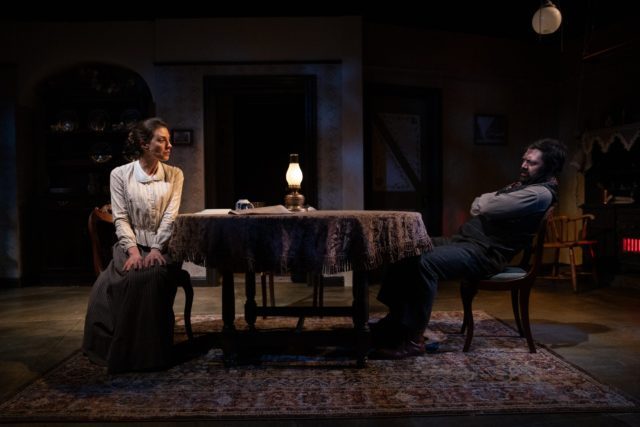
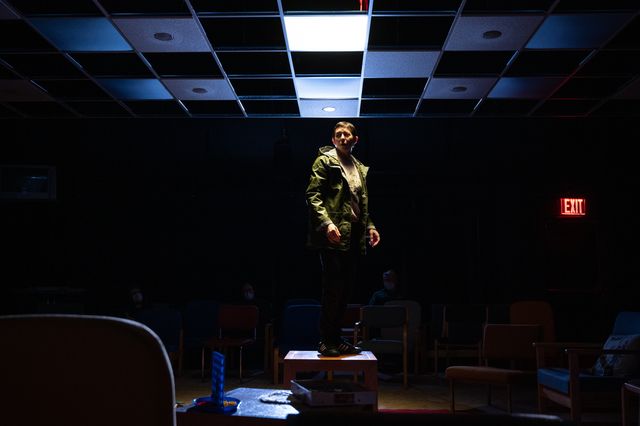
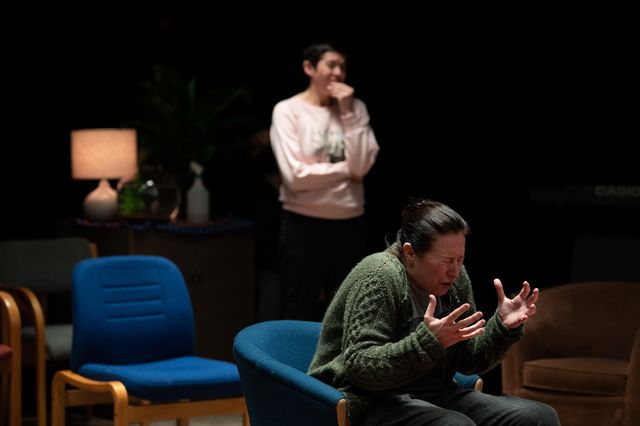
The central section of Mansa Ra’s In the Southern Breeze, which opened last night at Rattlestick, is a compelling fever dream in which four Black men from different time periods meet in a kind of bardo, trying to make sense of their existential situation. Unfortunately, that narrative is framed by a moralizing, didactic story involving a contemporary Black man (Allan K. Washington) literally at the end of his rope, as he considers hanging himself, suffering from severe depression because of pandemic isolation and systemic racism in America.

“It’s so stressful being black. And I don’t mean in some hypothetical way,” he says. The confinement of lockdown is also getting to him. “I honestly have no idea what’s gonna happen anymore. It’s been a while since I’ve interacted with people. Like a super long time. I was already depressed before the ’rona. Everybody was freaking out about quarantine cooped up with nowhere to go. But I was glad. I finally had a real excuse for not leaving my apartment. I know a lot about isolation. It feels like the walls are closing in around you. All day. And all night.”

While he contemplates his fate (offstage), a barefoot man in tatters enters. Madison (Charles Browning) is a runaway slave, just trying to stay alive while looking for his wife. He is soon joined by Lazarus (Victor Williams), a sharecropper who wants to know where his family is. Next, a Black Panther named Hue (Biko Eisen-Martin) arrives, calling out desperately for his wife. And finally, gay activist Tony (Travis Raeburn) shows up fresh from a protest march. As a group they represent such societal ills as racism, homophobia, injustice, inequality, and disenfranchisement, in search of their identity, separated from their wives and children as so many Black men have been throughout the history of the United States. “Unnatural fo’ a man to be taken ’way from his family. Just unnatural,” Madison says. It is critical to note that there are no women in the play; they exist on the periphery, longed-for sources of strength and ancestral continuity. Emmie Finckel’s set is a series of ever-smaller white-framed doorways on lush green grass, the promise of freedom closing fast.

In the Southern Breeze looks at loneliness, depression, racism, and isolation

Earnestly directed by Christopher D. Betts, In the Southern Breeze’s frame story ends up feeling like a cliched diatribe of platitudes lacking dramatic nuance; what the man is experiencing is horrific, something that no one should have to endure, but it comes off as more of an intense therapy session. A rant about holes, from the noose to anal sex to the planet Saturn, feels forced and unnecessary. The body of the play is powerful; Mansa Ra (fka Jiréh Breon Holder) should have more faith in his audience. For example, there is a moment near the end that could have made a memorable conclusion, but instead the narrative extends with a coda that plots out too easy a path for what is a complicated future. One of the smartest choices is to never show an actual noose, serving as a potent metaphor for what has lurked dangerously for centuries.

In her essay “Moral Inhabitants,” which influenced Mansa Ra, Nobel Prize winner Toni Morrison writes, “Our past is bleak. Our future dim. But I am not reasonable. A reasonable man adjusts to his environment. And unreasonable man does not. All progress, therefore, depends on the unreasonable man. I prefer not to adjust to my environment. I refuse the prison of ‘I’ and choose the open spaces of ‘we.’” In the Southern Breeze works best when it deals with the “we” as opposed to the “I.”

In conjunction with the seventy-five-minute play, which runs through December 12 (both at the theater and streaming live) and is presented in partnership with Black Boys Do Theater, the Boys’ Club of New York, the Eastern Group Psychotherapy Society, and the National Alliance on Mental Illness, Rattlestick is hosting a series of community talks, on November 22 at 5:00 (on Zoom, before the livestream, about safe and private spaces), November 28 at 4:00 (an in-person postshow discussion exploring the intersection of mental health and the political and social climate), and December 6 at 5:00 (on Zoom, before the livestream).

TWI-NY TALK: STEPHEN PETRONIO / PETRONIO’S PUNK PICKS AND OTHER DELIGHTS

Stephen Petronio leads an open rehearsal in preparation for La MaMa shows (photo by Paula Court)

PETRONIO’S PUNK PICKS AND OTHER DELIGHTS
La MaMa Experimental Theatre Club
The Ellen Stewart Theatre
66 East Fourth St. between Second Ave. & Bowery
November 18-21, $21-$30
212-475-7710
www.lamama.org
petron.io/event/lamama

At a recent open rehearsal streamed on Zoom, Newark-born, Manhattan-based choreographer Stephen Petronio said, “Wouldn’t it be fun to look back at some of those works from some of those smaller little gems that we love.” The result is “Petronio’s Punk Picks and Other Delights,” running November 18–21 at La MaMa. The evening consists of eleven short solos and duets, going back to 1993, set to songs by the Stranglers, the London Suede, Anohni, Nick Cave, Elvis Presley, Yoko Ono, Rufus Wainwright, and Radiohead, as well as Igor Stravinsky’s “Le Sacre Du Printemps,” performed by Larissa Asebedo, Kris Lee, Jaqlin Medlock, Tess Montoya, Tiffany Ogburn, Ryan Pliss, Nicholas Sciscione, and Mac Twining. Petronio will also present the world premiere of Johnnie Cruise Mercer’s multimedia and then we hit the boundary where the sun’s wind ceases . . . , with music by LVDF, Heliopause, and Anne Müller.

Founded in 1984, the Stephen Petronio Company was one of the busiest troupes during the pandemic. Beaming in first from their individual homes, then gathering together at the Petronio Residency Center (PRC), a 175-acre haven in the Catskills, the tight-knit company performed new pieces, hosted online galas and master classes, put on a virtual season at the Joyce, and had a public birthday party for Petronio. Over that time, Petronio kept a quarantine journal that has been published in a deluxe hardcover limited edition, In Absentia, with lavish photos by Sarah Silver and Grant Friedman. In addition, Petronio is expanding his Bloodlines program, in which he restages classic works by such choreographers as Yvonne Rainer, Merce Cunningham, Martha Graham, and Trisha Brown, to include a “futures” section that so far has featured new commissions by Davalois Fearon and Mercer.

While preparing for SPC’s debut at La MaMa, the always engaging and candid Petronio answered questions about choreographing “when the world stopped,” returning to the stage, what music is on his current playlist, and more.

Stephen Petronio released the deluxe hardcover book In Absentia during the pandemic (photo by Sarah Silver)

twi-ny: Let’s start with perhaps the most obvious question: How does it feel to be back working in theaters? At your open rehearsal following Fall for Dance, you said “it was exciting and frightening and emotional.”

stephen petronio: It’s all of those things but particularly with this body of work, it’s like finally, we can really focus in with a microscope on some of the details that are the underpinnings of what is at the center of a particular body of work and the delicious focus of what we do in the studio.

twi-ny: SPC was one of the most active companies during the pandemic lockdown. How soon after March 2020 did you decide to forge ahead at such a pace online?

sp: I decided immediately because that’s my survival instinct. My legs kept moving and I felt that to stop, we would all be overwhelmed with uncertainty and fear. I thought it best to use our physical practice to keep us grounded.

twi-ny: How important was PRC to that decision?

sp: I don’t think we would have been able to do it without PRC. First of all, I had a completely safe space to work in and I immediately began teaching classes on Zoom to the dancers just as a way of being together and then we began making on Zoom as a way of staying in touch with our practice. Then I began to realize that we could actually make stuff to show other people. I could only do that because of PRC. And then when I was able to work out the finances, I was able to bring the company up fairly regularly for a few weeks at a time across those endless months of lockdown. We also quickly realized that we could be a haven for other choreographers who could make it up to us.

twi-ny: You really took advantage of everything that Zoom has to offer. What was it like choreographing such virtual works as #GimmeShelter and Are You Lonesome Tonight that way?

sp: A complete nightmare! I hadn’t seen Zoom before the pandemic and it took me time to understand the lag time in relationship to making movement with music. And I also began to see many other people working on Zoom and some it was really fun and inventive and I was looking for a way to use the technology in a method that was true to my own work.

twi-ny: You also celebrated your sixty-fifth birthday over Zoom; did you have a good time? It was fun to watch.

sp: I had an amazing time and it was very emotional because it was such a lonely and isolated time; it was really fun to be with people in a very relaxed way.

twi-ny: You kept a journal during the pandemic that you’ve released as a deluxe book, In Absentia. What spurred you to keep that kind of diary?

sp: When the world stopped, I began to do all the things that I do that remind me of myself, remind me of my body, my thoughts, my emotional life, and so I went to writing as a natural response to check in with myself in a regular way. I did a memoir, Confessions of a Motion Addict, about ten years back and so a writing practice is not new to me and it seemed like such an important event that we were living through that I wanted to mark it in some way.

Jaqlin Medlock dances from her home during online presentation (photo courtesy Stephen Petronio Company)

twi-ny: My two favorite dancers during the lockdown were Sara Mearns and Jaqlin Medlock. (I named them Best Solo Dance Performance in the twi-ny Pandemic Awards, along with Jamar Roberts.) You have such an amazing rapport with Medlock, which was evident in your recent open rehearsal; what makes her the ideal SPC dancer?

sp: She is sharp as a razor, I’ve known her for over ten years so we’re so fluid together in terms of my thought process and language, and she’s incredibly determined to get things exactly the way she wants it. She’s a monster for details, and watching that [#GimmeShelter] solo come into focus up to the final recording was such a delight.

twi-ny: SPC performed at Fall for Dance at City Center, and next up is La MaMa. You’ve never performed there before, although I believe you’ve lived near there for a long time. What made you want to perform there this time around?

sp: I moved onto St. Marks Place in 1979 and lived there for many, many years. Normally, it’s hard for me to figure out the finances for my company’s performance in a theater of that size. My executive director, Jonas Klabin, was having drinks with the director of programming, Nicky Paraiso, of La MaMa at a performance and began to open up a discussion about it. Of course, I’ve known Nicky for years. But this is a time to do things that we really want to and let the economics fall as they may. La MaMa is such a gem of a place to perform and this is the perfect moment.

twi-ny: I love La MaMa, and I see Nicky all over town, always checking out what’s going on. “Petronio’s Punk Picks and Other Delights” consists of eleven numbers set to music by a wide range of artists. You’ve previously done an evening of songs by Nick Cave, Underland; if you could choreograph a whole album by anyone, what would it be? Is there a specific song you’d love to choreograph but haven’t been able to?

sp: Nick Cave was a highlight. I did a work to a catalog of Lou Reed songs [The Island of Misfit Toys], which was another miraculous moment in my life. I’ve been tempted to tackle Leonard Cohen’s body of work but his poetry is so dense that I’ve been hesitant. Leonard Cohen’s song “Democracy” is an anthem I’d love to have a go at!

Stephen Petronio walks down the outside of the Whitney as part of Trisha Brown retrospective (photo by twi-ny/mdr)

twi-ny: I would love to see that! What kind of music do you listen to when you’re not thinking about songs for dances?

sp: I’m listening to Bach a lot, Billie Eilish; I’m very fond of female vocalists in particular. Lana Del Rey has a new album out that’s pretty damn good. And I’m loving St. Vincent.

twi-ny: Now that you’ve embraced the virtual world, do you see the future of SPC as a hybrid one, or are you going to concentrate solely on in-person shows?

sp: I think it’s inevitable that we’re going to become hybridized. We jumped in and we’re in. But it’s so delicious to be back in front of an audience. And the shows at La MaMa are a total love letter to the people that have been following me over the years. It’s really fun to make a show that’s so much about the joy of the work that I’ve made with incredible dancers over the years and to music that I completely love. This is music that has moved me, and to pass it to this current generation of titan dancers seems just right. We’re still here!

FIRST ANNUAL BATTERY DANCE GALLERY CRAWL

Who: Battery Dance
What: First annual Battery Dance Gallery Crawl
Where: Eight Tribeca galleries
When: Saturday, November 20, free with advance RSVP, 2:00 – 4:00
Why: Founded in 1976 by president and artistic director Jonathan Hollander, Battery Dance “envisions a time when the universal expression of dance will ignite a movement across geographic, social, and cultural boundaries to improve people’s quality of life.” The company has been doing just that with unique programming both inside and outdoors, in New York City and around the world. The company is adding to its central presentation, the free Battery Dance Festival, held downtown for forty years, with the first annual Battery Dance Gallery Crawl. On November 20 between 2:00 and 4:00, eight current and former Battery Dance members and a special guest will perform in eight galleries near its home base in Tribeca, reacting directly to the art on display; the shows are free with advance RSVP and proof of full vaccination. “Coming out of pandemic-enforced isolation, we saw a renaissance on our streets with empty, distressed storefronts remade into gorgeous spaces for art. It seemed like a beckoning for us — come, dance, bring the neighbors out, and let’s celebrate each other and our community,” Hollander said in a statement. Below is the full list of performers, galleries, and their current exhibitions.

Mira Cook at GRIMM
Condition Humaine
54 White St.

Sarah Housepian at Jane Lombard Gallery
Drawn Together
58 White St.

Vivake Khamsingsavath & Durgesh Gangani at R & Company
Marquiscarpa: Richard Marquis Works 1991-2011
64 White St.

Jillian Linkowski at Projekt 105
New Figurations
105 Hudson St.

Randall Riley at Kapp Kapp
In the Margins
368 Broadway

Sean Scantlebury at Andrew Kreps Gallery
Moshekwa Langa: The Sweets of Sin
22 Cortlandt Alley

Sara Seger at David Lewis
Claire Lehmann
57 Walker St.

Razvan Stoian at CHART Gallery
8 Americans
74 Franklin St.

OPERA AT HOME: OTELLO

Allison Charney and Errin Brooks star in virtual adaptation of Verdi’s Otello

Who: The Town Hall, PREformances Chamber Music Collaborative
What: Virtual performance of Giuseppe Verdi’s Otello
Where: The Town Hall online
When: November 18-25, $20-$35
Why: The Town Hall’s new Opera at Home series, consisting of abridged versions of classic works shot in quarantine during the pandemic lockdown, kicks off with Giuseppe Verdi’s 1887 Otello, an adaptation of one of Shakespeare’s most beloved tragedies that is streaming November 18-25. The Town Hall is teaming up with the PREformances Chamber Music Collaborative for the sixty-minute presentation, which features tenor Errin Brooks as Otello, soprano and PREformances artistic director Allison Charney as Desdemona, actor Jordan Charney (Allison’s father) as the Narrator, and Craig Ketter on piano. There will also be a live Zoom talkback with the artists and creative team on November 22 at 8:00.

“The Town Hall, once the home of the classical music debut, is very excited to bring accessible opera to the masses,” artistic director Melay Araya said in a statement. “The history of classical vocalists at the hall is one of great pride, and diversity in classical music has been a thread throughout the hall’s one-hundred-year history. With a legacy that includes the debuts of Marian Anderson and Leontyne Price, the Town Hall is excited to bring diverse voices and high-quality, accessible classical programming to a wider audience.” Brooks, the Charneys, and Ketter performed scenes from Otello as part of PREformances’ Like the Wind concert at Merkin Concert Hall in March 2020; in addition, during the pandemic, PREformances and the Town Hall collaborated on the seven-part online free series The Season of Hope.

GENEALOGY: A SATIRE OF INCONVENIENT FAMILY TIES

Genealogy will stream for free from Wisconsin on November 19 (photo by Steve Noll)

Who: Broom Street Theater, Knowledge Workings Theater
What: Free livestream of Genealogy
Where: Broom Street Theater YouTube
When: Friday, November 19, free with RSVP (donations accepted), 9:00
Why: The latest play by T. J. Elliott and Joe Queenan of Knowledge Workings Theater is currently being performed live at Broom Street Theater in Madison, Wisconsin, but the November 19 performance will be streamed live, and for free, on YouTube. Directed by Dana Pellebon, Genealogy is about a podcast, Chasing the Dead, that one night reveals ancestral connections that shake up the guests, a pair of married couples, one a former football player and his activist professor wife, the other a homemaker and former prosecutor and her high-powered lawyer husband. The cast of the show, which is subtitled A Satire of Inconvenient Family Ties and delves into slavery and reparations, features Karl Reinhardt, Jamie England, Quanda Johnson, Atticus Cain, and Jackson Rosenberry.

MRS. WARREN’S PROFESSION

Karen Ziemba leads a lovely ensemble in revival of Mrs. Warren’s Profession

MRS. WARREN’S PROFESSION
Theatre Row
410 West 42nd St. between Ninth & Dyer Aves.
Through November 20, $73 (save $20 with code MWPGM)
gingoldgroup.org
bfany.org

Gingold Theatrical Group returns to live theater with a charming and delightful revival of Bernard Shaw’s Mrs. Warren’s Profession, continuing at Theatre Row through November 20. GTG artistic director David Staller adapted the script from several versions Shaw wrote as well as a proposed screenplay, resulting in a lighthearted, peppery satire of Victorian mores and societal prejudices that feels fresh and sprightly today.

Inspired by Henrik Ibsen and his own 1882 novel, Cashel Byron’s Profession, about a man who hides his profession as a boxer from the woman he loves, Shaw’s play is set in 1912 in a country home in Surrey. Vivie (Nicole King), who has recently graduated from university with a degree in mathematics and is preparing to work in the city as an actuary, is waiting for her wealthy mother (Karen Ziemba) to arrive. Vivie has spent much of her life in boarding schools and doesn’t know her mother very well, and it soon becomes apparent that there’s no father in the picture. They are joined by three friends of Mrs. Warren’s: the pompous aristocrat Sir George Crofts (Robert Cuccioli), the architect Praed (Alvin Keith), Rev. Samuel Gardner (Raphael Nash Thompson), and the reverend’s son, Frank (David Lee Huynh).

Crofts, Praed, and the elder Gardner are aware of how Mrs. Warren made her money, first as a prostitute, then as a madam. It’s possible that one of them is Vivie’s father, but that is not exactly preventing them from wooing the young woman with talk of art, romance, faith, and financial success. Meanwhile, Frank, a gold-digging gambler who has known Vivie since childhood, is in love with her, or at least with her money, pitting the men against one another even though Vivie has made it clear that she is ready to make a life for herself in London, unattached.

Vivie (Nicole King) and Frank (David Lee Huynh) consider their futures in Mrs. Warren’s Profession

Handsomely directed by Staller, the comedy of manners and equality plays out over Brian Prather’s lovely white set, consisting of a few chairs, several long steps in the center that evoke the ups and downs of class, and tall, lacy white shelves containing books and dolls, with drapes and ivy nearly swallowing it all up, nature infringing on this community of calculating machinations. Asa Benally’s dainty period costumes and Brandy Hoang Collier’s props add to the overall gracefulness.

The play caused controversy when it debuted in London in 1902 (after having been banned since 1895) and in New York City three years later, primarily because of Mrs. Warren’s profession, even though it’s never mentioned by name. It was written as a call for women’s rights, which still feels relevant more than a century later, as sex workers fight for legalization and respect and women have had to leave the work force in droves during the pandemic to do unpaid labor at home.

In her off-Broadway debut, King is terrific as Vivie, a forward-thinking woman who insists she does not need a man in her life in order to succeed. The men surround her like hungry bees, but she is not about to let them suffocate her; her strong handshake alone intimidates them, revealing her power from the start. When Praed praises that her mother did not raise Vivie “conventionally,” she replies, “Oh! Have I been behaving unconventionally?” He answers, “Oh no: oh dear no. At least, not ‘conventionally unconventionally,’ you understand. . . . When I was your age, young men and women were afraid of each other.” Vivie appears afraid of nothing. “In today’s world there’d be no stopping her,” Shaw wrote. Vivie later tells her mother, “People are always blaming circumstances for what they are. I don’t believe in circumstances. The people who get on in this world are the people who get up and look for the circumstances they want, and, if they can’t find them, make them.”

And just as Vivie is not about to make any apologies for the choices she’s making and the circumstances she’s creating, Mrs. Warren, wonderfully portrayed by Tony winner Ziemba (Contact, Curtains), is proud of her own past, doing whatever she feels necessary to rise up from her lowly beginnings. (The potent role has previously been played by Joan Plowright, Dana Ivey, Elizabeth Ashley, Cherry Jones, and Lilli Palmer.) “What’s a woman worth? What’s life worth? Without self-respect!” she says to Vivie. “Why am I independent? Because I always knew how to respect myself and control myself.”

Shaw addressed gender stereotypes in his long and detailed 1902 “Author’s Apology,” which called to task critics and censors who, he believed, missed the salient points of the play, including celebrating the title character. “The notion that Mrs. Warren must be a fiend is only an example of the violence and passion which the slightest reference to sex arouses in undisciplined minds, and which makes it seem natural for our lawgivers to punish silly and negligible indecencies with a ferocity unknown in dealing with, for example, ruinous financial swindling. Had my play been titled Mr. Warren’s Profession, and Mr. Warren been a bookmaker, nobody would have expected me to make him a villain as well.”

In the hands of King and Ziemba, and Shaw and Staller, Vivie and Mrs. Warren, each heroic in her own way, tower over the men, who are mere flies buzzing about. Shaw has nothing to apologize for.

SEEING CHINA THROUGH FILM: SHOWER

Who: Zhang Yang, Peter Loehr, Richard Peña
What: Film conversation
Where: China Institute online
When: Wednesday, November 17, $10, 8:30
Why: China Institute’s ten-part “Seeing China Through Film” continues November 17 with a discussion about Zhang Yang’s 1999 Shower, a touching tale of a family-run bathhouse in Beijing, starring Zhu Xu as the father and Pu Cunxin and Jiang Wu as his sons. Zhang (Sunflower, Paths of the Soul) will be talking online about changes in China since the late 1990s and the battle between tradition and modernity with series curator and Columbia film professor Richard Peña, the former head of the New York Film Festival, and Peter Loehr, whose Imar Film Co. has produced several of Zhang’s works, including Shower, Quitting, and Spicy Love Soup. The series previously featured Jia Zhangke discussing his debut film, The Pickpocket, film historian Christopher Rea on Yuan Muzhi’s Street Angels, Chen Kaige on his debut, Yellow Earth, and associate professor Weihong Bao on Zheng Junli’s Crows and Sparrows. Note that the films are not screened with the conversation but should be watched in advance; free links are usually provided.