featured

SHINE A LIGHT ON ANTISEMITISM

Who: David Broza, the Maccabeats, the Christian Cultural Center Choir, Eboni K. Williams, more
What: Public menorah lighting
Where: Times Square at Forty-Third St.
When: Monday, November 29, free, 5:30
Why: On November 29, the second night of Chanukah, the UJA, JCRC, AJC, and ADL are coming together for Shine a Light, a holiday menorah lighting in Times Square, focusing on antisemitism in America and around the world. The event will be emceed by Eboni K. Williams and feature live performances by David Broza, the Maccabeats, the Christian Cultural Center Choir, and others along with messages from public officials. In order to “Dispel the Darkness,” everyone is encouraged to bring their own light to shine on hope and justice and fight against bigotry and hate. The initiative, which is taking place across the country during the Festival of Lights, was started “to raise awareness of antisemitism, share educational resources, empower individuals to stand against Jew hatred, and mitigate ignorance.”

TWI-NY TALK: MICHAEL DORF / CITY WINERY

Entrepreneur and impresario Michael Dorf takes a much-deserved break during the pandemic (photo courtesy Michael Dorf)

City Winery New York
25 Eleventh Ave. at Fifteenth St.
646-751-6033
citywinery.com
michaeldorf.com

In Indulge Your Senses: Scaling Intimacy in a Digital World, music entrepreneur and philanthropist Michael Dorf writes about opening night at his new club, City Winery: “By then, the smartphone and social-media revolution was underway, and I realized why music fans were showing up in droves. Like me, they had inadvertently let technology disrupt their connection to music — and now they were coming to City Winery to get away from their devices. They were eager to escape their hermetic digital bubble, excited to watch their favorite musicians pluck real guitar strings and slam actual drum skins while also nourishing their other senses — the dramatic sight of a legendary performer up close, the aroma of the winery, the taste of great food and wine, the touch of a nearby friend. . . . Man, it feels great to be back in the real world.”

The Wisconsin-born longtime New Yorker and married father of three wrote those words in 2019 about a 2008 New Year’s Eve concert by Joan Osborne, but he could just as easily have written them today, as the country emerges from a lengthy pandemic lockdown. The amiable and driven Dorf started the much-loved Knitting Factory in 1986 with Louise Spitzer, when he was a twenty-three-year-old Washington University psychology and business graduate. (“We had no idea what we were doing!” he has admitted.) In 2008 he opened City Winery on Varick St., an intimate venue where fans came for food, wine, and music. Among the many acts who played there were Richard Thompson, Kasey Chambers, Robyn Hitchcock, the Mountain Goats, Living Colour, Bob Mould, Nanci Griffith, Eric Burdon, Los Lonely Boys, Lucinda Williams, Todd Rundgren, Steve Earle, Ian Hunter, Ed Sheeran, and Prince. Dorf has also presented “The Music Of” concerts at Carnegie Hall, paying tribute to such musicians as Bruce Springsteen, R.E.M., Led Zeppelin, Aretha Franklin, David Bowie, Bob Dylan, the Who, and Joni Mitchell with all-star lineups, raising money for music education in schools.

In 2020, just before the coronavirus crisis stopped the world, City Winery moved to a thirty-two-thousand-square-foot space on Pier 57 in Hudson River Park. During the pandemic, Dorf and City Winery hosted special livestreamed holiday concerts for Mother’s Day, Valentine’s Day, and Father’s Day and virtual seders for Passover. Early on, Dorf, who also runs City Vineyard, became a vocal advocate for the reopening of bars, restaurants, and music venues, citing numerous inconsistencies and incongruities in government regulations. Following strict CDC guidelines, City Winery is back in business, with music, food, and wine flowing. The upcoming schedule includes Suzanne Vega, John Waters, Betty, Los Lobos, Aimee Mann, and David Broza.

On December 13, City Winery and the Town Hall are joining forces for the seventh annual John Henry’s Friends benefit to raise funds for the educational needs of autistic children; the concert features Steve Earle and the Dukes with special guests Bruce Springsteen, Rosanne Cash, Willie Nile, and the Mastersons.

Dorf recently shared his thoughts with twi-ny on coming out of the lockdown, charity concerts, the future of livestreamed shows, and how great it feels to be back in the real world.

twi-ny: You were one of the leading advocates for reopening New York City, especially entertainment venues. What were the major issues that you felt the government wasn’t getting?

michael dorf: We all agreed, we needed to do things safe. But in the bureaucratic fear in the beginning, there was no practical thinking around seating vs. standing, paid tickets vs. just free music, etc. We wanted to take the smart Dr. Fauci approach to the gatherings, whether it was rapid testing, social distancing, and provide real world producer input so that we could follow what was being advised but dovetailed for live performances.

twi-ny: A lot of people like to knock Sen. Schumer, but he really pushed Save Our Stages. What was his involvement like?

md: People like to bash everyone and that is unfortunate. Chuck Schumer and several others helped enormously to push for our industry. He understood live music, theater, dance, and the impact it was having, not just on our venues, but on all our people, the ecosystem of the live entertainment world. I have tremendous respect for him because of this.

twi-ny: Your virtual seders were a blast. Going forward, will you do some kind of hybrid Passover?

md: Breaking bread (in this case matzah) around the table with other human beings is the essence of the seder. Now, my Passover event, which I’ve been doing in New York City for over twenty-five years now, is certainly not your normal seder. So, I think a hybrid is our future, three hundred people live in on our room in NYC and another few thousand around the globe.

twi-ny: You also hosted several special holiday streaming shows with artists from around the country, and you have livestreams coming up with Jacob Whitesides, Sa-Roc, the Empty Pockets, and Woofstock. Will you be doing more of that in the future, or do you see that coming to an eventual end?

md: Again, our business is to create live, intimate gatherings of people and sell them food, wine, great service, and an experience they will remember. We can’t do that as well virtually (especially the selling of wine), but certainly when it is practical for us to add the livestream for shows and events so that people who can’t travel to any of our venues can partially experience the event.

twi-ny: When you first reopened, what was the reaction of artists and audiences? Was there any initial hesitancy on the part of either or both?

md: Audiences are still a bit hesitant, especially as we live in a world where breakthrough cases happen, even with all our strict protocols of vaccine-only admissions and masks for all unless eating and drinking. Nevertheless, people miss the magic of live entertainment and when you get to it, it is an emotional experience that one misses. Artists are so grateful to be working again and audiences grateful to be entertained. Together, we are seeing lovefests every night with very happy fans and artists.

twi-ny: Were those reactions different at your various locations? Or was the situation pretty much the same in Boston, Chicago, Nashville, Atlanta, Philly, the Hudson Valley, and DC?

md: It is similar. In Nashville, perhaps a little weirder given the local political insanity and freer laws. But for the most part, we have worked hard to push smart policies on admission and staff throughout the pandemic. It’s not over either.

twi-ny: No, it’s not. City Winery is renowned for its vintages. Has the pandemic, as well as climate change, affected your vineyards?

md: Well, thanks for the positive on the wine. The pandemic has only made working in the winery and harvest more difficult from a labor perspective. However, global warming, the fires and temperature out west and in Europe, has severely affected the crop, the yield. The lack of water has made some vineyards not be able to deliver their grapes. It is only going to get more difficult for a supply of grapes, and prices on wine will be going up.

twi-ny: Are you loving your new location on the Hudson? What do you think of your neighbor, Little Island?

md: Love our new location; the entire neighborhood is filled with the arts — architecture, visual arts, cool businesses, and, yes, Little Island is very cool. We are also near the Whitney Museum, the Meatpacking District, the High Line, and so many other cool buildings.

twi-ny: City Winery has always put on terrific benefit shows, raising money for music education in schools with your annual “The Music Of” concerts at Carnegie Hall. Next up is Carly Simon in March, with Darlene Love, Livingston Taylor, Bettye Lavette, Jimmy Webb, and more to be announced. Can you share who might be feted in the future?

md: I’m a kid in a candy shop, thinking about the future shows at Carnegie. The music of Stevie Wonder, CSN, Dolly Parton, U2, Sting, so many other great songwriters out there to do. There are so many artists that love them and want to pay homage to them. And there remains much-needed cash to the music programs that serve undersupported youth in schools around the country.

twi-ny: On December 13, you’re teaming up with the Town Hall for the seventh annual John Henry’s Friends Benefit, featuring Steve Earle & the Dukes and several of his amazing colleagues. What can you tell us about that show and the charity?

md: We have done this to support our friend Steve Earle, who is really the hero of this evening. His son is autistic and goes to the Keswell School, which this benefits. Steve makes the importance of this real by explaining to the audience the severity and challenges and why we need to support this program. It’s very powerful stuff, and this year’s show is going to blow people away. It feels great for all of us at City Winery to help raise these important funds.

twi-ny: You seem to have been going nonstop for decades; do you ever take a break? When you’re not at City Winery, what cultural things are you doing elsewhere?

md: I like to hike, need to hike. I like to golf, need to golf. I like wine, I like my kids, I like my friends. But I love what I do. I love creating spaces where people can gather, indulge their senses, and creating lasting memories. It keeps me going, and we have a lot more still to do and grow. Five new locations in 2022 and many more before I am done.

NOLLYWOOD DREAMS

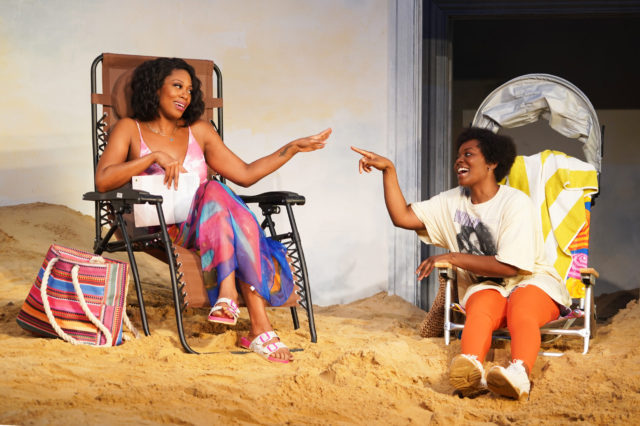
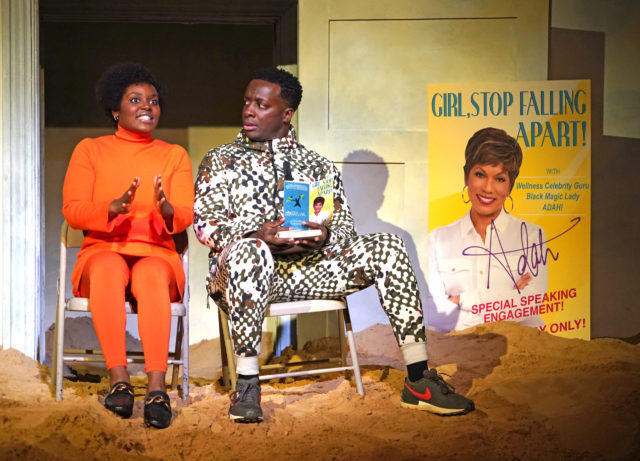
Sisters Ayamma (Sandra Okuboyejo) and Dede (Nana Mensah) are about to have a superstar travel into their lives in Nollywood Dreams (photo by Daniel J. Vasquez)

Newman Mills Theater, the Robert W. Wilson MCC Theater Space
511 West 52nd St. between Tenth & Eleventh Aves.
Tuesday – Sunday through November 28, $39-$88 (use code MCC)
mcctheater.org

“When your spirit is sad and you’ve given up / and you don’t know where to go / Don’t get down, turn around / Pick up that remote and tune into your favorite show!” So goes the theme song to the popular Adenikeh! talk show in Jocelyn Bioh’s Nollywood Dreams. The same can be said for the play itself, an appealingly sweet comedy continuing at MCC through November 28.

Nollywood Dreams is set in Lagos, Nigeria, in the early 1990s, during the rise of the Nigerian film industry, what would come to be known as Nollywood, named after Hollywood and Bollywood. Gbenga Ezie (Charlie Hudson III), who studied in New York City before becoming Nigeria’s most popular filmmaker, is holding an open casting call for his new movie, The Comfort Zone, looking for an actress to play the love interest of superstar celebrity and all-around hottie Wale Owusu (Ade Otukoya), a blend of Tom Cruise, Denzel Washington, George Clooney, and Will Smith.

Ayamma Okafor (Sandra Okuboyejo), a young woman who works in her parents’ travel agency, is determined to get the part despite her lack of experience. “This is my calling,” she tells her gossipy older sister, Dede (Nana Mensah), who works with her and believes that Wale is destined to be her future husband. When Ayamma arrives at Gbenga’s Nollywood Dreams Studios, she faces off against her main competition, established star Fayola Ogunleye (Emana Rachelle), the “Nigerian Halle Berry with Tina Turner legs,” who is willing to go to extreme lengths in order to get the role. But Ayamma is not going to just sit back and let that happen.

Director Gbenga Ezie (Charlie Hudson III) gossips with popular talk show host Adenikeh (Abena) in Nollywood Dreams (photo by Daniel J. Vasquez)

“Ah, I am so silly! How could I not see — you are perfect for the role of Comfort’s mother!” Ayamma snarkily says. After they read together, Ayamma tells Fayola, “I will never forget this day for the rest of my life,” to which Fayola responds, “That is nice. At least one of us will remember it.” When Ayamma later meets Wale, sparks fly, complicating Gbenga’s ultimate decision, as the movie-within-the-play is a ridiculously soapy tale that just might be based on Gbenga’s real life, echoing the relationship between him, Fayola, Wale, and Ayamma, which serves as fodder for Adenikeh (Abena) and her show.

Arnulfo Maldonado’s set switches back and forth between the travel agency, which features two old floppy-disk computers and posters of vacations to African nations, and Gbenga’s studio, which shares some of the same furniture while the walls are plastered with silly movie posters. The stage morphs into Adenikeh’s program several times, the central couch and chair moving forward toward the audience, with a backdrop where Alex Basco Koch’s projections play. (The mystery of the quick set changes is eventually revealed.) Abena is a blast as the talk show host, part Oprah Winfrey, part Wendy Williams, pronouncing her words very carefully — especially “Nigeria” — while wearing ornate African finery by award-winning costumer Dede Ayite.

Director Saheem Ali, who also helmed Bioh’s Goddess at the Public and overrated Shakespeare in the Park presentation Merry Wives, in addition to Anna Deavere Smith’s Fires in the Mirror at the Signature, Chris Urch’s The Rolling Stone at Lincoln Center, and Donja R. Love’s Fireflies at the Atlantic, takes just the right approach with the clever material, mixing slapstick comedy with sweet romantic flourishes. Bioh, who has appeared in such plays as Suzan-Lori Parks’s In the Blood, Branden Jacobs-Jenkins’s Everybody and An Octoroon, and Jaclyn Backhaus’s Men on Boats, explores not only celebrity culture and Nigerian film but class differences and ethnocentrism in Nollywood Dreams. After explaining to a phone caller that the Serengeti is not in Nigeria, Ayamma says to Dede, “These white people.” Her sister adds, “Africa is a country to them, you know that.”

In a script note, Bioh, an MCC playwright in residence who was born in New York City to Ghanaian parents and grew up watching low-budget Nollywood movies as a child in Washington Heights, writes, “Many of the themes of these [Nollywood] films dealt with love or family issues but were layered in subtext about the political strife/temperature of the country . . . telling the story of the sad duality that existed in Nigeria at the time: live like the rich or suffer like the poor — there is no middle. One could say the same about America, but I digress.”

In her daily greeting, Adenikeh says, “Thank you for letting me bring love into your home.” With Nollywood Dreams, Bioh, Ali, and a cool cast have brought love into the theater, as we finally escape our homes and return to live shows, especially irresistible ones such as Nollywood Dreams.

BOB DYLAN: ROUGH AND ROWDY WAYS WORLD TOUR 2021–2024

BOB DYLAN: ROUGH AND ROWDY WAYS
Beacon Theatre, 2124 Broadway at 74th St., November 19–21
Capitol Theatre, Port Chester, November 23-24
www.bobdylan.com

After being off the road for nearly two years because of the pandemic lockdown, Bob Dylan’s never-ending tour is back in action, returning to the Beacon Theatre this weekend in support of the Nobel Prize winner’s latest record, 2020’s phenomenal Rough and Rowdy Ways. Dylan rarely speaks to the audience during his live shows, except to introduce his crack band — and, on November 19, to celebrate that New York City is open again — but he had a lot to say in his setlist choices, essentially acknowledging that, at eighty, he might have only so much time left to do this.

He starts with 1971’s “Watching the River Flow,” declaring, “Oh, this ol’ river keeps on rollin’, though / No matter what gets in the way and which way the wind does blow / And as long as it does I’ll just sit here / And watch the river flow . . . I’ll sit down on this bank of sand / And watch the river flow.” The ninety-minute concert concludes with 1981’s “Every Grain of Sand,” in which Dylan admits, “Don’t have the inclination to look back on any mistake / Like Cain, I now behold this chain of events that I must break / In the fury of the moment I can see the Master’s hand / In every leaf that trembles, in every grain of sand.” (Although in past tours Dylan and the band would come out for two encores, he stopped doing that after the first two November concerts this year.)

He’s taking stock of his life, poignantly and publicly, right in front of our eyes — even though we can barely see him. The lighting keeps Dylan in a shadowy darkness, as if he doesn’t want us to see him clearly. As has been his desire for many years, no photography is allowed, and Beacon employees enforce that rule with vigor. He remains mostly behind his piano, which has now been turned so we cannot see his hands playing it, as we could in the past. He stands uncomfortably, at times reaching out his right hand to grasp the top of the piano for balance. (He no longer plays the guitar or harmonica, perhaps because of arthritis.) When he emerges briefly to croon at the back of the stage — he used to come front and center — as he does during the old Frank Sinatra standard “Melancholy Mood,” he is slightly hunched over and barely moves his feet. He pleads, “Pity me and break the chains / The chains that bind me / Won’t you release me, set me free?”

Dylan and the band are all dressed in black: Bob Britt and Doug Lancio on guitars, Tony Garnier on upright and electric bass, Donnie Herron on pedal steel, violin, and accordion, and Charlie Drayton on drums. They all keep a close eye on Bob as he signals them like a gentle conductor. During an aggressive “Gotta Serve Somebody,” he looked into the audience a few times; I thought I saw a smile or two, but my wife thought they were grimaces. “You might be a rock ’n’ roll addict prancing on the stage . . . But you’re gonna have to serve somebody,” he sings, with nary a prance.

Even given all that, Dylan is a marvel. His raspy voice, well rested from the long break, sounds better than it has in years. His enunciation is precise, his phrasing as strong as ever. He continually reinvents his old songs, which are barely recognizable at first, reconfiguring them with a bluesy jump jazz, transforming the Beacon into a rollicking juke joint. His version of “When I Paint My Masterpiece,” one of only three tunes repeated from his 2019 Beacon shows, is, indeed, a masterpiece.

He plays eight of the ten tracks from Rough and Rowdy Ways, and aside from the meandering and curious “Key West (Philosopher Pirate),” they sound triumphant, from the ballad “I’ve Made Up My Mind to Give Myself to You” to the propulsive “False Prophet,” feeling right at home with “Early Roman Kings” from 2012’s Tempest and a smoking version of 1967’s “I’ll Be Your Baby Tonight.” He also surprises with the relatively rare “To Be Alone with You,” from 1969’s Nashville Skyline.

For the first time in many moons, the tour, which heads to Port Chester after the Beacon gigs, has a name, after the new album, and an end date, 2024. The album title itself is a nod to Jimmie Rodgers’s and Merle Haggard’s “My Rough and Ready Ways,” in which the latter explains, “Somehow I can’t give up / My good old rambling ways / Lord, the railroad trains are calling me away.”

If only one thing is plainly evident from Friday night’s show, it’s that Dylan loves playing live, has to play live, in front of an audience. (Even his bizarre livestreamed pandemic show, Shadow Kingdom, was performed to a small, mysterious crowd, and included five of the older songs being played on this tour.) “I’ll lose my mind if you don’t come with me,” he sings in “I Contain Multitudes,” continuing, “Tell me, what’s next? What shall we do? . . . What more can I tell you? I sleep with life and death in the same bed.” With Dylan, there’s always more to be told.

YIN YUE DANCE COMPANY: RIPPLE

Yin Yue Dance Company presents gorgeous new work at 92nd St. Y and online (photo by Richard Termine)

Who: Yin Yue Dance Company
What: Streaming performance and discussion
Where: 92Y online
When: November 19-21, $15
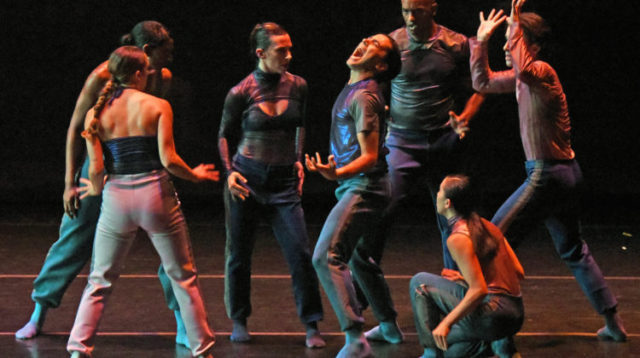
Why: Yin Yue Dance Company’s Ripple is one of the most gorgeous works I’ve seen during the pandemic — from the comfort of my apartment, where I’ve watched hundreds over the last twenty months. The thirty-six-minute piece was filmed live in front of an audience on November 18 at Kaufmann Concert Hall as part of the 92nd St. Y’s Mainstage Series. The world premiere, featuring Kristalyn Gill, Jordan Lang, Grace Whitworth, Nat Wilson, and Yin Yue performing on a dark stage, was essentially developed over the previous five days, and the company didn’t even meet in person in full until the dress rehearsal on the day of the show, when Yin was still finalizing the choreography.

Yin Yue leads her company in streaming performance (photo by Paul B. Goode)

You wouldn’t know it from how beautifully the work flows from one section to the next, highlighted by a dramatic solo by Yin, confined to an oval spotlight, her arms alternately reaching out and cradling herself. The music ranges from romantically cinematic to a pulsating electronic score, along with some spoken text, as the dancers form duets and trios, coming together for several emotional passages, bathed occasionally in blue, then red. If you’ve been reluctant to watch dance onscreen, Ripple is a great place to start. The performance is followed by a discussion with the dancers moderated by Harkness director Taryn Kaschock Russell.

On December 6, Yin (A Trace of Inevitability, A Glimpse Inside a Shared Story) will be at the Guggenheim to receive the Harkness Promise Award along with Alethea Pace at the sixty-fourth annual 2021 Dance Magazine Awards, which will be livestreamed. The Mainstage Series continues December 16–19 with Michelle Dorrance and Dormeshia with special guests, February 24–27 with Baye & Asa and Passion Fruit Dance Company, and March 3–6 with Caleb Teicher and Conrad Tao.

KURT VONNEGUT: UNSTUCK IN TIME

Kurt Vonnegut travels through his extraordinary life in Unstuck in Time,

KURT VONNEGUT: UNSTUCK IN TIME (Robert B. Weide & Don Argott, 2021)
IFC Center
323 Sixth Ave. at West Third St.
Opens Friday, November 19
www.ifccenter.com

“I had never seen him so at ease; they had found each other, as the subject and the filmmaker. It felt like a friendship,” Nanny Vonnegut says about her father, author Kurt Vonnegut Jr., and director Robert Weide in Kurt Vonnegut: Unstuck in Time, an extraordinary documentary opening November 19 at the IFC Center.

In 1982, twenty-three-year-old Weide wrote a letter to Vonnegut, wanting to make a film about him. Much to Weide’s surprise, the award-winning author of such novels as Slaughterhouse-Five and Cat’s Cradle wrote him back, agreeing to the project. Shooting began in 1988 and continued through Vonnegut’s death in 2007 at the age of eighty-four and beyond. During those years, the two men became good friends, so much so that Weide began doubting his ability to complete the film. “I don’t even like documentaries where the filmmakers has to put himself in the film. I mean, who cares?” he asks in one of several sections where he talks to the camera, concerned that he was becoming too much a part of the story.

After a moving moment in which he discusses putting the camera down and simply enjoying his time with Vonnegut, Weide admits, “Prior to that, I had always been concerned that the friendship might infringe on the film; this was the first time I realized that things had flipped so entirely now that I was worried about the film infringing on the friendship. That was a realization for me that I was maybe in trouble.”

Fortunately, however, Weide and codirector Don Argott, who was brought in to help navigate through Weide’s fears of having grown too close to Vonnegut, keep the main focus on Vonnegut, who opens up about his childhood, his schooling, his early jobs, and, ultimately, his writing career, reflecting on a life well lived yet filled with tragedy, from the death of his sister and her husband to his mother’s suicide and his experiences in Dresden during WWII. Vonnegut is shown giving a lecture in a church, taking a train with Weide, driving through his hometown of Indianapolis, visiting the house where he grew up — and getting sentimental when he sees the casts of his and his siblings’ hands on the top of a small cement wall — and attending his sixtieth high school reunion.

Vonnegut’s brother, Bernard, gives Weide boxes and boxes of home movies and slides, while their sisters, Nanny and Edie, and Vonnegut’s nephews, Jim, Steve, and Kurt Adams — who Vonnegut and his first wife, Jane Marie Cox, took in after the deaths of his beloved sister, Alice, and her husband, James Adams — speak openly and honestly about him, including their extreme disappointment when, upon finally gaining success as a writer, he dumped the devoted Jane for younger photographer Jill Krementz. Over the years, Vonnegut kept sending Weide tapes of his numerous public appearances, so the film includes a treasure trove of clips from speeches, television appearances, and commencement addresses as well as early, annotated drafts of Vonnegut’s writing.

The film discusses the aforementioned books in addition to The Sirens of Titan, Breakfast of Champions, and Mother Night, which was turned into a 1996 movie written by Weide, and explores such favorite Vonnegut characters as the author’s alter ego, Kilgore Trout, and Billy Pilgrim. The title of the film comes from the first line of the second chapter of Slaughterhouse-Five: “Listen: Billy Pilgrim has come unstuck in time.” The concept of time is a leitmotif of the documentary, highlighted by the comparison between the decades it took Weide to complete the film, which is significantly about the making of the film itself, and the years it took Vonnegut to finish his last novel, Timequake, which ended up being significantly about the writing of the book. And just as Vonnegut and his children share poignant memories, Weide inserts some of his own, particularly about his wife, Linda. The parallels between Weide and Vonnegut are striking. “How fucked up is that?” Weide says after noting another coincidence.

Robert B. Weide and Kurt Vonnegut became close friends while making documentary over several decades

Weide also speaks with Vonnegut’s friends and fellow writers John Irving and Sidney Offit, his publisher Dan Simon, his biographer Gregory Sumner, novelist Dan Wakefield, and In These Times editor Joel Bleifuss, who gave Vonnegut a forum in his final years. Actor Sam Waterston reads from several of Vonnegut’s works. “He made literature fun. That was huge,” critic David Ulin says.

Along the way, two elements stand out: Vonnegut’s love of laughing — his infectious laughter is sprinkled throughout the film — and his ever-present Pall Mall. In a cute touch, Emmy winner and Oscar nominee Weide (Curb Your Enthusiasm, Lenny Bruce: Swear to Tell the Truth) and Argott (The Art of the Steal, Believer) animate smoke coming out of his cigarettes in still photos.

On the first page of chapter two of Slaughterhouse-Five, Vonnegut also writes of Billy Pilgrim, “He has walked through a door in 1955 and come out another one in 1941. He has gone back through that door to find himself in 1963. He has seen his birth and death many times, he says, and pays random visits to all the events in between. He says. Billy is spastic in time, has no control over where he is going next, and the trips aren’t necessarily fun. He is in a constant state of stage fright, he says, because he never knows what part of his life he is going to have to act in next.” Weide and Argott have captured the essence of Vonnegut the person and Vonnegut the writer in Unstuck in Time, a must-see, utterly fun portrait of a man who never knew what part of his life he was going to have to act in next but always did so with a contagious sparkle.

BAD LUCK BANGING OR LOONY PORN: A SKETCH FOR A POSSIBLE FILM

Emi (Katia Pascariu) goes on a strange journey in Rade Jude’s Bad Luck Banging or Loony Porn

BAD LUCK BANGING OR LOONY PORN: A SKETCH FOR A POSSIBLE FILM (BABARDEALA CU BUCLUC SAU PORNO BALAMUC) (Radu Jude, 2021)
Film at Lincoln Center, Walter Reade Theater, Francesca Beale Theater
144/165 West Sixty-Fifth St. at Amsterdam Ave.
Film Forum, 209 West Houston St.
Opens Friday, November 19
www.filmlinc.org
filmforum.org

Radu Jude’s brilliantly absurdist Bad Luck Banging or Loony Porn lives up to its title, a wildly satiric takedown of social mores that redefines what is obscene. Winner of the Golden Bear for Best Film at the 2021 Berlinale, the multipart tale begins with an extremely graphic prologue, a XXX-rated homemade porn video with a woman and an unseen man holding nothing back. In the first main section, the woman, a successful teacher named Emi (Katia Pascariu), is distressed to learn that the video is threatening to go viral. She determinedly walks through the streets of Bucharest, buying flowers (which she holds upside down), discussing her dilemma with her boss, the headmistress (Claudia Ieremia), and calling her husband, Eugen, trying to get the video deleted before her meeting with angry parents at the prestigious private school where she teaches young children.

Jude and cinematographer Marius Panduru follow the masked Emi — the film was shot during the pandemic, so masks are everywhere — on her journey, the camera often lingering on the scene well after Emi has left the frame, focusing on advertising billboards, couples in the middle of conversations, people waiting for a bus, and other random actions, before finding Emi again. She sometimes fades into the background, barely seen through the windows of a passing vehicle or amid a crowd crossing at a light. She gets into an argument with a man who has parked on the sidewalk, blocking her way; she insists that he move the car, but he unleashes a stream of misogynistic curses. Swear words are prevalent throughout the film, mostly adding poignant humor.

The second segment consists of a montage of archival and new footage that details some of Romania’s recent history, involving the military, the government, religion, fascism, Nazi collaboration, patriotism, the two world wars, the 1989 revolution, Nicolae Ceaușescu, domestic violence, jokes about blondes, and the value of cinema itself. The bevy of images also points out which NSFW word is most commonly looked up in the dictionary, as well as which is second. (The film is splendidly edited by Cătălin Cristuțiu, with a fab soundtrack by Jura Ferina and Pavao Miholjević.)

It all comes together in the third section, in the school garden, where Emi faces a few dozen masked, socially distanced, very angry parents and grandparents who want her fired immediately, while the headmistress demands a calm discussion. The masked Emi is a stand-in for all of us, facing the wrath of the unruly mob forcing its sanctimonious platitudes on others when it really needs to look at itself. It’s a riotously funny sitcomlike debate in which Jude roasts many common, hypocritical beliefs held by Romanians (and people all over the world) that have not necessarily changed much from the news clips shown in the previous part.

The cartoonish cast, which includes Olimpia Mălai as Mrs. Lucia, Nicodim Ungureanu as Lt. Gheorghescu, Alexandru Potocean as Marius Buzdrugovici, and Andi Vasluianu as Mr. Otopeanu, really gets to strut its stuff while making sure their masks are properly covering their mouths and noses. They argue about beloved national poet Mihai Eminescu and Russian writer Isaac Babel, delve into various sexual positions, repeat Woody the Woodpecker’s trademark call, and quote long, intellectual passages from the internet as Jude (I Do Not Care If We Go Down in History as Barbarians, Aferim!) reveals where society’s true obscenities lie. It’s an irreverent tour de force that offers three distinct endings to put a capper on the strangely alluring affair, turning a scary mirror on the sorry state of twenty-first-century existence.

Playfully subtitled A Sketch for a Possible Film in a reference to André Malraux’s description of Eugène Delacroix’s belief that his sketches could be of the same quality as his paintings, Bad Luck Banging or Loony Porn, Romania’s official Oscars submission, opens November 19 at Lincoln Center and Film Forum.